




Superimposed Mineralization Model of Paleozoic Porphyry Copper Deposits in Xinjiang
-
摘要:
随着21世纪绿色能源转型的推进,全球铜的需求急剧上升,斑岩型铜矿作为全球铜资源的主要来源,受到了学术界和矿业界的高度重视.尽管目前已建立了基于新生代斑岩铜矿的经典模型,但古生代中亚造山带的斑岩铜矿却展现出独特的特征,其成因机制尚未完全明确.本研究以新疆地区的重要斑岩铜矿为研究对象,揭示了这些矿区普遍存在多期岩浆活动,时间跨度可长达1~2亿年,并在斑岩成矿期后,常常出现叠加改造成矿阶段.例如,土屋‒延东矿床在斑岩成矿期后出现了硬石膏、黄铜矿、方解石和绿泥石的矿物组合;玉海‒三岔口矿区则出现了绿帘石、石英、绿泥石、沸石、方解石等斑岩期后的脉体;哈腊苏铜矿带发育含铜硫化物脉和粘土化蚀变的后期蚀变矿化.成矿流体研究进一步证实,在斑岩期热液流体系统结束后会出现新的流体系统叠加.基于这些观察,我们提出了新疆古生代斑岩铜矿的叠加改造成矿模式.在岛弧演化的早期,成矿前的岩浆活动可能会在矿区形成蚀变,但这些蚀变通常与矿化无关,如哈腊苏成矿带的早期钠钙化和绿帘石化蚀变.随着岛弧的成熟,特殊的构造机制如平坦俯冲,形成了高氧逸度、富水的岩浆活动.这些岩浆活动部分具有埃达克质地球化学特征,并形成了矿区的斑岩型矿化与蚀变,如土屋‒延东的斜长花岗斑岩和哈腊苏的闪长斑岩及花岗闪长斑岩.伴随构造的进一步演化,包括俯冲极性的转变或后碰撞阶段软流圈上涌,导致了新的岩浆热液活动叠加在先成的斑岩型矿化与蚀变之上.此外,成矿后的构造变质作用也可能引入新的成矿物质或导致早期成矿物质的再富集.本研究模型指示了对于长期活动的、存在多期岩浆活动的长寿弧,除了经典的斑岩矿化蚀变类型,还应特别关注那些可能叠加在先成斑岩成矿系统上的特定构造或岩浆活动,因为它们可能带来新的矿化并提高勘查潜力.
Abstract:With the advance of green energy transformation in the 21st century, the demand for copper has surged dramatically and porphyry copper deposits as the main suppliers of global copper resources have been paid great attention from both academic and industrial communities. Although a set of classic models have been established for Cenozoic porphyry copper deposits, the porphyry copper deposits located at Paleozoic Central Asian Orogenic Belt exhibit unique characteristics and their genesis mechanisms are not fully understood. Taking important porphyry copper deposits in Xinjiang as research objects, this study reveals that these deposits generally experienced multiple magmatic activities with time spanning up to 100-200 Ma and often underwent superimposed and/or modification mineralization stages after porphyry mineralization. For example, the Tuwu-Yandong deposit has mineral assemblages of anhydrite, chalcopyrite, calcite, and chlorite after porphyry mineralization; the Yuhai-Sanchakou mining area exhibits post-porphyry veins of epidote, quartz, chlorite, zeolite, and calcite; and the Halasu copper belt shows late alteration and mineralization with copper-bearing sulfide veins and argillic alteration. Fluid inclusion studies further confirm that new fluid systems would overprint on the hydrothermal fluid system in the porphyry stage. Based on these observations, it proposes a new superimposed mineralization model of modification for Paleozoic porphyry copper deposits in Xinjiang. In the early stage of island arc evolution, pre-mineralization magmatic activities may form unmineralized alterations in the mining areas such as early sodic-calcic alteration and epidote alteration at the Halasu belt. With the maturity of the island arc, tectonic triggers such as flat subduction facilitated high oxygen fugacity, water-rich magmatic activities which partly have adakite-like geochemical features and formed the porphyry-type mineralization and alteration in the mining areas such as diorite porphyry in Tuwu-Yandong and diorite porphyry and granodiorite porphyry at Halasu. Further tectonic evolution including change of subduction polarity or postcollisional asthenospheric upwelling led to new magmatic hydrothermal activities superimposed on preexisting porphyry-type mineralization and alteration. Moreover, post-mineralization tectonic metamorphism may also introduce new mineralizing materials or cause remobilization of preexisting ores. The aforementioned models underscore the importance of specific tectonic or magmatic activities that may superimpose on pre-existing porphyry mineralization systems in long-lived arcs with sustained multistage magmatic activities. These activities, beyond the classic types of porphyry mineralization alteration, require special attention due to their exploration potential to introduce new mineralizing components.
-
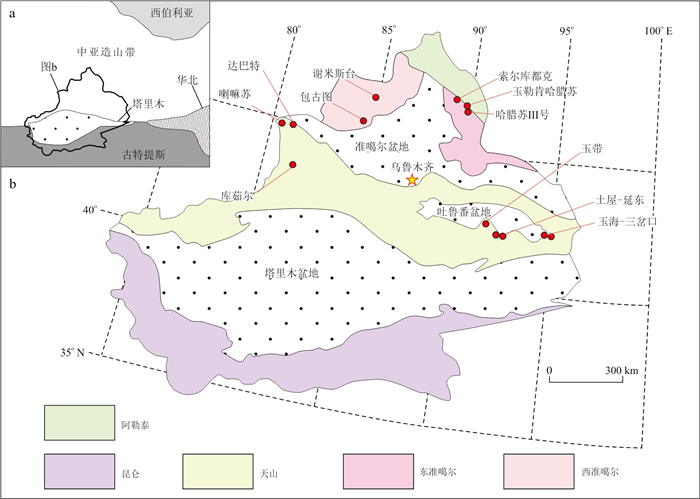
图 1 新疆斑岩铜矿床分布(据Chen et al., 2018修改)
Fig. 1. Distribution of porphyry copper deposits in Xinjiang (modified according to Chen et al., 2018)

图 2 土屋‒延东、玉海‒三岔口和哈腊苏铜矿带岩浆活动与成矿时代格架
1.肖兵等(2015);2.Xiao et al.(2017);3. Wang et al.(2018b);4.Wang et al.(2018a);5.Wang et al.(2022);6.王云峰(2018);7.Wu et al.(2015);8.Yang et al.(2014);9.Wu et al.(2024)
Fig. 2. Magmatic activity and metallogenic epoch framework of Tuwu-Yandong, Yuhai-Sanchakou and Halasu copper belts
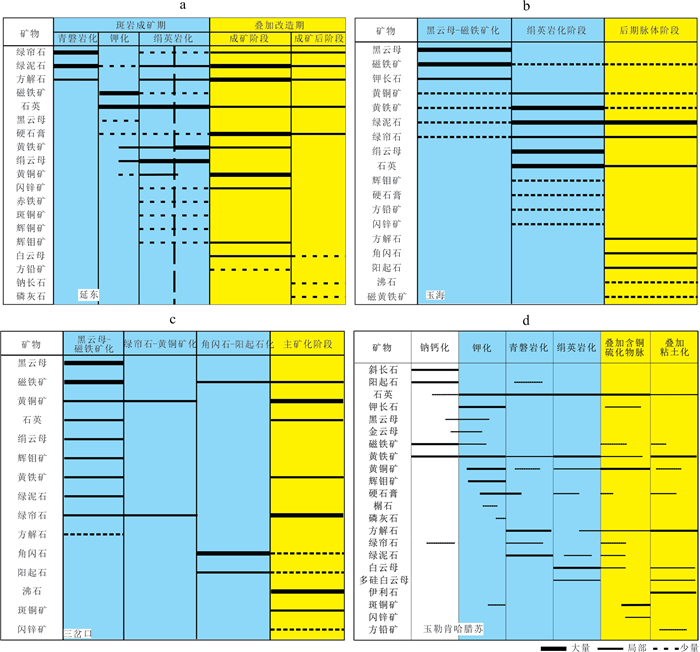
图 3 延东(a)、玉海(b)、三岔口(c)和玉勒肯哈腊苏矿床(d)矿化期次
Fig. 3. The paragenesis of Yandong (a), Yuhai (b), Sanchakou (c) and Yulekenhalasu (d) deposits
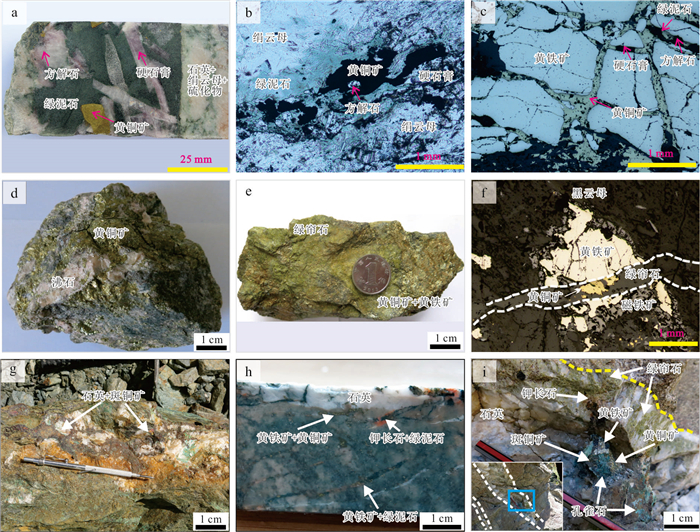
图 4 土屋‒延东矿床叠加硬石膏、黄铜矿、方解石和绿泥石脉体组合(a~c);玉海‒三岔口矿床叠加沸石、绿帘石、黄铜矿和黄铁矿组合(d~f);哈腊苏矿床后期叠加含铜硫化物脉(g~i)
Fig. 4. The veins of anhydrite, chalcopyrite, calcite and chlorite in the Tuwu-Yandong deposit (a‒c); the superimposed assemblages of zeolite, epidote, chalcopyrite and pyrite at Yuhai-Sanchakou deposit (d‒f); late superimposed copper sulfide bearing veins at the Halasu deposit (g-i)
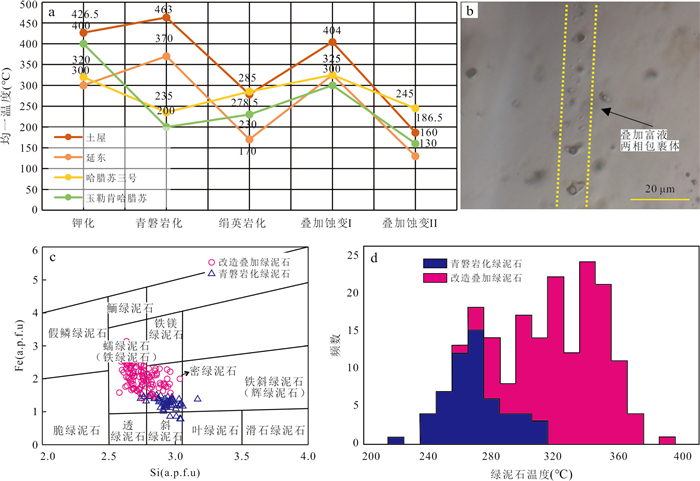
图 5 包裹体均一温度统计(a)、哈腊苏三号矿床叠加包裹体组合(b)、土屋‒延东铜矿青磐岩化阶段绿泥石与叠加改造阶段绿泥石类型(c)和形成温度(d)对比
Fig. 5. Statistics of homogenization temperatures of fluid inclusions (a); superimposed fluid inclusion assemblages of the Halasu Ⅲ deposit (b); comparison of chlorite type (c) and formation temperature (d) between propylitic alteration stage and superimposed stage in Tuwu-Yandong copper deposit

图 6 土屋‒延东铜矿青磐岩化阶段绿泥石与叠加改造阶段绿泥石微量元素对比
Fig. 6. The comparison of trace elements of chlorite between propylitic alteration stage and superimposed stage in Tuwu-Yandong copper deposit
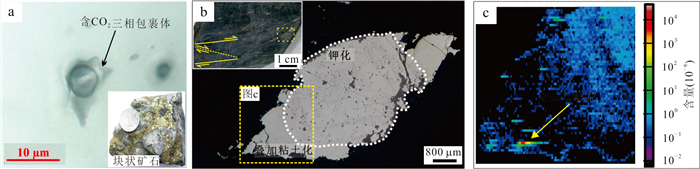
图 7 玉海‒三岔口块状矿石中含CO2三相包裹体(a)、玉勒肯哈腊苏矿床叠加粘土化阶段的黄铁矿围绕斑岩期钾化阶段黄铁矿压力影生长(b)、玉勒肯哈腊苏矿床叠加粘土化阶段的黄铁矿与钾化阶段黄铁矿金元素激光剥蚀扫面分析(c)
Fig. 7. CO2-bearing three-phase fluid inclusions in Yuhai-Sanchakou massive ore (a); potassic-stage pyrite grains overgrown by argillic-stage pyrite in the Yulekenhalasu deposit (b); laser ablation scanning analysis of gold in pyrite of the superimposed argillic and potassic alteration stage (c)
-
Chen, H. Y., Wan, B., Pirajno, F., et al., 2018. Metallogenesis of the Xinjiang Orogens, NW China: New Discoveries and Ore Genesis. Ore Geology Reviews, 100: 1-11. https://doi.org/10.1016/j.oregeorev.2018.02.035 Chen, H. Y., Wu, C., 2020. Metallogenesis and Major Challenges of Porphyry Copper Systems above Subduction Zones. Science China Earth Sciences, 63(7): 899-918 (in Chinese). https://doi.org/10.1007/s11430-019-9595-8 Chiaradia, M., 2022. Distinct Magma Evolution Processes Control the Formation of Porphyry Cu-Au Deposits in Thin and Thick Arcs. Earth and Planetary Science Letters, 599: 117864. https://doi.org/10.1016/j.epsl.2022.117864 Cooke, D. R., Hollings, P., Walshe, J. L., 2005. Giant Porphyry Deposits: Characteristics, Distribution, and Tectonic Controls. Economic Geology, 100(5): 801-818. https://doi.org/10.2113/gsecongeo.100.5.801 Du, S. J., Qu, X., Deng, G., et al., 2010. Chronology and Tectonic Setting of the Intrusive Bodies and Associated Porphyry Copper Deposit in Hersai Area, Eastern Junggar. Acta Petrologica Sinica, 26(10): 2981-2996 (in Chinese with English abstract). Han, C. M., Xiao, W. J., Zhao, G. C., et al., 2006. Geological Characteristics and Genesis of the Tuwu Porphyry Copper Deposit, Hami, Xinjiang, Central Asia. Ore Geology Reviews, 29(1): 77-94. https://doi.org/10.1016/j.oregeorev.2005.07.032 Hou, Z. Q., 2004. Porphyry Cu-Mo-Au Deposits: Some New Insights and Advances. Earth Science Frontiers, 11(1): 131-144 (in Chinese with English abstract). Hou, Z. Q., Yang, Z. M., 2009. Porphyry Deposits in Continental Settings of China: Geological Characteristics, Magmatic-Hydrothermal System, and Metallogenic Model. Acta Geologica Sinica, 83(12): 1779-1817 (in Chinese with English abstract). Hou, Z. Q., Yang, Z. M., Wang, R., et al., 2020. Further Discussion on Porphyry Cu-Mo-Au Deposit Formation in Chinese Mainland. Earth Science Frontiers, 27(2): 20-44 (in Chinese with English abstract). https://doi.org/10.13745/j.esf.sf.2020.3.8 Long, L. L., Wang, Y. W., Du, A. D., et al., 2011. Molybdenite Re-Os Age of Xilekuduke Cu-Mo Deposit in Xinjiang and Its Geological Significance. Mineral Deposits, 30(4): 635-644 (in Chinese with English abstract). Lowell, J. D., Guilbert, J. M., 1970. Lateral and Vertical Alteration-Mineralization Zoning in Porphyry Ore Deposits. Economic Geology, 65(4): 373-408. https://doi.org/10.2113/gsecongeo.65.4.373 Meng, X. Y., Mao, J. W., Simon, A., et al., 2024. Contrasting Tectonomagmatic Conditions for Coexisting Iron Oxide-Apatite Deposits and Porphyry and Skarn Cu ± Au Deposits in the Middle-Lower Yangtze River Metallogenic Belt, China. Economic Geology, 119(5): 1059-1087. https://doi.org/10.5382/econgeo.5084 Richards, J. P., 2011. Magmatic to Hydrothermal Metal Fluxes in Convergent and Collided Margins. Ore Geology Reviews, 40(1): 1-26. https://doi.org/10.1016/j.oregeorev.2011.05.006 Rui, Z. Y., Wang, L. S., Wang, Y. T., et al., 2002. Discussion on Metallogenic Epoch of Tuwu and Yandong Porphyry Copper Deposits in Eastern Tianshan Mountains, Xinjiang. Mineral Deposits, 21(1): 16-22 (in Chinese with English abstract). Shen, P., Dong, L. H., Feng, J., et al., 2010. Distribution, Age and Metallogenic Characteristics of the Porphyry Copper Deposits in Xinjiang, China. Xinjiang Geology, 28(4): 358-364 (in Chinese with English abstract). Shen, P., Pan, H. D., Eleonora, S., 2015. Characteristics of the Porphyry Cu Deposits in the Central Asia Metallogenic Domain. Acta Petrologica Sinica, 31(2): 315-332 (in Chinese with English abstract). Shen, P., Pan, H. D., Zhou, T. F., et al., 2014. Petrography, Geochemistry and Geochronology of the Host Porphyries and Associated Alteration at the Tuwu Cu Deposit, NW China: A Case for Increased Depositional Efficiency by Reaction with Mafic Hostrock? Mineralium Deposita, 49(6): 709-731. https://doi.org/10.1007/s00126-014-0517-4 Sillitoe, R. H., 2010. Porphyry Copper Systems. Economic Geology, 105(1): 3-41. https://doi.org/10.2113/gsecongeo.105.1.3 Sun, W. D., Huang, R. F., Li, H., et al., 2015. Porphyry Deposits and Oxidized Magmas. Ore Geology Reviews, 65: 97-131. https://doi.org/10.1016/j.oregeorev.2014.09.004 Sun, Y., Xiao, Y. F., Li, F. C., et al., 2009. The Mineralizing Fluid Characteristics and Genesis of the Sanchakou Copper Deposit in Xinjiang. Geology and Exploration, 45(3): 235-239 (in Chinese with English abstract). Tang, G. J., Wang, Q., Wyman, D. A., et al., 2010. Geochronology and Geochemistry of Late Paleozoic Magmatic Rocks in the Lamasu-Dabate Area, Northwestern Tianshan (West China): Evidence for a Tectonic Transition from Arc to Post-Collisional Setting. Lithos, 119(3/4): 393-411. https://doi.org/10.1016/j.lithos.2010.07.010 Tong, Y., Hong, D. W., Wang, T., et al., 2006. TIMS U-Pb Zircon Ages of Fuyun Post-Orogenic Linear Granite Plutons on the Southern Margin of Altay Orogenic Belt and Their Implications. Acta Petrologica et Mineralogica, 25(2): 85-89 (in Chinese with English abstract). Tu, G. Z., 1999. On the Certral Asia Metallogenic Province. Chinese Journal of Geology (Scientia Geologica Sinica), 34(4): 397-404 (in Chinese with English abstract). Wang, J. B., Xu, X., 2006. Post-Collisional Tectonic Evolution and Metallogenesis in Northern Xinjiang, China. Acta Geologica Sinica, 80(1): 23-31 (in Chinese with English abstract). Wang, Y. F., 2018. Overprinting-Type Porphyry Cu Deposits and Associated Magmatism in the Eastern Tianshan, Xinjiang-Case Study of the Tuwu, Yandong, Yuhai and Sanchakou Cu deposits (Dissertation). University of Chinese Academy of Sciences, Beijing (in Chinese with English abstract). Wang, Y. F., Chen, H. Y., Baker, M. J., et al., 2019. Multiple Mineralization Events of the Paleozoic Tuwu Porphyry Copper Deposit, Eastern Tianshan: Evidence from Geology, Fluid Inclusions, Sulfur Isotopes, and Geochronology. Mineralium Deposita, 54(7): 1053-1076. https://doi.org/10.1007/s00126-018-0859-4 Wang, Y. F., Chen, H. Y., Falloon, T. J., et al., 2022. The Paleozoic-Mesozoic Magmatic Evolution of the Eastern Tianshan, NW China: Constraints from Geochronology and Geochemistry of the Sanchakou Intrusive Complex. Gondwana Research, 103: 1-22. https://doi.org/10.1016/j.gr.2021.11.002 Wang, Y. F., Chen, H. Y., Han, J. S., et al., 2018a. Paleozoic Tectonic Evolution of the Dananhu-Tousuquan Island Arc Belt, Eastern Tianshan: Constraints from the Magmatism of the Yuhai Porphyry Cu Deposit, Xinjiang, NW China. Journal of Asian Earth Sciences, 153: 282-306. https://doi.org/10.1016/j.jseaes.2017.05.022 Wang, Y. F., Chen, H. Y., Xiao, B., et al., 2018b. Overprinting Mineralization in the Paleozoic Yandong Porphyry Copper Deposit, Eastern Tianshan, NW China—Evidence from Geology, Fluid Inclusions and Geochronology. Ore Geology Reviews, 100: 148-167. https://doi.org/10.1016/j.oregeorev.2017.04.013 Wang, Y. F., Chen, H. Y., Xiao, B., et al., 2016. Porphyritic-Overlapped Mineralization of Tuwu and Yandong Copper Deposits in Eastern Tianshan Mountains, Xinjiang. Mineral Deposits, 35(1): 51-68 (in Chinese with English abstract). Wang, Y. H., Xue, C. J., Liu, J. J., et al., 2014. Geochemistry, Geochronology, Hf Isotope, and Geological Significance of the Tuwu Porphyry Copper Deposit in Eastern Tianshan, Xinjiang. Acta Petrologica Sinica, 30(11): 3383-3399 (in Chinese with English abstract). Wang, Y. H., Zhang, F. F., Liu, J. J., 2016. The Genesis of the Ores and Intrusions at the Yuhai Cu-Mo Deposit in Eastern Tianshan, NW China: Constraints from Geology, Geochronology, Geochemistry, and Hf Isotope Systematics. Ore Geology Reviews, 77: 312-331. https://doi.org/10.1016/j.oregeorev.2016.03.003 Wang, Y. W., Wang, J. B., Long, L. L., et al., 2012. Tectonic Evolution Stages of Northern Xinjiang and Tectonic Types of Porphyry-Epithermal Deposits. Geology in China, 39(3): 695-716 (in Chinese with English abstract). Wu, C., Chen, H. Y., Hollings, P., et al., 2015. Magmatic Sequences in the Halasu Cu Belt, NW China: Trigger for the Paleozoic Porphyry Cu Mineralization in the Chinese Altay-East Junggar. Ore Geology Reviews, 71: 373-404. https://doi.org/10.1016/j.oregeorev.2015.06.017 Wu, C., Chen, H. Y., Liang, P., et al., 2018. Paragenesis and Fluid Evolution of the Halasu Ⅲ Porphyry Cu Deposit, East Junggar (NW China): Implications for the Paleozoic Multiphase Superimposing Mineralization in the Central Asian Orogenic Belt. Ore Geology Reviews, 100: 183-204. https://doi.org/10.1016/j.oregeorev.2016.08.001 Wu, C., Chen, H. Y., Lu, Y. J., 2022. Crustal Structure Control on Porphyry Copper Systems in Accretionary Orogens: Insights from Nd Isotopic Mapping in the Central Asian Orogenic Belt. Mineralium Deposita, 57(4): 631-641. https://doi.org/10.1007/s00126-021-01074-z Wu, C., Cooke, D. R., Baker, M. J., et al., 2024. Using Pyrite Composition to Track the Multi-Stage Fluids Superimposed on a Porphyry Cu System. American Mineralogist, 109(5): 827-845. https://doi.org/10.2138/am-2022-8727 Xiao, B., 2016. Magmatic Evolution, Alteration Characteristics and Genesis of the Tuwu-Yandong Cu Belt, Xinjiang (Dissertation). University of Chinese Academy of Sciences, Beijing (in Chinese with English abstract). Xiao, B., Chen, H. Y., 2020. Elemental Behavior during Chlorite Alteration: New Insights from a Combined EMPA and LA-ICPMS Study in Porphyry Cu Systems. Chemical Geology, 543: 119604. https://doi.org/10.1016/j.chemgeo.2020.119604 Xiao, B., Chen, H. Y., Hollings, P., et al., 2017. Magmatic Evolution of the Tuwu-Yandong Porphyry Cu Belt, NW China: Constraints from Geochronology, Geochemistry and Sr-Nd-Hf Isotopes. Gondwana Research, 43: 74-91. https://doi.org/10.1016/j.gr.2015.09.003 Xiao, B., Chen, H. Y., Wang, Y. F., et al., 2015. Discovery of the Late Silurian Granodiorite and Its Tectonic Significance in the Tuwu-Yandong Porphyry Copper Deposits, Dananhu-Tousuquan Island Arc, Eastern Tianshan. Earth Science Frontier, 22(6): 251-266 (in Chinese with English abstract). Xiao, W. J., Song, D. F., Windley, B. F., et al., 2020. Accretionary Processes and Metallogenesis of the Central Asian Orogenic Belt: Advances and Perspectives. Science China Earth Sciences, 63(3): 329-361. https://doi.org/10.1007/s11430-019-9524-6 Yang, F. Q., Chai, F. M., Zhang, Z. X., et al., 2014. Zircon U-Pb Geochronology, Geochemistry, and Sr-Nd-Hf Isotopes of Granitoids in the Yulekenhalasu Copper Ore District, Northern Junggar, China: Petrogenesis and Tectonic Implications. Lithos, 190: 85-103. https://doi.org/10.1016/j.lithos.2013.12.003 Zhai, Y. S., Wang, J. P., Peng, R. M., et al., 2009. Research on Superimposed Metallogenic Systems and Polygenetic Mineral Deposits. Earth Science Frontiers, 16(6): 282-290 (in Chinese with English abstract). Zhang, D., Fan, J. J., Liu, P., et al., 2013. 40Ar-39Ar Dating of Sericite in the Songkaersu Cu-Au Deposit of Eastern Junggar, Xinjiang. Journal of Mineralogy and Petrology, 33(4): 61-67 (in Chinese with English abstract). Zhang, F. F., Wang, Y. H., Liu, J. J., et al., 2023. Multiple Mineralization Events at Paleozoic Sanchakou Porphyry Cu Deposit, Xinjiang: New Insights from Geology, Geochronology, Fluid Inclusions, and H-O-C Isotopes. Ore Geology Reviews, 163: 105726. https://doi.org/10.1016/j.oregeorev.2023.105726 Zhou, T. F., Yuan, F., Tan, L. G., et al., 2006. Time Limit, Geochemical Characteristics and Tectonic Setting of the Paleozoic Magmatism in the Sawuer Region, Xinjiang. Acta Petrologica Sinica, 22(5): 1225-1237 (in Chinese with English abstract). 陈华勇, 吴超, 2020. 俯冲带斑岩铜矿系统成矿机理与主要挑战. 中国科学: 地球科学, 50(7): 865-886. 杜世俊, 屈迅, 邓刚, 等, 2010. 东准噶尔和尔赛斑岩铜矿成岩成矿时代与形成的构造背景. 岩石学报, 26(10): 2981-2996. 侯增谦, 2004. 斑岩Cu-Mo-Au矿床: 新认识与新进展. 地学前缘, 11(1): 131-144. 侯增谦, 杨志明, 2009. 中国大陆环境斑岩型矿床: 基本地质特征、岩浆热液系统和成矿概念模型. 地质学报, 83(12): 1779-1817. 侯增谦, 杨志明, 王瑞, 等, 2020. 再论中国大陆斑岩Cu- Mo-Au矿床成矿作用. 地学前缘, 27(2): 20-44. 龙灵利, 王玉往, 杜安道, 等, 2011. 新疆希勒库都克铜钼矿床辉钼矿Re-Os年龄及其地质意义. 矿床地质, 30(4): 635-644. 芮宗瑶, 王龙生, 王义天, 等, 2002. 东天山土屋和延东斑岩铜矿床时代讨论. 矿床地质, 21(1): 16-22. 申萍, 董连慧, 冯京, 等, 2010. 新疆斑岩型铜矿床分布、时代及成矿特点. 新疆地质, 28(4): 358-364. 申萍, 潘鸿迪, Eleonora, S., 2015. 中亚成矿域斑岩铜矿床基本特征. 岩石学报, 31(2): 315-332. 孙燕, 肖渊甫, 李凤春, 等, 2009. 新疆三岔口铜矿床成矿流体性质及成因. 地质与勘探, 45(3): 235-239. 童英, 洪大卫, 王涛, 等, 2006. 阿尔泰造山带南缘富蕴后造山线形花岗岩体锆石U-Pb年龄及其地质意义. 岩石矿物学杂志, 25(2): 85-89. 涂光炽, 1999. 初议中亚成矿域. 地质科学, 34(4): 397-404. 王京彬, 徐新, 2006. 新疆北部后碰撞构造演化与成矿. 地质学报, 80(1): 23-31. 王云峰, 2018. 新疆东天山叠加改造型斑岩铜矿成岩成矿作用研究——以土屋、延东、玉海和三岔口铜矿为例(博士学位论文). 北京: 中国科学院大学. 王云峰, 陈华勇, 肖兵, 等, 2016. 新疆东天山地区土屋和延东铜矿床斑岩‒叠加改造成矿作用. 矿床地质, 35(1): 51-68. 王银宏, 薛春纪, 刘家军, 等, 2014. 新疆东天山土屋斑岩铜矿床地球化学、年代学、Lu-Hf同位素及其地质意义. 岩石学报, 30(11): 3383-3399. 王玉往, 王京彬, 龙灵利, 等, 2012. 新疆北部大地构造演化阶段与斑岩‒浅成低温热液矿床的构造环境类型. 中国地质, 39(3): 695-716. 肖兵, 2016. 新疆土屋‒延东铜矿岩浆演化、蚀变特征与矿床成因(博士学位论文). 北京: 中国科学院大学. 肖兵, 陈华勇, 王云峰, 等, 2015. 东天山土屋‒延东铜矿矿区晚志留世岩体的发现及构造意义. 地学前缘, 22(6): 251-266. 翟裕生, 王建平, 彭润民, 等, 2009. 叠加成矿系统与多成因矿床研究. 地学前缘, 16(6): 282-290. 张栋, 范俊杰, 刘鹏, 等, 2013. 新疆东准噶尔松喀尔苏铜金矿区蚀变绢云母40Ar-39Ar年龄及其地质意义. 矿物岩石, 33(4): 61-67. 周涛发, 袁峰, 谭绿贵, 等, 2006. 新疆萨吾尔地区晚古生代岩浆作用的时限、地球化学特征及地球动力学背景. 岩石学报, 22(5): 1225-1237. -

 下载:
下载:
 点击查看大图
计量
- 文章访问数: 510
- HTML全文浏览量: 31
- PDF下载量: 36
- 被引次数: 0
