




Influence of Disaster-Pregnant Factors on Debris Flow Hazard
-
摘要: 不断变化的孕灾环境影响泥石流危险性,但鲜有研究揭示危险性变化规律.因此,基于多源监测信息和熵值法对锄头沟泥石流危险性进行评价,分析2007-2021年泥石流危险性与孕灾环境之间的控制关系,进而提出泥石流危险性监测体系.结果表明:震初锄头沟物源面积增大27倍,并呈逐年减少趋势,到2027年恢复至震前水平;锄头沟2019年泥石流临界雨量相较2013年提高12.97%,未来满足f(Ih,P)≥R(34.40 mm)临界降雨条件时,可能会暴发泥石流;震后泥石流总物源逐年减少,但危险性逐渐增加,并在极端降雨下使泥石流达到极高危险,随后会相对降低,且2021年锄头沟泥石流呈高危险性;提出的泥石流危险性监测体系,探寻高危险泥石流靶区,为防灾减灾决策等资源的合理调配提供指导.Abstract: Few studies focus on the change of debris flow hazard, although the change of disaster-pregnant factors would affect the hazard of debris flow. Taking the Chutou gully as an example, this study aims to discover the impact of disaster-pregnant factors on the development of debris flow hazard from 2007 to 2021 based on entropy method and multi-source monitoring data. A monitoring system of debris flow hazard is proposed. The findings are as follows: materials of debris flow increased 27 times after the Wenchuan earthquake, and then the materials continued to decrease and would return to the pre-earthquake levels by 2027. The critical rainfall of debris flow in 2019 increased by 12.97% compared with 2013 and the debris flow might occur if the conditions met the formula f(Ih, P)≥R(34.40 mm). The value of debris flow hazard increased after the earthquake, and hazard value would reach the peak (very high hazard) under extreme rainfall then relatively decrease. The Chutou gully would keep the high level of debris flow hazard after 2021.The monitoring system of debris flow hazard is proposed to find the high hazard area of debris flow, which could provide some new clues for prevention and control of debris flow.
-
Key words:
- disaster-pregnant factors /
- debris flow hazard /
- entropy method /
- change law /
- monitoring system /
- hazards /
- environmental geology
-

图 2 汶川县锄头沟流域2007-2021年植被覆盖、月平均降雨量与建筑面积变化统计
Fig. 2. Changing trends of vegetation coverage, monthly average rainfall and building area in Chutou gully basin from 2007 to 2021

图 3 锄头沟2007-2021年泥石流坡面和沟道物源遥感解译
Fig. 3. Material interpretation of debris flow based on remote sensing images in Chutou gully basin from 2007 to 2021

图 4 汶川地区泥石流激发雨强变化趋势
Fig. 4. Changing trend of triggering precipitations for debris flow in Wenchuan area
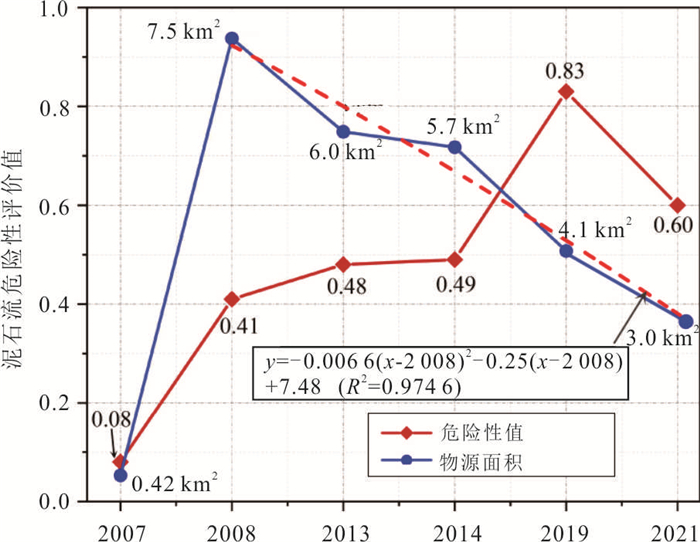
图 6 2007‒2021年泥石流危险性值和物源总面积变化统计
Fig. 6. Changing trends of total material and hazard value of debris flow from 2007 to 2021

图 7 泥石流危险性天空地协同监测体系
Fig. 7. Monitoring system of debris flow hazard based on spaceborne-airborne-ground sensor technique
表 1 遥感影像和地理数据
Table 1. Remote sensing image and geographic information data
数据类型 数据源 日期 分辨率 遥感影像 Landsat4-5 TM 20070918 30 20080718 Landsat8 OIL 20130817、20140601、20141023、20190311、20200414、20210604 15 Google image 200509、200805、201104、201412、201804、201910 0.3 DEM SRTM 2000 30 降雨 NOAA 2007‒2021 矢量数据 注:DEM和NOAA分别为Digital Elevation Model和National Oceanic and Atmospheric Administration缩写.  下载: 导出CSV
表 2 2007-2021年泥石流物源面积变化趋势和密度统计
Table 2. Changing trends of material area and material densities of debris flow from 2007 to 2021
坡面物源面积(km2) 增长率(%) 坡面物源占流域面积比(%) 沟道物源面积(km2) 增长率(%) 总物源占流域面积比(%) 2007 0.245 - 1.14 0.178 - 1.97 2008 6.880 2 708.00 32.07 0.620 248.30 34.96 2013 5.170 ‒24.90 24.10 0.820 32.20 27.92 2014 4.880 ‒5.60 22.75 0.860 4.80 26.76 2019 3.330 ‒31.80 15.52 0.730 ‒15.10 18.92 2021 2.040 ‒38.70 9.51 0.990 35.60 14.43
下载: 导出CSV
表 3 锄头沟泥石流危险性孕灾环境因子熵值和权重
Table 3. Value of entropy and weight of disaster-pregnant factors for debris flow in Chutou gully
评价因子 S1 S2 S3 S4 S5 S6 S7 S8 S9 S10 S11 熵值 0.8 0.95 1 1 1 0.88 1 0.72 0.83 0.69 0.8 权重 0.16 0.04 0 0 0 0.09 0 0.22 0.13 0.24 0.12
下载: 导出CSV
表 4 2007-2021年锄头沟泥石流危险性评价结果
Table 4. Dynamic evaluation on debris flow hazard from 2007 to 2021
年份 危险性评价值 危险级别 2007 0.08 轻度危险 2008 0.41 高度危险 2013 0.48 高度危险 2014 0.49 高度危险 2019 0.83 极高度危险 2021 0.60 高度危险
下载: 导出CSV
-
Chai, B., Tao, Y. Y., Du, J., et al., 2020. Hazard Assessment of Debris Flow Triggered by Outburst of Jialong Glacial Lake in Nyalam County, Tibet. Earth Science, 45(12): 4630-4639 (in Chinese with English abstract). Chang, M., Tang, C., Jiang, Z. L., et al., 2014. Dynamic Evolution Process of Sediment Supply for Debris Flow Occurrence in Longchi of Dujiangyan, Wenchuan Earthquake Area. Mountain Research, 32(1): 89-97 (in Chinese with English abstract). Chen, F. F., Yao, L. H., Zhao, H. L., et al., 2018. Discussion on the Risk Assessment of Debris Flow. Science Technology and Engineering, 18(32): 114-123 (in Chinese with English abstract). Chen, X. Q., Cui, P., Li, Y., et al., 2010. Mountain Hazard Induced by Wenchuan Earthquake and Its Long-Term Development Trends of Ganxi Gully, Beichuan. Journal of Sichuan University (Engineering Science Edition), 42(S1): 22-32 (in Chinese with English abstract). Cheng, L., Guo, R. L., 2007. The Method of Grey Comprehensive Evaluation and Its Application Based on the Principle of Maximum Deviation. Mathematics in Practice and Theory, 37(20): 94-100 (in Chinese with English abstract). Cui, P., Chen, X. Q., Zhu, Y. Y., et al., 2011. The Wenchuan Earthquake (May 12, 2008), Sichuan Province, China, and Resulting Geohazards. Natural Hazards, 56(1): 19-36. https://doi.org/10.1007/s11069-009-9392-1 Cui, P., Liu, S. J., Tan, W. P., 2000. Progress of Debris Flow Forecast in China. Journal of Natural Disasters, 9(2): 10-15 (in Chinese with English abstract). Cui, P., Zhuang, J. Q., Chen, X. C., et al., 2010. Characteristics and Countermeasures of Debris Flow in Wenchuan Area after the Earthquake. Journal of Sichuan University (Engineering Science Edition), 42(5): 10-19 (in Chinese with English abstract). Dai, L. X., Xu, Q., Fan, X. M., et al., 2017. A Preliminary Study on Spatial Distribution Patterns of Landslides Triggered by Jiuzhaigou Earthquake in Sichuan on August 8th, 2017 and Their Susceptibility Assessment. Journal of Engineering Geology, 25(4): 1151-1164 (in Chinese with English abstract). Fan, X. M., Scaringi, G., Korup, O., et al., 2019. Earthquake-Induced Chains of Geologic Hazards: Patterns, Mechanisms, and Impacts. Reviews of Geophysics, 57: 677. https://doi/org/10.1029/2018RG000626 doi: 10.1029/2018RG000626 Fan, X., Scaringi, G., Xu, Q., et al., 2018. Coseismic Landslides Triggered by the 8th August 2017 Ms 7.0 Jiuzhaigou Earthquake (Sichuan, China): Factors Controlling Their Spatial Distribution and Implications for the Seismogenic Blind Fault Identification. Landslides, 15(5): 967-983. https://doi/org/10.1007/s10346-018-0960-x doi: 10.1007/s10346-018-0960-x Guo, X., Cui, P., Li, Y., et al., 2016. Intensity-Duration Threshold of Rainfall-Triggered Debris Flows in the Wenchuan Earthquake Affected Area, China. Geomorphology, 253: 208-216. https://doi/org/10.1016/j.geomorph.2015.10.009 doi: 10.1016/j.geomorph.2015.10.009 Guzzetti, F., Ardizzone, F., Cardinali, M., et al., 2008a. Distribution of Landslides in the Upper Tiber River Basin, Central Italy. Geomorphology, 96(1-2): 105-122. https://doi/org/10.1016/j.geomorph.2007.07.015 doi: 10.1016/j.geomorph.2007.07.015 Guzzetti, F., Peruccacci, S., Rossi, M., et al., 2008b. The Rainfall Intensity-Duration Control of Shallow Landslides and Debris Flows: An Update. Landslides, 5(1): 3-17. https://doi/org/3-17.10.1007/s10346-007-0112-1 doi: 10.1007/s10346-007-0112-1 Han, Z., Su, B., Li, Y., et al., 2020. Modeling the Progressive Entrainment of Bed Sediment by Viscous Debris Flows Using the Three-Dimensional SC-HBP-SPH Method. Water Research, 182: 116031. https://doi.org/10.1016/j.watres.2020.116031 Hu, K. H., Ge, Y. G., Cui, P., et al., 2010. Preliminary Analysis of Extra-Large-Scale Debris Flow Disaster in Zhouqu County of Gansu Province. Journal of Mountain Science, 28(5): 628-634 (in Chinese with English abstract). Li, C. R., Wang, M., Liu, K., 2018. A Decadal Evolution of Landslides and Debris Flows after the Wenchuan Earthquake. Geomorphology, 323: 1-12. https://doi.org/10.1016/j.geomorph.2018.09.010 Li, N., Tang, C., Bu, X. H., et al., 2020. Characteristics and Evolution Analysis of Debris Flow in Wenchuan County after "5.12" Earthquake. Journal of Engineering Geology, 28(6): 1233-1245 (in Chinese with English abstract). Liang, W., Zhuang, D., Jiang, D., et al., 2012. Assessment of Debris Flow Hazards Using a Bayesian Network. Geomorphology, 171: 94-100. https://doi: 10.1016/j.geomorph.2012.05.008 Liu, B., Hu, X., Ma, G., et al., 2021. Back Calculation and Hazard Prediction of a Debris Flow in Wenchuan Meizoseismal Area, China. Bulletin of Engineering Geology and the Environment, 80(4): 3457-3474. https://doi: 10.1007/s10064-021-02127-3 Luo, G., Cheng, Q. G., Shen, W. G., et al., 2021. Research Status and Development Trend of the High-Altitude Extremely-Energetic Rockfalls. Earth Science, 47(3): 913-934 (in Chinese with English abstract). Peng, X. Y., Yu, P. C., Chen, G. Q., et al., 2020. Development of a Coupled DDA-SPH Method and Its Application to Dynamic Simulation of Landslides Involving Solid-Fluid Interaction. Rock Mechanics and Rock Engineering, 53(1): 113-131. https://doi.org/10.1007/s00603-019-01900-x Shi, J. S., Wu, S. R., Zhang, Y, S., et al., 2012. Integrated Landslide Mitigation Strategies Study for Global Change in China. Geological Review, 58(2): 309-318 (in Chinese with English abstract). Shieh, C., Chen, Y., Tsai, Y., et al., 2009. Variability in Rainfall Threshold for Debris Flow after the Chi-Chi Earthquake in Central Taiwan, China. International Journal of Sediment Research, 24(2): 177-188. https://doi.org/10.1016/S1001-6279(09)60025-1 Shrestha, S., Kang, T., Suwal, M., 2017. An Ensemble Model for Co-Seismic Landslide Susceptibility Using GIS and Random Forest Method. ISPRS International Journal of Geo-Information, 6(11): 365. https://doi.org/10.3390/ijgi6110365 Tang, C., Ding, J., Liang, J. T., 2010a. Remote Sensing Images Based Observational Analysis on Characters of Debris Flow Source Areas in Beichuan County of Wenchuan Earthquake Epicenter Region. Journal of Engineering Geology, 18(1): 1-7 (in Chinese with English abstract). Tang, C., Qi, X., Ding, J., et al., 2010b. Dynamic Analysis on Rainfall-Induced Landslide Activity in High Seismic Intensity Areas of the Wenchuan Earthquake Using Remote Sensing Image. Earth Science, 35(2): 317-323 (in Chinese with English abstract). Tie, Y. B., Tang, C., 2006. Application of AHP in Single Debris Flow Risk Assessment. The Chinese Journal of Geological Hazard and Control, 17(4): 79-84 (in Chinese with English abstract). Wang, C. Q., Diao, J. Z., 2020. Analysis of Chutougou Debris Flow Genesis and Engineering Governance Measures in Miansi Township, Wenchuan County. Coal Geology of China, 32(10): 31-34 (in Chinese with English abstract). Wang, F., Fan, X., Yunus, A., et al., 2019. Coseismic Landslides Triggered by the 2018 Hokkaido, Japan (Mw 6.6), Earthquake: Spatial Distribution, Controlling Factors, and Possible Failure Mechanism. Landslides, 16(8): 1551-1566. https://doi.org/10.1007/s10346-019-01187-7 Wang, F. X., Mao, A. H., Li, H. L., 2013. Quality Measurement and Regional Difference of Urbanization in Shandong Province Based on the Entropy Method. Scientia Geographica Sinica, 33(11): 1323-1329 (in Chinese with English abstract). Wang, Y. M., Yin, K. L., 2018. Initiating Mechanism of Typhoon-Triggered Debris Flow. Earth Science, 43(S2): 263-270 (in Chinese with English abstract). Xu, C., Shen, L., Wang, G., 2016. Soft Computing in Assessment of Earthquake-Triggered Landslide Susceptibility. Environmental Earth Sciences, 75(9): 767. https://doi.org/10.1007/s12665-016-5576-7 Xu, C., Xu, X., Shyu, J., 2015. Database and Spatial Distribution of Landslides Triggered by the Lushan, China Mw 6.6 Earthquake of 20 April 2013. Geomorphology, 248: 77-92. https://doi.org/10.1016/j.geomorph.2015.07.002 Xu, Q., Dong, X. J., Li, W. L., 2019. Integrated Space-Air-Ground Early Detection, Monitoring and Warning System for Potential Catastrophic Geohazards. Journal of Wuhan University (Information Science Edition), 44(7): 957-966 (in Chinese with English abstract). Zhang, S. H., Wu, G., 2019. Debris Flow Susceptibility and Its Reliability Based on Random Forest and GIS. Earth Science, 44(9): 3115-3134 (in Chinese with English abstract). Zhou, C., Chang, M., Xu, L., et al., 2023. Failure Modes and Dynamic Characteristics of the Landslide Dams in Strong Earthquake Area. Earth Science, 48(8): 3115-3126 (in Chinese with English abstract). 柴波, 陶阳阳, 杜娟, 等, 2020. 西藏聂拉木县嘉龙湖冰湖溃决型泥石流危险性评价. 地球科学, 45(12): 4630-4639. doi: 10.3799/dqkx.2020.294 常鸣, 唐川, 蒋志林, 等, 2014. 强震区都江堰市龙池镇泥石流物源的遥感动态演变. 山地学报, 32(1): 89-97. 陈飞飞, 姚磊华, 赵宏亮, 等, 2018. 泥石流危险性评价问题的探讨. 科学技术与工程, 18(32): 114-123. 陈晓清, 崔鹏, 李泳, 等, 2010. 汶川地震后北川干溪沟山地灾害及长期发展趋势初步分析. 四川大学学报(工程科学版), 42(S1): 22-32. 成兰, 郭瑞林, 2007. 基于离差最大化原理的灰色综合评判方法及其应用. 数学的实践与认识, 37(20): 94-100. 崔鹏, 刘世建, 谭万沛, 2000. 中国泥石流监测预报研究现状与展望. 自然灾害学报, 9(2): 10-15. 崔鹏, 庄建琦, 陈兴长, 等, 2010. 汶川地震区震后泥石流活动特征与防治对策. 四川大学学报(工程科学版), 42(5): 10-19. 戴岚欣, 许强, 范宣梅, 等, 2017.2017年8月8日四川九寨沟地震诱发地质灾害空间分布规律及易发性评价初步研究. 工程地质学报, 25(4): 1151-1164. 胡凯衡, 葛永刚, 崔鹏, 等, 2010. 对甘肃舟曲特大泥石流灾害的初步认识. 山地学报, 28(5): 628-634. 李宁, 唐川, 卜祥航, 等, 2020. "5·12" 地震后汶川县泥石流特征与演化分析. 工程地质学报, 28(6): 1233-1245. 罗刚, 程谦恭, 沈位刚, 等, 2022. 高位高能岩崩研究现状与发展趋势. 地球科学, 47(3): 913-934. doi: 10.3799/dqkx.2021.133 石菊松, 吴树仁, 张永双, 等, 2012. 应对全球变化的中国地质灾害综合减灾战略研究. 地质论评, 58(2): 309-318. 唐川, 丁军, 梁京涛, 2010a. 汶川震区北川县城泥石流源地特征的遥感动态分析. 工程地质学报, 18(1): 1-7. 唐川, 齐信, 丁军, 等, 2010b. 汶川地震高烈度区暴雨滑坡活动的遥感动态分析. 地球科学, 35(2): 317-323. doi: 10.3799/dqkx.2010.033 铁永波, 唐川, 2006. 层次分析法在单沟泥石流危险度评价中的应用. 中国地质灾害与防治学报, 17(4): 79-84. 王昌强, 刁建钟, 2020. 汶川县绵虒镇锄头沟泥石流成因及工程治理措施分析. 中国煤炭地质, 32(10): 31-34. 王富喜, 毛爱华, 李赫龙, 等, 2013. 基于熵值法的山东省城镇化质量测度及空间差异分析. 地理科学, 33(11): 1323-1329. 王一鸣, 殷坤龙, 2018. 台风暴雨型泥石流启动机制. 地球科学, 43(S2): 263-270. doi: 10.3799/dqkx.2018.312 许强, 董秀军, 李为乐, 2019. 基于天-空-地一体化的重大地质灾害隐患早期识别与监测预警. 武汉大学学报(信息科学版), 44(7): 957-966. 张书豪, 吴光, 2019. 随机森林与GIS的泥石流易发性及可靠性. 地球科学, 44(9): 3115-3134. doi: 10.3799/dqkx.2019.081 周超, 常鸣, 徐璐, 等, 2023. 强震区沟道堰塞体失稳模式及其动力学特征. 地球科学, 48 (8) : 3115-3126. doi: 10.3799/dqkx.2021.127 -


 点击查看大图
计量
- 文章访问数: 11
- HTML全文浏览量: 6
- PDF下载量: 2
- 被引次数: 0
