




Demarcation of North Boundary for Western Jiangnan Orogen: Evidence from Granitic Xenolith in Daping Area, East Guizhou
-
摘要: 幔源岩浆可作为获取地球深部物质信息的“岩石探针”.对黔东大坪晚奥陶世(449 Ma)钾镁煌斑岩中首次发现的花岗岩捕虏体展开了锆石U-Pb年代学、Lu-Hf同位素以及锆石微量元素分析.结果表明,捕虏花岗岩锆石U-Pb谐和年龄为(833±2.6)Ma(MSWD=1.3,n=26),其锆石εHf(t)值和亏损地幔模式年龄(TDM)分别为-11.4~-2.30和2 457~1 893 Ma,锆石REE、U、Th、Pb、Nb、Hf等微量元素表明该捕虏体为造山作用相关S型花岗岩.花岗岩捕虏体与梵净山地区出露的新元古代花岗岩在结晶年龄、锆石Hf同位素组成上一致,暗示二者可能在深部共同构成一巨大花岗岩基,该花岗岩基为厘定江南造山带西段北侧边界提供了重要的物质证据.提出江南造山带西段北侧与扬子地块的边界应以张家界-贵阳断裂为界.Abstract: Mantle-derived magmas can serve as a "lithoprobe" for acquiring information about deep Earth materials. In this study, a newly discovered granite xenolith from the Late Ordovician (449 Ma) lamproite at Daping, East Guizhou, was investigated. Zircon U-Pb geochronology, Lu-Hf isotope, and trace element analyses were conducted on the granite xenolith. The results indicate that the concordant zircon U-Pb age of the granite xenolith is (833±2.6) Ma (MSWD=1.3, n=26). The εHf(t) values range from -11.4 to -2.30, and the depleted mantle model ages (TDM) vary from 2 457 to 1 893 Ma. The trace element compositions of zircon, including REEs, U, Th, Pb, Nb, and Hf, suggest that the granite xenolith is an S-type granite related to orogenic processes. The similarity in crystallization ages and Hf isotopic compositions between this granite xenolith and the Neoproterozoic granites exposed in the Fanjingshan region implies that they may collectively form a large granitic batholith at depth. This batholith provides crucial evidence for delineating the northern boundary of the western segment of the Jiangnan Orogen. It is proposed that the boundary between the northern side of the western Jiangnan Orogen and the Yangtze Block should be defined by the Zhangjiajie-Guiyang fault.
-
Key words:
- Yangtze Block /
- Neoproterozoic /
- lithoprobe /
- xenolith /
- boundary of orogen belt /
- granitic batholith /
- isotopes /
- geochronology
-
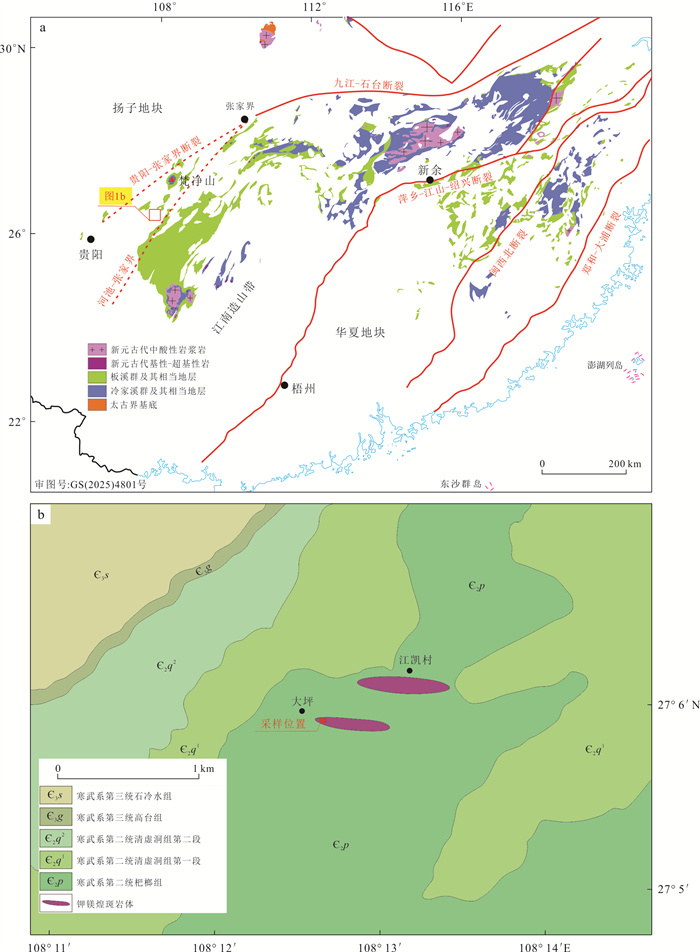
图 1 江南造山带及黔东大坪地区地质图
据GS(2023)2767修改. a.底图据叶天竺等(2017),九江‒石台线据Yao et al.(2019);b.根据贵州1∶5万G49E006001(施秉县)幅地质图修改
Fig. 1. Geological map of the Jiangnan Orogen and Daping area, East Guizhou Province
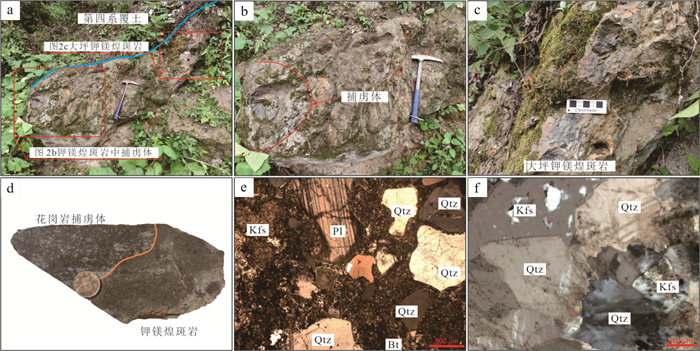
图 2 大坪钾镁煌斑岩露头及其花岗岩捕虏体照片
Kfs.碱性长石;Pl. 斜长石;Qtz. 石英;Bt. 黑云母
Fig. 2. Photographs of the Daping lamproite outcrop and its granitic xenolith
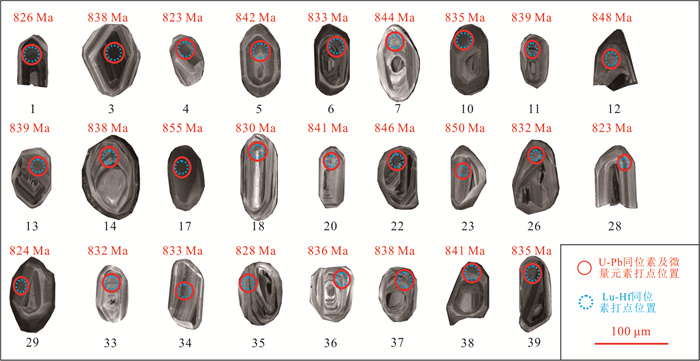
图 3 大坪钾镁煌斑岩捕虏花岗岩锆石阴极发光图及U-Pb、Lu-Hf同位素分析位置
Fig. 3. Zircon cathodoluminescence and U-Pb, Lu-Hf isotope analysis points of the granitic xenolith from the Daping lamproite
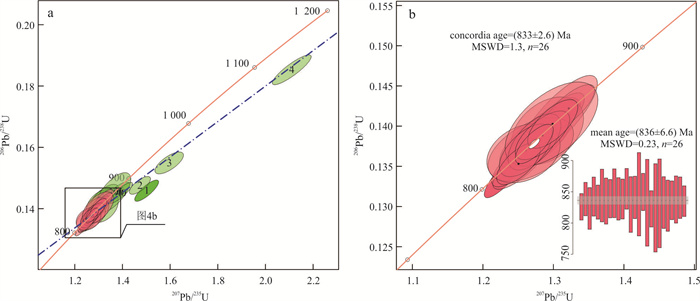
图 4 大坪钾镁煌斑岩捕虏花岗岩锆石U-Pb谐和年龄
Fig. 4. Zircon U-Pb concordia ages of the granitic xenolith from the Daping lamproite
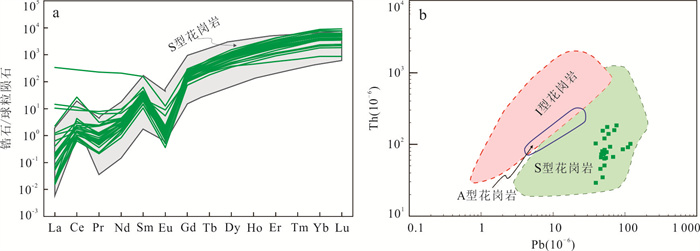
图 5 大坪钾镁煌斑岩捕虏花岗岩锆石微量元素
a.标准化值据Sun and McDonough(1989),S型花岗岩范围据Wang et al.(2012a);b.底图引自赵志丹等(2018)
Fig. 5. Characteristics of zircon trace element diagrams from the granitic xenolith of Daping lamproite

图 6 江南造山带新元古代花岗岩年龄统计
a.江南造山带花岗岩类岩体年龄分布概率核密度图数据来自Xin et al.(2017)、Deng et al.(2018)、Xia et al.(2018)及其参考文献;b.梵净山年龄数据来自高林志等(2011)、王敏等(2011)、Zhao et al.(2011)、Xiang et al.(2020)、Lv et al.(2021)
Fig. 6. Chart of Neoproterozoic granite ages from the Jiangnan Orogen
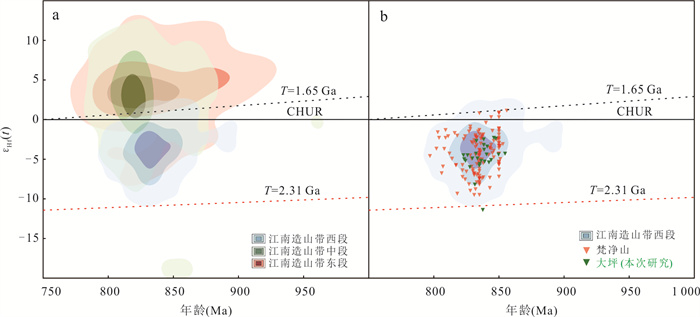
图 7 江南造山带花岗岩锆石εHf(t) vs. U-Pb年龄核密度估算图
江南造山带东段花岗岩Hf同位素数据来自Wu et al.(2006b)、Wang et al.(2012b)、Zhu et al.(2023b);江南造山带中段Hf同位素数据来自Zhao et al.(2013)、Xin et al.(2017)、Rong et al.(2018)、Wang and Wang(2021);江南造山带西段花岗岩Hf同位素数据来自Wang et al.(2013)、Su et al.(2014,2017)、Yao et al.(2014)、Chen et al.(2018)、Wei et al.(2018)、Lv et al.(2021);梵净山花岗岩Hf同位素数据来自Su et al.(2014)、Wei et al.(2018)、Lv et al.(2021)和本课题组未发表数据
Fig. 7. Bivariate kernel density estimation plots of εHf(t) vs. U-Pb ages of zircon from granite in the Jiangnan Orogen
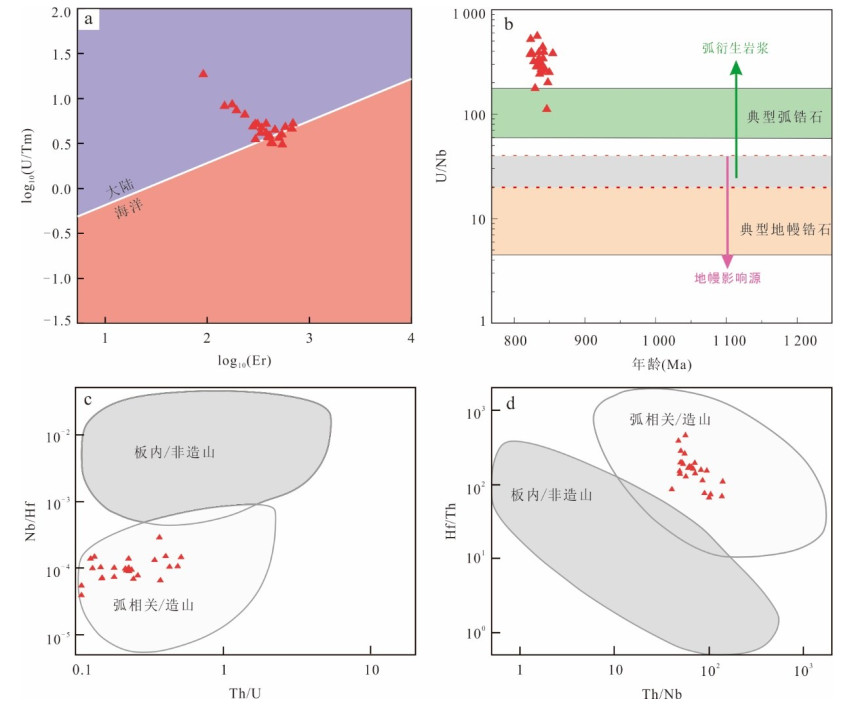
图 8 大坪钾镁煌斑岩捕虏花岗岩锆石微量元素构造判别
a.底图据Chen et al.(2023);b.底图据Drabon et al.(2022);c,d.底图据Yang et al.(2012)
Fig. 8. Tectonic discrimination diagrams of zircon trace element data from the granitic xenolith of Daping lamproite
-
Amelin, Y., Lee, D. C., Halliday, A. N., 2000. Early- Middle Archaean Crustal Evolution Deduced from Lu-Hf and U-Pb Isotopic Studies of Single Zircon Grains. Geochimica et Cosmochimica Acta, 64(24): 4205-4225. https://doi.org/10.1016/S0016-7037(00)00493-2 Belousova, E., Griffin, W., O'Reilly, S. Y., et al., 2002. Igneous Zircon: Trace Element Composition as an Indicator of Source Rock Type. Contributions to Mineralogy and Petrology, 143(5): 602-622. https://doi.org/10.1007/s00410-002-0364-7 Boyd, F. R., Gurney, J. J., 1986. Diamonds and the African Lithosphere. Science, 232(4749): 472-477. https://doi.org/10.1126/science.232.4749.472 Carley, T. L., Bell, E. A., Miller, C. F., et al., 2022. Zircon-Modeled Melts Shed Light on the Formation of Earth's Crust from the Hadean to the Archean. Geology, 50(9): 1028-1032. https://doi.org/10.1130/g50017.1 Cawood, P. A., Hawkesworth, C. J., Dhuime, B., 2013. The Continental Record and the Generation of Continental Crust. Geological Society of America Bulletin, 125(1-2): 14-32. https://doi.org/10.1130/b30722.1 Cawood, P. A., Krner, A., Collins, W. J., et al., 2009. Accretionary Orogens through Earth History. Geological Society, London, Special Publications, 318(1): 1-36. https://doi.org/10.1144/SP318.1 Cawood, P. A., Strachan, R. A., Pisarevsky, S. A., et al., 2016. Linking Collisional and Accretionary Orogens during Rodinia Assembly and Breakup: Implications for Models of Supercontinent Cycles. Earth and Planetary Science Letters, 449: 118-126. https://doi.org/10.1016/j.epsl.2016.05.049 Chen, C. X., Lü, Q. T., Chen, L., et al., 2022. Crustal Thickness and Composition in the South China Block: Constraints from Earthquake Receiver Function. Science China (Earth Sciences), 65(4): 698-713 (in Chinese). doi: 10.1007/s11430-021-9858-x Chen, G. X., Kusky, T., Luo, L., et al., 2023. Hadean Tectonics: Insights from Machine Learning. Geology, 51(8): 718-722. https://doi.org/10.1130/g51095.1 Chen, L., Wang, Z. Q., Yan, Z., et al., 2018. Zircon and Cassiterite U-Pb Ages, Petrogeochemistry and Metallogenesis of Sn Deposits in the Sibao Area, Northern Guangxi: Constraints on the Neoproterozoic Granitic Magmatism and Related Sn Mineralization in the Western Jiangnan Orogen, South China. Mineralogy and Petrology, 112(4): 437-463. https://doi.org/10.1007/s00710-018-0554-2 Chu, N. C., Taylor, R. N., Chavagnac, V., et al., 2002. Hf Isotope Ratio Analysis Using Multi-Collector Inductively Coupled Plasma Mass Spectrometry: An Evaluation of Isobaric Interference Corrections. Journal of Analytical Atomic Spectrometry, 17(12): 1567-1574. https://doi.org/10.1039/b206707b Collins, W. J., 2002. Hot Orogens, Tectonic Switching, and Creation of Continental Crust. Geology, 30(6): 535. https://doi.org/10.1130/0091-7613(2002)0300535:hotsac>2.0.co;2 doi: 10.1130/0091-7613(2002)0300535:hotsac>2.0.co;2 Collins, W. J., Richards, S. W., 2008. Geodynamic Significance of S-Type Granites in Circum-Pacific Orogens. Geology, 36(7): 559-562. https://doi.org/10.1130/G24658A.1 Dai, C. G., Qin, S. R., Chen, J. S., et al., 2013. Characteristics of Deep Concealed Faults in Guizhou. Geological Science and Technology Information, 32(6): 1-6, 13 (in Chinese with English abstract). Deng, T., Xu, D., Chi, G., et al., 2018. Revisiting the Ca. 845-820-Ma S-Type Granitic Magmatism in the Jiangnan Orogen: New Insights on the Neoproterozoic Tectono-Magmatic Evolution of South China. International Geology Review, 61(4): 383-403. https://doi.org/10.1080/00206814.2018.1426054 Dong, S. W., Zhang, Y. Q., Gao, R., et al., 2015. A Possible Buried Paleoproterozoic Collisional Orogen beneath Central South China: Evidence from Seismic-Reflection Profiling. Precambrian Research, 264: 1-10. https://doi.org/10.1016/j.precamres.2015.04.003 Downes, P. J., Griffin, B. J., Griffin, W. L., 2007. Mineral Chemistry and Zircon Geochronology of Xenocrysts and Altered Mantle and Crustal Xenoliths from the Aries Micaceous Kimberlite: Constraints on the Composition and Age of the Central Kimberley Craton, Western Australia. Lithos, 93(1-2): 175-198. https://doi.org/10.1016/j.lithos.2006.06.005 Drabon, N., Byerly, B. L., Byerly, G. R., et al., 2022. Destabilization of Long-Lived Hadean Protocrust and the Onset of Pervasive Hydrous Melting at 3.8 Ga. AGU Advances, 3(2): e2021AV000520. https://doi.org/10.1029/2021AV000520 Gao, J., Klemd, R., Long, L. L., et al., 2009. Adakitic Signature Formed by Fractional Crystallization: An Interpretation for the Neo-Proterozoic Meta-Plagiogranites of the NE Jiangxi Ophiolitic Mélange Belt, South China. Lithos, 110(1-4): 277-293. https://doi.org/10.1016/j.lithos.2009.01.009 Gao, L. Z., Dai, C. G., Ding, X. Z., et al., 2011. SHRIMP U-Pb Dating of Intrusive Alaskite in the Fanjingshan Group and Alaskite Basal Conglomerates: Constraints on the Deposition of the Xiajiang Group. Geology in China, 38(6): 1413-1420 (in Chinese with English abstract). Gardiner, N. J., Kirkland, C. L., Hollis, J. A., et al., 2020. North Atlantic Craton Architecture Revealed by Kimberlite-Hosted Crustal Zircons. Earth and Planetary Science Letters, 534: 116091. https://doi.org/10.1016/j.epsl.2020.116091 Grimes, C. B., John, B. E., Kelemen, P. B., et al., 2007. Trace Element Chemistry of Zircons from Oceanic Crust: A Method for Distinguishing Detrital Zircon Provenance. Geology, 35(7): 643. https://doi.org/10.1130/G23603A.1 Grimes, C. B., Wooden, J. L., Cheadle, M. J., et al., 2015. "Fingerprinting" Tectono-Magmatic Provenance Using Trace Elements in Igneous Zircon. Contributions to Mineralogy and Petrology, 170(5): 46. https://doi.org/10.1007/s00410-015-1199-3 Guo, L. H., Gao, R., 2018. Potential-Field Evidence for the Tectonic Boundaries of the Central and Western Jiangnan Belt in South China. Precambrian Research, 309: 45-55. https://doi.org/10.1016/j.precamres.2017.01.028 Han, R. B., Yang, D. H., Li, Q. S., et al., 2023. Structural Boundary and Deep Contact Relationship between the Yangtze and Cathaysia Blocks from Crustal Thickness Gradients. Frontiers in Earth Science, 10: 1065782. https://doi.org/10.3389/feart.2022.1065782 He, C. S., Dong, S. W., Santosh, M., et al., 2013. Seismic Evidence for a Geosuture between the Yangtze and Cathaysia Blocks, South China. Scientific Reports, 3: 2200. https://doi.org/10.1038/srep02200 Hou, Z. Q., Wang, T., 2018. Isotopic Mapping and Deep Material Probing (Ⅱ): Imaging Crustal Architecture and Its Control on Mineral Systems. Earth Science Frontiers, 25(6): 20-41 (in Chinese with English abstract). Hu, Z. C., Li, X. H., Luo, T., et al., 2021. Tanz Zircon Megacrysts: A New Zircon Reference Material for the Microbeam Determination of U-Pb Ages and Zr-O Isotopes. Journal of Analytical Atomic Spectrometry, 36(12): 2715-2734. https://doi.org/10.1039/D1JA00311A Huang, S. F., 2021. The Formation and Evolution of the Jiangnan Orogen: Implication from the Neoproterozoic Magmatic Rock (Dissertation). China University of Geosciences, Wuhan (in Chinese with English abstract). Huang, S. F., Wang, W., Zhao, J. H., et al., 2018. Petrogenesis and Geodynamic Significance of the ~850 Ma Dongling A-Type Granites in South China. Lithos, 318: 176-193. https://doi.org/10.1016/j.lithos.2018.08.016 Li, Q. W., Zhao, J. H., Dong, Y. L., et al., 2024. Large Granitoid Batholith Formed by Episodic Reworking of the Continental Basement. Precambrian Research, 413: 107568. https://doi.org/10.1016/j.precamres.2024.107568 Li, X. H., Li, Z. X., Ge, W. C., et al., 2001. U-Pb Zircon Ages of the Neoproterozoic Granitoids in South China and Their Tectonic Implications. Bulletin of Mineralogy, Petrology and Geochemistry, 20(4): 271-273 (in Chinese with English abstract). Li, X. L., Li, Z. W., Xia, X., et al., 2023. Crustal Structure and Tectonic Boundary Characteristics in South China: Constraints from Joint Tomography of Ambient Noise and Gravity. Chinese Science Bulletin, 68(24): 3221-3236 (in Chinese). doi: 10.1360/TB-2023-0417 Ling, X. X., Li, Q. L., Yang, C. A., et al., 2022. Zircon ZS-A Homogenous Natural Reference Material for U-Pb Age and O-Hf Isotope Microanalyses. Atomic Spectroscopy, 43(2): 134-144. https://doi.org/10.46770/as.2022.033 Liu, H., Zhao, J. H., 2018. Neoproterozoic Peraluminous Granitoids in the Jiangnan Fold Belt: Implications for Lithospheric Differentiation and Crustal Growth. Precambrian Research, 309: 152-165. https://doi.org/10.1016/j.precamres.2017.05.001 Liu, Y. S., Hu, Z. C., Zong, K. Q., et al., 2010. Reappraisement and Refinement of Zircon U-Pb Isotope and Trace Element Analyses by LA-ICP-MS. Chinese Science Bulletin, 55(15): 1535-1546. https://doi.org/10.1007/s11434-010-3052-4 Lv, Z. H., Chen, J., Zhang, H., et al., 2021. Petrogenesis of Neoproterozoic Rare Metal Granite-Pegmatite Suite in Jiangnan Orogen and Its Implications for Rare Metal Mineralization of Peraluminous Rock in South China. Ore Geology Reviews, 128: 103923. https://doi.org/10.1016/j.oregeorev.2020.103923 Ma, T. Q., Chen, L. X., Bai, D. Y., et al., 2009. Zircon SHRIMP Dating and Geochemical Characteristics of Neoproterozoic Granites in Southeastern Hunan. Geology in China, 36(1): 65-73 (in Chinese with English abstract). Miao, Z., Zhao, Z. D., Lei, H. S., et al., 2020. Genesis of LREE-Enriched Zircons and Their Highly Radiogenic Hf Compositions: A Case Study from Zhuopan Alkaline Complex in Western Yunnan. Acta Petrologica Sinica, 36(9): 2765-2784 (in Chinese with English abstract). doi: 10.18654/1000-0569/2020.09.10 Pearce, J. A., Peate, D. W., 1995. Tectonic Implications of the Composition of Volcanic Arc Magmas. Annual Review of Earth and Planetary Sciences, 23: 251-286. https://doi.org/10.1146/annurev.ea.23.050195.001343 Pearson, D. G., Canil, D., Shirey, S. B., 2003. Mantle Samples Included in Volcanic Rocks: Xenoliths and Diamonds. Treatise on Geochemistry, 2: 568. https://doi.org/10.1016/B0-08-043751-6/02005-3 Pearson, D. G., Wittig, N., 2014. The Formation and Evolution of Cratonic Mantle Lithosphere-Evidence from Mantle Xenoliths. Treatise on Geochemistry. Elsevier, Amsterdam, 255-292. https://doi.org/10.1016/b978-0-08-095975-7.00205-9 doi: 10.1016/b978-0-08-095975-7.00205-9 Rong, W., Zhang, S. B., Zheng, Y. F., et al., 2018. Mixing of Felsic Magmas in Granite Petrogenesis: Geochemical Records of Zircon and Garnet in Peraluminous Granitoids from South China. Journal of Geophysical Research: Solid Earth, 123(4): 2738-2769. https://doi.org/10.1002/2017JB014022 Rubatto, D., 2002. Zircon Trace Element Geochemistry: Partitioning with Garnet and the Link between U-Pb Ages and Metamorphism. Chemical Geology, 184(1-2): 123-138. https://doi.org/10.1016/S0009-2541(01)00355-2 Shu, L. S., Yao, J. L., Wang, B., et al., 2021. Neoproterozoic Plate Tectonic Process and Phanerozoic Geodynamic Evolution of the South China Block. Earth-Science Reviews, 216: 103596. https://doi.org/10.1016/j.earscirev.2021.103596 Sláma, J., Košler, J., Condon, D. J., et al., 2008. Plešovice Zircon—A New Natural Reference Material for U-Pb and Hf Isotopic Microanalysis. Chemical Geology, 249(1-2): 1-35. https://doi.org/10.1016/j.chemgeo.2007.11.005 Su, J. B., Dong, S. W., Zhang, Y. Q., et al., 2017. Orogeny Processes of the Western Jiangnan Orogen, South China: Insights from Neoproterozoic Igneous Rocks and a Deep Seismic Profile. Journal of Geodynamics, 103: 42-56. https://doi.org/10.1016/j.jog.2016.12.004 Su, J. B., Zhang, Y. Q., Dong, S. W., et al., 2014. Geochronology and Hf Isotopes of Granite Gravel from Fanjingshan, South China: Implication for the Precambrian Tectonic Evolution of Western Jiangnan Orogen. Journal of Earth Science, 25(4): 619-629. https://doi.org/10.1007/s12583-014-0469-8 Sun, J. J., Shu, L. S., Santosh, M., et al., 2017. Neoproterozoic Tectonic Evolution of the Jiuling Terrane in the Central Jiangnan Orogenic Belt (South China): Constraints from Magmatic Suites. Precambrian Research, 302: 279-297. https://doi.org/10.1016/j.precamres.2017.10.003 Sun, S. S., McDonough, W. F., 1989. Chemical and Isotopic Systematics of Oceanic Basalts: Implications for Mantle Composition and Processes. Geological Society, London, Special Publications, 42(1): 313-345. https://doi.org/10.1144/GSL.SP.1989.042.01.19 Tang, Y. W., Chen, L., Zhao, Z. F., et al., 2020. Geochemical Evidence for the Production of Granitoids through Reworking of the Juvenile Mafic Arc Crust in the Gangdese Orogen, Southern Tibet. GSA Bulletin, 132(7-8): 1347-1364. https://doi.org/10.1130/b35304.1 Vermeesch, P., 2018. IsoplotR: A Free and Open Toolbox for Geochronology. Geoscience Frontiers, 9(5): 1479-1493. https://doi.org/10.1016/j.gsf.2018.04.001 Vervoort, J., 2014. Lu-Hf Dating: The Lu-Hf Isotope System. Encyclopedia of Scientific Dating Methods. Springer Netherlands, Dordrecht, 1-20. https://doi.org/10.1007/978-94-007-6326-5_46-1 doi: 10.1007/978-94-007-6326-5_46-1 Vervoort, J. D., Patchett, P. J., Gehrels, G. E., et al., 1996. Constraints on Early Earth Differentiation from Hafnium and Neodymium Isotopes. Nature, 379(6566): 624-627. https://doi.org/10.1038/379624a0 Wang, D., Wang, X. L., 2021. Dual Mixing for the Formation of Neoproterozoic Granitic Intrusions within the Composite Jiuling Batholith, South China. Contributions to Mineralogy and Petrology, 176(1): 7. https://doi.org/10.1007/s00410-020-01757-2 Wang, L., Zhang, J. W., Chen, G. Y., et al., 2020. Delineation of Concealed Intermediate-Acidic Pluton and Significance of Mineral Prospecting in Guizhou Province. Geology and Exploration, 56(2): 387-402 (in Chinese with English abstract). Wang, L. J., Zhang, K. X., Lin, S. F., et al., 2022. Origin and Age of the Shenshan Tectonic Mélange in the Jiangshan-Shaoxing-Pingxiang Fault and Late Early Paleozoic Juxtaposition of the Yangtze Block and the West Cathaysia Terrane, South China. GSA Bulletin, 134(1/2): 113-129. https://doi.org/10.1130/b35963.1 Wang, M., Dai, C. G., Wang, X. H., et al., 2011. In-Situ Zircon Geochronology and Hf Isotope of Muscovite-Bearing Leucogranites from Fanjingshan, Guizhou Province, and Constraints on Continental Growth of the Southern China Block. Earth Science Frontiers, 18(5): 213-223 (in Chinese with English abstract). Wang, Q., Zhu, D. C., Zhao, Z. D., et al., 2012a. Magmatic Zircons from I-, S- and A-Type Granitoids in Tibet: Trace Element Characteristics and Their Application to Detrital Zircon Provenance Study. Journal of Asian Earth Sciences, 53: 59-66. https://doi.org/10.1016/j.jseaes.2011.07.027 Wang, X. L., Shu, L. S., Xing, G. F., et al., 2012b. Post-Orogenic Extension in the Eastern Part of the Jiangnan Orogen: Evidence from ca 800-760 Ma Volcanic Rocks. Precambrian Research, 222: 404-423. https://doi.org/10.1016/j.precamres.2011.07.003 Wang, T., Huang, H., Yang, L. Q., et al., 2022. The Methodological Framework for Deciphering 3-Demensional Material Architecture of the Lithosphere. Acta Geologica Sinica, 96(10): 3589-3618 (in Chinese with English abstract). Wang, X. L., Zhou, J. C., Chen, X., et al., 2017. Formation and Evolution of the Jiangnan Orogen. Bulletin of Mineralogy, Petrology and Geochemistry, 36(5): 714-735, 696 (in Chinese with English abstract). Wang, X. L., Zhou, J. C., Griffin, W. L., et al., 2014. Geochemical Zonation across a Neoproterozoic Orogenic Belt: Isotopic Evidence from Granitoids and Metasedimentary Rocks of the Jiangnan Orogen, China. Precambrian Research, 242: 154-171. https://doi.org/10.1016/j.precamres.2013.12.023 Wang, X. L., Zhou, J. C., Qiu, J. S., et al., 2006. LA-ICP-MS U-Pb Zircon Geochronology of the Neoproterozoic Igneous Rocks from Northern Guangxi, South China: Implications for Tectonic Evolution. Precambrian Research, 145(1-2): 111-130. https://doi.org/10.1016/j.precamres.2005.11.014 Wang, X. L., Zhou, J. C., Wan, Y. S., et al., 2013. Magmatic Evolution and Crustal Recycling for Neoproterozoic Strongly Peraluminous Granitoids from Southern China: Hf and O Isotopes in Zircon. Earth and Planetary Science Letters, 366: 71-82. https://doi.org/10.1016/j.epsl.2013.02.011 Wei, S. D., Liu, H., Zhao, J. H., 2018. Tectonic Evolution of the Western Jiangnan Orogen: Constraints from the Neoproterozoic Igneous Rocks in the Fanjingshan Region, South China. Precambrian Research, 318: 89-102. https://doi.org/10.1016/j.precamres.2018.10.006 Wiedenbeck, M., Allé, P., Corfu, F., et al., 1995. Three Natural Zircon Standards for U-Th-Pb, Lu-Hf, Trace Element and REE Analyses. Geostandards Newsletter, 19(1): 1-23. https://doi.org/10.1111/j.1751-908X.1995.tb00147.x Windley, B., 1992. Chapter 11 Proterozoic Collisional and Accretionary Orogens. Proterozoic Crustal Evolution. Elsevier, Amsterdam, 419-446. https://doi.org/10.1016/s0166-2635(08)70125-7 doi: 10.1016/s0166-2635(08)70125-7 Wu, F. Y., Li, X. H., Zheng, Y. F., et al., 2007. Lu-Hf Isotopic Systematics and Their Applications in Petrology. Acta Petrologica Sinica, 23(2): 185-220 (in Chinese with English abstract). Wu, F. Y., Yang, Y. H., Xie, L. W., et al., 2006a. Hf Isotopic Compositions of the Standard Zircons and Baddeleyites Used in U-Pb Geochronology. Chemical Geology, 234(1-2): 105-126. https://doi.org/10.1016/j.chemgeo.2006.05.003 Wu, R. X., Zheng, Y. F., Wu, Y. B., et al., 2006b. Reworking of Juvenile Crust: Element and Isotope Evidence from Neoproterozoic Granodiorite in South China. Precambrian Research, 146(3-4): 179-212. https://doi.org/10.1016/j.precamres.2006.01.012 Xia, Y., Xu, X. S., Niu, Y. L., et al., 2018. Neoproterozoic Amalgamation between Yangtze and Cathaysia Blocks: The Magmatism in Various Tectonic Settings and Continent-Arc-Continent Collision. Precambrian Research, 309: 56-87. https://doi.org/10.1016/j.precamres.2017.02.020 Xiang, L., Wang, R. C., Romer, R. L., et al., 2020. Neoproterozoic Nb-Ta-W-Sn Bearing Tourmaline Leucogranite in the Western Part of Jiangnan Orogen: Implications for Episodic Mineralization in South China. Lithos, 360: 105450. https://doi.org/10.1016/j.lithos.2020.105450 Xiang, L., Zheng, J. P., Siebel, W., et al., 2018. Unexposed Archean Components and Complex Post-Archean Accretion/Reworking Processes beneath the Southern Yangtze Block Revealed by Zircon Xenocrysts from the Paleozoic Lamproites, South China. Precambrian Research, 316: 174-196. https://doi.org/10.1016/j.precamres.2018.08.003 Xiang, L., Zheng, J. P., Zhai, M. G., 2022. Archean to Paleoproterozoic Crustal Evolution of the Southern Yangtze Block (South China): U-Pb Age and Hf-Isotope of Zircon Xenocrysts from the Paleozoic Diamondiferous Kimberlites. Precambrian Research, 374: 106651. https://doi.org/10.1016/j.precamres.2022.106651 Xin, Y. J., Li, J. H., Dong, S. W., et al., 2017. Neoproterozoic Post-Collisional Extension of the Central Jiangnan Orogen: Geochemical, Geochronological, and Lu-Hf Isotopic Constraints from the ca. 820-800 Ma Magmatic Rocks. Precambrian Research, 294: 91-110. https://doi.org/10.1016/j.precamres.2017.03.018 Xu, X. S., O'Reilly, S. Y., Griffin, W. L., et al., 2007. The Crust of Cathaysia: Age, Assembly and Reworking of Two Terranes. Precambrian Research, 158(1-2): 51-78. https://doi.org/10.1016/j.precamres.2007.04.010 Xu, X. S., Wang, X. L., Zhao, K., et al., 2020. Progresses and Tendencies of Granite Researches in Last Decade: A Review. Bulletin of Mineralogy, Petrology and Geochemistry, 39(5): 899-911, 1069 (in Chinese with English abstract). Xue, H. M., Ma, F., Song, Y. Q., et al., 2010. Geochronology and Geochemisty of the Neoproterozoic Granitoid Association from Eastern Segment of the Jiangnan Orogen, China: Constraints on the Timing and Process of Amalgamation between the Yangtze and Cathaysia Blocks. Acta Petrologica Sinica, 26(11): 3215-3244 (in Chinese with English abstract). Yan, C. L., Shu, L. S., Chen, Y., et al., 2021. The Construction Mechanism of the Neoproterozoic S-Type Sanfang-Yuanbaoshan Granitic Plutons in the Jiangnan Orogenic Belt, South China: Insights from Geological Observation, Geochronology, AMS and Bouguer Gravity Modeling. Precambrian Research, 354: 106054. https://doi.org/10.1016/j.precamres.2020.106054 Yan, J. Y., Lu, Q. T., Zhang, Y. Q., et al., 2022. The Deep Boundaries of Jiangnan Orogenic Belt and Its Constraints on Metallogenic: From the Understanding of Integrated Geophysics. Acta Petrologica Sinica, 38(2): 544-558 (in Chinese with English abstract). doi: 10.18654/1000-0569/2022.02.16 Yang, G. Z., Li, Y. G., Zhang, Y. L., et al., 2019. Distribution-Controlling Factors and Emplacement Mode of Lamproite in Southeastern Guizhou Province. Geological Bulletin of China, 38(1): 27-35 (in Chinese with English abstract). Yang, J. H., Cawood, P. A., Du, Y. S., et al., 2012. Large Igneous Province and Magmatic Arc Sourced Permian-Triassic Volcanogenic Sediments in China. Sedimentary Geology, 261: 120-131. https://doi.org/10.1016/j.sedgeo.2012.03.018 Yao, J. L., Cawood, P. A., Shu, L. S., et al., 2019. Jiangnan Orogen, South China: A ~970-820 Ma Rodinia Margin Accretionary Belt. Earth-Science Reviews, 196: 102872. https://doi.org/10.1016/j.earscirev.2019.05.016 Yao, J. L., Shu, L. S., Cawood, P. A., et al., 2016. Delineating and Characterizing the Boundary of the Cathaysia Block and the Jiangnan Orogenic Belt in South China. Precambrian Research, 275: 265-277. https://doi.org/10.1016/j.precamres.2016.01.023 Yao, J. L., Shu, L. S., Santosh, M., et al., 2014. Neoproterozoic Arc-Related Mafic-Ultramafic Rocks and Syn-Collision Granite from the Western Segment of the Jiangnan Orogen, South China: Constraints on the Neoproterozoic Assembly of the Yangtze and Cathaysia Blocks. Precambrian Research, 243: 39-62. https://doi.org/10.1016/j.precamres.2013.12.027 Yao, J. L., Shu, L. S., Zhao, G. C., et al., 2021. Ca. 835-823 Ma Doming Extensional Tectonics in the West Jiangnan Accretionary Orogenic Belt, South China: Implication for a Slab Roll-back Event. Journal of Geodynamics, 148: 101879. https://doi.org/10.1016/j.jog.2021.101879 Ye, T. Z., Huang, C. K., Deng, Z. Q., 2017. Spatial Database of 1: 2 500 000 Digital Geologic Map of People's Republic of China. Geology in China, 44(S1): 19-24, 139-146 (in Chinese with English abstract). Yu, J. H., Wang, L. J., O'Reilly, S. Y., et al., 2009. A Paleoproterozoic Orogeny Recorded in a Long-Lived Cratonic Remnant (Wuyishan Terrane), Eastern Cathaysia Block, China. Precambrian Research, 174(3-4): 347-363. https://doi.org/10.1016/j.precamres.2009.08.009 Yu, Y., Huang, X. L., He, P. L., et al., 2016. Ⅰ-Type Granitoids Associated with the Early Paleozoic Intracontinental Orogenic Collapse along Pre-Existing Block Boundary in South China. Lithos, 248: 353-365. https://doi.org/10.1016/j.lithos.2016.02.002 Zhai, M. G., Zhang, Q., Chen, G. N., et al., 2016. Adventure on the Research of Continental Evolution and Related Granite Geochemistry. Chinese Science Bulletin, 61(13): 1414-1420 (in Chinese). doi: 10.1360/N972015-01272 Zhang, H. F., Gao, S., 2012. Geochemistry. Geological Publishing House, Beijing (in Chinese). Zhang, J. W., Liao, M. Y., Santosh, M., et al., 2020. Middle Tonian Calc-Alkaline Picrites, Basalts, and Basaltic Andesites from the Jiangnan Orogen: Evidence for Rear-Arc Magmatism. Precambrian Research, 350: 105943. https://doi.org/10.1016/j.precamres.2020.105943 Zhang, J. W., Santosh, M., Zhu, Y. H., et al., 2023a. Constraining the Timing of Deep Magmatic Pulses from Diamondiferous Kimberlite and Related Rocks in the South China Continent and Implications for Diamond Exploration. Ore Geology Reviews, 154: 105328. https://doi.org/10.1016/j.oregeorev.2023.105328 Zhang, Z. Y., Hou, Z. Q., Lü, Q. T., et al., 2023b. Crustal Architectural Controls on Critical Metal Ore Systems in South China Based on Hf Isotopic Mapping. Geology, 51(8): 738-742. https://doi.org/10.1130/g51203.1 Zhang, J. W., Ye, T. P., Dai, Y. R., et al., 2019. Provenance and Tectonic Setting Transition as Recorded in the Neoproterozoic Strata, Western Jiangnan Orogen: Implications for South China within Rodinia. Geoscience Frontiers, 10(5): 1823-1839. https://doi.org/10.1016/j.gsf.2018.10.009 Zhang, S. B., Zheng, Y. F., Wu, Y. B., et al., 2006. Zircon Isotope Evidence for ≥3.5 Ga Continental Crust in the Yangtze Craton of China. Precambrian Research, 146(1-2): 16-34. https://doi.org/10.1016/j.precamres.2006.01.002 Zhao, G. C., 2015. Jiangnan Orogen in South China: Developing from Divergent Double Subduction. Gondwana Research, 27(3): 1173-1180. https://doi.org/10.1016/j.gr.2014.09.004 Zhao, G. C., Cawood, P. A., 2012. Precambrian Geology of China. Precambrian Research, 222: 13-54. https://doi.org/10.1016/j.precamres.2012.09.017 Zhao, J. H., Zhou, M. F., Yan, D. P., et al., 2011. Reappraisal of the Ages of Neoproterozoic Strata in South China: No Connection with the Grenvillian Orogeny. Geology, 39(4): 299-302. https://doi.org/10.1130/G31701.1 Zhao, J. H., Zhou, M. F., Zheng, J. P., 2013. Constraints from Zircon U-Pb Ages, O and Hf Isotopic Compositions on the Origin of Neoproterozoic Peraluminous Granitoids from the Jiangnan Fold Belt, South China. Contributions to Mineralogy and Petrology, 166(5): 1505-1519. https://doi.org/10.1007/s00410-013-0940-z Zhao, T., Zhu, G., Wu, Q., et al., 2021. Evidence for Discrete Archean Microcontinents in the Yangtze Craton. Precambrian Research, 361: 106259. https://doi.org/10.1016/j.precamres.2021.106259 Zhao, Z. D., Liu, D., Wang, Q., et al., 2018. Zircon Trace Elements and Their Use in Probing Deep Processes. Earth Science Frontiers, 25(6): 124-135 (in Chinese with English abstract). Zhao, Z. H., 2016. Discrimination of Tectonic Settings Based on Trace Elements in Igneous Minerals. Geotectonica et Metallogenia, 40(5): 986-995 (in Chinese with English abstract). Zheng, J. P., Griffin, W. L., O'Reilly, S. Y., et al., 2006. Widespread Archean Basement beneath the Yangtze Craton. Geology, 34(6): 417. https://doi.org/10.1130/g22282.1 Zheng, Y. F., 2022. Does the Mantle Contribute to Granite Petrogenesis?. Earth Science, 47(10): 3765 (in Chinese with English abstract). Zheng, Y. F., Gao, P., 2021. The Production of Granitic Magmas through Crustal Anatexis at Convergent Plate Boundaries. Lithos, 402: 106232. https://doi.org/10.1016/j.lithos.2021.106232 Zheng, Y. F., Xiao, W. J., Zhao, G. C., 2013. Introduction to Tectonics of China. Gondwana Research, 23(4): 1189-1206. https://doi.org/10.1016/j.gr.2012.10.001 Zheng, Y. F., Zhang, S. B., Zhao, Z. F., et al., 2007. Contrasting Zircon Hf and O Isotopes in the Two Episodes of Neoproterozoic Granitoids in South China: Implications for Growth and Reworking of Continental Crust. Lithos, 96(1-2): 127-150. https://doi.org/10.1016/j.lithos.2006.10.003 Zhu, D. C., Wang, Q., Weinberg, R. F., et al., 2023a. Continental Crustal Growth Processes Recorded in the Gangdese Batholith, Southern Tibet. Annual Review of Earth and Planetary Sciences, 51: 155-188. https://doi.org/10.1146/annurev-earth-032320-110452 Zhu, Q. B., Zhao, X. L., Hong, W. T., et al., 2023b. Geochronology, Hf Isotope and Trace Element of Zircon and Apatite for Neoproterozoic Granodiorites in the Eastern Jiangnan Orogen: Implications for the Neoproterozoic Tectonic Evolution. Lithos, 446: 107134. https://doi.org/10.1016/j.lithos.2023.107134 陈昌昕, 吕庆田, 陈凌, 等, 2022. 华南陆块地壳厚度与物质组成: 基于天然地震接收函数研究. 中国科学: 地球科学, 52(4): 760-776. 戴传固, 秦守荣, 陈建书, 等, 2013. 试论贵州深部隐伏断裂特征. 地质科技情报, 32(6): 1-6, 13. 高林志, 戴传固, 丁孝忠, 等, 2011. 侵入梵净山群白岗岩锆石U-Pb年龄及白岗岩底砾岩对下江群沉积的制约. 中国地质, 38(6): 1413-1420. 侯增谦, 王涛, 2018. 同位素填图与深部物质探测(Ⅱ): 揭示地壳三维架构与区域成矿规律. 地学前缘, 25(6): 20-41. 黄思访, 2021. 江南造山带的形成与演化——来自新元古代岩浆岩的启示(博士学位论文). 武汉: 中国地质大学(武汉). 李献华, 李正祥, 葛文春, 等, 2001. 华南新元古代花岗岩的锆石U-Pb年龄及其构造意义. 矿物岩石地球化学通报, 20(4): 271-273. 李雪垒, 李志伟, 夏鑫, 等, 2023. 华南地壳结构与构造边界特征: 来自地震背景噪声和重力联合成像模型的约束. 科学通报, 68(24): 3221-3236. 马铁球, 陈立新, 柏道远, 等, 2009. 湘东北新元古代花岗岩体锆石SHRIMP U-Pb年龄及地球化学特征. 中国地质, 36(1): 65-73. 苗壮, 赵志丹, 雷杭山, 等, 2020. 锆石轻稀土富集与Hf同位素异常成因: 以滇西卓潘碱性杂岩体为例. 岩石学报, 36(9): 2765-2784. 王亮, 张嘉玮, 陈国勇, 等, 2020. 贵州中酸性隐伏岩体圈定与找矿意义. 地质与勘探, 56(2): 387-402. 王敏, 戴传固, 王雪华, 等, 2011. 贵州梵净山白云母花岗岩锆石年代、铪同位素及对华南地壳生长的制约. 地学前缘, 18(5): 213-223. 王涛, 黄河, 杨立强, 等, 2022. 揭示三维岩石圈物质架构的技术方法体系框架. 地质学报, 96(10): 3589-3618. 王孝磊, 周金城, 陈昕, 等, 2017. 江南造山带的形成与演化. 矿物岩石地球化学通报, 36(5): 714-735, 696. 吴福元, 李献华, 郑永飞, 等, 2007. Lu-Hf同位素体系及其岩石学应用. 岩石学报, 23(2): 185-220. 徐夕生, 王孝磊, 赵凯, 等, 2020. 新时期花岗岩研究的进展和趋势. 矿物岩石地球化学通报, 39(5): 899-911, 1069. 薛怀民, 马芳, 宋永勤, 等, 2010. 江南造山带东段新元古代花岗岩组合的年代学和地球化学: 对扬子与华夏地块拼合时间与过程的约束. 岩石学报, 26(11): 3215-3244. 严加永, 吕庆田, 张永谦, 等, 2022. 江南造山带深部边界及成矿制约: 来自综合地球物理的认识. 岩石学报, 38(2): 544-558. 杨光忠, 李永刚, 张与伦, 等, 2019. 黔东钾镁煌斑岩分布控制因素及其侵位模式. 地质通报, 38(1): 27-35. 叶天竺, 黄崇轲, 邓志奇, 2017.1∶250万中华人民共和国数字地质图空间数据库. 中国地质, 44(S1): 19-24, 139-146. 翟明国, 张旗, 陈国能, 等, 2016. 大陆演化与花岗岩研究的变革. 科学通报, 61(13): 1414-1420. 张宏飞, 高山, 2012. 地球化学. 北京: 地质出版社. 赵志丹, 刘栋, 王青, 等, 2018. 锆石微量元素及其揭示的深部过程. 地学前缘, 25(6): 124-135. 赵振华, 2016. 矿物微量元素组成用于火成岩构造背景判别. 大地构造与成矿学, 40(5): 986-995. 郑永飞, 2022. 地幔是否对花岗岩的形成有贡献?. 地球科学, 47(10): 3765. doi: 10.3799/dqkx.2022.800 -
 王坤 附表.docx

-

 下载:
下载:
 点击查看大图
计量
- 文章访问数: 14
- HTML全文浏览量: 9
- PDF下载量: 1
- 被引次数: 0
