- 中文版:
- EI 100%收录
- 英文版
- SCI 100%收录


中国出版政府奖提名奖
中国百强科技报刊
湖北出版政府奖
中国高校百佳科技期刊
中国最美期刊
中国出版政府奖提名奖
中国百强科技报刊
湖北出版政府奖
中国高校百佳科技期刊
中国最美期刊
| Citation: | Wang Rui, Shen Yanjun, Wang Lei, Li Chao, Li Shaojie, Mu Qingyi, Ning Yibing, Xu Panpan, Peng Jianbing, 2026. Elevation Gradient Characteristics of the Interfeeding between Human Activities and Ecological Environment in Xi 'an Section of the Northern Foot of Qinling Mountains. Earth Science, 51(2): 432-445. doi: 10.3799/dqkx.2024.134

|
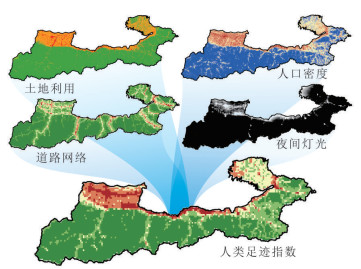
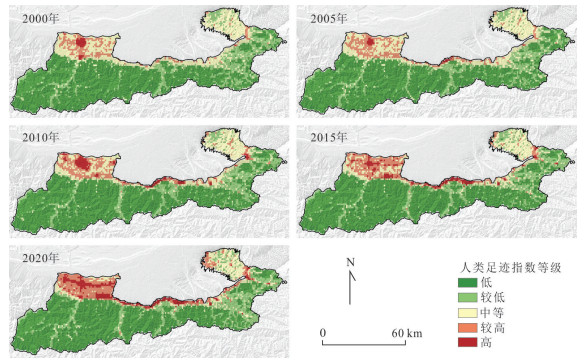
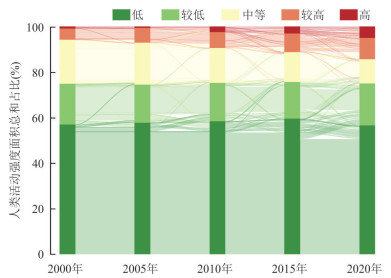
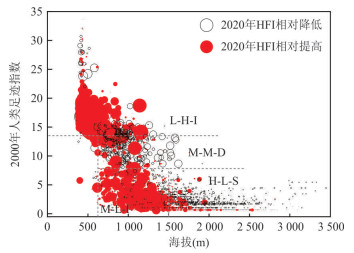
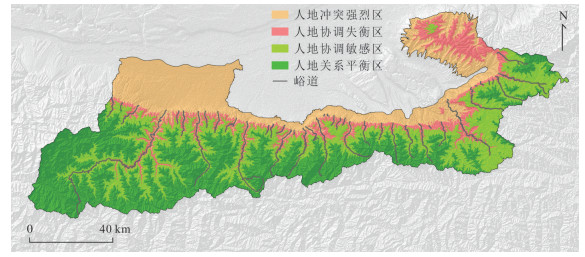
In order toelucidate the impact of human activities on ecosystem in Xi 'an section of the northern foot of Qinling Mountains, the spatio-temporal evolution of human activities and ecosystem services in the region in the past 20 years was analyzed in the present study.The human footprint index is adopted to quantify intensity of human activities. The InVEST model is used to evaluate the ecosystem services.Their spatial correlation characteristics are analyzed from the perspective of altitude gradient.The results indicate that the area of high and relatively high level human activity intensity increased by 5.99 times and 1.85 times, respectively. The areas where the intensity of human activities increased were mainly concentrated in the plain area of Zhouzhi County, the control zone in front of mountains and the four main valley roads. Urbanization, highway construction and tourism development are the main reasons for the increase of human activities in the northern foot of Qinling Mountains. In the past 20 years, the water conservation, soil conservation and carbon storage service functions of the ecosystem in the northern foot of the Qinling Mountains have been gradually weakened by human activities. Their stability has improved. However, habitat quality has become more sensitive to changes in human activities. The increasing intensity of human activities in the low mountainous areas weakened the stability of habitat quality. The coordination areas between human activities and ecological environment in the northern foot of Qinling Mountains can be divided into four categories: intense conflict area of human-land relationship (< 853 m), unbalance area of human-land coordination (853~1 105 m), sensitive area of human-land coordination (1 105~1 576 m), balance area of human-land relationship (> 1 576 m).

|
Chen, S. S., Liu, K., Li, T., et al., 2016. Evaluation of Ecological Service Function of Soil Conservation in Shangluo City Based on InVEST Model. Acta Pedologica Sinica, 53(3): 800-807(in Chinese with English abstract).
|
|
Cui, X. L., Bai, H. Y., Wang, T., 2013. Difference in NDVI with Altitudinal Gradient and Temperature in Qinling Area. Resources Science, 35(3): 618-626(in Chinese with English abstract).
|
|
Darvill, R., Lindo, Z., 2016. The Inclusion of Stakeholders and Cultural Ecosystem Services in Land Management Trade-off Decisions Using an Ecosystem Services Approach. Landscape Ecology, 31: 533-545. https://doi.org/10.1007/s10980-015-0260-y
|
|
Duan, Q. T., Luo, L. H., 2020. A Dataset of Human Footprint Over the Qinghai-Tibet Plateau During 1990-2015. China Scientific Data, 5(3): 303-312(in Chinese with English abstract).
|
|
Ellis, E., Ramankutty, N., 2008. Putting People in the Map: Anthropogenic Biomes of the World. Frontiers in Ecology and the Environment, 6(8): 439-447. https://doi.org/10.1890/070062
|
|
FAO, IIASA, 2023. Harmonized World Soil Database version 2.0. Rome and Laxenburg.
|
|
Guo, S. Z., Bai, H. Y., Meng, Q., et al., 2018. Landscape Pattern Phange and Its Response to Anthropogenic Disturbance inthe Qinling Mountains During 1980 to 2015. Chinese Journal of Applied Ecology, 29(12): 4080-4088(in Chinese with English abstract).
|
|
HJ 1173-2021, 2021. Technical Specification for Investigation and Assessment of National Ecological Status: Ecosystem Services Assessment. Ministry of Ecology and Environment of the People's Republic of China, Beijing (in Chinese).
|
|
Huang, Z. A., Chen, Y. B., Zheng, Z. H., et al., 2023. Spatiotemporal Coupling Analysis Between Human Footprint and Ecosystem Service Value in the Highly Urbanized Pearl River Delta Urban Agglomeration, China. Ecological Indicators, 148: 110033. https://10.1016/j.ecolind.2023.110033 doi: 10.1016/j.ecolind.2023.110033
|
|
Ji, Y. H., Zhou, G. S., Wang, S. D., et al., 2021. Evolution Characteristics and Its Driving Forces Analysis of Vegetation Ecological Quality in Qinling Mountains Region from 2000 to 2019. Chinese Journal of Plant Ecology, 45(6): 617-625(in Chinese with English abstract). doi: 10.17521/cjpe.2020.0253
|
|
Li, S., Wu, J., Gong, J., et al., 2018. Human Footprint in Tibet: Assessing the Spatial Layout and Effectiveness of Nature Reserves, Science of The Total Environment, 621: 18-29. https://10.1016/j.scitotenv.2017.11.216 doi: 10.1016/j.scitotenv.2017.11.216
|
|
Li, X., Li, D. R., Xu, H. M., et al., 2021. Intercalibration between DMSP/OLS and VIIRS Night-Time Light Images to Evaluate City Light Dynamics of Syria's Major Human Settlement during Syrian Civil War. Remote Sensing of Night-Time Light. London, Routledge, 80–97. https://doi.org/10.4324/9781003169246-5
|
|
Liu, D. Q., Cao, E. J., Zhang, J. X., et al., 2020. Spatiotemporal Pattern of Water Conservation and Its Influencing Factors in Bailongjiang Watershed of Gansu. Journal of Natural Resources, 35(7): 1728-1743(in Chinese with English abstract). doi: 10.31497/zrzyxb.20200716
|
|
Liu, T., Ren, C., Zhang, S., et al., 2022. Coupling Coordination Analysis of Urban Development and Ecological Environment in Urban Area of Guilin Based on Multi-Source Data. International Journal of Environmental Research and Public Health, 19(19): 12583. https://10.3390/ijerph191912583. doi: 10.3390/ijerph191912583
|
|
Ma, L., Wang, C. M., Wang, L. Y., et al., 2023. Study of Spatiotemporal Variation and Driving Factors of Habitat Quality in the Northern Foothills of the Qinling Mountains: a Case Study of Xi'an, China. Frontiers in Ecology and Evolution, 11: 1284281. https://doi.org/10.3389/fevo. 2023. 1284281 doi: 10.3389/fevo.2023.1284281
|
|
Peng, S. Z., 2020. 1km Monthly Precipitation Dataset for China (1901-2023). National Tibetan Plateau/Third Pole Environment Data Center.
|
|
Peng, S. Z., 2022. 1 km Monthly Potential Evapotranspiration Dataset in China (1901-2023). National Tibetan Plateau/Third Pole Environment Data Center.
|
|
Peng, J. B., Shen, Y. J., Jin, Z., et al., 2023. Key Thoughts on the Study of the Eco-Geological Environment System in Qinling Mountains. Acta Ecologica Sinica, 43(11): 4344-4358(in Chinese with English abstract).
|
|
Reid, W. V., Mooney, H. A., Cropper, A., et al., 2005. Ecosystems and Human Well-being-Synthesis: A Report of the Millennium Ecosystem Assessment. Island Press, Washington, D. C.
|
|
Ren, Z. G., Tian, Z. H., Wei, H. T., et al., 2022. Spatiotemporal Evolution and Driving Mechanisms of Vegetation in the Yellow River Basin, China during 2000—2020. Ecological Indicators, 138: 108832. https://doi.org/10.1016/j.ecolind.2022.108832
|
|
Sanderson, E. W., Jaiteh, M., Levy, M. A., et al., 2002. The Human Footprint and the Last of the Wild: the Human Footprint is a Global Map of Human Influence on the Land Surface, Which Suggests that Human Beings Are Stewards of Nature, Whether We Like It or Not. BioScience, 52(10): 891-904. https://doi.org/10.1641/0006-3568(2002)052[0891:thfatl]2.0.co;2
|
|
Sharp, R., Chaplin-Kramer, R., Wood, S., et al., 2018. InVEST User's Guide.
|
|
Shen, Y. J., Chen, X., Peng, J. B., et al., 2024. Background Characteristics of Ecological Geological Environment System in the Qinling Mountains and Assumption of Its Theoretical System. Earth Science, 49(6): 2103-2119(in Chinese with English abstract).
|
|
Si, F., Li, K., Huang, T. L., et al., 2024. Temporal and Spatial Variation in Atmospheric Wet Deposition of Nutrients and Organic Matter at the Southern and Northern Foothills of the Qinling Mountains. Water Science & Technology, 90(2): 631-648. https://doi.org/10.2166/wst.2024.237
|
|
Sun, Y. H., Zhang, S. R., Xu, Q. H., 2022. Pollen-Based Land Cover Changes Reveal Temporal and Spatial Differences of Human Activity in North-Central China During the Holocene. Catena, 219: 106620. https://10.1016/j.catena.2022.106620 doi: 10.1016/j.catena.2022.106620
|
|
Terrado, M., Sabater, S., Chaplin-Kramer, B., et al., 2016. Model Development for the Assessment of Terrestrial and Aquatic Habitat Quality in Conservation Planning. Science of The Total Environment, 540: 63-70. https://https://doi.org/10.1016/j.scitotenv.2015.03.064
|
|
Woolmer, G., Trombulak, S. C., Ray, J. C., et al., 2008. Rescaling the Human Footprint: A Tool for Conservation Planning at an Ecoregional Scale. Landscape and Urban Planning, 87(1): 42-53. https://https://doi.org/10.1016/j.landurbplan.2008.04.005
|
|
Wang, X. C., 2022. Evolution of Ecosystem Services of WeiheRiver Basin in Shaanxi Qinling Mountainbased on InVEST Model(Dissertation). Northwest University, Xi'an, 30(in Chinese with English abstract).
|
|
Wu, W. Q., Zhao, Y., Tian, H. W., et al., 2023. Spatio-Temporal Variation Characteristics and Driving Mechanism of Habitat Quality of Qinling Mountains in Recent 40 Years. Journal of Earth Environment, 14(4): 488-504(in Chinese with English abstract).
|
|
Wu, Y., Wu, Y. M., Gao, B. B., et al., 2023. Spatial Relationship between Human Activity Intensities and Ecosystem Services Value in Chengdu-Chongqing Urban Agglomeration. Research of Soil and Water Conservation, 30(1): 173-182(in Chinese with English abstract).
|
|
Xu, Z. H., Wei, H. J., Fan, W. G., et al., 2019. Relationships Between Ecosystem Services and Human Well-Being Changes Based on Carbon Flow: A Case Study of The Manas River Basin, Xinjiang, China. Ecosystem Services, 37, 100934. https://10.1016/j.ecoser.2019.100934. doi: 10.1016/j.ecoser.2019.100934
|
|
Yang, J., Huang, X., 2021. The 30 m Annual Land Cover Dataset and Its Dynamics in China from 1990 to 2019. Earth System Science Data, 13(8): 3907-3925. https://10.5194/essd-13-3907-2021 doi: 10.5194/essd-13-3907-2021
|
|
Yang, Y., Zhu, X., 2024. Distribution and Change Characteristics of Ecosystem Services in Highly Urbanized Areas along Gradients of Human Activity Intensity: A Case Study of Shenzhen City, China. Sustainability, 16(6): 2543. https://10.3390/su16062543. doi: 10.3390/su16062543
|
|
Zhang, C. X., Xie, G. D., Yang, Q. K., et al., 2008. Influence of Human Activities on the Value of Ecosystem Services: CaseStudy of Zhifanggou Watershed. Resources Science, 30(12): 1910-1915(in Chinese with English abstract).
|
|
Zhang, X. Y., Ning, X. G., Wang, H., et al., 2022. Impact of Human Footprint on Landscape Fragmentation in the Northeastern China Tiger and Leopard National Park. Acta Ecologica Sinica, 42(11): 4688-4702 (in Chinese with English abstract).
|
|
Zhang, Y. Z., Yin, H. R., Zhu, L. Q., et al., 2021. Landscape Fragmentation in Qinling-Daba Mountains Nature Reserves and Its Influencing Factors. Land, 10(11): 1124. https://doi.org/10.3390/land10111124
|
|
Zhang, Z., 2022. Research on the Carbon Source/Sink Characteristics of the Ecosystem on the Southern Slope of the Qilianmountains and Its Effect Factors of Carbon Pool(Dissertation). Qinghai Normal University. Xining, 55-56(in Chinese with English abstract).
|
|
Zheng, B. J., Liu, X. F., Zhou, Z. X., 2022. Effects of Human Activities on Ecosystem Quality in Qinling-Daba Mountains: A Case Study of Hanzhong city. Journal of Shaanxi Normal University(Natural Science Edition), 50(4): 45-58(in Chinese with English abstract).
|
|
陈姗姗, 刘康, 李婷, 等, 2016. 基于InVEST模型的商洛市水土保持生态服务功能研究. 土壤学报, 53(3): 800-807.
|
|
崔晓临, 白红英, 王涛, 2013. 秦岭地区植被NDVI海拔梯度差异及其气温响应. 资源科学, 35(3): 618-626.
|
|
段群滔, 罗立辉, 2020. 1990–2015年青藏高原人类足迹数据集. 中国科学数据(中英文网络版), 5(3): 303-312.
|
|
郭少壮, 白红英, 孟清, 等, 2018. 1980—2015年秦岭地区景观格局变化及其对人为干扰的响应. 应用生态学报, 29(12): 4080-4088.
|
|
HJ 1173-2021, 2021. 全国生态状况调查评估技术规范——生态系统服务功能评估. 北京: 中华人民共和国生态环境部.
|
|
汲玉河, 周广胜, 王树东, 等, 2021.2000–2019年秦岭地区植被生态质量演变特征及驱动力分析. 植物生态学报, 45(6): 617-625.
|
|
柳冬青, 曹二佳, 张金茜, 等, 2020. 甘肃白龙江流域水源涵养服务时空格局及其影响因素. 自然资源学报, 35(7): 1728-1743.
|
|
彭建兵, 申艳军, 金钊, 等, 2023. 秦岭生态地质环境系统研究关键思考. 生态学报, 43(11): 4344-4358.
|
|
申艳军, 陈兴, 彭建兵, 等, 2024. 秦岭生态地质环境系统本底特征及研究体系初步构想. 地球科学, 49(6): 2103-2119. doi: 10.3799/dqkx.2023.210
|
|
王晓晨, 2022. 基于InVEST模型的陕西秦岭(渭河流域)生态系统服务评估(博士学位论文). 西安: 西北大学, 30.
|
|
武文琦, 赵燕, 田瀚文, 等, 2023. 近40 a秦岭生境质量时空变化特征及驱动机制. 地球环境学报, 14(4): 488-504.
|
|
武燕, 吴映梅, 高彬嫔, 等, 2023. 成渝城市群生态系统服务价值与人类活动强度空间关系. 水土保持研究, 30(1): 173-182.
|
|
张彩霞, 谢高地, 杨勤科, 等, 2008. 人类活动对生态系统服务价值的影响——以纸坊沟流域为例. 资源科学, 30(12): 1910-1915.
|
|
张晓宇, 宁晓刚, 王浩, 等, 2022. 人类足迹对东北虎豹国家公园景观破碎化的影响. 生态学报, 42(11): 4688-4702.
|
|
张卓, 2022. 祁连山南坡生态系统碳源/汇特征及碳库影响因素研究(博士学位论文). 西宁: 青海师范大学, 55-56.
|
|
郑碧军, 刘晓芳, 周忠学, 2022. 秦巴山区人类活动对生态系统质量的影响——以汉中市为例. 陕西师范大学学报(自然科学版), 50(4): 45-58.
|
Figures(14) / Tables(3)

 DownLoad: