- 中文版:
- EI 100%收录
- 英文版
- SCI 100%收录


中国出版政府奖提名奖
中国百强科技报刊
湖北出版政府奖
中国高校百佳科技期刊
中国最美期刊
中国出版政府奖提名奖
中国百强科技报刊
湖北出版政府奖
中国高校百佳科技期刊
中国最美期刊
| Citation: | Gan Shengtian, Sun Maoyu, Dong Leilei, 2025. Exhumation History and Preservation Degree of Yulong Porphyry Copper Deposit in East Xizang: Constrained by Thermochronology. Earth Science, 50(11): 4208-4228. doi: 10.3799/dqkx.2024.151

|
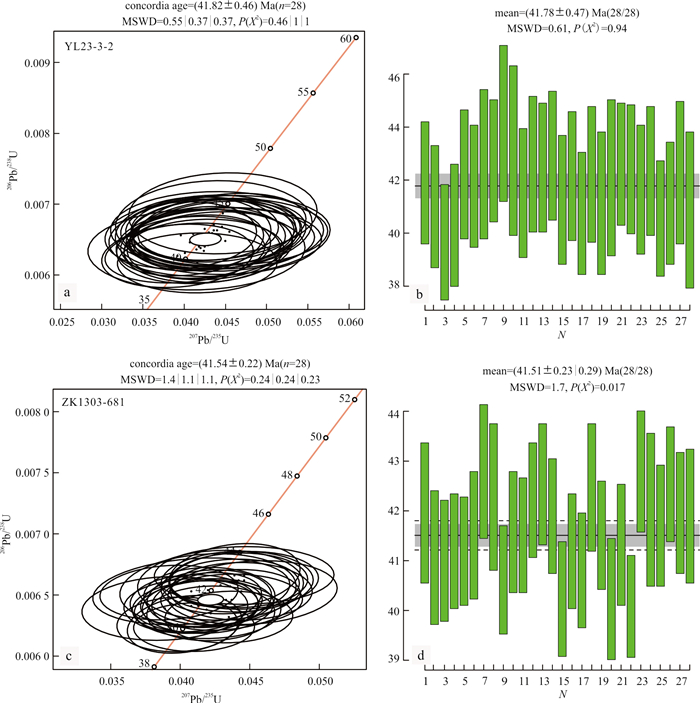
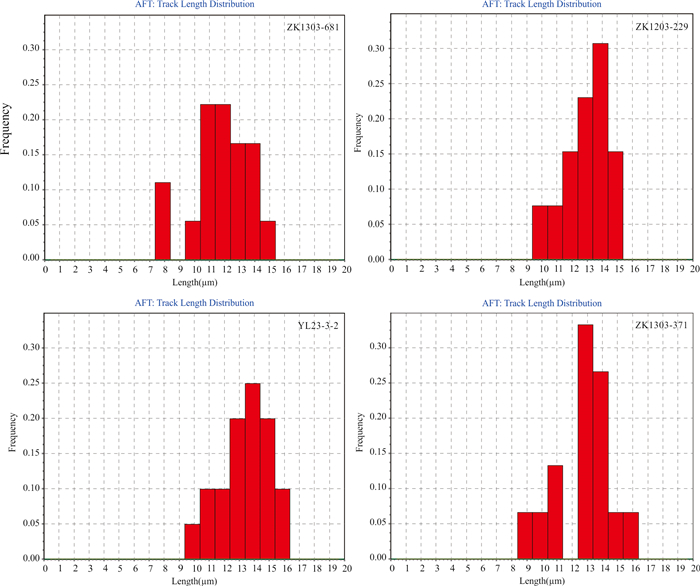
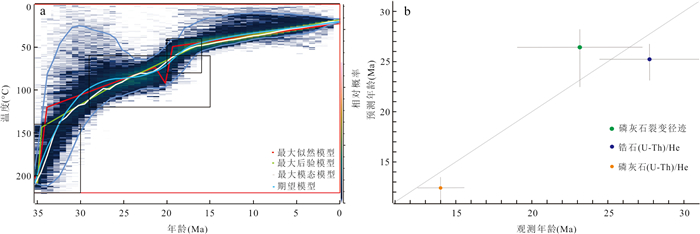
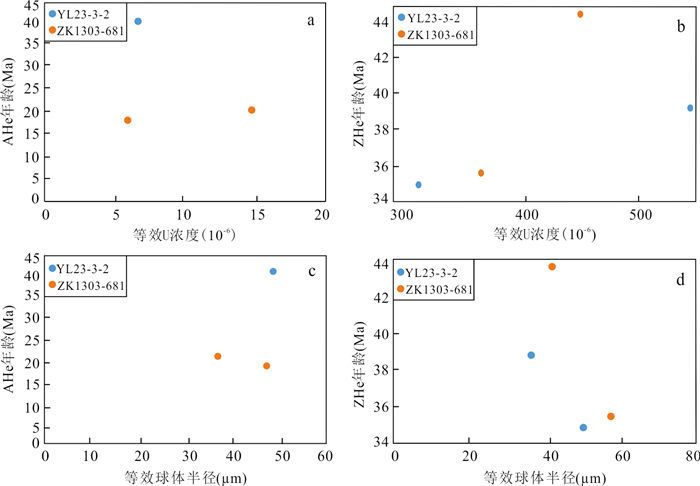
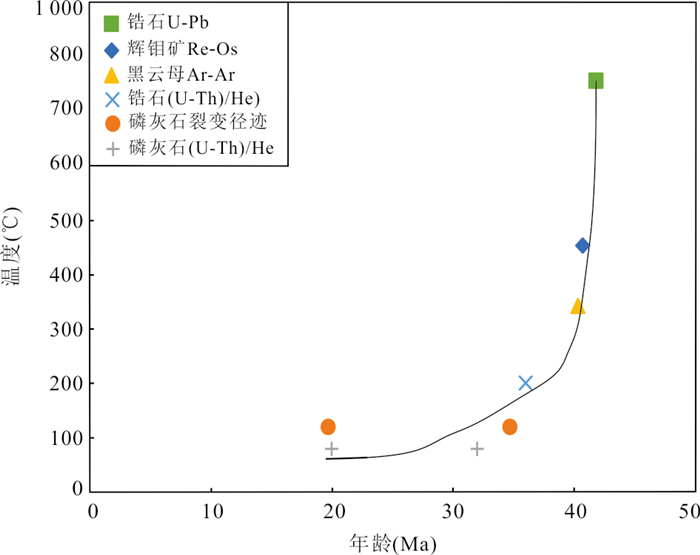
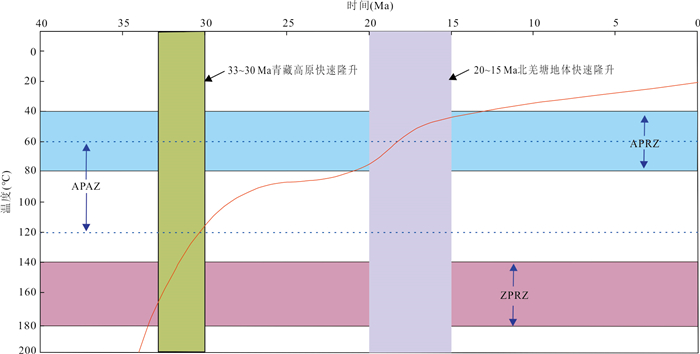
The Yulong porphyry copper deposit is the only super-large porphyry deposit in the Yulong porphyry copper belt, and the previous research on this deposit is primarily focused on genesis, with limited emphasis on the significance of post-metallogenic transformation in formulating prospecting strategies. Thermochronological methods such as zircon U-Pb, apatite fission track, apatite and zircon (U-Th)/He were employed to date and conduct related thermal history inverse modellings. The results indicate that the zircon U-Pb concordant age of the monzogranite porphyry of the Yulong deposit is (41.7±0.5) Ma, with zircon (U-Th)/He age ranging from 34.9 Ma to 39.3 Ma, indicating that the magmatic-hydrothermal evolution process of the Yulong deposit may have lasted at least 5 Ma. The apatite fission track ages range from 34.7 Ma to 19.7 Ma, while apatite (U-Th)/He ages range from 20.7 Ma to 18.4 Ma. These sequentially decreasing ages are indicative of the timing of cooling and exhumation events. The inverse thermal history modelling indicates that the Yulong deposit has undergone a roughly three-stage cooling process, combined with the regional tectonic evolution data, and the relatively rapid cooling between 34 Ma and 30 Ma may be related to the rapid uplift of the Qinghai-Xizang Plateau, resulting from the ongoing collision between the India and Eurasian continents during this period. The relatively slow cooling observed between 30 Ma and 21 Ma could be linked to the weakening collision activity. The relatively rapid cooling between 21 Ma and 14 Ma may be associated with the crustal thickening event in the North Qiangtang terrane, triggered by tectonic shortening or magma inflation during this period. Utilizing the thermal history simulation method, the exhumation amount of Yulong deposit is 3.45 km, Considering the 4- 5 km of metallogenic depth of Yulong deposit, there is still 0.5-1.5 km of prospecting space in the deep part of the deposit.

|
Chang, J., Li, J. W., Audétat, A., 2018. Formation and Evolution of Multistage Magmatic-Hydrothermal Fluids at the Yulong Porphyry Cu-Mo Deposit, Eastern Tibet: Insights from LA-ICP-MS Analysis of Fluid Inclusions. Geochimica et Cosmochimica Acta, 232: 181-205. https://doi.org/10.1016/j.gca.2018.04.009
|
|
Chang, J., Li, J. W., Selby, D., et al., 2017. Geological and Chronological Constraints on the Long-Lived Eocene Yulong Porphyry Cu-Mo Deposit, Eastern Tibet: Implications for the Lifespan of Giant Porphyry Cu Deposits. Economic Geology, 112(7): 1719-1746. https://doi.org/10.5382/econgeo.2017.4527
|
|
Chen, J. L., Yin, A., Xu, J. F., et al., 2018. Late Cenozoic Magmatic Inflation, Crustal Thickening, and >2 km of Surface Uplift in Central Tibet. Geology, 46(1): 19-22. https://doi.org/10.1130/g39699.1
|
|
Chen, Q., Wang, C., Bagas, L., et al., 2021. Time Scales of Multistage Magma-Related Hydrothermal Fluids at the Giant Yulong Porphyry Cu-Mo Deposit in Eastern Tibet: Insights from Titanium Diffusion in Quartz. Ore Geology Reviews, 39: 104459. https://doi.org/10.1016/j.oregeorev.2021.104459
|
|
Chew, D. M., Spikings, R. A., 2015. Geochronology and Thermochronology Using Apatite: Time and Temperature, Lower Crust to Surface. Elements, 11(3): 189-194. https://doi.org/10.2113/gselements.11.3.189
|
|
Corti, G., Bonini, M., Conticelli, S., et al., 2003. Analogue Modelling of Continental Extension: A Review Focused on the Relations between the Patterns of Deformation and the Presence of Magma. Earth-Science Reviews, 63(3-4): 169-247. https://doi.org/10.1016/S0012-8252(03)00035-7
|
|
Dai, S., 2005. Early Tectonic Uplift of the Northern Tibetan Plateau. Chinese Science Bulletin, 50(15): 1642. https://doi.org/10.1360/03wd0255
|
|
Danišík, M., McInnes, B. I. A., Kirkland, C. L., et al., 2017. Seeing is Believing: Visualization of He Distribution in Zircon and Implications for Thermal History Reconstruction on Single Crystals. Science Advances, 3(2): e1601121. https://doi.org/10.1126/sciadv.1601121
|
|
Donelick, R. A., 2005. Apatite Fission-Track Analysis. Reviews in Mineralogy and Geochemistry, 58(1): 49-94. https://doi.org/10.2138/rmg.2005.58.3
|
|
Farley, K. A., 2000. Helium Diffusion from Apatite: General Behavior as Illustrated by Durango Fluorapatite. Journal of Geophysical Research: Solid Earth, 105(B2): 2903-2914. https://doi.org/10.1029/1999JB900348
|
|
Farley, K. A., Wolf, R. A., Silver, L. T., 1996. The Effects of Long Alpha-Stopping Distances on (U‐Th)/He Ages. Geochimica et Cosmochimica Acta, 60(21): 4223-4229. https://doi.org/10.1016/S0016-7037(96)00193-7
|
|
Fitzgerald, P. G., Baldwin, S. L., Webb, L. E., et al., 2006. Interpretation of (U-Th)/He Single Grain Ages from Slowly Cooled Crustal Terranes: A Case Study from the Transantarctic Mountains of Southern Victoria Land. Chemical Geology, 225(1-2): 91-120. https://doi.org/10.1016/j.chemgeo.2005.09.001
|
|
Flowers, R. M., Ketcham, R. A., Shuster, D. L., et al., 2009. Apatite (U-Th)/He Thermochronometry Using a Radiation Damage Accumulation and Annealing Model. Geochimica et Cosmochimica Acta, 73(8): 2347-2365. https://doi.org/10.1016/j.gca.2009.01.015
|
|
Galbraith, R. F., 1981. On Statistical Models for Fission Track Counts. Journal of the International Association for Mathematical Geology, 13(6): 471-478. https://doi.org/10.1007/BF01034498
|
|
Gallagher, K., 2012. Transdimensional Inverse Thermal History Modeling for Quantitative Thermochronology. Journal of Geophysical Research: Solid Earth, 117(B2): 408. https://doi.org/10.1029/2011JB008825
|
|
Gautheron, C., Tassan-Got, L., Barbarand, J., et al., 2009. Effect of Alpha-Damage Annealing on Apatite (U-Th)/He Thermochronology. Chemical Geology, 266(3-4): 157-170. https://doi.org/10.1016/j.chemgeo.2009.06.001
|
|
Glorie, S., Otasevic, A., Gillespie, J., et al., 2019. Thermo-Tectonic History of the Junggar Alatau within the Central Asian Orogenic Belt (SE Kazakhstan, NW China): Insights from Integrated Apatite U/Pb, Fission Track and (U-Th)/He Thermochronology. Geoscience Frontiers, 10(6): 2153-2166. https://doi.org/10.1016/j.gsf.2019.05.005
|
|
Guenthner, W. R., Reiners, P. W., Ketcham, R. A., et al., 2013. Helium Diffusion in Natural Zircon: Radiation Damage, Anisotropy, and the Interpretation of Zircon (U-Th)/He Thermochronology. American Journal of Science, 313(3): 145-198. https://doi.org/10.2475/03.2013.01
|
|
Guo, L. G., Liu Y. P., Xu W., et al., 2006. Constraints to the Mineralization Age of the Yulong Porphyry Copper Deposit from SHRIMP U-Pb Zircon Data in Tibet. Acta Petrologica Sinica, 22(4): 1009-1016 (in Chinese with English abstract).
|
|
Hasebe, N., Barbarand, J., Jarvis, K., et al., 2004. Apatite Fission-Track Chronometry Using Laser Ablation ICP-MS. Chemical Geology, 207(3-4): 135-145. https://doi.org/10.1016/j.chemgeo.2004.01.007
|
|
Hou, Z. Q., Ma, H. W., Zaw, K., et al., 2003. The Himalayan Yulong Porphyry Copper Belt: Product of Large-Scale Strike-Slip Faulting in Eastern Tibet. Economic Geology, 98(1): 125-145. https://doi.org/10.2113/gsecongeo.98.1.125
|
|
Hou, Z. Q., Xie, Y. L., Xu, W. Y., et al., 2007. Yulong Deposit, Eastern Tibet: A High-Sulfidation Cu-Au Porphyry Copper Deposit in the Eastern Indo-Asian Collision Zone. International Geology Review, 49: 235-258. doi: 10.2747/0020-6814.49.3.235
|
|
Hou, Z. Q., Zeng, P. S., Gao, Y. F., et al., 2006. Himalayan Cu-Mo-Au Mineralization in the Eastern Indo-Asian Collision Zone: Constraints from Re-Os Dating of Molybdenite. Mineralium Deposita, 41(1): 33-45. https://doi.org/10.1007/s00126-005-0038-2
|
|
Hou, Z. Q., Zhong, D. L., Deng, W. M., 2004. A Tectonic Model for Porphyry Copper-Molybdenum-Gold Metallogenic Belts on the Eastern Margin of the Qinghai-Tibet Plateau. Geology in China, 31(1): 1-14 (in Chinese with English abstract).
|
|
Huang, M. L., Bi, X. W., Hu, R. Z., et al., 2019. Geochemistry, In-Situ Sr-Nd-Hf-O Isotopes, and Mineralogical Constraints on Origin and Magmatic-Hydrothermal Evolution of the Yulong Porphyry Cu-Mo Deposit, Eastern Tibet. Gondwana Research, 76: 98-114. https://doi.org/10.1016/j.gr.2019.05.012
|
|
Huang, M. L., Bi, X. W., Hu, R. Z., et al., 2024. Linking Porphyry Cu Formation to Tectonic Change in Postsubduction Settings: A Case Study from the Giant Yulong Belt, Eastern Tibet. Economic Geology, 119(2): 279-304. https://doi.org/10.5382/econgeo.5052
|
|
Huang, M. L., Zhu, J. J., Bi, X. W., et al., 2022. Low Magmatic Cl Contents in Giant Porphyry Cu Deposits Caused by Early Fluid Exsolution: A Case Study of the Yulong Belt and Implication for Exploration. Ore Geology Reviews, 141: 104664. https://doi.org/10.1016/j.oregeorev.2021.104664
|
|
Jiang, Y. H., Jiang, S. Y., Ling, H. F., et al., 2006. Low-Degree Melting of a Metasomatized Lithospheric Mantle for the Origin of Cenozoic Yulong Monzogranite-Porphyry, East Tibet: Geochemical and Sr-Nd-Pb-Hf Isotopic Constraints. Earth and Planetary Science Letters, 241(3-4): 617-633. https://doi.org/10.1016/j.epsl.2005.11.023
|
|
Ketcham, R. A., Carter, A., Donelick, R. A., et al., 2007. Improved Modeling of Fission-Track Annealing in Apatite. American Mineralogist, 92(5/6): 799-810. https://doi.org/10.2138/am.2007.2281
|
|
Ketcham, R. A., Donelick, R. A., Carlson, W. D., 1999. Variability of Apatite Fission-Track Annealing Kinetics; Ⅲ, Extrapolation to Geological Time Scales. American Mineralogist, 84(9): 1235-1255. https://doi.org/10.2138/am-1999-0903
|
|
Laslett, G. M., Kendall, W. S., Gleadow, A. J. W., et al., 1982. Bias in Measurement of Fission-Track Length Distributions. Nuclear Tracks and Radiation Measurements (1982), 6(2-3): 79-85. https://doi.org/10.1016/0735-245X(82)90031-X
|
|
Leng, C. B., Cooke, D. R., Hou, Z. Q., et al., 2018. Quantifying Exhumation at the Giant Pulang Porphyry Cu-Au Deposit Using U-Pb-He Dating. Economic Geology, 113(5): 1077-1092. https://doi.org/10.5382/econgeo.2018.4582
|
|
Li, J. X., Qin, K. Z., Li, G. M., et al., 2012. Petrogenesis and Thermal History of the Yulong Porphyry Copper Deposit, Eastern Tibet: Insights from U-Pb and U-Th/He Dating, and Zircon Hf Isotope and Trace Element Analysis. Mineralogy and Petrology, 105(3): 201-221. https://doi.org/10.1007/s00710-012-0211-0
|
|
Li, Y. Q., Rui, Z. Y., Cheng, L. X., 1981. Fluid Inclusion and Mineralization of the Yulong Porphyry Copper (Molybdenum) Deposit. Acta Geologica Sinica, 55(3): 216-231 (in Chinese with English abstract).
|
|
Liang, H. Y., Campbell, I. H., Allen, C., et al., 2006. Zircon Ce4+/Ce3+ Ratios and Ages for Yulong Ore-Bearing Porphyries in Eastern Tibet. Mineralium Deposita, 41(2): 152-159. https://doi.org/10.1007/s00126-005-0047-1
|
|
Liang, H. Y., Mo, J. H., Sun, W. D., et al., 2008. Study on the Duration of the Ore-Forming System of the Yulong Giant Porphyry Copper Deposit in Eastern Tibet, China. Acta Petrologica Sinica, 24(10): 2352-2358 (in Chinese with English abstract).
|
|
Liu, Y. S., Hu, Z. C., Zong, K. Q., et al., 2010. Reappraisement and Refinement of Zircon U-Pb Isotope and Trace Element Analyses by LA-ICP-MS. Chinese Science Bulletin, 55(15): 1535-1546. https://doi.org/10.1007/s11434-010-3052-4
|
|
Ludwig, K. R., 2003. Isoplot 3.00: A Geochronological Toolkit for Microsoft Excel. Berkeley Geochronology Center Special Publication, 4: 1-75.
|
|
McDowell, F. W., Keizer, R. P., 1977. Timing of Mid- Tertiary Volcanism in the Sierra Madre Occidental between Durango City and Mazatlan, Mexico. Geological Society of America Bulletin, 88(10): 1479. https://doi.org/10.1130/0016-7606(1977)881479:tomvit>2.0.co;2 doi: 10.1130/0016-7606(1977)881479:tomvit>2.0.co;2
|
|
McInnes, B. I. A., 2005. Application of Thermochronology to Hydrothermal Ore Deposits. Reviews in Mineralogy and Geochemistry, 58(1): 467-498. https://doi.org/10.2138/rmg.2005.58.18
|
|
Morel, M. L. A., Nebel, O., Nebel-Jacobsen, Y. J., et al., 2008. Hafnium Isotope Characterization of the GJ-1 Zircon Reference Material by Solution and Laser-Ablation MC-ICPMS. Chemical Geology, 255(1-2): 231-235. https://doi.org/10.1016/j.chemgeo.2008.06.040
|
|
Paton, C., Woodhead, J. D., Hellstrom, J. C., et al., 2010. Improved Laser Ablation U-Pb Zircon Geochronology through Robust Downhole Fractionation Correction. Geochemistry, Geophysics, Geosystems, 11(3): Q0AA06. 10.1029/2009gc002618 doi: 10.1029/2009gc002618
|
|
Reiners, P. W., 2005. Past, Present and Future of Thermochronology. Reviews in Mineralogy and Geochemistry, 58(1): 1-18. https://doi.org/10.2138/rmg.2005.58.1
|
|
Reiners, P. W., Brandon, M. T., 2006. Using Thermochronology to Understand Orogenic Erosion. Annual Review of Earth and Planetary Sciences, 34: 419-466. https://doi.org/10.1146/annurev.earth.34.031405.125202
|
|
Reiners, P. W., Farley, K. A., 2001. Influence of Crystal Size on Apatite (U-Th)/He Thermochronology: An Example from the Bighorn Mountains, Wyoming. Earth and Planetary Science Letters, 188(3-4): 413-420. https://doi.org/10.1016/S0012-821X(01)00341-7
|
|
Reiners, P. W., Spell, T. L., Nicolescu, S., et al., 2004. Zircon (U-Th)/He Thermochronometry: He Diffusion and Comparisons with 40Ar/39Ar Dating. Geochimica et Cosmochimica Acta, 68(8): 1857-1887. https://doi.org/10.1016/j.gca.2003.10.021
|
|
Reiners, P., Zhou, Z., Ehlers, T., et al., 2003. Post- Orogenic Evolution of the Dabie Shan, Eastern China, from (U-Th)/He and Fission-Track Thermochronology. American Journal of Science, 303(6): 489-518. https://doi.org/10.2475/ajs.303.6.489
|
|
Richards, J. P., 2022. Porphyry Copper Deposit Formation in Arcs: What are the Odds?. Geosphere, 18(1): 130-155. https://doi.org/10.1130/ges02086.1
|
|
Rui, Z. Y., Huang, C. K., Qi, G. M., et al., 1984. Porphyry Copper (Molybdenum) Deposits of China. Geological Publishing House, Beijing, 350 (in Chinese).
|
|
Seedorff, E., Dilles, J. H., Proffett, J. M., et al., 2005. Porphyry Deposits: Characteristics and Origin of Hypogene Features. Economic Geology 100th Anniversary Volume, 251-298. https://doi.org/10.5382/AV100.10
|
|
Sillitoe, R. H., 2010. Porphyry Copper Systems. Economic Geology, 105(1): 3-41. https://doi.org/10.2113/gsecongeo.105.1.3
|
|
Spikings, R., Simpson, G., 2014. Rock Uplift and Exhumation of Continental Margins by the Collision, Accretion, and Subduction of Buoyant and Topographically Prominent Oceanic Crust. Tectonics, 33(5): 635-655. https://doi.org/10.1002/2013TC003425
|
|
Staisch, L. M., Niemi, N. A., Clark, M. K., et al., 2016. Eocene to Late Oligocene History of Crustal Shortening within the Hoh Xil Basin and Implications for the Uplift History of the Northern Tibetan Plateau. Tectonics, 35(4): 862-895. https://doi.org/10.1002/2015TC003972
|
|
Sun, J. B., Chen, W., Yu, S., et al., 2017. Study on Zircon (U-Th)/He Dating Technique. Acta Petrologica Sinica, 33(6): 1947-1956 (in Chinese with English abstract).
|
|
Sun, M. Y., Monecke, T., Reynolds, T. J., et al., 2021. Understanding the Evolution of Magmatic-Hydrothermal Systems Based on Microtextural Relationships, Fluid Inclusion Petrography, and Quartz Solubility Constraints: Insights into the Formation of the Yulong Cu-Mo Porphyry Deposit, Eastern Tibetan Plateau, China. Mineralium Deposita, 56(5): 823-842. https://doi.org/10.1007/s00126-020-01003-6
|
|
Sun, M. Y., Qu, H. C., Li, Q. Y., et al., 2015. Recognition of the Ore-Forming Porphyry in the Yulong Cu Deposit and Its Geological Significance. Acta Petrologica et Mineralogica, 34(4): 493-504 (in Chinese with English abstract).
|
|
Tang, J. X., 2003. The Study on Metallogeny and Localizing Forecast of Yulong Porphyry Copper-Molybdenum Mineralization, Tibet (Dissertation). Chengdu University of Technology, Chengdu (in Chinese with English abstract).
|
|
Tang, J. X., Wang, C. H., Qu, W. J., et al., 2009. Re-Os Isotopic Dating of Molybdenite from the Yulong Porphyry Copper-Molybdenum Deposit in Tibet and Its Metallogenic Significance. Rock and Mineral Analysis, 28(3): 215-218 (in Chinese with English abstract).
|
|
Tang, J. X., Zhang, L., Li, Z. J., et al., 2006. Porphyry Copper Deposit Controlled by Structural Nose Trap: Yulong Porphyry Copper Deposit in Eastern Tibet. Mineral Deposits, 25(6): 652-662 (in Chinese with English abstract).
|
|
Tang, R. L., Luo, H. S., 1995. The Geology of Yulong Porphyry Copper (Molybdenum) Ore Belt, Xizang (Tibet). Geological Publishing House, Beijing, 320 (in Chinese).
|
|
Vermeesch, P., 2009. Radial Plotter: A Java Application for Fission Track, Luminescence and Other Radial Plots. Radiation Measurements, 44(4): 409-410. https://doi.org/10.1016/j.radmeas.2009.05.003
|
|
Vermeesch, P., 2018. Isoplot R: A Free and Open Toolbox for Geochronology. Geoscience Frontiers, 9(5): 1479-1493. https://doi.org/10.1016/j.gsf.2018.04.001
|
|
Wang, C. H., Tang, J. X., Chen, J. P., et al., 2009. Chronological Research of Yulong Copper-Molybdenum Porphyry Deposit. Acta Geologica Sinica, 83(10): 1445-1455 (in Chinese with English abstract).
|
|
Wolf, R. A., Farley, K. A., Kass, D. M., 1998. Modeling of the Temperature Sensitivity of the Apatite (U-Th)/He Thermochronometer. Chemical Geology, 148(1-2): 105-114. https://doi.org/10.1016/S0009-2541(98)00024-2
|
|
Wu, L., Wang, F., Shan, J. N., et al., 2016. (U-Th)/He Dating of International Standard Durango Apatite. Acta Petrologica Sinica, 32(6): 1891-1900 (in Chinese with English abstract).
|
|
Wu, L. M., Min, K., Gao, J. F., et al., 2021. Principle, Experimental Process and Application of Fission Track LA-ICP-MS/FT Method. Geology and Resources, 30(1): 75-84 (in Chinese with English abstract).
|
|
Xie, Y. L., Hou, Z. Q., Xu, J. H., et al., 2005. Evolution of Multi-Stage Ore-Forming Fluid and Mineralization: Evidence from Fluid Inclusions in Yulong Porphyry Copper Deposit, East Tibet. Acta Petrologica Sinica, 21(5): 1409-1415 (in Chinese with English abstract).
|
|
Yu, C., Yang, Z. M., Zhou, L. M., et al., 2019. Impact of Laser Focus on Accuracy of U-Pb Dating of Zircons by LA-ICPMS. Mineral Deposits, 38(1): 21-28 (in Chinese with English abstract).
|
|
Yang, F., Wen, Y. M., Jepson, G., et al., 2024. Prolonged Exhumation and Preservation of the Yuku Molybdenum Ore Field, East Qinling, China: Constraints from Medium- to Low-Temperature Thermochronology. Ore Geology Reviews, 167: 105973. https://doi.org/10.1016/j.oregeorev.2024.105973
|
|
Yang, T. N., Ding, Y., Zhang, H. R., et al., 2014. Two-Phase Subduction and Subsequent Collision Defines the Paleotethyan Tectonics of the Southeastern Tibetan Plateau: Evidence from Zircon U-Pb Dating, Geochemistry, and Structural Geology of the Sanjiang Orogenic Belt, Southwest China. Geological Society of America Bulletin, 126(11-12): 1654-1682. https://doi.org/10.1130/b30921.1
|
|
Yang, T. N., Zhang, H. R., Liu, Y. X., et al., 2011. Permo-Triassic Arc Magmatism in Central Tibet: Evidence from Zircon U-Pb Geochronology, Hf Isotopes, Rare Earth Elements, and Bulk Geochemistry. Chemical Geology, 284(3/4): 270-282. https://doi.org/10.1016/j.chemgeo.2011.03.006
|
|
Yang, Z. M., Cooke, D. R., 2019. Porphyry Copper Deposits in China: Mineral Deposits of China. 1601 Mclean: Society of Economic Geologists, Special Publication, 22: 133-187. https://doi.org/10.5382/SP.22.05
|
|
Zhai, Q. G., Jahn, B. M., Su, L., et al., 2013. Triassic Arc Magmatism in the Qiangtang Area, Northern Tibet: Zircon U-Pb Ages, Geochemical and Sr-Nd-Hf Isotopic Characteristics, and Tectonic Implications. Journal of Asian Earth Sciences, 63: 162-178. https://doi.org/10.1016/j.jseaes.2012.08.025
|
|
Zhang, K. J., Zhang, Y. X., Li, B., et al., 2006. The Blueschist-Bearing Qiangtang Metamorphic Belt (Northern Tibet, China) as an In Situ Suture Zone: Evidence from Geochemical Comparison with the Jinsa Suture. Geology, 34(6): 493. https://doi.org/10.1130/g22404.1
|
|
Zhang, Y. Q., Xie, Y. W., Liang, H. Y., et al., 1998. Shoshonitic Series: Geochemical Characteristics of Elements for Ore-Bearing Porphyry from Yulong Copper Ore Belt in Eastern Tibet. Geochemistry, 27(3): 236-243 (in Chinese with English abstract).
|
|
Zhao, H. S., Wang, Q. F., Li, W. C., et al., 2022. The Roles of Emplacement Depth, Magma Volume and Local Geologic Conditions in the Formation of the Giant Yulong Copper Deposit, Eastern Tibet. Ore Geology Reviews, 145: 104877. https://doi.org/10.1016/j.oregeorev.2022.104877
|
|
Zhao, J. X., Qin, K. Z., Xiao, B., et al., 2016. Thermal History of the Giant Qulong Cu-Mo Deposit, Gangdese Metallogenic Belt, Tibet: Constraints on Magmatic- Hydrothermal Evolution and Exhumation. Gondwana Research, 36: 390-409. https://doi.org/10.1016/j.gr.2015.07.005
|
|
Zhong, D. L., Ding, L., 1996. Rising Process of the Qinghai-Xizang (Tibet) Plateau and Its Mechanism. Science in China (Series D: Earth Sciences), 39(4): 369-379.
|
|
郭利果, 刘玉平, 徐伟, 等, 2006. SHRIMP锆石年代学对西藏玉龙斑岩铜矿成矿年龄的制约. 岩石学报, 22(4): 1009-1016.
|
|
侯增谦, 钟大赉, 邓万明, 2004. 青藏高原东缘斑岩铜钼金成矿带的构造模式. 中国地质, 31(1): 1-14.
|
|
李荫清, 芮宗瑶, 程莱仙, 1981. 玉龙斑岩铜(钼)矿床的流体包裹体及成矿作用研究. 地质学报, 55(3): 216-231.
|
|
梁华英, 莫济海, 孙卫东, 等, 2008. 藏东玉龙超大型斑岩铜矿床成岩成矿系统时间跨度分析. 岩石学报, 24(10): 2352-2358.
|
|
芮宗瑶, 黄崇轲, 齐国明, 等, 1984. 中国斑岩铜(钼)矿床. 北京: 地质出版社, 350.
|
|
孙敬博, 陈文, 喻顺, 等, 2017. 锆石(U-Th)/He定年技术研究. 岩石学报, 33(6): 1947-1956.
|
|
孙茂妤, 曲焕春, 李秋耘, 等, 2015. 西藏玉龙铜矿床成矿斑岩的厘定及地质意义. 岩石矿物学杂志, 34(4): 493-504.
|
|
唐菊兴, 2003. 西藏玉龙斑岩铜(钼) 矿成矿作用与矿床定位预测研究(博士学位论文). 成都: 成都理工大学.
|
|
唐菊兴, 王成辉, 屈文俊, 等, 2009. 西藏玉龙斑岩铜钼矿辉钼矿铼‒锇同位素定年及其成矿学意义. 岩矿测试, 28(3): 215-218.
|
|
唐菊兴, 张丽, 李志军, 等, 2006. 西藏玉龙铜矿床: 鼻状构造圈闭控制的特大型矿床. 矿床地质, 25(6): 652-662.
|
|
唐仁鲤, 罗怀松, 1995. 西藏玉龙斑岩铜(钼)矿带地质. 北京: 地质出版社, 320.
|
|
王成辉, 唐菊兴, 陈建平, 等, 2009. 西藏玉龙铜钼矿同位素年代学研究. 地质学报, 83(10): 1445-1455.
|
|
吴林, 王非, 单竞男, 等, 2016. 国际标样Durango磷灰石(U-Th)/He年龄测定. 岩石学报, 32(6): 1891-1900.
|
|
武利民, 闵康, 高剑峰, 等, 2021. 裂变径迹LA-ICP-MS/FT法原理、实验流程和应用. 地质与资源, 30(1): 75-84.
|
|
谢玉玲, 侯增谦, 徐九华, 等, 2005. 藏东玉龙斑岩铜矿床多期流体演化与成矿的流体包裹体证据. 岩石学报, 21(5): 1409-1415.
|
|
于超, 杨志明, 周利敏, 等, 2019. 激光焦平面变化对LA-ICP-MS锆石U-Pb定年准确度的影响. 矿床地质, 38(1): 21-28.
|
|
张玉泉, 谢应雯, 梁华英, 等, 1998. 藏东玉龙铜矿带含矿斑岩及成岩系列. 地球化学, 27(3): 236-243.
|
Figures(13) / Tables(4)

 DownLoad: