- 中文版:
- EI 100%收录
- 英文版
- SCI 100%收录


中国出版政府奖提名奖
中国百强科技报刊
湖北出版政府奖
中国高校百佳科技期刊
中国最美期刊
中国出版政府奖提名奖
中国百强科技报刊
湖北出版政府奖
中国高校百佳科技期刊
中国最美期刊
| Citation: | Yang Ruyu, Huang Xiaoyan, Qin Yue, Sun Teng, Wu Chuqing, Zhu Di, Xu Nuo, Xuan Dengqi, Wang Ziqi, Lv Yan, Liu Dong, Shen Yanjun, Cao Xiaoshu, Peng Jianbing, 2026. Patterns and Mechanisms of Human-Land-Industry System Mutual Feedback in Villages of the Northern Foothills of Qinling Mountains. Earth Science, 51(2): 446-461. doi: 10.3799/dqkx.2025.076

|
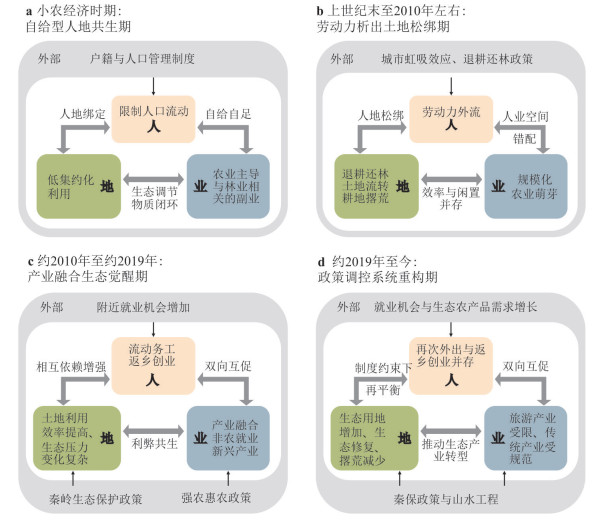
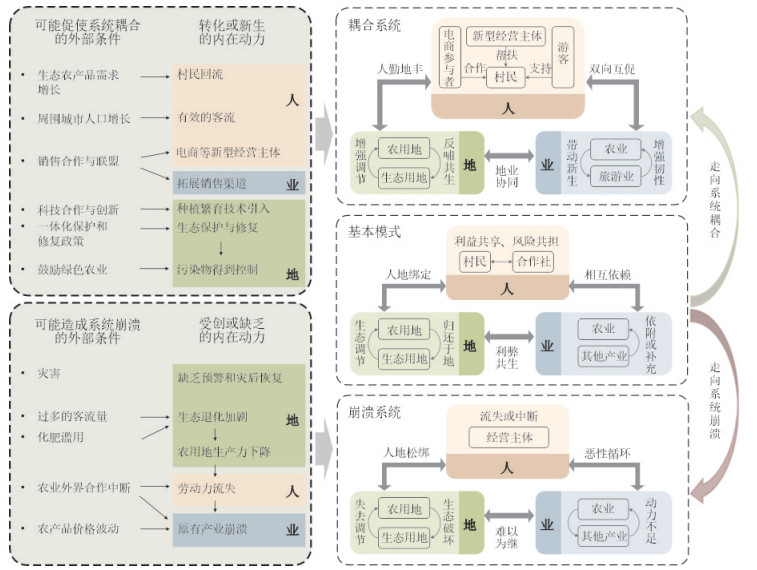
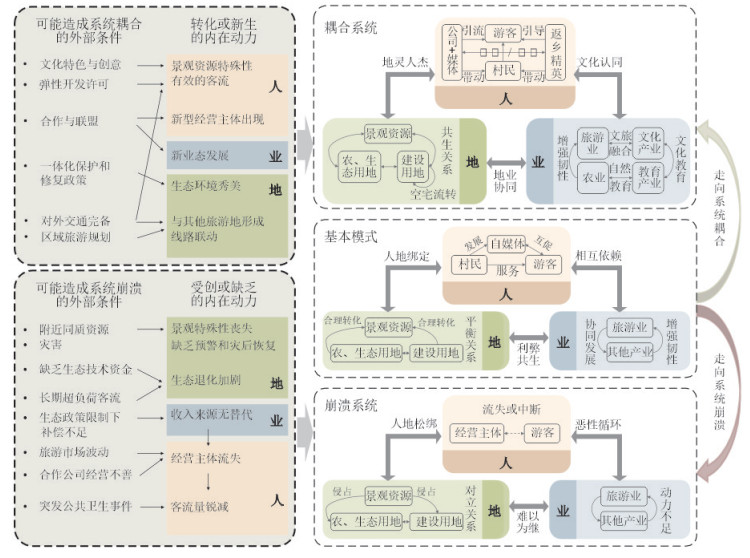
The countryside is the most prominent geographical unit of contradiction between the natural environment, human activities and industrial development, and clarifying the mechanism of human-land-industry system mutual feedback in the countryside is the scientific basis for the practice of the strategy of rural revitalization. The northern foothills of the Qinling Mountains are a typical area for the study of rural human-land-industry system inter-feedback due to its sensitive geographic and environmental characteristics and the rapid development of the neighbouring socio-economies, which pose a major challenge to the coordination of the local human-land. Based on the strength of human-land coupling coordination, geomorphology, land use and tourism resources, this paper divides the countryside into eight types, explores the mechanism of interaction between the elements of the human-land-industry system, summarises the typical patterns, and puts forward a path for system optimisation and prevention of system collapse regulation.It is found that the coupling and mutual feedback are divided into four stages, namely, the period of self-sufficient human-land symbiosis, the period of labor migration and land abandonment, the period of ecological awakening of industrial integration, and the period of reconfiguration of the policy-regulated system. The human-land-industry system in the villages in the northern foothills of the Qinling Mountains is categorised into two typical mutual feedback patterns, namely agricultural characteristics and tourism characteristics, according to the industry or livelihood mode. In order to prevent system collapse, agricultural villages need to build a multi-level resilience defence system, covering disaster early warning, industrial diversification, cooperative network maintenance and dynamic policy regulation; tourism villages need to maintain sustainable development by deeply developing cultural resources, constructing a composite industry of 'tourism+', and resilient development policies to resist homogeneous competition and ecological overload risks development. The results of this study can provide a scientific basis for promoting the coordinated development of human-land-industry systems in ecologically sensitive areas.

|
Bazzana, D., Zaitchik, B., Gilioli, G., 2020. Impact of Water and Energy Infrastructure on Local Well-Being: an Agent-Based Analysis of the Water-Energy-Food Nexus. Structural Change and Economic Dynamics, 55: 165-176. https://doi.org/10.1016/j.strueco.2020.08.003
|
|
Bourceret, A., Amblard, L., Mathias, J. D., 2021. Governance in Social-Ecological Agent-Based Models: a Review. Ecology and Society, 26(2): art38. https://doi.org/10.5751/es-12440-260238
|
|
Cao, X. S., 2019. Geogovernance of National Land Use Based on Coupled Human and Natural Systems. Journal of Natural Resources, 34(10): 2051-2059(in Chinese with English abstract). doi: 10.31497/zrzyxb.20191003
|
|
Carl, F., Steve, C., Thomas, E., et al., 2002. Resilience and Sustainable Development: Building Adaptive Capacity in a World of Transformations. AMBIO: A Journal of the Human Environment, 31(5): 437-440. https://doi.org/10.1579/0044-7447-31.5.437
|
|
Chen, S. H., 2024. Realization Pathways of Carbon Sequestration and Emission Reduction in China's Cultivated Land Soils under the Background of Dual Carbon Goal and Rural Revitalization. Areal Research and Development, 43(5): 132-137(in Chinese with English abstract).
|
|
Chen, Y. Y., LV, Y., Hong, W. Y., et al., 2024. Multi-Scenario Simulation of Population-Land-Industry Coupling and Coordinated Development of Rural Area System in China. Areal Research and Development, 43(6): 123-130(in Chinese with English abstract).
|
|
Cremin, E., Ladd, C. J. T., Balke, T., et al., 2024. Causes and Consequences of Tipping Points in River Delta Social-Ecological Systems. Ambio, 53(7): 1015-1036. https://doi.org/10.1007/s13280-023-01978-2
|
|
de Waroux, Y. L. P., Carignan, M., Del Giorgio, O., et al., 2024. How Do we Study Resilience? A Systematic Review. People and Nature, 6(2): 474-489. https://doi.org/10.1002/pan3.10603
|
|
Duan, D. G., Liu, J. W., 2018. Review of Village-Type Classification in China. Journal of Human Settlements in West China, 33(5): 78-83(in Chinese with English abstract).
|
|
Erickson, A., 2015. Efficient and Resilient Governance of Social-Ecological Systems. Ambio, 44(5): 343-352. https://doi.org/10.1007/s13280-014-0607-7
|
|
Feng, D. D., Long, H. L., Zhang, C., et al., 2025. Logic Mechanism and Key Dimensions of the Effective Connection between Consolidating and Expanding the Achievements of Poverty Alleviation and Rural Vitalization from a Telecoupling Perspective. Economic Geography, 45(1): 153-165(in Chinese with English abstract).
|
|
Gupta, H., Nishi, M., Gasparatos, A., 2022. Community-Based Responses for Tackling Environmental and Socio-Economic Change and Impacts in Mountain Social-Ecological Systems. Ambio, 51(5): 1123-1142. https://doi.org/10.1007/s13280-021-01651-6
|
|
Hu, T., Peng, K. L., Tang, R., et al., 2016. Research Progress Review on Farmer's Vulnerability and Its Theoretical Framework in Land Use Change. China Land Science, 30(11): 50-60(in Chinese with English abstract).
|
|
Huang, J., Xue, D. Q., Ma, B. B., et al., 2021. Spatial and Temporal Evolution Pattern and Driving Mechanism of Coordinated Level of Human-Land-Industry System in Rural Areas of the Loess Plateau. Human Geography, 36(3): 117-128(in Chinese with English abstract).
|
|
Keyhanpour, M. J., Musavi Jahromi, S. H., Ebrahimi, H., 2021. System Dynamics Model of Sustainable Water Resources Management Using the Nexus Water-Food-Energy Approach. Ain Shams Engineering Journal, 12(2): 1267-1281. https://doi.org/10.1016/j.asej.2020.07.029
|
|
Li, H. B., Wu, J. G., Zhang, X. L., et al., 2018. The Distribution Characteristics and Mechanism of the Rural Industrial Land with the "Southern Jiangsu Pattern": A Case Study of Changshu. Economic Geography, 38(1): 152-159(in Chinese with English abstract).
|
|
Li, J. T., Jia, L. R., Liu, Y. S., et al., 2018. Measuring Model of Rural Transformation Development Path in Fuping County of Beijing-Tianjin-Hebei Region. Habitat International, 74: 48-56. https://doi.org/10.1016/j.habitatint.2018.03.012
|
|
Li, J. Y., Fu, B. J., Sun, J. L., et al., 2021. Ecological Civilization Construction at Qinling Mountains in the New Era. Journal of Natural Resources, 36(10): 2449-2463(in Chinese with English abstract). doi: 10.31497/zrzyxb.20211001
|
|
Li, T., 2022. Spatial Effect on Destination Structure of Rural Tourism Investment: A Framework from the Perspective of Human-Land-Industry Synergy. Geographical Research, 41(12): 3259-3272(in Chinese with English abstract).
|
|
Li, X., Ma, X. D., Hu, M. L., 2022. The Mutual Feedback Mechanism of Human-Land-Industry Factors of the Rural Regional System. Geographical Research, 41(7): 1981-1994(in Chinese with English abstract).
|
|
Li, Y., Sang, S., Mote, S. F., et al., 2023. Challenges and Opportunities for Modeling Coupled Human and Natural Systems. National Science Review, 10(7): nwad054. https://doi.org/10.1093/nsr/nwad054
|
|
Liu, D., Cui, Y. J., Peng, J. B., et al., 2025. Study on Mutual Feedback between Small Town Communities and Ecological Communities in the Northern Foothills of Qinling Mountains. Earth Science. https://doi.org/10.3799/dqkx.2025.028 (in Chinese with English abstract).
|
|
Liu, J. G., Dietz, T., Carpenter, S. R., et al., 2007. Complexity of Coupled Human and Natural Systems. Science, 317(5844): 1513-1516. https://doi.org/10.1126/science. 1144004 doi: 10.1126/science.1144004
|
|
Liu, L. N., Liu, M., 2025. Driving Rural Development Towards Neo-Endogenous Development Model through Digital Technology: Analysis Based on Dynamic Capability Shaping and Digital Capital Cultivation. Administrative Tribune, 32(1): 141-150(in Chinese with English abstract).
|
|
Liu, Y. S., Zhou, Y., Li, Y. H., 2019. Rural Regional System and Rural Revitalization Strategy in China. Acta Geographica Sinica, 74(12): 2511-2528(in Chinese with English abstract).
|
|
Long, H. L., Liu, Y. S., Zou, J., 2009. Assessment of Rural Development Types and Their Rurality in Eastern Coastal China. Acta Geographica Sinica, 64(4): 426-434(in Chinese with English abstract).
|
|
Lu, L., Ren, Y. S., Zhu, D. C., et al., 2019. The Research Framework and Prospect of Rural Revitalization Led by Rural Tourism. Geographical Research, 38(1): 102-118(in Chinese with English abstract).
|
|
Luo, K. Y., Zhou, Y., Li, S., 2022. Study on the Influence of Characteristic Agricultural Clusters on Rural Restructuring and Transformation in Karst Mountainous Areas. Resource Development & Market, 38(5): 561-567(in Chinese with English abstract).
|
|
Ma, E. P., Ye, W. Y., Long, H. L., et al., 2023. Agricultural Land Use Transition under the Metacoupling Framework of Urban Food System. Acta Geographica Sinica, 78(12): 3058-3077(in Chinese with English abstract).
|
|
Ma, L., Long, H. L., 2020. Simulation on Sustainable Development of Rural Territorial System in China. Economic Geography, 40(11): 1-9(in Chinese with English abstract).
|
|
McIntyre, S., Roy, G., 2023. Revisiting the Dimensions of Rural Resilience: The CoVid-19 Pandemic. Journal of Rural Studies, 103: 103107. https://doi.org/10.1016/j.jrurstud.2023.103107
|
|
Ostrom, E., 2009. A General Framework for Analyzing Sustainability of Social-Ecological Systems. Science, 325(5939): 419-422. https://doi.org/10.1126/science.1 172133 doi: 10.1126/science.1172133
|
|
Palau, A. Z., Claramunt-López, B., 2024. Mountain Research for Sustainability: Where Are we and where to Go? Sustainability Science, 19(5): 1693-1707. https://doi.org/10.1007/s11625-024-01530-5
|
|
Peng, J. B., Shen, Y. J., Jin, Z., et al., 2023. Key Thoughts on the Study of Eco-Geological Environment System in Qinling Mountains. Acta Ecologica Sinica, 43(11): 4344-4358(in Chinese with English abstract).
|
|
Qu, S. D., Jiang, Y., Gao, J. B., et al., 2025. Revealing the Coupling Coordination of Social-Ecological System Resilience: Insights from the Southwest Karst Rural Area, China. Land Degradation & Development, 36(4): 1255-1268. https://doi.org/10.1002/ldr.5427
|
|
Quintas-Soriano, C., Brandt, J., Baxter, C. V., et al., 2022. A Framework for Assessing Coupling and De-Coupling Trajectories in River Social-Ecological Systems. Sustainability Science, 17(1): 121-134. https://doi.org/10.1007/s11625-021-01048-0
|
|
Shen, Y. J., Chen, X., Peng, J. B., et al., 2024. Background Characteristics of Ecological Geological Environment System in Qinling Mountains and Assumption of Its Theoretical System. Earth Science, 49(6): 2103-2119(in Chinese with English abstract).
|
|
Tao, H., Zhang, M. Z., Liu, J. M., 2022. Symbiosis and Integration: Coordinated Development of Human-Land-Industry in Rural Heritage Sites: A Case Study of the Tingsong Cultural Community. Progress in Geography, 41(4): 582-594(in Chinese with English abstract).
|
|
Wang, B. J., He, S. M., Min, Q. W., 2022. Experience and Optimisation of the Traditional Industrial Development and Transformation in Protected Areas: A Case Study of Tea Industries in Wuyishan National Park. Journal of Ecology and Rural Environment, 38(10): 1229-1238(in Chinese with English abstract).
|
|
Wang, J. Y., Qu, L. L., Li, Y. R., et al., 2023. Identifying the Structure of Rural Regional System and Implications for Rural Revitalization: a Case Study of Yanchi County in Northern China. Land Use Policy, 124: 106436. https://doi.org/10.1016/j.landusepol.2022.106436
|
|
Wu, C. J., 1991. Man-Earth Areal System: The Core of Geographical Study. Economic Geography, 11(3): 1-6(in Chinese).
|
|
Xu, N., Xu, C., Jin, Y. B., et al., 2022. Research on the Operating Mechanism of E-Commerce Poverty Alleviation in Agricultural Cooperatives: an Actor Network Theory Perspective. Frontiers in Psychology, 13: 847902. https://doi.org/10.3389/fpsyg.2022.847902
|
|
Xu, P. P., Shen, Y. J., Peng, J. B., et al., 2024. Typed Architecture of Valley Road in Northern Foothills of Qinling Mountains Based on Concept of Ecological-Economic-Social Collaborative Development. Earth Science, 49(12): 4564-4575(in Chinese with English abstract).
|
|
Yang, X. J., Shi, Y. Z., Wang, Z. Q., 2015. Exploring the Impacts of Road Construction on a Local Social-Ecological System in Qinling Mountainous Area: A Resilience Perspective. Acta Geographica Sinica, 70(8): 1313-1326(in Chinese with English abstract).
|
|
Yu, S. H., Kang, Y. Y. Deng, W., et al., 2022. Analysis of "Production-Living-Ecological" Land Transformation and Landscape Ecological Risk in the Eastern Counties of the Taihang Mountain: a Case Study in Pingshan County. Chinese Journal of Eco-Agriculture, 30(7): 1113-1122(in Chinese with English abstract).
|
|
Yue, B. R., Pan, W. T., Hao, W. H., 2022. Research on Influential Factors of Spatial Management and Control in Foothill Area Based on Grounded Theory: A Case Study of the Northern Foot of Qinling Mountains in Xi'an. Landscape Architecture, 29(8): 108-113(in Chinese with English abstract).
|
|
曹小曙, 2019. 基于人地耦合系统的国土空间重塑. 自然资源学报, 34(10): 2051-2059.
|
|
陈少华, 2024. "双碳"目标及乡村振兴背景下我国耕地土壤固碳减排的实现路径. 地域研究与开发, 43(5): 132-137.
|
|
陈义勇, 吕妍, 洪武扬, 等, 2024. 中国乡村地域系统人-地-业耦合协调发展状态多情景模拟. 地域研究与开发, 43(6): 123-130.
|
|
段德罡, 刘嘉伟, 2018. 中国乡村类型划分研究综述. 西部人居环境学刊, 33(5): 78-83.
|
|
冯德东, 龙花楼, 张聪, 等, 2025. 远程耦合视角下拓展脱贫攻坚成果同乡村振兴有效衔接的逻辑机理与关键维度. 经济地理, 45(1): 153-165.
|
|
胡特, 彭开丽, 唐睿, 等, 2016. 农户脆弱性研究综述及其在土地利用变化中的理论分析构架. 中国土地科学, 30(11): 50-60.
|
|
黄晶, 薛东前, 马蓓蓓, 等, 2021. 黄土高原乡村地域人-地-业协调发展时空格局与驱动机制. 人文地理, 36(3): 117-128.
|
|
李红波, 吴江国, 张小林, 等, 2018. "苏南模式"下乡村工业用地的分布特征及形成机制——以常熟市为例. 经济地理, 38(1): 152-159.
|
|
李君轶, 傅伯杰, 孙九林, 等, 2021. 新时期秦岭生态文明建设: 存在问题与发展路径. 自然资源学报, 36(10): 2449-2463.
|
|
李涛, 2022. "人-地-业"协同视角下乡村旅游投资与目的地空间作用研究. 地理研究, 41(12): 3259-3272.
|
|
李鑫, 马晓冬, 胡嫚莉, 2022. 乡村地域系统人-地-业要素互馈机制研究. 地理研究, 41(7): 1981-1994.
|
|
刘冬, 崔轶杰, 彭建兵, 等, 2025. 秦岭北麓小城镇群落与生态群落互馈的研究思考. 地球科学: 1-14.
|
|
刘鲁宁, 刘勉, 2025. 以数字技术驱动乡村形成新内生型发展模式——基于动态能力塑造与数字资本培育的分析. 行政论坛, 32(1): 141-150.
|
|
刘彦随, 周扬, 李玉恒, 2019. 中国乡村地域系统与乡村振兴战略. 地理学报, 74(12): 2511-2528.
|
|
龙花楼, 刘彦随, 邹健, 2009. 中国东部沿海地区乡村发展类型及其乡村性评价. 地理学报, 64(4): 426-434.
|
|
陆林, 任以胜, 朱道才, 等, 2019. 乡村旅游引导乡村振兴的研究框架与展望. 地理研究, 38(1): 102-118.
|
|
罗昆燕, 周扬, 李松, 2022. 喀斯特山区特色农业产业集群对乡村经济重构与转型的影响研究. 资源开发与市场, 38(5): 561-567.
|
|
马恩朴, 叶玮怡, 龙花楼, 等, 2023. 城市食物系统全程耦合下的农地利用转型. 地理学报, 78(12): 3058-3077.
|
|
马历, 龙花楼, 2020. 中国乡村地域系统可持续发展模拟仿真研究. 经济地理, 40(11): 1-9.
|
|
彭建兵, 申艳军, 金钊, 等, 2023. 秦岭生态地质环境系统研究关键思考. 生态学报, 43(11): 4344-4358.
|
|
申艳军, 陈兴, 彭建兵, 等, 2024. 秦岭生态地质环境系统本底特征及研究体系初步构想. 地球科学, 49(6): 2103-2119. doi: 10.3799/dqkx.2023.210
|
|
陶慧, 张梦真, 刘家明, 2022. 共生与融合: 乡村遗产地"人—地—业"协同发展研究——以听松文化社区为例. 地理科学进展, 41(4): 582-594.
|
|
王博杰, 何思源, 闵庆文, 2022. 自然保护地传统产业转型发展的经验与优化: 来自武夷山国家公园茶产业的启示. 生态与农村环境学报, 38(10): 1229-1238.
|
|
吴传钧, 1991. 论地理学的研究核心——人地关系地域系统. 经济地理, 11(3): 1-6.
|
|
徐盼盼, 申艳军, 彭建兵, 等, 2024. 基于生态-经济-社会协同发展理念的秦岭北麓峪道类型化架构思考. 地球科学, 49(12): 4564-4575. doi: 10.3799/dqkx.2024.042
|
|
杨新军, 石育中, 王子侨, 2015. 道路建设对秦岭山区社会—生态系统的影响——一个社区恢复力的视角. 地理学报, 70(8): 1313-1326.
|
|
于淑会, 康园园, 邓伟, 等, 2022. 太行山东部县域"三生"用地转型与景观生态风险分析——以河北省平山县为例. 中国生态农业学报(中英文), 30(7): 1113-1122.
|
|
岳邦瑞, 潘卫涛, 郝旺奂, 2022. 基于扎根理论的浅山区空间管控影响因素研究——以西安市秦岭北麓为例. 风景园林, 29(8): 108-113.
|
Figures(8) / Tables(4)

 DownLoad: