- 中文版:
- EI 100%收录
- 英文版
- SCI 100%收录


中国出版政府奖提名奖
中国百强科技报刊
湖北出版政府奖
中国高校百佳科技期刊
中国最美期刊
中国出版政府奖提名奖
中国百强科技报刊
湖北出版政府奖
中国高校百佳科技期刊
中国最美期刊
| Citation: | Kong Weiliang, Qiu Zhen, Zhang Jiaqiang, Zhang Qin, Liu Wen, Qu Tianquan, Gao Wanli, Cai Guangyin, Jiang Chong, 2025. Volcanic Activity and Extraordinarily High Organic Matter Deposition across Ordovician-Silurian Transition: A Case Study from South China. Earth Science, 50(12): 4583-4603. doi: 10.3799/dqkx.2025.125

|

|
Ayris, P., Delmelle, P., 2012. Volcanic and Atmospheric Controls on Ash Iron Solubility: A Review. Physics and Chemistry of the Earth, 45-46: 103-112. https://doi.org/10.1016/j.pce.2011.04.013
|
|
Bao, H. Y., Meng, Z. Y., Li, K., et al., 2023. Plane Heterogeneity Characteristics and Main Controlling Factors of Development of Upper Gas Layer in Gas-Bearing Shale of Longmaxi Formation in Fuling Area, Sichuan Basin. Earth Science, 48(7): 2750-2763 (in Chinese with English abstract).
|
|
Batchelor, R. A., 2008. Geochemical 'Golden Spike' for Lower Palaeozoic Metabentonites. Earth and Environmental Science Transactions of the Royal Society of Edinburgh, 99(3-4): 177-187. https://doi.org/10.1017/s1755691009007087
|
|
Bergquist, B. A., Blum, J. D., 2009. The Odds and Evens of Mercury Isotopes: Applications of Mass-Dependent and Mass-Independent Isotope Fractionation. Elements, 5(6): 353-357. https://doi.org/10.2113/gselements.5.6.353.
|
|
Bergström, S. M., Huff, W. D., Kolata, D. R., et al., 1997. A Unique Middle Ordovician K‐Bentonite Bed Succession at Röstånga, S. Sweden. GFF, 119(3): 231-244. https://doi.org/10.1080/11035899709546481
|
|
Biswas, A., Blum, J. D., Bergquist, B. A., et al., 2008. Natural Mercury Isotope Variation in Coal Deposits and Organic Soils. Environmental Science & Technology, 42(22): 8303-8309. https://doi.org/10.1021/es801444b
|
|
Blum, J. D., Sherman, L. S., Johnson, M. W., 2014. Mercury Isotopes in Earth and Environmental Sciences. Annual Review of Earth and Planetary Sciences, 42(1): 249-269. https://doi.org/10.1146/annurev-earth-050212-124107
|
|
Bond, D. P. G., Grasby, S. E., 2020. Late Ordovician Mass Extinction Caused by Volcanism, Warming, and Anoxia, not Cooling and Glaciation. Geology, 48(8): 777-781. https://doi.org/10.1130/g47377.1
|
|
Briffa, K. R., Jones, P. D., Schweingruber, F. H., et al., 1998. Influence of Volcanic Eruptions on Northern Hemisphere Summer Temperature over the Past 600 Years. Nature, 393: 450-455. https://doi.org/10.1038/30943
|
|
Buggisch, W., Joachimski, M. M., Lehnert, O., et al., 2010. Did Intense Volcanism Trigger the First Late Ordovician Icehouse? Geology, 38: 327-330. https://doi.org/10.1130/g30577.1
|
|
Cai, Q. S., Hu, M. Y., Yang, Z, et al., 2024. Sedimentary Environment and Organic Matter Accumulation of Black Rock Series of Wufeng-Longmaxi Formations in Foreland Depression, Western Hunan Province: An Example from Well TD2 in Changde Area. Earth Science, 49(7): 2330-2345 (in Chinese with English abstract).
|
|
Courtillot, V. E., 2002. Evolutionary Catastrophes: The Science of Mass Extinction. Cambridge University Press, Cambridge.
|
|
Cox, G. M., Lyons, T. W., Mitchell, R. N., et al., 2018. Linking the Rise of Atmospheric Oxygen to Growth in the Continental Phosphorus Inventory. Earth and Planetary Science Letters, 489: 28-36. https://doi.org/10.1016/j.epsl.2018.02.016
|
|
Dellwig, O., Leipe, T., März, C., et al., 2010. A New Particulate Mn-Fe-P-Shuttle at the Redoxcline of Anoxic Basins. Geochimica et Cosmochimica Acta, 74(24): 7100-7115. https://doi.org/10.1016/j.gca.2010.09.017
|
|
Demers, J. D., Blum, J. D., Zak, D. R., 2013. Mercury Isotopes in a Forested Ecosystem: Implications for Air-Surface Exchange Dynamics and the Global Mercury Cycle. Global Biogeochemical Cycles, 27(1): 222-238. https://doi.org/10.1002/gbc.20021
|
|
Derakhshi, M., Ernst, R. E., Kamo, S. L., 2022. Ordovician-Silurian Volcanism in Northern Iran: Implications for a New Large Igneous Province (LIP) and a Robust Candidate for the Late Ordovician Mass Extinction. Gondwana Research, 107: 256-280. https://doi.org/10.1016/j.gr.2022.03.009
|
|
Du, X. B., Lu, Y. C., Duan, D., et al., 2020. Was Volcanic Activity during the Ordovician-Silurian Transition in South China Part of a Global Phenomenon? Constraints from Zircon U-Pb Dating of Volcanic Ash Beds in Black Shales. Marine and Petroleum Geology, 114: 104209. https://doi.org/10.1016/j.marpetgeo.2019.104209
|
|
Du, X. B., Jia, J. X., Zhao, K., et al., 2022. Development Characteristics of Deep-Time Volcanic Ash Layers and Its Influence on Deposition of Organic-Rich Shale across Ordovician-Silurian Transition in Yangtze Area, South China. Journal of Central South University (Science and Technology), 53(9): 3509-3521 (in Chinese with English abstract).
|
|
Duggen, S., Croot, P., Schacht, U., et al., 2007. Subduction Zone Volcanic Ash can Fertilize the Surface Ocean and Stimulate Phytoplankton Growth: Evidence from Biogeochemical Experiments and Satellite Data. Geophysical Research Letters, 34(1): 2006GL027522. https://doi.org/10.1029/2006gl027522
|
|
Duhamel, S., Diaz, J. M., Adams, J. C., et al., 2021. Phosphorus as an Integral Component of Global Marine Biogeochemistry. Nature Geoscience, 14(6): 359-368. https://doi.org/10.1038/s41561-021-00755-8
|
|
Ernst, R. E., Youbi, N., 2017. How Large Igneous Provinces Affect Global Climate, Sometimes Cause Mass Extinctions, and Represent Natural Markers in the Geological Record. Palaeogeography, Palaeoclimatology, Palaeoecology, 478: 30-52. https://doi.org/10.1016/j.palaeo.2017.03.014
|
|
Fendley, I. M., Frieling, J., Mather, T. A., et al., 2024. Early Jurassic Large Igneous Province Carbon Emissions Constrained by Sedimentary Mercury. Nature Geoscience, 17(3): 241-248. https://doi.org/10.1038/s41561-024-01378-5
|
|
Finnegan, S., Heim, N. A., Peters, S. E., et al., 2012. Climate Change and the Selective Signature of the Late Ordovician Mass Extinction. Proceedings of the National Academy of Sciences of the United States of America, 109(18): 6829-6834. https://doi.org/10.1073/pnas.1117039109
|
|
Fisher, R. V., Schmincke, H. U., 1984. Pyroclastic Rocks. Springer, Berlin, Heidelberg. https://doi.org/10.1007/978-3-642-74864-6
|
|
Fortey, R. A., Cocks, L. R. M., 2005. Late Ordovician Global Warming: The Boda Event. Geology, 33(5): 405. https://doi.org/10.1130/g21180.1
|
|
Ge, X. Y., Mou, C. L., Men, X., et al., 2023. Discussion on U-Pb Dating and Tectonic Setting of K-Bentonites from Late Ordovician-Early Silurian Period in the Sichuan Basin. Sedimentary Geology and Tethyan Geology (in press)(in Chinese with English abstract).
|
|
Gernon, T. M., Barr, R., Fitton, J. G., et al., 2022. Transient Mobilization of Subcrustal Carbon Coincident with Palaeocene-Eocene Thermal Maximum. Nature Geoscience, 15(7): 573-579. https://doi.org/10.1038/s41561-022-00967-6
|
|
Gernon, T. M., Mills, B. J. W., Hincks, T. K., et al., 2024. Solid Earth Forcing of Mesozoic Oceanic Anoxic Events. Nature Geoscience, 17(9): 926-935. https://doi.org/10.1038/s41561-024-01496-0
|
|
Gong, Q., Wang, X. D., Zhao, L. S., et al., 2017. Mercury Spikes Suggest Volcanic Driver of the Ordovician-Silurian Mass Extinction. Scientific Reports, 7: 5304. https://doi.org/10.1038/s41598-017-05524-5
|
|
Grasby, S. E., Shen, W. J., Yin, R. S., et al., 2017. Isotopic Signatures of Mercury Contamination in Latest Permian Oceans. Geology, 45(1): 55-58. https://doi.org/10.1130/g38487.1
|
|
Grasby, S. E., Them, T. R., Chen, Z. H., et al., 2019. Mercury as a Proxy for Volcanic Emissions in the Geologic Record. Earth-Science Reviews, 196: 102880. https://doi.org/10.1016/j.earscirev.2019.102880
|
|
Guo, L. C., Xiong, S. F., Mills, B. J. W., et al., 2024. Acceleration of Phosphorus Weathering under Warm Climates. Science Advances, 10(28): eadm7773. https://doi.org/10.1126/sciadv.adm7773
|
|
Gutjahr, M., Ridgwell, A., Sexton, P. F., et al., 2017. Very Large Release of Mostly Volcanic Carbon during the Palaeocene-Eocene Thermal Maximum. Nature, 548(7669): 573-577. https://doi.org/10.1038/nature23646
|
|
Hamme, R. C., Webley, P. W., Crawford, W. R., et al., 2010. Volcanic Ash Fuels Anomalous Plankton Bloom in Subarctic Northeast Pacific. Geophysical Research Letters, 37(19): 2010GL044629. https://doi.org/10.1029/2010GL044629
|
|
Hong, H. L., Algeo, T. J., Fang, Q., et al., 2019. Facies Dependence of the Mineralogy and Geochemistry of Altered Volcanic Ash Beds: An Example from Permian-Triassic Transition Strata in Southwestern China. Earth-Science Reviews, 190: 58-88. https://doi.org/10.1016/j.earscirev.2018.12.007
|
|
Hu, X. M., Li, J., Han, Z., et al., 2020. Two Types of Hyperthermal Events in the Mesozoic-Cenozoic: Environmental Impacts, Biotic Effects, and Driving Mechanisms. Science China Earth Sciences, 50(8): 1023-1043(in Chinese).
|
|
Hu, D. P., Li, M. H., Chen, J. B., et al., 2021. Major Volcanic Eruptions Linked to the Late Ordovician Mass Extinction: Evidence from Mercury Enrichment and Hg Isotopes. Global and Planetary Change, 196: 103374. https://doi.org/10.1016/j.gloplacha.2020.103374
|
|
Hu, Y. H., Liu, J., Zhou, M. Z., et al., 2009a. An Overview of Ordovician and Silurian K-Bentonites. Geochimica, 38(4): 393-404(in Chinese with English abstract)
|
|
Hu, Y. H., Sun, W. D., Ding, X., et al., 2009b. Volcanic Event at the Ordovician-Silurian Boundary: The Message from K-Bentonite of Yangtze Block. Acta Petrologica Sinica, 25(12): 3298-3308 (in Chinese with English abstract).
|
|
Huang, X. L., Yu, Y., Li, J., et al., 2013. Geochronology and Petrogenesis of the Early Paleozoic Ⅰ-Type Granite in the Taishan Area, South China: Middle-Lower Crustal Melting during Orogenic Collapse. Lithos, 177: 268-284. https://doi.org/10.1016/j.lithos.2013.07.002
|
|
Huff, W. D., 2008. Ordovician K-Bentonites: Issues in Interpreting and Correlating Ancient Tephras. Quaternary International, 178(1): 276-287. https://doi.org/10.1016/j.quaint.2007.04.007
|
|
Huff, W. D., 2016. K-Bentonites: A Review. American Mineralogist, 101(1): 43-70. https://doi.org/10.2138/am-2016-5339
|
|
Huff, W. D., Kolata, D. R., Bergström, S. M., et al., 1996. Large-Magnitude Middle Ordovician Volcanic Ash Falls in North America and Europe: Dimensions, Emplacement and Post-Emplacement Characteristics. Journal of Volcanology and Geothermal Research, 73(3-4): 285-301. https://doi.org/10.1016/0377-0273(96)00025-x
|
|
Jia, J. X., Du, X. B., Zhao, K., et al., 2022. Sources of K-Bentonites across the Ordovician-Silurian Transition in South China: Implications for Tectonic Activities on the Northern and Southern Margins of the South China Block. Marine and Petroleum Geology, 139: 105599. https://doi.org/10.1016/j.marpetgeo.2022.105599
|
|
Jia, X. H., Wang, X. D., Yang, W. Q., 2017. Petrogenesis and Geodynamic Implications of the Early Paleozoic Potassic and Ultrapotassic Rocks in the South China Block. Journal of Asian Earth Sciences, 135: 80-94. https://doi.org/10.1016/j.jseaes.2016.12.013
|
|
Jiskra, M., Heimbürger-Boavida, L. E., Desgranges, M. M., et al., 2021. Mercury Stable Isotopes Constrain Atmospheric Sources to the Ocean. Nature, 597: 678-682. https://doi.org/10.1038/s41586-021-03859-8
|
|
Jones, D. S., Martini, A. M., Fike, D. A., et al., 2017. A Volcanic Trigger for the Late Ordovician Mass Extinction? Mercury Data from South China and Laurentia. Geology, 45(7): 631-634. https://doi.org/10.1130/g38940.1
|
|
Jones, M. T., Gislason, S. R., 2008. Rapid Releases of Metal Salts and Nutrients Following the Deposition of Volcanic Ash into Aqueous Environments. Geochimica et Cosmochimica Acta, 72(15): 3661-3680. https://doi.org/10.1016/j.gca.2008.05.030
|
|
Kiipli, T., Kallaste, T., Kiipli, E., et al., 2008a. Use of Immobile Trace Elements for the Correlation of Telychian Bentonites on Saaremaa Island, Estonia, and Mapping of Volcanic Ash Clouds. Estonian Journal of Earth Sciences, 57(1): 39. https://doi.org/10.3176/earth.2008.1.04
|
|
Kiipli, T., Soesoo, A., Kallaste, T., et al., 2008b. Geochemistry of Telichian (Silurian) K-Bentonites in Estonia and Latvia. Journal of Volcanology and Geothermal Research, 171(1-2): 45-58. https://doi.org/10.1016/j.jvolgeores.2007.11.005
|
|
Kiipli, T., Einasto, R., Kallaste, T., et al., 2011. Geochemistry and Correlation of Volcanic Ash Beds from the Rootsiküla Stage (Wenlock-Ludlow) in the Eastern Baltic. Estonian Journal of Earth Sciences, 60(4): 207. https://doi.org/10.3176/earth.2011.4.02
|
|
Kiipli, T., Kallaste, T., Nestor, V., 2012. Correlation of Upper Llandovery-Lower Wenlock Bentonites in the När (Gotland, Sweden) and Ventspils (Latvia) Drill Cores: Role of Volcanic Ash Clouds and Shelf Sea Currents in Determining Areal Distribution of Bentonite. Estonian Journal of Earth Sciences, 61(4): 295. https://doi.org/10.3176/earth.2012.4.08
|
|
Kong, W. L., Qiu, Z., Zhang, J. Q., et al., 2025. Mercury Deposition in South China across the Ordovician-Silurian Transition: Implications for Climate Change. Geochemistry, Geophysics, Geosystems, 26(7): e2024GC012122. https://doi.org/10.1029/2024GC012122
|
|
Kwon, S. Y., Blum, J. D., Yin, R. S., et al., 2020. Mercury Stable Isotopes for Monitoring the Effectiveness of the Minamata Convention on Mercury. Earth-Science Reviews, 203: 103111. https://doi.org/10.1016/j.earscirev.2020.103111
|
|
Li, X. L., Yu, J. H., Jiang, D. S., et al., 2021. Linking Ocean Subduction with Early Paleozoic Intracontinental Orogeny in South China: Insights from the Xiaying Complex in Eastern Guangxi Province. Lithos, 398/399: 106258. https://doi.org/10.1016/j.lithos.2021.106258
|
|
Liang, C., Liu, Y. D., Cao, Y. C., et al., 2023. Coupling Relationship of Multiple Events and Enrichment of Organic Matter during Ordovician-Silurian Transition Period in Yangtze Region. Journal of China University of Petroleum (Edition of Natural Science), 47(6): 1-12 (in Chinese with English abstract). https://doi.org/10.3969/j.issn.1673-5005.2023.06.001
|
|
Liang, C., Xie, H. R., Wu, J., et al., 2025. Volcanic Activity Driving Rapid Organic Carbon Burial during the Ordovician-Silurian Transition. Geological Society of America Bulletin, 137(5-6): 1909-1926. https://doi.org/10.1130/b37946.1
|
|
Lin, I. I., Hu, C. M., Li, Y. H., et al., 2011. Fertilization Potential of Volcanic Dust in the Low-Nutrient Low-Chlorophyll Western North Pacific Subtropical Gyre: Satellite Evidence and Laboratory Study. Global Biogeochemical Cycles, 25(1). https://doi.org/10.1029/2009gb003758
|
|
Liu, X., Wang, Q., Ma, L., et al., 2020. Early Paleozoic Intracontinental Granites in the Guangzhou Region of South China: Partial Melting of a Metasediment-Dominated Crustal Source. Lithos, 376-377: 105763. https://doi.org/10.1016/j.lithos.2020.105763
|
|
Liu, Y., Li, Y. C., Hou, M. C., et al., 2023. Terrestrial rather than Volcanic Mercury Inputs to the Yangtze Platform (South China) during the Ordovician-Silurian Transition. Global and Planetary Change, 220: 104023. https://doi.org/10.1016/j.gloplacha.2022.104023
|
|
Longman, J., Mills, B. J. W., Manners, H. R., et al., 2021. Late Ordovician Climate Change and Extinctions Driven by Elevated Volcanic Nutrient Supply. Nature Geoscience, 14(12): 924-929. https://doi.org/10.1038/s41561-021-00855-5
|
|
McLennan, S. M., 2001. Relationships between the Trace Element Composition of Sedimentary Rocks and Upper Continental Crust. Geochemistry, Geophysics, Geosystems, 2(4): 2000GC000109. https://doi.org/10.1029/2000GC000109
|
|
Melchin, M. J., Mitchell, C. E., Holmden, C., et al., 2013. Environmental Changes in the Late Ordovician-Early Silurian: Review and New Insights from Black Shales and Nitrogen Isotopes. Geological Society of America Bulletin, 125(11-12): 1635-1670. https://doi.org/10.1130/b30812.1
|
|
Meyer, K. M., Kump, L. R., 2008. Oceanic Euxinia in Earth History: Causes and Consequences. Annual Review of Earth and Planetary Sciences, 36: 251-288. https://doi.org/10.1146/annurev.earth.36.031207.124256
|
|
Olgun, N., Duggen, S., Andronico, D., et al., 2013. Possible Impacts of Volcanic Ash Emissions of Mount Etna on the Primary Productivity in the Oligotrophic Mediterranean Sea: Results from Nutrient-Release Experiments in Seawater. Marine Chemistry, 152: 32-42. https://doi.org/10.1016/j.marchem.2013.04.004
|
|
Olson, S. L., Ostrander, C. M., Gregory, D. D., et al., 2019. Volcanically Modulated Pyrite Burial and Ocean-Atmosphere Oxidation. Earth and Planetary Science Letters, 506: 417-427. https://doi.org/10.1016/j.epsl.2018.11.015
|
|
Perrot, V., Bridou, R., Pedrero, Z., et al., 2015. Identical Hg Isotope Mass Dependent Fractionation Signature during Methylation by Sulfate-Reducing Bacteria in Sulfate and Sulfate-Free Environment. Environmental Science & Technology, 49(3): 1365-1373. https://doi.org/10.1021/es5033376
|
|
Plunkett, G., Pilcher, J. R., 2018. Defining the Potential Source Region of Volcanic Ash in Northwest Europe during the Mid- to Late Holocene. Earth-Science Reviews, 179: 20-37. https://doi.org/10.1016/j.earscirev.2018.02.006
|
|
Pyle, D. M., Mather, T. A., 2003. The Importance of Volcanic Emissions for the Global Atmospheric Mercury Cycle. Atmospheric Environment, 37(36): 5115-5124. https://doi.org/10.1016/j.atmosenv.2003.07.011
|
|
Qiu, Z., Kong, W. L., Zhang, J. Q., et al., 2025. Mercury Evidences Link Intensive Volcanism to the Late Ordovician Mass Extinction and Changes in the Atmosphere-Land-Ocean System. The Innovation Geoscience, 3(2): 100124. https://doi.org/10.59717/j.xinn-geo.2024.100124
|
|
Qiu, Z., Zou, C. N., 2020. Unconventional Petroleum Sedimentology: Connotation and Prospect. Acta Sedimentologica Sinica, 38(1): 1-29(in Chinese with English abstract).
|
|
Qiu, Z., Wei, H. Y., Liu, H. L., et al., 2021. Accumulation of Sediments with Extraordinary High Organic Matter Content: Insight Gained through Geochemical Characterization of Indicative Elements. Oil & Gas Geology, 42(4): 931-948 (in Chinese with English abstract).
|
|
Qiu, Z., Wei, H. Y., Tian, L., et al., 2022a. Different Controls on the Hg Spikes Linked the Two Pulses of the Late Ordovician Mass Extinction in South China. Scientific Reports, 12: 5195. https://doi.org/10.1038/s41598-022-08941-3
|
|
Qiu, Z., Zou, C. N., Mills, B. J. W., et al., 2022b. A Nutrient Control on Expanded Anoxia and Global Cooling during the Late Ordovician Mass Extinction. Communications Earth & Environment, 3: 82. https://doi.org/10.1038/s43247-022-00412-x
|
|
Qiu, Z., Zou, C. N., Wang, H. Y., et al., 2020. Discussion on Characteristics and Controlling Factors of Differential Enrichment of Wufeng-Longmaxi Formations Shale Gas in South China. Natural Gas Geoscience, 31(2): 163-175 (in Chinese with English abstract).
|
|
Qiu, Z., Zou, C. N., Wei, H. Y., et al., 2024. Unconventional Hydrocarbon Accumulation and Major Geological Events—Innovation Research in Unconventional Petroleum Sedimentology. Science Press, Beijing (in Chinese).
|
|
Ray, D. C., Collings, A. V. J., Worton, G. J., et al., 2011. Upper Wenlock Bentonites from Wren's Nest Hill, Dudley: Comparisons with Prominent Bentonites along Wenlock Edge, Shropshire, England. Geological Magazine, 148(4): 670-681. https://doi.org/10.1017/s0016756811000288
|
|
Redfield, A. C., 1934. On the Proportions of Organic Derivatives in Sea Water and Their Relation to the Composition of Plankton. University Press of Liverpool, Liverpool.
|
|
Redfield, A. C., 1958. The Biological Control of Chemical Factors in the Environment. American Scientist, 46(3): 230A,205-230A,221.
|
|
Schobben, M., Foster, W. J., Sleveland, A. R. N., et al., 2020. A Nutrient Control on Marine Anoxia during the End-Permian Mass Extinction. Nature Geoscience, 13(9): 640-646. https://doi.org/10.1038/s41561-020-0622-1
|
|
Sell, B. K., Samson, S. D., 2011. Apatite Phenocryst Compositions Demonstrate a Miscorrelation between the Millbrig and Kinnekulle K-Bentonites of North America and Scandinavia. Geology, 39(4): 303-306. https://doi.org/10.1130/g31425.1
|
|
Sherman, L. S., Blum, J. D., Nordstrom, D. K., et al., 2009. Mercury Isotopic Composition of Hydrothermal Systems in the Yellowstone Plateau Volcanic Field and Guaymas Basin Sea-Floor Rift. Earth and Planetary Science Letters, 279(1-2): 86-96. https://doi.org/10.1016/j.epsl.2008.12.032
|
|
Smolarek-Lach, J., Marynowski, L., Trela, W., et al., 2019. Mercury Spikes Indicate a Volcanic Trigger for the Late Ordovician Mass Extinction Event: An Example from a Deep Shelf of the Peri-Baltic Region. Scientific Reports, 9: 3139. https://doi.org/10.1038/s41598-019-39333-9
|
|
Štrok, M., Baya, P. A., Hintelmann, H., 2015. The Mercury Isotope Composition of Arctic Coastal Seawater. Comptes Rendus Geoscience, 347(7-8): 368-376. https://doi.org/10.1016/j.crte.2015.04.001
|
|
Su, W. B., He, L. Q., Wang, Y. B., et al., 2002. K-Bentonite Beds and High-Resolution Integrated Stratigraphy of the Uppermost Ordovician Wufeng and the Lowest Silurian Longmaxi Formations in South China. Science in China (Seri. D), 32(3): 207-219 (in Chinese).
|
|
Su, W. B., Huff, W. D., Ettensohn, F. R., et al., 2009. K-Bentonite, Black-Shale and Flysch Successions at the Ordovician-Silurian Transition, South China: Possible Sedimentary Responses to the Accretion of Cathaysia to the Yangtze Block and Its Implications for the Evolution of Gondwana. Gondwana Research, 15(1): 111-130. https://doi.org/10.1016/j.gr.2008.06.004
|
|
Tao, H. F., Qiu, Z., Lu, B., et al., 2020. Volcanic Activities Triggered the First Global Cooling Event in the Phanerozoic. Journal of Asian Earth Sciences, 194: 104074. https://doi.org/10.1016/j.jseaes.2019.104074
|
|
Tyrrell, T., 1999. The Relative Influences of Nitrogen and Phosphorus on Oceanic Primary Production. Nature, 400: 525-531. https://doi.org/10.1038/22941
|
|
Walton, C. R., Ewens, S., Coates, J. D., et al., 2023. Phosphorus Availability on the Early Earth and the Impacts of Life. Nature Geoscience, 16(5): 399-409. https://doi.org/10.1038/s41561-023-01167-6
|
|
Wang, Y. J., Zhang, A. M., Fan, W. M., et al., 2011. Kwangsian Crustal Anatexis within the Eastern South China Block: Geochemical, Zircon U-Pb Geochronological and Hf Isotopic Fingerprints from the Gneissoid Granites of Wugong and Wuyi-Yunkai Domains. Lithos, 127(1-2): 239-260. https://doi.org/10.1016/j.lithos.2011.07.027
|
|
Westheimer, F. H., 1987. Why Nature Chose Phosphates. Science, 235(4793): 1173-1178. https://doi.org/10.1126/science.2434996
|
|
Wignall, P. B., 2001. Large Igneous Provinces and Mass Extinctions. Earth-Science Reviews, 53(1-2): 1-33. https://doi.org/10.1016/s0012-8252(00)00037-4
|
|
Wignall, P., 2005. The Link between Large Igneous Province Eruptions and Mass Extinctions. Elements, 1(5): 293-297. https://doi.org/10.2113/gselements.1.5.293
|
|
Xiong, G. Q., Wang, J., Li, Y. Y., et al., 2017. Zircon U-Pb Dating and Geological Significance of the Bentonites from the Upper Ordovician Wufeng Formation and Lower Silurian Longmaxi Formation in Western Daba Mountains. Sedimentary Geology and Tethyan Geology, 37(2): 46-58 (in Chinese with English abstract).
|
|
Xu, Y. J., Cawood, P. A., Du, Y. S., 2016. Intraplate Orogenesis in Response to Gondwana Assembly: Kwangsian Orogeny, South China. American Journal of Science, 316(4): 329-362. https://doi.org/10.2475/04.2016.02
|
|
Yang, S. C., Hu, W. X., Wang, X. L., et al., 2019. Duration, Evolution, and Implications of Volcanic Activity across the Ordovician-Silurian Transition in the Lower Yangtze Region, South China. Earth and Planetary Science Letters, 518: 13-25. https://doi.org/10.1016/j.epsl.2019.04.020.
|
|
Yang, S. C., Hu, W. X., Fan, J. X., et al., 2022. New Geochemical Identification Fingerprints of Volcanism during the Ordovician-Silurian Transition and Its Implications for Biological and Environmental Evolution. Earth-Science Reviews, 228: 104016. https://doi.org/10.1016/j.earscirev.2022.104016
|
|
Yin, R. S., Chen, D., Pan, X., et al., 2022. Mantle Hg Isotopic Heterogeneity and Evidence of Oceanic Hg Recycling into the Mantle. Nature Communications, 13: 948. https://doi.org/10.1038/s41467-022-28577-1
|
|
Yuan, X. C., Liu, J. L., Yang, Q. J., et al., 2024. Ordovician-Early Devonian Granitic Magmatism as the Consequence of Intracontinental Orogenic Activity along the Qinhang Belt in South China. Geological Society of America Bulletin, 136(7/8): 3137-3155. https://doi.org/10.1130/b36992.1
|
|
Zambardi, T., Sonke, J. E., Toutain, J. P., et al., 2009. Mercury Emissions and Stable Isotopic Compositions at Vulcano Island (Italy). Earth and Planetary Science Letters, 277(1-2): 236-243. https://doi.org/10.1016/j.epsl.2008.10.023
|
|
Zhang, F. F., Wang, Y. J., Zhang, A. M., et al., 2012. Geochronological and Geochemical Constraints on the Petrogenesis of Middle Paleozoic (Kwangsian) Massive Granites in the Eastern South China Block. Lithos, 150: 188-208. https://doi.org/10.1016/j.lithos.2012.03.011
|
|
Zhang, X. S., Xu, X. S., Xia, Y., et al., 2017. Early Paleozoic Intracontinental Orogeny and Post-Orogenic Extension in the South China Block: Insights from Volcanic Rocks. Journal of Asian Earth Sciences, 141: 24-42. https://doi.org/10.1016/j.jseaes.2016.07.016.
|
|
Zhang, Y., Shu, L. S., Chen, X. Y., 2011a. Geochemistry, Geochronology, and Petro-Genesis of the Early Paleozoic Granitic Plutons in the Central-Southern Jiangxi Province, China. Science China Earth Sciences, 54(10): 1492-1510. https://doi.org/10.1007/s11430-011-4249-3
|
|
Zhao, K., Du, X. B., Lu, Y. C., et al., 2021. Is Volcanic Ash Responsible for the Enrichment of Organic Carbon in Shales? Quantitative Characterization of Organic-Rich Shale at the Ordovician-Silurian Transition. GSA Bulletin, 133(3/4): 837-848. https://doi.org/10.1130/b35737.1
|
|
Zhao, M. Y., Mills, B. J. W., Poulton, S. W., et al., 2024. Drivers of the Global Phosphorus Cycle over Geological Time. Nature Reviews Earth & Environment, 5(12): 873-889. https://doi.org/10.1038/s43017-024-00603-4
|
|
Zheng, W., Zhou, A. W., Sahoo, S. K., et al., 2023. Recurrent Photic Zone Euxinia Limited Ocean Oxygenation and Animal Evolution during the Ediacaran. Nature Communications, 14: 3920. https://doi.org/10.1038/s41467-023-39427-z
|
|
Zheng, W., Zhou, A. W., Sun, R. Y., et al., 2023. Mercury Isotopes in Sedimentary Rocks as a Paleoenvironmental Proxy. Chinese Science Bulletin, 68(6): 628-643(in Chinese). doi: 10.1360/TB-2022-0158
|
|
Zhong, Y. F., Ma, C. Q., Liu, L., et al., 2014. Ordovician Appinites in the Wugongshan Domain of the Cathaysia Block, South China: Geochronological and Geochemical Evidence for Intrusion into a Local Extensional Zone within an Intracontinental Regime. Lithos, 198-199: 202-216. https://doi.org/10.1016/j.lithos.2014.04.002
|
|
Zhong, Y. F., Wang, L. X., Zhao, J. H., et al., 2016. Partial Melting of an Ancient Sub-Continental Lithospheric Mantle in the Early Paleozoic Intracontinental Regime and Its Contribution to Petrogenesis of the Coeval Peraluminous Granites in South China. Lithos, 264: 224-238. https://doi.org/10.1016/j.lithos.2016.08.026
|
|
Zhou, M. Z., Luo, T. Y., Huang, Z. L., et al., 2007. Advances in Research on K-Bentonite. Acta Mineralogica Sinica, 27(Suppl. 1): 351-359 (in Chinese with English abstract).
|
|
Zou, C. N., Qiu, Z., Poulton, S. W., et al., 2018a. Ocean Euxinia and Climate Change "Double Whammy" Drove the Late Ordovician Mass Extinction. Geology, 46(6): 535-538. https://doi.org/10.1130/g40121.1
|
|
Zou, C. N., Qiu, Z., Wei, H. Y., et al., 2018b. Euxinia Caused the Late Ordovician Extinction: Evidence from Pyrite Morphology and Pyritic Sulfur Isotopic Composition in the Yangtze Area, South China. Palaeogeography, Palaeoclimatology, Palaeoecology, 511: 1-11. https://doi.org/10.1016/j.palaeo.2017.11.033
|
|
Zou, C. N., Qiu, Z., Zhang, J. Q., et al., 2022. Unconventional Petroleum Sedimentology: A Key to Understanding Unconventional Hydrocarbon Accumulation. Engineering, 18: 62-78. https://doi.org/10.1016/j.eng.2022.06.016
|
|
包汉勇, 孟志勇, 李凯, 等, 2023. 四川盆地涪陵地区龙马溪组含气页岩段上部气层平面非均质性特征及其发育主控因素. 地球科学, 48(7): 2750-2763. doi: 10.3799/dqkx.2023.154
|
|
蔡全升, 胡明毅, 杨智, 等, 2024. 湘西前陆坳陷区五峰-龙马溪组黑色岩系沉积环境与有机质富集机制: 以TD2井为例. 地球科学, 49(7): 2330-2345. doi: 10.3799/dqkx.2023.098
|
|
杜学斌, 贾冀新, 赵珂, 等, 2022. 扬子地区奥陶纪-志留纪过渡期深时火山灰层发育特征及其对富有机质页岩沉积的影响. 中南大学学报(自然科学版), 53(9): 3509-3521.
|
|
葛祥英, 牟传龙, 门欣, 等, 2023. 四川盆地晚奥陶世末期-早志留世初期钾质斑脱岩U-Pb年代学及其成因环境研究. 沉积与特提斯地质(待刊).
|
|
胡修棉, 李娟, 韩中, 等, 2020. 中新生代两类极热事件的环境变化、生态效应与驱动机制. 中国科学: 地球科学, 50(8): 1023-1043.
|
|
胡艳华, 刘健, 周明忠, 等, 2009a. 奥陶纪和志留纪钾质斑脱岩研究评述. 地球化学, 38(4): 393-404.
|
|
胡艳华, 孙卫东, 丁兴, 等, 2009b. 奥陶纪-志留纪边界附近火山活动记录: 来华南周缘钾质斑脱岩的信息. 岩石学报, 25(12): 3298-3308.
|
|
梁超, 刘雨迪, 操应长, 等, 2023. 扬子地区奥陶纪-志留纪转折期多事件耦合关系及有机质富集. 中国石油大学学报(自然科学版), 47(6): 1-12.
|
|
邱振, 韦恒叶, 刘翰林, 等, 2021. 异常高有机质沉积富集过程与元素地球化学特征. 石油与天然气地质, 42(4): 931-948.
|
|
邱振, 邹才能, 王红岩, 等, 2020. 中国南方五峰组-龙马溪组页岩气差异富集特征与控制因素. 天然气地球科学, 31(2): 163-175.
|
|
邱振, 邹才能, 2020. 非常规油气沉积学: 内涵与展望. 沉积学报, 38(1): 1-29.
|
|
邱振, 邹才能, 韦恒叶, 等, 2024. 非常规油气资源富集与重大地质事件: 非常规油气沉积学创新研究. 北京: 科学出版社.
|
|
苏文博, 何龙清, 王永标, 等, 2002. 华南奥陶-志留系五峰组及龙马溪组底部斑脱岩与高分辨综合地层. 中国科学(D辑), 32(3): 207-219.
|
|
熊国庆, 王剑, 李园园, 等, 2017. 大巴山西段上奥陶统-下志留统五峰组-龙马溪组斑脱岩锆石U-Pb年龄及其地质意义. 沉积与特提斯地质, 37(2): 46-58.
|
|
郑旺, 周岸文, 孙若愚, 等, 2023. 沉积岩汞同位素的古环境指示意义. 科学通报, 68(6): 628-643.
|
|
周明忠, 罗泰义, 黄智龙, 等, 2007. 钾质斑脱岩的研究进展. 矿物学报, 27(增刊1): 351-359.
|
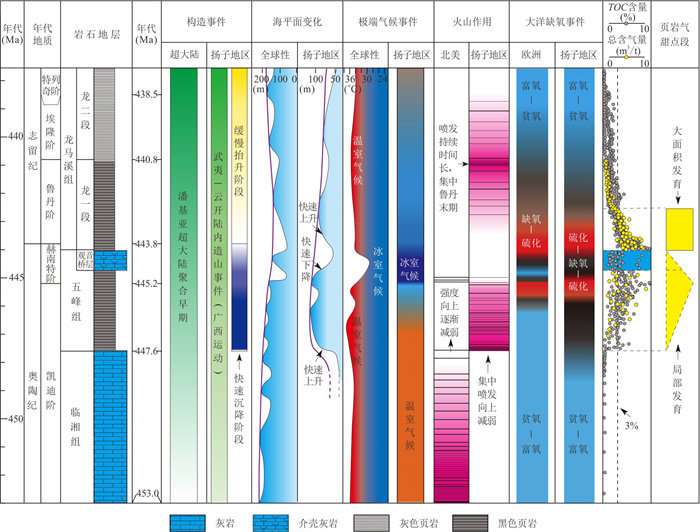
Figures(13)

 DownLoad: