- 中文版:
- EI 100%收录
- 英文版
- SCI 100%收录


中国出版政府奖提名奖
中国百强科技报刊
湖北出版政府奖
中国高校百佳科技期刊
中国最美期刊
中国出版政府奖提名奖
中国百强科技报刊
湖北出版政府奖
中国高校百佳科技期刊
中国最美期刊
| Citation: | Wu Shuanglan, Li Han, Cui Zhen, Nozu Atsushi, Zhuang Haiyang, Zhao Kai, Chen Guoxing, 2026. Kinematic Source Model of 2018 Hokkaido Eastern Iburi Mw6.6 Japan Earthquake. Earth Science, 51(1): 199-214. doi: 10.3799/dqkx.2025.171

|

|
Aki, K., 1967. Scaling Law of Seismic Spectrum. Journal of Geophysical Research, 72(4): 1217-1231. https://doi.org/10.1029/jz072i004p01217
|
|
Asano, K., Iwata, T., 2019. Source Rupture Process of the 2018 Hokkaido Eastern Iburi Earthquake Deduced from Strong-Motion Data Considering Seismic Wave Propagation in Three-Dimensional Velocity Structure. Earth, Planets and Space, 71: 1-17. https://doi.org/10.1186/s40623-019-1080-0
|
|
Bouchon, M., 1981. A Simple Method to Calculate Green's Functions for Elastic Layered Media. Bulletin of the Seismological Society of America, 71(4): 959-971. https://doi.org/10.1785/bssa0710040959
|
|
Cabinet Office, Government of Japan, 2018. Regarding the Damage Situation from the 2018 Hokkaido Eastern Iburi Earthquake. (2018-10-29) [2025-12-20].
|
|
Chen, Y. T., Xu, L. S., 2000. A Time‐Domain Inversion Technique for the Tempo‐Spatial Distribution of Slip on a Finite Fault Plane with Applications to Recent Large Earthquakes in the Tibetan Plateau. Geophysical Journal International, 143(2): 407-416. https://doi.org/10.1046/j.1365-246X.2000.01263.x
|
|
Dhakal, Y. P., Kunugi, T., Kimura, T., et al., 2019. Peak Ground Motions and Characteristics of Nonlinear Site Response during the 2018 MW6.6 Hokkaido Eastern Iburi Earthquake. Earth, Planets and Space, 71: 1-26. https://doi.org/10.1186/s40623-019-1038-2
|
|
Dreger, D. S., 1994. Empirical Green's Function Study of the January 17, 1994 Northridge, California Earthquake. Geophysical Research Letters, 21(24): 2633-2636. https://doi.org/10.1029/94gl02661
|
|
Fukuyama, E., Ishihida, M., Hori, S., et al. 1996. Broadband Seismic Observation Conducted under the FREESIA Project. Report of the National Research Institute for Earth Science and Disaster Resilience, 57: 23-31 (in Japanese with English abstract).
|
|
Fukuyama, E., Ishida, M., Douglas, S., et al. 1998. Automated Seismic Moment Tensor Determination by Using On-line Broadband Seismic Waveforms. Zishin (Journal of the Seismological Society of Japan), 51(1): 149-156(in Japanese with English abstract). doi: 10.4294/zisin1948.51.1_149
|
|
Gou, T., Huang, Z. C., Zhao, D. P., et al., 2019. Structural Heterogeneity and Anisotropy in the Source Zone of the 2018 Eastern Iburi Earthquake in Hokkaido, Japan. Journal of Geophysical Research: Solid Earth, 124(7): 7052-7066. https://doi.org/10.1029/2019jb017388
|
|
Guo, Z. L., Wen, Y. M., Xu, G. Y., et al., 2019. Fault Slip Model of the 2018 MW6.6 Hokkaido Eastern Iburi, Japan, Earthquake Estimated from Satellite Radar and GPS Measurements. Remote Sensing, 11(14): 1667. https://doi.org/10.3390/rs11141667
|
|
Hartzell, S. H., Heaton, T. H., 1983. Inversion of Strong Ground Motion and Teleseismic Waveform Data for the Fault Rupture History of the 1979 Imperial Valley, California, Earthquake. Bulletin of the Seismological Society of America, 73(6A): 1553-1583. https://doi.org/10.1785/bssa07306a1553
|
|
Hisakawa, T., Ando, R., Yano, T. E., et al., 2020. Dynamic Rupture Simulation of 2018, Hokkaido Eastern Iburi Earthquake: Role of Non-Planar Geometry. Earth, Planets and Space, 72: 1-14. https://doi.org/10.1186/s40623-020-01160-y
|
|
Hua, Y. Y., Zhao, D. P., Xu, Y. X., et al., 2019. Arc-Arc Collision Caused the 2018 Eastern Iburi Earthquake (M6.7) in Hokkaido, Japan. Scientific Reports, 9: 13914. https://doi.org/10.1038/s41598-019-50305-x
|
|
Iwasaki, T., Tsumura, N., Ito, T., et al., 2019. Structural Heterogeneity in and around the Fold-and-Thrust Belt of the Hidaka Collision Zone, Hokkaido, Japan and Its Relationship to the Aftershock Activity of the 2018 Hokkaido Eastern Iburi Earthquake. Earth, Planets and Space, 71: 1-19. https://doi.org/10.1186/s40623-019-1081-z
|
|
Kobayashi, H., Koketsu, K., Miyake, H., 2019. Rupture Process of the 2018 Hokkaido Eastern Iburi Earthquake Derived from Strong Motion and Geodetic Data. Earth, Planets and Space, 71: 1-9. https://doi.org/10.1186/s40623-019-1041-7
|
|
Kubo, H., Iwaki, A., Suzuki, W., et al., 2020. Estimation of the Source Process and Forward Simulation of Long-Period Ground Motion of the 2018 Hokkaido Eastern Iburi, Japan, Earthquake. Earth, Planets and Space, 72: 1-11. https://doi.org/10.1186/s40623-020-1146-z
|
|
Lawson, C. L., Hanson, R. J., 1974. Solving Least Squares Problems. Society for Industrial and Applied Mathematics, Philadelphia.
|
|
NIED, 2019. Rupture Process of the 2018 Hokkaido Eastern Iburi Earthquake Derived from Strong-Motion Data. (2019-10-11) [2024-7-30].
|
|
Nozu, A., 2007. Variable-Slip Rupture Model for the 2005 West Off Fukuoka Prefecture, Japan, Earthquake Waveform Inversion with Empirical Green's Functions. Zishin (Journal of the Seismological Society of Japan), 59(3): 253-270 (in Japanese with English abstract). doi: 10.4294/zisin.59.253
|
|
Nozu, A., 2012. A Simplified Source Model to Explain Strong Ground Motions from a Huge Subduction Earthquake, Simulation of Strong Ground Motions for the 201l off the Pacific Coast of Tohoku Earthquake with a Pseudo Point-Source Model. Zishin (Journal of the Seismological Society of Japan), 65(1): 45-67 (in Japanese with English abstract). doi: 10.4294/zisin.65.45
|
|
Nozu, A., Irikura, K., 2008. Strong-Motion Generation Areas of a Great Subduction-Zone Earthquake: Waveform Inversion with Empirical Green's Functions for the 2003 Tokachi-Oki Earthquake. Bulletin of the Seismological Society of America, 98(1): 180-197. https://doi.org/10.1785/0120060183
|
|
Nozu, A., Nagasaka, Y., 2017. Rupture Process of the Main Shock of the 2016 Kumamoto Earthquake with Special Reference to Damaging Ground Motions: Waveform Inversion with Empirical Green's Functions. Earth, Planets and Space, 69: 1-18. https://doi.org/10.1186/s40623-017-0609-3
|
|
Osanai, N., Yamada, T., Hayashi, S. I., et al., 2019. Characteristics of Landslides Caused by the 2018 Hokkaido Eastern Iburi Earthquake. Landslides, 16(8): 1517-1528. https://doi.org/10.1007/s10346-019-01206-7
|
|
Ren, C. M., Yue, H., Wang, T., et al., 2021. Source Rupture Model of the 2018 MW6.7 Iburi, Hokkaido Earthquake from Joint Inversion of Strong Motion and InSAR Observations. Earthquake Science, 34(1): 88-101. https://doi.org/10.29382/eqs-2020-0065
|
|
Satoh, T., 2019. Broadband Source Model and Strong Motions of the 2018 Hokkaido Eastern Iburi Earthquake. Journal of Structural and Construction Engineering, 84(763): 1175-1185. doi: 10.3130/aijs.84.1175
|
|
Tomozawa, Y., Kato, K., Nojiri, K., 2019. Estimation of Source, Path and Site Effects of the 2018 Hokkaido Eastern Iburi Earthquake. Journal of Japan Association for Earthquake Engineering, 19(4): 4_170-4_174. doi: 10.5610/jaee.19.4_170
|
|
Tozer, B., Sandwell, D. T., Smith, W. H. F., et al., 2019. Global Bathymetry and Topography at 15 Arc Sec: SRTM15+. Earth and Space Science, 6(10): 1847-1864. https://doi.org/10.1029/2019ea000658
|
|
Wang, D., Kawakatsu, H., Zhuang, J. C., et al., 2017. Automated Determination of Magnitude and Source Length of Large Earthquakes Using Backprojection and P Wave Amplitudes. Geophysical Research Letters, 44(11): 5447-5456. https://doi.org/10.1002/2017gl073801
|
|
Wang, D., Mori, J., 2012. The 2010 Qinghai, China, Earthquake: A Moderate Earthquake with Supershear Rupture. Bulletin of the Seismological Society of America, 102(1): 301-308. https://doi.org/10.1785/0120110034
|
|
Wessel, P., Smith, W. H. F., Scharroo, R., et al., 2013. Generic Mapping Tools: Improved Version Released. Eos, Transactions American Geophysical Union, 94(45): 409-410. https://doi.org/10.1002/2013eo450001
|
|
Wu, S. L., Nozu, A., Nagasaka, Y., 2021. Rupture Process of the 2021 Fukushima-Ken Oki Earthquake Estimated from Waveform Inversion with Empirical Green's Functions. World Earthquake Engineering, 37(2): 1-12 (in Chinese with English abstract).
|
|
Wu, S. L., Nozu, A., Nagasaka, Y., 2021. Rupture Process of the Mainshock of the 2019 Ridgecrest Earthquake Sequence from Waveform Inversion with Empirical Green's Functions. Bulletin of the Seismological Society of America, 111(2): 1014-1031. https://doi.org/10.1785/0120200266
|
|
Xie, Z. D., Yu, X. W., Zhang, W. B., 2024. Dynamic Rupture Process of the 2018 Hokkaido MW6.6 Earthquake, Japan. Chinese Journal of Geophysics, 67(8): 2972-2989 (in Chinese with English abstract).
|
|
Xu, L. S., Chen, Y. T., 1996. Extracting the Focal Time Function of Gonghe Earthquake from Long-Period Digital Waveform Data by Empirical Green Function Method. Acta Seismologica Sinica, 18(2): 156-159 (in Chinese with English abstract).
|
|
Xu, L. S., Chen, Y. T., 2002. Source Time Function and Rupture Process of Earthquake. Seismological and Geomagnetic Observation and Research, 23(6): 1-8 (in Chinese with English abstract).
|
|
Yamagishi, H., Yamazaki, F., 2018. Landslides by the 2018 Hokkaido Iburi-Tobu Earthquake on September 6. Landslides, 15(12): 2521-2524. https://doi.org/10.1007/s10346-018-1092-z
|
|
Yao, Q., Wang, D., Fang, L. H., et al., 2019. Rapid Estimation of Magnitudes of Large Damaging Earthquakes in and around Japan Using Dense Seismic Stations in China. Bulletin of the Seismological Society of America, 109(6): 2545-2555. https://doi.org/10.1785/0120190107
|
|
Zang, C., Ni, S. D., Shen, Z. C., 2019. Rupture Directivity Analysis of the 2018 Hokkaido Eastern Iburi Earthquake and Its Seismotectonic Implication. Seismological Research Letters, 90(6): 2121-2131. https://doi.org/10.1785/0220190131
|
|
Zhang, S., Li, R., Wang, F. W., et al., 2019. Characteristics of Landslides Triggered by the 2018 Hokkaido Eastern Iburi Earthquake, Northern Japan. Landslides, 16(9): 1691-1708. https://doi.org/10.1007/s10346-019-01207-6
|
|
Zhang, X., Xu, L. S., 2015. Inversion of the Apparent Source Time Functions for the Rupture Process of the Nepal MS8.1 Earthquake. Chinese Journal of Geophysics, 58(6): 1881-1890 (in Chinese with English abstract).
|
|
Zhou, H. X., Che, A. L., Wang, L. M., et al., 2021. Investigation and Mechanism Analysis of Disasters under Hokkaido Eastern Iburi Earthquake. Geomatics, Natural Hazards and Risk, 12(1): 1-28. https://doi.org/10.1080/19475705.2020.1856201
|
|
吴双兰, 野津厚, 長坂陽介, 2021.2021年日本福岛县冲地震的震源破裂过程分析: 基于采用经验格林函数方法的波形反演. 世界地震工程, 37(2): 1-12.
|
|
谢张迪, 于湘伟, 章文波, 2024. 2018年日本北海道MW6.6地震震源动力学破裂过程. 地球物理学报, 67(8): 2972-2989.
|
|
许力生, 陈运泰, 1996. 用经验格林函数方法从长周期数字波形资料中提取共和地震的震源时间函数. 地震学报, 18(2): 156-159.
|
|
许力生, 陈运泰, 2002. 震源时间函数与震源破裂过程. 地震地磁观测与研究, 23(6): 1-8.
|
|
张旭, 许力生, 2015. 利用视震源时间函数反演尼泊尔MS8.1地震破裂过程. 地球物理学报, 58(6): 1881-1890.
|
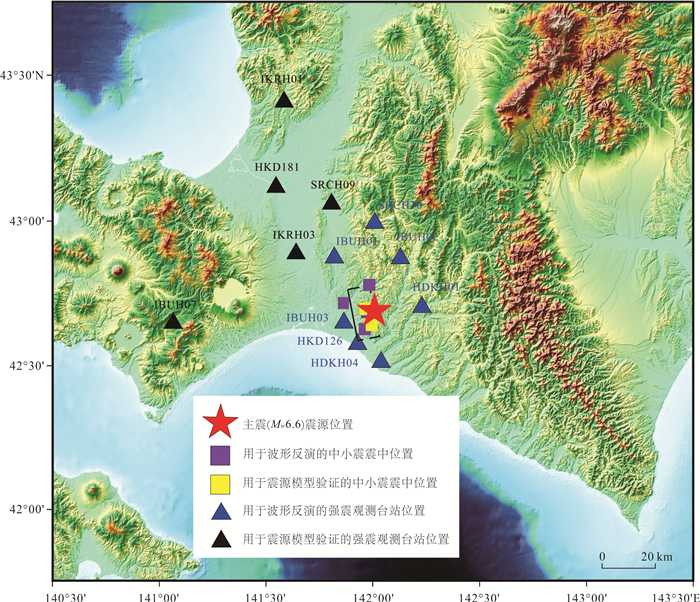
Figures(9) / Tables(1)


 DownLoad: