- 中文版:
- EI 100%收录
- 英文版
- SCI 100%收录


中国出版政府奖提名奖
中国百强科技报刊
湖北出版政府奖
中国高校百佳科技期刊
中国最美期刊
中国出版政府奖提名奖
中国百强科技报刊
湖北出版政府奖
中国高校百佳科技期刊
中国最美期刊
| Citation: | Mao Xiancheng, Duan Xinming, Deng Hao, Chen Jin, Liu Zhankun, Huang Jixian, 2026. Intelligent 3D Prediction of Deep Mineral Resources: Theory, Methods, and Challenges. Earth Science, 51(3): 793-815. doi: 10.3799/dqkx.2025.227

|
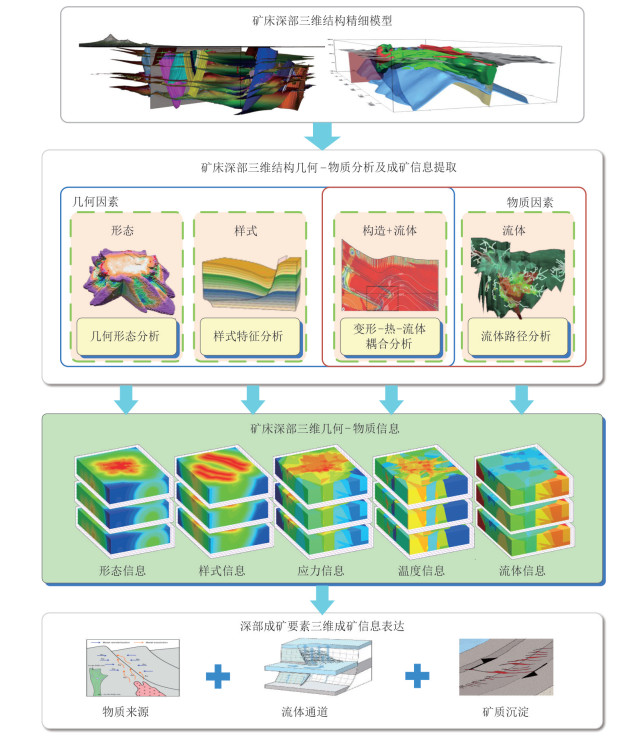
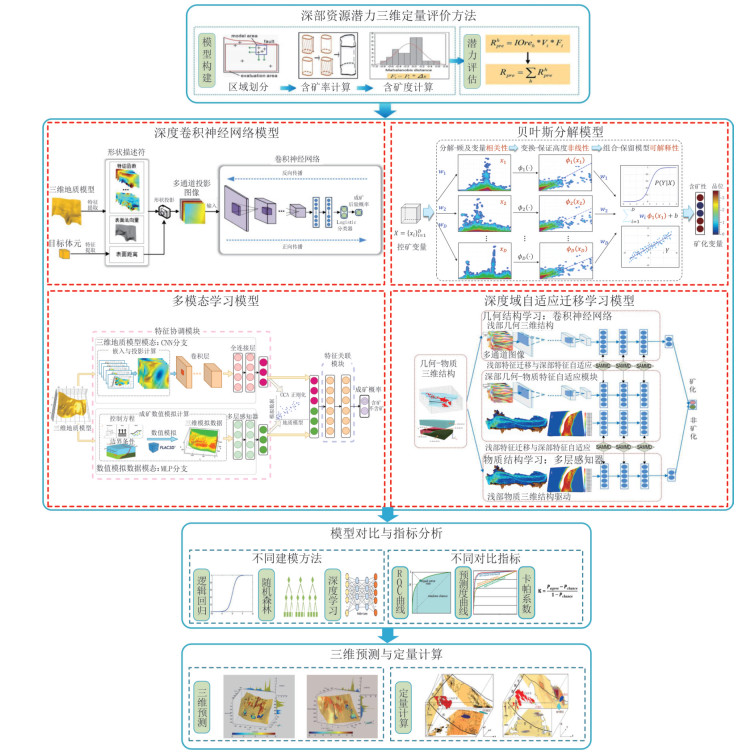
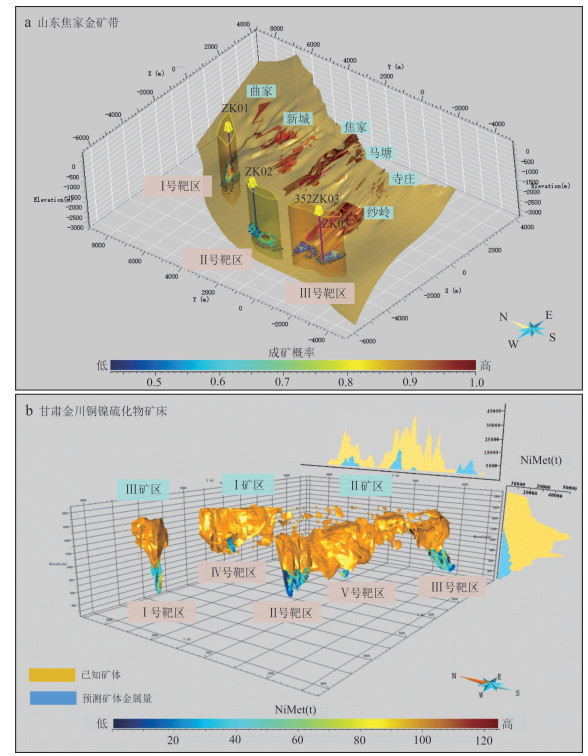
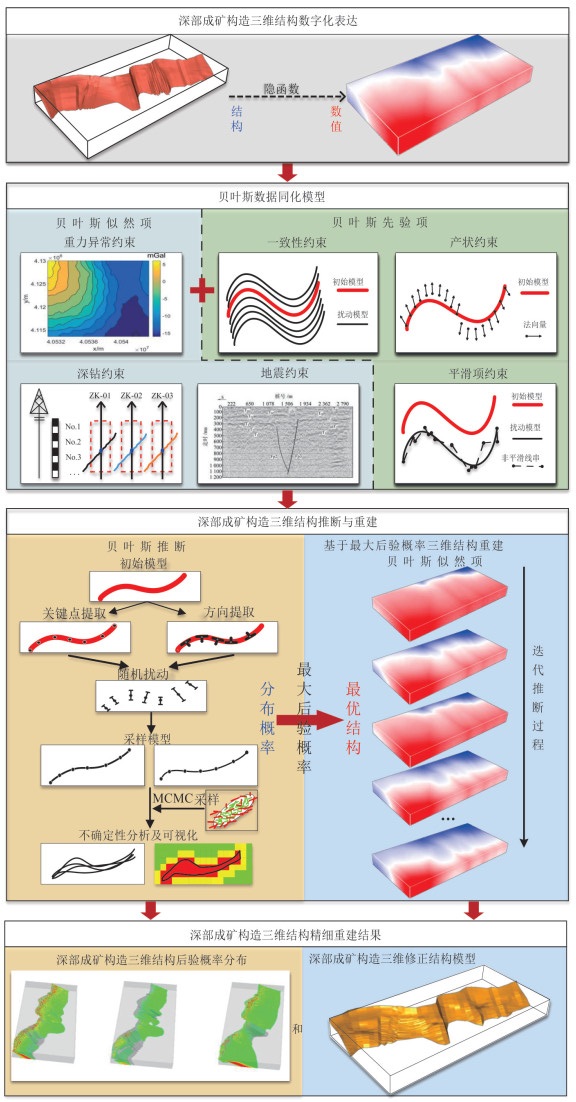
Mineral resources are vital for national economic security and industrial development. As shallow resources become increasingly depleted, the exploration of alternative resources in the deeper parts of mines has become an inevitable option to ensure resource security. However, deep mineral prospectivity mapping faces significant challenges, including great depths, limited direct observations, and weak indirect information. There is an urgent need to overcome key technical challenges, including unclear deep ore deposit structures, obscured deep ore-controlling patterns, and significant difficulties in spatial positioning of deep ore bodies, whereas it is very difficult for traditional quantitative prediction methods for mineral resources to meet the demand for precise 3D spatial positioning of deep resources. To address these issues, this paper proposes novel theories and methods of 3D intelligent prediction of deep mineral deposits. Guided by the metallogenic system theories and data science, these theories and methods have preliminarily broken through two key scientific issues: "geological-geophysical-geochemical constraints on the 3D reconstruction of deep ore deposit structures" and "the controlling mechanism of deep 3D ore deposit structures on the spatial positioning of mineralization". It has established a methodological framework of "geological analysis - refined modeling-3D analysis-intelligent prediction", and innovatively developed a theoretical, methodological, and technical system centered on the 3D refined reconstruction of deep deposit structures, 3D geometric-material analysis of ore-forming space, and intelligent 3D positioning prediction of deep ore bodies. The core technologies include: (1) refined 3D reconstruction of deep deposit structures based on multi-source heterogeneous data assimilation and Bayesian inference; (2) intelligent extraction of 3D spatial geometric and material mineralization information using coupled simulation of multi-level structural styles and metallogenic processes; (3) intelligent 3D positioning prediction of deep ore bodies applying artificial intelligence techniques such as deep neural networks, domain adaptation, and multi-modal learning. The automation of refined deep structure reconstruction, the quantification of deep ore-controlling patterns representation, and the intellectualization of orebody positioning prediction have been realized, and significant breakthroughs have been achieved in deep ore prospecting in major mineral concentration areas in China, such as the Jiaodong Peninsula and the Jinchuan. Finally, this paper discusses the future challenges and development directions of 3D intelligent prediction of deep mineral resources from the perspectives of multi-source data assimilation for refined 3D modeling of deep structures, characterization of mineralization information based on the coupling of spatial structure and metallogenic materials, and large language model-driven 3D positioning prediction of deep ore bodies, aiming to further promote the development of in-depth intellectualization of deep mineral prospectivity mapping.

|
Allais, M., 1957. Method of Appraising Economic Prospects of Mining Exploration over Large Territories: Algerian Sahara Case Study. Management Science, 3(4): 285-347. https://doi.org/10.1287/mnsc.3.4.285
|
|
Aydin, O., Caers, J. K., 2017. Quantifying Structural Uncertainty on Fault Networks Using a Marked Point Process within a Bayesian Framework. Tectonophysics, 712: 101-124. https://doi.org/10.1016/j.tecto.2017.04.027
|
|
Botbol, J. M., Sinding-Larsen, R., McCammon, R. B., et al., 1977. Weighted Characteristic Analysis of Spatially Dependent Mineral Deposit Data. Journal of the International Association for Mathematical Geology, 9(3): 309-311. https://doi.org/10.1007/BF02272392
|
|
Chen, G. X., Cheng, Q. M., Puetz, S., 2023. Data-Driven Discovery in Geosciences: Opportunities and Challenges. Mathematical Geosciences, 55(3): 287-293. https://doi.org/10.1007/s11004-023-10054-0
|
|
Chen, J. P., Lü, P., Wu, W., et al., 2007. A 3D Method for Predicting Blind Orebodies, Based on a 3D Visualization Model and Its Application. Earth Science Frontiers, 14(5): 54-62 (in Chinese with English abstract). doi: 10.1016/S1872-5791(07)60035-9
|
|
Chen, J. P., Shi, R., Wang, L. M., et al., 2012. 3D Metallogenic Prediction for Western Section of Q8 Gold Deposit in Tongguan County of Shaanxi Based on Digital Mineral Deposit Model. Journal of Geology, 36(3): 237-242 (in Chinese with English abstract).
|
|
Chen, J. P., Yu, P. P., Shi, R., et al., 2014. Research on Three-Dimensional Quantitative Prediction and Evaluation Methods of Regional Concealed Ore Bodies. Earth Science Frontiers, 21(5): 211-220 (in Chinese with English abstract).
|
|
Chen, J., Mao, X. C., Deng, H., et al., 2020. Three- Dimensional Modelling of Alteration Zones Based on Geochemical Exploration data: An Interpretable Machine-Learning Approach via Generalized Additive Models. Applied Geochemistry, 123: 104781. https://doi.org/10.1016/j.apgeochem.2020.104781
|
|
Chen, J., Mao, X. C., Liu, Z. K., et al., 2020. Three-Dimensional Metallogenic Prediction Based on Random Forest Classification Algorithm for the Dayingezhuang Gold Deposit. Geotectonica et Metallogenia, 44(2): 231-241 (in Chinese with English abstract).
|
|
Chen, J., Zuo, X., Liu, Z. K., et al., 2024a. 3D Mineral Prospectivity Modeling Using Deep Adaptation Network Transfer Learning: A Case Study of the Xiadian Gold Deposit, Eastern China. Geochemistry, 84(4): 126189. https://doi.org/10.1016/j.chemer.2024.126189
|
|
Chen, M., Qian, Z., Boers, N., et al., 2024b. Collaboration between Artificial Intelligence and Earth Science Communities for Mutual Benefit. Nature Geoscience, 17(10): 949-952. https://doi.org/10.1038/s41561-024-01550-x
|
|
Chen, Y. C., Pei, R. F., Wang, D. H., et al., 2020. Four-Dimensional Metallogeny in Earth System and Study Trends of Mineral deposits: A Discussion on Minerogenetic Series(Ⅶ). Mineral Deposits, 39(5): 745-753 (in Chinese with English abstract).
|
|
Chen, Y. X., Deng, H., Zheng, Y., et al., 2025. CurvRBF: Mean Curvature-Controllable Radial Basis Functions for Implicit Geological Modeling. Mathematical Geosciences, Online. https://doi.org/10.1007/s11004-025-10226-0
|
|
Cheng, Q. M., 2007. Singular Mineralization Processes and Mineral Resources Quantitative Prediction: New Theories and Methods. Earth Science Frontiers, 14(5): 42-53 (in Chinese with English abstract).
|
|
Cheng, Q. M., 2022. Quantitative Simulation and Prediction of Extreme Geological Events. Scientia Sinica (Terrae), 52(6): 975-991 (in Chinese). doi: 10.1360/SSTe-2021-0247
|
|
Cheng, Q. M., 2025. A New Paradigm for Mineral Resource Prediction Based on Human Intelligence-Artificial Intelligence Integration. Earth Science Frontiers, 32(4): 1-19 (in Chinese with English abstract).
|
|
Cheng, Q. M., Yang, Y. L., Zhou, Y. Z., et al., 2025. Earth Science in the Era of Foundation models: How AlphaErtha is Reshaping Quantitative Geoscience. Earth Science Frontiers, 32(5): 1-11 (in Chinese with English abstract).
|
|
Chinese Academy of Engineering, 2014. Status and Strategies for Mineral Resources in China. Higher Education Press, Beijing (in Chinese).
|
|
Cox, S. F., Knackstedt, M. A., Braun, J., 2001. Principles of Structural Control on Permeability and Fluid Flow in Hydrothermal Systems. In: Richards, J. P., Tosdal, R. M., eds., Structural Controls on Ore Genesis, McLean.
|
|
Deng, H., Huang, J. X., Liu, Z. K., et al., 2024. Hidden Markov Model for Spatial Analysis of Three-Dimensional Mineralization Distribution: Insights into Magma Flow and Mineral Exploration Targets in the Jinchuan Ni-Cu-(PGE) Sulfide Deposit, China. Applied Geochemistry, 162: 105911. https://doi.org/10.1016/j.apgeochem.2024.105911
|
|
Deng, H., Huang, X. F., Mao, X. C., et al., 2022a. Generalized Mathematical Morphological Method for 3D Shape Analysis of Geological Boundaries: Application in Identifying Mineralization-Associated Shape Features. Natural Resources Research, 31(4): 2103-2127. https://doi.org/10.1007/s11053-021-09975-6
|
|
Deng, H., Wei, Y. F., Chen, J., et al., 2021. Three- Dimensional Prospectivity Mapping and Quantitative Analysis of Structural Ore-Controlling Factors in Jiaojia Au Ore-Belt with Attention Convolutional Neural Networks. Journal of Central South University (Science and Technology), 52(9): 3003-3014 (in Chinese with English abstract).
|
|
Deng, H., Zheng, Y., Chen, J., et al., 2022b. Learning 3D Mineral Prospectivity from 3D Geological Models Using Convolutional Neural Networks: Application to a Structure-Controlled Hydrothermal Gold Deposit. Computers & Geosciences, 161: 105074. https://doi.org/10.48550/arXiv.2109.00756
|
|
Deng, X. L., Deng, H., Chen, J., et al., 2025. Spatial Interrelation Matters: Advancing 3D Mineral Prospectivity Modeling with Fully-Connected CRFs—Insights from Sanshandao Gold Belt, Eastern China. Ore Geology Reviews, 184: 106712. https://doi.org/10.1016/j.oregeorev.2025.106712
|
|
Dubiński, J., 2013. Sustainable Development of Mining Mineral Resources. Journal of Sustainable Mining, 12(1): 1-6. https://doi.org/10.7424/jsm130102
|
|
Fan, J., Guo, Y. Y., Cheng, Y. S., 2019. An Introduction to Deep Resources Exploration and Mining, a Special Project of National Key R & D Program of China. Geology in China, 46(4): 919-926 (in Chinese with English abstract).
|
|
Fu, G. M., Lü, Q. T., Yan, J. Y., et al., 2021.3D Mineral Prospectivity Modeling Based on Machine Learning: A Case Study of the Zhuxi Tungsten Deposit in Northeastern Jiangxi Province, South China. Ore Geology Reviews, 131: 104010. https://doi.org/10.1016/j.oregeorev.2021.104010
|
|
Gao, M., Wang, G. W., Carranza, E. J. M., et al., 2024.3D Au Targeting Using Machine Learning with Different Sample Combination and Return-Risk Analysis in the Sanshandao-Cangshang District, Shandong Province, China. Natural Resources Research, 33(1): 51-74. https://doi.org/10.1007/s11053-023-10279-0
|
|
Groves, D. I., Santosh, M., Goldfarb, R. J., et al., 2018. Structural Geometry of Orogenic Gold Deposits: Implications for Exploration of World-Class and Giant Deposits. Geoscience Frontiers, 9(4): 1163-1177. https://doi.org/10.1016/j.gsf.2018.01.006
|
|
Guo, J., Yan, W. D., Cui, R. G., et al., 2019. Outlook and Overview of Mineral Resources Situation of China. Land and Resources Information, (12): 46-51 (in Chinese with English abstract).
|
|
Huang, J. X., Deng, H., Chen, J., et al., 2023a. Assessing Geometrical Uncertainties in Geological Interface Models Using Markov Chain Monte Carlo Sampling via Abstract Graph. Tectonophysics, 864: 230032. https://doi.org/10.1016/j.tecto.2023.230032
|
|
Huang, J. X., Deng, H., Mao, X. C., et al., 2023b. 3D Modeling of Detachment Faults in the Jiaodong Gold Province, Eastern China: A Bayesian Inference Perspective and Its Exploration Implications. Ore Geology Reviews, 154: 105307. https://doi.org/10.1016/j.oregeorev.2023.105307
|
|
Huang, J. X., Deng, H., Mao, X. C., et al., 2024a. A Global-Local Collaborative Approach to Quantifying Spatial Non-Stationarity in Three-Dimensional Mineral Prospectivity Modeling. Ore Geology Reviews, 168: 106069. https://doi.org/10.1016/j.oregeorev.2024.106069
|
|
Huang, J. X., Liu, Z. K., Deng, H., 2024b. Identifying Fluid Pathways in Hydrothermal Deposits Using Hidden Markov Models: Representation of Fluid Flow as Exploration Criteria. Geochemistry, 84(4): 126180. https://doi.org/10.1016/j.chemer.2024.126180
|
|
Huang, Z. Y., Carr, N., Ju, T., 2019. Variational Implicit Point Set Surfaces. ACM Transactions on Graphics, 38(4): 1-13. https://doi.org/10.1145/3306346.3322994
|
|
Isakov, V., Leung, S., Qian, J. L., 2011. A Fast Local Level Set Method for Inverse Gravimetry. Communications in Computational Physics, 10(4): 1044-1070. https://doi.org/10.4208/cicp.100710.021210a
|
|
Kong, W. X., Tan, H. D., Lin, C. H., et al., 2021. Three-Dimensional Inversion of Magnetotelluric Data for a Resistivity Model with Arbitrary Anisotropy. Journal of Geophysical Research: Solid Earth, 126(8): e2020JB020562. https://doi.org/10.1029/2020JB020562
|
|
Lachowycz, S., 2024. Utility of Artificial Intelligence in Geoscience. Nature Geoscience, 17(10): 953-955. https://doi.org/10.1038/s41561-024-01548-5
|
|
Li, H., Li, X. H., Yuan, F., et al., 2023a. Genetic Algorithm Optimized Light Gradient Boosting Machine for 3D Mineral Prospectivity Modeling of Cu Polymetallic Skarn-Type Mineralization, Xuancheng Area, Anhui Province, Eastern China. Natural Resources Research, 32(5): 1897-1916. https://doi.org/10.1007/s11053-023-10227-y
|
|
Li, L. J., Li, D. X., Mao, X. C., et al., 2023b. Evolution of Magmatic Sulfide of the Giant Jinchuan Ni-Cu Deposit, NW China: Insights from Chalcophile Elements in Base Metal Sulfide Minerals. Ore Geology Reviews, 158: 105497. https://doi.org/10.1016/j.oregeorev.2023.105497
|
|
Li, N., Cao, R., Ye, H. S., et al., 2021. Three-Dimensional Modeling and Comprehensive Quantitative Mineral Resources assessment: A Case Study of the Haoyaoerhudong Gold Deposit in Inner Mongolia. Earth Science Frontiers, 28(3): 170-189 (in Chinese with English abstract).
|
|
Li, N., Cao, R., Ye, H. S., et al., 2022. Modeling-Based Multiscale Deep Prospectivity Mapping: A Case Study of the Haoyaoerhudong Gold Deposit, Inner Mongolia, China. Natural Resources Research, 31(4): 2129-2161. https://doi.org/10.1007/s11053-022-10019-w
|
|
Li, W. B., Lu, W. T., Qian, J. L., 2016. A Level-Set Method for Imaging Salt Structures Using Gravity Data. Geophysics, 81(2): G27-G40. https://doi.org/10.1190/geo2015-0295.1
|
|
Li, W. B., Qian, J. L., Li, Y. G., 2020. Joint Inversion of Surface and Borehole Magnetic Data: A Level-Set Approach. Geophysics, 85(1): J15-J32. https://doi.org/10.1190/geo2019-0139.1
|
|
Li, X. H., Dai, W. Q., Yuan, F., et al., 2018. Uncertainty Analysis of Data Combination within 3D Prospectivity modelling: A Case Study in Zhonggu Orefield, Ningwu Basin, China. Acta Petrologica Sinica, 34(11): 3235-3243 (in Chinese with English abstract).
|
|
Li, X. H., Xue, C., Chen, Y. H., et al., 2023c. 3D Convolutional Neural Network-Based 3D Mineral Prospectivity Modeling for Targeting Concealed Mineralization within Chating Area, Middle-Lower Yangtze River Metallogenic Belt, China. Ore Geology Reviews, 157: 105444. https://doi.org/10.1016/j.oregeorev.2023.105444
|
|
Li, X. H., Yuan, F., Zhang, M. M., et al., 2015. Three-Dimensional Mineral Prospectivity Modeling for Targeting of Concealed Mineralization within the Zhonggu Iron Orefield, Ningwu Basin, China. Ore Geology Reviews, 71: 633-654. https://doi.org/10.1016/j.oregeorev.2015.06.001
|
|
Liu, B. L., Zheng, W. B., Wang, L., et al., 2024a. Mineral Exploration Model for Lhasa Area, Eastern Gangdese Metallogenic Belt: Based on Knowledge-Driven Compositional Data Analysis and Catchment Basin Division. Journal of Geochemical Exploration, 259: 107415. https://doi.org/10.1016/j.gexplo.2024.107415
|
|
Liu, Z. K., Chen, J., Mao, X. C., et al., 2021a. Spatial Association between Orogenic Gold Mineralization and Structures Revealed by 3D Prospectivity Modeling: A Case Study of the Xiadian Gold Deposit, Jiaodong Peninsula, China. Natural Resources Research, 30(6): 3987-4007. https://doi.org/10.1007/s11053-021-09956-9
|
|
Liu, Z. K., Mao, X. C., Ackerman, L., et al., 2020. Two-Stage Gold Mineralization of the Axi Epithermal Au Deposit, Western Tianshan, NW China: Evidence from Re-Os Dating, S Isotope, and Trace Elements of Pyrite. Mineralium Deposita, 55(5): 863-880. https://doi.org/10.1007/s00126-019-00903-6
|
|
Liu, Z. K., Mao, X. C., Deng, H., et al., 2018. Hydrothermal Processes at the Axi Epithermal Au Deposit, Western Tianshan: Insights from Geochemical Effects of Alteration, Mineralization and Trace Elements in Pyrite. Ore Geology Reviews, 102: 368-385. https://doi.org/10.1016/j.oregeorev.2018.09.009
|
|
Liu, Z. K., Mao, X. C., Wang, F. Y., et al., 2021b. Deciphering Anomalous Ag Enrichment Recorded by Galena in Dayingezhuang Au(-Ag) Deposit, Jiaodong Peninsula, Eastern China. Transactions of Nonferrous Metals Society of China, 31(12): 3831-3846. https://doi.org/10.1016/S1003-6326(21)65768-0
|
|
Liu, Z. K., Yu, S. Y., Deng, H., et al., 2024b. 3D Mineral Prospectivity Modeling in the Sanshandao Goldfield, China Using the Convolutional Neural Network with Attention Mechanism. Ore Geology Reviews, 164: 105861. https://doi.org/10.1016/j.oregeorev.2023.105861
|
|
Lu, Z. X., Fan, Y. X., Liu, F. C., 1989. Metallogenic Regularities and Metallogenic Prognosis. China University of Geosciences Press, Wuhan (in Chinese).
|
|
Mao X. C., Chen G. G., 1991. The Three-Dimensional Mathematical Models of Xianghualing Tin Deposit and the Prediction of Outside-and-Deep-Seated Blind Ore Bodies. Journal of Central-South Institute of Mining and Metallurgy, 22(4): 360-365.
|
|
Mao, J. W., Liu, M., Yao, F. J., et al., 2024. Some Points Concerned in Field of Prospecting and Exploration in China and Future Considerations. Mineral Deposits, 43(6): 1211-1222 (in Chinese with English abstract)
|
|
Mao, X. C., 1986. A Preliminary Study on the Mathematical Model and Three-Dimensional Quantitative Prediction of the Xianghualing Tin Deposit (Dissertation). Central-South Institute of Mining and Metallurgy, Changsha (in Chinese with English abstract).
|
|
Mao, X. C., 2006. Research on 3D Digital Deposit and Stereo Quantitative Prediction of Concealed Ore Body (Dissertation). Central South University, Changsha (in Chinese with English abstract).
|
|
Mao, X. C., Chen, G. G., 1988. The Xianghualing Sn- Deposit: Its Mathematical Model and Three-Dimensional Quantitative Prognostication. Geology and Prospecting, 24(10): 25-31 (in Chinese with English abstract).
|
|
Mao, X. C., Dai, T. G., 2010. 3D Quantitative Prediction of Concealed Ore Bodies. Geological Publishing House, Beijing (in Chinese).
|
|
Mao, X. C., Deng, H., Chen, J., et al., 2024. Theory and Methods for Three-Dimensional Intelligent Prospectivity Mapping of Deep Resources in Metal Mines. Mineral Exploration, 15(8): 1365-1378 (in Chinese with English abstract).
|
|
Mao, X. C., Liu, P., Deng, H., et al., 2023a. A Novel Approach to Three-Dimensional Inference and Modeling of Magma Conduits with Exploration Data: A Case Study from the Jinchuan Ni-Cu Sulfide Deposit, NW China. Natural Resources Research, 32(3): 901-928. https://doi.org/10.1007/s11053-023-10183-7
|
|
Mao, X. C., Ren, J., Liu, Z. K., et al., 2019. Three- Dimensional Prospectivity Modeling of the Jiaojia-Type Gold Deposit, Jiaodong Peninsula, Eastern China: A Case Study of the Dayingezhuang Deposit. Journal of Geochemical Exploration, 203: 27-44. https://doi.org/10.1016/j.gexplo.2019.04.002
|
|
Mao, X. C., Song, J. X., Liu, Z. K., et al., 2024a. 3D Mineral Prospectivity Modeling at the Axi Epithermal Gold Deposit, NW China by Using a Feature Adaptive Fusion Strategy. Geochemistry, 84(4): 126190. https://doi.org/10.1016/j.chemer.2024.126190
|
|
Mao, X. C., Su, Z., Deng, H., et al., 2024b. Three- Dimensional Mineral Prospectivity Modeling with Geometric Restoration: Application to the Jinchuan Ni-Cu-(PGE) Sulfide Deposit, Northwestern China. Natural Resources Research, 33(1): 75-105. https://doi.org/10.1007/s11053-023-10269-2
|
|
Mao, X. C., Tang, Y. H., Deng, H., 2012. Three-Dimensional Morphological Analysis Method for Geologic Bodies and Its Application. Journal of Central South University (Science and Technology), 43(2): 588-595 (in Chinese with English abstract).
|
|
Mao, X. C., Wang, J. L., Deng, H., et al., 2023b. Bayesian Decomposition Modelling: An Interpretable Nonlinear Approach for Mineral Prospectivity Mapping. Mathematical Geosciences, 55(7): 897-942. https://doi.org/10.1007/s11004-023-10067-9
|
|
Mao, X. C., Wang, M. J., Liu, Z. K., et al., 2019. Quantitative Analysis of Ore-Controlling Factors Based on Exploration Data of the Dayingezhuang Gold Deposit in the Jiaodong Peninsula. Earth Science Frontiers, 26(4): 84-93 (in Chinese with English abstract).
|
|
Mao, X. C., Zhang, B., Deng, H., et al., 2016. Three- Dimensional Morphological Analysis Method for Geologic Bodies and Its Parallel Implementation. Computers & Geosciences, 96: 11-22. https://doi.org/10.1016/j.cageo.2016.07.004
|
|
Mao, X. C., Zhong, H. T., Liu, Z. K., et al., 2024c. 3D Numerical Modeling for Investigating Structural Controls on Orogenic Gold Mineralization, Sanshandao Gold Belt, Eastern China. Natural Resources Research, 33(4): 1413-1437. https://doi.org/10.1007/s11053- 024-10353-1 doi: 10.1007/s11053-024-10353-1
|
|
Mao, X. C., Zhou, S. G., Zhang, B. Y., et al., 2014. GIS Analysis and Appraisal of Manganese Ore: A Case Study of Western Guangxi-Southeastern Yunnan Region. Geological Publishing House, Beijing (in Chinese).
|
|
Mao, X. C., Zou, Y. H., Chen, J., et al., 2010. Three- Dimensional Visual Prediction of Concealed Ore Bodies in the Deep and Marginal Parts of Crisis Mines: A Case Study of the Fenghuangshan Ore Field in Tongling, Anhui, China. Geological Bulletin of China, 29(S1): 401-413 (in Chinese with English abstract).
|
|
Mao, X. C., Zou, Y. H., Lu, X. Q., et al., 2009. Quantitative Analysis of Geological Ore-Controlling Factors and Stereoscopic Quantitative Prediction of Concealed Ore Bodies. Journal of Central South University of Technology, 16(6): 987-993. https://doi.org/10.1007/s11771-009-0164-6
|
|
Nawaz, M. A., Curtis, A., 2019. Rapid Discriminative Variational Bayesian Inversion of Geophysical Data for the Spatial Distribution of Geological Properties. Journal of Geophysical Research: Solid Earth, 124(6): 5867-5887. https://doi.org/10.1029/2018JB016652
|
|
Nawaz, M. A., Curtis, A., Shahraeeni, M. S., et al., 2020. Variational Bayesian Inversion of Seismic Attributes Jointly for Geologic Facies and Petrophysical Rock Properties. Geophysics, 85(4): MR213-MR233. https://doi.org/10.1190/geo2019-0163.1
|
|
Oberle, B., Bringezu, S., Hatfield-Dodds S., et al., 2019. Global Resources Outlook 2019: Natural Resources for the Future We Want. International Resource Panel, Paris.
|
|
Pakyuz-Charrier, E., Jessell, M., Giraud, J., et al., 2019. Topological Analysis in Monte Carlo Simulation for Uncertainty Propagation. Solid Earth, 10(5): 1663-1684. https://doi.org/10.5194/se-10-1663-2019
|
|
Rong, Z. H., Liu, Y. H., Yin, C. C., et al., 2022. Three-Dimensional Magnetotelluric Inversion for Arbitrarily Anisotropic Earth Using Unstructured Tetrahedral Discretization. Journal of Geophysical Research: Solid Earth, 127(8): e2021JB023778. https://doi.org/10.1029/2021JB023778
|
|
Sagar, D., Cheng, Q., Agterberg, F., 2018. Handbook of Mathematical Geosciences: Fifty Years of IAMG. Springer, Amsterdam.
|
|
Schneeberger, R., de la Varga, M., Egli, D., et al., 2017. Methods and Uncertainty Estimations of 3-D Structural Modelling in Crystalline Rocks: A Case Study. Solid Earth, 8(5): 987-1002. https://doi.org/10.5194/se-8-987-2017
|
|
Shan, W. F., Mao, X. C., Liu, Z. K., et al., 2023. Computational Simulation of the Ore-Forming Processes Associated with the Sanshandao-Haiyu Gold Belt, Jiaodong Peninsula, Eastern China: Implications for the Duration of Ore Formation. Frontiers in Earth Science, 11: 1154945. https://doi.org/10.3389/feart.2023.1154945
|
|
Teng, J. W., Xue, G. Q., Song, M. C., 2022. Theory on Exploring Mineral Resources in the Second Deep Space and Practices with Electromagnetic Method. Chinese Journal of Geophysics, 65(10): 3975-3985 (in Chinese with English abstract).
|
|
Wang, F. Y., Mao, X. C., Deng, H., et al., 2020. Manganese Potential Mapping in Western Guangxi-Southeastern Yunnan (China) via Spatial Analysis and Modal-Adaptive Prospectivity Modeling. Transactions of Nonferrous Metals Society of China, 30(4): 1058-1070. https://doi.org/10.1016/S1003-6326(20)65277-3
|
|
Wang, G. W., Li, R. X., Carranza, E. J. M., et al., 2015. 3D Geological Modeling for Prediction of Subsurface Mo Targets in the Luanchuan District, China. Ore Geology Reviews, 71: 592-610. https://doi.org/10.1016/j.oregeorev.2015.03.002
|
|
Wang, G. W., Zhang, Z. Q., Li, R. X., et al., 2021. Resource Prediction and Assessment Based on 3D/4D Big Data Modeling and Deep integration in Key Ore Districts of North China. Scientia Sinica (Terrae), 51(9): 1594-1610 (in Chinese with English abstract). doi: 10.1360/SSTe-2020-0289
|
|
Wang, H. C., Fu, T. F., Du, Y. Q., et al., 2023a. Scientific Discovery in the Age of Artificial Intelligence. Nature, 620(7972): 47-60. https://doi.org/10.1038/s41586-023-06221-2
|
|
Wang, J. L., Mao, X. C., Liu, Z. K., et al., 2024. Three-Dimensional Mineral Prospectivity Mapping Considering Structural Restoration in the Dayingezhuang Gold Deposit, Eastern China. Ore Geology Reviews, 165: 105860. https://doi.org/10.1016/j.oregeorev.2023.105860
|
|
Wang, J. L., Mao, X. C., Peng, C., et al., 2023b. Three-Dimensional Refined Modelling of Deep Structures by Using the Level Set Method: Application to the Zhaoping Detachment Fault, Jiaodong Peninsula, China. Mathematical Geosciences, 55(2): 229-262. https://doi.org/10.1007/s11004-022-10031-z
|
|
Wang, S. C., Cheng, Q. M., Fan, J. Z., 1989. Modelling of Gold Deposit Prospecting. Journal of Jilin University (Earth Science Edition), 19(3): 311-316 (in Chinese with English abstract).
|
|
Wang, Y. Z., Wen, S. B., Li, B. W., et al., 2025. Construction Technology of Super-Agents for Intelligent Mineral Resources Prediction Driven by Large Model. Earth Science Frontiers, 32(4): 38-45 (in Chinese with English abstract).
|
|
Wellmann, J. F., 2013. Information Theory for Correlation Analysis and Estimation of Uncertainty Reduction in Maps and Models. Entropy, 15(4): 1464-1485. https://doi.org/10.3390/e15041464
|
|
Xia, Q. L., Cheng, Q. M., Zuo, R. G., et al., 2009. GIS Technique of Optimum Target Areas in Mineral Resource Prospecting. Earth Science, 34(2): 287-293 (in Chinese with English abstract).
|
|
Xiao, F., Chen, X. Y., Cheng, Q. M., 2024. Combining Numerical Modeling and Machine Learning to Predict Mineral prospectivity: A Case Study from the Fankou Pb-Zn Deposit, Southern China. Applied Geochemistry, 160: 105857. https://doi.org/10.1016/j.apgeochem.2023.105857
|
|
Xiao, K. Y., Li, C., Tang, R., et al., 2025. Big Data Intelligent Prediction and Evaluation. Earth Science Frontiers, 32(4): 20-37 (in Chinese with English abstract).
|
|
Xiao, K. Y., Li, N., Sun, L., et al., 2012. Large Scale 3D Mineral Prediction Methods and Channels Based on 3D Information Technology. Journal of Geology, 36(3): 229-236 (in Chinese with English abstract).
|
|
Xiao, K. Y., Sun, L., Li, N., et al., 2015. Mineral Resources Assessment under the Thought of Big Data. Geological Bulletin of China, 34(7): 1266-1272 (in Chinese with English abstract).
|
|
Xiao, K. Y., Xiang, J., Fan, M. J., et al., 2021. 3D Mineral Prospectivity Mapping Based on Deep Metallogenic Prediction Theory: A Case Study of the Lala Copper Mine, Sichuan, China. Journal of Earth Science, 32(2): 348-357. https://doi.org/10.1007/s12583-021-1437-8
|
|
Xiao, K. Y., Zhu, Y. S., Song, G. Y., 2000. Gis-Based Quantitative Assessment of Mineral Resources. Chinese Geology, 27(7): 29-32 (in Chinese with English abstract).
|
|
Xie, S. F., Liu, Z. K., Mao, X. C., et al., 2025. Ore-Forming Simulation of the Axi Low-Sulfidation Epithermal Gold Deposit, Western China: Genetic Implications on Mineralization Pattern. Journal of Geochemical Exploration, 273: 107740. https://doi.org/10.1016/j.gexplo.2025.107740
|
|
Yao, H. B., Ren, Z. Y., Tang, J. T., et al., 2023. Trans-Dimensional Bayesian Joint Inversion of Magnetotelluric and Geomagnetic Depth Sounding Responses to Constrain Mantle Electrical discontinuitiesPurchased. Geophysical Journal International, 233(3): 1821-1846. https://doi.org/10.1093/gji/ggad029
|
|
Yu, C. W., 1994. Dynamics of Metallogenesis: Theoretical System and Methodology. Earth Science Frontiers, 1(3): 54-82 (in Chinese with English abstract).
|
|
Yuan, F., Li, X. H., Tian, W. D., et al., 2024. Key Issues in Three-Dimensional Predictive Modeling of Mineral Prospectivity. Earth Science Frontiers, 31(4): 119-128 (in Chinese with English abstract).
|
|
Yuan, F., Li, X. H., Zhang, M. M., et al., 2014. Three Dimension Prospectivity Modelling Based on Integrated Geoinformation for Prediction of Buried Orebodies. Acta Geologica Sinica, 88(4): 630-643 (in Chinese with English abstract).
|
|
Yuan, F., Zhang, M. M., Li, X. H., et al., 2019. Prospectivity Modeling: From Twodimension to Three- Dimension. Acta Petrologica Sinica, 35(12): 3863-3874 (in Chinese with English abstract). doi: 10.18654/1000-0569/2019.12.18
|
|
Zhai, Y. S., Deng, J., Wang, J. P., et al., 2004. Researches on Deep Ore Prospecting. Mineral Deposits, 23(2): 142-149 (in Chinese with English abstract).
|
|
Zhang, B. Y., Du, L. Z., Khan, U., et al., 2023. AdaHRBF V1.0: Gradient-Adaptive Hermite-Birkhoff Radial Basis Function Interpolants for Three-Dimensional Stratigraphic Implicit Modeling. Geoscientific Model Development, 16(13): 3651-3674. https://doi.org/10.5194/gmd-16-3651-2023
|
|
Zhang, M. M., Zhou, G. Y., Shen, L., et al., 2019. Comparison of 3D Prospectivity Modeling Methods for Fe-Cu Skarn Deposits: A Case Study of the Zhuchong Fe-Cu Deposit in the Yueshan Orefield (Anhui), Eastern China. Ore Geology Reviews, 114: 103126. https://doi.org/10.1016/j.oregeorev.2019.103126
|
|
Zhang, M. M., Zhou, T. F., Yuan, F., et al., 2014. Three-Dimensional Morphological Analysis Method for Mineralization Related Intrusion and Prospecting Indicators of Nihe Iron Deposit in Luzong Basin. Acta Geologica Sinica, 88(4): 574-583 (in Chinese with English abstract).
|
|
Zhang, Q. P., Chen, J. P., Xu, H., et al., 2022. Three-Dimensional Mineral Prospectivity Mapping by XGBoost Modeling: A Case Study of the Lannigou Gold Deposit, China. Natural Resources Research, 31(3): 1135-1156. https://doi.org/10.1007/s11053-022-10054-7
|
|
Zhang, Z. Q., Chen, W. L., Carranza, E. J. M., et al., 2025. Deep Subdomain Adaptation Network for Three-Dimensional Mineral Prospectivity Modeling with Imbalanced Data: A Case Study of the Damiao-Hongshila Fe-V-Ti Belt, China. Natural Resources Research, 35: 227-243. https://doi.org/10.1007/s11053-025-10544-4
|
|
Zhang, Z. Q., Wang, G. W., Carranza, E. J. M., et al., 2024. An Uncertainty-Quantification Machine Learning Framework for Data-Driven Three-Dimensional Mineral Prospectivity Mapping. Natural Resources Research, 33(4): 1393-1411. https://doi.org/10.1007/s11053-024-10349-x
|
|
Zhang, Z. Q., Zhang, J. J., Wang, G. W., et al., 2020. From 2D to 3D Modeling of Mineral Prospectivity Using Multi-Source Geoscience Datasets, Wulong Gold District, China. Natural Resources Research, 29(1): 345-364. https://doi.org/10.1007/s11053-020-09614-6
|
|
Zhao, P. D., 2007. Quantitative Mineral Prediction and Deep Mineral Exploration. Earth Science Frontiers, 14(5): 1-10 (in Chinese with English abstract).
|
|
Zhao, P. D., Hu, W. L., Li, Z. J., 1983. The Theory and Practices of Statistical Prediction for Mineral Deposits. Earth Science, 8(4): 107-121 (in Chinese with English abstract).
|
|
Zhao, P. D., Hu, W. L., Li, Z. J., 1994. Statistical Prediction of Mineral Deposits (2nd Edition). Geological Publishing House, Beijing (in Chinese with English abstract).
|
|
Zhao, P. D., Zhang, S. T., Chen, J. P., 2004. Discussion on Prediction and Appraisement of Replaceable Resources of Crisis Mine. Journal of Chengdu University of Technology (Science & Technology Edition), 31(2): 111-117 (in Chinese with English abstract).
|
|
Zheng, Y., Deng, H., Wu, J. J., et al., 2023. Space-Associated Domain Adaptation for Three-Dimensional Mineral Prospectivity Modeling. International Journal of Digital Earth, 16(1): 2885-2911. https://doi.org/10.1080/17538947.2023.2241432
|
|
Zheng, Y., Deng, H., Wu, J. J., et al., 2024. Deep Multimodal Fusion for 3D Mineral Prospectivity modeling: Integration of Geological Models and Simulation Data via Canonical-Correlated Joint Fusion Networks. Computers & Geosciences, 188: 105618. https://doi.org/10.1016/j.cageo.2024.105618
|
|
Zhou, Y. Z., Zhang, L. J., Zhang, A. D., et al., 2018. Big Data Mining and Machine Learning in Earth Sciences. Sun Yat-Sen University Press, Guangzhou (in Chinese with English abstract).
|
|
Zhou, Y. Z., Zhang, Q. L., Huang, Y. J., et al., 2021. Constructing Knowledge Graph for the Porphyry Copper Deposit in the Qingzhou-Hangzhou Bay Area: Insight into Knowledge Graph Based Mineral Resource Prediction and Evaluation. Earth Science Frontiers, 28(3): 67-75 (in Chinese with English abstract).
|
|
Zuo, R. G., 2019. Deep Learning-Based Mining and Integration of Deep-Level Mineralization Information. Bulletin of Mineralogy, Petrology and Geochemistry, 38(1): 53-60, 203 (in Chinese with English abstract).
|
|
Zuo, R. G., 2020. Geodata Science-Based Mineral Prospectivity Mapping: A Review. Natural Resources Research, 29(6): 3415-3424. https://doi.org/10.1007/s11053-020-09700-9
|
|
Zuo, R. G., 2025. Key Technology for Intelligent Mineral Prospectivity Mapping: Challenges and Solutions. Scientia Sinica (Terrae), 55(9): 3104-3119 (in Chinese with English abstract). doi: 10.1360/SSTe-2025-0096
|
|
Zuo, R. G., Cheng, Q. M., Xu, Y., et al., 2024. Explainable Artificial Intelligence Models for Mineral Prospectivity Mapping. Scientia Sinica (Terrae), 54(9): 2917-2928 (in Chinese with English abstract). doi: 10.1360/N072024-0018
|
|
Zuo, R. G., Xia, Q. L., Tan, N., et al., 2007. Synthetic Information Prediction of Porphyry Copper in Tibet. Journal of Central South University (Science and Technology), 38(2): 368-373 (in Chinese with English abstract).
|
|
Zuo, R. G., Xiong, Y. H., Wang, J., et al., 2019. Deep Learning and Its Application in Geochemical Mapping. Earth-Science Reviews, 192: 1-14. https://doi.org/10.1016/j.earscirev.2019.02.023
|
|
Zuo, R. G., Xiong, Y. H., Wang, Z. Y., et al., 2023. A New Generation of Artificial Intelligence Algorithms for Mineral Prospectivity Mapping. Natural Resources Research, 32(5): 1859-1869. https://doi.org/10.1007/s11053-023-10237-w
|
|
Zuo, R. G., Yang, F. F., Cheng, Q. M., et al., 2025. A Novel Data-Knowledge Dual-Driven Model Coupling Artificial Intelligence with a Mineral Systems Approach for Mineral Prospectivity Mapping. Geology, 53(3): 284-288. https://doi.org/10.1130/g52970.1
|
|
陈建平, 吕鹏, 吴文, 等, 2007. 基于三维可视化技术的隐伏矿体预测. 地学前缘, 14(5): 54-62.
|
|
陈建平, 史蕊, 王丽梅, 等, 2012. 基于数字矿床模型的陕西潼关县Q8号金矿脉西段三维成矿预测. 地质学刊, 36(3): 237-242.
|
|
陈建平, 于萍萍, 史蕊, 等, 2014. 区域隐伏矿体三维定量预测评价方法研究. 地学前缘, 21(5): 211-220.
|
|
陈进, 毛先成, 刘占坤, 等, 2020. 基于随机森林算法的大尹格庄金矿床三维成矿预测. 大地构造与成矿学, 44(2): 231-241.
|
|
陈毓川, 裴荣富, 王登红, 等, 2020. 论地球系统四维成矿及矿床学研究趋向: 七论矿床的成矿系列. 矿床地质, 39(5): 745-753.
|
|
成秋明, 2007. 成矿过程奇异性与矿产预测定量化的新理论与新方法. 地学前缘, 14(5): 42-53.
|
|
成秋明, 2022. 极端地质事件定量模拟与预测. 中国科学: 地球科学, 52(6): 975-991.
|
|
成秋明, 2025. 面向人类智能与人工智能融合的矿产资源预测新范式. 地学前缘, 32(4): 1-19.
|
|
成秋明, 杨一琳, 周远志, 等, 2025. 基础模型时代的地球科学: AlphaEarth如何重塑定量地学. 地学前缘, 32(5): 1-11.
|
|
中国工程院, 2014. 中国矿产资源形势与对策. 北京: 高等教育出版社.
|
|
邓浩, 魏运凤, 陈进, 等, 2021. 基于注意力卷积神经网络的焦家金矿带三维成矿预测及构造控矿因素定量分析. 中南大学学报(自然科学版), 52(9): 3003-3014.
|
|
樊俊, 郭源阳, 成永生, 2019. 国家重点研发计划"深地资源勘查开采" 攻关目标与任务剖析. 中国地质, 46(4): 919-926.
|
|
郭娟, 闫卫东, 崔荣国, 等, 2019. 我国矿产资源形势回顾与展望. 国土资源情报(12): 46-51.
|
|
李楠, 曹瑞, 叶会寿, 等, 2021. 内蒙古浩尧尔忽洞金矿三维建模与深部成矿预测. 地学前缘, 28(3): 170-189.
|
|
李晓晖, 戴文强, 袁峰, 等, 2018. 三维成矿预测数据整合过程不确定性研究: 以宁芜盆地钟姑矿田为例. 岩石学报, 34(11): 3235-3243.
|
|
卢作祥, 范永香, 刘辅臣, 1989. 成矿规律和成矿预测学. 武汉: 中国地质大学出版社.
|
|
毛景文, 刘敏, 姚佛军, 等, 2024. 当前中国找矿勘查值得关注的问题与发展方向. 矿床地质, 43(6): 1211-1222.
|
|
毛先成, 1986. 香花岭锡矿矿床数学模型与立体定量预测初探(硕士学位论文). 长沙: 中南矿冶学院.
|
|
毛先成, 2006. 三维数字矿床与隐伏矿体立体定量预测研究(博士学位论文). 长沙: 中南大学.
|
|
毛先成, 陈国珖, 1988. 香花岭锡矿床数学模型及立体定量预测初探. 地质与勘探, 24(10): 25-31.
|
|
毛先成, 戴塔根, 2010. 隐伏矿体立体定量预测. 北京: 地质出版社.
|
|
毛先成, 邓浩, 陈进, 等, 2024. 金属矿山深部资源三维智能预测理论与方法. 矿产勘查, 15(8): 1365-1378.
|
|
毛先成, 唐艳华, 邓浩, 2012. 地质体的三维形态分析方法与应用. 中南大学学报(自然科学版), 43(2): 588-595.
|
|
毛先成, 王迷军, 刘占坤, 等, 2019. 基于勘查数据的胶东大尹格庄金矿床控矿地质因素定量分析. 地学前缘, 26(4): 84-93.
|
|
毛先成, 周尚国, 张宝一, 等, 2014. 锰矿GIS分析与评价以桂西-滇东南地区为例. 北京: 地质出版社.
|
|
毛先成, 邹艳红, 陈进, 等, 2010. 危机矿山深部、边部隐伏矿体的三维可视化预测: 以安徽铜陵凤凰山矿田为例. 地质通报, 29(S1): 401-413.
|
|
滕吉文, 薛国强, 宋明春, 2022. 第二深度空间矿产资源探查理念与电磁法找矿实践. 地球物理学报, 65(10): 3975-3985.
|
|
王功文, 张智强, 李瑞喜, 等, 2021. 华北重点矿集区大数据三维/四维建模与深层次集成的资源预测评价. 中国科学: 地球科学, 51(9): 1594-1610.
|
|
王世称, 成秋明, 范继璋, 1989. 金矿综合信息找矿模型. 长春地质学院学报, 19(3): 311-316.
|
|
王永志, 温世博, 李博文, 等, 2025. 大模型驱动的矿产资源智能预测超级智能体构建方法探索. 地学前缘, 32(4): 38-45.
|
|
夏庆霖, 成秋明, 左仁广, 等, 2009. 基于GIS矿产勘查靶区优选技术. 地球科学, 34(2): 287-293. http://www.earth-science.net/article/id/1827
|
|
肖克炎, 李程, 唐瑞, 等, 2025. 大数据智能预测评价. 地学前缘, 32(4): 20-37.
|
|
肖克炎, 李楠, 孙莉, 等, 2012. 基于三维信息技术大比例尺三维立体矿产预测方法及途径. 地质学刊, 36(3): 229-236.
|
|
肖克炎, 孙莉, 李楠, 等, 2015. 大数据思维下的矿产资源评价. 地质通报, 34(7): 1266-1272.
|
|
肖克炎, 朱裕生, 宋国耀, 2000. 矿产资源GIS定量评价. 中国地质, 27(7): 29-32.
|
|
於崇文, 1994. 成矿作用动力学: 理论体系和方法论. 地学前缘, 1(3): 54-82.
|
|
袁峰, 李晓晖, 田卫东, 等, 2024. 三维成矿预测关键问题. 地学前缘, 31(4): 119-128.
|
|
袁峰, 李晓晖, 张明明, 等, 2014. 隐伏矿体三维综合信息成矿预测方法. 地质学报, 88(4): 630-643.
|
|
袁峰, 张明明, 李晓晖, 等, 2019. 成矿预测: 从二维到三维. 岩石学报, 35(12): 3863-3874.
|
|
翟裕生, 邓军, 王建平, 等, 2004. 深部找矿研究问题. 矿床地质, 23(2): 142-149.
|
|
张明明, 周涛发, 袁峰, 等, 2014. 庐枞盆地泥河铁矿床成矿岩体三维形态学分析及找矿指标研究. 地质学报, 88(4): 574-583.
|
|
赵鹏大, 2007. 成矿定量预测与深部找矿. 地学前缘, 14(5): 1-10.
|
|
赵鹏大, 胡旺亮, 李紫金, 1983. 矿床统计预测的理论与实践. 地球科学, 8(4): 107-121.
|
|
赵鹏大, 胡旺亮, 李紫金, 1994. 矿床统计预测(第二版). 北京: 地质出版社.
|
|
赵鹏大, 张寿庭, 陈建平, 2004. 危机矿山可接替资源预测评价若干问题探讨. 成都理工大学学报(自然科学版), 31(2): 111-117.
|
|
周永章, 张良均, 张奥多, 等, 2018. 地球科学大数据挖掘与机器学习. 广州: 中山大学出版社.
|
|
周永章, 张前龙, 黄永健, 等, 2021. 钦杭成矿带斑岩铜矿知识图谱构建及应用展望. 地学前缘, 28(3): 67-75.
|
|
左仁广, 2019. 基于深度学习的深层次矿化信息挖掘与集成. 矿物岩石地球化学通报, 38(1): 53-60, 203.
|
|
左仁广, 2025. 智能矿产预测的技术挑战与解决方案. 中国科学: 地球科学, 55(9): 3104-3119.
|
|
左仁广, 成秋明, 许莹, 等, 2024. 可解释性矿产预测人工智能模型. 中国科学: 地球科学, 54(9): 2917-2928.
|
|
左仁广, 夏庆霖, 谭宁, 等, 2007. 西藏冈底斯斑岩铜矿综合信息预测. 中南大学学报(自然科学版), 38(2): 368-373.
|
Figures(4) / Tables(1)


 DownLoad: