- 中文版:
- EI 100%收录
- 英文版
- SCI 100%收录


中国出版政府奖提名奖
中国百强科技报刊
湖北出版政府奖
中国高校百佳科技期刊
中国最美期刊
中国出版政府奖提名奖
中国百强科技报刊
湖北出版政府奖
中国高校百佳科技期刊
中国最美期刊
| Citation: | Wu Hao, Wu Jiawei, Zheng Defeng, Zhong Qiming, Nian Tingkai, 2026. Peak Breach Discharge Prediction for Landslide Dams Using a Bayesian-Optimized XGBoost Model and Sensitivity Analysis. Earth Science, 51(4): 1489-1498. doi: 10.3799/dqkx.2025.238

|
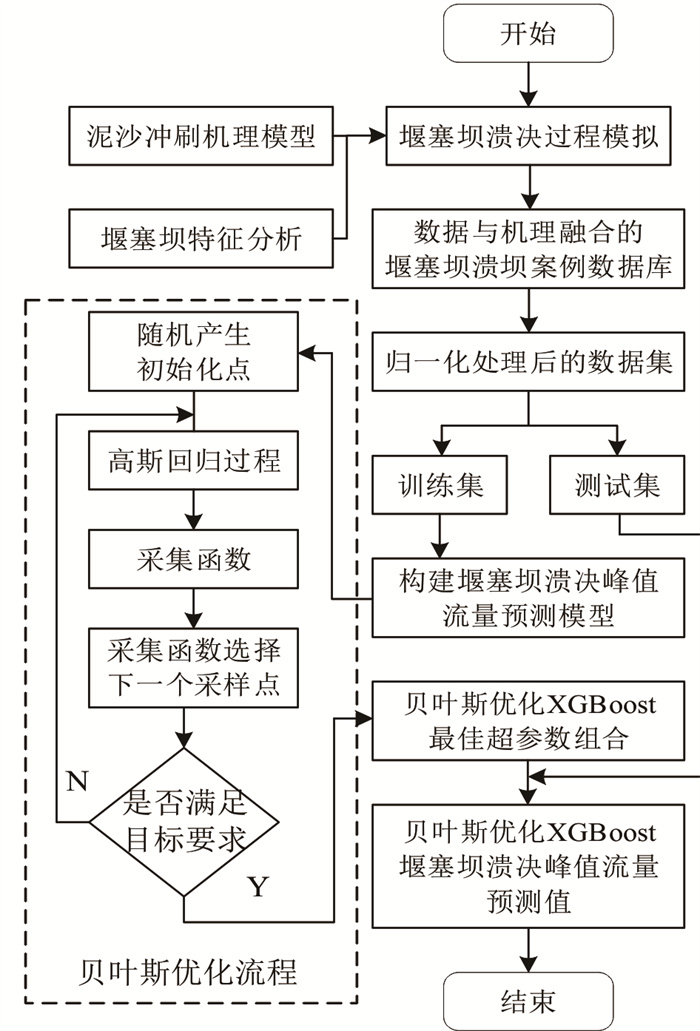
Accurate and rapid assessment of peak flood discharge from landslide dam breaches is crucial for emergency response efforts. Predicting breach parameters of sudden landslide dam failures using machine learning methods has become a current research focus. However, existing landslide dam database slack sufficient case records, and current predictive models for peak breach discharge fail to capture the nonlinear interactions among influencing factors, resulting in limited generalization capability. In response to this, this study employs a sediment erosion model to simulate the landslide dam breach process, thereby expanding the landslide dam breach case database. The Extreme Gradient Boosting (XGBoost) machine learning algorithm is used to predict the peak flood discharge of landslide dam breaches, and the Bayesian algorithm is employed to optimize the hyperparameters of the XGBoost model. An innovative machine learning prediction model for peak flood discharge of heterogeneous landslide dam breaches is proposed, considering eight influencing factors, including geometric parameters of the dam (height, width, length, volume), reservoir capacity, triggering factors, and material composition (erodibility and structural type). The results indicate that, compared to traditional models, the Bayesian-optimized XGBoost machine learning model exhibits higher prediction accuracy. Case analyses of Tangjiashan and Baige landslide dams confirm that the model's predicted peak flood discharge has a maximum error of approximately 20% compared to the actual values. This study provides a valuable reference for emergency response and regional disaster mitigation in the context of landslide dam breaches.

|
Bergen, K. J., Johnson, P. A., de Hoop, M. V., et al., 2019. Machine Learning for Data-Driven Discovery in Solid Earth Geoscience. Science, 363(6433): eaau0323. https://doi.org/10.1126/science.aau0323
|
|
Cai, Y. J., Cheng, H. Y., Wu, S. F., et al., 2020. Breaches of the Baige Barrier Lake: Emergency Response and Dam Breach Flood. Science China Technological Sciences, 63(7): 1164-1176. https://doi.org/10.1007/s11431-019-1475-y
|
|
Chen, X. Q., Cui, P., Cheng, Z. L., et al., 2008. Emergency Risk Assessment of Dammed Lakes Caused by the Wenchuan Earthquake on May 12, 2008. Earth Science Frontiers, 15(4): 244-249 (in Chinese with English abstract).
|
|
Cheng, Z. L., Xia, Y. F., Xu, H., et al., 2024. Study on the Response Mechanism of Landslide Dam Failure to External Dynamic Condition. Advances in Water Science, 35(4): 657-668 (in Chinese with English abstract).
|
|
Costa, J. E., Schuster, R. L., 1988. The Formation and Failure of Natural Dams. Geological Society of America Bulletin, 100(7): 1054-1068. https://doi.org/10.1130/0016-7606(1988)1001054:tfafon>2.3.co;2 doi: 10.1130/0016-7606(1988)1001054:tfafon>2.3.co;2
|
|
Cui, P., Zhu, Y. Y., Han, Y. S., et al., 2009. The 12 May Wenchuan Earthquake-Induced Landslide Lakes: Distribution and Preliminary Risk Evaluation. Landslides, 6(3): 209-223. https://doi.org/10.1007/s10346-009-0160-9
|
|
Feng, Z. Y., Yang, X. G., Zhou, J. W., et al., 2024. Estimation of Breach Parameters and Longevity of Landslide Dam. Journal of Hydraulic Engineering, 55(3): 367-377 (in Chinese with English abstract).
|
|
Hakimzadeh, H., Nourani, V., Amini, A. B., 2014. Genetic Programming Simulation of Dam Breach Hydrograph and Peak Outflow Discharge. Journal of Hydrologic Engineering, 19(4): 757-768. https://doi.org/10.1061/(asce)he.1943-5584.0000849
|
|
Li, D. Y., Nian, T. K., Tiong, R. L. K., et al., 2023. River Blockage and Impulse Wave Evolution of the Baige Landslide in October 2018: Insights from Coupled DEM-CFD Analyses. Engineering Geology, 321: 107169. https://doi.org/10.1016/j.enggeo.2023.107169
|
|
Long, X. Y., Hu, Y. X., Gan, B. R., et al., 2024. Numerical Simulation of the Mass Movement Process of the 2018 Sedongpu Glacial Debris Flow by Using the Fluid-Solid Coupling Method. Journal of Earth Science, 35(2): 583-596. https://doi.org/10.1007/s12583-022-1625-1
|
|
Mastbergen, D. R., Van Den Berg, J. H., 2003. Breaching in Fine Sands and the Generation of Sustained Turbidity Currents in Submarine Canyons. Sedimentology, 50(4): 625-637. https://doi.org/10.1046/j.1365-3091.2003.00554.x
|
|
Mei, S. Y., Chen, S. S., Zhong, Q. M., et al., 2022. Detailed Numerical Modeling for Breach Hydrograph and Morphology Evolution during Landslide Dam Breaching. Landslides, 19(12): 2925-2949. https://doi.org/10.1007/s10346-022-01952-1
|
|
Nian, T. K., Wu, H., Chen, G. Q., et al., 2018. Research Progress on Stability Evaluation Method and Disaster Chain Effect of Landslide Dam. Chinese Journal of Rock Mechanics and Engineering, 37(8): 1796-1812 (in Chinese with English abstract).
|
|
Peng, M., Zhang, L. M., 2012. Breaching Parameters of Landslide Dams. Landslides, 9(1): 13-31. https://doi.org/10.1007/s10346-011-0271-y
|
|
Qi, Z. J., Huang, W., Wang, L. X., et al., 2022. Evaluation and Optimization Analysis of Barrier Dam Breach Parameter Models. Yangtze River, 53(12): 157-166 (in Chinese with English abstract).
|
|
Reichstein, M., Camps-Valls, G., Stevens, B., et al., 2019. Deep Learning and Process Understanding for Data-Driven Earth System Science. Nature, 566(7743): 195-204. https://doi.org/10.1038/s41586-019-0912-1
|
|
Ruan, H. C., Chen, H. Y., Li, X., et al., 2022. Modification and Comparison of Flood Peak Discharge Prediction Model for Landslide Dam Failure Based on New Samples. Science Technology and Engineering, 22(20): 8606-8615 (in Chinese with English abstract).
|
|
Shan, Y. B., Chen, S. S., Zhong, Q. M., 2020. Rapid Prediction of Landslide Dam Stability Using the Logistic Regression Method. Landslides, 17(12): 2931-2956. https://doi.org/10.1007/s10346-020-01414-6
|
|
Shen, D. Y., Shi, Z. M., Zheng, H. C., et al., 2022. Effects of Grain Composition on the Stability, Breach Process, and Breach Parameters of Landslide Dams. Geomorphology, 413: 108362. https://doi.org/10.1016/j.geomorph.2022.108362
|
|
Shi, N., Li, Y. L., Wen, L. F., et al., 2022. Rapid Prediction of Landslide Dam Stability Considering the Missing Data Using XGBoost Algorithm. Landslides, 19(12): 2951-2963. https://doi.org/10.1007/s10346-022-01947-y
|
|
Shi, Z. M., Ma, X. L., Peng, M., et al., 2014. Statistical Analysis and Efficient Dam Burst Modelling of Landslide Dams Based on a Large-Scale Database. Chinese Journal of Rock Mechanics and Engineering, 33(9): 1780-1790 (in Chinese with English abstract).
|
|
Soulsby, R. L., 1997. Dynamics of Marine Sands: A Manual for Practical Applications. Oceanographic Literature Review, 9: 947.
|
|
Walder, J. S., O'Connor, J. E., 1997. Methods for Predicting Peak Discharge of Floods Caused by Failure of Natural and Constructed Earthen Dams. Water Resources Research, 33(10): 2337-2348. https://doi.org/10.1029/97WR01616
|
|
Wu, H., 2021. Study on the Process Simulation and Hazard Prediction Method of Landslide Damming (Dissertation). Dalian University of Technology, Dalian (in Chinese with English abstract).
|
|
Wu, H., Nian, T. K., Shan, Z. G., 2023. Investigation of Landslide Dam Life Span Using Prediction Models Based on Multiple Machine Learning Algorithms. Geomatics, Natural Hazards and Risk, 14(1): 2273213. https://doi.org/10.1080/19475705.2023.2273213
|
|
Wu, H., Nian, T. K., Shan, Z. G., 2023. Research Progress on Formation and Evolution Mechanism and Risk Prediction Method of Landslide Blocking River and Dam. Chinese Journal of Rock Mechanics and Engineering, 42(S1): 3192-3205 (in Chinese with English abstract).
|
|
Yuan, H., Guo, C. B., Wu, R. A., et al., 2023. Research Progress and Prospects of the Giant Yigong Long Run-out Landslide, Tibetan Plateau, China. Geological Bulletin of China, 42(10): 1757-1773 (in Chinese with English abstract).
|
|
Zhang, R. H., Li, Y. Q., Goh, A. T. C., et al., 2021. Analysis of Ground Surface Settlement in Anisotropic Clays Using Extreme Gradient Boosting and Random Forest Regression Models. Journal of Rock Mechanics and Geotechnical Engineering, 13(6): 1478-1484. https://doi.org/10.1016/j.jrmge.2021.08.001
|
|
Zhang, W. G., Wu, C. Z., Tang, L. B., et al., 2023. Efficient Time-Variant Reliability Analysis of Bazimen Landslide in the Three Gorges Reservoir Area Using XGBoost and LightGBM Algorithms. Gondwana Research, 123: 41-53. https://doi.org/10.1016/j.gr.2022.10.004
|
|
Zhu, X. H., Liu, B. X., Guo, J., et al., 2020. Summary of Research on Landslide Dam Break. Science Technology and Engineering, 20(21): 8440-8451 (in Chinese with English abstract).
|
|
陈晓清, 崔鹏, 程尊兰, 等, 2008.5. 12汶川地震堰塞湖危险性应急评估. 地学前缘, 15(4): 244-249.
|
|
成泽霖, 夏云峰, 徐华, 等, 2024. 滑坡堰塞坝漫顶溃决对外部动力条件的响应机制. 水科学进展, 35(4): 657-668.
|
|
冯震宇, 杨兴国, 周家文, 等, 2024. 堰塞坝溃决参数及其寿命预测. 水利学报, 55(3): 367-377.
|
|
年廷凯, 吴昊, 陈光齐, 等, 2018. 堰塞坝稳定性评价方法及灾害链效应研究进展. 岩石力学与工程学报, 37(8): 1796-1812.
|
|
齐子杰, 黄卫, 汪利先, 等, 2022. 堰塞坝溃决参数模型评估与优化分析. 人民长江, 53(12): 157-166.
|
|
阮合春, 陈华勇, 李霄, 等, 2022. 基于新样本的滑坡坝溃决洪峰流量预测模型修正与对比. 科学技术与工程, 22(20): 8606-8615.
|
|
石振明, 马小龙, 彭铭, 等, 2014. 基于大型数据库的堰塞坝特征统计分析与溃决参数快速评估模型. 岩石力学与工程学报, 33(9): 1780-1790.
|
|
吴昊, 2021. 滑坡堵江成坝过程模拟及危险性预测方法研究(博士学位论文). 大连: 大连理工大学.
|
|
吴昊, 年廷凯, 单治钢, 2023. 滑坡堵江成坝的形成演进机制及危险性预测方法研究进展. 岩石力学与工程学报, 42(增刊1): 3192-3205.
|
|
袁浩, 郭长宝, 吴瑞安, 等, 2023. 西藏易贡高位远程滑坡研究进展与展望. 地质通报, 42(10): 1757-1773.
|
|
朱兴华, 刘邦晓, 郭剑, 等, 2020. 堰塞坝溃坝研究综述. 科学技术与工程, 20(21): 8440-8451.
|
Figures(5) / Tables(5)


 DownLoad: