- 中文版:
- EI 100%收录
- 英文版
- SCI 100%收录


中国出版政府奖提名奖
中国百强科技报刊
湖北出版政府奖
中国高校百佳科技期刊
中国最美期刊
中国出版政府奖提名奖
中国百强科技报刊
湖北出版政府奖
中国高校百佳科技期刊
中国最美期刊
| Citation: | Du Zhenhan, Zhong Qiming, Zhou Jiawen, Hou Wenang, Zhang Shichen, 2026. Experimental Methodology for Modeling Disaster Chain of Near-Dam Landslide-Generated Waves and Resultant Dam Breach. Earth Science, 51(4): 1476-1488. doi: 10.3799/dqkx.2025.283

|
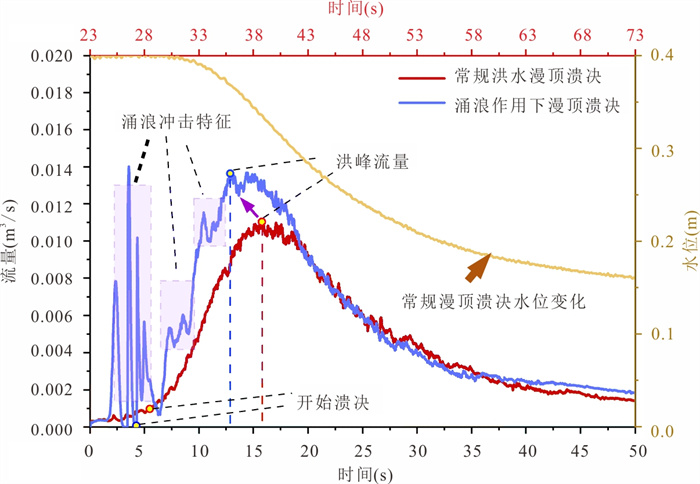
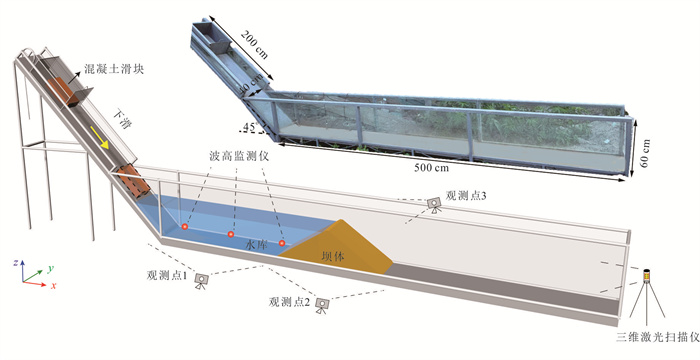
The disaster chain initiated by near-dam reservoir landslides, characterized by its abrupt onset, cascading nature, and severe destructive potential, poses a significant threat to hydraulic structures and downstream safety. This study presents integrated physical model tests simulating landslide-generated impulse waves and subsequent dam breaching. Key data on wave evolution, dam erosion, and the breach process were systematically recorded, revealing the failure mechanisms of earth-rock dams subjected to wave impact. Leveraging the experimental data, a refined three-dimensional numerical model was developed using the Finite Volume Method. This model couples modules for landslide motion, hydrodynamics, and dam material erosion. The reliability of the numerical model was validated against the experimental results. A parametric study was then conducted to investigate the influence of key factors, including landslide volume, fall height, dam geometry, and landslide location, on the breaching process. The results demonstrate that wave impact significantly accelerates dam erosion, leading to an increased peak discharge and an advanced breach timeline, highlighting a clear disaster amplification effect. This study provides both a theoretical foundation and an advanced simulation methodology for the risk identification and assessment of cascading geological hazards in near-dam reservoir areas.

|
Chen, S. Z., Xu, W. Y., Shi, A. C., et al., 2023. Review of Hazard Chain of Landslide Surge for High Dams and Large Reservoirs. Advances in Science and Technology of Water Resources, 43(3): 83-93 (in Chinese with English abstract).
|
|
Du, Z. H., Chen, X., Pan, H. Y., et al., 2025. Research Advances on Landslide-Induced Surge and Dam-Break Cascading Disasters near Dams. China Water Resources, (3): 50-57 (in Chinese with English abstract).
|
|
Du, Z. H., Zhou, J. W., Zhang, S. C., et al., 2025. Experimental Analysis on Breaching Mechanism of Earth-Rock Dam Induced by Landslide Generated Waves. Engineering Geology, 346: 107913. https://doi.org/10.1016/j.enggeo.2025.107913
|
|
Evers, F. M., Heller, V., Fuchs, H., et al., 2019. Landslide-Generated Impulse Waves in Reservoirs: Basics and Computation (2nd Edition). VAW-Mitteilung, 254.
|
|
Ghirotti, M., Stead, D., 2013. Vaiont Landslide, Italy. Springer, Netherlands.
|
|
Guo, W. L., Zhu, J. G., Wen, Y. F., 2016. Unified Description for Four Grading Scale Methods for Coarse Aggregate. Chinese Journal of Geotechnical Engineering, 38(8): 1473-1480 (in Chinese with English abstract).
|
|
Heller, V., Ruffini, G., 2023. A Critical Review about Generic Subaerial Landslide-Tsunami Experiments and Options for a Needed Step Change. Earth-Science Reviews, 242: 104459. https://doi.org/10.1016/j.earscirev.2023.104459
|
|
Hu, Y. X., Li, H. B., Li, C. J., et al., 2022. Quantitative Evaluation in Classification and Amplitude of Near-Field Landslide Generated Wave Induced by Granular Debris. Ocean Engineering, 261: 112142. https://doi.org/10.1016/j.oceaneng.2022.112142
|
|
Huang, B. L., Yin, Y. P., Li, R. J., et al., 2025. Research Progress and Challenges of Landslide-Induced Impulse Wave Prevention and Control Engineering Measures. Journal of Engineering Geology, 33(1): 159-170 (in Chinese with English abstract).
|
|
Li, S., Peng, M., Shi, Z. M., et al., 2025. Simulation and Analysis of Cascading Hazard Based on Fluid-Soil Coupled SPH Method. Earth Science, 50(10): 3967-3981 (in Chinese with English abstract).
|
|
Mastbergen, D. R., Van Den Berg, J. H., 2003. Breaching in Fine Sands and the Generation of Sustained Turbidity Currents in Submarine Canyons. Sedimentology, 50(4): 625-637. https://doi.org/10.1046/j.1365-3091.2003.00554.x
|
|
Meyer-Peter, E., Muller, R., 1948. Formulas for Bed-Load Transport. In Process of Congress IAHR, 6(2): 39-64.
|
|
Mei, S. Y., Zhong, Q. M., Chen, S. S., et al., 2023. Numerical Simulation of Breach Hydrograph and Morphology Evolution during Landslide Dam Breaching. Earth Science, 48(4): 1634-1648 (in Chinese with English abstract).
|
|
Peng, M., Jiang, Q. L., Zhang, Q. Z., et al., 2019. Stability Analysis of Landslide Dams under Surge Action Based on Large-Scale Flume Experiments. Engineering Geology, 259: 105191. https://doi.org/10.1016/j.enggeo.2019.105191
|
|
Peng, M., Ma, C. Y., Chen, H. X., et al., 2021. Experimental Study on Breaching Mechanisms of Landslide Dams Composed of Different Materials under Surge Waves. Engineering Geology, 291: 106242. https://doi.org/10.1016/j.enggeo.2021.106242
|
|
Peng, M., Wang, Y., Ma, C. Y., et al., 2025. Review of Risk Assessment and Prevention for Valley Landslide Disaster Chains. Earth Science, 50(10): 3723-3760 (in Chinese with English abstract).
|
|
Peng, M., Zhao, Q. X., Li, S., et al., 2025. Two-Phase SPH Simulation of Granular Landslide-Tsunamis Processes Considering Dynamic Seepage. Earth Science, 50(10): 3795-3808 (in Chinese with English abstract).
|
|
Pourshahbaz, H., Abbasi, S., Pandey, M., et al., 2022. Morphology and Hydrodynamics Numerical Simulation around Groynes. ISH Journal of Hydraulic Engineering, 28(1): 53-61. https://doi.org/10.1080/09715010.2020.1830000
|
|
PRC Ministry of Water Resources, 2012a. Regulations for River Model Test (SL 99-2012). China Water and Power Press, Beijing (in Chinese).
|
|
PRC Ministry of Water Resources, 2012b. Test Regulation for Normal Hydraulic Model (SL 155-2012). China Water and Power Press, Beijing (in Chinese).
|
|
PRC Ministry of Water Resources, 2019. Regulation for Simulation of Landslide Generated Waves (SL/T 165-2019). China Water and Power Press, Beijing (in Chinese).
|
|
Qi, B., Du, Z. H., Zhang, S. C., 2023. Study on the Construction of Early Warning System for Reservoir Flood Discharge in China. Hydraulic and Civil Engineering (Technology Ⅷ), 43: 783-790. https://doi.org/10.3233/atde230797
|
|
Rauter, M., Hoße, L., Mulligan, R. P., et al., 2021. Numerical Simulation of Impulse Wave Generation by Idealized Landslides with OpenFOAM. Coastal Engineering, 165: 103815. https://doi.org/10.1016/j.coastaleng.2020.103815
|
|
Sabeti, R., Heidarzadeh, M., 2022. Numerical Simulations of Water Waves Generated by Subaerial Granular and Solid-Block Landslides: Validation, Comparison, and Predictive Equations. Ocean Engineering, 266(3): 112853. https://doi.org/10.1016/j.oceaneng.2022.112853
|
|
Samma, H., Khosrojerdi, A., Rostam-Abadi, M., et al., 2020. Numerical Simulation of Scour and Flow Field over Movable Bed Induced by a Submerged Wall Jet. Journal of Hydroinformatics, 22(2): 385-401. https://doi.org/10.2166/hydro.2020.091
|
|
Sattar, A., Cook, K. L., Rai, S. K., et al., 2025. The Sikkim Flood of October 2023: Drivers, Causes, and Impacts of a Multihazard Cascade. Science, 387(6740): eads2659. https://doi.org/10.1126/science.ads2659
|
|
Semenza, E., Ghirotti, M., 2000. History of the 1963 Vaiont Slide: The Importance of Geological Factors. Bulletin of Engineering Geology and the Environment, 59(2): 87-97. https://doi.org/10.1007/s100640000067
|
|
Singh, A., Anand, V., Durga Rao, K. H. V., et al., 2025. Unveiling the Catastrophic Landslide-Induced Flash Flood in Teesta River, Sikkim: Insight from South Lhonak Glacial Lake. Landslides, 22(3): 837-855. https://doi.org/10.1007/s10346-024-02378-7
|
|
Su, Z. Y., Kang, X., Ding, X. C., et al., 2026. SPH-DEM Modeling of Rainfall-Induced Slope Failure in Partially Saturated Soil-Rock Mixture. Computers and Geotechnics, 189: 107635. https://doi.org/10.1016/j.compgeo.2025.107635
|
|
Su, Z. Y., Wang, S., Li, D. Q., et al., 2024. SPH–DEM Modeling Overtopping Failure of Earthfill Dams. Acta Geotechnica, 19(2): 953-970. https://doi.org/10.1007/s11440-024-02258-3
|
|
Tang, C. L., Hu, J. C., Lin, M. L., et al., 2009. The Tsaoling Landslide Triggered by the Chi-Chi Earthquake, Taiwan: Insights from a Discrete Element Simulation. Engineering Geology, 106(1-2): 1-19. https://doi.org/10.1016/j.enggeo.2009.02.011
|
|
Wang, W., Chen, G. Q., Zhang, Y. B., et al., 2017. Dynamic Simulation of Landslide Dam Behavior Considering Kinematic Characteristics Using a Coupled DDA-SPH Method. Engineering Analysis with Boundary Elements, 80: 172-183. https://doi.org/10.1016/j.enganabound.2017.02.016
|
|
Zhong, Q. M., Wang, L., Chen, S. S., et al., 2021. Breaches of Embankment and Landslide Dams-State of the Art Review. Earth-Science Reviews, 216: 103597. https://doi.org/10.1016/j.earscirev.2021.103597
|
|
陈世壮, 徐卫亚, 石安池, 等, 2023. 高坝大库滑坡涌浪灾害链研究综述. 水利水电科技进展, 43(3): 83-93.
|
|
杜镇瀚, 陈祥, 潘洪月, 等, 2025. 近坝库岸滑坡涌浪-溃坝链生灾害研究进展. 中国水利(3): 50-57.
|
|
郭万里, 朱俊高, 温彦锋, 2016. 对粗粒料4种级配缩尺方法的统一解释. 岩土工程学报, 38(8): 1473-1480.
|
|
黄波林, 殷跃平, 李仁江, 等, 2025. 滑坡涌浪综合防控工程措施研究进展与挑战. 工程地质学报, 33(1): 159-170.
|
|
李爽, 彭铭, 石振明, 等, 2025. 基于水土耦合SPH方法的滑坡-堵江-成坝灾害链全过程动力演化模拟. 地球科学, 50(10): 3967-3981. doi: 10.3799/dqkx.2025.112
|
|
梅胜尧, 钟启明, 陈生水, 等, 2023. 堰塞体溃决流量与溃口形态演化数值模拟. 地球科学, 48(4): 1634-1648. doi: 10.3799/dqkx.2022.360
|
|
彭铭, 王悦, 马晨议, 等, 2025a. 河谷滑坡灾害链风险评估及防控研究进展. 地球科学, 50(10): 3723-3760. doi: 10.3799/dqkx.2025.142
|
|
彭铭, 赵庆新, 李爽, 等, 2025b. 考虑动态渗流的散粒体滑坡-涌浪过程两相SPH模拟. 地球科学, 50(10): 3795-3808. doi: 10.3799/dqkx.2025.100
|
|
中华人民共和国水利部, 2012a. 河工模型试验规程(SL 99-2012). 北京: 中国水利水电出版社.
|
|
中华人民共和国水利部, 2012b. 水工(常规)模型试验规程(SL 155-2012). 北京: 中国水利水电出版社.
|
|
中华人民共和国水利部, 2019. 滑坡涌浪模拟技术规程(SL/T 165-2019). 北京: 中国水利水电出版社.
|
Figures(10) / Tables(3)


 DownLoad: