- 中文版:
- EI 100%收录
- 英文版
- SCI 100%收录


中国出版政府奖提名奖
中国百强科技报刊
湖北出版政府奖
中国高校百佳科技期刊
中国最美期刊
中国出版政府奖提名奖
中国百强科技报刊
湖北出版政府奖
中国高校百佳科技期刊
中国最美期刊
| Citation: | Bai Ru, Sun Tao, 2026. A Review on the Fifty-Year Development Trajectory and Hotspot Evolution of Mineral Prospectivity Mapping: A Bibliometrics Perspective. Earth Science, 51(3): 862-880. doi: 10.3799/dqkx.2026.003

|
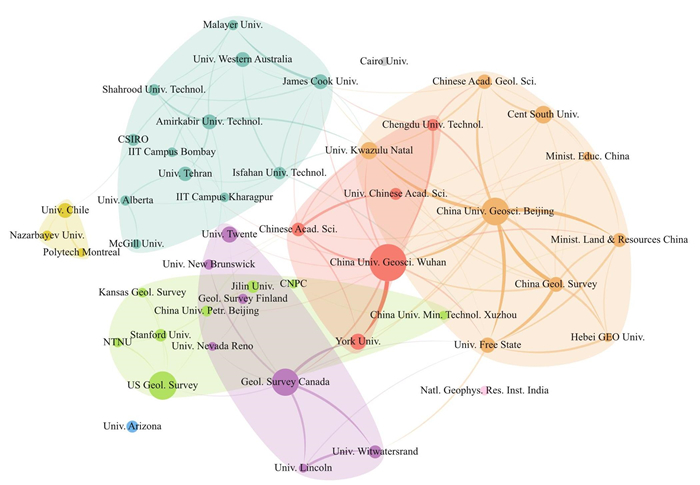
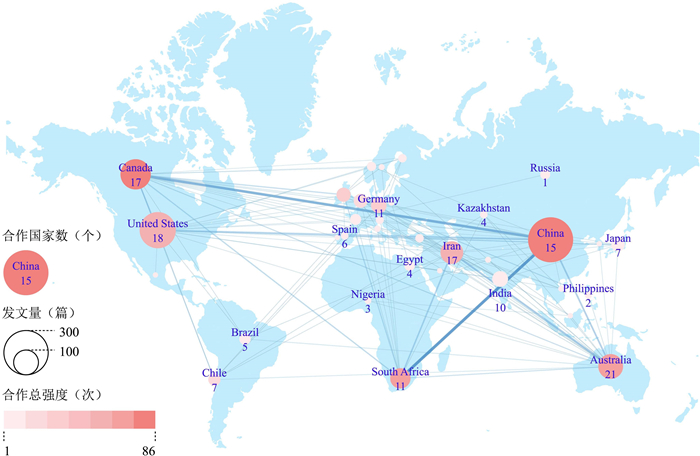
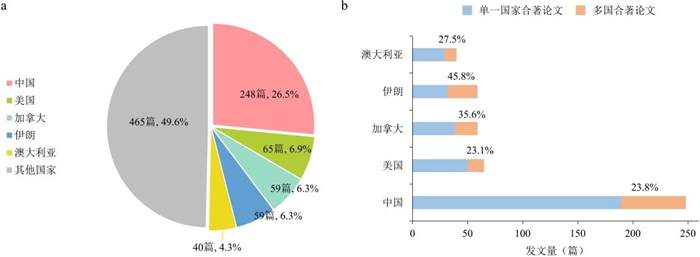
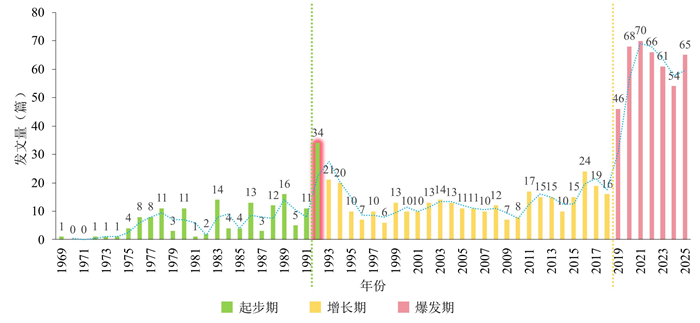
Mineral exploration is a fundamental task for safeguarding national resource security and the stability of industrial supply chain. As a core step of mineral exploration, mineral prospectivity mapping (MPM) has undergone transformative development, driven by big data and artificial intelligence, emerging as a prominent research field within Earth science and accumulating a substantial volume of literature. In this study, we employ bibliometric methods to analyze and discuss the research status, developmental trajectory, and hotspot evolution of MPM over the past five decades, based on a dataset of 935 relevant publications from three flagship journals of the International Association for Mathematical Geosciences, spanning from 1969 to 2025. Bibliometric statistics on authors, institutions, and countries reveal that Carranza E.J.M. and Zuo Renguang are the most highly productive and highly cited scholars in the field as listed as author and first/corresponding author, respectively. China is the largest contributor of publications in this field, and the China University of Geosciences (Wuhan) ranks first in global institutions in both publication volume and total citation. The analysis of collaboration networks indicates a strong regional orientation, lacking a high-level and regular international cooperative research network. The evolution of MPM, based on the hotspot analysis of keywords, is divided into three distinct stages, namely the foundation stage (1969-1990), the expansion stage (1991-2010), and the boom stage (2011-2025). The thematic focus and developmental trajectory of each stage are determined by the prevailing technologies and algorithms of the era. The foundation stage, focusing on mineral resource assessment, was dominated by geostatistics (variogram and Kriging). The rise and widespread application of GIS technology during the expansion stage facilitated the shift of MPM into the mainstream scientific task. In the boom stage, the prevalence of machine learning algorithms led to the dominance of intelligent MPM in the thematic tasks. Recent research hotspots and trends indicate a shift from relying solely on high-performance predictive models towards in-depth exploration and optimization of the internal mechanisms of intelligent models. The focus is on leveraging cutting-edge AI technologies to address inherent challenges such as the black-box nature of decision processes and sample scarcity. Although advanced deep learning algorithms have gained significant traction, classic shallow learning algorithms, such as support vector machine, which exhibits great performance in processing high-dimensional data and nonlinear problems, and random forest characterized by its strong resistance to overfitting, remain popular choices among scholars in this field during the boom stage due to their high suitability for few-shot MPM tasks. By leveraging quantitative statistical and visualization tools, this study provides a macro and comprehensive perspective for understanding the development of MPM, and offers critical insights into future research directions of intelligent prediction in MPM.

|
Abedi, M., Norouzi, G. H., Bahroudi, A., 2012. Support Vector Machine for Multi-Classification of Mineral Prospectivity Areas. Computers & Geosciences, 46: 272-283. https://doi.org/10.1016/j.cageo.2011.12.014
|
|
Agterberg, F. P., 1974. Automatic Contouring of Geological Maps to Detect Target Areas for Mineral Exploration. Journal of the International Association for Mathematical Geology, 6(4): 373-395. https://doi.org/10.1007/BF02082358
|
|
Allais, M., 1957. Method of Appraising Economic Prospects of Mining Exploration over Large Territories: Algerian Sahara Case Study. Management Science, 3(4): 285-347. https://doi.org/10.1287/mnsc.3.4.285
|
|
Aria, M., Cuccurullo, C., 2017. Bibliometrix: An R-Tool for Comprehensive Science Mapping Analysis. Journal of Informetrics, 11(4): 959-975. https://doi.org/10.1016/j.joi.2017.08.007
|
|
Barry, G. S., Freyman, A. J., 1970. Mineral Endowment of the Canadian Northwest: A Subjective Probability Assessment. Canadian Mining and Metallurgical Bulletin, 63(701): 1031-1042.
|
|
Carranza, E. J. M., Laborte, A. G., 2015. Random Forest Predictive Modeling of Mineral Prospectivity with Small Number of Prospects and Data with Missing Values in Abra (Philippines). Computers & Geosciences, 74: 60-70. https://doi.org/10.1016/j.cageo.2014.10.004
|
|
Chen, C. M., 2006. CiteSpace Ⅱ: Detecting and Visualizing Emerging Trends and Transient Patterns in Scientific Literature. Journal of the American Society for Information Science and Technology, 57(3): 359-377. https://doi.org/10.1002/asi.20317
|
|
Cheng, Q. M., 2025. A New Paradigm for Mineral Resource Prediction Based on Human Intelligence-Artificial Intelligence Integration. Earth Science Frontiers, 32(4): 1-19 (in Chinese with English abstract).
|
|
Cheng, Q. M., Agterberg, F. P., 1999. Fuzzy Weights of Evidence Method and Its Application in Mineral Potential Mapping. Natural Resources Research, 8(1): 27-35. https://doi.org/10.1023/A:1021677510649
|
|
Cheng, Q. M., Xu, Y. G., Grunsky, E., 2000. Integrated Spatial and Spectrum Method for Geochemical Anomaly Separation. Natural Resources Research, 9(1): 43-52. https://doi.org/10.1023/A:1010109829861
|
|
Cressie, N., 1988. Spatial Prediction and Ordinary Kriging. Mathematical Geology, 20(4): 405-421. https://doi.org/10.1007/BF00892986
|
|
Ellegaard, O., Wallin, J. A., 2015. The Bibliometric Analysis of Scholarly Production: How Great is the Impact? Scientometrics, 105(3): 1809-1831.
|
|
Fang, Y. Y., 1987. Achievements of Computer Application in Our Institute during the "Sixth Five-Year Plan" Period. Earth Science, 12(3): 276-320, 256 (in Chinese with English abstract).
|
|
Filzmoser, P., Garrett, R. G., Reimann, C., 2005. Multivariate Outlier Detection in Exploration Geochemistry. Computers & Geosciences, 31(5): 579-587. https://doi.org/10.1016/j.cageo.2004.11.013
|
|
Garfield, E., 2009. From the Science of Science to Scientometrics Visualizing the History of Science with HistCite Software. Journal of Informetrics, 3(3): 173-179. https://doi.org/10.1016/j.joi.2009.03.009
|
|
Gui, B. L., 1984. Principles for Estimating the Accuracy and Reliability of Mineral Resources Prediction and Assessment. Geological Review, 30(6): 536-543 (in Chinese with English abstract).
|
|
Harris, D. P., 1973. A Subjective Probability Appraisal of Metal Endowment of Northern Sonora, Mexico. Economic Geology, 68(2): 222-242. https://doi.org/10.2113/gsecongeo.68.2.222
|
|
Hassan-Montero, Y., De-Moya-Anegón, F., Guerrero-Bote, V. P., 2022. SCImago Graphica: A New Tool for Exploring and Visually Communicating Data. El Profesional de la Información, : e310502. https://doi.org/10.3145/epi.2022.sep.02
|
|
Jing, L. H., Li, G. M., Ding, H. F., et al., 2025. Remote Sensing Prospecting, Geological Evaluation, and Significant Discovery of Porphyry Copper Deposits in the Middle-Western Segment of Bangonghu-Nujiang Metallogenic Belt, Tibet. Acta Petrologica Sinica, 41(2): 362-382 (in Chinese with English abstract). doi: 10.18654/1000-0569/2025.02.02
|
|
Kang, Q. L., Ding, Y. N., 2024. A Bibliometric Analysis of Global Research Trends of Exercise in Oncology during the Past Three Decades. Journal of Clinical and Nursing Research, 8(4): 219-224. https://doi.org/10.26689/jcnr.v8i4.6787
|
|
Mao, X. C., 2006. Research on 3D Digital Deposit and Stereo Quantitative Prediction of Concealed Ore Body (Dissertation). Central South University, Changsha (in Chinese with English abstract).
|
|
Mao, X. C., Chen, G. G., 1988. The Xianghualing Sn-Deposit: Its Mathematical Model and Three-Dimensional Quantitative Prognostication. Geology and Prospecting, 24(10): 25-31 (in Chinese with English abstract).
|
|
Mao, X. C., Duan, X., Deng, H., et al., 2026. Intelligent 3D Prediction of Deep Mineral Resources: Theory, Methods, and Challenges. Earth Science, 51(3): 793-815 (in Chinese with English abstract).
|
|
Porwal, A., Carranza, E. J. M., Hale, M., 2003. Knowledge-Driven and Data-Driven Fuzzy Models for Predictive Mineral Potential Mapping. Natural Resources Research, 12(1): 1-25. https://doi.org/10.1023/A:1022693220894
|
|
Price, D. J. D. S., 1963. Little Science, Big Science. Columbia University Press, New York.
|
|
Pritchard, A., 1969. Statistical Bibliography or Bibliometrics. Journal of Documentation, 25: 348
|
|
Shi, L. Y., Zuo, R. G., 2026. Foundation Model for Mineral Prospectivity Mapping. Earth Science, 51(3): 832-848 (in Chinese with English abstract).
|
|
Sun, T., Liu, Y., Bai, R., et al., 2025. Intelligent Mapping of Tungsten Prospectivity in Southern Jiangxi Province. Central South University Press, Changsha (in Chinese).
|
|
Thiergärtner, H., 2006. Theory and Practice in Mathematical Geology—Introduction and Discussion. Mathematical Geology, 38(6): 659-665. https://doi.org/10.1007/s11004-006-9041-0
|
|
van Eck, N. J., Waltman, L., 2010. Software Survey: VOSviewer, a Computer Program for Bibliometric Mapping. Scientometrics, 84(2): 523-538. https://doi.org/10.1007/s11192-009-0146-3
|
|
Wang, S. C., Cheng, Q. M., Fan, J. Z., 1989. Modelling of Gold Deposit Prospecting. Journal of Jilin University (Earth Science Edition), 19(3): 311-316 (in Chinese with English abstract).
|
|
Wang, Y. Z., Wen, S. B., Li, B. W., et al., 2025. Construction Technology of Super-Agents for Intelligent Mineral Resources Prediction Driven by Large Model. Earth Science Frontiers, 32(4): 38-45 (in Chinese with English abstract).
|
|
Xiao, K. Y., Li, C., Tang, R., et al., 2025. Big Data Intelligent Prediction and Evaluation. Earth Science Frontiers, 32(4): 20-37 (in Chinese with English abstract).
|
|
Xiong, Y. H., Zuo, R. G., 2016. Recognition of Geochemical Anomalies Using a Deep Autoencoder Network. Computers & Geosciences, 86: 75-82. https://doi.org/10.1016/j.cageo.2015.10.006
|
|
Yousefi, M., Carranza, E. J. M., 2015. Prediction-Area (P-A) Plot and C-A Fractal Analysis to Classify and Evaluate Evidential Maps for Mineral Prospectivity Modeling. Computers & Geosciences, 79: 69-81. https://doi.org/10.1016/j.cageo.2015.03.007
|
|
Yu, C. W., 2003. The Complexity of Geological Systems. Geological Publishing House, Beijing (in Chinese).
|
|
Yuan, F., Zhang, M. M., Li, X. H., et al., 2019. Prospectivity Modeling: From Twodimension to Three-Dimension. Acta Petrologica Sinica, 35(12): 3863-3874 (in Chinese with English abstract). doi: 10.18654/1000-0569/2019.12.18
|
|
Zhang, H. W., Sun, T., 2025. Bibliometric Analysis of Mineral Prospectivity Mapping Research from 2006 to 2024. Natural Resources Research, 1-27. https://doi.org/10.1007/s11053-025-10560-4
|
|
Zhang, X. Y., Zhang, Z. W., Zou, T. Y., et al., 2025. Research Status and Development Trend of Mine Pollution Control and Ecological Restoration Based on Bibliometrics Analysis. Environmental Pollution & Control, 47(10): 123-134 (in Chinese with English abstract).
|
|
Zhao, P. D., Hu, W. L., Li, Z. J., 1983. Statistical Prediction of Ore Deposits. Geological Publishing House, Beijing (in Chinese).
|
|
Zhou, Y. Z., Zuo, R. G., Liu, G., et al., 2021. The Great-Leap-Forward Development of Mathematical Geoscience during 2010-2019: Big Data and Artificial Intelligence Algorithm Are Changing Mathematical Geoscience. Bulletin of Mineralogy, Petrology and Geochemistry, 40(3): 556-573, 777 (in Chinese with English abstract).
|
|
Zhu, Z. S., Zhang, Q. X., Yang, L. Q., 1990. Differentiation Theory and Model-Free Prediction. IWSPMR' 90, Wuhan (in Chinese).
|
|
Zhu, Z. S., Zhu, L., 1998. Prediction Theory and Method System of Deposits. Journal of Chengdu University of Technology (Science & Technology Edition), 25(S1): 6-12 (in Chinese with English abstract).
|
|
Zuo, R. G., 2025. Key Technology for Intelligent Mineral Prospectivity Mapping: Challenges and Solutions. Scientia Sinica (Terrae), 55(9): 3104-3119 (in Chinese with English abstract). doi: 10.1360/SSTe-2025-0096
|
|
Zuo, R. G., Carranza, E. J. M., 2011. Support Vector Machine: A Tool for Mapping Mineral Prospectivity. Computers & Geosciences, 37(12): 1967-1975. https://doi.org/10.1016/j.cageo.2010.09.014
|
|
Zuo, R. G., Carranza, E. J. M., 2023. Machine Learning-Based Mapping for Mineral Exploration. Mathematical Geosciences, 55(7): 891-895. https://doi.org/10.1007/s11004-023-10097-3
|
|
Zuo, R. G., Cheng, Q. M., Xu, Y., et al., 2024. Explainable Artificial Intelligence Models for Mineral Prospectivity Mapping. Scientia Sinica (Terrae), 54(9): 2917-2928 (in Chinese with English abstract). doi: 10.1360/N072024-0018
|
|
Zuo, R. G., Kreuzer, O. P., Wang, J., et al., 2021. Uncertainties in GIS-Based Mineral Prospectivity Mapping: Key Types, Potential Impacts and Possible Solutions. Natural Resources Research, 30(5): 3059-3079. https://doi.org/10.1007/s11053-021-09871-z
|
|
成秋明, 2025. 面向人类智能与人工智能融合的矿产资源预测新范式. 地学前缘, 32(4): 1-19.
|
|
方玉禹, 1987. 我院"六五"期间计算机应用成果. 地球科学, 12(3): 276-320, 256.
|
|
桂宝林, 1984. 矿产资源预测评价精确性与可靠性的估计原则. 地质论评, 30(6): 536-543.
|
|
荆林海, 李光明, 丁海峰, 等, 2025. 班怒带中西段斑岩铜矿遥感选区、地质评价与重大发现. 岩石学报, 41(2): 362-382.
|
|
毛先成, 2006. 三维数字矿床与隐伏矿体立体定量预测研究(博士学位论文). 长沙: 中南大学.
|
|
毛先成, 陈国珖, 1988. 香花岭锡矿床数学模型及立体定量预测初探. 地质与勘探, 24(10): 25-31.
|
|
毛先成, 段新明, 邓浩, 等, 2026. 深部矿产三维智能预测理论、方法与挑战. 地球科学, 51(3): 793-815. doi: 10.3799/dqkx.2025.227
|
|
师路易, 左仁广, 2026. 矿产预测大模型. 地球科学, 51(3): 832-848. doi: 10.3799/dqkx.2025.190
|
|
孙涛, 刘月, 白茹, 等, 2025. 赣南钨资源成矿潜力智能预测. 长沙: 中南大学出版社.
|
|
王世称, 成秋明, 范继璋, 1989. 金矿综合信息找矿模型. 长春地质学院学报, 19(3): 311-316.
|
|
王永志, 温世博, 李博文, 等, 2025. 大模型驱动的矿产资源智能预测超级智能体构建方法探索. 地学前缘, 32(4): 38-45.
|
|
肖克炎, 李程, 唐瑞, 等, 2025. 大数据智能预测评价. 地学前缘, 32(4): 20-37.
|
|
於崇文, 2003. 地质系统的复杂性. 北京: 地质出版社.
|
|
袁峰, 张明明, 李晓晖, 等, 2019. 成矿预测: 从二维到三维. 岩石学报, 35(12): 3863-3874.
|
|
张向阳, 张宗文, 邹天远, 等, 2025. 基于文献计量学的矿山污染治理和生态修复研究现状及发展趋势. 环境污染与防治, 47(10): 123-134.
|
|
赵鹏大, 胡旺亮, 李紫金, 1983. 矿床统计预测. 北京: 地质出版社.
|
|
周永章, 左仁广, 刘刚, 等, 2021. 数学地球科学跨越发展的十年: 大数据、人工智能算法正在改变地质学. 矿物岩石地球化学通报, 40(3): 556-573, 777.
|
|
朱章森, 张庆希, 杨丽清, 1990. 求异理论与无模型预测. 矿产资源统计预测国际学术讨论会, 武汉.
|
|
朱章森, 朱磊, 1998. 矿床定量预测理论与方法体系. 成都理工大学学报(自然科学版), 25(S1): 6-12.
|
|
左仁广, 2025. 智能矿产预测的技术挑战与解决方案. 中国科学: 地球科学, 55(9): 3104-3119.
|
|
左仁广, 成秋明, 许莹, 等, 2024. 可解释性矿产预测人工智能模型. 中国科学: 地球科学, 54(9): 2917-2928.
|
Figures(10) / Tables(5)


 DownLoad: