- 中文版:
- EI 100%收录
- 英文版
- SCI 100%收录


中国出版政府奖提名奖
中国百强科技报刊
湖北出版政府奖
中国高校百佳科技期刊
中国最美期刊
中国出版政府奖提名奖
中国百强科技报刊
湖北出版政府奖
中国高校百佳科技期刊
中国最美期刊
| Citation: | Liu Xiaobo, He Lianyi, Huang Huaijin, Xiang Hongbo, Cai Zhihua, Li Changhe, 2026. Geological Modeling Method of Generative Adversarial Networks Based on Multi-Scale Feature Fusion and Depthwise Separable Convolutions. Earth Science, 51(3): 1110-1128. doi: 10.3799/dqkx.2026.009

|
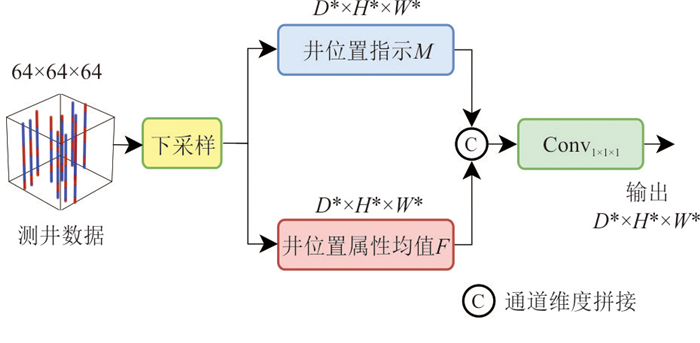
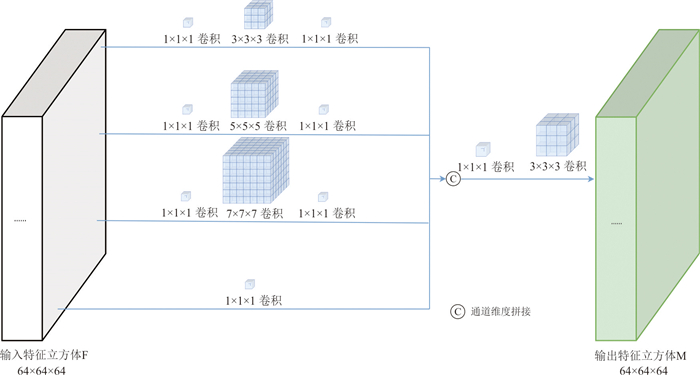
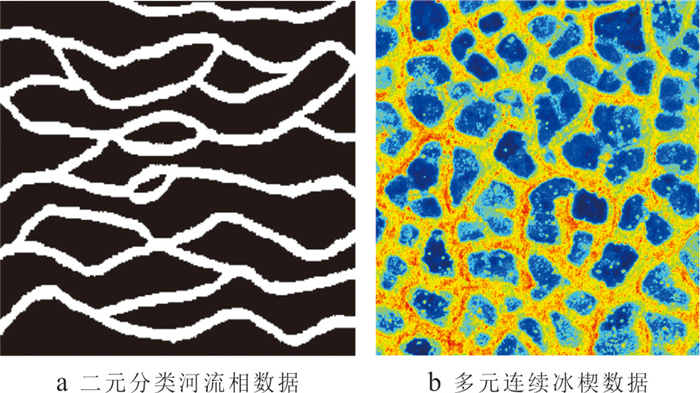
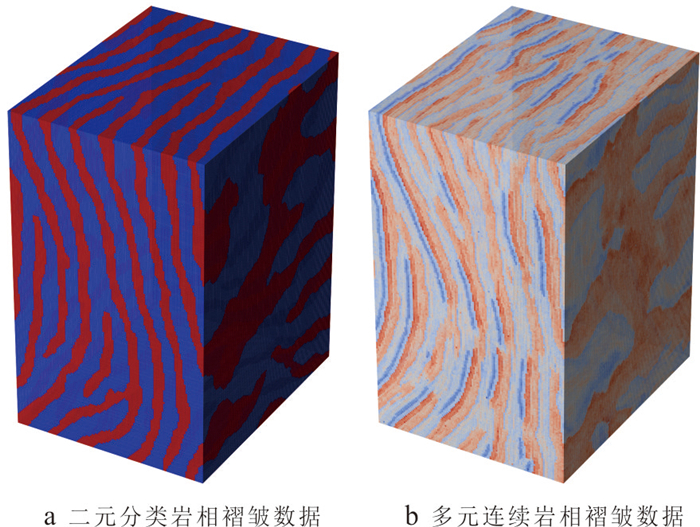
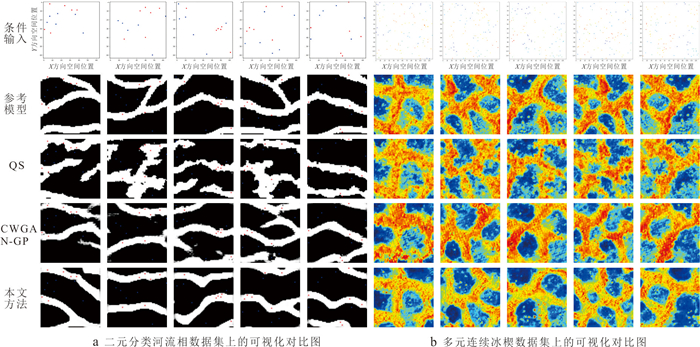
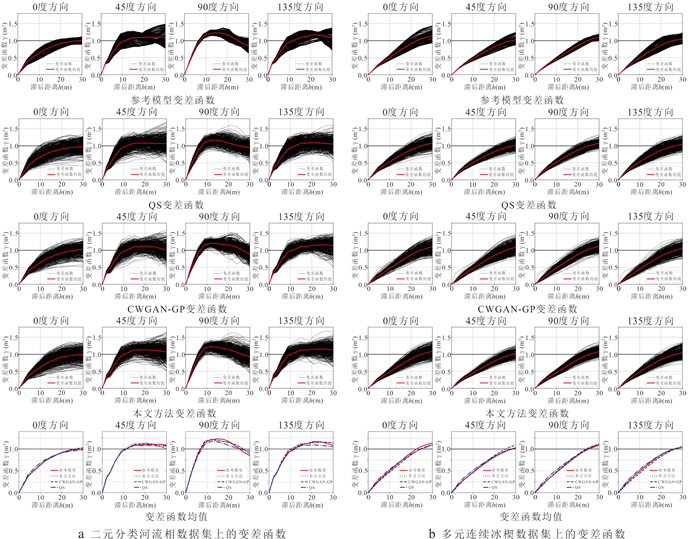
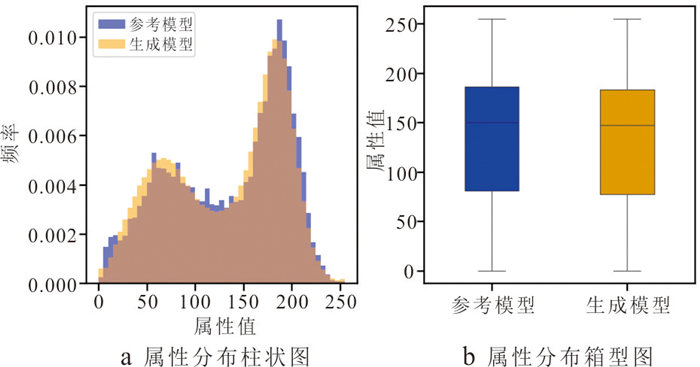
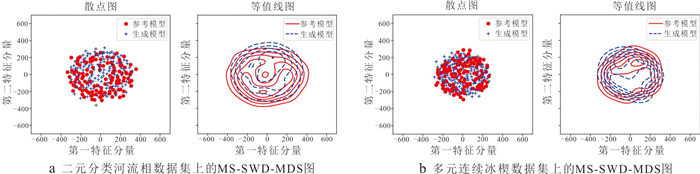
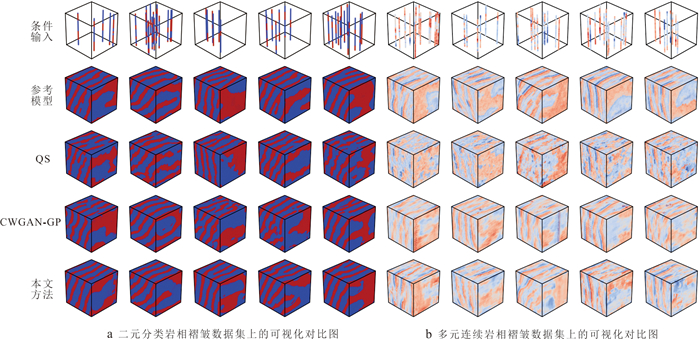
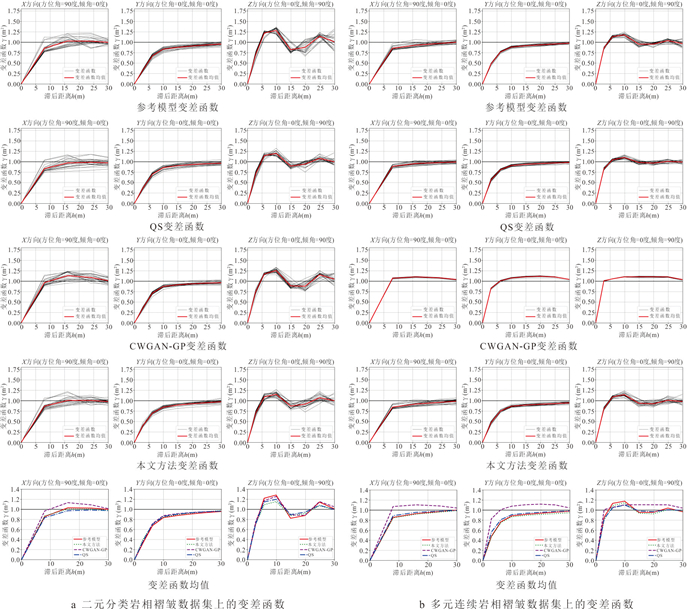
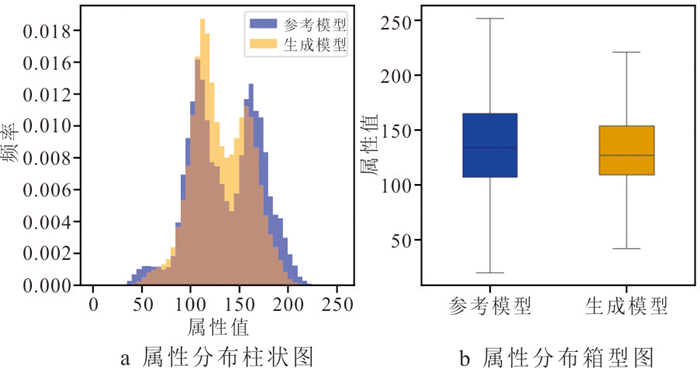
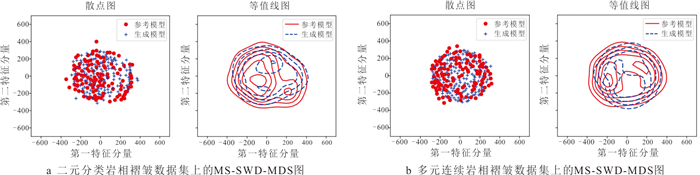
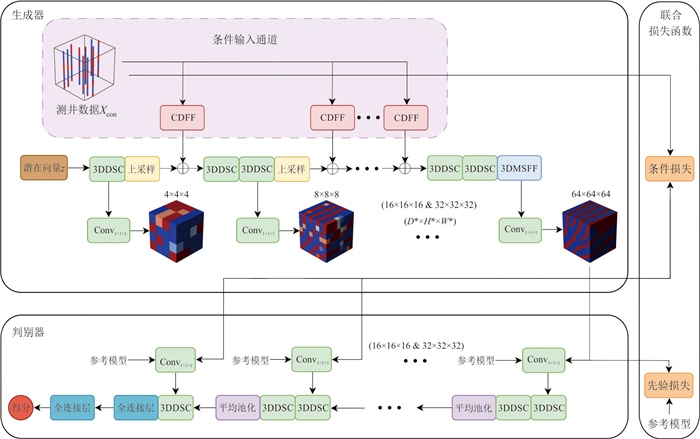
Complex geological structure modeling is of significant importance in fields such as resources exploration, underground engineering design, and geological hazard prediction. Generative Adversarial Networks (GANs) have demonstrated strong nonlinear modeling capabilities and pattern transfer abilities in geological modeling. However, when dealing with complex geological constraints and the reconstruction of fine structures, they still face challenges in modeling accuracy, structural connectivity, and modeling efficiency. To address these issues, this paper proposes a GAN-based geological modeling method incorporating multi-scale feature fusion and deep separable convolutions. A multi-scale feature fusion module enhances the expression of geological structure details and overall consistency, while deep separable convolutions reduce model parameters and computational costs, improving modeling efficiency. Additionally, a conditional feature adaptive fusion and progressive resolution generation strategy enhances the model's sensitivity to conditional data. To validate the method's effectiveness, typical models including two-dimensional river phases, multi-attribute ice wedges, and three-dimensional fold structures were selected. Systematic evaluations were conducted across spatial variability, connectivity, attribute consistency, and conditional point reconstruction accuracy. Comparative analyses were performed against multi-point statistical methods (e.g., QS) and an improved generative adversarial network (e.g., CWGAN-GP). The results show that at resolutions of 64×64 and 64×64×64, the MS-SWD indicators of the generated models for the two-dimensional and three-dimensional datasets are 0.016, 0.025, 0.007 9, and 0.008 7 respectively, which are significantly lower than those of the comparison methods. At the same time, the average connected region size of the generated models is closest to that of the reference model (300.59 pixels for the two-dimensional river data and 17 814.17 pixels for the three-dimensional fold data). In terms of overall accuracy, the accuracy rate and MSE indicators of the proposed method are superior to those of the comparison method (73.24%, 69.48% and 0.024, 0.047 respectively), and the advantages in efficiency and parameter quantity are proved through efficiency analysis and ablation experiments. The experiments show that the proposed method is suitable for efficient modeling tasks of complex non-stationary geological bodies since it significantly improves the modeling efficiency while ensuring reasonable and high fidelity, endowed with broad engineering application prospects.

|
Abedi, M., Norouzi, G. H., 2012. Integration of Various Geophysical Data with Geological and Geochemical Data to Determine Additional Drilling for Copper Exploration. Journal of Applied Geophysics, 83: 35-45. https://doi.org/10.1016/j.jappgeo.2012.05.003
|
|
Chan, S., Elsheikh, A. H., 2019. Parametric Generation of Conditional Geological Realizations Using Generative Neural Networks. Computational Geosciences, 23(5): 925-952. https://doi.org/10.1007/s10596-019-09850-7
|
|
Chen, Q. Y., Cui, Z. S., Liu, G., et al., 2022. Deep Convolutional Generative Adversarial Networks for Modeling Complex Hydrological Structures in Monte-Carlo Simulation. Journal of Hydrology, 610: 127970. https://doi.org/10.1016/j.jhydrol.2022.127970
|
|
Cui, Z. S., Chen, Q. Y., Liu, G., et al., 2024a. SA-RelayGANs: A Novel Framework for the Characterization of Complex Hydrological Structures Based on GANs and Self-Attention Mechanism. Water Resources Research, 60: e2023WR035932. https://doi.org/10.1029/2023wr035932
|
|
Cui, Z. S., Chen, Q. Y., Luo, J., et al., 2024b. Characterizing Subsurface Structures from Hard and Soft Data with Multiple-Condition Fusion Neural Network. Water Resources Research, 60(11): e2024WR038170. https://doi.org/10.1029/2024wr038170
|
|
Fan, W. Y., Liu, G., Chen, Q. Y., et al., 2023. Geological Model Automatic Reconstruction Based on Conditioning Wasserstein Generative Adversarial Network with Gradient Penalty. Earth Science Informatics, 16(3): 2825-2843. https://doi.org/10.1007/s12145-023-01012-9
|
|
Feng, R. H., Mosegaard, K., Grana, D., et al., 2024. Stochastic Facies Inversion with Prior Sampling by Conditional Generative Adversarial Networks Based on Training Image. Mathematical Geosciences, 56(4): 665-690. https://doi.org/10.1007/s11004-023-10119-0
|
|
Gravey, M., Mariethoz, G., 2020. QuickSampling V1.0: A Robust and Simplified Pixel-Based Multiple-Point Simulation Approach. Geoscientific Model Development, 13(6): 2611-2630. https://doi.org/10.5194/gmd-13-2611-2020
|
|
Heusel, M., Ramsauer, H., Unterthiner, T., et al., 2017. Gans Trained by a Two Time-Scale Update Rule Converge to a Local Nash Equilibrium. arXiv, 1706.08500. https://doi.org/10.48550/arXiv.1706.08500
|
|
Hou, W. S., Liu, H. G., Zheng, T. C., et al., 2022. Extended GOSIM: MPS-Driven Simulation of 3D Geological Structure Using 2D Cross-Sections. Earth and Space Science, 9(6): e2021EA001801. https://doi.org/10.1029/2021ea001801
|
|
Hu, F., Wu, C. L., Shang, J. W., et al., 2023. Multi-Condition Controlled Sedimentary Facies Modeling Based on Generative Adversarial Network. Computers & Geosciences, 171: 105290. https://doi.org/10.1016/j.cageo.2022.105290
|
|
Hu, X., Song, S. H., Hou, J. G., et al., 2024. Stochastic Modeling of Thin Mud Drapes Inside Point Bar Reservoirs with ALLUVSIM-GANSim. Water Resources Research, 60(6): e2023WR035989. https://doi.org/10.1029/2023wr035989
|
|
Hua, W. H., Zeng, X. L., Guo, D. Y., et al., 2024. 3D Geological Modeling Method Based on Tectonic Restoration Theory. Earth Science, 49(4): 1411-1420 (in Chinese with English abstract).
|
|
Karras, T., Aila, T., Laine, S., et al., 2018. Progressive Growing of GANs for Improved Quality, Stability, and Variation. 6th International Conference on Learning Representations, ICLR 2018, Vancouver.
|
|
Liu, G., Fang, H. F., Chen, Q. Y., et al., 2022. A Feature-Enhanced MPS Approach to Reconstruct 3D Deposit Models Using 2D Geological Cross Sections: A Case Study in the Luodang Cu Deposit, Southwestern China. Natural Resources Research, 31(6): 3101-3120. https://doi.org/10.1007/s11053-022-10113-z
|
|
Marano, G. C., Rosso, M. M., Aloisio, A., et al., 2024. Generative Adversarial Networks Review in Earthquake-Related Engineering Fields. Bulletin of Earthquake Engineering, 22(7): 3511-3562. https://doi.org/10.1007/s10518-023-01645-7
|
|
Mariethoz, G., Renard, P., Straubhaar, J., 2010. The Direct Sampling Method to Perform Multiple-Point Geostatistical Simulations. Water Resources Research, 46(11): 2008WR007621. https://doi.org/10.1029/2008wr007621
|
|
Mohaghegh, S. D., 2013. Reservoir Modeling of Shale Formations. Journal of Natural Gas Science and Engineering, 12: 22-33. https://doi.org/10.1016/j.jngse.2013.01.003
|
|
Mosser, L., Dubrule, O., Blunt, M. J., 2020. Stochastic Seismic Waveform Inversion Using Generative Adversarial Networks as a Geological Prior. Mathematical Geosciences, 52(1): 53-79. https://doi.org/10.1007/s11004-019-09832-6
|
|
Mustapha, H., Dimitrakopoulos, R., 2011. HOSIM: A High-Order Stochastic Simulation Algorithm for Generating Three-Dimensional Complex Geological Patterns. Computers & Geosciences, 37(9): 1242-1253. https://doi.org/10.1016/j.cageo.2010.09.007
|
|
Song, S. H., Mukerji, T., Hou, J. G., 2021. GANSim: Conditional Facies Simulation Using an Improved Progressive Growing of Generative Adversarial Networks (GANs). Mathematical Geosciences, 53(7): 1413-1444. https://doi.org/10.1007/s11004-021-09934-0
|
|
Song, S. H., Shi, Y. Q., Hou, J. G., 2022. Review of a Generative Adversarial Networks(GANs)-Based Geomodelling Method. Petroleum Science Bulletin, 7(1): 34-49 (in Chinese with English abstract).
|
|
Strebelle, S., 2002. Conditional Simulation of Complex Geological Structures Using Multiple-Point Statistics. Mathematical Geology, 34(1): 1-21. https://doi.org/10.1023/A:1014009426274
|
|
Tang, J. F., Tang, M. M., Lu, S. F., et al., 2024. Three-Dimensional Modeling of Estuary Reservoir Based on Coupling Sedimentary Dynamics Simulation and Multipoint Geostatistics Method. Earth Science, 49(1): 174-188 (in Chinese with English abstract).
|
|
Wang, G. C., Xu, Y. X., Chen, X. J., et al., 2015. Three-Dimensional Geological Mapping and Visualization of Complex Orogenic Belts. Earth Science, 40(3): 397-406 (in Chinese with English abstract).
|
|
Wang, L. F., Liu, X. L., Xu, K., et al., 2024. Bayesian-MCMC (Markov Chain Monte Carlo) Based Three-Dimensional Geological Model Optimization by Data and Knowledge Fusion. Earth Science, 49(8): 3056-3070 (in Chinese with English abstract).
|
|
Zhang, T. F., Tilke, P., Dupont, E., et al., 2019. Generating Geologically Realistic 3D Reservoir Facies Models Using Deep Learning of Sedimentary Architecture with Generative Adversarial Networks. Petroleum Science, 16(3): 541-549. https://doi.org/10.1007/s12182-019-0328-4
|
|
Zhang, T., Yang, Z. H., Li, D. Y., 2022. Stochastic Simulation of Deltas Based on a Concurrent Multi-Stage VAE-GAN Model. Journal of Hydrology, 607: 127493. https://doi.org/10.1016/j.jhydrol.2022.127493
|
|
Zhou, T., Li, Q., Lu, H. L., et al., 2023. GAN Review: Models and Medical Image Fusion Applications. Information Fusion, 91: 134-148. https://doi.org/10.1016/j.inffus.2022.10.017
|
|
花卫华, 曾新灵, 郭丹阳, 等, 2024. 基于构造恢复理论的含复杂断层三维地质建模方法. 地球科学, 49(4): 1411-1420. doi: 10.3799/dqkx.2022.452
|
|
宋随宏, 史燕青, 侯加根, 2022. 基于生成对抗网络的储层地质建模方法研究进展. 石油科学通报, 7(1): 34-49.
|
|
唐佳凡, 唐明明, 卢双舫, 等, 2024. 基于耦合沉积动力学模拟与多点地质统计学方法的河口湾储层三维建模. 地球科学, 49(1): 174-188. doi: 10.3799/dqkx.2022.199
|
|
王国灿, 徐义贤, 陈旭军, 等, 2015. 基于地表地质调查剖面网络基础上的复杂造山带三维地质调查与建模方法. 地球科学, 40(3): 397-406. doi: 10.3799/dqkx.2015.031
|
|
王丽芳, 刘肖莉, 徐坤, 等, 2024. 数据和知识融合的Bayesian-MCMC三维地质建模. 地球科学, 49(8): 3056-3070. doi: 10.3799/dqkx.2023.069
|
Figures(13) / Tables(11)


 DownLoad: