- 中文版:
- EI 100%收录
- 英文版
- SCI 100%收录


中国出版政府奖提名奖
中国百强科技报刊
湖北出版政府奖
中国高校百佳科技期刊
中国最美期刊
中国出版政府奖提名奖
中国百强科技报刊
湖北出版政府奖
中国高校百佳科技期刊
中国最美期刊
| Citation: | Zhang Yuang, Xie Zhong, Tian Miao, Wu Qirui, Wu Liang, Qiu Qinjun, Chen Jianguo, 2026. A Large Language Model for Mineral Exploration via Multi-Source Continual Pre-Training and Integrated Retrieval-Augmented Generation. Earth Science, 51(3): 1025-1039. doi: 10.3799/dqkx.2026.032

|
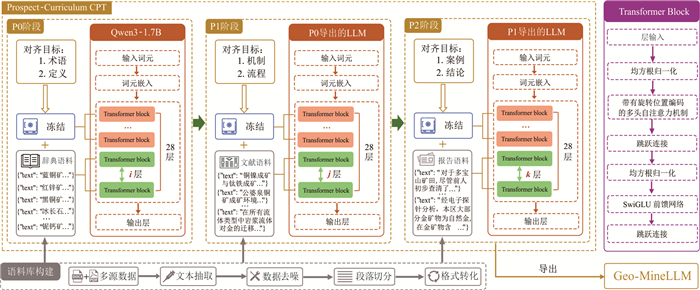
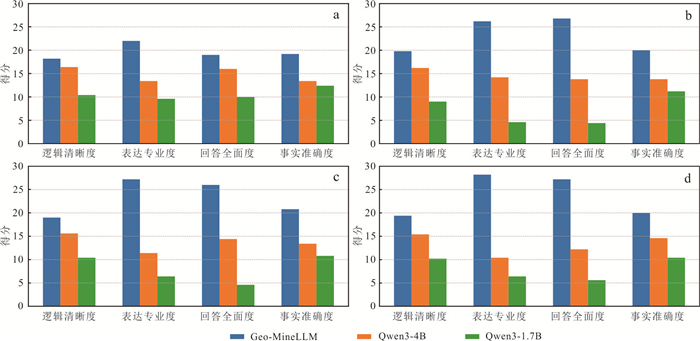
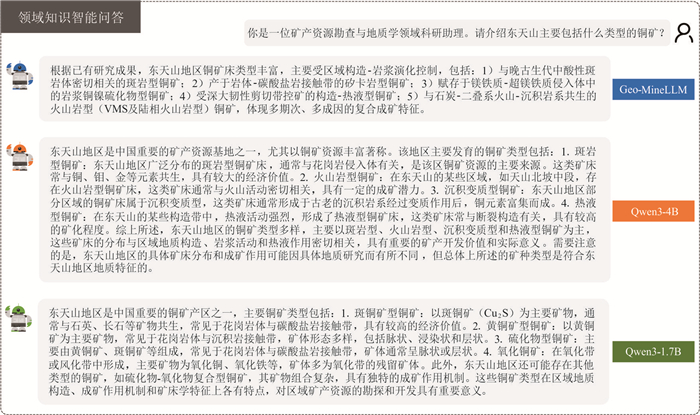
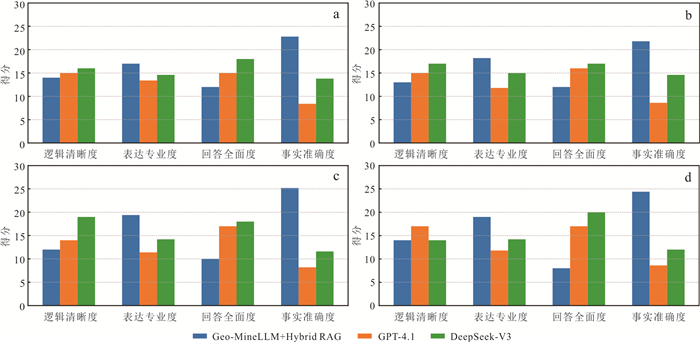
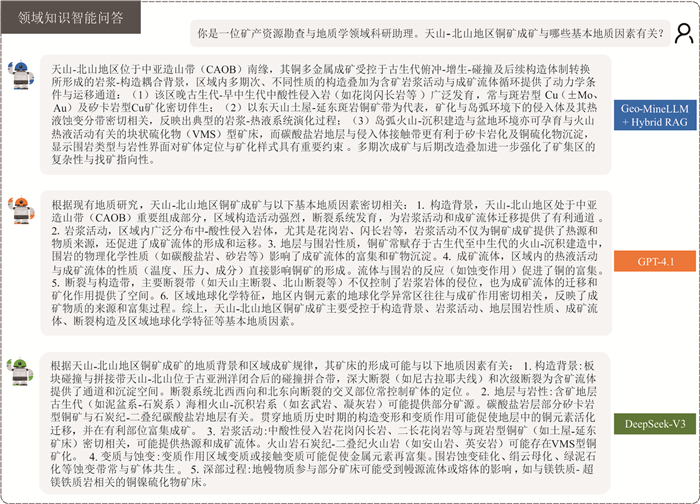
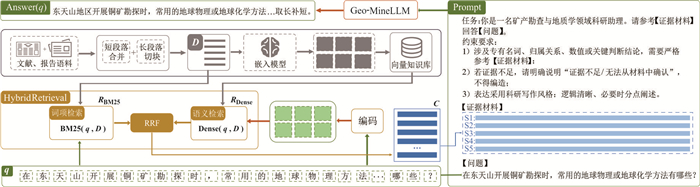
To address the challenges faced by general-purpose large language models in mineral exploration, including scarcity of domain corpora, insufficient coverage of domain terminology and register adaptation, and pronounced factual hallucinations. We constructed a mineral-exploration corpus of approximately 25 million tokens and, on this basis, proposed a curriculum-based continual pre-training strategy, which organizes training data into three stages: terminology, mechanisms, and cases. Coupled with gradual unfreezing of Transformer blocks and learning-rate scheduling, we conducted continual pre-training of Qwen3-1.7B to achieve stage-wise domain adaptation, resulting in a mineral-exploration-oriented LLM, Geo-MineLLM. During inference, we integrated a Hybrid RAG framework, leveraging hybrid retrieval and evidence-constrained generation to enhance factual consistency. Human evaluation indicates that Geo-MineLLM substantially improves domain question-answering performance relative to the base model and larger-parameter models within the same family. With Hybrid RAG enabled, overall domain QA performance approaches that of GPT-4.1. The proposed training-inference integrated framework provides a lightweight pathway for building mineral-exploration LLMs and enabling reliable domain-specific question answering.

|
Bengio, Y., Louradour, J., Collobert, R., et al., 2009. Curriculum Learning. The 26th Annual International Conference on Machine Learning. Montreal.
|
|
Cheng, Q. M., 2025. A New Paradigm for Mineral Resource Prediction Based on Human Intelligence-Artificial Intelligence Integration. Earth Science Frontiers, 32(4): 1-19 (in Chinese with English abstract).
|
|
Cormack, G. V., Clarke, C. L. A., Buettcher, S., 2009. Reciprocal Rank Fusion Outperforms Condorcet and Individual Rank Learning Methods. The 32nd International ACM SIGIR Conference on Research and Development in Information Retrieval. Boston.
|
|
Deng, C., Zhang, T. H., He, Z. M., et al., 2024. K2: A Foundation Language Model for Geoscience Knowledge Understanding and Utilization. The 17th ACM International Conference on Web Search and Data Mining. Merida.
|
|
Farquhar, S., Kossen, J., Kuhn, L., et al., 2024. Detecting Hallucinations in Large Language Models Using Semantic Entropy. Nature, 630(8017): 625-630. https://doi.org/10.1038/s41586-024-07421-0
|
|
Fu, Y., Wang, M. G., Wang, C. B., et al., 2025. GeoMinLM: A Large Language Model in Geology and Mineral Survey in Yunnan Province. Ore Geology Reviews, 182: 106638. https://doi.org/10.1016/j.oregeorev.2025.106638
|
|
Gupta, K., Thérien, B., Ibrahim, A., et al., 2023. Continual Pre-Training of Large Language Models: How to (Re) Warm Your Model? ICML2023, Hawaii.
|
|
Gururangan, S., Marasović, A., Swayamdipta, S., et al., 2020. Don't Stop Pretraining: Adapt Language Models to Domains and Tasks. The 58th Annual Meeting of the Association for Computational Linguistics, Online.
|
|
He, H., Ma, C., Ye, S., et al., 2024. Low Resource Chinese Geological Text Named Entity Recognition Based on Prompt Learning. Journal of Earth Science, 35(3): 1035-1043. https://doi.org/10.1007/s12583-023-1944-8
|
|
Hou, X. Y., Zhao, Y. J., Liu, Y., et al., 2024. Large Language Models for Software Engineering: A Systematic Literature Review. ACM Transactions on Software Engineering and Methodology, 33(8): 1-79. https://doi.org/10.1145/3695988
|
|
Howard, J., Ruder, S., 2018. Universal Language Model Fine-Tuning for Text Classification. The 56th Annual Meeting of the Association for Computational Linguistics. Melbourne.
|
|
Jawahar, G., Sagot, B., Seddah, D., 2019. What Does BERT Learn about the Structure of Language? The 57th Annual Meeting of the Association for Computational Linguistics, Florence.
|
|
Ji, Z. W., Lee, N., Frieske, R., et al., 2023. Survey of Hallucination in Natural Language Generation. ACM Computing Surveys, 55(12): 1-38. https://doi.org/10.1145/3571730
|
|
Karpukhin, V., Oguz, B., Min, S., et al., 2020. Dense Passage Retrieval for Open-Domain Question Answering. The 2020 Conference on Empirical Methods in Natural Language Processing (EMNLP), Online.
|
|
Lachowycz, S., 2024. Utility of Artificial Intelligence in Geoscience. Nature Geoscience, 17(10): 953-955. https://doi.org/10.1038/s41561-024-01548-5
|
|
Lewis, P., Perez, E., Piktus, A., et al., 2020. Retrieval-Augmented Generation for Knowledge-Intensive NLP Tasks. arXiv, 2005.11401.
|
|
Liu, C. P., Yang, H. M., Duan, R. C., et al., 2014. Metallogenic Age of the Matoutan Gold Deposit in East Tianshan and Its Geological Significance. Geological Bulletin of China, 33(6): 912-923 (in Chinese with English abstract).
|
|
Qiu, Q. J., Tian, M., Xie, Z., et al., 2023a. Extracting Named Entity Using Entity Labeling in Geological Text Using Deep Learning Approach. Journal of Earth Science, 34(5): 1406-1417. https://doi.org/10.1007/s12583-022-1789-8
|
|
Qiu, Q. J., Wang, B., Ma, K., et al., 2023b. A Practical Approach to Constructing a Geological Knowledge Graph: A Case Study of Mineral Exploration Data. Journal of Earth Science, 34(5): 1374-1389. https://doi.org/10.1007/s12583-023-1809-3
|
|
Qiu, Q. J., Wu, L., Ma, K., et al., 2023. A Knowledge Graph Construction Method for Geohazard Chain for Disaster Emergency Response. Earth Science, 48(5): 1875-1891 (in Chinese with English abstract).
|
|
Raffel, C., Shazeer, N., Roberts, A., et al., 2020. Exploring the Limits of Transfer Learning with a Unified Text-to-Text Transformer. Journal of Machine Learning Research, 21(140): 1-67.
|
|
Robertson, S., Zaragoza, H., 2009. The Probabilistic Relevance Framework: BM25 and Beyond. Foundations and Trends® in Information Retrieval, 3(4): 333-389. https://doi.org/10.1561/1500000019
|
|
Shi, L. Y., Zuo, R. G., 2026. Foundation Model for Mineral Prospectivity Mapping. Earth Science, 53(3): 832-848(in Chinese with English abstract).
|
|
Wu, G., Wang, H. T., Zhang, K. Y., et al., 2025. GeoProspect: A Domain-Specific Geological Large Language Model with Enhanced Continual Learning. Neurocomputing, 650: 130801. https://doi.org/10.1016/j.neucom.2025.130801
|
|
Wu, S. J., Irsoy, O., Lu, S., et al., 2023. BloombergGPT: A Large Language Model for Finance. arXiv, 2303.17564.
|
|
Yang, X., Chen, A. K., PourNejatian, N., et al., 2022. A Large Language Model for Electronic Health Records. NPJ Digital Medicine, 5: 194. https://doi.org/10.1038/s41746-022-00742-2
|
|
Zhang, B. Y., Tang, J. C., Zhang, T. Y., et al., 2026. Knowledge Graph and Question-Answering Model for Geological Prospecting Empowered by Large Language Models. Earth Science, 53(3): 982-995 (in Chinese with English abstract).
|
|
Zhang, K. P., Ma, L., Cui, B. B., et al., 2024a. Visual Large Language Model for Wheat Disease Diagnosis in the Wild. Computers and Electronics in Agriculture, 227: 109587. https://doi.org/10.1016/j.compag.2024.109587
|
|
Zhang, Y. F., Wei, C., He, Z. T., et al., 2024b. GeoGPT: An Assistant for Understanding and Processing Geospatial Tasks. International Journal of Applied Earth Observation and Geoinformation, 131: 103976. https://doi.org/10.1016/j.jag.2024.103976
|
|
Zhou, B., Li, K., 2025. Fusing Geoscience Large Language Models and Lightweight RAG for Enhanced Geological Question Answering. Geosciences, 15(10): 382. https://doi.org/10.3390/geosciences15100382
|
|
Zuo, R. G., Cheng, Q. M., Xu, Y., et al., 2024. Explainable Artificial Intelligence Models for Mineral Prospectivity Mapping. Scientia Sinica (Terrae), 54(9): 2917-2928 (in Chinese with English abstract). doi: 10.1360/N072024-0018
|
|
成秋明, 2025. 面向人类智能与人工智能融合的矿产资源预测新范式. 地学前缘, 32(4): 1-19.
|
|
刘重芃, 杨红梅, 段瑞春, 等, 2014. 东天山马头滩金矿的成矿时代及其地质意义. 地质通报, 33(6): 912-923.
|
|
邱芹军, 吴亮, 马凯, 等, 2023. 面向灾害应急响应的地质灾害链知识图谱构建方法. 地球科学, 48(5): 1875-1891. doi: 10.3799/dqkx.2022.313
|
|
师路易, 左仁广, 2026. 矿产预测大模型. 地球科学, 53(3): 832-848.
|
|
张宝一, 唐嘉成, 张彤蕴, 等, 2026. 大语言模型赋能的地质找矿知识图谱与问答模型构建. 地球科学, 53(3): 982-995. doi: 10.3799/dqkx.2025.176
|
|
左仁广, 成秋明, 许莹, 等, 2024. 可解释性矿产预测人工智能模型. 中国科学: 地球科学, 54(9): 2917-2928.
|
Figures(9) / Tables(4)


 DownLoad: