- 中文版:
- EI 100%收录
- 英文版
- SCI 100%收录


中国出版政府奖提名奖
中国百强科技报刊
湖北出版政府奖
中国高校百佳科技期刊
中国最美期刊
中国出版政府奖提名奖
中国百强科技报刊
湖北出版政府奖
中国高校百佳科技期刊
中国最美期刊
| Citation: | Song Huan, Wang Xingang, Teng Hongquan, Ye Xuguang, Liu Kai, Shi Wei, Yang Jinshui, 2026. Study on Creep Characteristics and Long-Term Strength of Soil in Loess-Red Clay Composite Slopes Under Excavation Conditions. Earth Science, 51(2): 398-406. doi: 10.3799/dqkx.2026.050

|
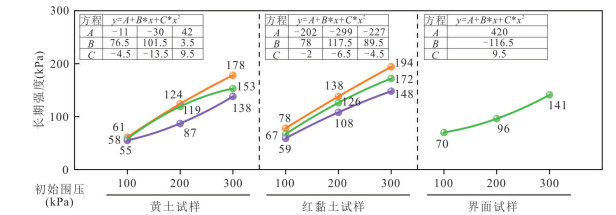
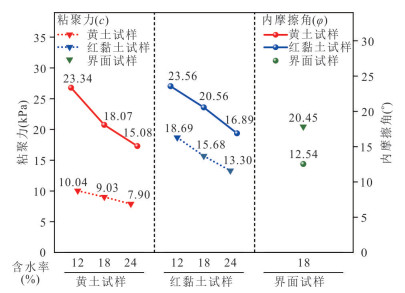
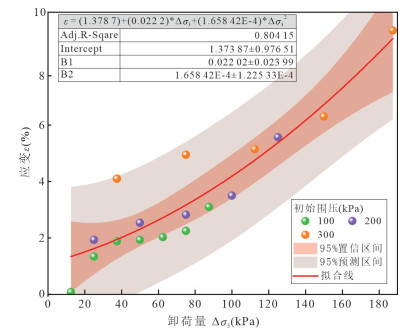
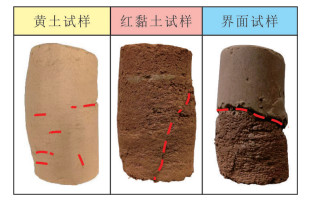
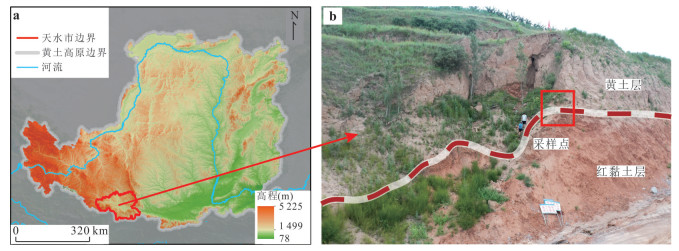
In the Loess Plateau region, excavation-induced unloading is prone to triggering slope instability disasters, and the water sensitivity and creep characteristics of loess are key factors governing the deformation of excavated slopes. To investigate the creep characteristics and long-term strength of loess, red clay, and composite soil under excavation conditions, this study relies on an excavated slope project in Zhongliang Town, Tianshui City. Through triaxial unloading creep tests, the unloading creep behaviors of loess, red clay, and interface specimens were studied under different moisture contents (12%, 18%, and 24%) and confining pressures (100 kPa, 200 kPa, and 300 kPa). The results show that: (1) All specimens exhibit three-stage creep characteristics, namely attenuated creep, steady-state creep, and accelerated creep. Higher confining pressure makes the soil more sensitive to unloading; an increase in moisture content exacerbates the creep of specimens and renders them more susceptible to failure. Under the same unloading conditions, the creep strain of red clay is slightly lower than that of loess, while the interface increases the creep strain. The interface specimens have the lowest critical unloading amount and are more likely to fracture along the interface. (2) The long-term strength parameters (cohesion c, internal friction angle φ) increase with the rise in confining pressure and decrease with the increase in moisture content. The φ value of the interface specimens is the smallest, reaching 12.54°. (3) The creep strain of the interface specimens increases acceleratively with the intensification of unloading amount, and the interface is a shear-weak zone. This study can provide experimental basis for the stability control and prevention of loess-red clay composite slopes under excavation conditions.

|
Chen, L. F., Liu, G., Tian, H., et al., 2017. Reliability Analysis on Loess-Red Mudstone Interface Landslide Stability. Geological Science and Technology Information, 36(2): 244-248(in Chinese with English abstract).
|
|
Chen, Q., Cui, D. S., Wang, Q. W., et al., 2020. An Experimental Study of Creep Characteristics of Sliding Zone Soil of Huangtupo Landslide Under Different Consolidation Stresses. Rock and Soil Mechanics, 41(5): 1635-1642(in Chinese with English abstract).
|
|
Chen, Z. J., 1982. The Mechanical Problems for the Long-Term Stability of Underground Galleries. Chinese Journal of Rock Mechanics and Engineering, 1(1): 1-20(in Chinese with English abstract).
|
|
Li, Z. K., Ma, P. H., Peng, J. B., et al., 2023. The Permeability Characteristics of Loess and Red Clay Interface in Heifangtai Area. Journal of Engineering Geology, 31(5): 1516-1527(in Chinese with English abstract).
|
|
Li, Y., Wu, Q., 2001. Study on the Failure Mechanism of the Loess-Red Stratum Contact Surface Landslide in Mengjiashan. Hydrogeology and Engineering Geology, 28(1): 52-54(in Chinese with English abstract).
|
|
Long, J. H., Guo, W. B., Li, P., et al., 2010. Creep Property of Soil in the Sliding Zone of Loess Landslides. Chinese Journal of Geotechnical Engineering, 32(7): 1023-1028(in Chinese with English abstract).
|
|
Peng, J. B., Fan, Z. J., Wu, D., et al., 2019. Landslides Triggered by Excavation in the Loess Plateau of China: a Case Study of Middle Pleistocene Loess Slopes. Journal of Asian Earth Sciences, 171: 246-258. https://doi.org/10.1016/j.jseaes.2018.11.014
|
|
Peng, M., Wang, Y., Ma, C. Y., et al., 2025. Review of Risk Assessment and Prevention for Valley Landslide Disaster Chains. Earth Science, 50(10): 3723(in Chinese with English abstract).
|
|
Qi, Z. Y., Li, Z. Q., 2023. Review on Creep Properties of Loess. Journal of Earth Sciences and Environment, 45(3): 485-510(in Chinese with English abstract).
|
|
Shan, S., Xie, W. L., Zhu, R. S., et al., 2021. Creep Characteristics of Compacted Loess in Yan'an New District under Loading and Unloading Conditions. Journal of Arid Land Resources and Environment, 35(7): 144-155. (in Chinese with English abstract).
|
|
Wang, Y. F., Cheng Q. G., Lin Q. W., et al., 2025. Research on Rock Avalanches in Tibetan Plateau: From Field Observations to Dynamic Mechanisms. Earth Science, 50(10): 4071-4095. https://doi.org/10.3799/dqkx.2025.207
|
|
Wang, X. G., Liu, K., Lian, B. Q., et al., 2022. An experimental study of the creep characteristics of loess landslide sliding zone soil with different water content. Hydrogeology and Engineering Geology, 49(5): 137-143(in Chinese with English abstract).
|
|
Wang, X. G., Liu, K., Lian, B. Q., et al., 2024. Study on the Unloading Creep Characteristics of Loess and the Mechanism of Typical Excavated Loess Landslide: Journal of Engineering Geology, 32(2): 513-521(in Chinese with English abstract).
|
|
Wen, B. P, , 1997. Study on Prediction and Forecast of Typical Landslides and Disaster Mitigation Measures in Loess Areas. Geological Publishing House, Beijing (in Chinese).
|
|
Wu, J. J., Wang, C. H., Li, G. X., 2004. Influence of Matric Suction in Unsaturated Soils on Slope Stability. Rock and Soil Mechanics, 25(5): 732-736+744(in Chinese with English abstract).
|
|
Wu, W. J., Su, X., Liu, W., et al., 2014. Loess-Mudstone Interface Landslides: Characteristics and Causes. Journal of Glaciology and Geocryology, 36(5): 1167-1175(in Chinese with English abstract).
|
|
Xiao, B., Hu, M. Y., Zhou, P. J., et al., 2021. Creep Behavior of Saturated Clay in Triaxial Test and a Hyperbolic Model. Geofluids, 2021(1): 7882046. https://doi.org/10.1155/2021/7882046
|
|
Xie, Q. Y., Huang, Q. B., Zhao, J. Y., et al., 2025. Key Factors in the Reactivation of Thick Loess Mudstone Ancient Landslides: A Case Study of the Gaojiawan Landslide, China. Environmental Earth Sciences, 84(6): 169. https://doi.org/10.1007/s12665-025-12161-z
|
|
Xu, Q., 2012. Theoretical Studies on Prediction of Landslides Using Slope Deformation Process Data. Journal of Engineering Geology, 20(2): 145-151(in Chinese with English abstract).
|
|
Zhang, M. S., Hu, W., Sun, P. P., et al., 2016. Advances and Prospects of Water Sensitivity of Loess and the Induced Loess Landslides. Journal of Earth Environment, 7(4): 323-334(in Chinese with English abstract).
|
|
Zhang, Z. D., Pei, X. J., Zhang, X. C., et al., 2018. Study on Mechanical Response and Failure Mechanism of Excavation Unloading in Loess Slope. Journal of Engineering Geology, 26(3): 684-693(in Chinese with English abstract).
|
|
Zheng, Y. R., Zhao, S. Y., Deng, C. J., et al., 2006. Development of Finite Element Limit Analysis Method and its Applications in Geotechnical Engineering. Engineering Science, 8(12): 39-61+112(in Chinese with English abstract).
|
|
Zhu, J. D., Yan, H., Li, S. H., et al., 2019. Laboratory Model Experiment of Landslides Along Loess-Mudstone Interface Induced by Rainfall Patterns. Journal of Engineering Geology, 27(3): 623-631(in Chinese with English abstract).
|
|
Zhu, Y. B., Miao, S. S., Li, H. F., et al., 2022. An Empirical Shear Model of Interface between the Loess and Hipparion Red Clay in a Loess Landslide. Frontiers in Earth Science, 9: 806832. https://doi.org/10.3389/feart.2021.806832
|
|
Zhuang, J. Q., Peng, J. B., Li, T. L., et al., 2015. Triggerred Factores and Motion Simulation of "9·17" Baqiao Catastrophic Landslide. Journal of Engineering Geology, 23(4): 747-754(in Chinese with English abstract).
|
|
陈龙飞, 刘高, 田华, 等, 2017. 黄土-红层接触面滑坡稳定性可靠性分析. 地质科技情报, 36(2): 244-248.
|
|
陈琼, 崔德山, 王菁莪, 等, 2020. 不同固结状态下黄土坡滑坡滑带土的蠕变试验研究. 岩土力学, 41(5): 1635-1642.
|
|
陈宗基, 1982. 地下巷道长期稳定性的力学问题. 岩石力学与工程学报, 1(1): 1-20.
|
|
单帅, 谢婉丽, 朱荣森, 等, 2021. 加卸荷条件下延安新区压实黄土蠕变特性研究. 干旱区资源与环境, 35(7): 144-155.
|
|
李媛, 吴奇, 2001. 孟家山黄土-红层接触面滑坡破坏机理研究. 水文地质工程地质, 28(1): 52-54.
|
|
李泽坤, 马鹏辉, 彭建兵, 等, 2023. 黑方台区域黄土红黏土界面渗透特性研究. 工程地质学报, 31(5): 1516-1527.
|
|
龙建辉, 郭文斌, 李萍, 等, 2010. 黄土滑坡滑带土的蠕变特性. 岩土工程学报, 32(7): 1023-1028.
|
|
彭铭, 王悦, 马晨议, 等, 2025. 河谷滑坡灾害链风险评估及防控研究进展. 地球科学, 50(10): 3723-3760. doi: 10.3799/dqkx.2025.142
|
|
戚志宇, 李志清, 2023. 黄土蠕变特性研究进展. 地球科学与环境学报, 45(3): 485-510.
|
|
王新刚, 刘凯, 连宝琴, 等, 2024. 黄土卸荷蠕变特性与典型开挖型黄土滑坡机理研究. 工程地质学报, 32(2): 513-521.
|
|
王新刚, 刘凯, 王友林, 等, 2022. 典型黄土滑坡滑带土不同含水率下蠕变特性试验研究. 水文工程地质, 49(5): 137-143.
|
|
王玉峰, 程谦恭, 林棋文, 等., 2025. 青藏高原高速远程滑坡研究: 从地质现象到动力学机理. 地球科学, 50(10): 4071-4095. doi: 10.3799/dqkx.2025.207
|
|
文宝萍, 1997. 黄土地区典型滑坡预测预报及减灾对策研究. 北京: 地质出版社.
|
|
吴俊杰, 王成华, 李广信, 2004. 非饱和土基质吸力对边坡稳定的影响. 岩土力学, 25(5): 732-736+744.
|
|
吴玮江, 宿星, 刘伟, 等, 2014. 黄土-泥岩接触面滑坡的特征与成因. 冰川冻土, 36(5): 1167-1175.
|
|
许强, 2012. 滑坡的变形破坏行为与内在机理. 工程地质学报, 20(2): 145-151.
|
|
张茂省, 胡炜, 孙萍萍, 等, 2016. 黄土水敏性及水致黄土滑坡研究现状与展望. 地球环境学报, 7(4): 323-334.
|
|
张子东, 裴向军, 张晓超, 等, 2018. 黄土边坡开挖卸荷力学响应与破坏机理研究. 工程地质学报, 26(3): 684-693.
|
|
郑颖人, 赵尚毅, 邓楚键, 等, 2006. 有限元极限分析法发展及其在岩土工程中的应用. 中国工程科学, 8(12): 39-61+112.
|
|
朱建东, 鄢好, 李绍红, 等, 2019. 黄土-泥岩接触面滑坡的两种雨型模型试验. 工程地质学报, 27(3): 623-631.
|
|
庄建琦, 彭建兵, 李同录, 等, 2015. "9·17"灞桥灾难性黄土滑坡形成因素与运动模拟. 工程地质学报, 23(4): 747-754.
|
Figures(9) / Tables(2)


 DownLoad: