- 中文版:
- EI 100%收录
- 英文版
- SCI 100%收录


中国出版政府奖提名奖
中国百强科技报刊
湖北出版政府奖
中国高校百佳科技期刊
中国最美期刊
中国出版政府奖提名奖
中国百强科技报刊
湖北出版政府奖
中国高校百佳科技期刊
中国最美期刊
| Citation: | Wu Jing, Guo Qinghai, 2026. Occurrence Forms of Antimony in Geothermal Waters of Different Genesis and Its Controlling Factors and Indicative Significance. Earth Science, 51(6): 2357-2370. doi: 10.3799/dqkx.2026.126

|

|
Aksoy, N., Şimşek, C., Gunduz, O., 2009. Groundwater Contamination Mechanism in a Geothermal Field: A Case Study of Balcova, Turkey. Journal of Contaminant Hydrology, 103(1-2): 13-28. https://doi.org/10.1016/j.jconhyd.2008.08.006
|
|
Bai, D. H., Liao, Z. J., Zhao, G. Z., et al., 1994. Inferring the Magma Heat Source of Tengchong Rehai Geothermal Field from MT Detection Results. Chinese Science Bulletin, 39(4): 344-347 (in Chinese). doi: 10.1360/csb1994-39-4-344
|
|
Cavallo, D., Iavicoli, I., Setini, A., et al., 2002. Genotoxic Risk and Oxidative DNA Damage in Workers Exposed to Antimony Trioxide. Environmental and Molecular Mutagenesis, 40(3): 184-189. https://doi.org/10.1002/em.10102
|
|
Chen, L. Z., Ma, T., Du, Y., et al., 2016. Hydrochemical and Isotopic (2H, 18O and 37Cl) Constraints on Evolution of Geothermal Water in Coastal Plain of Southwestern Guangdong Province, China. Journal of Volcanology and Geothermal Research, 318: 45-54. https://doi.org/10.1016/j.jvolgeores.2016.03.003
|
|
Feng, R. W., Wei, C. Y., Tu, S. X., et al., 2013. The Uptake and Detoxification of Antimony by Plants: A Review. Environmental and Experimental Botany, 96: 28-34. https://doi.org/10.1016/j.envexpbot.2013.08.006
|
|
Filella, M., Belzile, N., Chen, Y. W., 2002. Antimony in the Environment: A Review Focused on Natural Waters I. Occurrence. Earth-Science Reviews, 57(1-2): 125-176. https://doi.org/10.1016/S0012-8252(01)00070-8
|
|
Giggenbach, W. F., 1988. Geothermal Solute Equilibria. Derivation of Na-K-Mg-Ca Geoindicators. Geochimica et Cosmochimica Acta, 52(12): 2749-2765. https://doi.org/10.1016/0016-7037(88)90143-3
|
|
Guo, Q. H., 2020. Magma-Heated Geothermal Systems and Hydrogeochemical Evidence of Their Occurrence. Acta Geologica Sinica, 94(12): 3544-3554 (in Chinese with English abstract).
|
|
Guo, Q. H., Liu, M. L., Li, J. X., et al., 2014. Acid Hot Springs Discharged from the Rehai Hydrothermal System of the Tengchong Volcanic Area (China): Formed via Magmatic Fluid Absorption or Geothermal Steam Heating? Bulletin of Volcanology, 76(10): 868. https://doi.org/10.1007/s00445-014-0868-9
|
|
Guo, Q. H., Liu, M. L., Li, J. X., 2017. Thioarsenic Species in the High-Temperature Hot Springs from the Rehai Geothermal Field(Tengchong) and Their Geochemical Geneses. Earth Science, 42(2): 286-297 (in Chinese with English abstract).
|
|
Guo, Q. H., Liu, M. L., Li, J. X., et al., 2017. Fluid Geochemical Constraints on the Heat Source and Reservoir Temperature of the Banglazhang Hydrothermal System, Yunnan-Tibet Geothermal Province, China. Journal of Geochemical Exploration, 172: 109-119. https://doi.org/10.1016/j.gexplo.2016.10.012
|
|
Guo, Q. H., Planer-Friedrich, B., Luo, L., et al., 2020. Speciation of Antimony in Representative Sulfidic Hot Springs in the YST Geothermal Province (China) and Its Immobilization by Spring Sediments. Environmental Pollution, 266: 115221. https://doi.org/10.1016/j.envpol.2020.115221
|
|
Guo, Q. H., Qian, J. B., Li, Y., et al., 2025. The Antimonite-Thioantimonates-Antimonate Pathway: Insights from Sulfidic Hot Springs and Microbial Culture Experiments for a Novel Mechanism of Abiotic Antimonite Oxidation. Geochimica et Cosmochimica Acta, 406: 164-174. https://doi.org/10.1016/j.gca.2025.01.007
|
|
Guo, Q. H., Wang, Y. X., 2012. Geochemistry of Hot Springs in the Tengchong Hydrothermal Areas, Southwestern China. Journal of Volcanology and Geothermal Research, 215: 61-73. https://doi.org/10.1016/j.jvolgeores.2011.12.003
|
|
Herath, I., Vithanage, M., Bundschuh, J., 2017. Antimony as a Global Dilemma: Geochemistry, Mobility, Fate and Transport. Environmental Pollution, 223: 545-559. https://doi.org/10.1016/j.envpol.2017.01.057
|
|
Johnston, S. G., Bennett, W. W., Doriean, N., et al., 2020. Antimony and Arsenic Speciation, Redox-Cycling and Contrasting Mobility in a Mining-Impacted River System. Science of the Total Environment, 710: 136354. https://doi.org/10.1016/j.scitotenv.2019.136354
|
|
Li, X., Guo, Q. H., Zhao, Q., 2024. Dissolution of Stibnite and Morphological Distribution of Antimony in Its Products under Different Aqueous Conditions. Earth Science, 49(11): 4022-4034 (in Chinese with English abstract).
|
|
Liu, L., Wang, G. L., Li, Y. L., et al., 2024. Hydrogeochemistry of Geothermal Water in Huangshadong and Adjacent Areas of Guangdong Province: Implications for Water-Rock Interaction. Geothermics, 122: 103084. https://doi.org/10.1016/j.geothermics.2024.103084
|
|
Okkenhaug, G., Grasshorn Gebhardt, K. A., Amstaetter, K., et al., 2016. Antimony (Sb) and Lead (Pb) in Contaminated Shooting Range Soils: Sb and Pb Mobility and Immobilization by Iron Based Sorbents, a Field Study. Journal of Hazardous Materials, 307: 336-343. https://doi.org/10.1016/j.jhazmat.2016.01.005
|
|
Pierart, A., Shahid, M., Séjalon-Delmas, N., et al., 2015. Antimony Bioavailability: Knowledge and Research Perspectives for Sustainable Agricultures. Journal of Hazardous Materials, 289: 219-234. https://doi.org/10.1016/j.jhazmat.2015.02.011
|
|
Planer-Friedrich, B., Scheinost, A. C., 2011. Formation and Structural Characterization of Thioantimony Species and Their Natural Occurrence in Geothermal Waters. Environmental Science Technology, 45(16): 6855-6863. https://doi.org/10.1021/es201003k
|
|
Planer-Friedrich, B., Wilson, N., 2012. The Stability of Tetrathioantimonate in the Presence of Oxygen, Light, High Temperature and Arsenic. Chemical Geology, 322: 1-10. https://doi.org/10.1016/j.chemgeo.2012.06.010
|
|
Qin, S. L., Zeng, Z. J., Zhou, X. C., et al., 2025. Study on the Hot Spring Hydrogeochmistry and Their Anomalous Characteristics of Short-Term and Impending Earthquake Precursors at Yingjiang. Earthquake, 45(2): 193-210 (in Chinese with English abstract).
|
|
Reimann, C., Matschullat, J., Birke, M., et al., 2010. Antimony in the Environment: Lessons from Geochemical Mapping. Applied Geochemistry, 25(2): 175-198. https://doi.org/10.1016/j.apgeochem.2009.11.011
|
|
Shangguan, Z. G., Bai, C. H., Sun, M. L., 2000. Mantle-Derived Magmatic Gas Releasing Features at the Rehai Area, Tengchong County, Yunnan Province, China. Science in China: Earth Sciences, 43(2): 132-140. https://doi.org/10.1007/bf02878142
|
|
Smichowski, P., 2008. Antimony in the Environment as a Global Pollutant: A Review on Analytical Methodologies for Its Determination in Atmospheric Aerosols. Talanta, 75(1): 2-14. https://doi.org/10.1016/j.talanta.2007.11.005
|
|
Song, H. Y., Guo, Q. H., 2023. The Morphological Distribution and Geochemical Genesis of Antimony in Typical High-Temperature Hot Springs. Earth Science, 48(3): 946-957 (in Chinese with English abstract).
|
|
Ullrich, M. K., Pope, J. G., Seward, T. M., et al., 2013. Sulfur Redox Chemistry Governs Diurnal Antimony and Arsenic Cycles at Champagne Pool, Waiotapu, New Zealand. Journal of Volcanology and Geothermal Research, 262: 164-177. https://doi.org/10.1016/j.jvolgeores.2013.07.007
|
|
Wehmeier, S., Feldmann, J., 2005. Investigation into Antimony Mobility in Sewage Sludge Fermentation. Journal of Environmental Monitoring, 7(12): 1194. https://doi.org/10.1039/b509538g
|
|
Willis, S. S., Haque, S. E., Johannesson, K. H., 2011. Arsenic and Antimony in Groundwater Flow Systems: A Comparative Study. Aquatic Geochemistry, 17(6): 775-807. https://doi.org/10.1007/s10498-011-9131-6
|
|
Wilson, N., Webster-Brown, J., 2009. The Fate of Antimony in a Major Lowland River System, the Waikato River, New Zealand. Applied Geochemistry, 24(12): 2283-2292. https://doi.org/10.1016/j.apgeochem.2009.09.016
|
|
Wu, G. P., 2023. Characteristics and Genesis of Uplift Geothermal System in Guangdong Province. Yunnan Geology, 42(4): 442–450 (in Chinese with English abstract).
|
|
Wu, Y. T., Ye, H. E., Guo, Z., 2019. A Brief Analysis of the Distribution Characteristics and Genesis of Geothermal Resources in Guangdong Province. Earth, (4): 99-101 (in Chinese).
|
|
Yan, K. T., Guo, Q. H., Luo, L., 2022. Methylation and Thiolation of Arsenic in Tengchong Hot Springs. Earth Science, 47(2): 622–632 (in Chinese with English abstract).
|
|
Yin, Z. P., Ye, L., Jing, C. Y., 2022. Thiolated Methylantimonials: A New Organoantimony Group Identified in Mouse and Human Urines. Environmental Science Technology Letters, 9(9): 792-797. https://doi.org/10.1021/acs.estlett.2c00308
|
|
Yuan, J. F., 2013. Hydrogeochemistry of the Geothermal Systems in Coastal Areas of Guangdong Province, South China(Dissertation). China University of Geosciences, Wuhan (in Chinese with English abstract).
|
|
Zhao, C. P., Ran, H., Chen, K. H., 2006. Present-Day Magma Chambers in Tengchong Volcano Area Inferred from Relative Geothermal Gradient. Acta Petrologica Sinica, 22(6): 1517-1528(in Chinese with English abstract).
|
|
Zheng, H. R., Luo, J., 2024. Progress in Research on the Exploration and Evaluation of Deep Geothermal Resources in the Fujian-Guangdong-Hainan Region, China. Energy Geoscience, 5(2): 100232. https://doi.org/10.1016/j.engeos.2023.100232
|
|
白登海, 廖志杰, 赵国泽, 等, 1994. 从MT探测结果推论腾冲热海热田的岩浆热源. 科学通报, 39(4): 344-347.
|
|
郭清海, 2020. 岩浆热源型地热系统及其水文地球化学判据. 地质学报, 94(12): 3544-3554.
|
|
郭清海, 刘明亮, 李洁祥, 2017. 腾冲热海地热田高温热泉中的硫代砷化物及其地球化学成因. 地球科学, 42(2): 286-297. doi: 10.3799/dqkx.2017.021
|
|
李鑫, 郭清海, 赵倩, 2024. 不同水环境条件下辉锑矿的溶解及其产物中锑的形态分布. 地球科学, 49(11): 4022-4034. doi: 10.3799/dqkx.2023.172
|
|
秦双龙, 曾召君, 周晓成, 等, 2025. 云南盈江-龙陵断裂带温泉水文地球化学与地震短临前兆异常特征研究. 地震, 45(2): 193-210.
|
|
宋泓禹, 郭清海, 2023. 典型高温热泉中锑的形态分布及其地球化学成因. 地球科学, 48(3): 946-957. doi: 10.3799/dqkx.2022.310
|
|
吴广翩, 2023. 广东隆起山地型地热系统特征及成因. 云南地质, 42(4): 442-450.
|
|
吴玉婷, 叶洪恩, 郭志, 2019. 浅析广东省地热资源分布特征及成因. 地球, (4): 99-101.
|
|
严克涛, 郭清海, 罗黎, 2022. 腾冲热泉中砷的甲基化和巯基化过程. 地球科学, 47(2): 622-632. doi: 10.3799/dqkx.2021.105
|
|
袁建飞, 2013. 广东沿海地热系统水文地球化学研究(博士学位论文). 武汉: 中国地质大学.
|
|
赵慈平, 冉华, 陈坤华, 2006. 由相对地热梯度推断的腾冲火山区现存岩浆囊. 岩石学报, 22(6): 1517-1528.
|
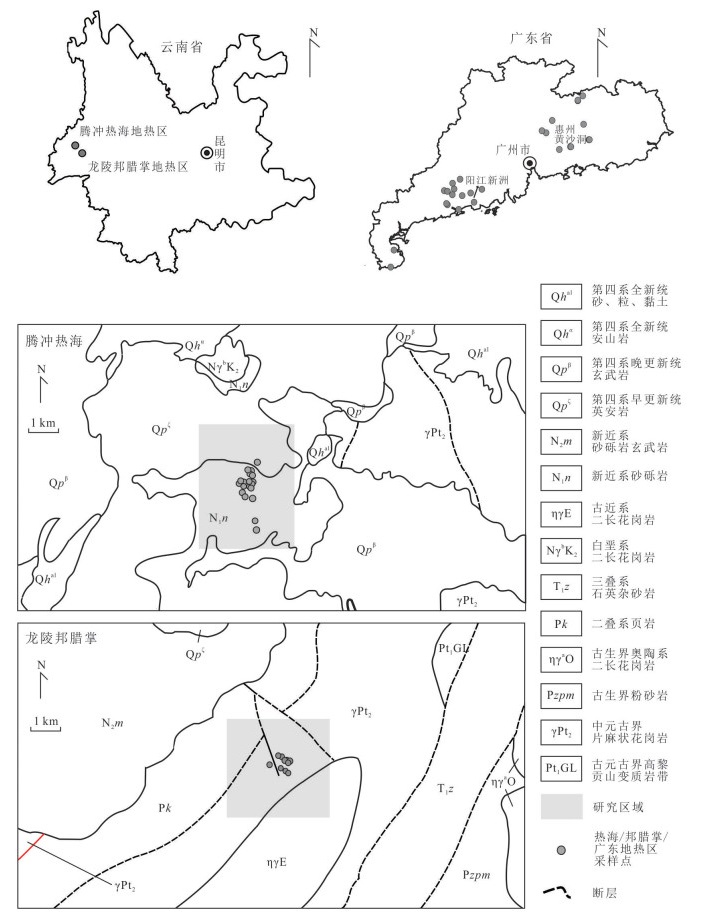
Figures(9)

 DownLoad: