- 中文版:
- EI 100%收录
- 英文版
- SCI 100%收录


中国出版政府奖提名奖
中国百强科技报刊
湖北出版政府奖
中国高校百佳科技期刊
中国最美期刊
中国出版政府奖提名奖
中国百强科技报刊
湖北出版政府奖
中国高校百佳科技期刊
中国最美期刊
| Citation: | SU Ming, JIE Xi-nong, JIANG Tao, LI Jun-liang, SUN Zhi-peng, TIAN Shan-shan, ZHANG Cheng, HE Yun-long, ZHANG Cui-mei, 2011. Characteristics of S40 Boundary and Its Significance in Qiongdongnan Basin, Northern Continental Margin of South China Sea. Earth Science, 36(5): 886-894. doi: 10.3799/dqkx.2011.093

|

| [1] |
Haq, B. U., Hardenbol, J., Vail, P. R., 1987. Chronology of fluctuating sea-levels since the Triassic. Science, 235(4793): 1156-1167. doi: 10.1126/science.235.4793.1156.
|
| [2] |
Li, S. T., Lin, C. S., Zhang, Q. M., et al., 1998. The dynamic process of screen rift of continental marginal basin in the northern South China Sea and the tectonic events since 10 Ma. Chinese Science Bulletin, 43(8): 797-810 (in Chinese). doi: 10.1360/csb1998-43-8-797
|
| [3] |
Liu, F. L., Wu, L. S., 2006. Topographic and morphologic characteristics and genesis analysis of Xisha trough Sea area in the South China Sea. Marine Geology & Quaternary Geology, 26(3): 7-14 (in Chinese with English abstract). http://en.cnki.com.cn/Article_en/CJFDTOTAL-HYDZ200603001.htm
|
| [4] |
Ren, J. Y., 2004. Tectonic significance of S6' boundary in Dongying depression, Bohai Gulf basin. Earth Science—Journal of China University of Geosciences, 29(1): 69-76, 92 (in Chinese with English abstract). http://en.cnki.com.cn/Article_en/CJFDTOTAL-DQKX200401013.htm
|
| [5] |
Shao, L., Li, X. H., Wang, P. X., et al., 2004. Sedimentary record of the tectonic evolution of the South China Sea since the Oligocene: evidence from deep sea sediments of ODP Site 1148. Advances in Earth Science, 19(4): 539-544 (in Chinese with English abstract). http://www.cnki.com.cn/Article/CJFDTotal-DXJZ200404008.htm
|
| [6] |
Steckler, M. S., Watts, A. B., 1978. Subsidence of the Atlantic-type continental margin off New York. Earth and Planetary Science Letters, 41(1): 1-13. doi: 10.1016/0012-821X(78)90036-5.
|
| [7] |
Su, M., Li, J. L., Jiang, T., et al., 2009. Morphological features and formation mechanism of central Canyon in the Qiongdongnan basin. Marine Geology & Quaternary Geology, 29(4): 85-93 (in Chinese with English abstract). http://www.cnki.com.cn/Article/CJFDTotal-HYDZ200904017.htm
|
| [8] |
Tao, Z. P., Deng, H. W., Su, Z. F., et al., 2005. Transformation characteristics of sequence boundary and stratum statistics of Paleogene third-order sequences. Journalof Oil and Gas Technology (Journal of Jianghan Petroleum Institute-J. JPI), 27(3): 409-412 (in Chinese with English abstract). http://en.cnki.com.cn/Article_en/CJFDTOTAL-JHSX2005S3000.htm
|
| [9] |
Xie, X. N., Müller, R. D., Ren, J. Y., et al., 2008. Stratigraphic architecture and evolution of the continental slope system in offshore Hainan, northern South China Sea. Marine Geology, 247(3-4): 129-144. doi: 10.1016/j.margeo.2007.08.005.
|
| [10] |
Yang, M. Z., Wang, M. J., Liang, J. Q., et al., 2003. Tectonic subsidence and its control on hydrocarbon resources in the Wan'an basin in the South China Sea. Marine Geology & Quaternary Geology, 23(2): 85-88 (in Chinese with English abstract). http://www.researchgate.net/publication/285754757_Tectonic_subsidence_and_its_control_on_hydrocarbon_resources_in_the_Wan'an_basin_in_the_South_China_Sea
|
| [11] |
Yao, B. C., Wan, L., Liu Z. H., et al., 2004a. Tectonic significance and its petroleum effect of the Wan'an tectonic movement in the south of the South China Sea. Marine Geology & Quaternary Geology, 24(1): 69-77 (in Chinese with English abstract). http://en.cnki.com.cn/Article_en/CJFDTOTAL-HYDZ200401010.htm
|
| [12] |
Yao, B. C., Wan, L., Wu, N. Y., 2004b. Cenozoic plate tectonic activities in the great South China Sea area. Geology in China, 31(2): 113-122 (in Chinese with English abstract). http://www.researchgate.net/publication/291025969_Cenozoic_plate_tectonic_activities_in_the_Great_South_China_Sea_area
|
| [13] |
Zhao, Q. H., Wang, P. X., Cheng, X. R., et al., 2001. A record of Miocene carbon excursions in the South China Sea. Science in China (Ser. D), 31(10): 808-815 (in Chinese). doi: 10.1007/BF02907087
|
| [14] |
李思田, 林畅松, 张启明, 等, 1998. 南海北部大陆边缘盆地幕式裂陷的动力过程及10 Ma以来的构造事件. 科学通报, 43(8): 797-810. doi: 10.3321/j.issn:0023-074X.1998.08.003
|
| [15] |
刘方兰, 吴庐山, 2006. 西沙海槽海域地形地貌特征及成因. 海洋地质与第四纪地质, 26(3): 7-14. https://www.cnki.com.cn/Article/CJFDTOTAL-HYDZ200603001.htm
|
| [16] |
任建业, 2004. 渤海湾盆地东营凹陷S6'界面的构造变革意义. 地球科学——中国地质大学学报, 29(1): 69-76, 92.
|
| [17] |
邵磊, 李献华, 汪品先, 等, 2004. 南海渐新世以来构造演化的沉积记录——ODP1148站深海沉积物中的证据. 地球科学进展, 19(4): 539-544. doi: 10.3321/j.issn:1001-8166.2004.04.008
|
| [18] |
苏明, 李俊良, 姜涛, 等, 2009. 琼东南盆地中央峡谷的形态及成因. 海洋地质与第四纪地质, 29(4): 85-93. https://www.cnki.com.cn/Article/CJFDTOTAL-HYDZ200904017.htm
|
| [19] |
陶宗普, 邓宏文, 苏宗富, 等, 2005. 层序界面的转换性质与济阳坳陷下第三系三级层序统层. 石油天然气学报(江汉石油学院学报), 27(3): 409-412. https://www.cnki.com.cn/Article/CJFDTOTAL-JHSX2005S3000.htm
|
| [20] |
杨木壮, 王明君, 梁金强, 等, 2003. 南海万安盆地构造沉降及其油气成藏控制作用. 海洋地质与第四纪地质, 23(2): 85-88. https://www.cnki.com.cn/Article/CJFDTOTAL-HYDZ200302013.htm
|
| [21] |
姚伯初, 万玲, 刘振湖, 等, 2004a. 南海南部海域新生代万安运动的构造意义及其油气资源效应. 海洋地质与第四纪地质, 24(1): 69-77. https://www.cnki.com.cn/Article/CJFDTOTAL-HYDZ200401010.htm
|
| [22] |
姚伯初, 万玲, 吴能友, 2004b. 大南海地区新生代板块构造活动. 中国地质, 31(2): 113-122. https://www.cnki.com.cn/Article/CJFDTOTAL-DIZI200402000.htm
|
| [23] |
赵泉鸿, 汪品先, 成鑫荣, 等, 2001. 中新世"碳位移"事件在南海的记录. 中国科学(D辑), 31(10): 808-815. https://www.cnki.com.cn/Article/CJFDTOTAL-JDXK200110002.htm
|
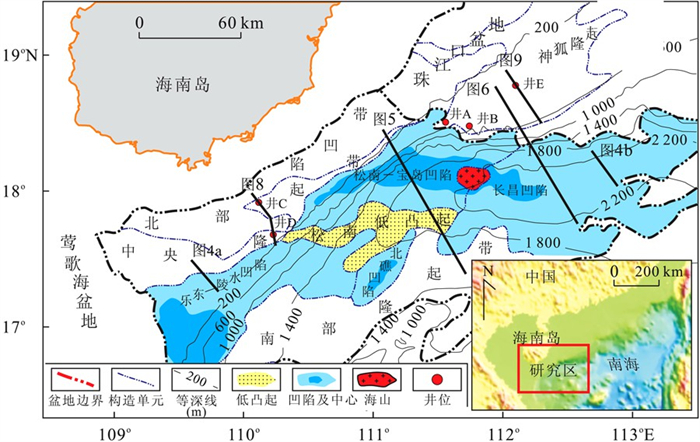
Figures(9)

 DownLoad: