




Reactive Transport Numerical Modeling of Typical Heavy Metal Pollutants in Three-Dimensional Fracture Networks
-
摘要: 自然界中裂隙介质的具体结构往往控制着其中的水流流动和溶质运移过程. 由于真实裂隙网络的复杂性,常据不同裂隙参数(形状、位置、大小、密度、走向等)概化并使用特定数学分布来刻画和产生离散裂隙网络,但这种离散裂隙网络介质因其高度非均质性和各向异性导致传统基于多孔介质理论的数值方法难于模拟裂隙水流和溶质运移过程. 利用三维离散裂隙网络模型生成场地裂隙介质不连续体,并基于裂隙空间参数将离散裂隙网络模型映射为等效多孔介质模型,由此进一步耦合地下水流与多组分反应性溶质运移开源代码PFLOTRAN,以实现三维裂隙网络中重金属污染物反应运移过程的数值模拟与污染物通量的定量评估. 算例研究表明,随着裂隙密度的增大,裂隙网络表征逐渐趋近于多孔介质;裂隙发育的密度和方向均影响着裂隙网络的连通性,进而影响裂隙水流中不同组分的迁移规律和通量评估,其中保守性组分与不同反应性组分的迁移行为有明显差异. 同时,研究表明,裂隙粗糙度对刻画裂隙网络中的污染组分迁移过程和通量评估具有重要影响. 本文方法可为场地裂隙介质中地下水流和污染物的反应运移提供有效模拟手段和定量评估工具.Abstract: The geologic discontinuities present in natural fractured rock governs groundwater flow and solute transport process. Due to the complexity of real-world fracture network, discrete fracture network (DFN) is often be described and generated based on specific probability distributions determined by different parameters (shape, location, size, density, orientation, etc.). Due to DFN's highly heterogeneous and an isotropic features, it's a challenge to simulate groundwater flow and solute transport processes using traditional numerical solution based on the experience achieved in porous media. In this paper, a 3-D DFN model is built for field-scale study, and mapped to an equivalent porous medium (EPM) model, which further couples groundwater flow model with the multi-component reactive transport code PFLOTRAN to achieve numerical simulation of the reactive transport process of heavy metal contaminants in the fractured network and quantitative assessment of mass fluxes. The study shows that the behavior of the fracture network gradually transforms into the transport in porous media as the density of the network increases; Both the density and orientation of fracture development affect the connectivity of the fracture network, which in turn affects the migration pattern and flux assessment of different components in fractured rock groundwater flow, where the migration behavior of conservative components and various reactive components are significantly different.Meanwhile, it is shown that roughness has an important influence on the migration process and flux assessment of the transport components in the fracture network.This paper provides an effective simulation and quantitative assessment tool for the reactive transport of heavy metals and groundwater flow in the fractured field.
-
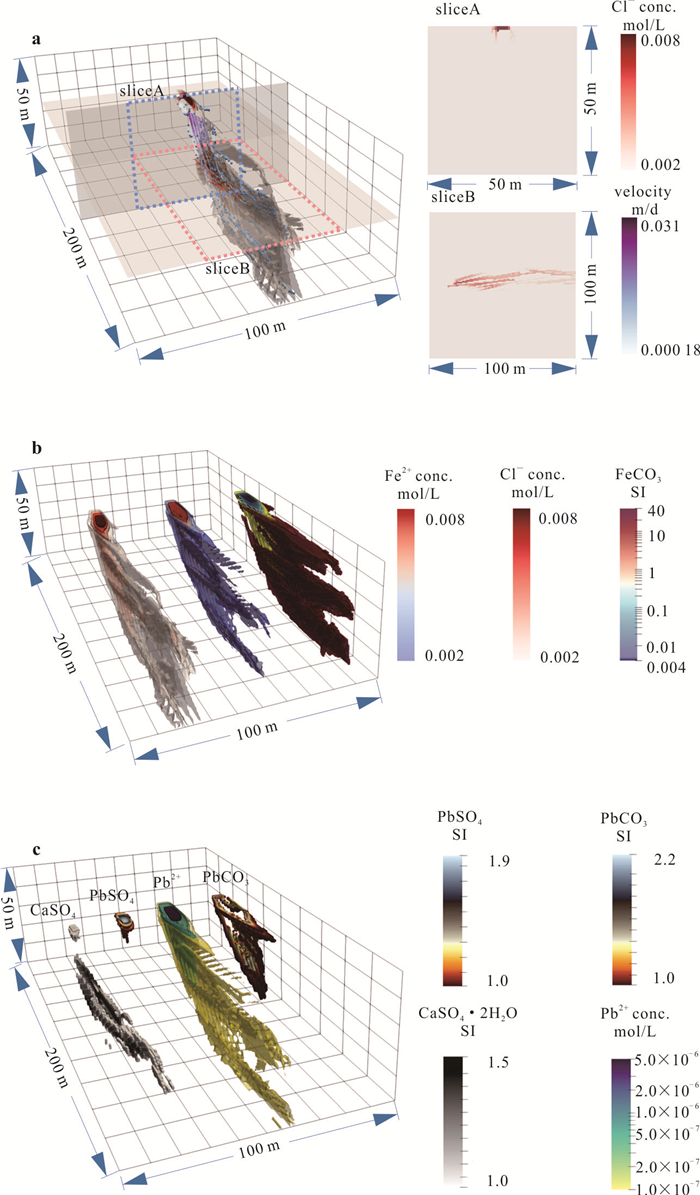
图 4 高密度裂隙网络中不同组分运移结果及其空间分布
a.对流速度场分布及保守性Cl-浓度空间分布;b. Cl-、Fe2+浓度以及菱铁矿饱和指数空间分布;c.Pb2+浓度及碳酸铅、硫酸铅、软石膏饱和指数的空间分布
Fig. 4. Solute transport results and their spatial distributions of different components in the high-density fracture network
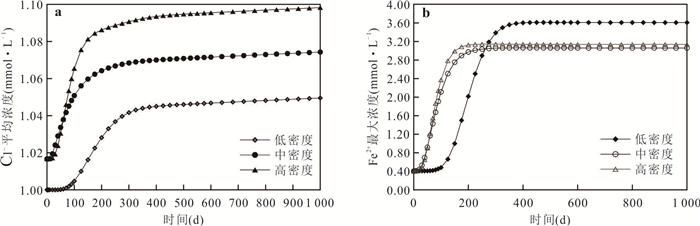
图 5 不同密度裂隙网络情景下不同组分在下游断面的浓度穿透曲线
a. Cl-平均浓度;b. Fe2+最大浓度
Fig. 5. Breakthrough curves of different components in the downstream section under different density fracture network scenarios
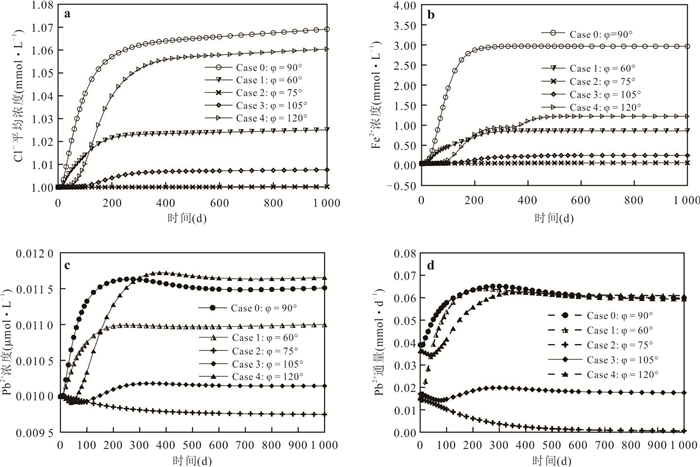
图 6 不同走向裂隙网络情景下不同组分在下游断面的穿透曲线
a. Cl-平均浓度;b. Fe2+平均浓度;c. Pb2+平均浓度;d. Pb2+通量
Fig. 6. Breakthrough curves of different components in the downstream section under different trends fracture network scenarios
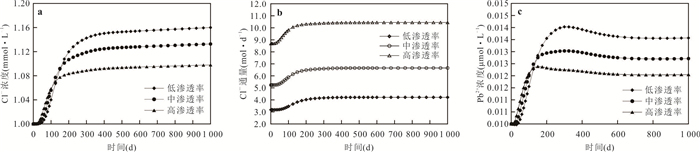
图 7 不同渗透率裂隙网络情景下不同组分在下游断面的穿透曲线
a. Cl-浓度;b. Cl-通量;c. Pb2+浓度
Fig. 7. Breakthrough curve of different components in the downstream section under different permeability fracture network scenarios
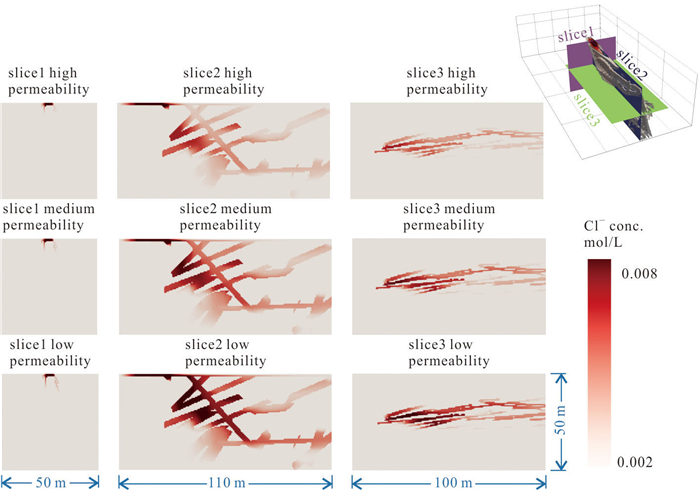
图 8 不同渗透率裂隙网络情景下同一切面位置上对应的Cl-浓度分布
Fig. 8. Distribution of Cl- concentration at the same slice location under different permeability fracture network scenarios
表 1 溶质运移模型初始及边界各组分浓度(单位:mol$ \cdot $L-1, pH除外)
Table 1. Initial and boundary condition of the solute transport model (unit: mol$ \cdot $L-1, except pH)
主要离子组分 背景值 源强组分 降水组分 H+ (pH) 9.2 4.0 7.0 Al3+ 1.00×10⁻²⁰ 4.30×10⁻³ 1.30×10⁻⁷ Fe3+ 1.00×10⁻²² 2.00×10⁻⁷ 2.30×10⁻⁸ Fe2+ 4.20×10⁻⁵ 3.06×10⁻² 5.40×10⁻⁵ Mn2+ 2.90×10⁻⁵ 7.84×10⁻³ 4.70×10⁻⁵ SO42- 5.30×10⁻³ 5.00×10⁻² 7.50×10⁻³ CO32- 2.10×10⁻⁵ 4.92×10⁻⁴ 3.90×10⁻³ Cl- 1.00×10⁻³ 1.58×10⁻² 1.00×10⁻³ K+ 6.60×10⁻⁵ 8.14×10⁻⁴ 6.70×10⁻⁵ Na+ 1.30×10⁻³ 1.39×10⁻³ 1.30×10⁻³ Mg2+ 1.50×10⁻³ 9.69×10⁻⁴ 1.90×10⁻³ Ca2+ 5.20×10⁻³ 1.08×10⁻² 6.09×10⁻³ Pb2+ 1.00×10⁻⁸ 1.52×10⁻⁵ 1.00×10⁻²⁰  下载: 导出CSV
表 2 不同密度连通裂隙网络的参数
Table 2. Parameters of connected fracture networks with different density
裂隙密度 目标裂隙数N/(条) 连通裂隙数n/(条) P32 低密度 250 54 0.16 中密度 500 277 0.70 高密度 1 000 511 1.12
下载: 导出CSV
表 3 中密度(N=500)条件下生成不同走向的裂隙网络特征
Table 3. Fracture network features with different trends generated under the condition of medium density (N=500)
不同情景 走向φ(°) 连通裂隙数n(条) P32 Case 0(基准方向) 90 277 0.70 Case 1 60 192 0.51 Case 2 75 92 0.24 Case 3 105 114 0.32 Case 4 120 256 0.66
下载: 导出CSV
表 4 不同渗透率裂隙网络设定
Table 4. Fracture networks settings with different permeability
渗透特性 修正系数 渗透率取值范围(m2) $ \overline{{\boldsymbol{k}}_{\boldsymbol{x}\boldsymbol{x}}} $ $ \overline{{\boldsymbol{k}}_{\boldsymbol{y}\boldsymbol{y}}} $ $ \overline{{\boldsymbol{k}}_{\boldsymbol{z}\boldsymbol{z}}} $ 低渗透率 0.24 [2.95×10⁻¹³, 3.58×10⁻¹²] [5.32×10⁻¹⁷, 1.54×10⁻¹²] [3.18×10⁻¹³, 3.47×10⁻¹²] 中渗透率 0.48 [5.78×10⁻¹³, 7.02×10⁻¹²] [1.04×10⁻¹⁶, 3.02×10⁻¹²] [6.22×10⁻¹³, 6.79×10⁻¹²] 高渗透率 1.00 [1.21×10⁻¹², 1.47×10⁻¹¹] [2.19×10⁻¹⁶, 6.35×10⁻¹²] [1.31×10⁻¹², 1.43×10⁻¹¹]
下载: 导出CSV
表 5 化学反应及其平衡常数
Table 5. Chemical reactions and their equilibrium constants
反应表达式 平衡常数lgK $ \mathrm{O}{\mathrm{H}}^{-}+{\mathrm{H}}^{+}\leftrightarrow {\mathrm{H}}_{2}\mathrm{O} $ 13.995 1 $ {\mathrm{H}}^{+}+\mathrm{C}{\mathrm{O}}_{3}^{2-}\leftrightarrow \mathrm{H}\mathrm{C}{\mathrm{O}}_{3}^{-} $ 10.328 8 $ \mathrm{C}{\mathrm{O}}_{2}\left(\mathrm{a}\mathrm{q}\right)+{\mathrm{H}}_{2}\mathrm{O}\leftrightarrow {\mathrm{H}}^{+}+\mathrm{H}\mathrm{C}{\mathrm{O}}_{3}^{-} $ -6.344 7 $ \mathrm{C}\mathrm{a}\mathrm{C}{\mathrm{O}}_{3}+{\mathrm{H}}^{+}\leftrightarrow \mathrm{C}{\mathrm{a}}^{2+}+\mathrm{H}\mathrm{C}{\mathrm{O}}_{3}^{-} $ 1.848 7 $ \mathrm{F}\mathrm{e}\mathrm{C}{\mathrm{O}}_{3}+{\mathrm{H}}^{+}\leftrightarrow \mathrm{F}{\mathrm{e}}^{2+}+\mathrm{H}\mathrm{C}{\mathrm{O}}_{3}^{-} $ -0.192 0 $ \mathrm{A}\mathrm{l}{\left(\mathrm{O}\mathrm{H}\right)}_{3}+3{\mathrm{H}}^{+}\leftrightarrow \mathrm{A}{\mathrm{l}}^{3+}+3{\mathrm{H}}_{2}\mathrm{O} $ 7.756 0 $ \mathrm{F}\mathrm{e}{\left(\mathrm{O}\mathrm{H}\right)}_{3}+3{\mathrm{H}}^{+}\leftrightarrow \mathrm{F}{\mathrm{e}}^{3+}+3{\mathrm{H}}_{2}\mathrm{O} $ 4.896 0 $ \mathrm{C}\mathrm{a}\mathrm{S}{\mathrm{O}}_{4}\cdot 2{\mathrm{H}}_{2}\mathrm{O}\leftrightarrow \mathrm{C}{\mathrm{a}}^{2+}+\mathrm{S}{\mathrm{O}}_{4}^{2-}+2{\mathrm{H}}_{2}\mathrm{O} $ -4.482 3 $ \mathrm{P}\mathrm{b}\mathrm{S}{\mathrm{O}}_{4}\leftrightarrow \mathrm{P}{\mathrm{b}}^{2+}+\mathrm{S}{\mathrm{O}}_{4}^{2-} $ -7.852 7 $ \mathrm{P}\mathrm{b}\mathrm{C}{\mathrm{O}}_{3}+{\mathrm{H}}^{+}\leftrightarrow \mathrm{P}{\mathrm{b}}^{2+}+\mathrm{H}\mathrm{C}{\mathrm{O}}_{3}^{-} $ -3.209 1
下载: 导出CSV
-
Barton, N., Bandis, S., Bakhtar, K., 1985. Strength, Deformation and Conductivity Coupling of Rock Joints. International Journal of Rock Mechanics and Mining Sciences & Geomechanics Abstracts, 22(3): 121-140. https://doi.org/10.1016/0148-9062(85)93227-9 Bense, V. F., Gleeson, T., Loveless, S. E., et al., 2013. Fault Zone Hydrogeology. Earth-Science Reviews, 127: 171-192. https://doi.org/10.1016/j.earscirev.2013.09.008 Chen, H. F., Zhang, F. W., He, Y., et al., 2016. Geological and Geomorphologic Settings Acting as the Controlling Factors and Indicators for Karst Systems. Hydrogeology & Engineering Geology, 43(5): 42-47(in Chinese with English abstract). de Dreuzy, J. R., Méheust, Y., Pichot, G., 2012. Influence of Fracture Scale Heterogeneity on the Flow Properties of Three-Dimensional Discrete Fracture Networks (DFN). Journal of Geophysical Research: Solid Earth, 117(B11) https://doi.org/10.1029/2012JB009461 Dershowitz, W. S., Einstein, H. H., 1988. Characterizing Rock Joint Geometry with Joint System Models. Rock Mechanics and Rock Engineering, 21(1): 21-51. https://doi.org/10.1007/BF01019674 Gan, L., Ma, H. Y., Shen, Z. Z., 2021. Roughness Characterization of Concave Fracture Surface and Coefficient Fitting of Modified Cubic Law. Journal of Hydraulic Engineering, 52(4): 420-431(in Chinese with English abstract). Hammond, G. E., Lichtner, P. C., 2010. Field-Scale Model for the Natural Attenuation of Uranium at the Hanford 300 Area Using High-Performance Computing. Water Resources Research, 46(9). https://doi.org/10.1029/2009WR008819 Hu, Y., Xu, W., Zhan, L., et al., 2022. Modeling of Solute Transport in a Fracture-Matrix System with a Three-Dimensional Discrete Fracture Network. Journal of Hydrology, 605: 127333. https://doi.org/10.1016/j.jhydrol.2021.127333 Hyman, J. D., Aldrich, G., Viswanathan, H., et al., 2016. Fracture Size and Transmissivity Correlations: Implications for Transport Simulations in Sparse Three-Dimensional Discrete Fracture Networks Following a Truncated Power Law Distribution of Fracture Size. Water Resources Research, 52(8): 6472-6489. https://doi.org/10.1002/2016WR018806 Hyman, J. D., Gable, C. W., Painter, S. L., et al., 2014. Conforming Delaunay Triangulation of Stochastically Generated Three Dimensional Discrete Fracture Networks: A Feature Rejection Algorithm for Meshing Strategy. SIAM Journal on Scientific Computing, 36(4): A1871-A1894. https://doi.org/10.1137/130942541 Hyman, J. D., Karra, S., Makedonska, N., et al., 2015. dfnWorks: A Discrete Fracture Network Framework for Modeling Subsurface Flow and Transport. Computers & Geosciences, 84: 10-19. https://doi.org/10.1016/j.cageo.2015.08.001 Jordan, G., Rammensee, W., 1998. Dissolution Rates of Calcite (1014) Obtained by Scanning Force Microscopy: Microtopography-Based Dissolution Kinetics on Surfaces with Anisotropic Step Velocities. Geochimica et Cosmochimica Acta, 62(6): 941-947. https://doi.org/10.1016/S0016-7037(98)00030-1 Lei, Q., Latham, J. P., Tsang, C. F., 2017. The Use of Discrete Fracture Networks for Modelling Coupled Geomechanical and Hydrological Behaviour of Fractured Rocks. Computers and Geotechnics, 85: 151-176. https://doi.org/10.1016/j.compgeo.2016.12.024 Li, X., Li, D., Xu, Y., et al., 2020. A DFN based 3D numerical Approach for Modeling Coupled Groundwater Flow and Solute Transport in Fractured Rock Mass. International Journal of Heat and Mass Transfer, 149: 119179. https://doi.org/10.1016/j.ijheatmasstransfer.2019.119179 Li, Y. M., Wen, Z., 2020. Impacts of Non-Darcian Flow in the Fracture on Flow Field and Solute Plumes in a Fracture-Aquifer System. Earth Science, 45(2): 693-700(in Chinese with English abstract). Liang, M., 2010. Numerical Simulation Study of Flow in Single Rough Fractures Based on Fluent(Dissertation). Hefei University of Technology, Hefei(in Chinese with English abstract). Lichtner, P. C., 2016. Kinetic Rate Laws Invariant to Scaling the Mineral Formula Unit. American Journal of Science, 316(5): 437. https://doi.org/10.2475/05.2016.02 Long, J. C. S., Karasaki, K., Davey, A., et al., 1990. Preliminary Prediction of Inflow into the D-Holes at the Stripa Mine. Lawrence Berkeley National Laboratory. LBNL Report #: LBL-27182. https://escholarship.org/uc/item/7mb9q37h Makedonska, N., Hyman, J. D., Karra, S., et al., 2016. Evaluating the Effect of Internal Aperture Variability on Transport in Kilometer Scale Discrete Fracture Networks. Advances in Water Resources, 94: 486-497. https://doi.org/10.1016/j.advwatres.2016.06.010 Makedonska, N., Painter, S. L., Bui, Q. M., et al., 2015. Particle Tracking Approach for Transport in Three-Dimensional Discrete Fracture Networks. Computational Geosciences, 19(5): 1123-1137. https://doi.org/10.1007/s10596-015-9525-4 Molson, J., Aubertin, M., Bussière, B., et al., 2008. Geochemical Transport Modelling of Drainage from Experimental Mine Tailings Cells Covered by Capillary Barriers. Applied Geochemistry, 23(1): 1-24. https://doi.org/10.1016/j.apgeochem.2007.08.004 Molson, J., Aubertin, M., Bussière, B., 2012. Reactive Transport Modelling of Acid Mine Drainage within Discretely Fractured Porous Media: Plume Evolution from a Surface Source Zone. Environmental Modelling & Software, 38: 259-270. https://doi.org/10.1016/j.envsoft.2012.06.010 Pandey, S., Rajaram, H., 2016. Modeling the Influence of Preferential Flow on the Spatial Variability and Time-Dependence of Mineral Weathering Rates. Water Resources Research, 52(12): 9344-9366. https://doi.org/10.1002/2016WR019026 Peters, R. R., Klavetter, E. A., 1988. A Continuum Model for Water Movement in an Unsaturated Fractured Rock Mass. Water Resources Research, 24(3): 416-430. https://doi.org/10.1029/WR024i003p00416 Romano, V., Bigi, S., Carnevale, F., et al., 2020. Hydraulic Characterization of a Fault Zone from Fracture Distribution. Journal of Structural Geology, 135: 104036. https://doi.org/10.1016/j.jsg.2020.104036 Sweeney, M. R., Gable, C. W., Karra, S., et al., 2020. Upscaled Discrete Fracture Matrix Model (UDFM): an Octree-Refined Continuum Representation of Fractured Porous Media. Computational Geosciences, 24(1): 293-310. https://doi.org/10.1007/s10596-019-09921-9 Trinchero, P., Iraola, A., Bruines, P., et al., 2021. Water-Mineral Reactions in a Translated Single Realistic Fracture: Consequences for Contaminant Uptake by Matrix Diffusion. Water Resources Research, 57(10): e2021WR030442. https://doi.org/10.1029/2021WR030442 Tsang, Y. W., Tsang, C. F., 1987. Channel Model of Flow through Fractured Media. Water Resources Research, 23(3): 467-479. https://doi.org/10.1029/WR023i003p00467 Walter, A. L., Frind, E. O., Blowes, D. W., et al., 1994. Modeling of Multicomponent Reactive Transport in Groundwater: 2. Metal Mobility in Aquifers Impacted by Acidic Mine Tailings Discharge. Water Resources Research, 30(11): 3149-3158. https://doi.org/10.1029/94WR00954 Wang, W., Fu, H., Xing, L. X., et al., 2021. Crack Propagation Behavior of Carbonatite Geothermal Reservoir Rock Mass Based on Extended Finite Element Method. Earth Science, 46(10): 3509-3519(in Chinese with English abstract). White, A. F., Brantley, S. L., 2003. The Effect of Time on the Weathering of Silicate Minerals: Why do Weathering Rates Differ in the Laboratory and Field? Chemical Geology, 202(3): 479-506. https://doi.org/10.1016/j.chemgeo.2003.03.001 Wilson, C. R., Witherspoon, P. A., Long, J. C. S., et al., 1983. Large-Scale Hydraulic Conductivity Measurements in Fractured Granite. International Journal of Rock Mechanics and Mining Sciences & Geomechanics Abstracts, 20(6): 269-276. https://doi.org/10.1016/0148-9062(83)90596-X Yang, B., Wang, H., Wang, B., et al., 2021. Digital Quantification of Fracture in Full-Scale Rock Using Micro-CT Images: A Fracturing Experiment with N2 and CO2. Journal of Petroleum Science and Engineering, 196: 107682. https://doi.org/10.1016/j.petrol.2020.107682 Zhong, Q. M., Chen, J. S., Chen, L., 2006. Symmetry Certification of Permea Bility Tensor and Derivation of Principal Permea Bility of Fractured Rock Mass. Chinese Journal of Rock Mechanics And Engineering, (S1): 2997-3002(in Chinese with English abstract). Zimmerman, R. W., Yeo, I. W., 2000. Fluid Flow in Rock Fractures: From the Navier-Stokes Equations to the Cubic Law. Dynamics of Fluids in Fractured Rock: 213-224. https://doi.org/10.1029/GM122p0213 陈宏峰, 张发旺, 何愿, 等, 2016. 地质与地貌条件对岩溶系统的控制与指示. 水文地质工程地质, 43(5): 42-47. https://www.cnki.com.cn/Article/CJFDTOTAL-SWDG201605006.htm 甘磊, 马洪影, 沈振中, 2021. 下凹形态裂隙面粗糙程度表征及立方定律修正系数拟合. 水利学报, 52(4): 420-431. https://www.cnki.com.cn/Article/CJFDTOTAL-SLXB202104005.htm 梁敏, 2010. 基于Fluent的粗糙单裂隙水流数值模拟研究(硕士学位论文). 合肥: 合肥工业大学. 李一鸣, 文章, 2020. 非达西裂隙流对渗透性基岩中流场及溶质羽的影响. 地球科学, 45(2): 693-700. doi: 10.3799/dqkx.2018.345 王伟, 付豪, 邢林啸, 2021. 基于扩展有限元法的碳酸盐岩地热储层岩体裂缝扩展行为. 地球科学, 46(10): 3509-3519. doi: 10.3799/dqkx.2021.005 钟启明, 陈建生, 陈亮, 2006. 裂隙岩体渗透张量的对称性证明及主渗透性推导. 岩石力学与工程学报, (S1): 2997-3002. https://www.cnki.com.cn/Article/CJFDTOTAL-YSLX2006S1060.htm -

 点击查看大图
计量
- 文章访问数: 842
- HTML全文浏览量: 484
- PDF下载量: 86
- 被引次数: 0
