




Characterization of Architecture of Intraplate Strike-Slip Faults in Yanchang Formation of Jinghe Oilfield in Southern Ordos Basin
-
摘要: 板内走滑断裂的内部结构具有控储和控藏作用.在断缝体油气藏勘探开发过程中,由于走滑断裂带内部结构具有高度非均质性,需要对其内部结构进行刻画.综合岩心、测井和地震资料,对鄂尔多斯盆地南部泾河油田延长组走滑断裂带进行了走向分段和侧向分带研究,并提出了利用综合裂缝指数测井(comprehensive fracture index log,CFI)和断层形态指数地震属性(fault shape index attribute,FSI)累积曲线定量划分损伤带边界的方法.结果表明,泾河油田延长组走滑断裂带以张扭段和走滑段为主,压扭段仅少量发育.CFI和FSI均与裂缝密度呈正相关关系,根据累积CFI和累积FSI曲线的梯度变化可以刻画地下走滑断裂的损伤带边界.泾河油田延长组走滑断裂带内单条断裂的宽度主要在160~300 m,且张扭段的宽度最大,其次为压扭段和走滑段.
-
关键词:
- 板内走滑断裂带 /
- 内部结构 /
- 损伤带 /
- 断裂带宽度 /
- 走向分段 /
- 综合裂缝指数测井(CFI) /
- 断层形态指数属性(FSI) /
- 延长组 /
- 鄂尔多斯盆地南部 /
- 构造
Abstract: The architecture of intraplate strike-slip faults plays an important role in controlling reservoir properties as well as hydrocarbon migration and accumulation. In the process of exploration and development of strike-slip fault-controlled fracturing reservoirs, the architecture of the strike-slip fault zone needs to be characterized because of its high heterogeneity. Taking strike-slip fault zones of the Yanchang Formation of the Jinghe oilfield in the southern Ordos basin as an example, in this paper it conducted fault segmentation along the fault strike and lateral zonation along the fault dip by integrating core, logging and seismic data. In this paper it puts forward a method to quantitatively detect damage zone boundaries by cumulative curves of comprehensive fracture index log (CFI) and fault shape index attribute (FSI). The results show that strike-slip fault zones of the Yanchang Formation in the Jinghe oilfield are mainly composed of transtensional and strike-slip segments, and transpressional segments are rarely developed. CFI and FSI are positively correlated with fracture density, and damage zone boundaries can be detected according to the gradient change of the cumulative curves of CFI and FSI. The width of a single fault within the strike-slip fault zones in the Yanchang Formation of the Jinghe oilfield is mainly between 160-300 m, and the average width of transtensional segments is the largest, followed by transpressional and strike-slip segments. -
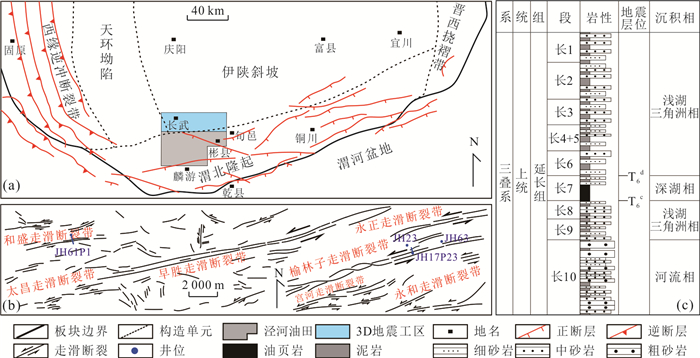
图 1 鄂尔多斯盆地南部泾河油田的构造位置及走滑断裂体系
a.构造位置;b.走滑断裂体系;c.延长组地层及地震层位
Fig. 1. Structural position and strike-slip fault system of the Jinghe oilfield in the southern Ordos basin
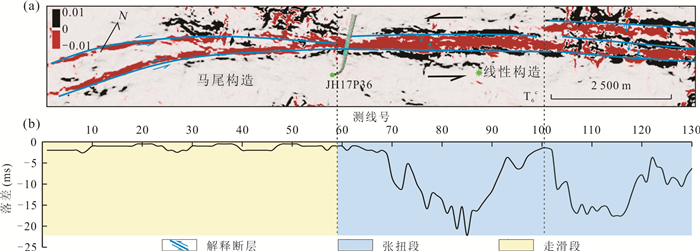
图 3 延长组长7段底面(T6c界面)永正走滑断裂带的分段特征
a.延长组长7段底面(T6c界面)的FSI地震属性图及解释断层;b.T6c界面沿永正走滑断裂带走向的落差变化图
Fig. 3. Segmentation of Zaosheng strike-slip fault zone at the bottom surface of the Chang 7 member (T6c)
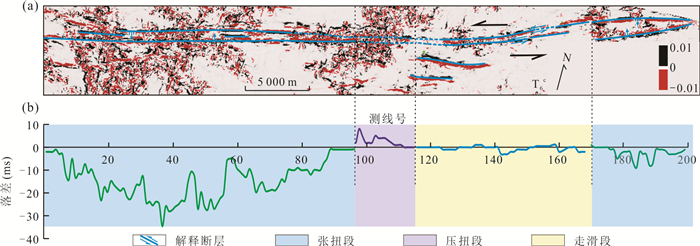
图 4 延长组长7段底面(T6c界面)早胜走滑断裂带的分段特征
a.延长组长7段底面(T6c界面)的断层形态指数地震属性图及解释断层;b.T6c界面沿早胜走滑断裂带走向的落差变化图
Fig. 4. Segmentation of Zaosheng strike-slip fault zone at the bottom surface of the Chang 7 member (T6c)
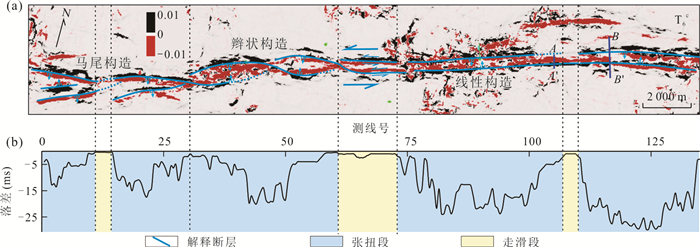
图 5 延长组长7段底面(T6c界面)榆林子走滑断裂带的分段特征
a.延长组长7段底面(T6c界面)的FSI地震属性图及解释断层;b.T6c界面沿榆林子走滑断裂带走向的落差变化图
Fig. 5. Segmentation of Yulinzi strike slip fault zone at the bottom surface of the Chang 7 member (T6c)
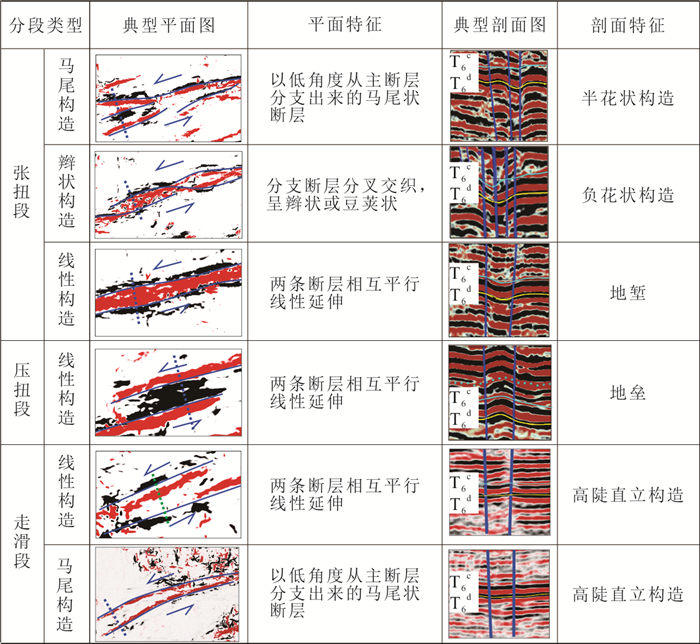
图 6 走滑断裂带的分段类型及特征
Fig. 6. Segmentation types and characteristics of strike-slip fault zones
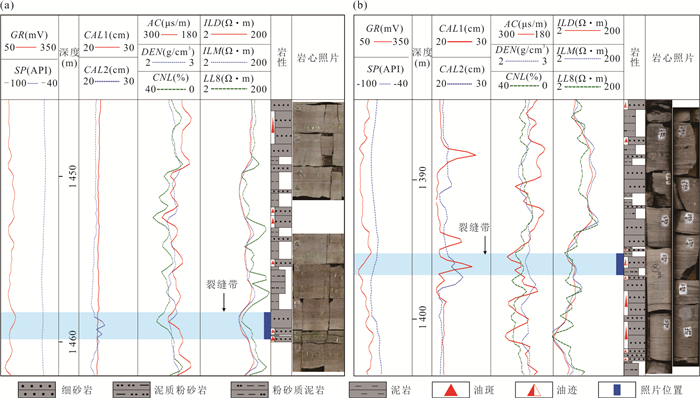
图 7 取心井JH23井和JH63井的综合柱状图
a.JH23井;b.JH63井
Fig. 7. Comprehensive log diagrams of cored wells JH23 and JH63
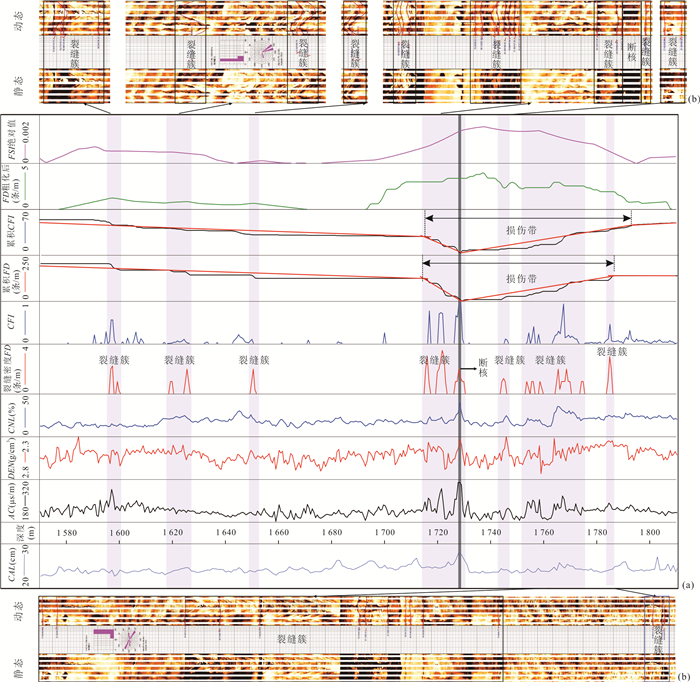
图 8 JH17P23成像测井水平段的走滑断裂带内部结构
a.JH17P23水平段的电成像及内部结构解释;b.JH17P23水平段的综合测井柱状图
Fig. 8. Interpreted architecture of strike-slip fault zone in the horizontal section of JH17P23 image logs
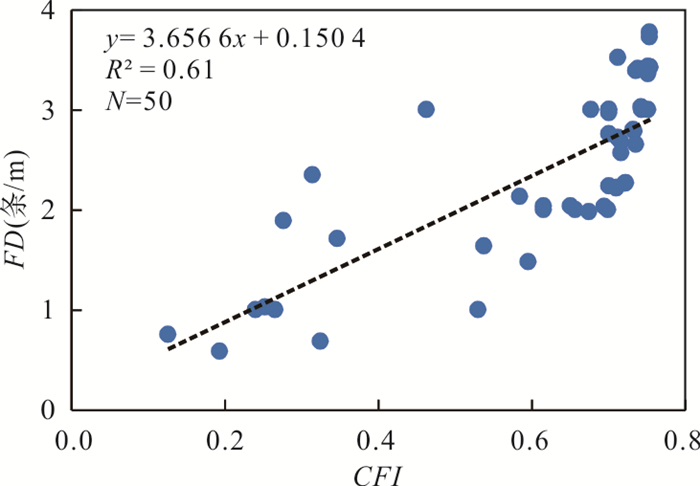
图 10 JH17P23井水平段的综合裂缝指数(CFI)与裂缝密度(FD)的关系
Fig. 10. Relationship between the comprehensive fracture index (CFI) and fracture density (FD) in the horizontal section of well JH17P23
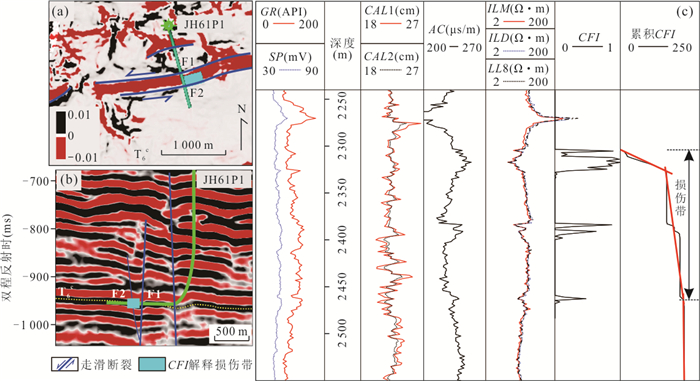
图 11 水平井JH61P1水平段的损伤带边界划分
a.长7段底界面(T6c)FSI属性切片的JH17P61位置及断裂解释;b.过JH17P61的地震剖面及断裂解释;c.JH61P1测井柱状图
Fig. 11. Damage zone boundary identification of the horizontal section of horizontal well JH61P1
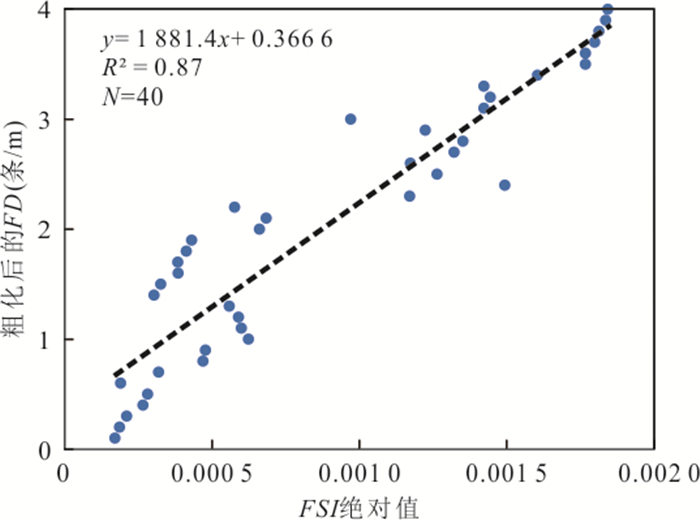
图 12 JH17P23井水平段断层形态指数属性值(FSI)与粗化后的裂缝密度(FD)的关系
Fig. 12. Relationship between the absolute value of fault shape index (FSI) and scaled-up fracture density (FD) the in the horizontal section of well JH17P23
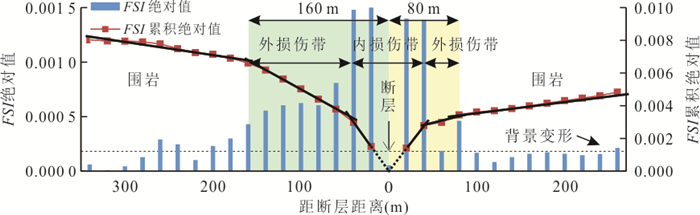
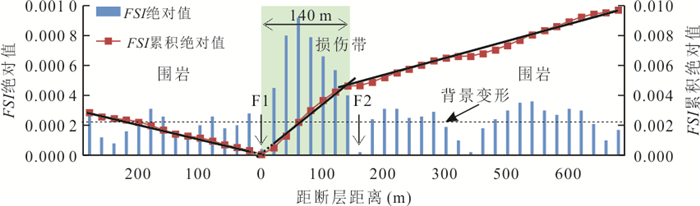
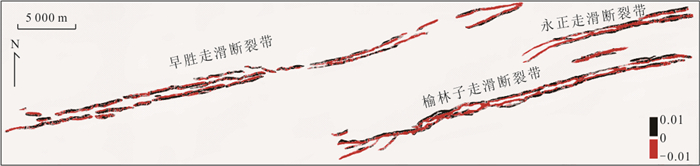
图 15 泾河油田长7段底界面(T6c)断层形态指数属性切片上主要走滑断裂带的损伤带边界
FSI < 0,指示断层下降盘;FSI > 0,指示断层上升盘
Fig. 15. Damage zone boundaries of three main strike-slip faults on bottom interface (T6c) of Chang 7 member in the Jinghe oilfield
-
Alaei, B., Torabi, A., 2017. Seismic Imaging of Fault Damaged Zone and Its Scaling Relation with Displacement. Interpretation, 5(4): 83-93. https://doi.org/10.1190/int-2016-0230.1 Ampuero, J. P., Mao, X. L., 2017. Upper Limit on Damage Zone Thickness Controlled by Seismogenic Depth. In: Thomas, M. Y., Mitchell, T. M., Bhat, H. S., eds., Fault Zone Dynamic Processes: Evolution of Fault Properties during Seismic Rupture. John Wiley & Sons, Inc., Hoboken, NJ, USA, 243-253. https://doi.org/10.1002/9781119156895.ch13 Bao, H. P., Guo, W., Liu, G., et al., 2020. Tectonic Evolution in the Southern Ordos Block and Its Significance in the Tectono-Depositional Differentiation in the Interior of the Ordos Basin. Chinese Journal of Geology, 55(3): 703-725(in Chinese with English abstract). Berg, S. S., Skar, T., 2005. Controls on Damage Zone Asymmetry of a Normal Fault Zone: Outcrop Analyses of a Segment of the Moab Fault, SE Utah. Journal of Structural Geology, 27(10): 1803-1822. https://doi.org/10.1016/j.jsg.2005.04.012 Brogi, A., 2008. Fault Zone Architecture and Permeability Features in Siliceous Sedimentary Rocks: Insights from the Rapolano Geothermal Area (Northern Apennines, Italy). Journal of Structural Geology, 30(2): 237-256. https://doi.org/10.1016/j.jsg.2007.10.004 Caine, J. S., Evans, J. P., Forster, C. B., 1996. Fault Zone Architecture and Permeability Structure. Geology, 24(11): 1025. https://doi.org/10.1130/0091-7613(1996)0241025:fzaaps>2.3.co;2 doi: 10.1130/0091-7613(1996)0241025:fzaaps>2.3.co;2 Choi, J. H., Edwards, P., Ko, K., et al., 2016. Definition and Classification of Fault Damage Zones: A Review and a New Methodological Approach. Earth-Science Reviews, 152: 70-87. https://doi.org/10.1016/j.earscirev.2015.11.006 Choi, J. H., Jin, K., Enkhbayar, D., et al., 2012. Rupture Propagation Inferred from Damage Patterns, Slip Distribution, and Segmentation of the 1957 Mw 8.1 Gobi-Altay Earthquake Rupture along the Bogd Fault, Mongolia. Journal of Geophysical Research: Solid Earth, 117(B12): B12401. https://doi.org/10.1029/2011JB008676 Chopra, S., Marfurt, K., 2007. Curvature Attribute Applications to 3D Surface Seismic Data. The Leading Edge, 26(4): 404-414. https://doi.org/10.1190/1.2723201 de Joussineau, G., Aydin, A., 2007. The Evolution of the Damage Zone with Fault Growth in Sandstone and Its Multiscale Characteristics. Journal of Geophysical Research: Solid Earth, 112(B12): B12401. https://doi.org/10.1029/2006jb004711 de Joussineau, G., Aydin, A., 2009. Segmentation along Strike-Slip Faults Revisited. Pure and Applied Geophysics, 166(10): 1575-1594. https://doi.org/10.1007/s00024-009-0511-4 Deng, S., Li, H. L., Zhang, Z. P., et al., 2019. Structural Characterization of Intracratonic Strike-Slip Faults in the Central Tarim Basin. AAPG Bulletin, 103(1): 109-137. https://doi.org/10.1306/06071817354 Deng, S., Zhao, R., Kong, Q. F., et al., 2022. Two Distinct Strike-Slip Fault Networks in the Shunbei Area and Its Surroundings, Tarim Basin: Hydrocarbon Accumulation, Distribution, and Controlling Factors. AAPG Bulletin, 106(1): 77-102. https://doi.org/10.1306/07202119113 Ding, Z. W., Wang, R. J., Chen, F. F., et al., 2020. Origin, Hydrocarbon Accumulation and Oil-Gas Enrichment of Fault-Karst Carbonate Reservoirs: A Case Study of Ordovician Carbonate Reservoirs in South Tahe Area of Halahatang Oilfield, Tarim Basin. Petroleum Exploration and Development, 47(2): 286-296(in Chinese with English abstract). Fossen, H., Tikoff, B., Teyssier, C., et al., 1994. Strain Modeling of Transpressional and Transtensional Deformation. Norsk Geologisk Tidsskrift, 74: 134-145. He, F. Q., Liang, C. C., Lu, C., et al., 2020. Identification and Description of Fault-Fracture Bodies in Tight and Low Permeability Reservoirs in Transitional Zone at the South Margin of Ordos Basin. Oil & Gas Geology, 41(4): 710-718(in Chinese with English abstract). Huang, Y. H., Ampuero, J. P., 2011. Pulse-Like Ruptures Induced by Low-Velocity Fault Zones. Journal of Geophysical Research: Solid Earth, 116(B12): B12307. https://doi.org/10.1029/2011JB008684 Iacopini, D., Butler, R. W. H., Purves, S., et al., 2016. Exploring the Seismic Expression of Fault Zones in 3D Seismic Volumes. Journal of Structural Geology, 89: 54-73. https://doi.org/10.1016/j.jsg.2016.05.005 Kim, Y. S., Sanderson, D. J., 2006. Structural Similarity and Variety at the Tips in a Wide Range of Strike-Slip Faults: A Review. Terra Nova, 18(5): 330-344. https://doi.org/10.1111/j.1365-3121.2006.00697.x Li, P. J., Chen, H. H., Tang, D. Q., et al., 2017. Coupling Relationship between NE Strike-Slip Faults and Hypogenic Karstification in Middle-Lower Ordovician of Shunnan Area, Tarim Basin, Northwest China. Earth Science, 42(1): 93-104(in Chinese with English abstract). Liao, Z. H., Liu, H., Carpenter, B. M., et al., 2019. Analysis of Fault Damage Zones Using Three-Dimensional Seismic Coherence in the Anadarko Basin, Oklahoma. AAPG Bulletin, 103(8): 1771-1785. https://doi.org/10.1306/1219181413417207 Lin, A. M., Yamashita, K., 2013. Spatial Variations in Damage Zone Width along Strike-Slip Faults: An Example from Active Faults in Southwest Japan. Journal of Structural Geology, 57: 1-15. https://doi.org/10.1016/j.jsg.2013.10.006 Liu, H. P., Luo, Y., Meng, Y. J., et al., 2021. Effects of Pore Structure on the Moveable Oil Saturation in Water-Driven Tight Oil Sandstone Reservoirs. Journal of Petroleum Science and Engineering, 207: 109142. https://doi.org/10.1016/j.petrol.2021.109142 Liu, H. P., Zhao, Y. C., Luo, Y., et al., 2020. Origin of the Reservoir Quality Difference between Chang 8 and Chang 9 Member Sandstones in the Honghe Oil Field of the Southern Ordos Basin, China. Journal of Petroleum Science and Engineering, 185: 106668. https://doi.org/10.1016/j.petrol.2019.106668 Liu, Y., Wu, K. Y., Wang, X., et al., 2017. Architecture of Buried Reverse Fault Zone in the Sedimentary Basin: A Case Study from the Hong-Che Fault Zone of the Junggar Basin. Journal of Structural Geology, 105: 1-17. https://doi.org/10.1016/j.jsg.2017.11.002 Liu, Y. Q., Deng, S., 2022. Structural Analysis of Intraplate Strike-Slip Faults with Small to Medium Displacement: A Case Study of the Shunbei 4 Fault, Tarim Basin. Journal of China University of Mining & Technology, 51(1): 124-136(in Chinese with English abstract). Luo, Y., Wang, Y. Z., Liu, H. P., et al., 2020. Overpressure Controlling Factors for Tectonic Fractures in Near-Source Tight Reservoirs in the Southwest Ordos Basin, China. Journal of Petroleum Science and Engineering, 188: 106818. https://doi.org/10.1016/j.petrol.2019.106818 Lü, W. Y., Zeng, L. B., Liu, Z. Q., et al., 2016. Fracture Responses of Conventional Logs in Tight-Oil Sandstones: A Case Study of the Upper Triassic Yanchang Formation in Southwest Ordos Basin, China. AAPG Bulletin, 100(9): 1399-1417. https://doi.org/10.1306/04041615129 Ma, D. B., Wang, Z. C., Duan, S. F., et al., 2018. Strike-Slip Faults and Their Significance for Hydrocarbon Accumulation in Gaoshiti-Moxi Area, Sichuan Basin, SW China. Petroleum Exploration and Development, 45(5): 795-805(in Chinese with English abstract). Mann, P., 2007. Global Catalogue, Classification and Tectonic Origins of Restraining- and Releasing Bends on Active and Ancient Strike-Slip Fault Systems. Geological Society, London, Special Publications, 290(1): 13-142. https://doi.org/10.1144/sp290.2 Peacock, D. C. P., Dimmen, V., Rotevatn, A., et al., 2017. A Broader Classification of Damage Zones. Journal of Structural Geology, 102: 179-192. https://doi.org/10.1016/j.jsg.2017.08.004 Rafiq, A., Eaton, D. W., McDougall, A., et al., 2016. Reservoir Characterization Using Microseismic Facies Analysis Integrated with Surface Seismic Attributes. Interpretation, 4(2): 167-181. https://doi.org/10.1190/int-2015-0109.1 Riley, P. R., Goodwin, L. B., Lewis, C. J., 2010. Controls on Fault Damage Zone Width, Structure, and Symmetry in the Bandelier Tuff, New Mexico. Journal of Structural Geology, 32(6): 766-780. https://doi.org/10.1016/j.jsg.2010.05.005 Storti, F., Holdsworth, R. E., Salvini, F., 2003. Intraplate Strike-Slip Deformation Belts. Geological Society, London, Special Publications, 210(1): 1-14. https://doi.org/10.1144/gsl.sp.2003.210.01.01 Sun, Q. Q., Fan, T. L., Gao, Z. Q., et al., 2021. New Insights on the Geometry and Kinematics of the Shunbei 5 Strike-Slip Fault in the Central Tarim Basin, China. Journal of Structural Geology, 150: 104400. https://doi.org/10.1016/j.jsg.2021.104400 Teng, C. Y., Cai, Z. X., Hao, F., et al., 2020. Structural Geometry and Evolution of an Intracratonic Strike-Slip Fault Zone: a Case Study from the North SB5 Fault Zone in the Tarim Basin, China. Journal of Structural Geology, 140: 104159. https://doi.org/10.1016/j.jsg.2020.104159 Torabi, A., Berg, S. S., 2011. Scaling of Fault Attributes: A Review. Marine and Petroleum Geology, 28(8): 1444-1460. https://doi.org/10.1016/j.marpetgeo.2011.04.003 Torabi, A., Ellingsen, T. S. S., Johannessen, M. U., et al., 2020. Fault Zone Architecture and Its Scaling Laws: Where does the Damage Zone Start and Stop? Geological Society, London, Special Publications, 496(1): 99-124. https://doi.org/10.1144/sp496-2018-151 Wang, W. F., Zhou, W. W., Xu, S. L., 2017. Formation and Evolution of Concealed Fault Zone in Sedimentary Basins and Its Significance in Hydrocarbon Accumulation. Earth Science, 42(4): 613-624(in Chinese with English abstract). Wang, X., 2021. Characteristics of Chang 8 Strike-Slip Fault in Jinghe and Its Influence on Oil and Gas Enrichment. Petrochemical Industry Application, 40(6): 101-105(in Chinese with English abstract). doi: 10.3969/j.issn.1673-5285.2021.06.024 Wu, G. H., Gao, L. H., Zhang, Y. T., et al., 2019. Fracture Attributes in Reservoir-Scale Carbonate Fault Damage Zones and Implications for Damage Zone Width and Growth in the Deep Subsurface. Journal of Structural Geology, 118: 181-193. https://doi.org/10.1016/j.jsg.2018.10.008 Wu, G. H., Kim, Y. S., Su, Z., et al., 2020. Segment Interaction and Linkage Evolution in a Conjugate Strike-Slip Fault System from the Tarim Basin, NW China. Marine and Petroleum Geology, 112: 104054. https://doi.org/10.1016/j.marpetgeo.2019.104054 Xu, L. M., Zhou, L. F., Zhang, Y. K., et al., 2006. Characteristics and Tectonic Setting of Tectono-Stress Field of Ordos Basin. Geotectonica et Metallogenia, 30(4): 455-462(in Chinese with English abstract). Xu, X. Y., Wang, W. F., 2020. The Recognition of Potential Fault Zone in Ordos Basin and Its Reservoir Control. Earth Science, 45(5): 1754-1768(in Chinese with English abstract). Yun, L., Deng, S., 2022. Structural Styles of Deep Strike-Slip Faults in Tarim Basin and the Characteristics of Their Control on Reservoir Formation and Hydrocarbon Accumulation: a Case Study of Shunbei Oil and Gas Field. Acta Petrolei Sinica, 43(6): 770-787(in Chinese with English abstract). Zhou, B. W., Chen, H. H., Yun, L., et al., 2022. The Relationship between Fault Displacement and Damage Zone Width of the Paleozoic Strike-Slip Faults in Shunbei Area, Tarim Basin. Earth Science, 47(2): 437-451(in Chinese with English abstract). 包洪平, 郭玮, 刘刚, 等, 2020. 鄂尔多斯地块南缘构造演化及其对盆地腹部的构造-沉积分异的效应. 地质科学, 55(3): 703-725. https://www.cnki.com.cn/Article/CJFDTOTAL-DZKX202003005.htm 丁志文, 汪如军, 陈方方, 等, 2020. 断溶体油气藏成因、成藏及油气富集规律: 以塔里木盆地哈拉哈塘油田塔河南岸地区奥陶系为例. 石油勘探与开发, 47(2): 286-296. https://www.cnki.com.cn/Article/CJFDTOTAL-SKYK202002009.htm 何发岐, 梁承春, 陆骋, 等, 2020. 鄂尔多斯盆地南缘过渡带致密-低渗油藏断缝体的识别与描述. 石油与天然气地质, 41(4): 710-718. https://www.cnki.com.cn/Article/CJFDTOTAL-SYYT202004006.htm 李培军, 陈红汉, 唐大卿, 等, 2017. 塔里木盆地顺南地区中-下奥陶统NE向走滑断裂及其与深成岩溶作用的耦合关系. 地球科学, 42(1): 93-104. doi: 10.3799/dqkx.2017.007 刘雨晴, 邓尚, 2022. 板内中小滑移距走滑断裂发育演化特征精细解析: 以塔里木盆地顺北4号走滑断裂为例. 中国矿业大学学报, 51(1): 124-136. https://www.cnki.com.cn/Article/CJFDTOTAL-ZGKD202201012.htm 马德波, 汪泽成, 段书府, 等, 2018. 四川盆地高石梯-磨溪地区走滑断层构造特征与天然气成藏意义. 石油勘探与开发, 45(5): 795-805. https://www.cnki.com.cn/Article/CJFDTOTAL-SKYK201805006.htm 王伟锋, 周维维, 徐守礼, 2017. 沉积盆地断裂趋势带形成演化及其控藏作用. 地球科学, 42(4): 613-624. doi: 10.3799/dqkx.2017.048 王旭, 2021. 泾河长8走滑断裂特征及其对油气富集的影响. 石油化工应用, 40(6): 101-105. https://www.cnki.com.cn/Article/CJFDTOTAL-NXSH202106024.htm 徐黎明, 周立发, 张义楷, 等, 2006. 鄂尔多斯盆地构造应力场特征及其构造背景. 大地构造与成矿学, 30(4): 455-462. https://www.cnki.com.cn/Article/CJFDTOTAL-DGYK200604006.htm 徐兴雨, 王伟锋, 2020. 鄂尔多斯盆地隐性断裂识别及其控藏作用. 地球科学, 45(5): 1754-1768. doi: 10.3799/dqkx.2019.175 云露, 邓尚, 2022. 塔里木盆地深层走滑断裂差异变形与控储控藏特征: 以顺北油气田为例. 石油学报, 43(6): 770-787. https://www.cnki.com.cn/Article/CJFDTOTAL-SYXB202206003.htm 周铂文, 陈红汉, 云露, 等, 2022. 塔里木盆地顺北地区下古生界走滑断裂带断距分段差异与断层宽度关系. 地球科学, 47(2): 437-451. doi: 10.3799/dqkx.2021.073 -

 下载:
下载:
 点击查看大图
计量
- 文章访问数: 1480
- HTML全文浏览量: 1619
- PDF下载量: 173
- 被引次数: 0
