




Different Distribution of Deep and Shallow Geothermal Resources in Jizhong Depression under Complex Heat Transfer
-
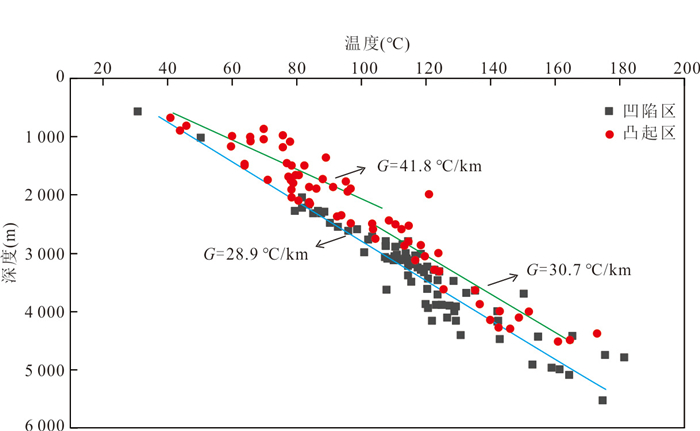
摘要: 渤海湾盆地冀中坳陷地热资源开发潜力巨大,但目前仅对浅部中-低温地热资源的成因机制进行了大规模的研究,深部高温地热资源成因机制尚不明确.以区域地质、地热地质、岩石热物性为基础,分析了研究区深部温度场特征和控制因素,探究了传导-对流复杂热传递作用下深部高温聚热机制.渤海湾盆地冀中坳陷地温梯度和大地热流较高,地温梯度介于27.4~39.7 ℃/km,平均约34.8 ℃/km,大地热流主要分布在50~70 mW/m2之间.地温场受到岩石热导率、基底构造起伏以及地下水流动的影响,平面和垂向分布均表现出复杂的差异性.通过实测数据计算研究区深部地温,认为凸起区浅部温度高但深部温度低,凹陷区浅部温度低深部温度高.因此形成了冀中坳陷5 000 m内高温地热资源主要分布在凹陷区深部的特征,地层温度可达190 ℃,可作为潜在干热岩勘探的有利目标.从地质构造、源、储、盖、流体等方面研究了冀中坳陷凸起区水热型地热资源和深部潜在干热岩型地热资源的特征,建立了浅部凸起区水热型地热资源与深部凹陷区潜在干热岩地热资源聚集模式.研究加深了对冀中坳陷乃至渤海湾盆地深部高温地热成因机制和分布规律的认识,对干热岩地热资源的开发利用具有参考价值.Abstract: The Jizhong Depression, Bohai Bay Basin, has enormous potential for geothermal resource development, but currently only the genesis mechanism of shallow to mid-temperature geothermal resources has been extensively researched, and the genesis mechanism of deep and high-temperature geothermal resources remains unclear. Based on regional geology, geothermal geology, and rock thermal properties, in this study it analyzed the characteristics and controlling factors of the deep temperature field in the study area and explored the deep and high-temperature heat accumulation mechanism under complex heat transfer processes of conduction and convection. The temperature gradient and heatflow in Jizhong Depression of the Bohai Bay Basin are relatively high, with a temperature gradient ranging from 27.4 ℃/km to 39.7 ℃/km, with an average of about 34.8℃/km, and a heatflow ranging from 50 mW/m2 to 70 mW/m2. The temperature field is affected by rock thermal conductivity, basement structures, and groundwater flow, and has complex differences in both plane and vertical distribution. Based on measured data, it was found that the shallow temperature is high but the deep temperature is low in the convex areas, and the shallow temperature is low but the deep temperature is high in the depressed areas, leading to the deep and high-temperature geothermal resources largely concentrated in the depressions within 5 000 m depth in Jizhong Depression, with the reservoir temperature reaching 190 ℃, and which can serve as potential favorable targets for exploring hot dry rock resources. The characteristics of hydrothermal geothermal resources in the uplift area and deep potential hot dry rock geothermal resources in the Jizhong Depression are studied from the perspectives of geological structure, source, storage, cap, and fluid, and a model of the accumulation of shallow hydrothermal geothermal resources and deep potential hot dry rock geothermal resources in the studied area was established. This study deepened our understanding of the genesis mechanisms and distribution patterns of deep and high-temperature geothermal resources in Jizhong Depression and even the Bohai Bay Basin, and has significant reference value for the exploration and utilization of hot dry rock geothermal resources.
-
Key words:
- geothermal field /
- geothermal resources /
- thermal refraction /
- thermal convection /
- hot dry rock /
- Bohai Bay Basin /
- geophysics
-

图 4 冀中坳陷不同岩性热导率频率分布直方图
Fig. 4. Histogram of frequency distribution of thermal conductivity of different lithologies in Jizhong Depression
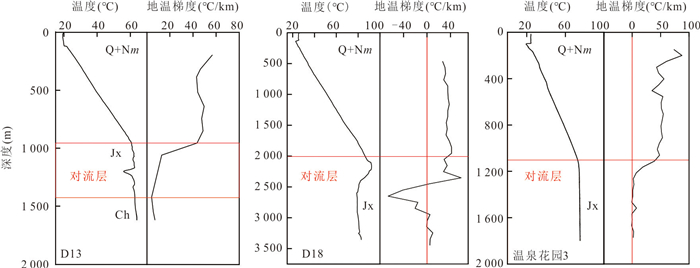
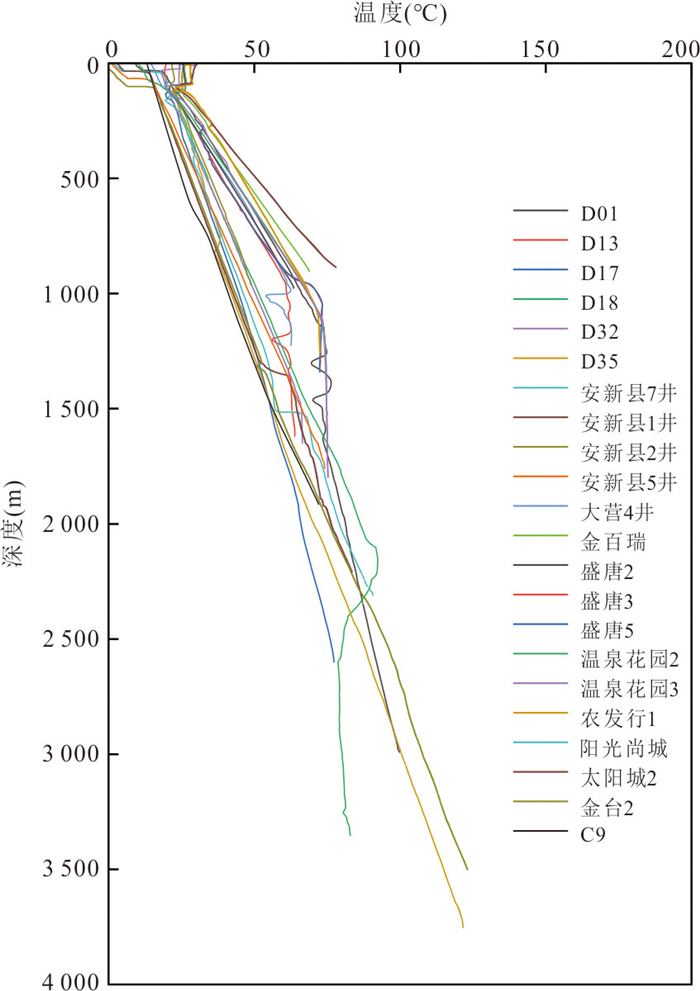
图 5 冀中坳陷部分井地温梯度-深度图
Fig. 5. Geothermal gradient-depth map of some wells in Jizhong Depression
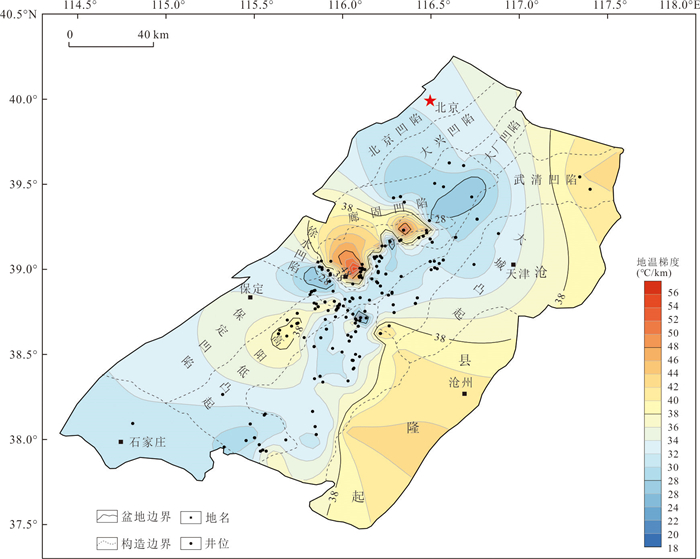
图 6 冀中坳陷地温梯度平面分布
Fig. 6. Plane distribution of geothermal gradient in Jizhong Depression
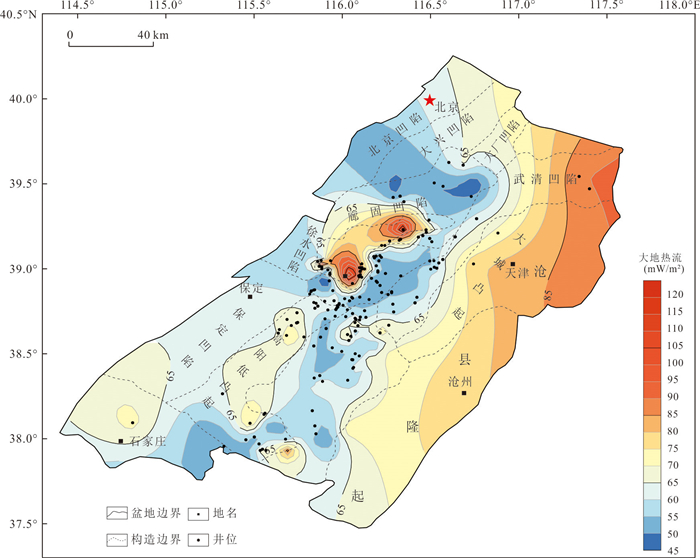
图 7 冀中坳陷大地热流平面分布
Fig. 7. Plane distribution of terrestrial heat flow in Jizhong Depression
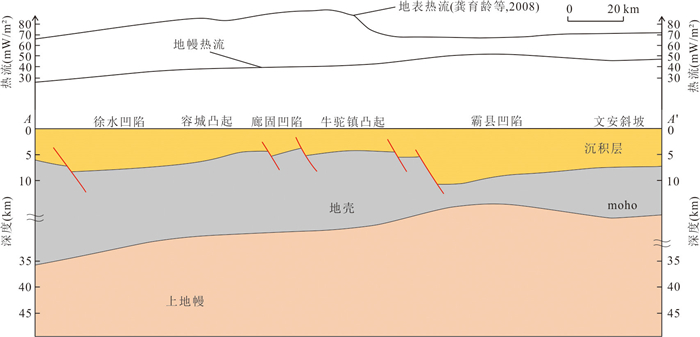
图 8 冀中坳陷深部结构剖面-热流图
Fig. 8. Deep structure profile-heat flow map of Jizhong Depression
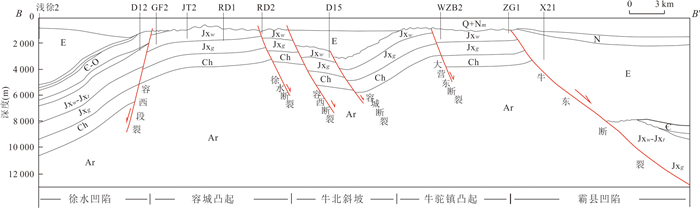
图 9 冀中坳陷区域构造及地层剖面图(改自戴明刚等,2020)
Fig. 9. Regional structural and stratigraphic profile of Jizhong Depression (adapted from Dai et al., 2020)
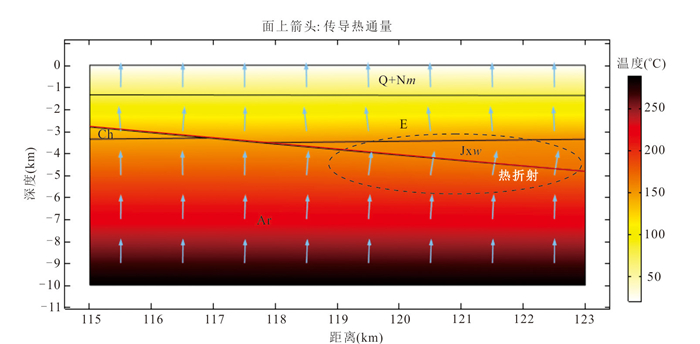
图 10 断层“热折射”数值模拟
蓝色箭头表征热流方向和大小
Fig. 10. Numerical simulation of fault 'thermal refraction'
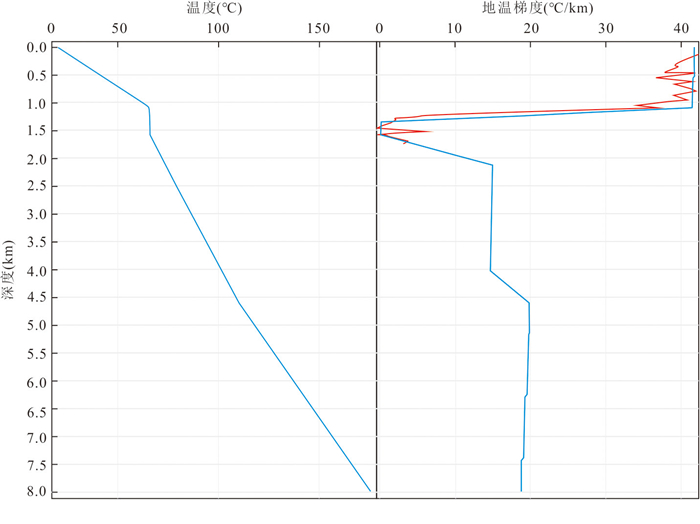
图 11 模拟计算结果与实际测量数据对比
Fig. 11. The simulation results compared with the measurement data
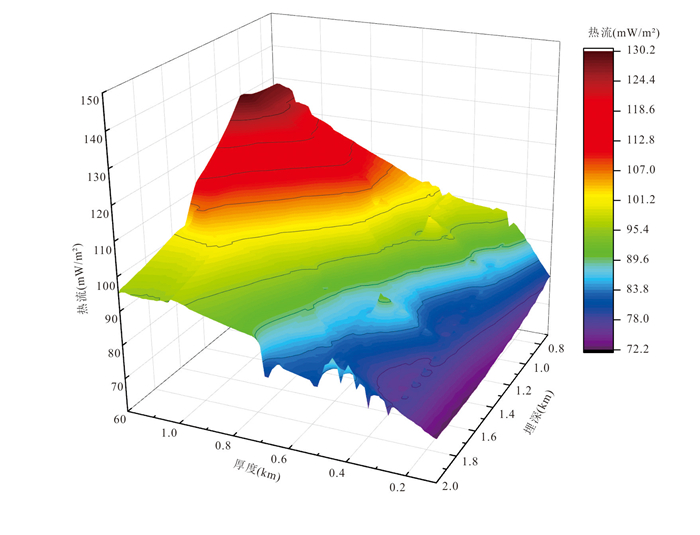
图 12 COMSOL模拟对流层厚度、埋深与地表热流关系
Fig. 12. Relationship between thickness of the convective layer, burial depth, and surface heat flow as simulated by COMSOL
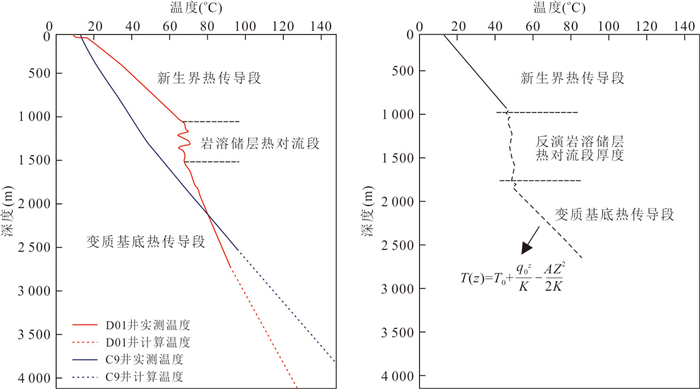
图 13 研究区不同构造单元代表性测温曲线及分层计算深部温度方法示意
Fig. 13. Typical temperature measurement curves and layered calculation method for deep temperature in different structural units of the research area
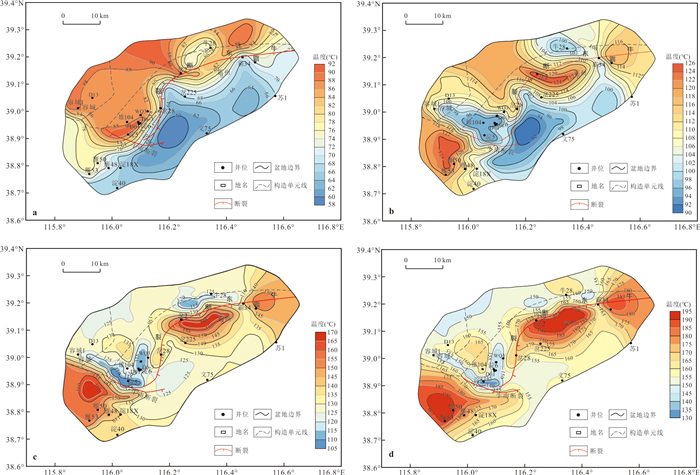
图 14 容城、牛驼镇凸起-霸县凹陷不同深度地层温度分布
a. 深度为2 000 m;b.深度为3 000 m;c. 深度为4 000 m;d. 深度为5 000 m
Fig. 14. The temperature distribution in Rongcheng and Niutuozhen uplift-Baxian Depression at different depths
表 1 冀中坳陷岩石生热率、热导率柱
Table 1. Rock heat generation rate and thermal conductivity column in Jizhong Depression
 下载: 导出CSV
-
Cao, Y. Z., Bao, Z. D., Lu, K., et al., 2021. Genetic Model and Main Controlling Factors of the Xiongxian Geothermal Field. Acta Sedimentologica Sinica, 39(4): 863-872(in Chinese with English abstract). Chang, J., Qiu, N. S., Zhao, X. Z., et al., 2016. Present-Day Geothermal Regime of the Jizhong Depression in Bohai Bay Basin, East China. Chinese Journal of Geophysics, 59(3): 1003-1016(in Chinese with English abstract). Chen, M. X., 1988. North China Geothermal. Science Press, Beijing(in Chinese). Cui, Y., 2020. Genetic Mechanism of Geothermal Resources and Heat Sources in Wumishan Formation, Xiong'an New Area (Dissertation). China University of Petroleum (Beijing), Beijing (in Chinese with English abstract). Cui, Y., Zhu, C. Q., Qiu, N. S., et al., 2022. The Heat Source Origin of Geothermal Resources in Xiong'an New Area, North China, in View of the Influence of Igneous Rocks. Frontiers in Earth Science, 10: 818129. https://doi.org/10.3389/feart.2022.818129 Dai, D. L., Zhao, R. S., Hu, J., et al., 2024. The Lithospheric Thermal Structure in the Songliao Basin Inferred from Thermal Parameter Analyses: Implications for the Background of Geothermal Resources. Natural Resources Research, 33(3): 1103-1129. https://doi.org/10.1007/s11053-023-10303-3 Dai, M. G., Ma, P. P., Lei, H. F., et al., 2020. Distribution Characteristics and Favorable Targets of Karst Geothermal Reservoir of Wumishan Formation in Xiongan New Area. Chinese Journal of Geology (Scientia Geologica Sinica), 55(2): 487-505 (in Chinese with English abstract). Dong, Y. X., Huang, H. X., Ren, L., et al., 2021. Geology and Development of Geothermal Field in Neogene Guantao Formation in Northern Bohai Bay Basin: A Case of the Caofeidian Geothermal Heating Project in Tangshan, China. Petroleum Exploration and Development, 48(3): 666-676 (in Chinese with English abstract). Duan, H. X., Liu, Y. G., Wang, G. L., et al., 2023. Characteristics of the Terrestrial Heat Flow and Lithospheric Thermal Structure in Central Cangxian Uplift: A Case Study of Xianxian Geothermal Field. Earth Science, 48(3): 988-1001 (in Chinese with English abstract). Gong, Y. L., Wang, L. S., Liu, S. W., et al., 2011. Thermal Structure and Thermal Evolution of Bohai Bay Basin in Eastern China. Atomic Energy Press, Beijing (in Chinese). Guo, R. J., Ji, Y. L., Ma, Z. T., et al., 2023. Mechanism and Development Model of Karst Reservoir in the Wumishan Formation in Xiongan New Area. Journal of Palaeogeography, 25(1): 180-197 (in Chinese with English abstract). Guo, S. S., 2020. Study on the Occurrence Law and Genetic Model of Deep Geothermal Resources in Xiong'an New Area and Its Genetic Model (Dissertation). China University of Petroleum (Beijing), Beijing (in Chinese with English abstract). Guo, S. S., Zhu, C. Q., Qiu, N. S., et al., 2020. Formation Conditions and Favorable Areas for the Deep Geothermal Resources in Xiongan New Area. Acta Geologica Sinica, 94(7): 2026-2035 (in Chinese with English abstract). Li, G. S., Wu, X. G., Song, X. Z., et al., 2022. Status and Challenges of Hot Dry Rock Geothermal Resource Exploitation. Petroleum Science Bulletin, 7(3): 343-364 (in Chinese with English abstract). Lin, W. J., Liu, Z. M., Wang, W. L., et al., 2013. The Assessment of Geothermal Resources Potential of China. Geology in China, 40(1): 312-321 (in Chinese with English abstract). Liu, N., Qiu, N. S., Qin, M. K., et al., 2023. Main Controlling Factors and Models of Hydrocarbon Accumulation in the Shulu Buried-Hill Belt, Jizhong Depression, Bohai Bay Basin. Acta Geologica Sinica, 97(3): 897-910(in Chinese with English abstract). Mao, G. H., Zhang, L. Y., Chen, J. B., et al., 2023. Terrestrial Heat Flow in Zhejiang Province and Its Significance of Geothermal Resources. Earth Science, 48(3): 1030-1039 (in Chinese with English abstract). Qiu, N. S., Hu, S. B., He, L. J., 2019. Geothermics in Sedimentary Basins. China University of Petroleum Press, Qingdao(in Chinese). Wang, G. L., Zhang, W., Liang, J. Y., et al., 2017. Evaluation of Geothermal Resources Potential in China. Acta Geoscientica Sinica, 38(4): 449-450, 134, 451-459(in Chinese with English abstract). Wang, J. Y., Hu, S. B., Pang, Z. H., et al., 2012. Estimate of Geothermal Resources Potential for Hot Dry Rock in the Continental Area of China. Science & Technology Review, 30(32): 25-31(in Chinese with English abstract). Wang, Z. T., Hu, S. B., Wang, Y. B., et al., 2022. Influence of the Groundwater Convection within the High Permeability Formation on the Overlying Temperature Field in Niutuozhen Uplift. Chinese Journal of Geophysics, 65(2): 726-736(in Chinese with English abstract). Wang, Z. T., Zhang, C., Jiang, G. Z., et al., 2019. Present-Day Geothermal Field of Xiongan New Area and Its Heat Source Mechanism. Chinese Journal of Geophysics, 62(11): 4313-4322(in Chinese with English abstract). Xiong, L. P., Zhang, J. M., 1984. Mathematical Simulation of Refract and Redistribution of Heat Flow. Chinese Journal of Geology, 19(4): 445-454(in Chinese with English abstract). Xu, T. F., Zhang, W., 2016. Enhanced Geothermal Systems: International Developments and China's Prospects. Petroleum Science Bulletin, 1(1): 38-44(in Chinese with English abstract). Yan, D. S., Yu, Y. T., 2000. Evaluation and Utilization of Geothermal Resources in Beijing-Tianjin-Hebei Oil Region. China University of Geosciences Press, Wuhan (in Chinese). Zhang, Y. M., Chang, J., Liu, N., et al., 2017. Present-Day Temperature-Pressure Field and Its Implications for the Geothermal Resources Development in the Baxian Area, Jizhong Depression of the Bohai Bay Basin. Natural Gas Industry, 37(10): 118-126(in Chinese with English abstract). Zhang, Y. M., Chang, J., Liu, N., et al., 2018. Present-Day Temperature-Pressure Field and Its Implications for the Geothermal Resources Development in the Baxian Area, Jizhong Depression of the Bohai Bay Basin. Natural Gas Industry B, 5(3): 226-234. https://doi.org/10.1016/j.ngib.2017.10.006 Zhao, Z. R., Zhang, W., Wang, G. L., et al., 2023. Hydrogeochemical Characteristics of Levin Geothermal Field in Jizhong Depression and Its Constraints on Geothermal Genesis. Geology in China, 52(1): 246-263 (in Chinese with English abstract). Zhu, C. Q., Chen, C., Jiang, X. X., 2022. Numerical Simulation of Internal Factors that Influence the Thermal Conductivity of Rock. International Journal of Thermophysics, 44(2): 24. https://doi.org/10.1007/s10765-022-03132-8 Zhu, C. Q., Chen, C., Yang, Y. B., et al., 2022. Experimental Study into the Factors Influencing Rock Thermal Conductivity and Their Significance to Geothermal Resource Assessment. Petroleum Science Bulletin, 7(3): 321-333(in Chinese with English abstract). Zhu, X., Wang, G. L., Ma, F., et al., 2023. Evaluation of Geothermal Resources of the Xiongan New Area. Earth Science, 48(3): 1093-1106(in Chinese with English abstract). 曹瑛倬, 鲍志东, 鲁锴, 等, 2021. 冀中坳陷雄县地热田主控因素及成因模式. 沉积学报, 39(4): 863-872. 常健, 邱楠生, 赵贤正, 等, 2016. 渤海湾盆地冀中坳陷现今地热特征. 地球物理学报, 59(3): 1003-1016. 陈墨香, 1988. 华北地热. 北京: 科学出版社. 崔悦, 2020. 雄安新区雾迷山组地热资源热源成因机制(硕士学位论文). 北京: 中国石油大学(北京). 戴明刚, 马鹏鹏, 雷海飞, 等, 2020. 雄安新区雾迷山组岩溶热储特征与有利区. 地质科学, 55(2): 487-505. 董月霞, 黄红祥, 任路, 等, 2021. 渤海湾盆地北部新近系馆陶组地热田特征及开发实践: 以河北省唐山市曹妃甸地热供暖项目为例. 石油勘探与开发, 48(3): 666-676. 段和肖, 刘彦广, 王贵玲, 等, 2023. 沧县隆起中部大地热流及岩石圈热结构特征: 以献县地热田为例. 地球科学, 48(3): 988-1001. doi: 10.3799/dqkx.2022.070 龚育龄, 王良书, 刘绍文, 等, 2011. 中国东部渤海湾盆地热结构和热演化. 北京: 中国原子能出版社. 郭瑞婧, 纪友亮, 马铮涛, 等, 2023. 雄安新区雾迷山组岩溶热储成储机制及发育模式. 古地理学报, 25(1): 180-197. 郭飒飒, 2020. 雄安新区深部地热资源赋存规律和成因模式研究和成因模式研究(硕士学位论文). 北京: 中国石油大学(北京). 郭飒飒, 朱传庆, 邱楠生, 等, 2020. 雄安新区深部地热资源形成条件与有利区预测. 地质学报, 94(7): 2026-2035. 李根生, 武晓光, 宋先知, 等, 2022. 干热岩地热资源开采技术现状与挑战. 石油科学通报, 7(3): 343-364. 蔺文静, 刘志明, 王婉丽, 等, 2013. 中国地热资源及其潜力评估. 中国地质, 40(1): 312-321. 刘念, 邱楠生, 秦明宽, 等, 2023. 冀中坳陷束鹿潜山带油气成藏主控因素与成藏模式. 地质学报, 97(3): 897-910. 毛官辉, 张立勇, 陈俊兵, 等, 2023. 浙江省大地热流及其地热资源意义. 地球科学, 48(3): 1030-1039. doi: 10.3799/dqkx.2022.314 邱楠生, 胡圣标, 何丽娟, 2019. 沉积盆地地热学. 青岛: 中国石油大学出版社. 王贵玲, 张薇, 梁继运, 等, 2017. 中国地热资源潜力评价. 地球学报, 38(4): 449-450, 134, 451-459. 汪集旸, 胡圣标, 庞忠和, 等, 2012. 中国大陆干热岩地热资源潜力评估. 科技导报, 30(32): 25-31. 王朱亭, 胡圣标, 王一波, 等, 2022. 雄安牛驼镇凸起区高渗性白云岩对上覆地层温度场的影响. 地球物理学报, 65(2): 726-736. 王朱亭, 张超, 姜光政, 等, 2019. 雄安新区现今地温场特征及成因机制. 地球物理学报, 62(11): 4313-4322. 熊亮平, 张菊明, 1984. 热流的折射和再分配的数学模拟. 地质科学, 19(4): 445-454. 许天福, 张炜, 2016. 增强型地热工程国际发展和我国前景展望. 石油科学通报, 1(1): 38-44. 阎敦实, 于英太, 2000. 京津冀油区地热资源评价与利用. 武汉: 中国地质大学出版社. 张以明, 常健, 刘念, 等, 2017. 冀中坳陷霸县地区现今温压场及其与地热资源的关系. 天然气工业, 37(10): 118-126. 赵子锐, 张薇, 王贵玲, 等, 2023. 冀中坳陷高阳地热田水文地球化学特征及其对地热成因的约束. 中国地质, 52(1): 246-263. 朱传庆, 陈驰, 杨亚波, 等, 2022. 岩石热导率影响因素实验研究及其对地热资源评估的启示. 石油科学通报, 7(3): 321-333. 朱喜, 王贵玲, 马峰, 等, 2023. 雄安新区地热资源潜力评价. 地球科学, 48(3): 1093-1106. doi: 10.3799/dqkx.2022.200 -

 点击查看大图
计量
- 文章访问数: 334
- HTML全文浏览量: 209
- PDF下载量: 45
- 被引次数: 0
