




Unified Framework for Probabilistic Prediction of Critical Mechanical Parameters of Loess by Machine Learning Methods
-
摘要:
为实现黄土关键力学参数的准确预测,并合理刻画预测结果的不确定性,提出了基于机器学习方法的黄土关键力学参数概率预测统一框架体系,通过对训练集的预测偏差进行概率分布拟合,进而构建预测结果的95%置信区间,置信区间的大小反映了预测结果的合理与否.基于随机森林、决策树、极限梯度提升和自适应提升4种方法预测黄土黏聚力,对应的决定系数R2分别达到了0.84、0.75、0.81和0.79,4种方法所构建的95%置信区间包含真正的试验结果的比例均在95%左右.表明通过训练集的预测偏差得到的95%置信区间是相对可靠的,可对预测结果的不确定性进行合理量化.此外,基于上述4种方法可实现黄土黏聚力的相对准确的预测.
Abstract:In order to predict the criticalmechanical parameters of loess accurately and quantify the uncertainty corresponding to the prediction results reasonably, anunified framework for probabilistic prediction of critical mechanical parameters of loess by machine learning methods is proposed. By fitting probability density function to the bias of the training dataset, a 95% confidence interval for the prediction results is constructed, and the size of the confidence interval reflects the rationality of the prediction results.(Result) Predicting cohesion of loess based on four machine learning methods, namely, random forest, decision tree, extreme gradient boosting and adaptive boosting, the corresponding coefficients of determination R2 reached 0.84, 0.75, 0.81 and 0.79, respectively. The proportion of measurement data included in the 95% confidence interval constructed by the four methods is around 95%. It is shown that the 95% confidence interval obtained from the bias based on the training dataset is relatively reliable and can quantify the uncertainty of the prediction results reasonably. In addition, the cohesion of loess can be predicted accurately using the four machine learning methods.
-
Key words:
- loess /
- cohesion /
- data-driven /
- probabilistic prediction /
- bias /
- uncertainty
-
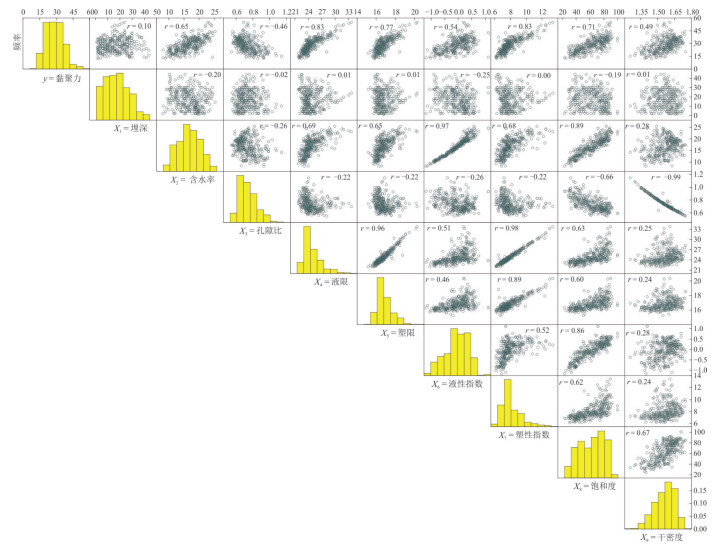
图 1 黄土物理力学参数分布直方图及相关关系图
Fig. 1. The histograms of the physical and mechanical parameters of loess and correlations among them
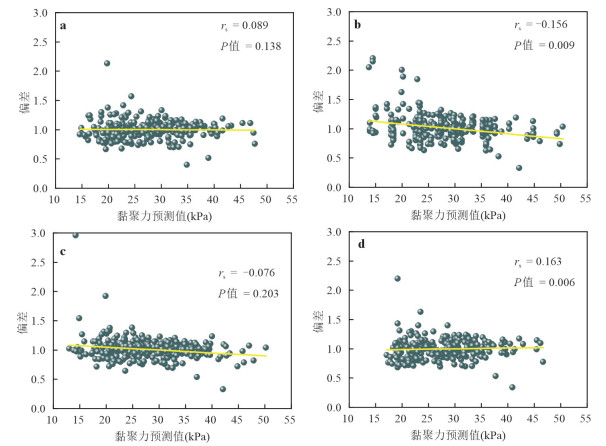
图 2 基于框架体系二的预测偏差与黄土黏聚力预测值分布散点图
Fig. 2. Scatter plots between bias obtained from unified framework 2 and predicted cohesion of loess
a. RF; b. DT; c. XGBoost; d. AdaBoost
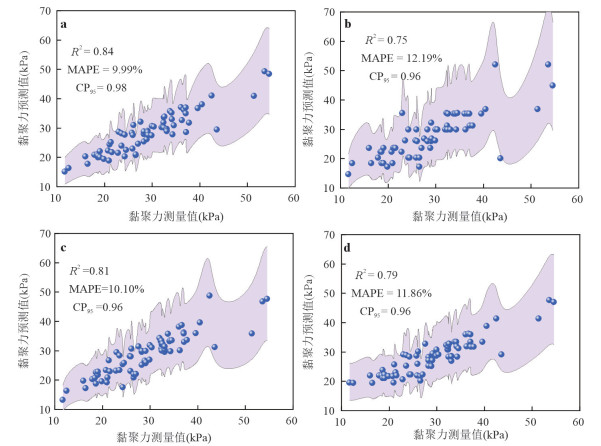
图 3 基于框架体系二的不同机器学习方法预测结果及其不确定性
Fig. 3. Results of cohesion prediction and uncertainty quantification for different machine learning methodsbased on unified framework 2
a. RF; b. DT; c. XGBoost; d. AdaBoost
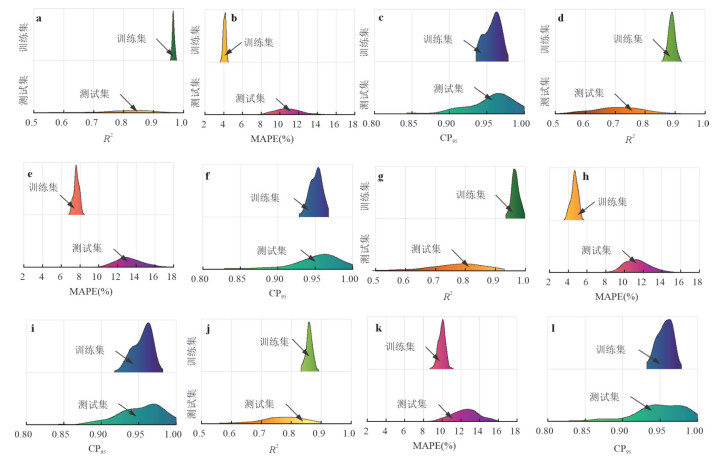
图 4 基于框架体系二的100次随机试验黄土黏聚力预测性能与不确定性量化结果统计特征分析
a. RF方法:R2;b. RF方法:MAPE;c. RF方法:CP95;d. DT方法:R2;e. DT方法:MAPE;f. DT方法:CP95;g. XGBoost方法:R2;h. XGBoost方法:MAPE;i. XGBoost方法:CP95;j. AdaBoost方法:R2;k. AdaBoost方法:MAPE;l. AdaBoost方法:CP95
Fig. 4. Statistical characteristic results of predicted cohesion of loess and uncertainty quantification for 100 experiments based on unified framework 2
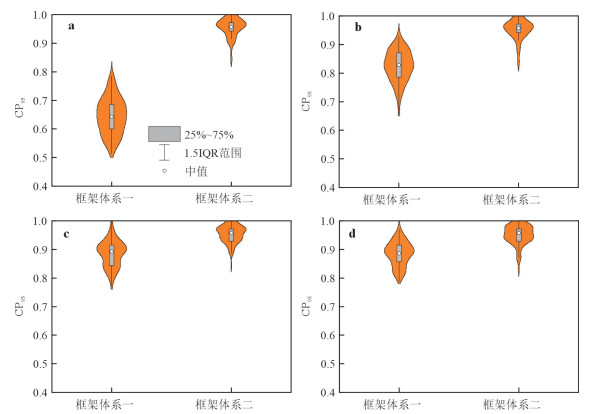
图 5 基于框架体系一和二的100次随机试验黄土黏聚力概率预测结果统计特征分析
Fig. 5. Statistical characteristic results of probabilisticprediction of cohesion of loess for 100 experiments based on unified framework 1 and 2
a. RF; b. DT; c. XGBoost; d. AdaBoost
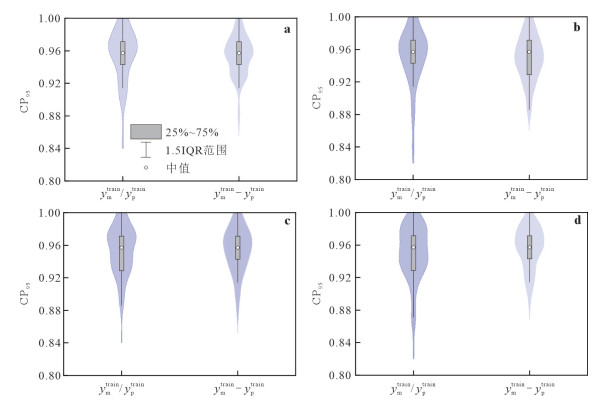
图 6 基于预测残差的100次随机试验黄土黏聚力概率预测结果统计特征分析
Fig. 6. Statistical characteristic results of probabilisticprediction of cohesion of loess for 100 experiments based on residual
a. RF; b. DT; c. XGBoost; d. AdaBoost
表 1 黄土物理力学参数的基本统计特征
Table 1. Statistical characteristics of the physical and mechanical parameters of loess
黄土参数 单位 最大值 最小值 平均值 标准差 偏度 峰度 黏聚力 kPa 54.60 11.70 28.20 8.03 0.37 2.99 埋深 m 44.00 1.00 17.13 9.89 0.34 2.41 含水率 % 25.30 8.20 16.63 3.72 0.00 2.30 孔隙比 1 1.15 0.55 0.74 0.11 0.80 3.39 液限 % 33.70 21.90 24.86 2.02 1.44 5.32 塑限 % 20.30 15.20 16.82 0.79 1.21 4.86 液性指数 1 1.11 -1.17 -0.06 0.42 -0.30 2.56 塑性指数 1 13.40 6.20 8.04 1.29 1.44 5.25 饱和度 % 100.00 24.00 62.55 17.48 -0.17 1.89 干密度 g/cm3 1.75 1.26 1.56 0.09 -0.51 2.80  下载: 导出CSV
表 2 基于框架体系二的预测偏差与黄土黏聚力预测值及输入特征的斯皮尔曼相关系数及P值检验结果
Table 2. Spearman's correlation coefficientbetween bias obtained from unified framework 2 and predicted cohesion/ input variables and corresponding results of P-value test
黄土参数 RF DT XGBoost AdaBoost rs P值 rs P值 rs P值 rs P值 y=黏聚力 0.089 0.138 -0.156 0.009 -0.076 0.203 0.163 0.006 X1=埋深 0.140 0.019 0.213 0.000 0.052 0.389 0.122 0.041 X2=含水率 0.068 0.256 0.049 0.413 0.027 0.652 0.105 0.078 X3=孔隙比 -0.154 0.010 -0.091 0.131 -0.062 0.298 -0.244 0.000 X4=液限 0.122 0.041 0.089 0.137 0.064 0.287 0.225 0.000 X5=塑限 0.085 0.154 0.060 0.315 0.052 0.391 0.175 0.003 X6=液性指数 0.060 0.319 0.044 0.463 0.021 0.732 0.074 0.218 X7=塑性指数 0.129 0.031 0.097 0.104 0.062 0.300 0.240 0.000 X8=饱和度 0.131 0.028 0.083 0.168 0.048 0.423 0.204 0.001 X9=干密度 0.161 0.007 0.095 0.115 0.068 0.257 0.253 0.000
下载: 导出CSV
表 3 基于框架体系一的预测偏差与黄土黏聚力预测值及输入特征的斯皮尔曼相关系数及P值检验结果
Table 3. Spearman's correlation coefficient between bias obtained from unified framework 1 and predicted cohesion/ input variables and corresponding results of P-value test
黄土参数 RF DT XGBoost AdaBoost rs P值 rs P值 rs P值 rs P值 y=黏聚力 0.418 0.000 0.024 0.693 0.196 0.001 0.305 0.000 X1=埋深 0.116 0.053 0.134 0.025 0.026 0.667 0.175 0.003 X2=含水率 0.083 0.167 0.019 0.749 0.001 0.990 0.091 0.131 X3=孔隙比 -0.144 0.016 -0.119 0.047 0.017 0.781 -0.279 0.000 X4=液限 0.148 0.013 0.062 0.304 0.012 0.847 0.222 0.000 X5=塑限 0.111 0.063 0.027 0.659 0.027 0.649 0.186 0.002 X6=液性指数 0.074 0.216 0.005 0.930 -0.008 0.888 0.054 0.365 X7=塑性指数 0.154 0.010 0.077 0.201 -0.002 0.971 0.224 0.000 X8 =饱和度 0.134 0.025 0.073 0.224 -0.017 0.775 0.204 0.001 X9=干密度 0.152 0.011 0.123 0.040 0.008 0.894 0.286 0.000
下载: 导出CSV
表 4 预测残差与黄土黏聚力预测值及输入特征的斯皮尔曼相关系数及P值检验结果
Table 4. Spearman's correlation coefficient between residual and predicted cohesion/ input variables and corresponding results of P-value test
黄土参数 RF DT XGBoost AdaBoost rs P值 rs P值 rs P值 rs P值 y=黏聚力 0.098 0.101 -0.169 0.004 -0.075 0.211 0.164 0.006 X1=埋深 0.151 0.011 0.224 0.000 0.057 0.341 0.129 0.032 X2=含水率 0.078 0.193 0.036 0.547 0.022 0.718 0.109 0.068 X3=孔隙比 -0.160 0.007 -0.079 0.185 -0.060 0.320 -0.247 0.000 X4=液限 0.132 0.027 0.079 0.186 0.067 0.266 0.231 0.000 X5=塑限 0.094 0.115 0.052 0.382 0.056 0.352 0.183 0.002 X6=液性指数 0.067 0.262 0.032 0.597 0.012 0.842 0.074 0.216 X7=塑性指数 0.139 0.020 0.087 0.149 0.065 0.279 0.245 0.000 X8 =饱和度 0.143 0.016 0.070 0.242 0.044 0.461 0.212 0.000 X9=干密度 0.168 0.005 0.082 0.169 0.066 0.275 0.256 0.000
下载: 导出CSV
-
Abdi, Y., Momeni, E., Armaghani, D. J., 2023. Elastic Modulus Estimation of Weak Rock Samples Using Random Forest Technique. Bulletin of Engineering Geology and the Environment, 82(5): 176. https://doi.org/10.1007/s10064-023-03154-y Bao, T., Burghardt, J., 2022. A Bayesian Approach for In-Situ Stress Prediction and Uncertainty Quantification for Subsurface Engineering. Rock Mechanics and Rock Engineering, 55(8): 4531-4548. https://doi.org/10.1007/s00603-022-02857-0 Breiman, L., 2001. Random Forests. Machine Learning, 45(1): 5-32. https://doi.org/10.1023/A:1010933404324 Chen, J. F., Zhao, Z. H., Zhang, J. T., 2024. Predicting Peak Shear Strength of Rock Fractures Using Tree-Based Models and Convolutional Neural Network. Computers and Geotechnics, 166: 105965. https://doi.org/10.1016/j.compgeo.2023.105965 Chen, Y., Xu, Y. F., Jamhiri, B., et al., 2022. Predicting Uniaxial Tensile Strength of Expansive Soil with Ensemble Learning Methods. Computers and Geotechnics, 150: 104904. https://doi.org/10.1016/j.compgeo.2022.104904 Ching, J., Phoon, K. K., Li, K. H., et al., 2019. Multivariate Probability Distribution for Some Intact Rock Properties. Canadian Geotechnical Journal, 56(8): 1080-1097. https://doi.org/10.1139/cgj-2018-0175 Dang, J. Q., Li, J., 1997. Strength Characteristics of Unsaturated Loess. Chinese Journal of Geotechnical Engineering, (2): 59-64(in Chinese with English abstract). Dong, X. C., Guo, M. W., Wang, S. L., et al., 2023. Inclination Prediction of a Super-Sized Open Caisson Foundation During Sinking Process Based on Ensemble Learning. Chinese Journal of Rock Mechanics and Engineering, 42(S1): 3812-3822(in Chinese with English abstract). Ewusi-Wilson, R., Lee, C., Park, J., 2023. Artificial Intelligence-Optimized Design for Dynamic Compaction in Granular Soils. Acta Geotechnica, 19(6): 3487-3503. https://doi.org/10.1007/s11440-023-02081-2 Jing, Y. L., Wu, Y. Q., Lin, D. J., et al., 2011. Study of Relationship Between Loess Collapsibility and Index of Compaction Test. Rock and Soil Mechanics, 32(2): 393-397(in Chinese with English abstract). Kardani, N., Aminpour, M., Nouman Amjad Raja, M., et al., 2022. Prediction of the Resilient Modulus of Compacted Subgrade Soils Using Ensemble Machine Learning Methods. Transportation Geotechnics, 36: 100827. https://doi.org/10.1016/j.trgeo.2022.100827 Li, S. Y., Chen, X., Lu, J. Q., et al., 2024. Real-Time Discrimination Model for Local Earthquake Intensity Threshold Based on XGBoost. Earth Science, 49(2): 379-390(in Chinese with English abstract). Liu, D., Lin, P. Y., Zhao, C. Y., et al., 2021. Mapping Horizontal Displacement of Soil Nail Walls Using Machine Learning Approaches. Acta Geotechnica, 16(12): 4027-4044. https://doi.org/10.1007/s11440-021-01345-z Liu, Q. S., Wang, X. Y., Huang, X., et al., 2020. Prediction Model of Rock Mass Class Using Classification and Regression Tree Integrated AdaBoost Algorithm Based on TBM Driving Data. Tunnelling and Underground Space Technology, 106: 103595. https://doi.org/10.1016/j.tust.2020.103595 Nguyen, T., Ly, D. K., Huynh, T. Q., et al., 2023. Soft Computing for Determining Base Resistance of Super-Long Piles in Soft soil: A Coupled SPBO-XGBoost Approach. Computers and Geotechnics, 162: 105707. https://doi.org/10.1016/j.compgeo.2023.105707 Song, C., Zhao, T. Y., Xu, L., et al., 2024. Probabilistic Prediction of Uniaxial Compressive Strength for Rocks from Sparse Data Using Bayesian Gaussian Process Regression with Synthetic Minority Oversampling Technique (SMOTE). Computers and Geotechnics, 165: 105850. https://doi.org/10.1016/j.compgeo.2023.105850 Song, C., Zhao, T. Y., Xu, L., 2023. Estimation of Uniaxial Compressive Strength Based on Fully Bayesian Gaussian Process Regression and Model Selection. Chinese Journal of Geotechnical Engineering, 45(8): 1664-1673(in Chinese with English abstract). Wen, L. F., Li, Y. L., Zhao, W. B., et al., 2023. Predicting the Deformation Behaviour of Concrete Face Rockfill Dams by Combining Support Vector Machine and AdaBoost Ensemble Algorithm. Computers and Geotechnics, 161: 105611. https://doi.org/10.1016/j.compgeo.2023.105611 Wu, L. Y., Li, J. H., Ma, D., et al., 2023. Prediction for Rock Compressive Strength Based on Ensemble Learning and Bayesian Optimization. Earth Science, 48(5): 1686-1695(in Chinese with English abstract). Xu, L., Zhou, G. P., Zhao, T. Y., et al., 2023. Characterization of Inherent Spatial Variability of Loess Deposit Properties in Shaanxi Province, China. Journal of Soils and Sediments, 23(7): 2862-2877. https://doi.org/10.1007/s11368-023-03517-8 Yan, D. D., Zhao, T. Y., Xu, L., et al., 2023. Statistical Modeling of Multivariate Loess Properties in Taiyuan Using Regular Vine Copula with Optimized Tree Structure. Transportation Geotechnics, 41: 101025. https://doi.org/10.1016/j.trgeo.2023.101025 Yang, L., Wei, J., 2023. Prediction of Rockburst Intensity Grade Based on SVM and Adaptive Boosting Algorithm. Earth Science, 48(5): 2011-2023(in Chinese with English abstract). Zhang, J. R., Song, C. Y., Jiang, T., et al., 2023. Hydromechanical Characteristics and Microstructure of Unsaturated Loess Under High Suction. Rock and Soil Mechanics, 44(8): 2229-2237(in Chinese with English abstract). Zhang, L., Wang, M., Zhao, H. B., et al., 2022a. Uncertainty Quantification for the Mechanical Behavior of Fully Grouted Rockbolts Subjected to Pull-out Tests. Computers and Geotechnics, 145: 104665. https://doi.org/10.1016/j.compgeo.2022.104665 Zhang, P., Yin, Z. Y., Jin, Y. F., 2022b. Bayesian Neural Network-Based Uncertainty Modelling: application to Soil Compressibility and Undrained Shear Strength Prediction. Canadian Geotechnical Journal, 59(4): 546-557. https://doi.org/10.1139/cgj-2020-0751 Zhang, W. G., Li, H. R., Tang, L. B., et al., 2022c. Displacement Prediction of Jiuxianping Landslide Using Gated Recurrent Unit (GRU) Networks. Acta Geotechnica, 17(4): 1367-1382. https://doi.org/10.1007/s11440-022-01495-8 Zhang, W. G., Wu, C. Z., Zhong, H. Y., et al., 2021. Prediction of Undrained Shear Strength Using Extreme Gradient Boosting and Random Forest Based on Bayesian Optimization. Geoscience Frontiers, 12(1): 469-477. https://doi.org/10.1016/j.gsf.2020.03.007 Zhao, T. Y., Song, C., Lu, S. F., et al., 2022. Prediction of Uniaxial Compressive Strength Using Fully Bayesian Gaussian Process Regression (fB-GPR) with Model Class Selection. Rock Mechanics and Rock Engineering, 55(10): 6301-6319. https://doi.org/10.1007/s00603-022-02964-y Zuo, L., Xu, L., Baudet, B. A., et al., 2024. Small-Strain Shear Stiffness Anisotropy of a Saturated Clayey Loess. Géotechnique, 74(4): 325-336. https://doi.org/10.1680/jgeot.21.00179 党进谦, 李靖, 1997. 非饱和黄土的强度特征. 岩土工程学报, 19(2): 56-61. 董学超, 郭明伟, 王水林, 等, 2023. 基于集成学习的超大型沉井基础下沉倾斜程度预测. 岩石力学与工程学报, 42(S1): 3812-3822. 井彦林, 仵彦卿, 林杜军, 等, 2011. 黄土的湿陷性与击实试验指标关系研究. 岩土力学, 32(2): 393-397. 李山有, 陈欣, 卢建旗, 等, 2024. 基于XGBoost的现地地震烈度阈值实时判别模型. 地球科学, 49(2): 379-390. doi: 10.3799/dqkx.2023.159 宋超, 赵腾远, 许领, 等, 2023. 基于贝叶斯高斯过程回归与模型选择的岩石单轴抗压强度估计方法. 岩土工程学报, 45(8): 1664-1673. 吴禄源, 李建会, 马丹, 等, 2023. 基于集成学习与贝叶斯优化的岩石抗压强度预测. 地球科学, 48(5): 1686-1695. doi: 10.3799/dqkx.2023.029 杨玲, 魏静, 2023. 基于支持向量机和增强学习算法的岩爆烈度等级预测. 地球科学, 48(5): 2011-2023. doi: 10.3799/dqkx.2022.251 张俊然, 宋陈雨, 姜彤, 等, 2023. 非饱和黄土高吸力下的水力力学特性及微观结构分析. 岩土力学, 44(8): 2229-2237. -

 点击查看大图
计量
- 文章访问数: 45
- HTML全文浏览量: 23
- PDF下载量: 4
- 被引次数: 0
