




Study on Mutual Feedback between Small Town Communities and Ecological Communities in the Northern Foothills of Qinling Mountains
-
摘要:
习总书记强调保护好秦岭生态环境具有十分重大而深远的意义. 秦岭北麓区位独特、功能突出、人地关系复杂等特征,致使趋于群网化发展的小城镇与生态结构单一、环境脆弱等矛盾日益突出,成为制约秦岭生态文明建设与高质量发展最薄弱的环节.突破单一学科壁垒,基于生态学“群落”的概念,审视秦岭北麓小城镇群落与生态群落作为人地系统互馈的表征,综合运用地理学、生态学、城乡规划学等学科理论及方法,探索缓解小城镇发展与生态保护相冲突的机制和路径.研究表明:(1)秦岭北麓小城镇群落与生态群落的互馈要素多元,呈现出以地形地貌为核心的制力要素,具有基础决定性和一般不发生较大变化的性状;以小城镇群落为核心的动力要素,是推动小城镇群落发展变化的传统物质性要素,并决定群落发展水平和规模;以生态群落为核心的潜力要素,是推动小城镇群落发展变化的软性环境要素.(2)秦岭北麓小城镇群落与生态群落相互作用是复杂的系统问题,涉及人为活动和自然过程的双向互馈,具有显著的从低级、简单向高级、复杂演替的层级递进特征;且相互嵌套、相互牵制、相互促进的基本状态和非线性的互馈循环特性,使得群落互馈的共存、共损与共荣3大关系能够演变和转移.秦岭北麓小城镇群落与生态群落“互馈共荣、动态平衡”策略的提出,是对小城镇群落空间建设的灵活性,以及生态群落保护治理本底性的有效回应,通过识别“失衡”构建止损、补缺、调控的自愈和治愈机制措施.
Abstract:President Xi has emphasized that protecting the ecological environment of the Qinling Mountains holds great and far-reaching significance. The northern slope of the Qinling Mountains is characterized by its unique location, prominent functions, and complex human-land relationships. As a result, the increasing contradiction between the trend of small towns developing in a clustered and networked manner and the single ecological structure with fragile environment has become the weakest link restricting the construction of ecological civilization and high-quality development in the Qinling Mountains. This paper breaks through the barriers of single disciplines and examines the small town clusters and ecological communities on the northern slope of the Qinling Mountains as manifestations of human-land system interactions, based on the concept of "community" in ecology. By comprehensively applying theories and methodologies from geography, ecology, urban and rural planning, and other disciplines, it explores mechanisms and pathways to alleviate conflicts between small town development and ecological protection. The research indicates that: (1) The interaction between small town clusters and ecological communities on the northern slope of the Qinling Mountains involves diverse feedback elements. These elements can be categorized as follows: control elements centered on topography and landforms, which are fundamentally decisive and generally do not undergo significant changes; driving elements centered on small town clusters, which are traditional material factors that promote the development and transformation of small town clusters and determine their development level and scale; and potential elements centered on ecological communities, which are soft environmental factors that drive the development and transformation of small town clusters.(2) The interaction between small town clusters and ecological communities constitutes a complex system involving bidirectional feedback between human activities and natural processes It exhibits hierarchical and progressive characteristics, evolving from low-level and simple states to high-level and complex states. Furthermore, the basic states of mutual nesting, mutual restraint, and mutual promotion, along with nonlinear feedback cycles, enable the three major relationships of coexistence, common loss, and common prosperity in community feedback to evolve and shift.The proposal of the strategy of "mutual feedback and common prosperity, dynamic balance" between small town clusters and ecological communities on the northern slope of the Qinling Mountains is an effective response to the flexibility in the spatial development of small town clusters and the foundational nature of ecological community protection and governance. By identifying "imbalances, " it establishes self-healing and remedial mechanisms for stopping losses, filling gaps, and regulating the system.
-
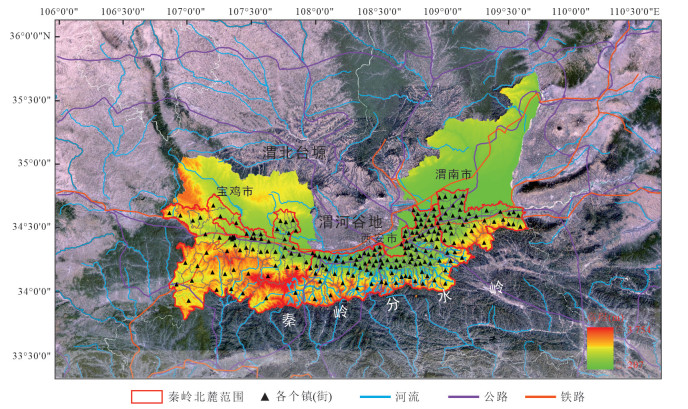
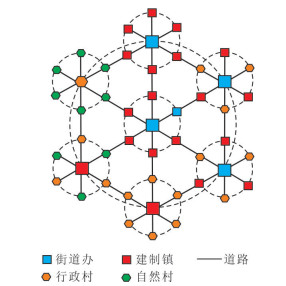
图 1 秦岭北麓镇街分布
Fig. 1. Distribution of towns & streets in the northern foothills of Qinling Mountains
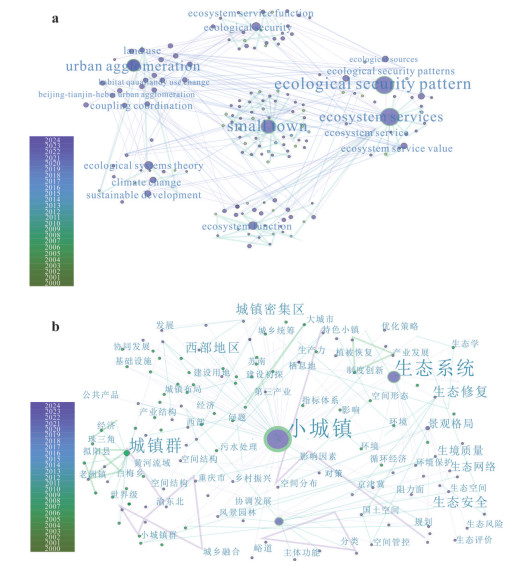
图 2 小城镇群落“关键词”共现网络图
a.国外研究;b.国内研究
Fig. 2. Co-occurrence network diagram of "keywords" for small town clusters
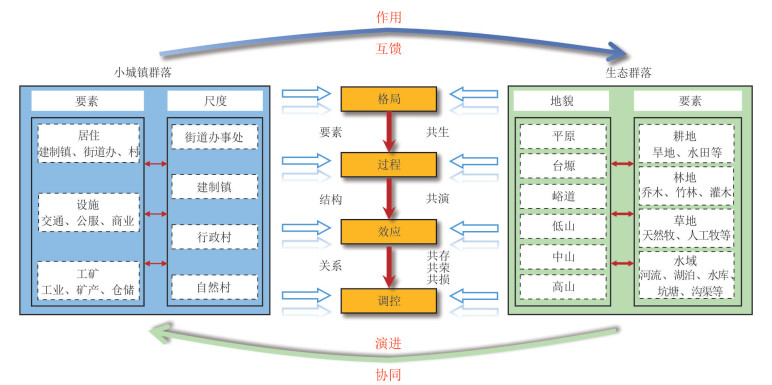
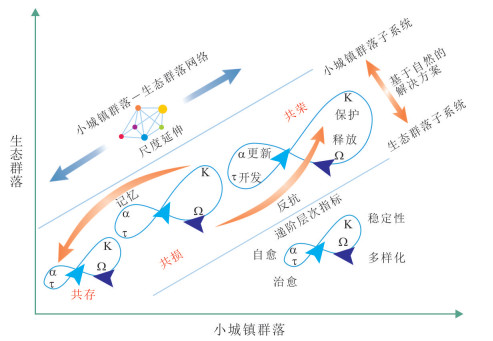
图 3 秦岭北麓群落互馈路径及其关系
Fig. 3. Mutual feeding paths and relationships of communities in the northern foothills of Qin Mountains
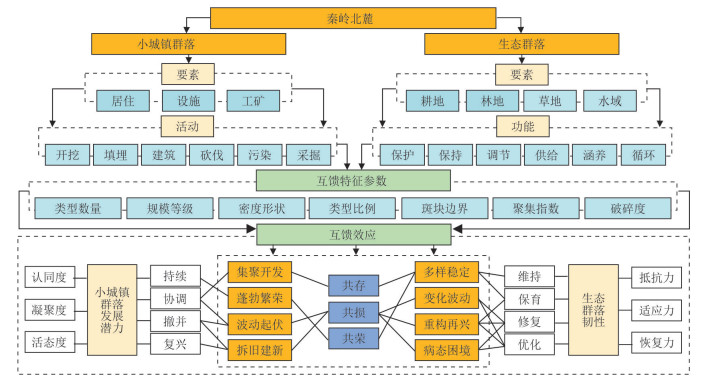
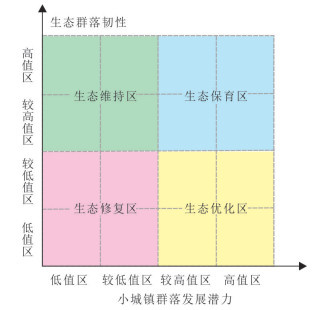
图 6 秦岭北麓群落互馈效应识别构架
Fig. 6. The identification framework for the reciprocal effects of communities in the northern foothills of Qin Mountains
表 1 群落互馈共生要素构成
Table 1. The composition of symbiotic elements of mutual feeding
构成类别Constitutes category 大类要素Major elements 要素特征Element characteristics 中类要素Elements of the class 量化指标Quantitative indicators 地形地貌 制力要素 有基础决定性,一般不发生较大变化 地形地貌 规模、位置、区划 行政区划 小城镇群落 动力要素 推动小城镇群落发展变化的传统物质性要素,决定群落发展水平和规模 居住要素(建制镇、街道办、行政村、自然村) 规模、位置; 分类、形状; 密度、等级 设施要素(交通、公共服务、商业、市政设施) 工矿要素(工业、矿产、仓储) 生态群落 潜力要素 推动小城镇群落发展变化的软性环境要素,与小城镇群落相互依存、相互制约 耕地要素(旱地、水田、水浇地) 形状面积、类型比例、斑块密度、边界密度、聚集指数、破碎度等 林地要素(乔木、竹林、灌木、其他等) 草地要素(天然牧、人工牧、其他等) 水域要素(河流、湖泊、水库、坑塘、沟渠等)  下载: 导出CSV
表 2 秦岭北麓群落空间格局类型与单元构成
Table 2. Spatial pattern and unit composition of communities in the northern foothills of Qin Mountains
空间单元Space units
格局类型Pattern type街道办Subdistrict offices 建制镇Administrative town 行政村Administrative village 自然村Nature village 平原区群落 


○ ○ ○ ○ ○ 台塬区群落 ○ ○ ○ ○ ○ 峪道区群落 ○ ○ ○ 
低山区群落 ○ ○ ○ 中高山区群落 ○ ○ ○ 注: 表 3 群落互馈关系
Table 3. Community-feeding relationship
互馈关系Reciprocal feedback 关系细化Relationship refinement 特征描述Feature description 共存 - 两个群落之间互不影响 共损 同步共损 两个群落之间互相抑制 偏离共损 ①一方受抑制,一方无影响:分开时皆无影响;
②一方有利,一方无影响;分开时一方有害,一方无影响寄生共损 一方有利,一方受抑制;分开时一方受抑制,一方无影响 共荣 - 两个群落彼此有利;如果没有对方,均不能存在
下载: 导出CSV
-
Chen, Y. P., 2019. Significance and Strategies on the Ecological Civilization Construction at Qinling Mountains. Journal of Earth Environment, 10(1): 1-11(in Chinese with English abstract). Dai, E. F., Wang, X. L., Zhu, J. J., et al., 2015. Progress and Perspective on Ecosystem Services Trade-offs. Advances in Earth Science, 30(11): 1250-1259(in Chinese with English abstract). Ebenezer, H., 1902. Garden Cities of Tomorrow. Swan Sonnenschein & Co, London. Feng, Y., Cao, Y. G., Li, S. P., et al., 2022. Trade-offs and Synergies of Ecosystem Services: Development History and Research Characteristics. Journal of Agricultural Resources and Environment, 39(1): 11-25 (in Chinese with English abstract). Fischer, J., Riechers, M., Loos, J., et al., 2021. Making the UN Decade on Ecosystem Restoration a Social-Ecological Endeavour. Trends in Ecology & Evolution, 36(1): 20-28. https://doi.org/10.1016/j.tree.2020.08.018 Folke, C., Hahn, T., Olsson, P., et al., 2005. Adaptive Governance of Social-Ecological Systems. Annual Review of Environment and Resources, 30: 441-473. https://doi.org/10.1146/annurev.energy.30.050504.144511 Fu, B. J., 2010. Trends and Priority Areas in Ecosystem Research of China. Geographical Research, 29(3): 383-396(in Chinese with English abstract). Fu, X. T., 1989. Research on Urban-Rural Development: Urban-Rural Relations, Small Towns, and Development of Border Areas. Hunan People's Publishing House, Changsha, 1-17(in Chinese with English abstract). Gong, S. Q., Li, H. X., 2002. The Discussion on the Development of Small Town Cluster in Developed Provinces with Small Town Cluster in Zhe Jiang Province as An Example. City Planning Review, (4): 32-37(in Chinese with English abstract). Han, T. T., Tang, X., Ren, H., et al., 2021. Community/Ecosystem Functional Diversity: Measurements and Development. Acta Ecological Sinica, 41(8): 3286-3295(in Chinese with English abstract). Holling, C. S., 2001. Understanding the Complexity of Economic, Ecological, and Social Systems. Ecosystems, 4(5): 390-405. https://doi.org/10.1007/s10021-001-0101-5 Huang, S. H., 2021. The Construction of Ecological Civilization is a Fundamental Plan Related to the Sustainable Development of the Chinese Nation. People's Daily, 2021-12-14(9)(in Chinese). Lewis, M., 1961. The City in History: Its Origins, Its Transformations, and Its Prospects. Harcourt Brace Janovich, Inc. Liu, D., Peng, J. B., Ye, W. J., et al., 2023. The Systematic Architecture of Livable Countryside in Qinling Mountainous. Journal of Xi'an University of Science and Technology, 43(4): 743-751. (in Chinese with English abstract). Li, J. Y., Fu, B. J., Sun, J. L., et al., 2021. Ecological Civilization Construction at Qinling Mountains in the New Era. Journal of Natural Resources, (10): 2449-2463(in Chinese with English abstract). Liu, B. H., Peng, Z, W., 2019. Research on the Spatial Evolution and Mechanism of Small TownAgglomeration in Metropolitan Area: A Case Study of Fengcheng Area in Shanghai. Shanghai Urban Planning, (5): 8-15(in Chinese with English abstract). Liu, R. Z., 2003. Review and Rethinking of the Study of City-and-Town Concentrated Area and Interrelated Concepts. Human Geography, (3): 13-17+51(in Chinese with English abstract). Ma, M., Fu, B. J., Li, X. Y., et al., 2004. The Regional Pattern for Ecological Security(RPES): the Concept and the Theoretical Basis. Acta Ecological Sinica, 24(4): 761-768(in Chinese with English abstract). Marsh, G. P., 1965. Man and Nature: Or, Physical Geography as Modified by Human Action. The John Harvard Library, Harvard. Park, R. E., 1915. The City: Suggestions for the Investigation of Human Behavior in the City Environment. American Journal of Sociology, 20(5): 577-612. https://doi.org/10.1086/212433 Pan, M., Chen, T. W., Huang, L., et al., 2020. Spatial and Temporal Variations in Ecosystem Services and its Driving Factors Analysis in Jing-Jing-Ji Region. Acta Ecological Sinica, 40(15): 5151-5167(in Chinese with English abstract). Peng, J. B., Lan, H. X., 2022. Ecological Geology and Eco-geological Environment System. Journal of Earth Sciences and Environment, 44(6): 877-893(in Chinese with English abstract). Peng, J. B., Shen, Y. J, Jin, Z., et al., 2023. Key Thoughts on the Study of Eco-Geological Environment System in Qinling Mountains. Acta Ecological Sinica, 43(11): 4344-4358 (in Chinese with English abstract). Shen, Y. J., Chen, X., Peng, J. B., et al., 2024. Background Characteristics of Ecological Geological Environment System inQinling Mountains and Assumption of Its Theoretical System. Earth Science, 49(6): 2103-2119(in Chinese with English abstract). Spyra, M., Kleemann, J., Cetin, N. I., et al., 2019. The Ecosystem Services Concept: a New Esperanto to Facilitate Participatory Planning Processes? Landscape Ecology, 34(7): 1715-1735. https://doi.org/10.1007/s10980-018-0745-6 Wang, X. Q., Qi, W., Liu, S. G., 2020. Spatial Distribution and Driving Factors of Small Towns in China. Geographical Research, 39(2): 319-336(in Chinese with English abstract). Wu, L. Y., 1995. Development Model of Urban High Density Space: A Case Study of the Yangtze River Delta. Urban Development Research, (2): 8-14+62(in Chinese with English abstract). Xiao, Y. R., 2018. Seventy Two Valleys of the Qinling Mountains. Western Development, (8): 138-139(in Chinese with English abstract). Xiao, Z. T., Hao, L. J., He H. X., 2014. A Study on the Adaptive Protection and Utilization of Ecological Environmentalong the Northern Foot of QinlingMountains in Xi'an Section. Ecological Economy, 30(6): 187-192(in Chinese with English abstract). Xie, H., Zhou, Q. H., 2016. Preliminary Discussion on the Distribution of Traditional Villages in Alluvial-Diluvial Fan in the Northern Foot of Qinling Mountains. Journal of Arid Land Resources and Environment, (12): 66-72 (in Chinese with English abstract). Xu, P. P., Shen, Y. J., Peng, J. B., et al., 2024. Typed Architecture of Valley Road in the Northern Foothills of Qinling Mountains Based on the Concept of Ecological-Economic-Social Collaborative Development. Earth Sciences, 49(12): 4564-4575 (in Chinese with English abstract). Xu, Q., Dai, S. Z., 2006. Small Towns Agglomerations: A Case Study of Wenzhou. Urban Planning, (7): 37-41+47(in Chinese with English abstract). Xiao, Y. R., 2018. Seventy two valleys of the Qinling Mountains. Western Development, (8): 138-139(in Chinese). Yang, Z. H., Xiu, H. S., Bao, H. R., 2022. On Theoretical System of XiJinping's Ecological Civilization Thought. Journal Nanjing Tech University(Social Science Edition), 21(3): 1-11(in Chinese with English abstract). Yue, B. R., Pan, W. T., Hao, W. H., 2022. Research on Influential Factors of Spatial Management and Control in FoothillArea Based on Grounded Theory: A Case Study of the Northern Foot of Qinling Mountains in Xi'an. Landscape Architecture, (8): 108-113 (in Chinese with English abstract). Zhang, L., Yang, M. J., Bai, Y. X., Pang, L., 2023. Main Progress and Important IssuesinResearch ofSmall Towns in China: ADevelopmentand Planning. Perspective Urban Planning, 47(8): 114-122 (in Chinese with English abstract). Zhou, X., Lv, H. L., Zhu, T. L., et al., 2023. The Implementation Path of Ecological Preservation and Recovery Based on "Watershed, Function, and Geography": The Northern Qinling Mountains of Xi'an Section. Planners, 39(6): 127-133(in Chinese with English abstract). Zhang, X. H., Xu, J. G., Ma, X. D., 2006. A Study on Integrated Development Modes of Small Town Clusters in the Fringe of Metropolis: The Case of the Region in the East of Wujiang near Shanghai. Area Research and Development, (4): 25-29(in Chinese with English abstract). 陈怡平, 2019. 大秦岭生态文明建设的意义与对策. 地球环境学报, 10(1): 1-11. 戴尔阜, 王晓莉, 朱建佳, 等, 2015. 生态系统服务权衡/协同研究进展与趋势展望. 地球科学进展, 30(11): 1250-1259. 傅伯杰, 2010. 我国生态系统研究的发展趋势与优先领域. 地理研究, 29(3): 383-396. 费孝通, 1989. 城乡发展研究: 城乡关系、小城镇, 边区开发. 长沙: 湖南人民出版社, 1-17 冯漪, 曹银贵, 李胜鹏, 等, 2022. 生态系统服务权衡与协同研究: 发展历程与研究特征. 农业资源与环境学报, 39(1): 11-25. 龚松青, 厉华笑, 2002. 经济发达地区小城镇群发展初探——浙江省小城镇群规划示例. 城市规划, (4): 32-37. 黄守宏, 2021. 生态文明建设是关乎中华民族永续发展的根本大计. 人民日报, 2021-12-14(9) 韩涛涛, 唐玄, 任海, 等, 2021. 群落/生态系统功能多样性研究方法及展望. 生态学报, 41(8): 3286-3295 刘荣增, 2003. 城镇密集区及其相关概念研究的回顾与再思考. 人文地理, (3): 13-17+51. 刘碧含, 彭震伟, 2019. 大都市地区小城镇群的空间演进及其机理研究——以上海市奉城地区为例. 上海城市规划, (5): 8-15. 李君轶, 傅伯杰, 孙九林, 等, 2021. 新时期秦岭生态文明建设: 存在问题与发展路径. 自然资源学报, (10): 2449-2463. 马克明, 傅伯杰, 黎晓亚, 等, 2004. 区域生态安全格局: 概念与理论基础. 生态学报, 24(4): 761-768 潘梅, 陈天伟, 黄麟, 等, 2020. 京津冀地区生态系统服务时空变化及驱动因素. 生态学报, 40(15): 5151-5167 吴良镛, 1995. 城镇密集地区空间发展模式——以长江三角洲为例. 城市发展研究, (2): 8-14+62. 王雪芹, 戚伟, 刘盛和, 2020. 中国小城镇空间分布特征及其相关因素. 地理研究, 39(2): 319-336. 谢晖, 周庆华, 2016. 秦岭北麓冲洪积扇区环境影响下传统村落布点特征初探. 干旱区资源与环境, (12): 66-72. 徐强, 戴慎志, 2006. 小城镇密集地区整合发展探索——以温州市鳌江流域为例. 城市规划, (7): 37-47. -

 点击查看大图
计量
- 文章访问数: 274
- HTML全文浏览量: 31
- PDF下载量: 19
- 被引次数: 0
