




Influence of Long-Term Surface Water Reinjection on Thermal Reservoir of Wentang Fault
-
摘要: 断裂型热储回灌在增大地热水供给能力、抬升地热水水位等方面成效显著,能有效改善地热开发利用过程中的资源与环境问题,已引起广泛关注.以宜春温汤地热田为研究对象,采用时间序列分析、水文地球化学等方法,分析地热田地表水回灌—开采过程中回灌量、开采量、水温、水位和水质等长序列监测数据,总结地热田地温场、流体场和化学场等动态变化规律,研究长期回灌对断裂型热储回灌的可持续性和安全性.结果表明,回灌量是影响地温场、流体场和化学场动态变化的主要因素.长期回灌抬升地热田水位3.952~4.986 m,增大水位动态变幅13.4倍,倒转水位平面分布方向;回灌量未超出阈值时,开采井水温随回灌量呈3~12个月延迟的反向变化,超出后则呈“断崖式”下降;长期回灌引起井温整体下降,最大幅度6.8~10.0 ℃,但控制回灌量后趋于稳定;回灌水直接“淡化”地热水,Piper图中水化学类型向地表水方向迁移,由HCO3-Na型转变为HCO3·SO4-Na·Ca型;长期监测证实地热田回灌量控制在9 734 m3/d以下时安全可控,资源量增大414%.断裂型热储地表水回灌在控制回灌量不超出阈值时具有良好的可行性和安全性.Abstract: Fractured geothermal reservoir reinjection has garnered significant attention for its remarkable effectiveness in enhancing geothermal water supply capacity, raising water levels, and mitigating resource and environmental issues associated with geothermal exploitation. This study focuses on the Yichun Wentang geothermal field, employing time series analysis and hydrogeochemical methods to analyze long-term monitoring data of reinjection volume, extraction volume, water temperature, water level, and water quality during surface water reinjection and extraction processes. The study summarizes the dynamic variations in the geothermal field's temperature field, fluid field, and chemical field, and investigates the sustainability and safety of long-term reinjection in fractured reservoirs. The results indicate that reinjection volume is the primary factor influencing the dynamic changes in the temperature, fluid, and chemical fields. Long-term reinjection raises the geothermal field's water level by 3.952-4.986 m, increases the dynamic amplitude of water level fluctuations by 13.4 times, and reverses the planar distribution direction of water levels. When the reinjection volume remains below the threshold, the production well's water temperature exhibits an inverse correlation with reinjection volume, delayed by 3-12 months; exceeding the threshold leads to a "cliff-like" decline in temperature. Long-term reinjection causes an overall decrease in well temperatures, with a maximum reduction of 6.8-10.0 ℃, though stabilization occurs after controlling reinjection volume. Reinjection water directly "dilutes" geothermal water, shifting hydrochemical types in the Piper diagram toward surface water characteristics, transitioning from HCO3-Na type to HCO3·SO4-Na·Ca type. Long-term monitoring confirms that the geothermal field remains safe and controllable when reinjection volume is maintained below 9, 734 m3/d, increasing resource availability by 414%. Surface water reinjection in fractured reservoirs demonstrates good feasibility and safety, provided the reinjection volume does not exceed the threshold.
-
Key words:
- Wentang /
- fracture-controlled convection /
- geothermal /
- surface water reinjection /
- reservoir dynamics /
- hydrogeology
-
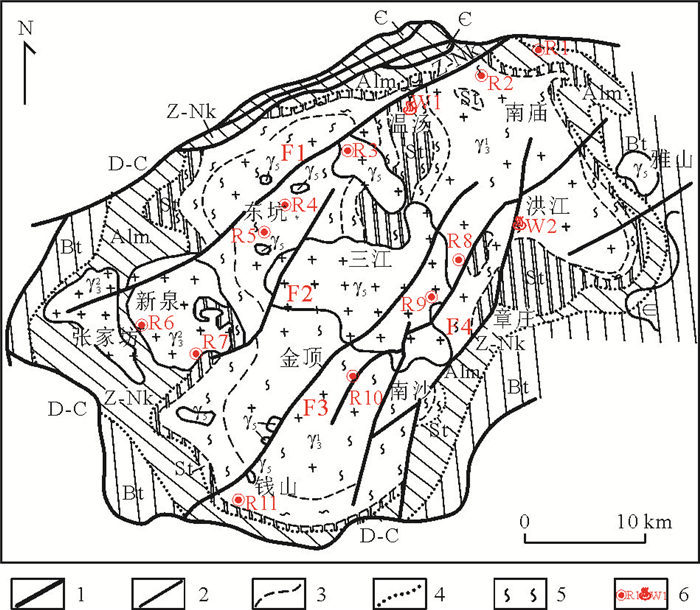
图 1 武功山隆起构造地质略图
D-C.泥盆-石炭系;ϵ.寒武系;Z-Nh.震旦-南华系;γ5.印支-燕山期花岗岩;γ32.加里东晚期花岗岩;γ31.加里东早期片麻状花岗岩、花岩质糜棱岩;Bt.绿泥石-黑云母带;Alm.铁铝榴石带;St.十字石带;1.断层:F1.温汤大断裂,F2.青龙山断裂,F3.梅州-泰山-钱山大断裂,F4.洪江-浒坑大断裂;2.地质界线;3.渐变质地质界线;4.变质矿物组合带界线;5.混合岩化带;6.地热田:R1.鼻田地热,R2.枫树下地热,R3.夏家坊地热,R4.长岭地热,R5.万龙山地热,R6.新泉地热,R7.麻田地热,R8.唐佳山地热,R9.三江地热,R10.泰山地热,R11.钱山地热,W1.温汤温泉,W2.温塘温泉
Fig. 1. Geological sketch map of the Wugongshan uplift structure
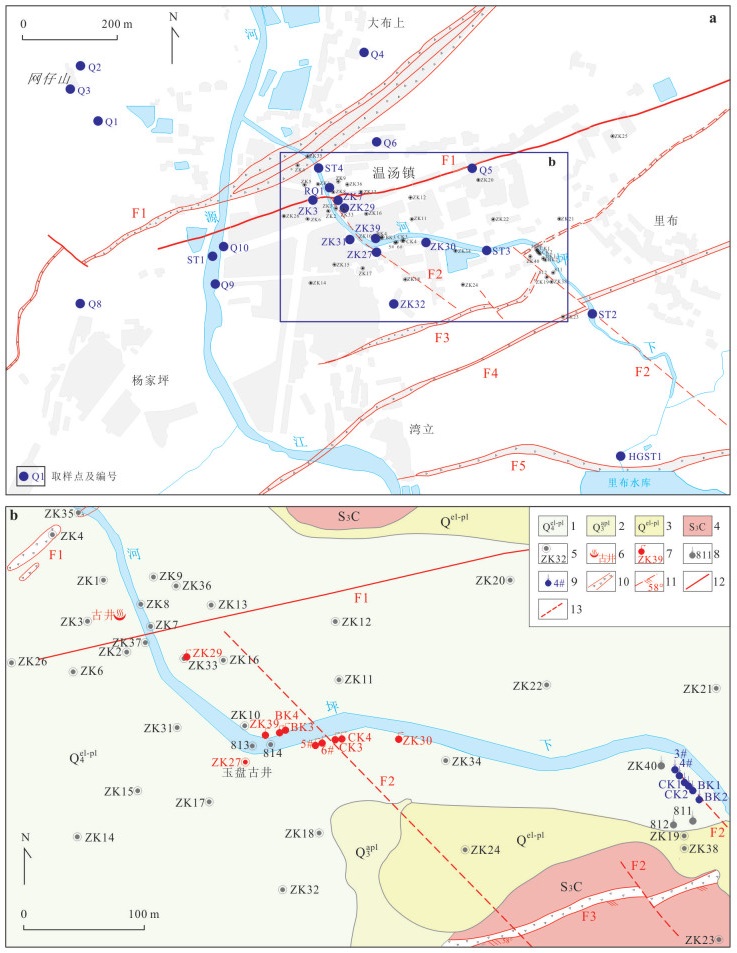
图 2 温汤采样点位置(a)、地热地质及开采-回灌井分布(b)简图
1.第四系全新统冲积洪积层;2.第四系上更新统冰积层;3.第四系坡积残积层;4.晚志留世稠坪单元花岗岩;5.原勘查孔;6.温泉古井;7.现有开采井;8.原回灌井;9.现有自流回灌井;10.硅化破碎带;11.压扭性断裂;12.张性断裂;13.推测断裂
Fig. 2. Locations of sampling points in Wentang (a) and simplified map of geothermal geology and distribution of production and recharge wells (b)
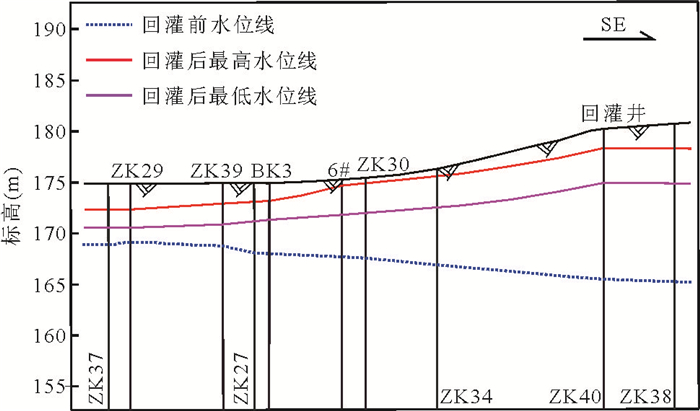
图 3 地热田回灌前、后钻孔水位分布
Fig. 3. Borehole water level distribution in the geothermal field before and after recharge
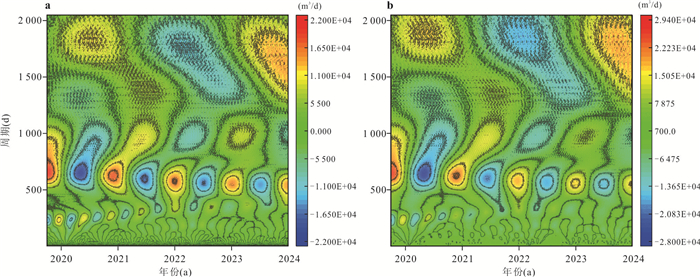
图 4 开采量(a)、回灌量(b)小波变化系数实部图
Fig. 4. Real parts of wavelet transformation coefficients of production (a) and recharge (b)
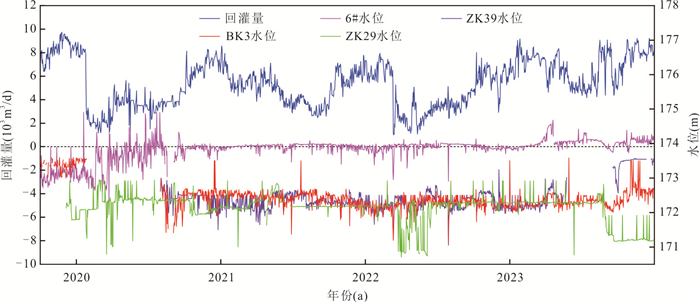
图 5 2019—2023年开采井水位动态曲线
Fig. 5. Water level dynamic curves of production wells from 2019 to 2023
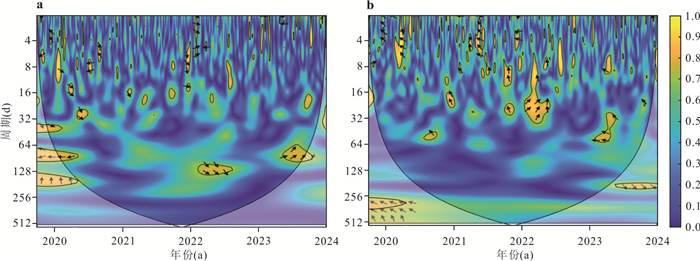
图 6 回灌量和ZK29(a)、6#(b)水位的小波相干图
Fig. 6. Wavelet coherence between recharge and water levels of ZK29 (a) and 6# (b)
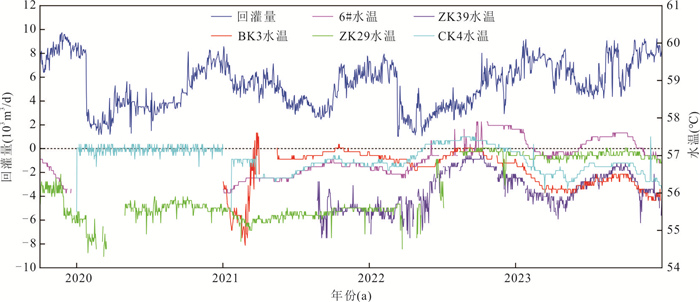
图 7 2019—2023年井口水温与回灌量变化曲线
Fig. 7. Curves of wellhead temperature and recharge volume from 2019 to 2023
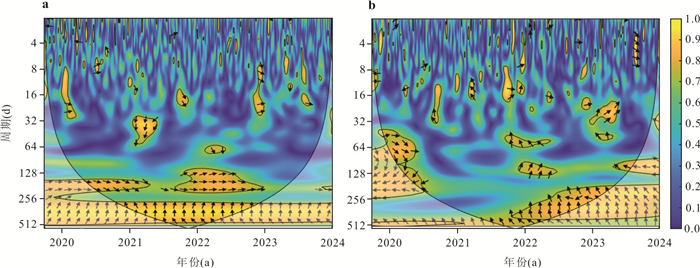
图 8 回灌量和ZK29(a)、CK4(b)水温的小波相干图
Fig. 8. Wavelet coherence between recharge and water temperature of ZK29 (a) and CK4 (b)
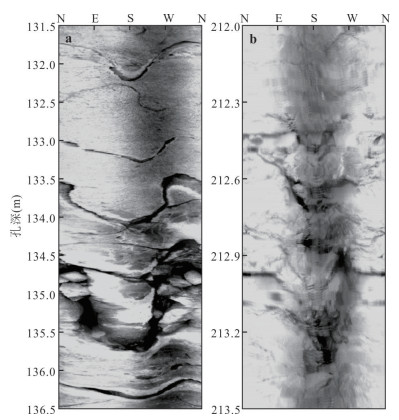
图 9 开采井CK3(a)、ZK30(b)主要热储段孔内成像
Fig. 9. Borehole imaging of the main geothermal reservoir sections in production wells CK3 (a) and ZK30 (b)
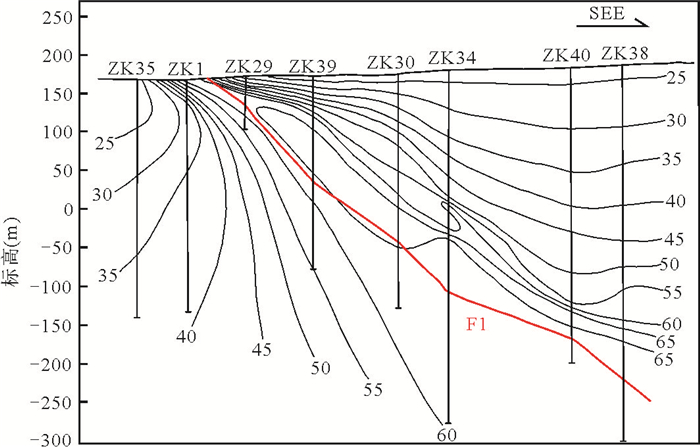
图 10 地热田垂向天然地温场等值线图
Fig. 10. Contour map of the vertical natural geothermal gradient in the geothermal field
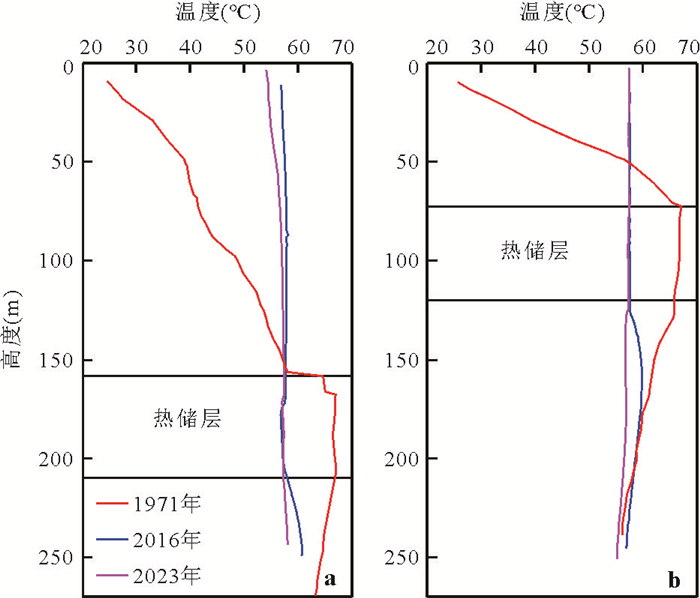
图 11 ZK30(a)、ZK39(b)孔内温度变化曲线
Fig. 11. Temperature variation curves in boreholes ZK30 (a) and ZK39 (b)
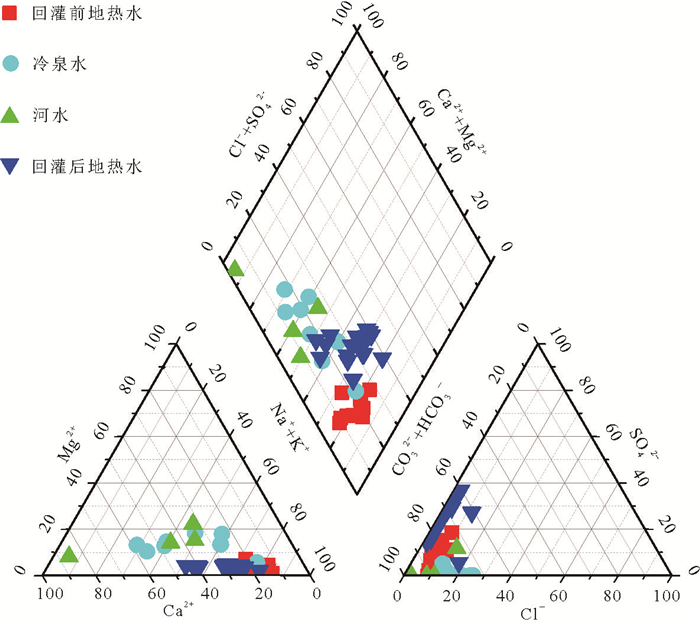
图 12 地热田及周边水体Piper三线图
Fig. 12. Piper trilinear diagram of the geothermal field and surrounding water bodies
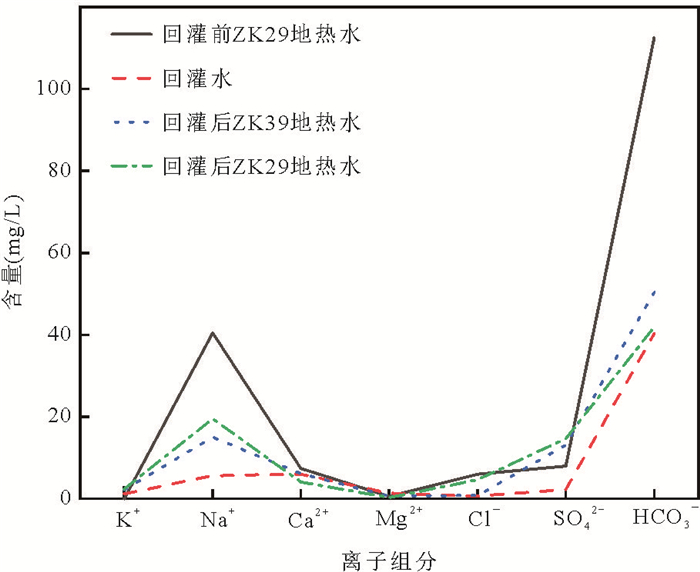
图 13 回灌水与回灌前后地热水宏量组分含量变化趋势图
Fig. 13. Changes in major component concentrations of recharge water and geothermal water before and after recharge
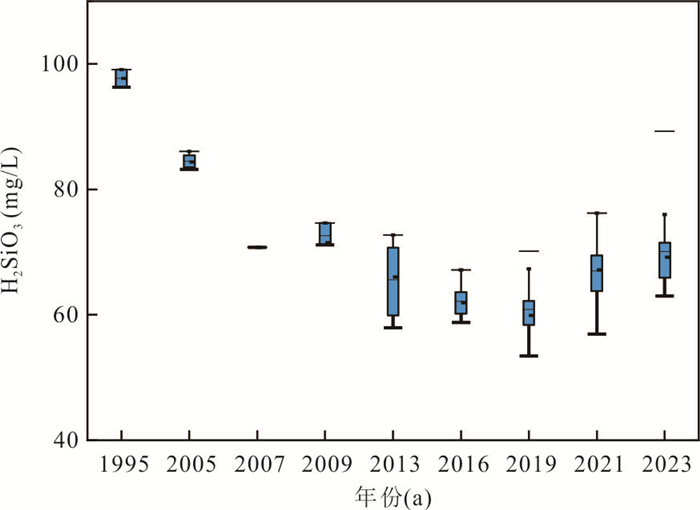
图 14 地热水中H2SiO3动态变化
Fig. 14. Trends in the dynamic changes of H2SiO3 in geothermal water
-
Ahmad Gondal, I., Masood, S. A., Amjad, M., 2017. Review of Geothermal Energy Development Efforts in Pakistan and Way Forward. Renewable and Sustainable Energy Reviews, 71: 687-696. https://doi.org/10.1016/j.rser.2016.12.097 Bakke, S., Vik, E. A., Gruener, H., et al., 1995. Produced Water Reinjection (PWRI): Experiences from the Ula Field. Environmental Science Research, 52: 447-456. Chen, M. X., Wang, J. Y., Deng, X., 1996. The Map of Geothermal System Types in China and Its Brief Explanation. Chinese Journal of Geology (Scientia Geologica Sinica), 31(2): 114-121(in Chinese with English abstract). Chen, Y., Yuan, J., Tang, C. H., et al., 2024. A Remote Sensing Methodology for Predicting Geothermal Resources in the Wugongshan Uplift Zone. Remote Sensing for Natural Resources, 36(2): 27-38(in Chinese with English abstract). Deng, A. L., Sun, H. P., 2002. Dynamic Changes of Hot Water Caused by Over-Exploitation of Qicun Geothermal Field in Shanxi Province. Earth Science, 27(2): 134-208(in Chinese with English abstract). Deng, H. C., Peng, X. Y., Jiang, L., et al., 1988. Research on the Fluorine Redueing Functions of Mineral Water in Wentang. Acta Academiae Medicinae Jiangxi, 28(2): 11-14(in Chinese with English abstract). Fan, B. H., Ye, H. L., Bai, X. M., et al., 2024. Implications of Geothermal Fluid Dynamics for Injection-Production Balance in Wentang Geothermal Field. Geological Review 70(Suppl. 1): 195-198(in Chinese with English abstract). Gao, B., Sun, Z. X., Liu, J. H., 2006. Exploitation and Protection of Geothermal Hotsprings in Jiangxi Province. Water Resources Protection, 22(2): 92-94(in Chinese with English abstract). Gao, H. L., Hu, Z. H., Wan, H. P., et al., 2023. Characteristics of Geothermal Geology of the Gulu Geothermal Field in Tibet. Earth Science, 48(3): 1014-1029(in Chinese with English abstract). He, L. F., 2004. On Discussion of the Artificial Recharge Pattern of Geothermal Fields in Fuzhou City. Geology of Fujian, 23(2): 77-81(in Chinese with English abstract). Jie, F. L., 2023. Research on the Lagging and Uncertainty of Drainage in Large Yellow River Irrigation Areas (Dissertation). Xi'an University of Technology (in Chinese with English abstract). Li, M. S., Hinnov, L., Kump, L., 2019. Acycle: Time-Series Analysis Software for Paleoclimate Research and Education. Computers & Geosciences, 127: 12-22. https://doi.org/10.1016/j.cageo.2019.02.011 Lin, W. J., Liu, Z. M., Wang, W. L., et al., 2013. The Assessment of Geothermal Resources Potential of China. Geology in China, 40(1): 312-321(in Chinese with English abstract). Liu, H. T., 2016. Study on Water Resources and Environmental Protection of Selenium-Enriched Hot Springs in Yichun Wentang. Energy and Environment, (5): 48, 50(in Chinese). Liu, J. R., 2003. The Status of Geothermal Reinjection. Hydrogeology and Engineering Geology, 30(3): 100-104(in Chinese with English abstract). Liu, K., Ye, C., Liu, Y. Z., et al., 2018. Regionalization of Geothermal Resource Potential in Beijing. Journal of Engineering Geology, 26(2): 551-560(in Chinese with English abstract). Liu, X. Y., Zhong, C. D., 2003. Discussion of the Structure Problem in Wugongshan Region in Western Jiangxi Province. Journal of East China Geological Institute, 26(3): 249-253(in Chinese with English abstract). Lou, F. S., Shu, L. S., Yu, J. H., et al., 2002. Petrological and Geochemical Characteristics and Origin of the Wugongshan Dome Granite, Jiangxi Province. Geological Review, 48(1): 80-88(in Chinese with English abstract). Lund, J. W., Boyd, T. L., 2016. Direct Utilization of Geothermal Energy 2015 Worldwide Review. Geothermics, 60: 66-93. https://doi.org/10.1016/j.geothermics.2015.11.004 Ruan, C. X. 2018. Research on Geothermal Reinjection in Wumishan Formation, Tianjin (Dissertation). China University of Geosciences, Beijing(in Chinese with English abstract). Wang, A. D., Sun, Z. X., Lin, W. J., et al., 2023. Occurrence Features of Geothermal Resources and Geothermal Potential Assessment of Jiangxi Province. Geology in China, 50(6): 1646-1654(in Chinese with English abstract). Wang, J. Y., Xiong, L. P., Pang, Z. H., 1990. Determination of Geothermal Water Circulation Depth Using Geothermal Data. Chinese Science Bulletin, 35(5): 378-380 (in Chinese). Wang, R. J., 1983. Trilinear Diagram and Its Hydrogeological Interpretation. Geotechnical Investigation & Surveying 11(6): 6-11(in Chinese). Xin, T. J., 2016. Genetic Mechanism and Development Prospects of Geothermal Water in Wentang Geothermal Field, Jiangxi(Dissertation). Nanjing University, Nanjing (in Chinese with English abstract). Xu, D. L., Jing, T. Y., Tan, J. Q., 2018. Analysis of Production Wells Monitoring and Its Impacts in Yangbajing Geothermal Field. Sino-Global Energy, 23(12): 22-28(in Chinese with English abstract). Ye, H. L., Fan, B. H., Bai, X. M., et al., 2023. Analysis of Hydrogeochemical Characteristics and Origin in the Shicheng Geothermal Belt. Acta Geologica Sinica, 97(1): 238-249(in Chinese with English abstract). Yin, X. X., Zhao, S. M., Cai, Y., et al., 2024. Dynamics of Geothermal Reservoirs for Intensive Geothermal Development in Tianjin from 1992 to 2021. Acta Geologica Sinica, 98(1): 297-313(in Chinese with English abstract). Zeng, M. X., Li, H. J., Shi, J. J., et al., 2007. The Study on Drilling Technique of Tertiary Reservoir Reinjection Well. Geology and Prospecting, 43(2): 88-92(in Chinese with English abstract). Zhang, Y. P., Li, Q. H., Yu, S. W., 2024. Hydrochemical Characteristics Constraints on Evolution of Geothermal Water in Guantang Area on the East Coast of Hainan Island. Earth Science, 49(3): 952-964(in Chinese with English abstract). Zhou, Z. Y., Liu, S. L., Liu, J. X., 2015. Study on the Characteristics and Development Strategies of Geothermal Resources in China. Journal of Natural Resources, 30(7): 1210-1221(in Chinese with English abstract). 陈墨香, 汪集旸, 邓孝, 1996. 中国地热系统类型图及其简要说明. 地质科学, 31(2): 114-121. 陈艳, 袁晶, 唐春花, 等, 2024. 武功山隆起区地热资源预测遥感方法研究. 自然资源遥感, 36(2): 27-38. 邓安利, 孙和平, 2002. 山西省奇村地热田超采引起的热水动态变化. 地球科学, 27(2): 134-208. doi: 10.3321/j.issn:1000-2383.2002.02.024 邓焕彩, 彭小玉, 蒋琳, 等, 1988. 宜春温汤矿泉水的降氟研究. 江西医学院学报, 28(2): 11-14. 樊柄宏, 叶海龙, 白细民, 等, 2024. 地热流体动态对温汤地热田地热水灌采平衡的指示意义. 地质论评, 70(增刊1): 195-198. 高柏, 孙占学, 刘金辉, 2006. 江西省地热温泉开发利用与保护. 水资源保护, 22(2): 92-94. 高洪雷, 胡志华, 万汉平, 等, 2023. 西藏谷露地热田地热地质特征. 地球科学, 48(3): 1014-1029. 何连发, 2004. 福州地热田人工回灌模式的探讨. 福建地质, 23(2): 77-81. 介飞龙, 2023. 大型引黄灌区退水滞后性与不确定性研究(博士学位论文). 西安: 西安理工大学. 蔺文静, 刘志明, 王婉丽, 等, 2013. 中国地热资源及其潜力评估. 中国地质, 40(1): 312-321. 刘慧婷, 2016. 宜春温汤富硒温泉水资源与环境保护研究. 能源与环境(5): 48, 50. 刘久荣, 2003. 地热回灌的发展现状. 水文地质工程地质, 30(3): 100-104. 刘凯, 叶超, 刘玉忠, 等, 2018. 北京地区地热资源潜力区划. 工程地质学报, 26(2): 551-560. 刘细元, 衷存堤, 2003. 关于赣西武功山地区构造问题的讨论. 华东地质学院学报, 26(3): 249-253. 楼法生, 舒良树, 于津海, 等, 2002. 江西武功山穹隆花岗岩岩石地球化学特征与成因. 地质论评, 48(1): 80-88. 阮传侠, 2018. 天津地区雾迷山组热储地热回灌研究(博士学位论文). 北京: 中国地质大学. 王安东, 孙占学, 蔺文静, 等, 2023. 江西省地热资源赋存特征及潜力评价. 中国地质, 50(6): 1646-1654. 汪集旸, 熊亮萍, 庞忠和, 1990. 利用地热资料确定地下热水循环深度. 科学通报, 35(5): 378-380. 王瑞久, 1983. 三线图解及其水文地质解释. 工程勘察, 11(6): 6-11. 辛田军, 2016. 江西省温汤地热田地热水成因机理及开发利用前景(硕士学位论文). 南京: 南京大学. 许多龙, 荆铁亚, 谭金群, 2018. 羊八井热田生产井监测及变化影响分析. 中外能源, 23(12): 22-28. 叶海龙, 樊柄宏, 白细民, 等, 2023. 石城地热带水文地球化学特征与成因分析. 地质学报, 97(1): 238-249. 殷肖肖, 赵苏民, 蔡芸, 等, 2024. 近三十年天津市地热大规模开发热储动态特征研究. 地质学报, 98(1): 297-313. 曾梅香, 李会娟, 石建军, 等, 2007. 新近系热储层回灌井钻探工艺探索. 地质与勘探, 43(2): 88-92. 张彦鹏, 黎清华, 余绍文, 2024. 海南岛东海岸官塘地区地热水水化学特征及其循环演化过程识别. 地球科学, 49(3): 952-964. doi: 10.3799/dqkx.2022.225 周总瑛, 刘世良, 刘金侠, 2015. 中国地热资源特点与发展对策. 自然资源学报, 30(7): 1210-1221. -

 下载:
下载:
 点击查看大图
计量
- 文章访问数: 240
- HTML全文浏览量: 10
- PDF下载量: 9
- 被引次数: 0
