




Fracture Classification-Grading Prediction Technology and Application in Carbonate Reservoir Rocks: A Case Study from Tahe Oilfield, Tarim Basin
-
摘要: 碳酸盐岩储层作为全球油气资源的重要载体,其内部溶洞和断裂系统的发育特征直接影响油气的储集与运移能力.针对深层-超深层碳酸盐岩储层中多尺度断裂预测的难题,研究以塔里木盆地塔河油田奥陶系碳酸盐岩为例,提出了一种基于地震波场特征分析的分类分级断裂预测技术.通过三维正演模拟揭示了规模缝洞体对常规断裂预测属性(如相干、最大似然)的干扰机制,发现缝洞体边界的“串珠状”反射异常会导致断裂假连通和归位偏差.基于断裂的尺度与溶蚀特征差异,将研究区断裂系统划分为大尺度破碎-溶蚀断裂(> 20 m)、中尺度弱-未溶蚀断裂(10~20 m)和小尺度裂缝(< 10 m),并分别开发了针对性的预测方法:针对大尺度断裂,提出基于梯度结构张量薄化的断裂归位技术,有效克服溶洞异常边界的干扰;针对中尺度断裂,结合AFE相干加强属性与U⁃Net深度学习算法,显著提升了断裂纵向连续性;针对小尺度裂缝,利用Likelihood属性与构造导向滤波实现弱反射信号的精准提取.进一步通过深度前馈神经网络(deep feedforward neural network,DFNN)融合多尺度断裂属性及钻井漏失数据,构建了井控多属性融合模型.应用结果表明,该技术体系在塔河油田复杂缝洞区实现了断裂系统的全尺度刻画,大尺度走滑断裂呈NNE⁃NNW向共轭分布,中尺度断裂形成花状构造,小尺度裂缝密集发育于断裂东侧主动盘.本研究为深层碳酸盐岩储层断裂预测提供了新的技术思路,对同类油气藏的勘探开发具有重要参考价值.Abstract: Carbonate reservoirs are important carriers of global oil and gas resources. The development characteristics of their internal karst caves and fault systems directly affect the storage and migration capacity of oil and gas. In order to solve the problem of multi-scale fault prediction in deep and ultra-deep carbonate reservoirs, this study takes the Ordovician carbonate rocks in the Tahe oilfield in the Tarim basin as an example and proposes a classification and grading fault prediction technology based on seismic wave field characteristic analysis. The interference mechanism of large-scale fracture-cavity bodies on conventional fault prediction attributes (such as coherence and maximum likelihood) is revealed through three-dimensional forward simulation, and it is found that the "beaded" reflection anomaly at the boundary of the fracture-cavity body will lead to false connectivity of faults and relocation deviation. Based on the differences in the scale and dissolution characteristics of the faults, the fault system in the study area is divided into large-scale broken-dissolution faults (> 20 m), medium-scale weak-undissolved faults (10-20 m) and small-scale fractures (< 10 m), and targeted prediction methods are developed for each of them: for large-scale faults, a fracture retrieval technology based on gradient structural tensor thinning is proposed to effectively overcome the interference of abnormal boundaries of karst caves; for medium-scale faults, the longitudinal continuity of the faults is significantly improved by combining AFE coherent enhancement attributes with U-Net deep learning algorithm; for small-scale fractures, the Likelihood attribute and structural guidance filtering are used to accurately extract weak reflection signals. Further, a well control multi-attribute fusion model is constructed by fusing multi-scale fault attributes and drilling loss data through deep feed forward neural network (DFNN). The application results show that this technology system has achieved full-scale characterization of the fault system in the complex fracture-cave area of Tahe oilfield. Large-scale strike-slip faults are distributed in a conjugate NNE-NNW direction, medium-scale faults form flower-like structures, and small-scale fractures are densely developed on the active disk (east side) of the fault. This study provides a new technical approach for the prediction of deep carbonate reservoir faults and has important reference value for the exploration and development of similar oil and gas reservoirs.
-
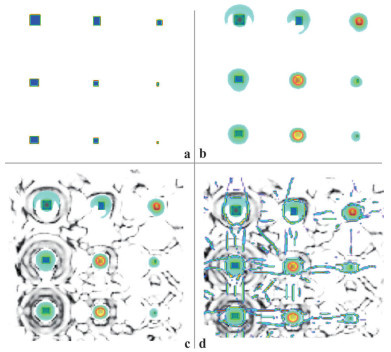
图 2 三维数值缝洞模型及能量、相干、似然属性平面图
a.不同尺度缝洞体模型;b.不同尺度缝洞体模型与能量叠合;c.三维模型的相干属性;d.三维模型相干、似然属性<
Fig. 2. 3D numerical fracture⁃cavity model and planar maps of energy, coherence, and likelihood attributes
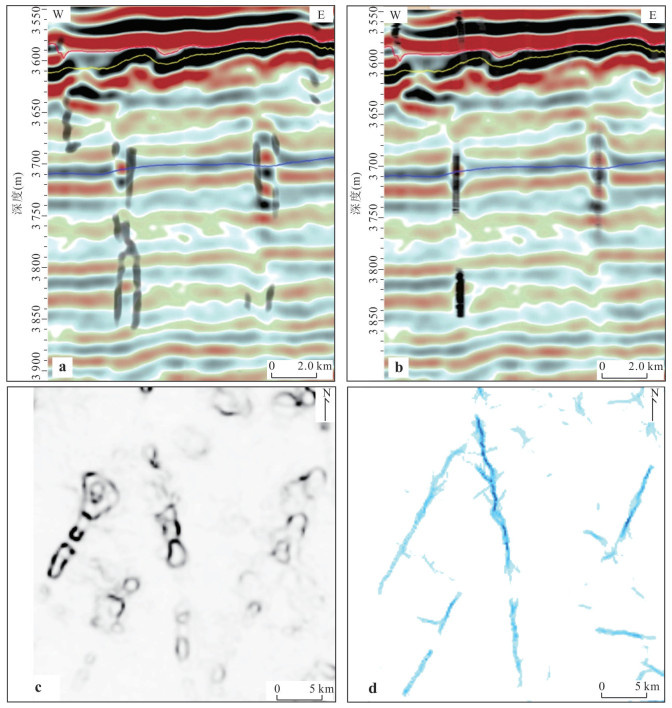
图 3 常规相干属性与张量薄化剖面及平面对比
a.常规相干断裂检测与原始剖面叠合图;b.张量薄化断裂检测与原始剖面叠合图;c.常规相干断裂检测平面图;d.张量薄化断裂检测平面图
Fig. 3. Comparison of conventional coherence attributes and tensor thinning profiles/planar maps
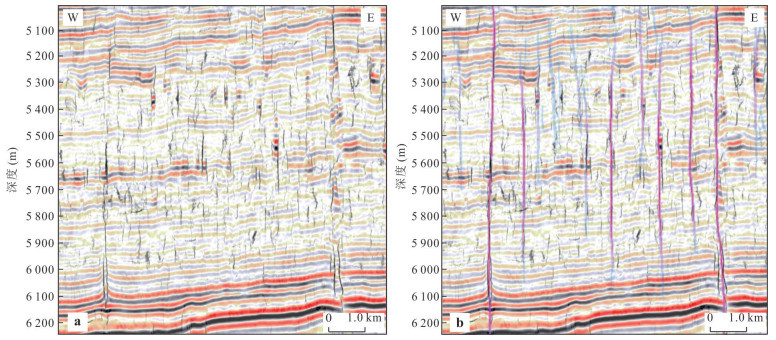
图 5 AFE及机器学习的断裂检测效果剖面对比
a.断裂检测剖面(黑色);b.基于机器学习的断裂预测剖面(红色、蓝色)
Fig. 5. Comparison of fracture detection results between AFE and machine learning in cross⁃sections
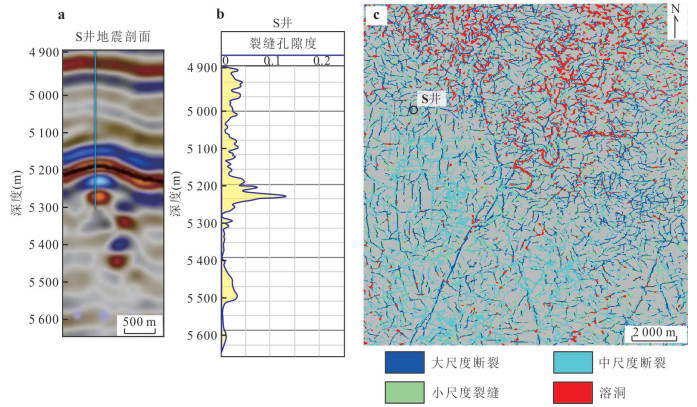
图 6 小尺度裂缝空间展布预测效果
Fig. 6. Prediction results of small⁃scale fracture spatial distribution
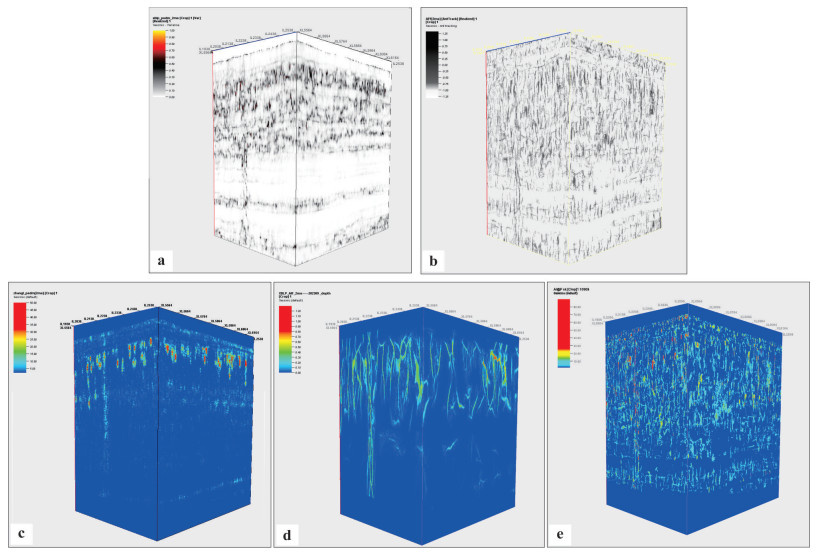
图 7 多属性融合数据体.
a.方差体;b.AFE相干加强属性体;c.张量薄化体;d.U⁃Net架构下深度学习体;e.深度前馈神经网络多属性分类分级融合体
Fig. 7. Multi⁃attribute fusion data volume
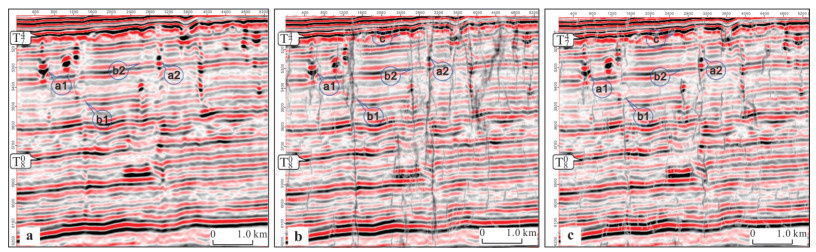
图 8 典型断裂深度偏移剖面及分类分级预测、精细相干与原始地震剖面叠合图
a.典型断裂深度偏移剖面;b.分类分级预测与原始地震剖面叠合图;c.精细相干与原始地震剖面叠合图
Fig. 8. Depth⁃migrated profiles of typical fractures with superimposed maps of classification/prediction, refined coherence, and original seismic sections.
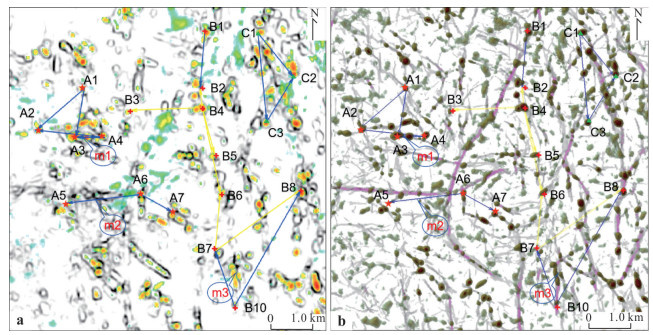
图 9 分类分级预测与精细相干效果平面对比
a.精细相干(黑色)+能量(红黄绿);b.分类分级断裂(黑色)+能量(红、绿色)
Fig. 9. Planar comparison of classification/grading prediction and refined coherence effects
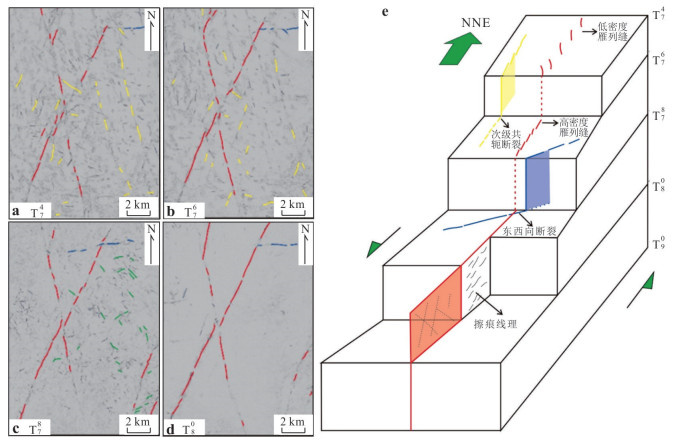
图 10 研究区不同层面大-中尺度断裂几何样式分布特征与断层发育空间模式
a~d.红色线段代表大尺度断裂,黄、绿、蓝色分别代表不同层位中尺度断裂,灰色代表小尺度断裂
Fig. 10. Distribution characteristics of large⁃to⁃medium⁃scale fracture geometric patterns and spatial development models of faults at different horizons in the study area
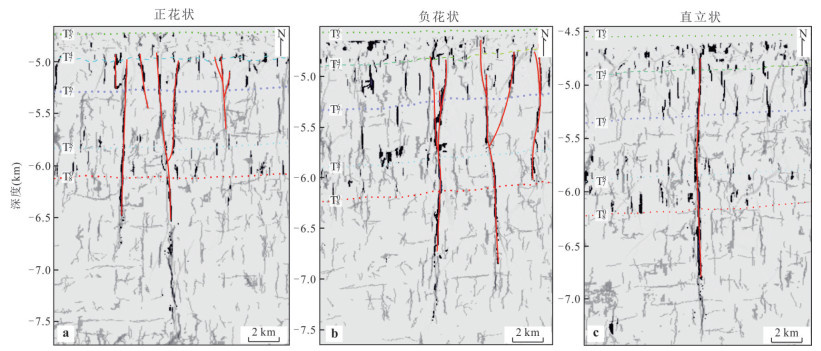
图 11 塔河地区大尺度、中尺度分级分类断裂识别代表性走滑构造样式
暗色为识别出的大尺度断裂,浅灰色代表识别中的中尺度断裂.a.正花状构造;b.负花状构造;c.直立状构造
Fig. 11. Representative strike⁃slip structural styles of large⁃scale and medium⁃scale classified fractures identified in the Tahe area
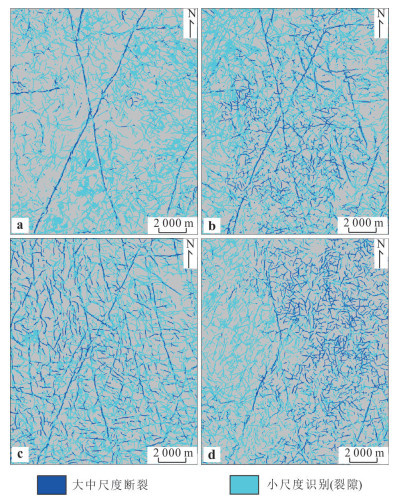
图 12 研究区分级分类地震属性融合识别断裂和裂隙不同平面分布特征
a.T80界面;b.T78界面;c.T76界面解释;d. T74界面
Fig. 12. Planar distribution characteristics of fractures and fissures identified through hierarchical classification and seismic attribute fusion in the study area
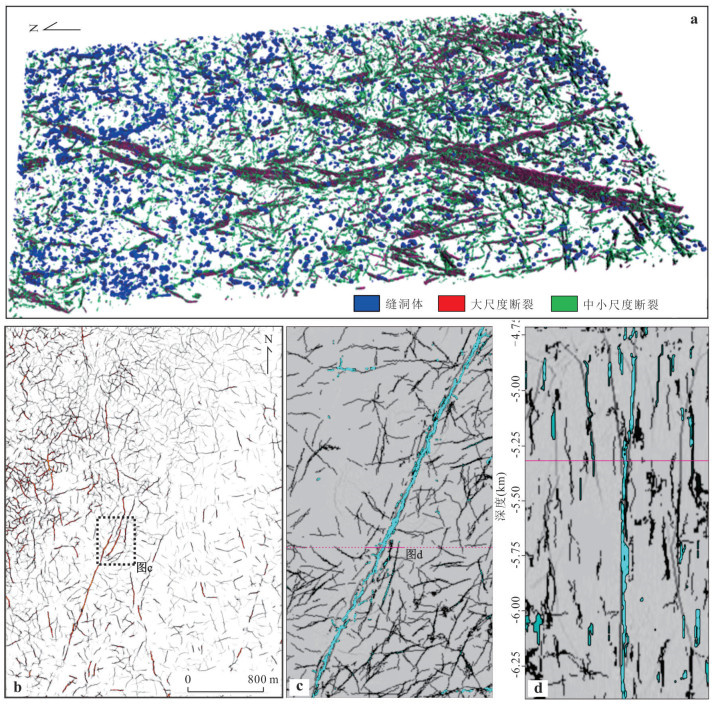
图 13 不同尺度裂缝地震识别效果展示
b.表示图c的位置;平面c和剖面d断裂东侧裂隙数量明显高于西侧
Fig. 13. Demonstration of different scale fracture seismic identification results
表 1 塔河油田碳酸盐岩断裂分类分级预测技术
Table 1. Classification and grading prediction technology of carbonate fractures in Tahe oilfield
断裂类型 断距尺度 典型剖面 波场特征 预测技术 大尺度
破碎-溶蚀断裂大于20 m 
宽度40 m、100 m杂乱强反射 张量薄化 中尺度弱-未溶蚀断裂 10~20 m 
断距20 m、15 m、10 m同相轴错断、扰动 AFE+机器学习预测 小尺度弱-未溶蚀断裂-裂缝 小于10 m 
叠前各向速度、能量差异和高灵敏度弱信号增强 叠前各向异性预测和
Likelihood属性 下载: 导出CSV
-
Benardos, P. G., Vosniakos, G. C., 2007. Optimizing Feedforward Artificial Neural Network Architecture. Engineering Applications of Artificial Intelligence, 20(3): 365-382. https://doi.org/10.1016/j.engappai.2006.06.005 Bo, X., Xu, W. L., Chen, X. H., et al., 2022. LP-PCNN Multi-Attribute Fusion Fracture Prediction Method Based on Local Entropy. Geophysical Prospecting for Petroleum, 61(5): 821-829(in Chinese with English abstract). Chen, G., Qi, H. Y., Yu, J. L., et al., 2023. Application of a Multi-Layer Feedforward Neural Network to Predict Fracture Density in Shale Oil, Junggar Basin, China. Frontiers in Earth Science, 11: 1114389. https://doi.org/10.3389/feart.2023.1114389 Chen, G. F., Shi, Y., Yang, H. D., et al., 2023. Fault Identification Method of Attribute Fusion Based on Seismic Optimized Frequency of Seismic Data. Chinese Journal of Geophysics, 66(3): 1232-1243(in Chinese with English abstract). Chen, J. A., Chen, H. D., Gong, W., et al., 2022. Application of Comprehensive Fault Detection Technology Combining Deep Learning with Edge Enhancement in Detecting Ultra-Deep Strike-Slip Faults in Shunbei Block. Oil Geophysical Prospecting, 57(6): 1304-1316, 1256(in Chinese with English abstract). Cui, L. J., He, Y. B., Wang, J. X., et al., 2012. Application of Seismic Curvature Based on Horizon to Carbonate Fault Prediction: an Example of an Area in Tabei, Tarim Basin. Lithologic Reservoirs, 24(1): 92-96 (in Chinese with English abstract). Cui, Z. W., Cheng, B. J., Xu, T. J., et al., 2021. Reservoir Fracture Prediction Method and Application Based on Structure-Oriented Filtering and Coherent Attributes of Gradient Structure Tensor. Oil Geophysical Prospecting, 56(3): 555-563, 413-414 in Chinese with English abstract. Feng, C., Pan, J. G., Li, C., et al., 2023. Fault High-Resolution Recognition Method Based on Deep Neural Network. Earth Science, 48(8): 3044-3052 (in Chinese with English abstract). Han, P. Y., Ding, W. L., Yang, D. B., et al., 2024. Characteristics of the S80 Strike-Slip Fault Zone and Its Controlling Effects on the Ordovician Reservoirs in the Tahe Oilfield, Tarim Basin. Oil & Gas Geology, 45(3): 770-786 (in Chinese with English abstract). Hao. J. M., Wang, X. Y., Sun, J. F., et al., 2019. Characteristics and Main Controlling Factors of Natural Fractures in the Lower-to-Middle Ordovician Carbonate Reservoirs in Tahe Area, Northern Tarim Basin. Oil & Gas Geology, 40(5): 1022-1030(in Chinese with English abstract). He, Z. L., Peng, S. T., Zhang, T., 2010. Controlling Factors and Genetic Pattern of the Ordovician Reservoirs in the Tahe Area, Tarim Basin. Oil & Gas Geology, 31(6): 743-752(in Chinese with English abstract). Huang, C., Yun, L., Cao, Z. C., et al., 2022. Division and Formation Mechanism of Fault-Controlled Fracture-Vug System of the Middle-to-Lower Ordovician, Shunbei Area, Tarim Basin. Oil & Gas Geology, 43(1): 54-68(in Chinese with English abstract). Lucia, F. J., 2007. Carbonate Reservoir Characterization: An Integrated Approach. Springer-Verlag Berlin Heidelberg Press, Berlin, 342. Li, F. Y., Wang, T., Zeng, Q. B., et al., 2023. Application of High-Definition Likelihood Attributes Based on Structure Orientation in the Prediction of Deep Faults in Baiyun Sag. Geophysical Prospecting for Petroleum, 62(1): 163-172(in Chinese with English abstract). Li, H. L., Pan, H., Gao, J. H., et al., 2024. Post-Stack Fracture Prediction Technique Based on Improved Phase Decomposition. Journal of Geophysics and Engineering, 21(5): 1499-1510. https://doi.org/10.1093/jge/gxae088 Li, H. Y., Liu, J., Gong, W., et al., 2020. Identification and Characterization of Strike-Slip Faults and Traps of Fault-Karst Reservoir in Shunbei Area. China Petroleum Exploration, 25(3): 107-120(in Chinese with English abstract). Li, P. F., Cui, D. Y., Tian, H. N., 2017. Fault-Karst Carbonate Reservoir Description with GeoEast Interpretation Sub-System in the Tabei Area, Tarim Basin. Oil Geophysical Prospecting, 52(S1): 189-194, 13(in Chinese with English abstract). Li, T. T., Wang, Z., Ma, S. Z., et al., 2015. Summary of Seismic Attributes Fusion Method. Progress in Geophysics, 30(1): 378-385(in Chinese with English abstract). Li, Y. Q., Sun, Wei, H. H., Song, S. H., 2019. Architectural Features of Fault-Controlled Karst Reservoirs in the Tahe Oilfield. Journal of Petroleum Science and Engineering, 181: 106208. doi: 10.1016/j.petrol.2019.106208 Li, Z. D., Zhang, L. S., Li, Y., et al., 2017. Channel Sand Characterization Based on the Fusion of Multiple Iterative Attributes—A Case Study of Z Area of Fuyu Oil Layer in Daqing Oil Field. Progress in Geophysics, 32(3): 1161-1168(in Chinese with English abstract). Liang, Z. Q., 2019. Poststack Seismic Prediction Techniques for Fractures of Different Scales. Geophysical Prospecting for Petroleum, 58(5): 766-772(in Chinese with English abstract). Liu, B. L., Zhao, Y. G., Zhang, Y. T., et al., 2025. The Deformation Characteristics of the Main Strike-Slip Faults and the Development of Fault-Karst Reservoirs in the Eastern Part of the Aman Transition Zone, Tarim Basin. Chinese Journal of Geology, 60(2): 360-377(in Chinese with English abstract). Liu, J., Ren, L. D., Li, Z. J., et al., 2017. Seismic Identification and Evaluation of Deep Carbonate Faults and Fractures in Shunnan Area, Tarim Basin. Oil & Gas Geology, 38(4): 703-710(in Chinese with English abstract). Liu, Q., Li, H. Y., Deng, G. X., 2013. Application of Seismic Fault Detection to Carbonate Reservoir Prediction in Southern Tahe Oilfield. Oil & Gas Geology, 34(2): 202-206(in Chinese with English abstract). Lu, Z. Q., Wang, L., Yang, R. Z., et al., 2018. Coherence-Based Fine Characterization Technology for Fractures and Its Application to Shunbei Area. Natural Gas Exploration and Development, 41(3): 20-25(in Chinese with English abstract). Lü, B. N., Chen, X. H., Qie, C. C., et al., 2024. Integrated Characterization of Deep Karsted Carbonates in the Tahe Oilfield, Tarim Basin. Journal of Geophysics and Engineering, 21: 668-684. doi: 10.1093/jge/gxae031 Ma, D. B., Zhao, Y. M., Zhang, Y. T., et al., 2018. Application of Maximum Likelihood Attribute to Fault Identification: A Case Study of Rewapu Block in Halahatang Area, Tarim Basin, NW China. Natural Gas Geoscience, 29(6): 817-825(in Chinese with English abstract). Malozyomov, B. V., Martyushev, N. V., Kukartsev, V. V., et al., 2023. Overview of Methods for Enhanced Oil Recovery from Conventional and Unconventional Reservoirs. Energies, 16(13): 4907. https://doi.org/10.3390/en16134907 Ronneberger, O., Fischer, P., Brox, T., 2015. U-Net: Convolutional Networks for Biomedical Image Segmentation. Medical Image Computing and Computer-Assisted Intervention: MICCAI 2015. Springer, Berlin Heidelberg, 234-241 Wang, J., Xu, J. F., Zhao, M. F., et al., 2023. Prediction of Crack Width of Drilling Fluid Leakage Based on Neural Network. Coal Geology & Exploration, 51(9): 81-88(in Chinese with English abstract). Wang, Z., Wen, H., Deng, G. X., et al., 2019. Fault-Karst Characterization Technology in the Tahe Oilfield, China. Geophysical Prospecting for Petroleum, 58(1): 149-154(in Chinese with English abstract). Wang, Z. W., Fu, L. Y., Liu, J., et al., 2023. Multiscale Characterization and Connectivity Analysis of 3D Seismic Attributes of Ultra-Deep Carbonate Conduction System in Shunbei, Tarim Basin. Chinese Journal of Geophysics, 66(1): 83-94(in Chinese with English abstract). Wei, T. G., Zhang, H., Li, F. Q., et al., 2024. Application of Multi-Scale Curvature in Fault Interpretation of K Oilfield in Bohai Sea. Computerized Tomography Theory and Applications, 33(6): 773-780(in Chinese with English abstract). Wei, X. L., Zhang, C. X., Kim, S. W., et al., 2022. Seismic Fault Detection Using Convolutional Neural Networks with Focal Loss. Computers & Geosciences, 158: 104968. https://doi.org/10.1016/j.cageo.2021.104968 Wu, X. M., Liang, L. M., Shi, Y. Z., et al., 2019. FaultSeg3D: Using Synthetic Data Sets to Train an End-to-End Convolutional Neural Network for 3D Seismic Fault Segmentation. Geophysics, 84(3): IM35-IM45. https://doi.org/10.1190/geo2018-0646.1. Wu, Z. Y., Mo, X. W., Liu, J. H., et al., 2018. Convolutional Neural Network Algorithm for Classification Evaluation of Fractured Reservoirs. Geophysical Prospecting for Petroleum, 57(4): 618-626(in Chinese with English abstract). Xie, P. F., Hou, J. G., Wang, Y., et al., 2023. Application of Multi-Information Fusion Modeling of Fracture-Vuggy Reservoir in Ordovician Reservoir of 12th Block in Tahe Oilfield. Journal of China University of Petroleum (Edition of Natural Science), 47(3): 1-14(in Chinese with English abstract). Xie, Q. H., Zhao, C. D., Rui, Z. F., et al., 2022. An Improved Ant-Tracking Workflow Based on Divided-Frequency Data for Fracture Detection. Journal of Geophysics and Engineering, 19(5): 1149-1162. https://doi.org/10.1093/jge/gxac075 Xue, J., Cai, C. G., 2022. Theory and Method of Pre-Stack Earthquake Prediction for Fractured Reservoirs. China University of Geosciences Press, Wuhan(in Chinese). Yang, D. B., He, X. M., Zhang, H., et al., 2024. Intelligent Identification of Ordovician Epikarst Zones and Development Laws of Fractures and Vugs in the Main Area of Tahe Oilfield. Acta Petrolei Sinica, 45(2): 374-389, 411(in Chinese with English abstract). Yang, D. B., Ma, H. L., Ren, W. B., et al., 2024a. Fracture Identification and Characterization of Ordovician Carbonate Rock Reservoir in Block B of the Tahe Oilfield. Carbonates and Evaporites, 39(2): 40. https://doi.org/10.1007/s13146-024-00957-2 Yang, J., Lu, R. Q., Tao, W., et al., 2024b. MultiURNet for 3D Seismic Fault Attributes Fusion Detection Combined with PCA. Journal of Applied Geophysics, 221: 105296. https://doi.org/10.1016/j.jappgeo.2024.105296 Yang, J., Ding, R. W., Lin, N. T., et al., 2022. Research Progress of Intelligent Identification of Seismic Faults Based on Deep Learning. Progress in Geophysics, 37(1): 298-311(in Chinese with English abstract). Yang, Y. J., Wang, X. P., Yang, C. Q., 2013. Application of RGB Frequency Division and Color Mixing Technology in Tahe Oilfield. Xinjiang Geology, 31(Suppl. 1): 79-81(in Chinese with English abstract). Yao, H., Yin, H. C., Yin, S. X., et al., 2024. Research Progress on Risk Assessment of Floor Water Inrush. Coal Science and Technology, 52(Suppl. 1): 183-191(in Chinese with English abstract). Yuan, F., Shen, T., Xie, X. S., et al., 2021. Application of Deep Learning-Based Seismic Multi-Attribute Fusion Technology in the Detection of Water Conducting Fissure Zone. Journal of China Coal Society, 46(10): 3234-3244(in Chinese with English abstract). Zeng, L. B., Lyu, W. Y., Zhang, Y. Z., et al., 2021. The Effect of Multi-Scale Faults and Fractures on Oil Enrichment and Production in Tight Sandstone Reservoirs: A Case Study in the Southwestern Ordos Basin, China. Frontiers in Earth Science, 9: 664629. https://doi.org/10.3389/feart.2021.664629 Zhang, C. J., Jiang, L., Wang, Y., et al., 2024. Characteristics of Maze Karst Cave System in Lianglitage Formation of Tahe Oilfield, Tarim Basin. Xinjiang Petroleum Geology, 45(5): 522-532(in Chinese with English abstract). Zhang, S., Li, Y. L., Xiao, Y. J., et al., 2022. Research and Application of Carbonate Fracture-Cavity Boundary Characterization Method Based on Gradient Structure-Tensor. Oil Geophysical Prospecting, 57(4): 907-915, 742(in Chinese with English abstract). Zhang, X. X., Yu, J. J., Li, N. Y., et al., 2021. Multi-Scale Fracture Prediction and Characterization Method of a Fractured Carbonate Reservoir. Journal of Petroleum Exploration and Production, 11(1): 191-202. https://doi.org/10.1007/s13202-020-01033-w Zhang, Y. D., Munnecke, A., 2016. Ordovician Stable Carbon Isotope Stratigraphy in the Tarim Basin, NW China. Palaeogeography, Palaeoclimatology, Palaeoecology, 458: 154-175. https://doi.org/10.1016/j.palaeo.2015.09.001 Zhang, Y. T., Chang, S. Y., Xie, Z., et al., 2025. Concept, Geological Model and Seismic Characterization Technique of Ultra-Deep "Fault Shoal Body": A Case Study of Tarim Oilfield. Fault-Block Oil & Gas Field, 32(1): 108-117(in Chinese with English abstract). Zhang, Z. L., Yang, W., Wang, Q. J., et al., 2023. Hydrocarbon Transport and Migration Characteristics of Different Structural Units of Strike-Slip Fault System and Their Differential Control on Hydrocarbon Accumulation Patterns: A Case Study of Bituminous Vein Area in Wuerhe, Junggar Basin. Fault-Block Oil & Gas Field, 30(3): 424-433(in Chinese with English abstract). Zhao, J., Ran, Q., Zhu, B. H., et al., 2024. A Method for Identifying Faults Based on Well-Controlled Multi-Attribute Fusion Using a Feedforward Neural Network. Geophysical and Geochemical Exploration, 48(4): 1045-1053(in Chinese with English abstract). Zou, Y. M., Liu, D. L., Huang, Y., et al., 2023. Application of Post-Stack Multi-Attributes in the Description of Submerged Mountain Fault and Fracture Development. Petroleum Science Bulletin, 8(6): 725-737(in Chinese with English abstract). 薄昕, 徐旺林, 陈小宏, 等, 2022. 基于局部熵的LP-PCNN多属性融合裂缝预测方法. 石油物探, 61(5): 821-829. 陈国飞, 石颖, 杨会东, 等, 2023. 基于优势低频带地震数据的属性融合断层识别方法. 地球物理学报, 66(3): 1232-1243. 陈俊安, 陈海东, 龚伟, 等, 2022. 深度学习与边缘增强相结合的断裂综合检测技术: 顺北地区超深走滑断裂检测应用实例. 石油地球物理勘探, 57(6): 1304-1316, 1256. 崔立杰, 何幼斌, 王锦喜, 等, 2012. 基于层面的地震曲率属性在碳酸盐岩断裂预测中的应用: 以塔里木盆地塔北某区块为例. 岩性油气藏, 24(1): 92-96 崔正伟, 程冰洁, 徐天吉, 等, 2021. 基于构造导向滤波与梯度结构张量相干属性的储层裂缝预测方法及应用. 石油地球物理勘探, 56(3): 555-563, 413-414. 丰超, 潘建国, 李闯, 等, 2023. 基于深度神经网络的断层高分辨率识别方法. 地球科学, 48(8): 3044-3052. doi: 10.3799/dqkx.2022.276 韩鹏远, 丁文龙, 杨德彬, 等, 2024. 塔里木盆地塔河油田S80走滑断裂发育特征及其对奥陶系储层的控制作用. 石油与天然气地质, 45(3): 770-786. 赫俊民, 王小垚, 孙建芳, 等, 2019. 塔里木盆地塔河地区中-下奥陶统碳酸盐岩储层天然裂缝发育特征及主控因素. 石油与天然气地质, 40(5): 1022-1030. 何治亮, 彭守涛, 张涛, 2010. 塔里木盆地塔河地区奥陶系储层形成的控制因素与复合-联合成因机制. 石油与天然气地质, 31(6): 743-752. 黄诚, 云露, 曹自成, 等, 2022. 塔里木盆地顺北地区中-下奥陶统"断控"缝洞系统划分与形成机制. 石油与天然气地质, 43(1): 54-68. 李飞跃, 王涛, 曾清波, 等, 2023. 基于构造导向的高清似然属性在白云凹陷深层断裂预测中的应用. 石油物探, 62(1): 163-172 李海英, 刘军, 龚伟, 等, 2020. 顺北地区走滑断裂与断溶体圈闭识别描述技术. 中国石油勘探, 25(3): 107-120. 李鹏飞, 崔德育, 田浩男, 2017. 塔里木盆地塔北地区X区块断溶体刻画方法与效果. 石油地球物理勘探, 52(增刊1)189-194, 13. 李婷婷, 王钊, 马世忠, 等, 2015. 地震属性融合方法综述. 地球物理学进展, 30(1): 378-385. 李占东, 张丽双, 李阳, 等, 2017. 基于多次迭代属性融合技术的河道砂刻画: 以大庆油田扶余油层Z区为例. 地球物理学进展, 32(3): 1161-11 梁志强, 2019. 不同尺度裂缝的叠后地震预测技术研究. 石油物探, 58(5): 766-772. 刘冰雷, 赵永刚, 张银涛, 等, 2025. 塔里木盆地阿满过渡带东部主干走滑断裂变形特征及断溶储集体发育. 地质科学, 60(2): 360-377. 刘军, 任丽丹, 李宗杰, 等, 2017. 塔里木盆地顺南地区深层碳酸盐岩断裂和裂缝地震识别与评价. 石油与天然气地质, 38(4): 703-710. 刘群, 李海英, 邓光校, 2013. 地震断裂检测技术在塔河油田南部碳酸盐岩储层及油藏预测中的应用. 石油与天然气地质, 34(2): 202-206. 卢志强, 王力, 杨瑞召, 等, 2018. 基于相干的精细断裂刻画技术在顺北地区的应用. 天然气勘探与开发, 41(3): 20-25. 马德波, 赵一民, 张银涛, 等, 2018. 最大似然属性在断裂识别中的应用: 以塔里木盆地哈拉哈塘地区热瓦普区块奥陶系走滑断裂的识别为例. 天然气地球科学, 29(6): 817-825. 唐世伟, 张向君, 董建萍, 等, 2020. 基于优选区域的地震属性融合重构技术. 物探化探计算技术, 42(5): 603-608. 王健, 徐加放, 赵密福, 等, 2023. 基于神经网络的钻井液漏失裂缝宽度预测研究. 煤田地质与勘探, 51(9): 81-88. 王震, 文欢, 邓光校, 等, 2019. 塔河油田碳酸盐岩断溶体刻画技术研究与应用. 石油物探, 58(1): 149-154. 王志伟, 符力耘, 刘军, 等, 2023. 塔里木盆地顺北超深层碳酸盐岩输导体系三维地震属性多尺度表征及连通性分析. 地球物理学报, 66(1): 83-94. 魏天罡, 张珩, 李福强, 等, 2024. 多尺度曲率在渤海K油田断裂解释中的应用. CT理论与应用研究, 33(6): 773-780. 吴正阳, 莫修文, 柳建华, 等, 2018. 裂缝性储层分级评价中的卷积神经网络算法研究与应用. 石油物探, 57(4): 618-626. 谢鹏飞, 侯加根, 汪彦, 等, 2023. 碳酸盐岩缝洞型储层多元信息融合建模方法在塔河油田十二区奥陶系油藏的应用. 中国石油大学学报(自然科学版), 47(3): 1-14. 薛姣, 蔡成国, 2022. 裂缝型储层叠前地震预测理论与方法. 武汉: 中国地质大学出版社. 杨德彬, 何新明, 张恒, 等, 2024. 塔河油田主体区奥陶系表层岩溶带智能识别及缝洞发育规律. 石油学报, 45(2): 374-389, 411. 杨晶, 丁仁伟, 林年添, 等, 2022. 基于深度学习的地震断层智能识别研究进展. 地球物理学进展, 37(1): 298-311. 杨玉杰, 王希平, 杨春琴, 2013. RGB分频混色技术在塔河油田的应用. 新疆地质, 31(S1): 79-81. 姚辉, 尹慧超, 尹尚先, 等, 2024. 底板突水危险性评价研究进展. 煤炭科学技术, 52(S1): 183-191. 袁峰, 申涛, 谢晓深, 等, 2021. 基于深度学习的地震多属性融合技术在导水裂隙带探测中的应用. 煤炭学报, 46(10): 3234-3244. https://doi.org/10.13225/j.cnki.jccs.2020.0902. 张长建, 蒋林, 汪彦, 等, 2024. 塔河油田良里塔格组迷宫型岩溶洞穴系统发育特征. 新疆石油地质, 45(5): 522-532. 张晟, 李亚林, 肖又军, 等, 2022. 利用梯度结构张量刻画碳酸盐岩缝洞体边界. 石油地球物理勘探, 57(4): 907-915, 742. 张银涛, 常少英, 谢舟, 等, 2025. 超深层"断滩体"概念、地质模式及地震表征技术方法: 以塔里木油田为例. 断块油气田, 32(1): 108-117. 张子隆, 杨威, 王千军, 等, 2023. 走滑断裂不同结构单元输导、运聚特性及其差异控藏模式: 以准噶尔盆地乌尔禾沥青矿地区为例. 断块油气田, 30(3): 424-433. 赵军, 冉琦, 朱博华, 等, 2024. 基于前馈神经网络井控多属性融合的断裂识别方法. 物探与化探, 48(4): 1045-1053. 邹雅铭, 刘道理, 黄媛, 等, 2023. 叠后多属性在潜山断裂系统描述中的应用研究. 石油科学通报, 8(6): 725-737. -

 点击查看大图
计量
- 文章访问数: 208
- HTML全文浏览量: 13
- PDF下载量: 19
- 被引次数: 0
