




Oil Correlation for Whole Petroleum System in Qintong Sag, Subei Basin
-
摘要: 随着湖相页岩油勘探开发不断深入,苏北盆地溱潼凹陷已进入全油气系统评价阶段.前人开展的油源对比研究侧重烃源岩发育时期湖水盐度变化对生物标志化合物的影响,难以满足“同时异相”烃源岩的全油气系统油源对比要求.本文在古气候驱动旋回地层及其对烃源岩发育控制作用分析的基础上,分析了溱潼凹陷11件页岩油和常规原油样品中反映硫化生境的芳基类异戊二烯烃生标,并进行全油气系统油源对比;同时,运用2,3,6-芳基类异戊二烯烃(2,3,6-AIPs)和2,3,4-芳基类异戊二烯烃(2,3,4-AIPs)构造的C3=Σ(2,3,6-AIPs)/Σ(2,3,4-AIPs)和C4=Σ(2,3,6-AIPs)/Σ(2,3,4-AIPs)+ Σ(2,3,6-AIPs).指标,分别计算了页岩油和常规原油烃源岩的相对硫化强度和相对古水深.结果表明:(1)溱潼凹陷阜宁组二段发育早期湖扩→晚期湖扩→高位体系域低频旋回,且由9个四级准层序组和32.5个五级准层高频旋回构成;总体上呈现着寒冷干旱→温暖潮湿、(半)咸化→淡水介质演变趋势.(2)阜宁组二段残留总有机碳丰度(TOC)相对高值对应于体系域旋回的温暖潮湿和淡化介质最大湖泛面,相对低值对应于寒冷干燥和咸化介质初始湖泛面.温暖潮湿的半深湖-深湖相淡水介质环境更有利于有机质的富集.(3)阜二段发育水体较浅+硫化较弱咸化环境、水体较深+硫化中等咸化环境、水体最深+硫化最强咸化环境和非硫化+淡水环境等4种类型的烃源岩.该研究不仅为“同时异相”烃源岩评价提供了一种新的工具,而且为全油气系统分布序列建立提供依据.Abstract: With the continual progressing of shale oil exploration and development in lacustrine facies, the investigation in Qintong sag of Subei basin steps into the stage of whole petroleum system evaluation. The previous oil correlation researches focused on the influence of salinity of lake water during source rock development onto biomarkers, which is hard to satisfy the requirement of oil correlation with the source rocks of "contemporaneous heterotopic facies" for whole petroleum system. This study is on the basis of analysis of controlling of high-resolution sequence stratigraphy driven by paleoclimate on source rock development and distribution, totally 11 shale oil and conventional crude oil samples in Qintong sag have been employed to measure the aryl isoprenoid biomarkers which can reflect sulfuration habitat and be used to correlate the whole petroleum system with source rocks. Meanwhile, the 2, 3, 6- aryl isoprenoids (2, 3, 6-AIPs) and 2, 3, 4- aryl isoprenoids (2, 3, 4-AIPs) have been applied to build two parameters: C3=Σ(2, 3, 6-AIPs)/Σ(2, 3, 4-AIPs) and C4=Σ(2, 3, 6-AIPs)/ Σ(2, 3, 4-AIPs)+ Σ(2, 3, 6-AIPs), which are utilized to calculate the relative sulfuration intensity and relative paleo-depth of lake water for the source rocks of shale oils and conventional crude oils, respectively. And then, several research results have been obtained as following. (1) The second member of Funing Formation in Qintong sag underwent the low frequency cycle of earlier lake expansion system tract (EEST)→later lake expansion system tract (LEST) →high level system tract (HST), which can be divided into high frequency cycle of 9-fourth level quasi-sequence group (P1-P9), and 32.5-fifth level subsequences, which indicates the total tendency from the (semi-) haline water during the earlier cold and dry paleoclimate evolving into the fresh water during the later warm and humid paleoclimate. (2) The relative higher values of residual total organic carbon (TOC) in the second member of Funing Formation are always corresponding to the maximum lake flooding surface of system tract cycles with warm and humid paleo-climate and fresh water; and the relative lower values of residual TOC being always corresponding to the initial lake flooding surface with cold and dry paleo-climate and (semi-) haline water. This leads to a conclusion that bathyal-deep lake environments with warm, humid paleoclimate and fresh water are more beneficial to organic enrichment. (3) Four types of source rocks in the second member of Funing Formation can be recognized: the first is relatively shallower water column and weaker sulfuration facies; the second being relatively deeper water column and moderate sulfuration facies; the third being deeper water column and intensive sulfuration facies; and the fourth being deeper and fresh water column facies. This research is not only providing a new tool for "contemporaneous heterotopic facies" source rock evolution, but also giving the evidence to establish the distribution sequence of whole petroleum system.
-
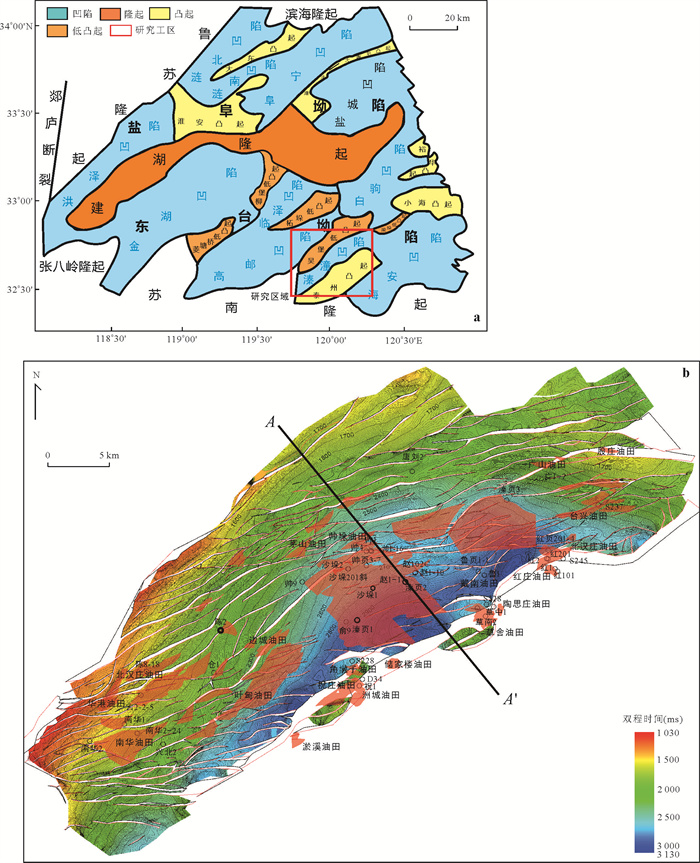
图 1 苏北盆地构造单元划分及溱潼凹陷位置图(a)、溱潼凹陷阜二段底(T33)构造图和油藏及原油样品井位(b)
Fig. 1. Structural unit division and the location of Qintong sag (a) and the structural map of the bottom boundary of the second member of Funing Formation (T33) and locations of oil samples in Qintong sag (b)
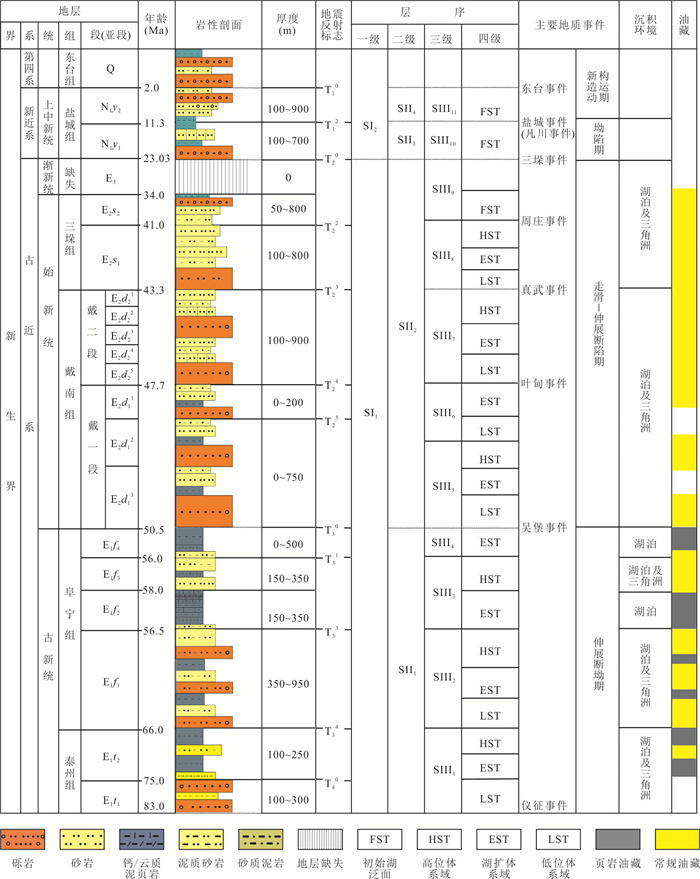
图 2 苏北盆地溱潼凹陷综合地层柱状图
Fig. 2. The synthetic stratigraphic column of Qintong sag in Subei basin
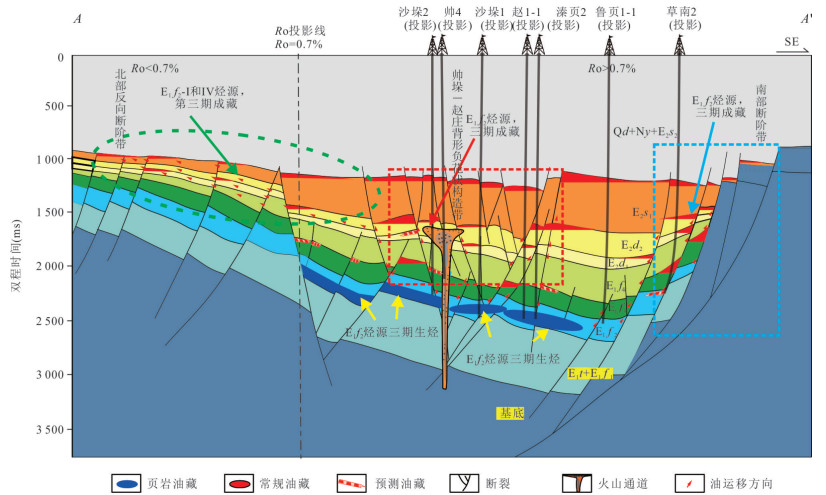
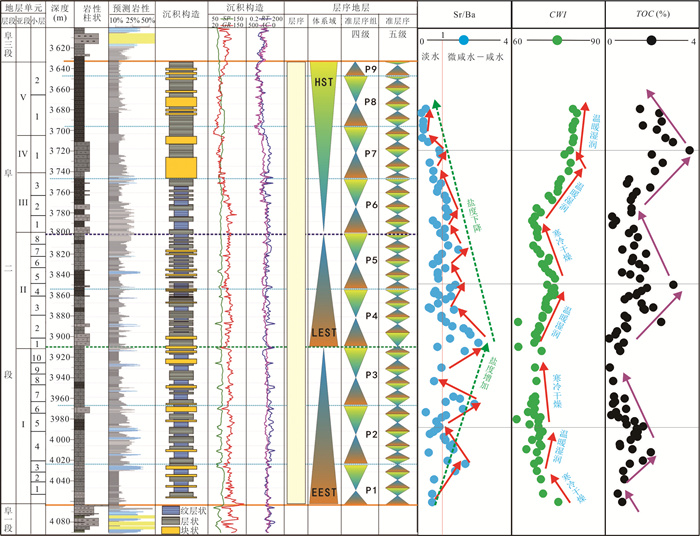
图 4 溱潼凹陷QY1井阜二段旋回性地层与有机/无机地化指标关系
化学风化指数CWI=[Al2O3/(Al2O3+Na2O+K2O)] ×100
Fig. 4. The cyclic stratigraphic column and relative organic-inorganic geochemical of well QY1 in Qintong sag
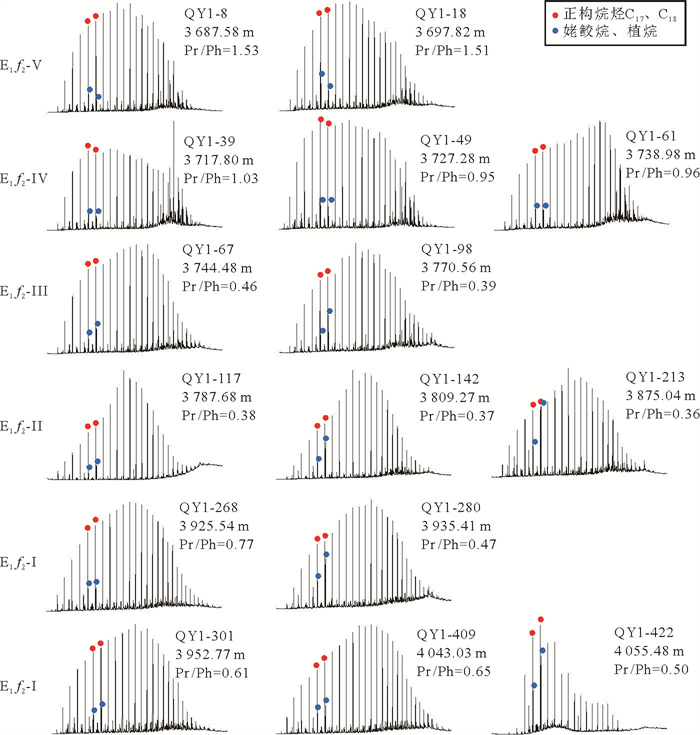
图 5 溱潼凹陷溱页1井阜二段泥页岩总离子流图(TIC)
Fig. 5. The total ion current diagrams of mudstones and shales of the second member of Funing Formation in well QY1 in Qintong sag
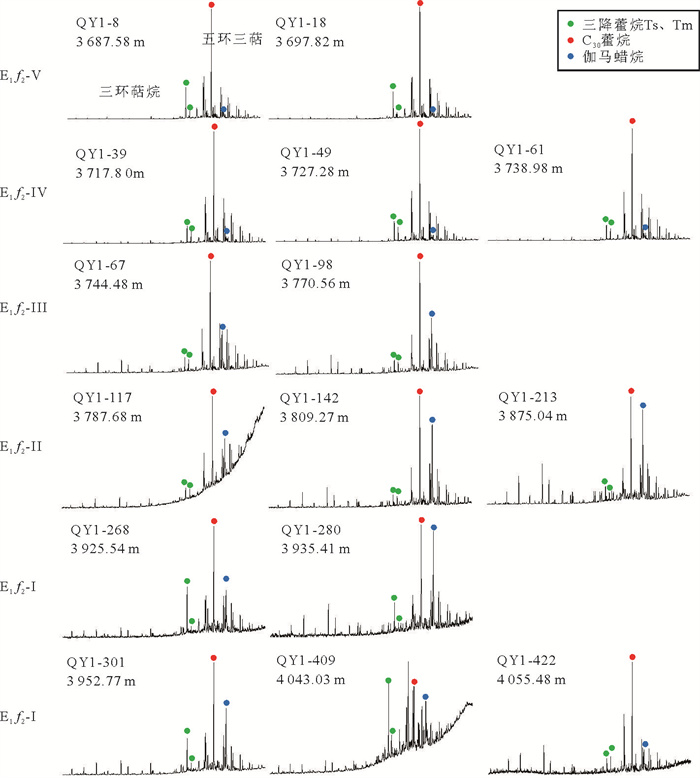
图 6 溱潼凹陷溱页1井阜二段泥页岩质量色谱图(m/z=191)
Fig. 6. The mass chromatograms (m/z=191) of mudstones and shales of the second member of Funing Formation in well QY1 in Qintong sag
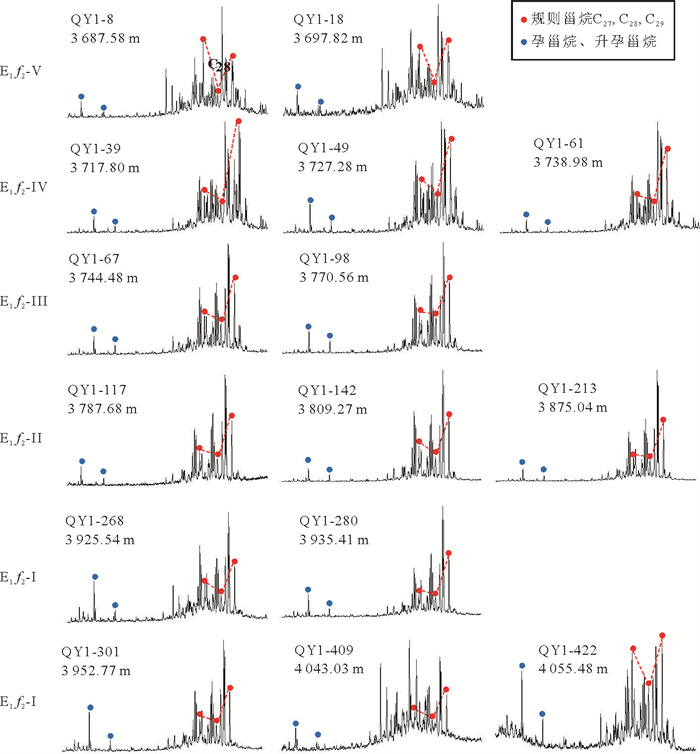
图 7 溱潼凹陷溱页1井阜二段泥页岩质量色谱图(m/z=217)
Fig. 7. The mass chromatograms (m/z=217) of mudstones and shales of the second member of Funing Formation in well QY1 in Qintong sag
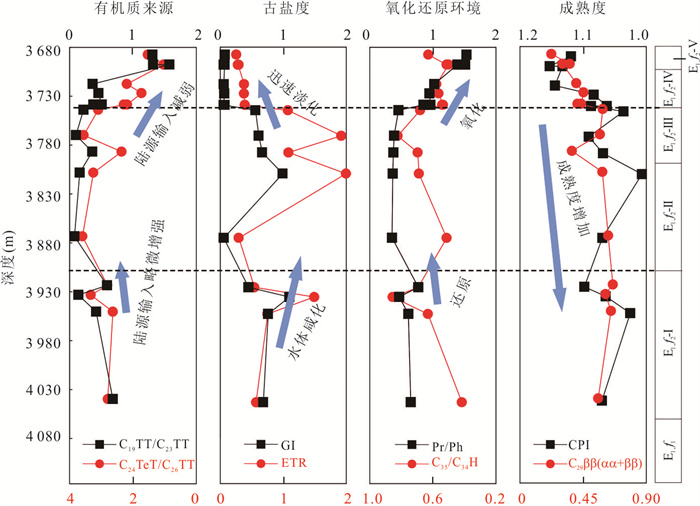
图 8 溱潼凹陷溱页1井阜二段泥页岩分子地球化学特征剖面
TT.三环萜,C24TeT.C24四环萜,GI.伽马蜡烷/C30藿烷;ETR=C28TT/ C28TT+ C29TT;C35/C34H∶C35/C34.升藿烷比值,CPI.碳优势指数=∑(奇数碳正构烷烃)/ ∑(偶数碳正构烷烃)
Fig. 8. The molecular geochemical characteristic profile of mudstones and shales of the second member of Funing Formation in well QY1 in Qintong sag
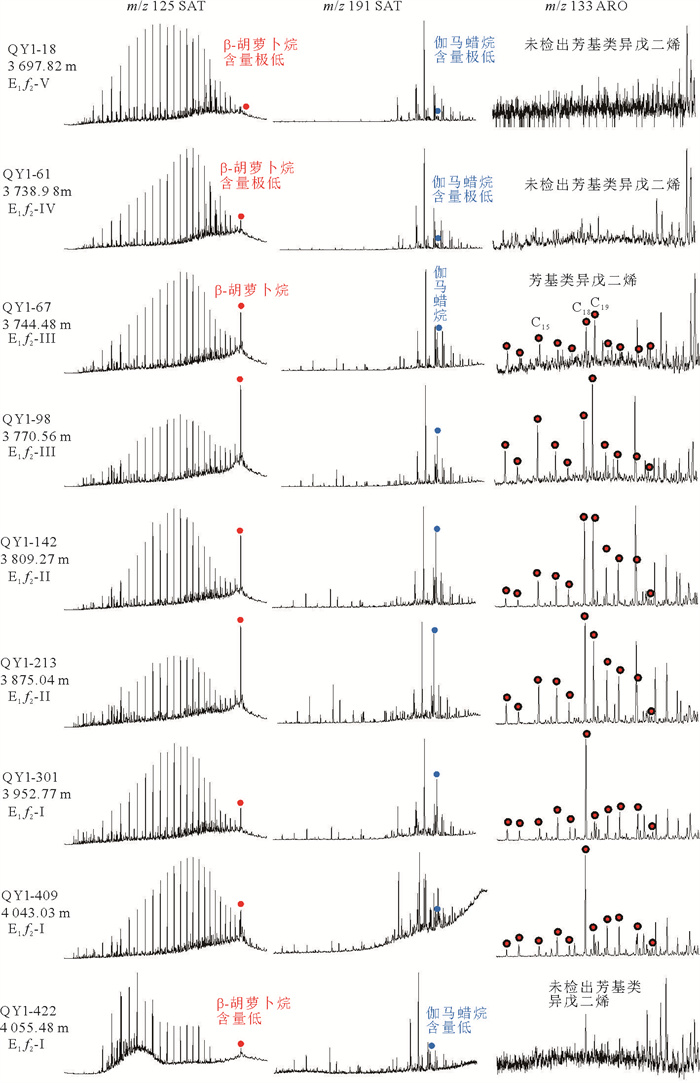
图 9 溱页1井泥页岩中β-胡萝卜烷、伽马蜡烷和芳基类异戊二烯发育的相关性
Fig. 9. The relationship among β-daucanes, gammaceranes and aryl isoprenoids of mudstones and shales of the second member of Funing Formation of well QY1 in Qintong sag
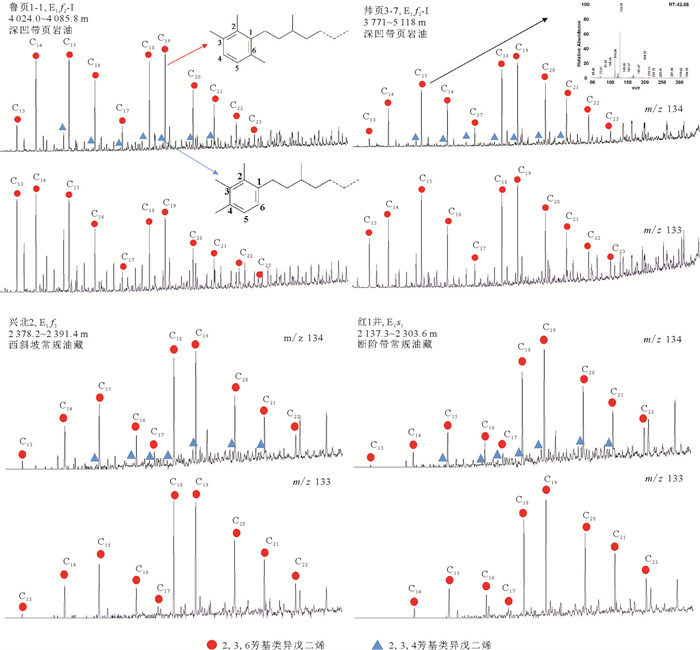
图 10 溱潼凹陷页岩油和常规原油检测到芳基类异戊二烯烃GC-MS图谱
Fig. 10. The GC-MS spectra of detected aryl isoprenoids of shale oils and conventional crude oils in Qintong sag
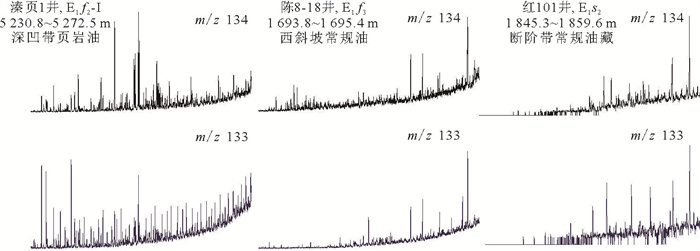
图 11 溱潼凹陷页岩油和常规原油未检测到芳基类异戊二烯烃GC-MS图谱
Fig. 11. The GC-MS spectrums of undetected aryl isoprenoids of shale oils and conventional crude oils in Qintong sag
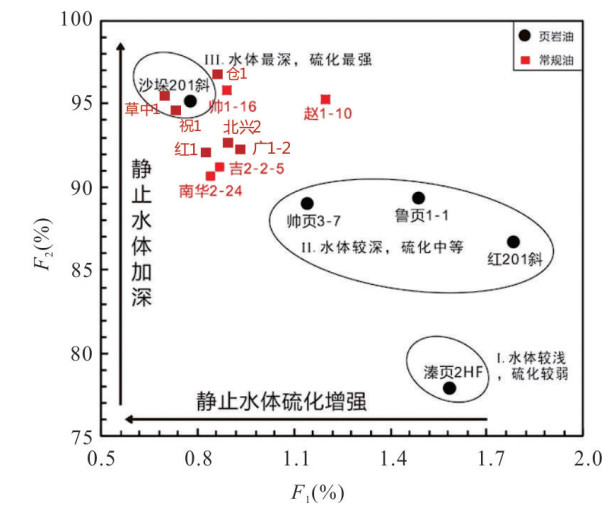
图 12 溱潼凹陷页岩油和常规油F1与F2关系
Fig. 12. The plot of F1 vs. F2 of shale oils and conventional oils in Qintong sag
表 1 溱潼凹陷QY1井阜二段烃源岩热解地化参数统计
Table 1. The statistical geochemical parameters of source rock pyrolysis of the second member of Funing Formation of Well QY1 in Qintong sag
样品编号 深度(m) 小层 TOC(%) 有机质类型 Ro(%) S1(mg/g) S2(mg/g) OSI(mg·g-1/TOC) 范围 平均值 范围 平均值 范围 平均值 范围 平均值 范围 平均值 QY1-1~QY1-4 3 680.53~3 702.24 E1f2-Ⅴ-1 1.25~1.76 1.52 Ⅱ1 0.87~0.95 0.91 0.91~1.55 1.21 3.72~5.21 4.65 69.41~88.06 79.26 QY1-5~QY1-9 3 705.85~3 738.90 E1f2-Ⅳ-1 1.98~2.82 2.35 Ⅱ1 0.98 0.98 1.40~2.11 1.75 5.61~10.38 7.59 59.83~96.78 75.81 QY10-1~QY1-16 3 744.86~3 760.93 E1f2-Ⅲ-2 0.60~2.89 1.73 Ⅱ1 0.89~1.07 0.99 0.55~2.50 1.48 1.37~14.69 6.75 52.02~133.08 91.59 QY10-17~QY1-24 3 766.51~3 796.98 E1f2-Ⅲ-1 0.27~2.60 1.22 Ⅱ2 0.95 0.95 0.10~6.21 1.97 0.14~11.50 3.37 37.04~326.84 136.95 QY10-25~QY1-28 3 799.91~3 809.03 E1f2-Ⅱ-8 0.95~1.86 1.30 Ⅱ2 1.06~1.11 1.09 1.46~3.72 2.68 1.16~5.33 2.80 136.45~347.34 213.51 QY10-29~QY1-32 3 810.72~3 819.02 E1f2-Ⅱ-7 0.69~1.60 1.16 Ⅱ2 0.97 0.97 0.75~2.91 2.12 1.51~4.05 2.63 108.70~216.15 174.78 QY10-33~QY1-36 3 823.31~3 834.19 E1f2-Ⅱ-6 1.11~1.56 1.43 Ⅱ2 0.96~1.09 1.03 1.77~3.65 2.32 1.94~3.57 2.90 113.46~243.33 163.65 QY10-37~QY1-41 3 837.40~3 849.15 E1f2-Ⅱ-5 0.93~1.76 1.28 Ⅲ 1.07 1.07 1.76~3.61 2.67 0.85~4.75 2.33 120.55~269.44 215.81 QY10-42~QY1-44 3 852.95~3 860.13 E1f2-Ⅱ-4 1.74~2.65 2.25 Ⅱ1 1.00~1.01 1.01 1.38~6.63 3.56 4.97~10.57 8.28 58.47~250.19 154.04 QY10-45~QY1-49 3 864.69~3 874.99 E1f2-Ⅱ-3 0.95~1.88 1.23 Ⅱ2 1.01 1.01 1.92~4.03 2.82 1.20~4.20 2.20 202.11~266.10 230.16 QY10-50~QY1-53 3 880.74~3 891.65 E1f2-Ⅱ-2 0.39~1.61 1.10 — — — 0.39~2.25 1.38 0.27~2.66 1.51 54.66~181.65 127.35 QY10-54~QY1-60 3 893.28~3 908.27 E1f2-Ⅱ-1 0.32~1.35 0.69 Ⅲ-Ⅱ2 1.08~1.09 1.09 0.11~1.53 0.69 0.21~2.75 0.90 30.00~150.00 85.53 QY10-61~QY1-64 3 912.96~3 922.23 E1f2-Ⅰ-10 0.21~0.74 0.42 Ⅲ-Ⅱ2 1.00~1.11 1.06 0.06~0.73 0.35 0.10~0.70 0.39 26.09~112.24 66.39 QY10-65~QY1-67 3 926.13~3 931.52 E1f2-Ⅰ-9 0.34~0.60 0.50 Ⅱ2 0.91 0.91 0.17~0.71 0.38 0.22~1.04 0.60 49.09~118.33 72.47 QY10-68~QY1-71 3 933.40~3 942.80 E1f2-Ⅰ-8 0.52~1.11 0.77 Ⅲ 0.94 0.94 0.91~2.35 1.56 0.41~1.66 1.07 175.00~236.84 201.11 QY10-72~QY1-77 3 946.33~3 962.04 E1f2-Ⅰ-7 0.44~1.73 0.86 Ⅲ-Ⅱ2 1.00~1.24 1.12 0.47~2.20 1.06 0.39~5.15 1.58 106.82~155.17 124.27 QY10-78~QY1-82 3 965.31~3 974.71 E1f2-Ⅰ-6 0.33~1.35 0.78 Ⅲ 1.06 1.06 0.12~2.83 1.48 0.12~2.39 0.95 36.36~336.90 173.05 QY10-83~QY1-92 3 978.38~3 992.57 E1f2-Ⅰ-5 0.76~1.86 1.25 Ⅱ2 0.88 0.88 1.60~9.80 4.07 0.54~4.15 1.84 136.75~673.12 327.06 QY10-93~QY1-101 3 997.51~4 017.22 E1f2-Ⅰ-4 0.75~1.73 1.34 Ⅱ2 0.88~1.04 0.96 1.29~3.67 2.35 0.67~3.20 2.06 113.29~293.60 179.23 QY10-102~QY1-103 4 021.55~4 024.40 E1f2-Ⅰ-3 1.15~1.23 1.19 — — — 1.62~1.90 1.76 1.43~2.21 1.82 131.71~165.22 148.47 QY10-104~QY1-106 4 028.07~4 033.53 E1f2-Ⅰ-2 0.60~0.76 0.68 Ⅲ 1.19 1.19 0.64~1.09 0.82 0.36~0.60 0.50 104.35~143.42 118.15 注:—为未检测;TOC为总有机碳含量;Ro为镜质体反射率;S1为可溶烃含量;S2为热解烃含量;OSI为含油饱和度指数.  下载: 导出CSV
表 2 溱页1井阜二段烃源岩GC-MS测试样品信息
Table 2. The GC-MS analysis sample information of source rocks for the second member of Funing Formation in well QY1
序号 样品编号 岩性 均深(m) 层位 1 QY1-8 泥岩 3 687.58 E1f2-Ⅴ 2 QY1-18 泥岩 3 697.82 E1f2-Ⅴ 3 QY1-18RE(重复样品) 泥岩 3 697.82 E1f2-Ⅴ 4 QY1-39 灰质泥岩 3 717.80 E1f2-Ⅳ 5 QY1-49 灰质泥岩 2 727.28 E1f2-Ⅳ 6 QY1-61 含灰泥岩 3 738.98 E1f2-Ⅳ 7 QY1-61RE(重复样品) 含灰泥岩 3 738.98 E1f2-Ⅳ 8 QY1-67 灰云质泥岩 3 744.48 E1f2-Ⅲ 9 QY1-98 灰云质泥岩 3 770.56 E1f2-Ⅲ 10 QY1-117 灰云质泥岩 3 787.68 E1f2-Ⅱ 11 QY1-142 纹层状泥灰岩 3 809.27 E1f2-Ⅱ 12 QY1-213 灰云质泥岩 3 875.04 E1f2-Ⅱ 13 QY1-268 含灰云泥岩 3 925.54 E1f2-Ⅰ 14 QY1-280 灰云质泥岩 3 935.41 E1f2-Ⅰ 15 QY1-301 灰云质泥岩 3 952.77 E1f2-Ⅰ 16 QY1-409 含灰云泥岩 4 043.03 E1f2-Ⅰ 17 QY1-422 含灰云泥岩 4 055.48 E1f2-Ⅰ
下载: 导出CSV
表 3 溱潼凹陷页岩油和常规原油芳基类异戊二烯化合物参数
Table 3. The parameters of aryl isoprenoid of shale oils and conventional crude oils in Qintong sag
样品编号 油藏类型 井号 层位 深度(m) 是否检测到AIPs F1 F2 QY1-103X 深凹带页岩油 溱页1 E1f2-Ⅰ 5 230.8~5 272.5 × — — QY2HFFC 深凹带页岩油 溱页2HF E1f2-Ⅱ 5 403~5 420.5 √ 1.58 77.94 LY1-1 深凹带页岩油 鲁页1-1 E1f2-Ⅰ 4 024~4 085.8 √ 1.49 89.33 SY3-7 深凹带页岩油 帅页3-7 E1f2-Ⅰ 3 771~5 118 √ 1.14 89.05 H201X 深凹带页岩油 红201斜 E1f2-Ⅰ~Ⅱ 4 182~4 218 √ 1.78 86.71 SD201X 深凹带页岩油(侵入岩蚀变) 沙垛201斜 E1f2-Ⅰ~Ⅲ 3 374~3 686.8 √ 0.78 95.11 J2-2-5 西斜坡常规油藏 吉2-2-5 E1f3 1 505.1~1 666.4 √ 0.87 91.23 NH2-24 西斜坡常规油藏 南华2-24 E1f3 1 732.8~1 745.6 √ 0.84 90.61 C8-18 西斜坡常规油藏 陈8-18 E1f3 1 693.8~1 695.4 × — — S1-16 内斜坡常规油藏 帅1-16 E2d1 2 599.3~2 663.3 √ 0.89 95.8 Z1-10 深凹带常规油藏 赵1-10 E2d1 2 754.3~2 757.6 √ 1.20 95.3 Cang1 西斜坡常规油藏 仓1 E1f3 2 210.6~2 310 √ 0.85 97.1 Zhu1 断阶带常规油藏 祝1 E1f3 2 698~2 703 √ 0.68 94.8 CZ1 断阶带常规油藏 草中1 E1f3 3 087.4~3 132 √ 0.63 95.5 H1 断阶带常规油藏 红1 E2s1 2 137.3~2 303.6 √ 0.80 92.3 H101 断阶带常规油藏 红101 E2s2 1 845.3~1 859.6 × — — XB2 北斜坡常规油藏 兴北2 E1f3 2 378.2~2 391.4 √ 0.86 93.2 G1-2 北斜坡常规油藏 广1-2 E1f3 2 111~2 176 √ 0.83 93.5 注:“√”表示检测到AIPs;“×”表示未检测到AIPs.
下载: 导出CSV
-
Brocks, J. J., Schaeffer, P., 2008. Okenane, a Biomarker for Purple Sulfur Bacteria (Chromatiaceae), and Other New Carotenoid Derivatives from the 1 640 Ma Barney Creek Formation. Geochimica et Cosmochimica Acta, 72(5): 1396-1414. https://doi.org/10.1016/j.gca.2007.12.006 Chen, H. H., 2023. Advances on Relationship between Strike-Slip Structures and Hydrocarbon Accumulations in Large Superimposed Craton Basins, China. Earth Science, 48(6): 2039-2066(in Chinese with English abstract). Fang, C. H., Zhang, Z. H., Wang, Y. F., et al., 2008. Geochemical Characteristics of the Lower Tertiary Source Rock in Qintong Sag, Subei Basin. Journal of Xi'an Shiyou University (Natural Science Edition), 23(6): 1-5, 117(in Chinese with English abstract). Gao, Y. Q., He, X. P., Cheng, X., et al., 2024. Discussion on High Hydrocarbon Generation Efficiency of Saline Lacustrine Source Rocks with Low TOC: A Case Study of the Second Member of Funing Formation, Qintong Sag, Subei Basin. Petroleum Reservoir Evaluation and Development, 14(5): 678-687(in Chinese with English abstract). Guo, X. S., Li, W. P., Shen, B. J., et al., 2025. Selection Evaluation of Oil Shale In-Situ Mining in China Petrochemical Exploration Area and Its Adjacent Areas. Petroleum Reservoir Evaluation and Development, 15(1): 1-10(in Chinese with English abstract). Guo, X. S., Ma, X. X., Li, M. W., et al., 2023. Mechanisms for Lacustrine Shale Oil Enrichment in Chinese Sedimentary Basins. Oil & Gas Geology, 44(6): 1333-1349(in Chinese with English abstract). He, T. H., Li, W. H., Lu, S. F., et al., 2022. Distribution and Isotopic Signature of 2- Alkyl- 1, 3, 4- Trimethylbenzenes in the Lower Paleozoic Source Rocks and Oils of Tarim Basin: Implications for the Oil- Source Correlation. Petroleum Science, 19(6): 2572-2582. https://doi.org/10.1016/j.petsci.2022.07.014 Hu, Y., Zhang, Z. H., Fang, C. H., 2005. Biomarker Features of Low- Mature Oil in Qintong Sag and Maturity Analysis. Oil & Gas Geology, 26(4): 512-517(in Chinese with English abstract). Huo, Q. L., Li, Z. G., Zeng, H. S., et al., 2010. Aryl Isoprenoids Found in Late Cretaceous Qn1 Source Rocks in Songliao Basin and Its Significance. Acta Sedimentologica Sinica, 28(4): 815-820(in Chinese with English abstract). Júnior, G. R. S., Santos, A. L. S., de Lima S. G., et al, 2013. Evidence for Euphotic Zone Anoxia during the Deposition of Aptian Source Rocks Based on Aryl Isoprenoids in Petroleum, Sergipe-Alagoas Basin, Northeastern Brazil. Organic Geochemistry, 63: 94-104. https://doi.org/10.1016/j.orggeochem.2013.07.009 Li, M. Q., Yao, C., Chen, F. F., et al., 2025. Biomarker Classifications of Lower Paleozoic Deep Source Rocks and Crude Oils from the Tarim Basin and Oil Sources. Natural Gas Geoscience, 36(1): 166-182(in Chinese with English abstract). Li, Z. X., Fan, P., Li, J. G., et al., 1998. An Application of Aryl Isoprenoids in Indicating Sedimentary Environments. Acta Sedimentologica Sinica, 16(2): 9-13(in Chinese with English abstract). Li, Z. M., Liu, Y. H., He, J. Y., et al., 2023. Limits of Critical Parameters for Sweet- Spot Interval Evaluation of Lacustrine Shale Oil. Oil & Gas Geology, 44(6): 1453-1467(in Chinese with English abstract). Li, Z. P., Yu, Q. L., Zan, L., et al., 2023. Geochemical Characteristics and Hydrocarbon Generation Potential of Different Lithologic Source Rocks in the Second Member of Funing Formation in Qintong Sag, Subei Basin. Geoscience, 37(5): 1345-1357(in Chinese with English abstract). Lu, H. S., Qin, L. M., Liu, J., et al., 2009. Petroleum Migration and Accumulation in Qintong Sag, North Jiangsu Basin. Geological Review, 55(3): 395-405(in Chinese with English abstract). Lyu, C., Zhang, C. M., Wu, Y. F., 2015. Qualitative Analysis of Trimethylaryl Isoprenoids Using GC- MS Combined with Retention Indices. Journal of Yangtze University (Natural Science Edition), 12(5): 15-18, 27(in Chinese with English abstract). Ma, J., Wu, C. D., Wang, Y. Z., et al., 2020. Discoveryof Carotenoids and Its Paleolake Significance in the Oligocene Anjihaihe Formation, Southern Junggar Basin, China. Acta Geologica Sinica, 94(6): 1853-1868(in Chinese with English abstract). Quan, C., Liu, Y. S., Utescher, T., 2012. Eocene Monsoon Prevalence over China: A Paleobotanical Perspective. Palaeogeography, Palaeoclimatology, Palaeoecology, 365: 302-311. https://doi.org/10.1016/j.palaeo.2012.09.035. Schwark, L., Frimmel, A., 2004. Chemostratigraphy of the Posidonia Black Shale, SW-Germany Ⅱ. Assessment of Extent and Persistence of Photic-Zone Anoxia Using Aryl Isoprenoid Distributions. Chemical Geology, 206(3-4): 231-248. https://doi.org/10.1016/j.chemgeo.2003.12.008 Song, Y., Jia, C. Z., Jiang, L., et al., 2024. Connotation and Research Strategy of the Whole Petroleum System. Petroleum Exploration and Development, 51(6): 1-13(in Chinese with English abstract). Sun, Y. G., Xiao, Z. Y., Xu, S. P., et al., 2004. Aryl-Isoprenoids in Crude Oil and Its Implication in Geological Exploration. Xinjiang Petroleum Geology, 25(2): 215-218(in Chinese with English abstract). Wu, Q., Yu, W. D., Luo, W. F., et al., 2016. Achievements and Recognitions of Exploration in Lithologic Reservoirs in Qintong Sag, North Jiangsu Basin. China Petroleum Exploration, 21(3): 99-107(in Chinese with English abstract). Yang, Y. C., Zhang, Z. H., Fang, C. H., et al., 2006. Feature of Crude Oil Triaromatic Steroid and Oil Correlation in Qintong Sag of Subei Basin. Memoir of the Fourth International Conference of Hydrocarbon Reservoiring Mechanism and Reserve Evaluation, 26(3): 531-539(in Chinese). Yao, H. S., Yun, L., Zan, L., et al., 2023. Development Mode and Practice of Fault- Block Oriented Shale Oil Well in the Second Member of Funing Formation, Qintong Sag, Subei Basin. Petroleum Reservoir Evaluation and Development, 13(2): 141-151(in Chinese with English abstract). Yao, H. S., Zan, L., Gao, Y. Q., et al., 2021. Main Controlling Factors for the Enrichment of Shale Oil and Significant Discovery in Second Member of Paleogene Funing Formation, Qintong Sag, Subei Basin. Petroleum Geology & Experiment, 43(5): 776-783(in Chinese with English abstract). Yu, X. K., Fan, P., 1990. Discovery of New Biomarker Compounds of South Florid Basin in America. Science in China (Series B), (5): 539-544(in Chinese with English abstract). Yun, L., He, X. P., Hua, C. X., et al., 2023. Accumulation Characteristics and Resource Potential of Paleogene Continental Shale Oil in Qintong Sag of Subei Basin. Acta Petrolei Sinica, 44(1): 176-187(in Chinese with English abstract). Zan, L., Bai, L. X., Yin, Y. L., et al., 2023. Basic Characteristics and Genesis Analysis of Shale Oil in the Second Member of Paleogene Funing Formation in Qintong Sag, Subei Basin. Petroleum Geology & Experiment, 45(2): 356-365(in Chinese with English abstract). Zan, L., Chai, F. Y., Yin, Y. L., 2021a. Physical Properties, Geochemical Characteristics and Origins of Crude Oils in the Qintong Sag Slope. Acta Sedimentologica Sinica, 39(5): 1068-1077(in Chinese with English abstract). Zan, L., Luo, W. F., Yin, Y. L., et al., 2021b. Formation Conditions of Shale Oil and Favorable Targets in the Second Member of Paleogene Funing Formation in Qintong Sag, Subei Basin. Petroleum Geology & Experiment, 43(2): 233-241(in Chinese with English abstract). Zan, L., Luo, W. F., Ma, X. D., 2016. Hydrocarbon Generation Potential and Genetic Environments of Second Member of Funing Formation in Qintong Sag, Subei Basin. Unconventional Oil & Gas, 3(3): 1-8(in Chinese with English abstract). Zhang, C. M., Yang, L., 2013. Nomenclature of Aryl Isoprenoid Hydrocarbons. Geochimica, 42(4): 379-384(in Chinese with English abstract). Zhang, D. L., Zhang, K. Q., Xu, T. W., et al., 2020. Research on a Potential Indicator of High- Quality Source Rocks in Saline Lacustrine Basin: A Case Study of the Dongpu Depression. Journal of Yangtze University (Natural Science Edition), 17(1): 1-8(in Chinese with English abstract). Zhang, Z. H., Wang, Y., Wu, Y. Y., et al., 2006. Geochemical Behaviors of Condensates in Hongzhuang Structure in Qintong Sag. Natural Gas Industry, 26(9): 8-11(in Chinese with English abstract). Zhong, Z. G., Yu, W. Q., Duan, H. L., et al., 2025. Progress and Research Direction of Shale Oil Exploration in Complex Fault Blocks with Low to Medium TOC in Subei Basin. Petroleum Reservoir Evaluation and Development, 15(1): 11-18(in Chinese with English abstract). Zhu, L., Qin, L. M., Zhang, Z. H., et al., 2009. Geochemical Characteristics and Accumulation Process of Beihanzhuang Oilfield of Qintong Depression, Northern Jiangsu Basin. Natural Gas Geoscience, 20(1): 36-43(in Chinese with English abstract). 陈红汉, 2023. 我国大型克拉通叠合盆地的走滑构造与油气聚集研究进展. 地球科学, 48(6): 2039-2066. doi: 10.3799/dqkx.2023.094 方朝合, 张枝焕, 王义凤, 等, 2008. 苏北盆地溱潼凹陷第三系烃源岩地球化学特征. 西安石油大学学报(自然科学版), 23(6): 1-5, 117. 高玉巧, 何希鹏, 程熊, 等, 2024. 陆相咸化湖盆"低TOC"烃源岩高生烃效率探讨: 以苏北盆地溱潼凹陷阜宁组二段泥页岩为例. 油气藏评价与开发, 14(5): 678-687. 郭旭升, 李王鹏, 申宝剑, 等, 2025. 中国石化探区和邻区油页岩原位开采选区评价. 油气藏评价与开发, 15(1): 1-10. 郭旭升, 马晓潇, 黎茂稳, 等, 2023. 陆相页岩油富集机理探讨. 石油与天然气地质, 44(6): 1333-1349. 胡瑛, 张枝焕, 方朝合, 2005. 溱潼凹陷低熟油生物标志物特征及成熟度浅析. 石油与天然气地质, 26(4): 512-517. 霍秋立, 李振广, 曾花森, 等, 2010. 松辽盆地北部晚白垩系青一段源岩中芳基类异戊二烯烃的检出及意义. 沉积学报, 28(4): 815-820. 李梦勤, 姚超, 陈方方, 等, 2025. 塔里木盆地下古生界深层烃源岩和原油生物标志物类型划分及油源. 天然气地球科学, 36(1): 166-182. 李振西, 范璞, 李景贵, 等, 1998. 芳基类异戊二烯生标在指相上的应用. 沉积学报, 16(2): 9-13. 李志明, 刘雅慧, 何晋译, 等, 2023. 陆相页岩油"甜点"段评价关键参数界限探讨. 石油与天然气地质, 44(6): 1453-1467. 李志鹏, 余麒麟, 昝灵, 等, 2023. 苏北盆地溱潼凹陷阜二段不同岩性烃源岩的地球化学特征及生烃潜力对比. 现代地质, 37(5): 1345-1357. 陆黄生, 秦黎明, 刘军, 等, 2009. 苏北盆地溱潼凹陷油气运聚模式. 地质论评, 55(3): 395-405. 吕超, 张春明, 吴育飞, 2015. GC- MS结合保留指数对三甲基芳基类异戊二烯的定性. 长江大学学报(自然科学版), 12(5): 15-18, 27. 马健, 吴朝东, 王熠哲, 等, 2020. 准噶尔盆地渐新世安集海河组类胡萝卜素的发现及古环境意义. 地质学报, 94(6): 1853-1868. 宋岩, 贾承造, 姜林, 等, 2024. 全油气系统内涵与研究思路. 石油勘探与开发, 51(6): 1-13. 孙永革, 肖中尧, 徐世平, 等, 2004. 塔里木盆地原油中芳基类异戊二烯烃的检出及其地质意义. 新疆石油地质, 25(2): 215-218. 吴群, 余文端, 骆卫峰, 等, 2016. 苏北盆地溱潼凹陷岩性油藏勘探成果及启示. 中国石油勘探, 21(3): 99-107. 杨永才, 张枝焕, 方朝合, 等, 2006. 苏北盆地溱潼凹陷原油三芳甾烷特征及油源对比. 第四届油气成藏机理与资源评价国际学术研讨会论文集, 26(3): 531-539. 姚红生, 云露, 昝灵, 等, 2023. 苏北盆地溱潼凹陷阜二段断块型页岩油定向井开发模式及实践. 油气藏评价与开发, 13(2): 141-151. 姚红生, 昝灵, 高玉巧, 等, 2021. 苏北盆地溱潼凹陷古近系阜宁组二段页岩油富集高产主控因素与勘探重大突破. 石油实验地质, 43(5): 776-783. 于心科, 范璞, 1990. 发现于美国South Florida盆地的新生物标志化合物. 中国科学(B辑), (5): 539-544. 云露, 何希鹏, 花彩霞, 等, 2023. 苏北盆地溱潼凹陷古近系陆相页岩油成藏地质特征及资源潜力. 石油学报, 44(1): 176-187. 昝灵, 白鸾羲, 印燕铃, 等, 2023. 苏北盆地溱潼凹陷古近系阜宁组二段页岩油基本特征及成因分析. 石油实验地质, 45(2): 356-365. 昝灵, 柴方园, 印燕铃, 2021a. 溱潼凹陷斜坡带原油物性和地化特征及成因. 沉积学报, 39(5): 1068-1077. 昝灵, 骆卫峰, 印燕铃, 等, 2021b. 苏北盆地溱潼凹陷古近系阜宁组二段页岩油形成条件及有利区评价. 石油实验地质, 43(2): 233-241. 昝灵, 骆卫峰, 马晓东, 2016. 苏北盆地溱潼凹陷阜二段烃源岩生烃潜力及形成环境. 非常规油气, 3(3): 1-8. 张春明, 杨禄, 2013. 芳基类异戊二烯烃类化合物的命名. 地球化学, 42(4): 379-384. 张冬琳, 张蔻乔, 徐田武, 等, 2020. 一种潜在的咸化湖盆优质烃源岩指相标志物研究: 以东濮凹陷为例. 长江大学学报(自然科学版), 17(1): 1-8. 张枝焕, 王瑶, 吴聿元, 等, 2006. 溱潼凹陷红庄构造凝析油气地化特征研究. 天然气工业, 26(9): 8-11, 160 钟志国, 于雯泉, 段宏亮, 等, 2025. 苏北盆地中低TOC复杂断块页岩油勘探进展与攻关方向. 油气藏评价与开发, 15(1): 11-18. 朱雷, 秦黎明, 张枝焕, 等, 2009. 苏北盆地溱潼凹陷北汉庄油田油气成藏地球化学特征. 天然气地球科学, 20(1): 36-43. -

 点击查看大图
计量
- 文章访问数: 160
- HTML全文浏览量: 12
- PDF下载量: 11
- 被引次数: 0
