




Depositional Differences and Main Controlling Factors of Lacustrine Carbonate Sediments in Lower Cretaceous of Santos Basin, Brazil
-
摘要: 巴西桑托斯盆地裂谷期(早白垩世巴雷姆期-阿普特期)发育世界级大型湖相碳酸盐岩,目前已在该领域获得大量的油气发现,是世界油气勘探的热点领域.碳酸盐岩发育程度是该盆地油气能否富集成藏的关键.钻井揭示该盆地裂谷期发育“两期两类”湖相碳酸盐岩:早期断坳转换期(巴雷姆晚期-阿普特期)Itapema(ITP)组贝壳灰岩和晚期坳陷期(阿普特中-晚期)Barra Velha(BV)组微生物礁灰岩.这“两期两类”湖相碳酸盐岩虽均为生物灰岩,但其成因机制和岩性组合差异较大,为厘清“两期两类”湖相碳酸盐岩沉积差异及发育主控因素,基于薄片、岩心、测井、地震等数据资料,对该盆地两类盐下湖相碳酸盐岩开展了系统的微观、宏观相结合的岩石学、沉积学研究.综合研究分析表明巴西桑托斯盆地下白垩统大型湖相碳酸盐岩发育主要受古地貌、古湖水盐度和古水体能量变化控制,其中古地貌控制了湖相碳酸盐岩储层沉积微相展布和发育程度,古水体盐度控制湖相碳酸盐岩岩石类型垂向演化,古水体能量变化和水深控制湖相碳酸盐岩微相平面变化.最终明确迎浪高能淡水环境为ITP组贝壳灰岩储层发育有利背景,而迎浪清浅的中-高能半咸水-咸水环境是BV组叠层石灰岩储层发育有利背景,这为寻找有利储层发育区带指明了方向,对巴西盐下湖相碳酸盐岩油气勘探具有实际指导意义.Abstract: The rift stage (Barremian-Aptian of the Early Cretaceous) of the Santos basin in Brazil is characterized by the development of world-class large-scale lacustrine carbonates deposition. At present, numerous oil and gas discoveries have been made in this field, making it a hot spot for global oil and gas exploration. The development degree of carbonate sediments is the key to the enrichment and accumulation of oil and gas in the basin. Drilling results reveal the development of "two phases and two types" of lacustrine carbonate sediments during the rift stage of the basin: shell limestone of Itapema (ITP) group in early fault-sag depression transition period (Late Barremian-Aptian) and microbial reef limestone of Barra Velha (BV) group in late sag depression period (Mid-Late Aptian). Although both of these "two phases and two types" lacustrine carbonate sediments are biogenic limestone, their genesis mechanisms and lithological combinations differ significantly. In order to clarify the sedimentary differences and main controlling factors of the "two phases and two types" lacustrine carbonate rocks, based on thin section, core, logging, seismic and other data, this paper conducts a systematic petrological and sedimentological study of two types of lacustrine carbonate sediments in the basin, combining micro and macro perspectives. Comprehensive research shows the development of large-scale lacustrine carbonate sediment in the Lower Cretaceous of the Santos basin in Brazil is mainly controlled by paleogeomorphology, paleolake water salinity and paleowater energy changes. Paleogeomorphology controls the distribution and development of sedimentary microfacies of lacustrine carbonate reservoirs, paleowater salinity controls the vertical evolution of lacustrine carbonate sediments types, and paleowater energy and water depth control the microfacies variation of lacustrine carbonate sediments. Finally, it was confirmed that the high-energy freshwater environment in the face of waves is a favorable background for the development of shell limestone reservoir in Itapema Formation, and the shallow medium-high energy semi saline-saline water environment in the face of waves is a favorable background for the development of stromatolitic limestone reservoir in Barra Velha Formation. This points out the directions for finding favorable reservoir development zones and has practical guiding significance for the oil and gas exploration in lacustrine carbonate rocks of Brazil.
-
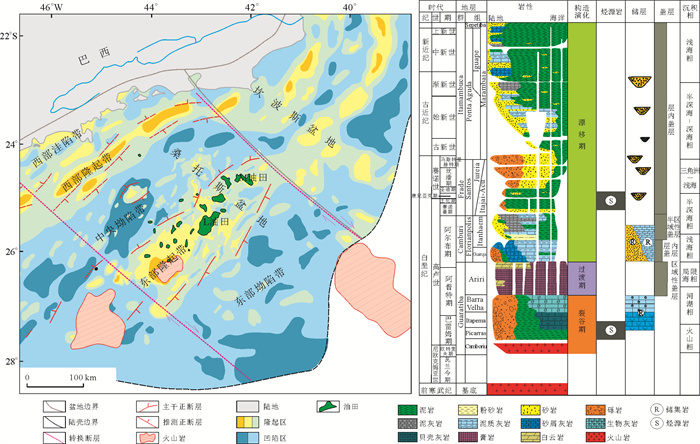
图 1 桑托斯盆地裂陷期构造纲要图与下白垩统碳酸盐岩油气发现叠合图(a)和地层-构造演化综合柱状图(b)
Fig. 1. Rift tectonic framework with oil-gas discoveries in Lower Cretaceous carbonate reservoir (a) and an integrated stratigraphic column showing tectonic evolution (b) of the Santos basin
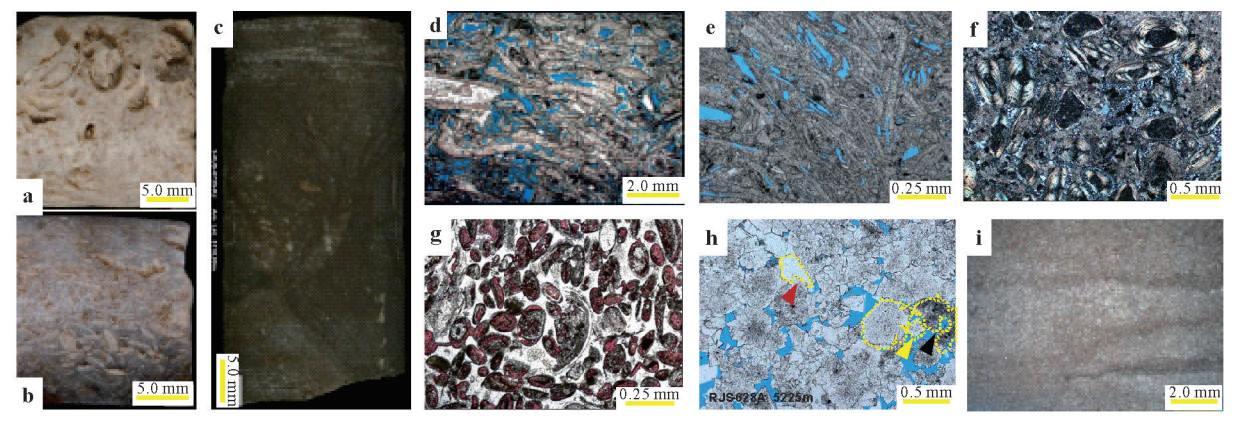
图 2 ITP组典型岩石类型特征
a.贝壳灰岩岩心照片;b.含泥/泥质贝壳灰岩岩心照片;c.泥灰岩岩心照片;d.贝壳灰岩镜下照片,颗粒支撑,亮晶胶结,由于波浪的改造作用,未见完整双壳特征,多为贝壳碎片,内部被部分溶蚀,单偏光;e.泥质贝壳灰岩镜下照片,泥晶胶结,发育铸膜孔,单偏光;f.鲕粒灰岩镜下薄片,正交偏光;g.鲕粒灰岩镜下薄片,单偏光;h.白云岩镜下照片,黑色箭头指向它形白云石晶粒,内部为未完全云化灰岩,具残余结构;黄色箭头指向自形白云石晶粒,粒径约0.25 mm;红色箭头指向鞍状白云石晶粒;i.泥灰岩镜下照片,见生物扰动,有效缝洞不发育,单偏光
Fig. 2. Petrological characteristics of typical lithological type in the ITP Formation
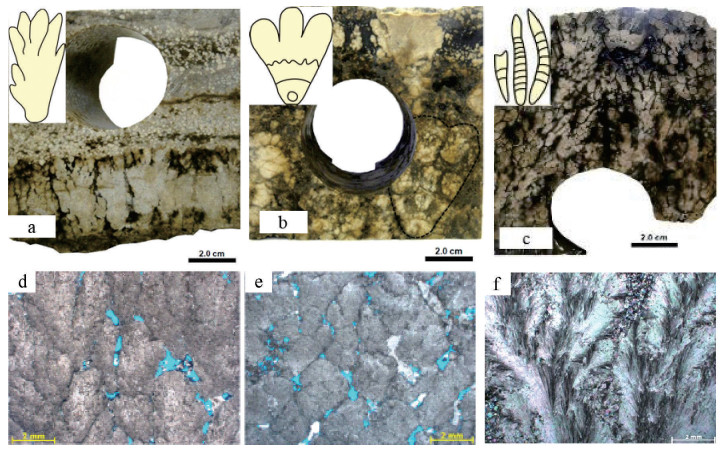
图 3 BV组叠层石灰岩典型岩石类型特征
a.假分支状叠层石岩心照片;b.穹窿状状叠层石岩心照片;c.分支状叠层石岩心照片;d.假分支状叠层石镜下照片,单偏光;e.穹窿状状叠层石镜下照片,单偏光;f.分枝状叠层石镜下照片,具有放射状生长结构,正交偏光
Fig. 3. Petrological characteristics of stromatolitic limestone in the BV Formation
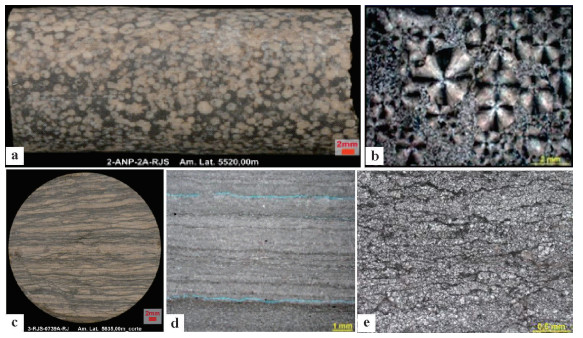
图 4 BV组球粒微生物灰岩及层纹岩典型岩石学特征
a.球粒灰岩岩心照片;b.球粒灰岩镜下照片,粒径0.5 mm~1.0 cm,呈十字消光现象,正交偏光;c.层纹岩岩心照片,见较平直纹层结构,单偏光;d、e.层纹岩镜下照片,微齿状不规则纹层,单偏光;来自L、M油田钻井
Fig. 4. Petrological characteristics of spherulitestone and laminated limestone in the BV Formation
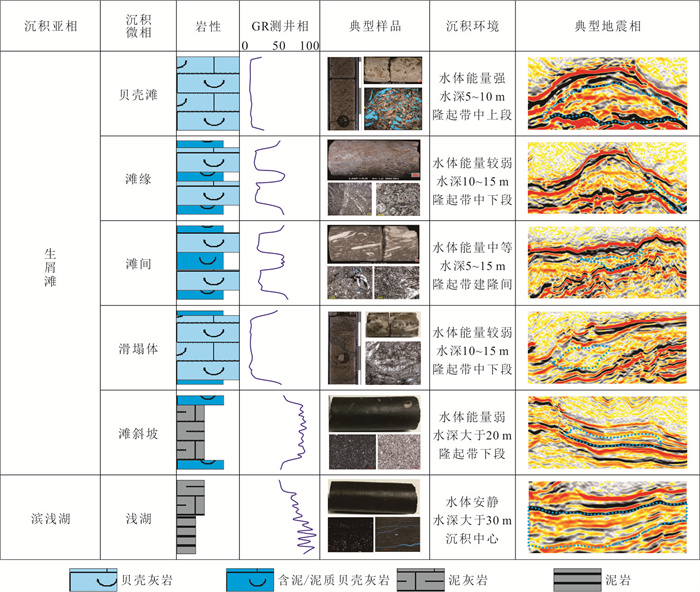
图 5 ITP组碳酸盐岩沉积类型识别图
Fig. 5. Identification plate of carbonate sedimentary types in the ITP Formation
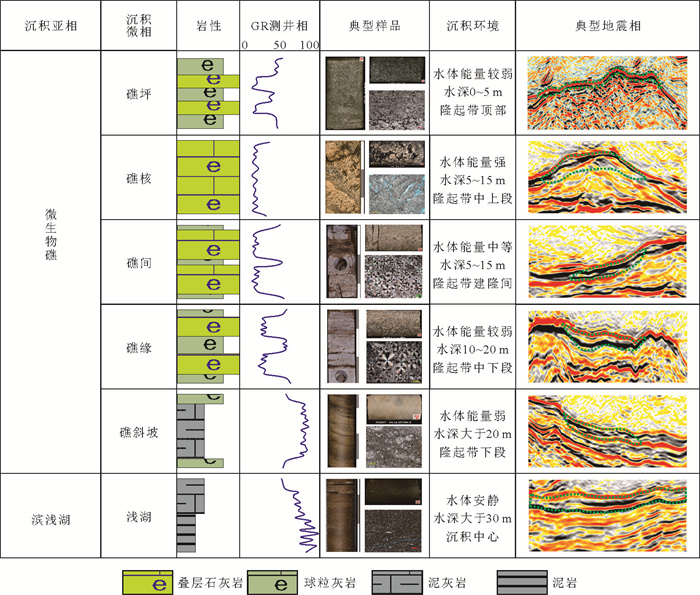
图 6 BV组碳酸盐岩沉积类型识别图
Fig. 6. Identification plate of carbonate sedimentary types in the BV Formation
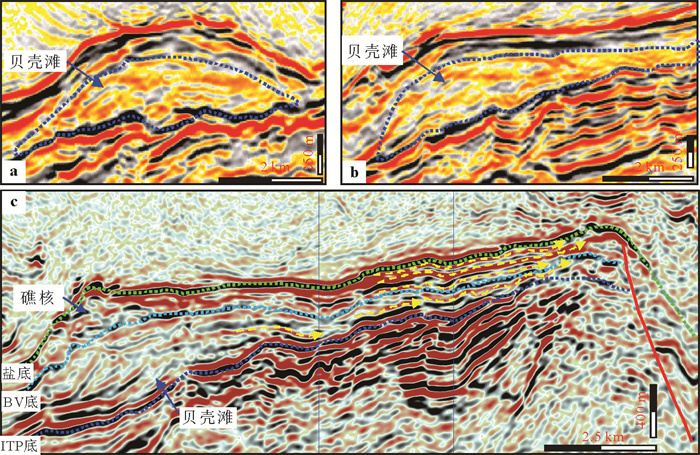
图 7 过ITP组贝壳滩微相典型地震剖面
a.垂直生长方向;b~c.平行生长方向
Fig. 7. Seismic sections across coquina bank in the ITP Formation
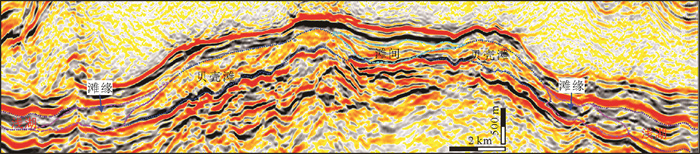
图 8 过ITP组滩缘、滩间微相典型地震剖面
Fig. 8. Typical seismic section across bank edge and inter bank in the ITP Formation
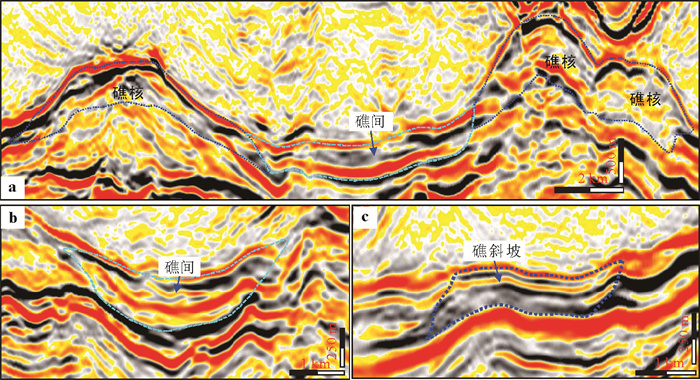
图 9 过BV组生物礁亚相典型地震剖面
a.生物礁;b.礁间;c.礁斜坡
Fig. 9. Typical seismic facies across reef in the BV Formation
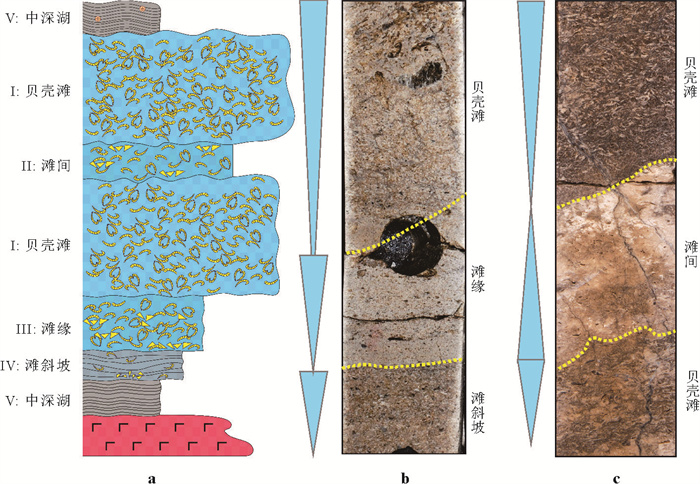
图 10 研究区ITP组沉积相类型及序列
a.ITP组典型沉积相序列;b.滩斜坡-滩缘-贝壳滩相组合;c.贝壳滩-滩间相组合
Fig. 10. Depositional Sequence of carbonate rocks in the ITP Formation
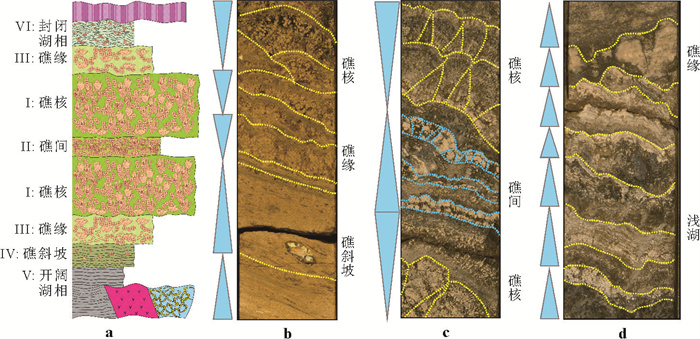
图 11 研究区BV组沉积相类型及序列
a.BV组典型沉积相序列;b.礁核-礁缘-礁斜坡相组合;c.礁核-礁间相组合;d.礁缘-浅湖相组合
Fig. 11. Depositional sequence of carbonate rocks in the BV Formation
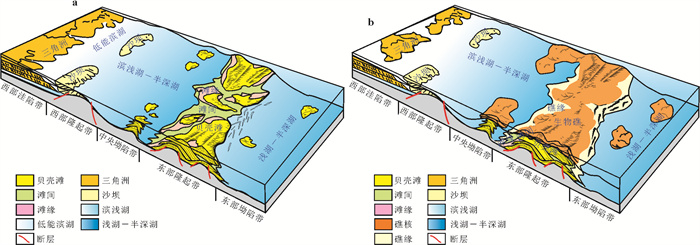
图 12 研究区裂谷期湖相碳酸盐岩沉积发育模式
a.ITP组贝壳滩沉积发育模式;b.BV组微生物礁沉积发育模式
Fig. 12. Depositional model of lacustrine carbonate in study area
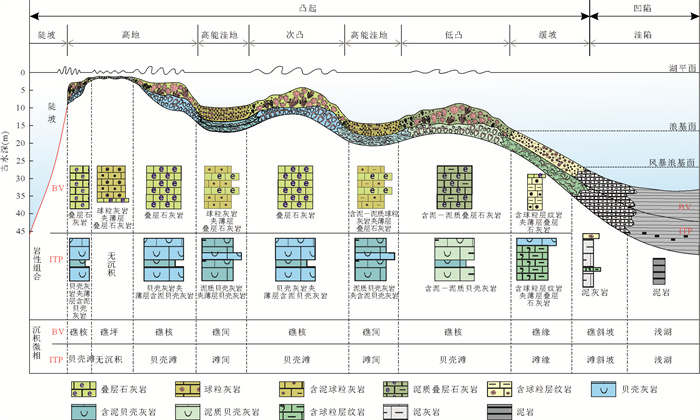
图 13 研究区隆起区微古地貌划分及其控制下碳酸盐岩沉积储层发育模式
Fig. 13. Micro-paleogeomorphology division of uplift area and the carbonate reservoir depositional model under the controlling of micro-paleogeomorphology
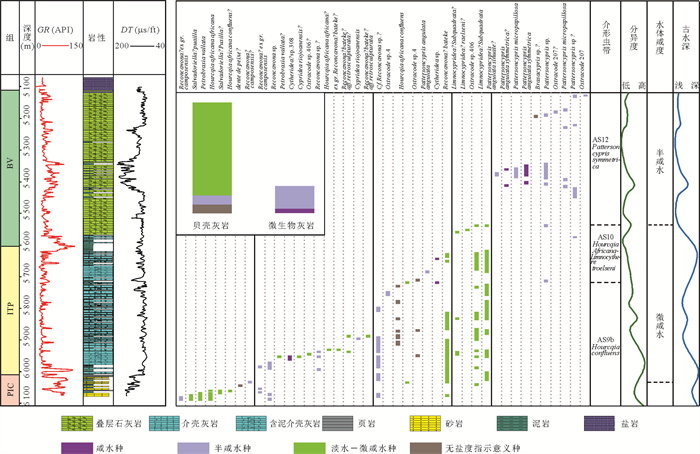
图 14 研究区典型井湖相介形虫属种分布及盐度、古水深变化
Fig. 14. Vertical changes in salinity and water depth indicated by the species and differentiation degree of ostracoda
表 1 桑托斯盆地下白垩统湖相碳酸盐岩岩石类型划分
Table 1. Classification of Lower Cretaceous lacustrine carbonate rock in the Santos basin
地层 成因机制 岩石类型 BV组 微生物成因 层纹石灰岩 Laminated limestone 叠层石灰岩 Stromatolite 核形石灰岩 Oncoids 球状灰岩 Spherical limestone ITP组 机械-化学成因 内碎屑灰岩(砂屑、砾屑灰岩) Dolostone 鲕粒灰岩 Oolitic limestone/ooid grainstone 贝壳灰岩 Coquina 微晶颗粒灰岩 Packstone 含颗粒微晶灰岩 Wackstone 微晶灰岩 Micrite 颗粒灰岩 Grainstone 交代成因 白云岩 Dolostone  下载: 导出CSV
表 2 研究区裂谷期介形虫盐度标志种
Table 2. Ostracods marker species of syn-rift lacustrine salinity in study area
淡水种 微咸水种 半咸水种 咸水种 Salvadoriella Pusilla
Hourcqia africana africana
Hourcqia africana confluens
Hourcqia sp.
Cypridea riojoanensisLimnocypridea Subquadrata
Limnocypridea troelseni
Reconcavona bateke
Petrobrasia vallata
Ostracode sp. 406Reconcavona camposensis
Reconcavona retrosculpturata
Reconcavona sp.
Pattersoncypris angulata sinuate
Pattersoncypris micropapillosa
Pattersoncypris angulata angulata
Pattersoncypris sp.
Ostracode sp. 207Cytheridea sp. 308
Cytheridea sp.
Pattersoncypris angulata symmetrica
下载: 导出CSV
-
Adams, E. W., Grotzinger, J. P., Watters, W. A., et al., 2005. Digital Characterization of Thrombolite-Stromatolite Reef Distribution in a Carbonate Ramp System (Terminal Proterozoic, Nama Group, Namibia). AAPG Bulletin, 89(10): 1293-1318. https://doi.org/10.1306/06160505005 Altenhofen, S. D., Rodrigues, A. G., Borghi, L., et al., 2024. Dynamic Re-Sedimentation of Lacustrine Carbonates in the Búzios Field, Pre-Salt Section of Santos Basin, Brazil. Journal of South American Earth Sciences, 138: 104863. https://doi.org/10.1016/j.jsames.2024.104863 Chaboureau, A. C., Guillocheau, F., Robin, C., et al., 2013. Paleogeographic Evolution of the Central Segment of the South Atlantic during Early Cretaceous Times: Paleotopographic and Geodynamic Implications. Tectonophysics, 604: 191-223. https://doi.org/10.1016/j.tecto.2012.08.025 Chafetz, H., Barth, J., Cook, M., et al., 2018. Origins of Carbonate Spherulites: Implications for Brazilian Aptian Pre-Salt Reservoir. Sedimentary Geology, 365: 21-33. https://doi.org/10.1016/j.sedgeo.2017.12.024 Chang, H. K., Kowsmann, R. O., Figueiredo, A. M. F., et al., 1992. Tectonics and Stratigraphy of the East Brazil Rift System: an Overview. Tectonophysics, 213, 97-138. https://doi.org/10.1016/0040-1951(92)90253-3 Chen, Z. H., Zha, M., Jin, Q., 2004. Application of Natural Gamma Ray Logging and Natural Gamma Spectrometry Logging to Recovering Paleoenvironment of Sedimentary Basin. Chinese Journal of Geophysics, 47(6): 1145-1150(in Chinese with English abstract). Cheng, T., Kang, H. Q., Bai, B., et al., 2018. Key Technologies and Their Application in Exploration of Pre-Salt Lacustrine Carbonate Rock in Santos Basin, Brazil. China Offshore Oil and Gas, 30(4): 27-35(in Chinese with English abstract). Claes, H., Miranda, T., Falcão, T. C., et al., 2021. Model for Calcite Spherulite Formation in Organic, Clay-Rich, Lacustrine Carbonate Shales (Barbalha Formation, Aptian, Araripe Basin, NE Brazil). Marine and Petroleum Geology, 128: 104988. https://doi.org/10.1016/j.marpetgeo.2021.104988 Embry, A. F., Klovan, J. E., 1971. A Late Devonian Reef Tract on Northeastern Banks Island, N. W. T. . Bulletin of Canadian Petroleum Geology, 19: 730-781. https://doi.org/10.35767/gscpgbull.19.4.730 Gomes, J. P., Bunevich, R. B., Tedeschi, L. R., et al., 2020. Facies Classification and Patterns of Lacustrine Carbonate Deposition of the Barra Velha Formation, Santos Basin, Brazilian Pre-Salt. Marine and Petroleum Geology, 113: 104176. https://doi.org/10.1016/j.marpetgeo.2019.104176 He, S., Li, G. R., Wu, C. R., et al., 2022. Sedimentary Filling Characteristics and Controlling Factors of Lacustrine Microbial Carbonates Sequence in the Santos Basin, Brazil. Petroleum Exploration and Development, 49(4): 683-692(in Chinese with English abstract). Jia, H. C., Kang, H. Q., Liang, J. S., et al., 2021. Characteristic and Developmental Controlled Factors of Pre-Salt Lacustrine Carbonate, Santos Basin. Journal of Southwest Petroleum University (Science & Technology Edition), 43(2): 1-9(in Chinese with English abstract). Jia, J. Z., Kang, H. Q., Cai, W. J., et al., 2021. Characteristics of Pre-Salt Lacustrine Ostracods in the Great Campos Basin and Its Indicative Significance of Paleo Sedimentary Environment. China Offshore Oil and Gas, 33(6): 52-61(in Chinese with English abstract). Kang, H. Q., Cheng, T., Li, M. G., et al., 2016. Characteristics and Main Control Factors of Hydrocarbon Accumulation in Santos Basin, Brazil. China Offshore Oil and Gas, 28(4): 1-8(in Chinese with English abstract). Kang, H. Q., Lü, J., Cheng, T., 2018a. Depositional Environment of Stromatolitic Limestone of Pre-Salt Barra Velha Formation in Santos Basin, Brazil. Marine Origin Petroleum Geology, 23(1): 29-36(in Chinese with English abstract). Kang, H. Q., Lü, J., Cheng, T., 2018b. Characteristics of Subsalt Lacustrine Carbonate Reservoirs in Santos Basin, Brazil. Marine Geology & Quaternary Geology, 38(4): 170-178(in Chinese with English abstract). Kirkham, A., Tucker, M. E., 2018. Thrombolites, Spherulites and Fibrous Crusts (Holkerian, Purbeckian, Aptian): Context, Fabrics and Origins. Sedimentary Geology, 374: 69-84. https://doi.org/10.1016/j.sedgeo.2018.07.002 Lima, B. E. M., De Ros, L. F., 2019. Deposition, Diagenetic and Hydrothermal Processes in the Aptian Pre-Salt Lacustrine Carbonate Reservoirs of the Northern Campos Basin, Offshore Brazil. Sedimentary Geology, 383: 55-81. https://doi.org/10.1016/j.sedgeo.2019.01.006 Liu, S. Y., Hu, X. L., Li, J. B., 2011. Great Discovery and Its Significance for Exploration in Subsalt Reservoir in Santos Basin, Brazil. China Petroleum Exploration, 16(4): 74-81(in Chinese with English abstract). Luo, X. T., Wen, H. G., Peng, C., et al., 2020. Sedimentary Characteristics and High-Precision Sequence Division of Lacustrine Carbonate Rocks of BV Formation in L OilField of Santos Basin, Brazil. Lithologic Reservoirs, 32(3): 68-81(in Chinese with English abstract). Mercedes-Martín, R., Brasier, A. T., Rogerson, M., et al., 2017. A Depositional Model for Spherulitic Carbonates Associated with Alkaline, Volcanic Lakes. Marine and Petroleum Geology, 86: 168-191. https://doi.org/10.1016/j.marpetgeo.2017.05.032 Moreira, J. L. P., Madeira, C. V., Gil, J. A., 2007. Bacia de Santos. Bol. Geociencias Petrobras, 15(2): 531-549. Moulin, M., Aslanian, D., Unternehr, P., 2010. A New Starting Point for the South and Equatorial Atlantic Ocean. Earth-Science Reviews, 98(1-2): 1-37. https://doi.org/10.1016/j.earscirev.2009.08.001 Neves, I., Lupinacci, W. M., Ferreira, D. J. A., et al., 2019. Presalt Reservoirs of the Santos Basin: Cyclicity, Electrofacies, and Tectonic-Sedimentary Evolution. Interpretation, 7(4): SH33-SH43. https://doi.org/10.1190/int-2018-0237.1 Rebelo, T. B., Batezelli, A., Mattos, N. H., et al., 2023. Sedimentary Processes and Paleoenvironment Reconstruction of the Barra Velha Formation, Santos Basin, Brazilian Pre-Salt. Marine and Petroleum Geology, 150: 106141. https://doi.org/10.1016/j.marpetgeo.2023.106141 Rogerson, M., Mercedes-Martín, R., Brasier, A. T., et al., 2017. Are Spherulitic Lacustrine Carbonates an Expression of Large-Scale Mineral Carbonation? A Case Study from the East Kirkton Limestone, Scotland. Gondwana Research, 48: 101-109. https://doi.org/10.1016/j.gr.2017.04.007 Sam, P., Kerr, J., Dempsey, A., et al., 2014. Large-Scale Carbonate Platform Development of Cay Sal Bank, Bahamas, and Implications for Associated Reef Geomorphology. Geomorphology, 222: 25-38. https://doi.org/10.1016/j.geomorph.2014.03.004 Smith, R. J., 2000. Morphology and Ontogeny of Cretaceous Ostracods with Preserved Appendages from Brazil. Palaeontology, 43(1): 63-98. https://doi.org/10.1111/1475-4983.00119 Thompson, D. L., Stilwell, J. D., Hall, M., 2015. Lacustrine Carbonate Reservoirs from Early Cretaceous Rift Lakes of Western Gondwana: Pre-Salt Coquinas of Brazil and West Africa. Gondwana Research, 28(1): 26-51. https://doi.org/10.1016/j.gr.2014.12.005 Tome, M. E. T. R., Lima Filho, M. F., Neumann, V. H. M. L., 2014. Taxonomic Studies of Non-Marine Ostracods in the Lower Cretaceous (Aptian-Lower Albian) of Post-Rift Sequence from Jatobá and Araripe Basins (Northeast Brazil): Stratigraphic Implications. Cretaceous Research, 48: 153-176. https://doi.org/10.1016/j.cretres.2013.12.007 Wang, Y., Wang, X. Z., Liao, J. H., et al., 2016. Cretaceous Lacustrine Algal Stromatolite Reef Characteristics and Controlling Factors, Santos Basin, Brazil. Acta Sedimentologica Sinica, 34(5): 819-829(in Chinese with English abstract). Warren, J. K., 2011. Evaporitic Source Rocks: Mesohaline Responses to Cycles of "Famine or Feast" in Layered Brines. Wiley, New York. https://doi.org/10.1002/9781444392326.ch16 http://www.a.cn/b.htm Wei, L. B., Zhao, J. X., Su, Z. T., et al., 2021. Distribution and Depositional Model of Microbial Carbonates in the Ordovician Middle Assemblage, Ordos Basin, NW China. Petroleum Exploration and Development, 48(6): 1162-1174(in Chinese with English abstract). Whalen, M. T., Day, J., Eberli, G. P., et al., 2002. Microbial Carbonates as Indicators of Environmental Change and Biotic Crises in Carbonate Systems: Examples from the Late Devonian, Alberta Basin, Canada. Palaeogeography, Palaeoclimatology, Palaeoecology, 181(1-3): 127-151. https://doi.org/10.1016/s0031-0182(01)00476-x Wright, V. P., 1992. A Revised Classification of Limestones. Sedimentary Geology, 76(3-4): 177-185. https://doi.org/10.1016/0037-0738(92)90082-3 Wright, V. P., Barnett, A. J., 2019. The Textural Evolution and Ghost Matrices of the Cretaceous Barra Velha Formation Carbonates from the Santos Basin, Offshore Brazil. Facies, 66(1): 7. https://doi.org/10.1007/s10347-019-0591-2 Xiao, H. Y., Liao, L. B., Ji, J. F., et al., 2014. Sedimentary Records and Paleoclimate Evolution of the Great Barrier Reef, Australia during the Past 150 000 Years. Earth Science Frontiers, 21(2): 323-330(in Chinese with English abstract). Zhu, Y. X., Zhang, Z. M., Zhang, D. M., 2022. Sedimentary Environment and Genesis of the Early Cretaceous Microbial Carbonates in Santos Basin, Brazil. Acta Petrologica Sinica, 38(9): 2619-2633(in Chinese with English abstract). 陈中红, 查明, 金强, 2004. 自然伽玛及自然伽玛能谱测井在沉积盆地古环境反演中的应用. 地球物理学报, 47(6): 1145-1150. 程涛, 康洪全, 白博, 等, 2018. 巴西桑托斯盆地盐下湖相碳酸盐岩勘探关键技术及其应用. 中国海上油气, 30(4): 27-35. 何赛, 李国蓉, 吴昌荣, 等, 2022. 巴西桑托斯盆地湖相微生物碳酸盐岩层序沉积特征及控制因素. 石油勘探与开发, 49(4): 683-692. 贾怀存, 康洪全, 梁建设, 等, 2021. 桑托斯盆地湖相碳酸盐岩储层特征及控制因素. 西南石油大学学报(自然科学版), 43(2): 1-9. 贾建忠, 康洪全, 蔡文杰, 等, 2021. 大坎波斯盆地盐下湖相介形虫特征及其古环境指示意义. 中国海上油气, 33(6): 52-61. 康洪全, 程涛, 李明刚, 等, 2016. 巴西桑托斯盆地油气成藏特征及主控因素分析. 中国海上油气, 28(4): 1-8. 康洪全, 吕杰, 程涛, 2018a. 桑托斯盆地白垩系盐下Barra Velha组叠层石灰岩沉积环境探讨. 海相油气地质, 23(1): 29-36. 康洪全, 吕杰, 程涛, 等, 2018b. 巴西桑托斯盆地盐下湖相碳酸盐岩储层特征. 海洋地质与第四纪地质, 38(4): 170-178. 刘深艳, 胡孝林, 李进波, 2011. 巴西桑托斯盆地盐下大发现及其勘探意义. 中国石油勘探, 16(4): 74-81. . 罗晓彤, 文华国, 彭才, 等, 2020. 巴西桑托斯盆地L油田BV组湖相碳酸盐岩沉积特征及高精度层序划分. 岩性油气藏, 32(3): 68-81. 王颖, 王晓州, 廖计华, 等, 2016. 巴西桑托斯盆地白垩系湖相藻叠层石礁特征及主控因素分析. 沉积学报, 34(5): 819-829. 魏柳斌, 赵俊兴, 苏中堂, 等, 2021. 鄂尔多斯盆地奥陶系中组合微生物碳酸盐岩分布规律及沉积模式. 石油勘探与开发, 48(6): 1162-1174. 肖海漪, 廖立兵, 季峻峰, 等, 2014. 澳大利亚大堡礁海域近15万年沉积记录及古气候演化. 地学前缘, 21(2): 323-330. 朱奕璇, 张忠民, 张德民, 2022. 巴西桑托斯盆地早白垩世微生物碳酸盐岩沉积环境与成因. 岩石学报, 38(9): 2619-2633. -

 点击查看大图
计量
- 文章访问数: 132
- HTML全文浏览量: 12
- PDF下载量: 12
- 被引次数: 0
