




Rethinking the Advances and Challenges of Contemporary Auto-Cataloging Workflows: In the AI Processing Era
-
摘要: 基于AI算法的自动编目技术逐步成为主流的今天,预训练模型的泛化性问题也在成为共识. 通过对一些最新成果的综述和一些简单的测试,试图指出这一技术瓶颈问题,并阐述关于未来发展的想法. 一方面,AI模型评价体系亟需更新,目前主流的基于人工标注的评价方式存在一些局限性,且对于用户的具体案例而言缺乏实用性;另一方面,关于训练数据与模型表现的关系的研究尚处萌芽状态,各家解决泛化性问题的策略也各有不同,但针对这个复杂的问题都缺少系统性讨论. 本文旨在给出方向性的建议,即这些技术难题有可能通过何种方式取得进展,希望对钻研AI编目技术的研究者有所帮助.Abstract: With AI-based automatic cataloging techniques increasingly becoming the mainstream, the limited generalization ability of pre-trained models has also emerged as a widely recognized issue. Through a review of several recent studies and a set of simple tests, this paper seeks to highlight this technological bottleneck and to outline perspectives on future development. On the one hand, the evaluation framework for AI models is in urgent need of updating: the prevailing assessment approaches based on manual annotations exhibit inherent limitations and often lack practical relevance for specific user applications. On the other hand, research on the relationship between training data and model performance remains at an early stage. Although different strategies have been proposed to address generalization issues, systematic discussions of this complex problem are still lacking. This paper aims to provide directional recommendations on potential pathways to overcome these challenges, with the hope of offering useful insights to researchers engaged in AI-based earthquake cataloging.
-
Key words:
- AI algorithms /
- earthquake cataloging /
- generalization /
- evaluation metrics /
- training datasets
-
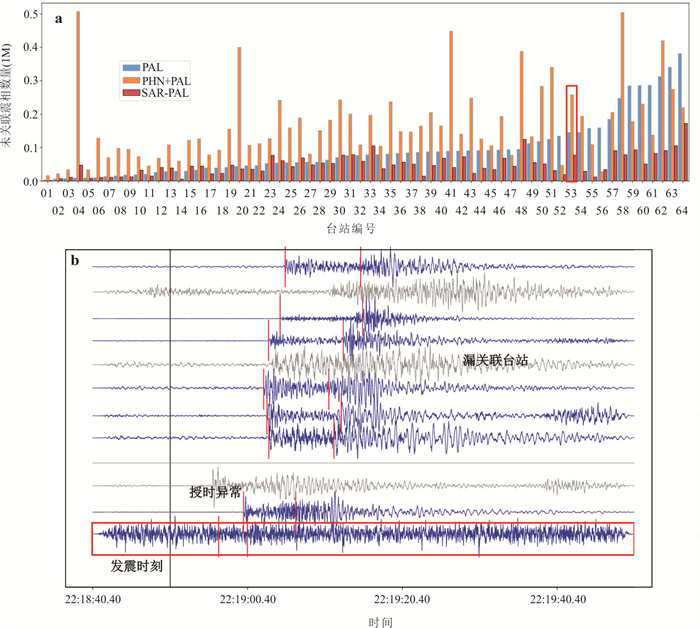
图 2 (a) PAL,PhaseNet,以及AI-PAL的未关联震相数在各台站的分布;(b) PhaseNet误识别波形示例
a. 改自Zhou et al.(2025);b. 其中蓝色和灰色波形分别为被关联台站和漏关联台站,红色竖线为P & S波到时拾取
Fig. 2. (a) Number of unassociated picks by PAL, PhaseNet, and AI-PAL across different stations; (b) Example false detection by PhaseNet
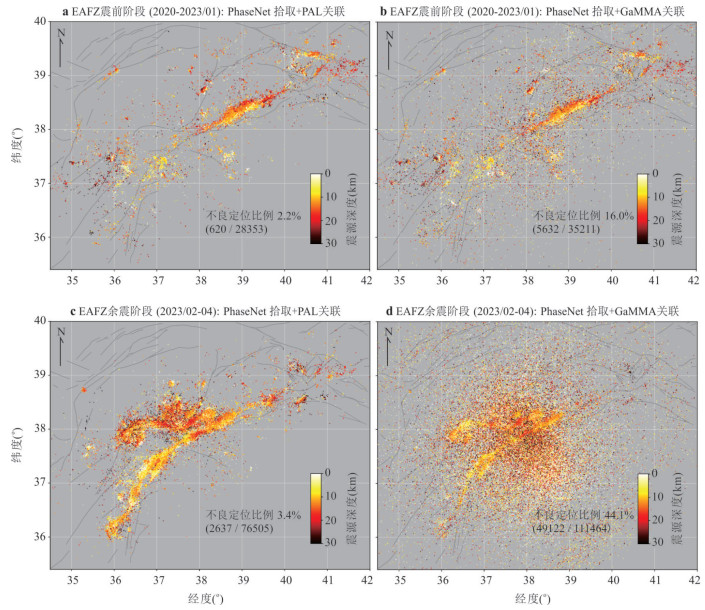
图 3 PAL与GaMMA关联的定位效果对比
在EAFZ断裂带的震前阶段(a,b)与余震阶段(c,d);改自Zhou et al.(2025)
Fig. 3. Comparison of location distribution along the EAFZ using PAL and GaMMA for phase association
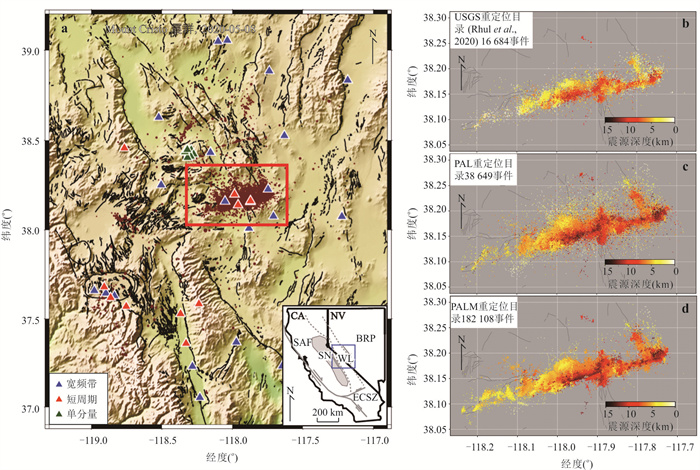
图 4 美国内华达州2020 Mount Cristo震群及目录对比
a.台站分布和构造背景;b~d. 分别为USGS重定位目录、PAL重定位目录,以及PALM重定位目录的事件水平分布
Fig. 4. Catalog comparison for the 2020 Mount Cristo swarm in Nevada, USA
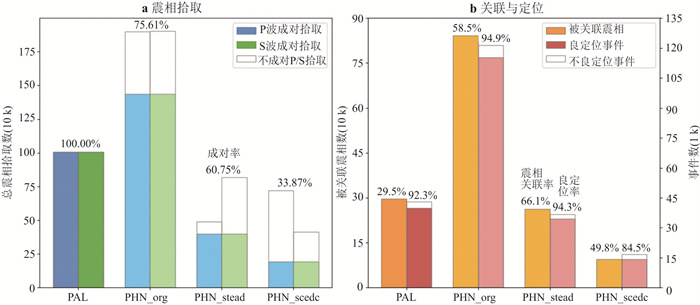
图 5 PAL与不同版本的PhaseNet (图中缩写为PHN)在Mount Cristo震群的震相拾取与地震检测效果对比
a. 柱状图每组以蓝色与绿色分别代表P波和S波的震相拾取数,空白为不成对的P/S拾取;b. 柱状图每组以橙色与红色分别代表被关联震相数和事件检测数,空白为不良定位事件;各版本PhaseNet分别为:PHN_org. 原始版本;PHN_stead. STEAD数据集训练版本;PHN_scedc. 南加州台网中心数据训练版本
Fig. 5. Comparison of phase picking, association, and event detection performance between PAL and various versions of PhaseNet (abbreviated as PHN) in the 2020 Mount Cristo swarm
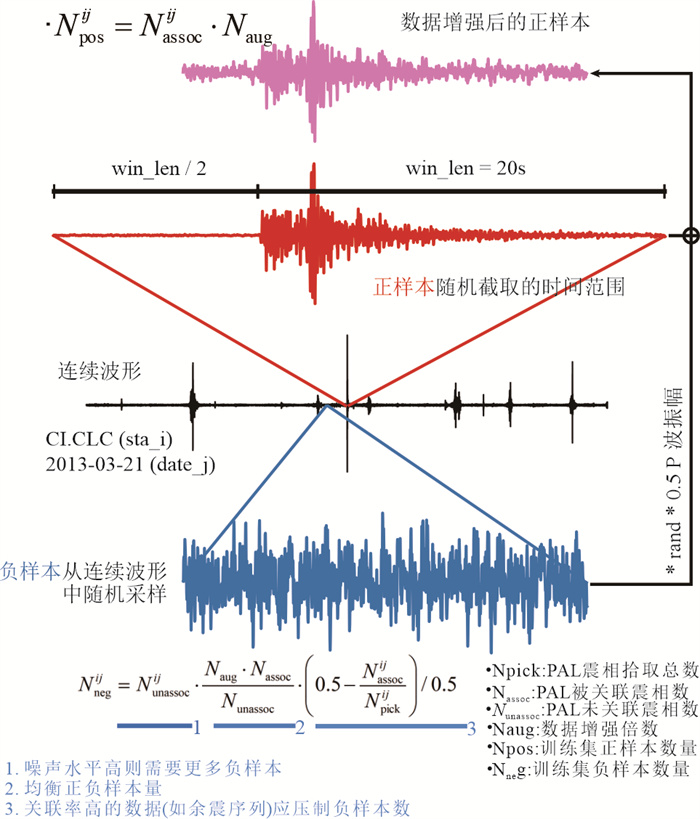
图 6 AI-PAL流程中训练集正负样本的采样策略
Fig. 6. Sampling strategy of noise data in the AI-PAL workflow
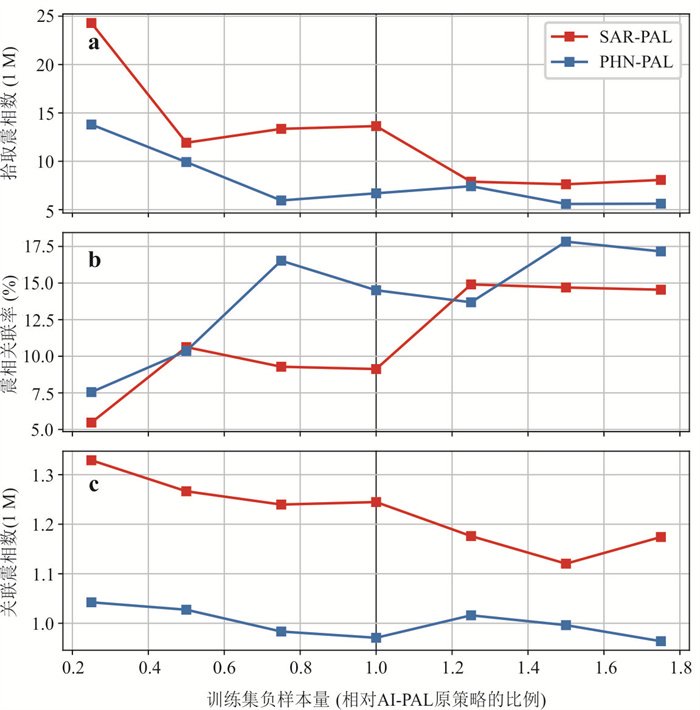
图 7 训练集负样本量对AI模型震相拾取效果的影响
红色与蓝色分别表示SAR拾取模型和PhaseNet模型结合PAL关联算法的结果
Fig. 7. Effects of negative training samples on the AI picker performance
-
Ader, T. J., Avouac, J. P., 2013. Detecting Periodicities and Declustering in Earthquake Catalogs Using the Schuster Spectrum, Application to Himalayan Seismicity. Earth and Planetary Science Letters, 377: 97-105. https://doi.org/10.1016/j.epsl.2013.06.032 Arrowsmith, S. J., Trugman, D. T., MacCarthy, J., et al., 2022. Big Data Seismology. Reviews of Geophysics, 60(2): e2021RG000769. https://doi.org/10.1029/2021RG000769 Bergen, K. J., Johnson, P. A., de Hoop, M. V., et al., 2019. Machine Learning for Data-Driven Discovery in Solid Earth Geoscience. Science, 363(6433): eaau0323. https://doi.org/10.1126/science.aau0323 Bormann, J. M., Morton, E. A., Smith, K. D., et al., 2021. Nevada Seismological Laboratory Rapid Seismic Monitoring Deployment and Data Availability for the 2020 Mww 6.5 Monte Cristo Range, Nevada, Earthquake Sequence. Seismological Research Letters, 92(2A): 810-822. https://doi.org/10.1785/0220200344 Bornstein, T., Lange, D., Münchmeyer, J., et al., 2024. PickBlue: Seismic Phase Picking for Ocean Bottom Seismometers with Deep Learning. Earth and Space Science, 11: e2023EA003332. https://doi.org/10.1029/2023ea003332 Chai, C. P., Maceira, M., Santos-Villalobos, H. J., et al., 2020. Using a Deep Neural Network and Transfer Learning to Bridge Scales for Seismic Phase Picking. Geophysical Research Letters, 47(16): e2020GL088651. https://doi.org/10.1029/2020gl088651 Chai, C. P., Rose, D., Stewart, S., et al., 2025. PickerXL, a Large Deep Learning Model to Measure Arrival Times from Noisy Seismic Signals. Seismological Research Letters, 96(4): 2394-2404. https://doi.org/10.1785/0220240353 Chen, C., Holland, A. A., 2016. PhasePApy: a Robust Pure Python Package for Automatic Identification of Seismic Phases. Seismological Research Letters, 87(6): 1384-1396. https://doi.org/10.1785/0220160019 Chiaraluce, L., Michele, M., Waldhauser, F., et al., 2022. A Comprehensive Suite of Earthquake Catalogues for the 2016-2017 Central Italy Seismic Sequence. Scientific Data, 9: 710. https://doi.org/10.1038/s41597-022-01827-z Cui, X., Li, Z. F., Ampuero, J. P., et al., 2025. Does Foreshock Identification Depend on Seismic Monitoring Capability? Geophysical Research Letters, 52(11): e2025GL115394. https://doi.org/10.1029/2025GL115394 Gulia, L., Wiemer, S., Wyss, M., 2012. Catalog Artifacts and Quality Control. Community Online Resource for Statistical Seismicity Analysis. https://doi.org/10.5078/corssa-93722864 Herrmann, M., Marzocchi, W., 2020. Inconsistencies and Lurking Pitfalls in the Magnitude-Frequency Distribution of High-Resolution Earthquake Catalogs. Seismological Research Letters, 92(2A): 909-922. https://doi.org/10.1785/0220200337 Hsu, Y. F., Zaliapin, I., Ben-Zion, Y., 2024. Informative Modes of Seismicity in Nearest-Neighbor Earthquake Proximities. Journal of Geophysical Research: Solid Earth, 129(3): e2023JB027826. https://doi.org/10.1029/2023JB027826 Husen, S., Hardebeck, J., 2010. Earthquake Location Accuracy. Community Online Resource for Statistical Seismicity Analysis. https://doi.org/10.5078/corssa-55815573 Jiang, C., Fang, L. H., Fan, L. P., et al., 2021. Comparison of the Earthquake Detection Abilities of PhaseNet and EQTransformer with the Yangbi and Maduo Earthquakes. Earthquake Science, 34(5): 425-435. https://doi.org/10.29382/eqs-2021-0038 Kato, A., 2024. Implications of Fault-Valve Behavior from Immediate Aftershocks Following the 2023 Mj6.5 Earthquake beneath the Noto Peninsula, Central Japan. Geophysical Research Letters, 51(1): e2023GL106444. https://doi.org/10.1029/2023GL106444 Klein, F. W., 2002. User's Guide to HYPOINVERSE-2000, a Fortran Program to Solve for Earthquake Locations and Magnitudes. U. S. Geological Survey Open-File Report 02-171. Kong, Q. K., Trugman, D. T., Ross, Z. E., et al., 2018. Machine Learning in Seismology: Turning Data into Insights. Seismological Research Letters, 90(1): 3-14. https://doi.org/10.1785/0220180259 Li, J. L., Yao, H. J., Wang, B. S., et al., 2022. A Real-Time AI-Assisted Seismic Monitoring System Based on New Nodal Stations with 4G Telemetry and Its Application in the Yangbi MS 6.4 Aftershock Monitoring in Southwest China. Earthquake Research Advances, 2(2): 100033. https://doi.org/10.1016/j.eqrea.2021.100033 Li, Z. F., 2021. Recent Advances in Earthquake Monitoring Ⅱ: Emergence of Next-Generation Intelligent Systems. Earthquake Science, 34(6): 531-540. https://doi.org/10.29382/eqs-2021-0054 Liao, S. R., Zhang, H. C., Fan, L. P., et al., 2021. Development of a Real-Time Intelligent Seismic Processing System and Its Application in the 2021 Yunnan Yangbi MS6.4 Earthquake. Chinese Journal of Geophysics, 64(10): 3632-3645(in Chinese with English abstract). Lim, C. S. Y., Lapins, S., Segou, M., et al., 2024. Deep Learning Phase Pickers: How Well Can Existing Models Detect Hydraulic-Fracturing Induced Microseismicity from a Borehole Array? Geophysical Journal International, 240(1): 535-549. https://doi.org/10.1093/gji/ggae386 Liu, M., Li, H. Y., Li, L., et al., 2022. Multistage Nucleation of the 2021 Yangbi MS 6.4 Earthquake, Yunnan, China and Its Foreshocks. Journal of Geophysical Research: Solid Earth, 127(5): e2022JB024091. https://doi.org/10.1029/2022JB024091 Liu, M., Tan, Y. J., 2025. Evaluating the Performance of Machine-Learning-Based Phase Pickers when Applied to Ocean Bottom Seismic Data: Blanco Oceanic Transform Fault as a Case Study. Geophysical Journal International, 242(3): ggaf256. https://doi.org/10.1093/gji/ggaf256 Mousavi, S. M., Sheng, Y. X., Zhu, W. Q., et al., 2019a. STanford EArthquake Dataset (STEAD): a Global Data Set of Seismic Signals for AI. IEEE Access, 7: 179464-179476. https://doi.org/10.1109/ACCESS.2019.2947848 Mousavi, S. M., Zhu, W. Q., Sheng, Y. X., et al., 2019b. CRED: a Deep Residual Network of Convolutional and Recurrent Units for Earthquake Signal Detection. Scientific Reports, 9(1): 10267. https://doi.org/10.1038/s41598-019-45748-1 Mousavi, S. M., Ellsworth, W. L., Zhu, W. Q., et al., 2020. Earthquake Transformer: an Attentive Deep-Learning Model for Simultaneous Earthquake Detection and Phase Picking. Nature Communications, 11(1): 3952. https://doi.org/10.1038/s41467-020-17591-w Mousavi, S. M., Beroza, G. C., 2022. Deep-Learning Seismology. Science, 377(6607): eabm4470. https://doi.org/10.1126/science.abm4470 Mousavi, S. M., Beroza, G. C., 2023. Machine Learning in Earthquake Seismology. Annual Review of Earth and Planetary Sciences, 51: 105-129. https://doi.org/10.1146/annurev-earth-071822-100323 Münchmeyer, J., Woollam, J., Rietbrock, A., et al., 2022. Which Picker Fits My Data? A Quantitative Evaluation of Deep Learning Based Seismic Pickers. Journal of Geophysical Research: Solid Earth, 127(1): e2021JB023499. https://doi.org/10.1029/2021JB023499 Naoi, M., Hirano, S., Chen, Y. Q., 2025. High-Resolution Monitoring of Hydraulically Induced Acoustic Emission Activities Using Neural Phase Picking and Matched Filter Analysis. Progress in Earth and Planetary Science, 12(1): 24. https://doi.org/10.1186/s40645-025-00696-5 Niksejel, A., Zhang, M., 2024. OBSTransformer: a Deep-Learning Seismic Phase Picker for OBS Data Using Automated Labelling and Transfer Learning. Geophysical Journal International, 237(1): 485-505. https://doi.org/10.1093/gji/ggae049 Peng, Z. G., Zhao, P., 2009. Migration of Early Aftershocks Following the 2004 Parkfield Earthquake. Nature Geoscience, 2(12): 877-881. https://doi.org/10.1038/ngeo697 Perol, T., Gharbi, M., Denolle, M., 2018. Convolutional Neural Network for Earthquake Detection and Location. Science Advances, 4(2): e1700578. https://doi.org/10.1126/sciadv.1700578 Ross, Z. E., Meier, M. A., Hauksson, E., et al., 2018. Generalized Seismic Phase Detection with Deep Learning. Bulletin of the Seismological Society of America, 108(5A): 2894-2901. https://doi.org/10.1785/0120180080 Ross, Z. E., Idini, B., Jia, Z., et al., 2019a. Hierarchical Interlocked Orthogonal Faulting in the 2019 Ridgecrest Earthquake Sequence. Science, 366(6463): 346-351. https://doi.org/10.1126/science.aaz0109 Ross, Z. E., Trugman, D. T., Hauksson, E., et al., 2019b. Searching for Hidden Earthquakes in Southern California. Science, 364(6442): 767-771. https://doi.org/10.1126/science.aaw6888 Ruhl, C. J., Morton, E. A., Bormann, J. M., et al., 2021. Complex Fault Geometry of the 2020 Mw 6.5 Monte Cristo Range, Nevada, Earthquake Sequence. Seismological Research Letters, 92(3): 1876-1890. https://doi.org/10.1785/0220200345 Rydelek, P. A., Hass, L., 1994. On Estimating the Amount of Blasts in Seismic Catalogs with Schuster's Method. Bulletin of the Seismological Society of America, 84(4): 1256-1259. https://doi.org/10.1785/bssa0840041256 Shelly, D. R., 2020. A High-Resolution Seismic Catalog for the Initial 2019 Ridgecrest Earthquake Sequence: Foreshocks, Aftershocks, and Faulting Complexity. Seismological Research Letters, 91(4): 1971-1978. https://doi.org/10.1785/0220190309 Tan, F. Z., Kao, H., Yi, K. M., et al., 2024. Next Generation Seismic Source Detection by Computer Vision: Untangling the Complexity of the 2016 Kaikōura Earthquake Sequence. Journal of Geophysical Research: Solid Earth, 129(5): e2024JB028735. https://doi.org/10.1029/2024JB028735 Tan, Y. J., Waldhauser, F., Ellsworth, W. L., et al., 2021. Machine-Learning-Based High-Resolution Earthquake Catalog Reveals how Complex Fault Structures Were Activated during the 2016-2017 Central Italy Sequence. The Seismic Record, 1(1): 11-19. https://doi.org/10.1785/0320210001 Waldhauser, F., 2001. hypoDD: A Program to Compute Double-Difference Hypocenter Locations. U. S. Geological Survey Open-File Report 01-113, 25. Waldhauser, F., Michele, M., Chiaraluce, L., et al., 2021. Fault Planes, Fault Zone Structure and Detachment Fragmentation Resolved with High-Precision Aftershock Locations of the 2016-2017 Central Italy Sequence. Geophysical Research Letters, 48(16): e2021GL092918. https://doi.org/10.1029/2021GL092918 Wang, J., Xiao, Z. W., Liu, C., et al., 2019. Deep Learning for Picking Seismic Arrival Times. Journal of Geophysical Research: Solid Earth, 124(7): 6612-6624. https://doi.org/10.1029/2019JB017536 Wilding, J. D., Zhu, W. Q., Ross, Z. E., et al., 2023. The Magmatic Web beneath Hawai'I. Science, 379(6631): 462-468. https://doi.org/10.1126/science.ade5755 Woollam, J., Münchmeyer, J., Tilmann, F., et al., 2022. SeisBench: A Toolbox for Machine Learning in Seismology. Seismological Research Letters, 93(3): 1695-1709. https://doi.org/10.1785/0220210324 Xi, Z. Y., Wei, S. S., Zhu, W. Q., et al., 2024. Deep Learning for Deep Earthquakes: Insights from OBS Observations of the Tonga Subduction Zone. Geophysical Journal International, 238(2): 1073-1088. https://doi.org/10.1093/gji/ggae200 Yao, J. Y., Yao, D. D., Chen, F., et al., 2025. A Preliminary Catalog of Early Aftershocks Following the 7 January 2025 MS6.8 Dingri, Xizang Earthquake. Journal of Earth Science, 36(2): 856-860. https://doi.org/10.1007/s12583-025-0210-9 Yoon, C. E., Shelly, D. R., 2024. Distinct yet Adjacent Earthquake Sequences near the Mendocino Triple Junction: 20 December 2021 Mw 6.1 and 6.0 Petrolia, and 20 December 2022 Mw 6.4 Ferndale. The Seismic Record, 4(1): 81-92. https://doi.org/10.1785/0320230053 Yu, S. W., Ma, J. W., 2021. Deep Learning for Geophysics: Current and Future Trends. Reviews of Geophysics, 59(3): e2021RG000742. https://doi.org/10.1029/2021RG000742 Yu, Z. Y., Wang, W. T., Chen, Y. N., 2023. Benchmark on the Accuracy and Efficiency of Several Neural Network Based Phase Pickers Using Datasets from China Seismic Network. Earthquake Science, 36(2): 113-131. https://doi.org/10.1016/j.eqs.2022.10.001 Zhang, M., Ellsworth, W. L., Beroza, G. C., 2019. Rapid Earthquake Association and Location. Seismological Research Letters, 90(6): 2276-2284. https://doi.org/10.1785/0220190052 Zhang, M., Liu, M., Feng, T., et al., 2022. LOC-FLOW: an End-to-End Machine Learning-Based High-Precision Earthquake Location Workflow. Seismological Research Letters, 93(5): 2426-2438. https://doi.org/10.1785/0220220019 Zhao, M., Xiao, Z. W., Chen, S., et al., 2023. DiTing: a Large-Scale Chinese Seismic Benchmark Dataset for Artificial Intelligence in Seismology. Earthquake Science, 36(2): 84-94. https://doi.org/10.1016/j.eqs.2022.01.022 Zhong, Y. Y., Tan, Y. J., 2024. Deep-Learning-Based Phase Picking for Volcano-Tectonic and Long-Period Earthquakes. Geophysical Research Letters, 51(12): e2024GL108438. https://doi.org/10.1029/2024GL108438 Zhou, Y. J., Yue, H., Kong, Q. K., et al., 2019. Hybrid Event Detection and Phase-Picking Algorithm Using Convolutional and Recurrent Neural Networks. Seismological Research Letters, 90(3): 1079-1087. https://doi.org/10.1785/0220180319 Zhou, Y. J., Ghosh, A., Fang, L. H., et al., 2021a. A High-Resolution Seismic Catalog for the 2021 MS6.4/MW6.1 Yangbi Earthquake Sequence, Yunnan, China: Application of AI Picker and Matched Filter. Earthquake Science, 34(5): 390-398. https://doi.org/10.29382/eqs-2021-0031 Zhou, Y. J., Yue, H., Fang, L. H., et al., 2021b. An Earthquake Detection and Location Architecture for Continuous Seismograms: Phase Picking, Association, Location, and Matched Filter (PALM). Seismological Research Letters, 93(1): 413-425. https://doi.org/10.1785/0220210111 Zhou, Y. J., Ding, H. Y., Ghosh, A., et al., 2025. AI-PAL: Self-Supervised AI Phase Picking via Rule-Based Algorithm for Generalized Earthquake Detection. Journal of Geophysical Research: Solid Earth, 130(4): e2025JB031294. https://doi.org/10.1029/2025JB031294 Zhu, J., Li, Z. F., Fang, L. H., 2023. USTC-Pickers: a Unified Set of Seismic Phase Pickers Transfer Learned for China. Earthquake Science, 36(2): 95-112. https://doi.org/10.1016/j.eqs.2023.03.001 Zhu, W. Q., Beroza, G. C., 2018. PhaseNet: a Deep-Neural-Network-Based Seismic Arrival-Time Picking Method. Geophysical Journal International, 216(1): 261-273. https://doi.org/10.1093/gji/ggy423 Zhu, W. Q., Hou, A. B., Yang, R., et al., 2022a. QuakeFlow: a Scalable Machine-Learning-Based Earthquake Monitoring Workflow with Cloud Computing. Geophysical Journal International, 232(1): 684-693. https://doi.org/10.1093/gji/ggac355 Zhu, W. Q., McBrearty, I. W., Mousavi, S. M., et al., 2022b. Earthquake Phase Association Using a Bayesian Gaussian Mixture Model. Journal of Geophysical Research: Solid Earth, 127(5): e2021JB023249. https://doi.org/10.1029/2021JB023249 廖诗荣, 张红才, 范莉苹, 等, 2021. 实时智能地震处理系统研发及其在2021年云南漾濞MS6.4地震中的应用. 地球物理学报, 64(10): 3632-3645. -

 下载:
下载:
 点击查看大图
计量
- 文章访问数: 560
- HTML全文浏览量: 35
- PDF下载量: 65
- 被引次数: 0
