




Foundation Model for Mineral Prospectivity Mapping
-
摘要:
大数据人工智能驱动的矿产预测已成为矿产勘查的重要方向,但现有方法普遍存在泛化能力弱、迁移性差、可解释性不足等问题,难以实现跨区域应用.以“预训练-微调”为核心范式的大模型在自然语言处理、计算机视觉等领域展现出卓越的跨任务迁移能力和强泛化性,为突破上述瓶颈提供了可行路径.研发矿产预测大模型,对创新找矿范式、提升勘查效率具有重要探索价值,是智能矿产预测发展的新方向.本文聚焦大语言模型、视觉大模型及多模态大模型的技术特性,系统梳理了大模型的发展历程与构建流程.在此基础上,剖析了现有矿产预测大模型的技术路径与局限,探讨了面向矿产预测语言、视觉和多模态大模型的构建思路,分析了构建矿产预测大模型面临的挑战,为进一步研发矿产预测大模型提供参考.
Abstract:Mineral prospectivity mapping (MPM) driven by big data and artificial intelligence (AI) represents a cutting-edge approach in mineral exploration. However, exisiting methods are typically constrained by the inability to achieve stable cross-regional applications due to the limited generalization ability, poor transferability, and insufficient interpretability. Foundation models, based on the "pretrain and fine-tune" paradigm, have demonstrated excellent cross-task transfer and strong generalization ability in the fields such as natural language processing and computer vision, offering a promising path to overcome the aforementioned bottlenecks. The development of foundation models for MPM has significant potential to revolutionize traditional models and improve exploration efficiency, representing a new research direction for intelligent MPM. This study systematically reviews the development and construction processes of foundation models, focusing on the state-of-the-art technical characteristics of large language models, visual foundation models, and multimodal foundation models. This study also summarizes the limitations of existing foundation models for MPM, and explores the construction process of MPM foundation models from a perspective of language-based, visual-based and multimodal-based foundation models, and discusses the challenges of developing MPM foundation models, providing a reference for development of MPM foundation models.
-
Key words:
- mineral prospectivity mapping /
- big data /
- artificial intelligence /
- foundation model
-
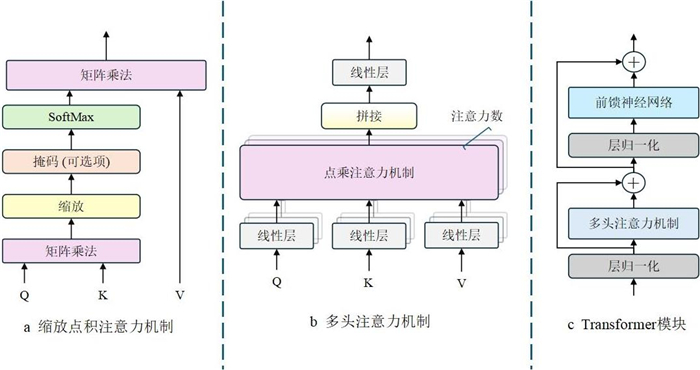
图 1 Transformer架构示意图(修改自Vaswani et al., 2017)
Fig. 1. The architecture of the Transformer architecture (modified by Vaswani et al., 2017)
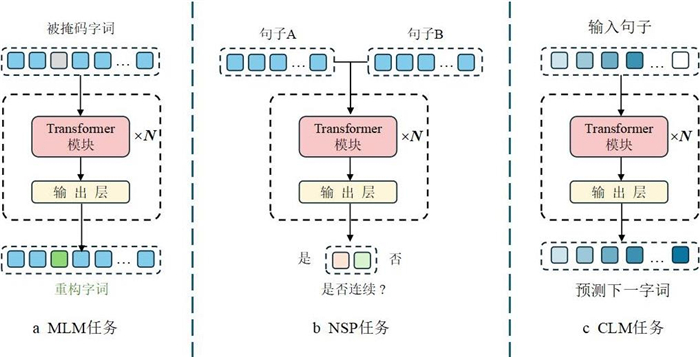
图 3 大语言模型预训练任务示意图
Fig. 3. The architecture of pre-training tasks for large language models
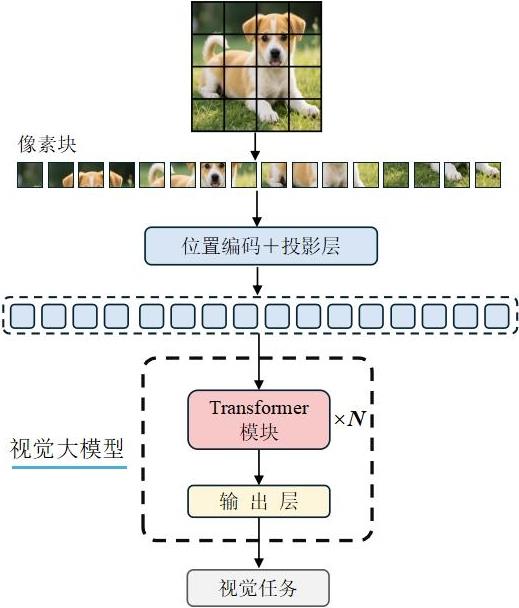
图 4 基于ViT的视觉大模型示意图(修改自Dosovitskiy et al., 2020)
Fig. 4. The architecture of the visual foundation model based on ViT (modified by Dosovitskiy et al., 2020)
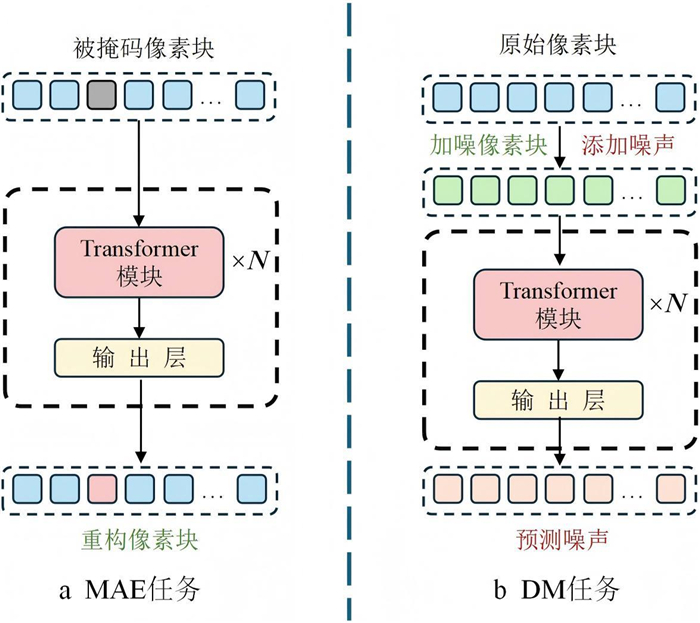
图 5 视觉大模型预训练任务示意图
Fig. 5. The architecture of pre-training tasks for visual foundation models
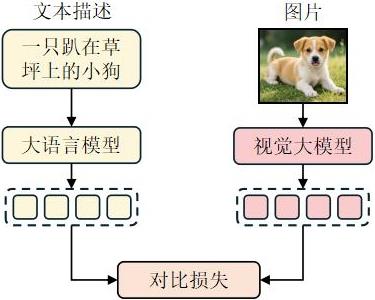
图 6 基于CLIP的多模态大模型预训练任务示意图(修改自Radford et al., 2021)
Fig. 6. The architecture of pre-training tasks for multimodal foundation models based on CLIP (modified by Radford et al., 2021)
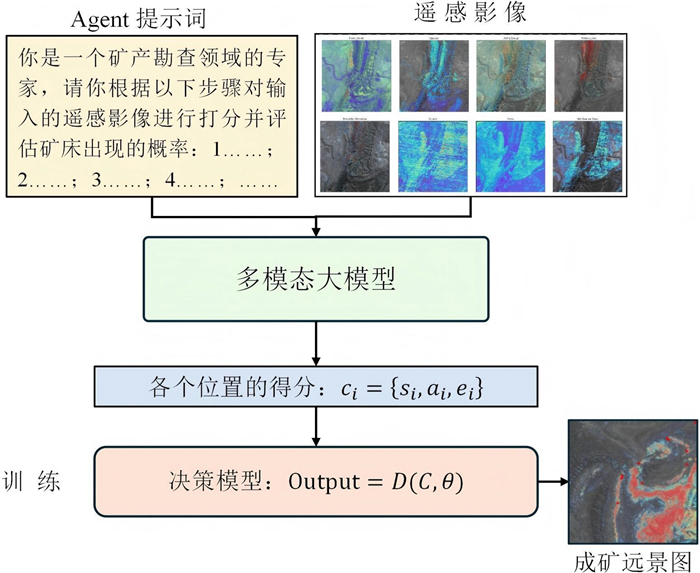
图 8 MineAgent示意图(修改自Yu et al., 2024)
Fig. 8. The architecture of MineAgent (modified by Yu et al., 2024)
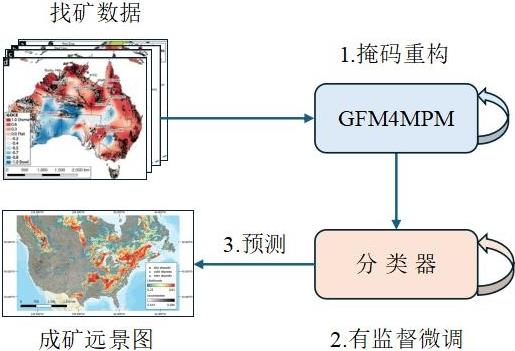
图 9 GFM4MPM示意图(修改自Daruna et al., 2024)
Fig. 9. The architecture of GFM4MPM (modified by Daruna et al., 2024)
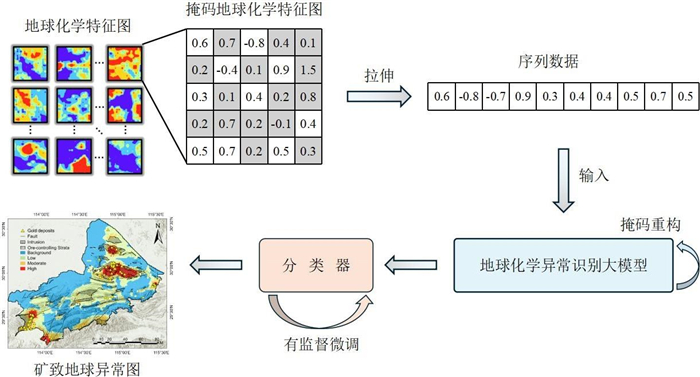
图 10 FM4GAI示意图(修改自Shi and Zuo, 2026)
Fig. 10. The architecture of FM4GAI (modified by Shi and Zuo, 2026)
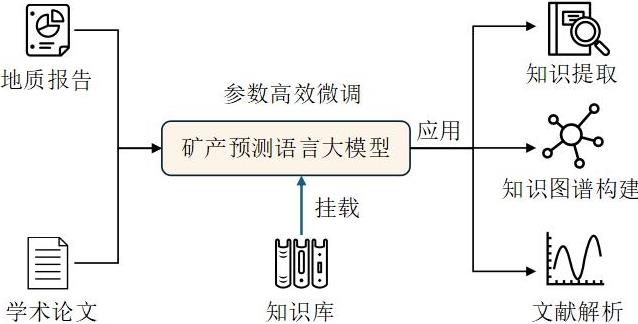
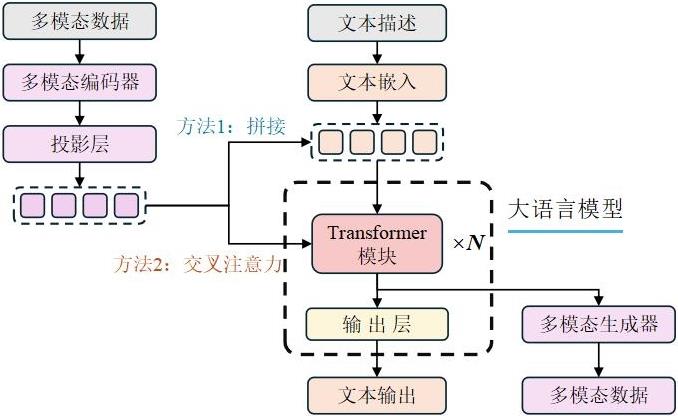
图 11 矿产预测语言大模型示意图
Fig. 11. The architecture of the large language model for mineral prospectivity mapping
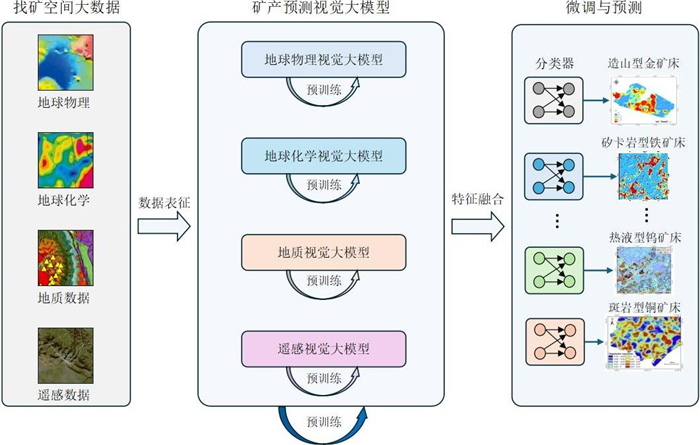
图 12 矿产预测视觉大模型示意图
Fig. 12. The architecture of the visual foundation model for mineral prospectivity mapping
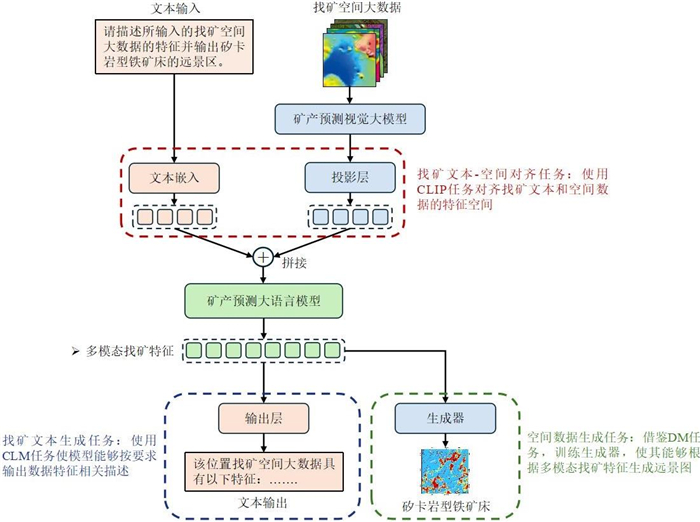
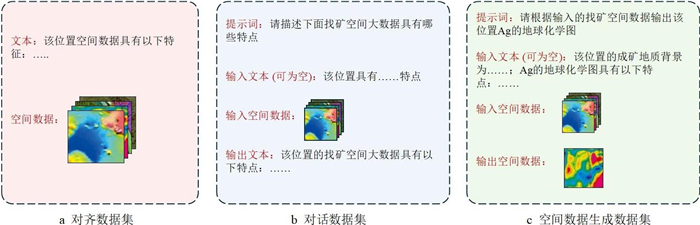
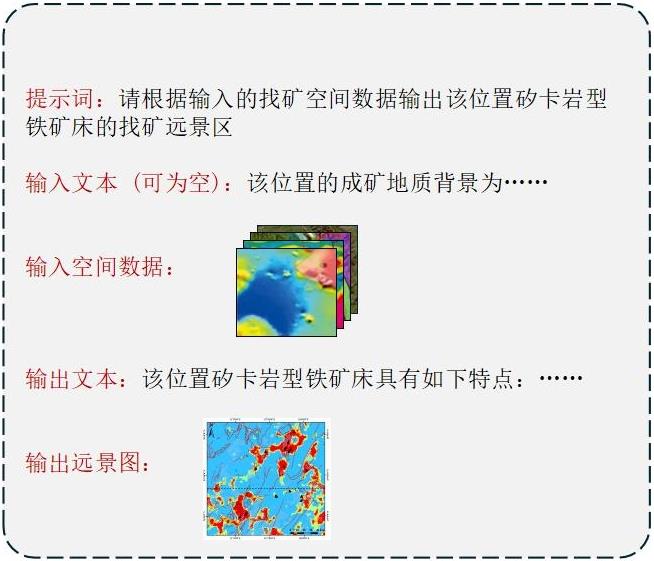
图 15 矿产预测多模态大模型预训练示意图
Fig. 15. The architecture of pre-training for the mineral prospectivity mapping multimodal foundation model
表 1 MineAgent、GFM4MPM和FM4GAI技术路线对比
Table 1. Comparison of technical roadmaps: MineAgent, GFM4MPM and FM4GAI
路线 代表 训练数据 主要优势 主要局限 适用性 多模态大模型+
AgentMineAgent 多波段遥感数据 训练成本低,实现简单,流程自动化 未用专业找矿数据系统微调;对隐伏构造识别有限;概率输出缺少地质约束 适合快速部署与流程自动化 从零构建矿产预测视觉大模型 GFM4MPM 北美/澳大利亚地质与地球物理数据,铅锌矿监督标签 空间模式学习强,目标任务表现好 文本信息One-Hot编码致语义丢失;输入特征固化,跨区适配性受限 适合同构数据区域的高精度预测 从零构建地球化学
异常识别大模型FM4GAI 39种地球化学特征 学习单个地球化学特征图的空间模式 缺少成矿知识约束,结果可解释性差,不确定性高 可用于具有不同地球化学特征的研究区  下载: 导出CSV
-
Achiam, J., Adler, S., Agarwal, S., et al., 2023. GPT-4 Technical Report. arXiv, 2303.08774. http://arxiv.org/abs/2303.08774 Agterberg, F. P., 1989. Computer Programs for Mineral Exploration. Science, 245(4913): 76-81. https://doi.org/10.1126/science.245.4913.76 Awais, M., Naseer, M., Khan, S., et al., 2025. Foundation Models Defining a New Era in Vision: A Survey and Outlook. IEEE Transactions on Pattern Analysis and Machine Intelligence, 47(4): 2245-2264. https://doi.org/10.1109/TPAMI.2024.3506283 Azulay, A., Weiss, Y., 2019. Why Do Deep Convolutional Networks Generalize so Poorly to Small Image Transformations? Journal of Machine Learning Research, 20(184): 1-25. Bai, J., Bai, S., Chu, Y., et al., 2023. Qwen Technical Report. arXiv, 2309.16609. http://arxiv.org/abs/2309.16609 Baltrušaitis, T., Ahuja, C., Morency, L. P., 2019. Multimodal Machine Learning: A Survey and Taxonomy. IEEE Transactions on Pattern Analysis and Machine Intelligence, 41(2): 423-443. https://doi.org/10.1109/TPAMI.2018.2798607 Bao, H., Dong, L., Piao, S., et al., 2022. BEiT: BERT Pre-Training of Image Transformers. arXiv, 2106.08254. http://arxiv.org/abs/2106.08254 Bommasani, R., Hudson, D. A., Adeli, E., et al., 2022. On the Opportunities and Risks of Foundation Models. arXiv, 2108.07258. http://arxiv.org/abs/2108.07258 Brown, T. B., Mann, B., Ryder, N., et al., 2020. Language Models are Few-Shot Learners. arXiv, 2005.14165. https://doi.org/10.48550/arXiv.2005.14165 Carranza, E. J. M., 2009. Geochemical Anomaly and Mineral Prospectivity Mapping in GIS. Economic Geology, 104(6): 890-890. https://doi.org/10.2113/gsecongeo.104.6.890 Chowdhary, K. R., 2020. Natural Language Processing. In: Chowdhary, K. R., ed., Fundamentals of Artificial Intelligence. Springer, New Delhi, 603-649. https://doi.org/10.1007/978-81-322-3972-7_19 Collobert, R., Weston, J., Bottou, L., et al., 2011. Natural Language Processing (Almost) from Scratch. Journal of Machine Learning Research, 12(7): 2493-2537. Dalal, N., Triggs, B., 2005. Histograms of Oriented Gradients for Human Detection. IEEE Computer Society Conference on Computer Vision and Pattern Recognition(CVPR'05), San Diego. https://doi.org/10.1109/CVPR.2005.177 Daruna, A., Zadorozhnyy, V., Lukoczki, G., et al., 2024. GFM4MPM: Towards Geospatial Foundation Models for Mineral Prospectivity Mapping. The 32nd ACM International Conference on Advances in Geographic Information Systems, Atlanta, 565-568. https://doi.org/10.1145/3678717.3691268 Deng, C., Zhang, T. H., He, Z. M., et al., 2024. K2: A Foundation Language Model for Geoscience Knowledge Understanding and Utilization. The 17th ACM International Conference on Web Search and Data Mining, New York. https://doi.org/10.1145/3616855.3635772 Deng, J., Dong, W., Socher, R., et al., 2009. ImageNet: A Large-Scale Hierarchical Image Database. 2009 IEEE Conference on Computer Vision and Pattern Recognition, Miami. https://doi.org/10.1109/CVPR.2009.5206848 Devlin, J., Chang, M. W., Lee, K., et al., 2019. BERT: Pre-Training of Deep Bidirectional Transformers for Language Understanding. The 2019 Conference of the North American Chapter of the Association for Computational Linguistics, Minneapolis. https://doi.org/10.18653/v1/N19-1423 Dong, H., Xie, S., 2024. Large Language Models (LLMs): Deployment, Tokenomics and Sustainability. arXiv, 2405.17147. https://doi.org/10.48550/arXiv.2405.17147 Dosovitskiy, A., Beyer, L., Kolesnikov, A., et al., 2020. An Image is Worth 16×16 Words: Transformers for Image Recognition at Scale. arXiv, 2010.11929. http://arxiv.org/abs/2010.11929 Fedus, W., Zoph, B., Shazeer, N., 2022. Switch Transformers: Scaling to Trillion Parameter Models with Simple and Efficient Sparsity. Journal of Machine Learning Research, 23(120): 1-39. Feng, X. S., Liu, S. C., Chen, H. T., et al., 2023. Continual Trajectory Prediction with Uncertainty-Aware Generative Memory Replay. 2023 IEEE International Conference on Data Mining (ICDM), Shanghai. https://doi.org/10.1109/ICDM58522.2023.00116 Fu, Y., Wang, M. G., Wang, C. B., et al., 2025. GeoMinLM: A Large Language Model in Geology and Mineral Survey in Yunnan Province. Ore Geology Reviews, 182: 106638. https://doi.org/10.1016/j.oregeorev.2025.106638 Gemma Team, 2025. Gemma 3 Technical Report. arXiv, 2503.19786. https://doi.org/10.48550/ARXIV.2503.19786 Gong, L., Hou, X., Li, F., et al., 2025. Seedream 2.0: A Native Chinese-English Bilingual Image Generation Foundation Model. arXiv, 2503.07703. http://arxiv.org/abs/2503.07703 Grattafiori, A., Dubey, A., Jauhri, A., et al., 2024. The Llama 3 Herd of Models. arXiv, 2407.21783. https://doi.org/10.48550/ARXIV.2407.21783 Guo, X., Lao, J., Dang, B., et al., 2024. SkySense: A Multi-Modal Remote Sensing Foundation Model Towards Universal Interpretation for Earth Observation Imagery. arXiv, 2312.10115. http://arxiv.org/abs/2312.10115 Guo, Z. X., Wu, X. M., Liang, L. M., et al., 2025. Cross-Domain Foundation Model Adaptation: Pioneering Computer Vision Models for Geophysical Data Analysis. Journal of Geophysical Research: Machine Learning and Computation, 2(1): e2025JH000601. https://doi.org/10.1029/2025JH000601 Han, S., Pool, J., Tran, J., et al., 2015. Learning Both Weights and Connections for Efficient Neural Network. arXiv, 1506.02626. https://doi.org/10.48550/arXiv.1506.02626 He, K. M., Zhang, X. Y., Ren, S. Q., et al., 2016. Deep Residual Learning for Image Recognition. 2016 IEEE Conference on Computer Vision and Pattern Recognition (CVPR), Las Vegas. https://doi.org/10.1109/CVPR.2016.90 He, K., Chen, X., Xie, S., et al., 2021. Masked Autoencoders are Scalable Vision Learners. arXiv, 2111.06377. http://arxiv.org/abs/2111.06377 Hinton, G. E., Osindero, S., Teh, Y. W., 2006. A Fast Learning Algorithm for Deep Belief Nets. Neural Computation, 18(7): 1527-1554. https://doi.org/10.1162/neco.2006.18.7.1527 Hinton, G. E., Salakhutdinov, R. R., 2006. Reducing the Dimensionality of Data with Neural Networks. Science, 313(5786): 504-507. https://doi.org/10.1126/science.1127647 Hinton, G., Vinyals, O., Dean, J., 2015. Distilling the Knowledge in a Neural Network. arXiv, 1503.02531. https://doi.org/10.48550/arXiv.1503.02531 Ho, J., Jain, A., Abbeel, P., 2020. Denoising Diffusion Probabilistic Models. arXiv, 2006.11239. https://arxiv.org/abs/2006.11239 Hong, D. F., Zhang, B., Li, X. Y., et al., 2024. SpectralGPT: Spectral Remote Sensing Foundation Model. IEEE Transactions on Pattern Analysis and Machine Intelligence, 46(8): 5227-5244. https://doi.org/10.1109/TPAMI.2024.3362475 Houlsby, N., Giurgiu, A., Jastrzebski, S., et al., 2019. Parameter-Efficient Transfer Learning for NLP. arXiv, 1902.00751. https://doi.org/10.48550/ARXIV.1902.00751 Hu, E. J., Shen, Y., Wallis, P., et al., 2022. Lora: Low-rank Adaptation of Large Language Models. arXiv, 2106.09685https://doi.org/10.48550/arXiv.2106.09685 Hu, Y., Yuan, J., Wen, C., et al., 2023. RSGPT: A Remote Sensing Vision Language Model and Benchmark. arXiv, 2307.15266. http://arxiv.org/abs/2307.15266 Jacob, B., Kligys, S., Chen, B., et al., 2018. Quantization and Training of Neural Networks for Efficient Integer-Arithmetic-Only Inference. 2018 IEEE/CVF Conference on Computer Vision and Pattern Recognition, Salt Lake City. https://doi.org/10.1109/CVPR.2018.00286 Jacobs, R. A., Jordan, M. I., Nowlan, S. J., et al., 1991. Adaptive Mixtures of Local Experts. Neural Computation, 3(1): 79-87. https://doi.org/10.1162/neco.1991.3.1.79 Kirillov, A., Mintun, E., Ravi, N., et al., 2023. Segment Anything. arXiv, 2304.02643. http://arxiv.org/abs/2304.02643 Krizhevsky, A., Sutskever, I., Hinton, G. E., 2012. Imagenet Classification with Deep Convolutional Neural Networks. Advances in Neural Information Processing Systems, New York. Lazebnik, S., Schmid, C., Ponce, J., 2006. Beyond Bags of Features: Spatial Pyramid Matching for Recognizing Natural Scene Categories. 2006 IEEE Computer Society Conference on Computer Vision and Pattern Recognition(CVPR'06), New York. https://doi.org/10.1109/CVPR.2006.68 LeCun, Y., Boser, B., Denker, J. S., et al., 1989. Backpropagation Applied to Handwritten Zip Code Recognition. Neural Computation, 1(4): 541-551. doi: 10.1162/neco.1989.1.4.541 LeCun, Y., Bottou, L., Bengio, Y., et al., 1998. Gradient-Based Learning Applied to Document Recognition. Proceedings of the IEEE, 86(11): 2278-2324. https://doi.org/10.1109/5.726791 Lewis, M., Liu, Y., Goyal, N., et al., 2019. BART: Denoising Sequence-to-Sequence Pre-Training for Natural Language Generation, Translation, and Comprehension. arXiv, 1910.13461. http://arxiv.org/abs/1910.13461 Li, T., Zuo, R. G., Xiong, Y. H., et al., 2021. Random-Drop Data Augmentation of Deep Convolutional Neural Network for Mineral Prospectivity Mapping. Natural Resources Research, 30(1): 27-38. https://doi.org/10.1007/s11053-020-09742-z Li, X. L., Liang, P., 2021. Prefix-Tuning: Optimizing Continuous Prompts for Generation. arXiv, 2101.00190. https://doi.org/10.48550/ARXIV.2101.00190 Liang, L., Bo, Z. P., Gui, Z. K., et al., 2025. KAG: Boosting LLMs in Professional Domains via Knowledge Augmented Generation. The ACM on Web Conference 2025, Sydney. https://doi.org/10.1145/3701716.3715240 Lin, Z., Deng, C., Zhou, L., et al., 2023. Geogalactica: A Scientific Large Language Model in Geoscience. arXiv, 2401.00434. http://arxiv.org/abs/2401.00434 Liu, A., Feng, B., Xue, B., et al., 2024a. Deepseek-V3 Technical Report. arXiv, 2412.19437. http://arxiv.org/abs/2412.19437 Liu, F., Chen, D. L., Guan, Z., et al., 2024b. RemoteCLIP: A Vision Language Foundation Model for Remote Sensing. IEEE Transactions on Geoscience and Remote Sensing, 62: 5622216. https://doi.org/10.1109/TGRS.2024.3390838 Liu, Q., Ma, J., 2024. Foundation Models for Geophysics: Review and Perspective. arXiv, 2406.03163. https://doi.org/10.48550/arXiv.2406.03163 Liu, X., Ji, K., Fu, Y., et al., 2021a. P-Tuning V2: Prompt Tuning Can be Comparable to Fine-Tuning Universally across Scales and Tasks. arXiv, 2110.07602. http://arxiv.org/abs/2110.07602 Liu, Y., Zhang, K., Li, Y., et al., 2024c. Sora: A Review on Background, Technology, Limitations, and Opportunities of Large Vision Models. arXiv, 2402.17177. http://arxiv.org/abs/2402.17177 Liu, Z., Lin, Y. T., Cao, Y., et al., 2021b. Swin Transformer: Hierarchical Vision Transformer Using Shifted Windows. 2021 IEEE/CVF International Conference on Computer Vision (ICCV), Montreal. https://doi.org/10.1109/ICCV48922.2021.00986 Lowe, D. G., 2004. Distinctive Image Features from Scale-Invariant Keypoints. International Journal of Computer Vision, 60(2): 91-110. https://doi.org/10.1023/B:VISI.0000029664.99615.94 Ma, X. G., 2022. Knowledge Graph Construction and Application in Geosciences: A Review. Computers & Geosciences, 161: 105082. https://doi.org/10.1016/j.cageo.2022.105082 Mikolov, T., Chen, K., Corrado, G., et al., 2013. Efficient Estimation of Word Representations in Vector Space. arXiv, 1301.3781. http://arxiv.org/abs/1301.3781 Nadkarni, P. M., Ohno-Machado, L., Chapman, W. W., 2011. Natural Language Processing: An Introduction. Journal of the American Medical Informatics Association, 18(5): 544-551. https://doi.org/10.1136/amiajnl-2011-000464 Ouyang, L., Wu, J., Jiang, X., et al., 2022. Training Language Models to Follow Instructions with Human Feedback. arXiv, 2203.02155. http://arxiv.org/abs/2203.02155 Pennington, J., Socher, R., Manning, C., 2014. Glove: Global Vectors for Word Representation. The 2014 Conference on Empirical Methods in Natural Language Processing (EMNLP), Doha. https://doi.org/10.3115/v1/d14-1162 Poddar, L., Szarvas, G., Wang, C., et al., 2022. Deploying a Retrieval based Response Model for Task Oriented Dialogues. arXiv, 2210.14379. https://arxiv.org/abs/2210.14379 .Qiu, Q. J., Wang, B., Ma, K., et al., 2023. A Practical Approach to Constructing a Geological Knowledge Graph: A Case Study of Mineral Exploration Data. Journal of Earth Science, 34(5): 1374-1389. https://doi.org/10.1007/s12583-023-1809-3 Radford, A., Kim, J. W., Hallacy, C., et al., 2021. Learning Transferable Visual Models From Natural Language Supervision. arXiv, 2103.00020. http://arxiv.org/abs/2103.00020 Radford, A., Narasimhan, K., 2018. Improving Language Understanding by Generative Pre-Training. OpenAI Technical Report. https://cdn.openai.com/research-covers/language-unsupervised/language_understanding_paper.pdf Rombach, R., Blattmann, A., Lorenz, D., et al., 2021. High-Resolution Image Synthesis with Latent Diffusion Models. arXiv, 2112.10752. https://doi.org/10.48550/arXiv.2112.10752 Schuhmann, C., Beaumont, R., Vencu, R., et al., 2022. Laion-5b: An Open Large-Scale Dataset for Training Next Generation Image-Text Models. Advances in Neural Information Processing Systems, New Orleans. Sheng, H. L., Wu, X. M., Si, X., et al., 2025b. Seismic Foundation Model: A Next Generation Deep-Learning Model in Geophysics. Geophysics, 90(2): IM59-IM79. https://doi.org/10.1190/geo2024-0262.1 Sheng, H., Wu, X., Gao, H., et al., 2025a. On the Workflow, Opportunities and Challenges of Developing Foundation Model in Geophysics. arXiv, 2504.17384. https://doi.org/10.48550/ARXIV.2504.17384 Shi, L. Y., Xu, Y., Zuo, R. G., 2024. A Heterogeneous Graph Construction Method for Mineral Prospectivity Mapping. Natural Resources Research, 33(4): 1365-1376. https://doi.org/10.1007/s11053-024-10344-2 Shi, L. Y., Zuo, R. G., 2025. Geological Knowledge-Embedding Transfer-Learning Architecture for Geochemical Anomaly Identification. Mathematical Geosciences, 57(5): 821-844. https://doi.org/10.1007/s11004-025-10190-9 Shi, L. Y., Zuo, R. G., 2026. A Foundation Model for Geochemical Anomaly Identification. Natural Resources Research, Online. https://doi.org/10.1007/s11053-026-10664-5 Simonyan, K., Zisserman, A., 2014. Very Deep Convolutional Networks for Large-Scale Image Recognition. arXiv, 1409.1556. https://doi.org/10.48550/arXiv.1409.1556 Sutskever, I., Vinyals, O., Le, Q. V., 2014. Sequence to Sequence Learning with Neural Networks. Advances in Neural Information Processing Systems, Montréal. Szeliski, R., 2022. Computer Vision: Algorithms and Applications. Springer. https://doi.org/10.1007/978-3-030-34372-9 Tang, D., Qin, B., Feng, X., et al., 2015. Effective LSTMs for Target-Dependent Sentiment Classification. arXiv, 1512.01100. https://doi.org/10.48550/arXiv.1512.01100 Taylor, R. B., Steven, T. A., 1983. Definition of Mineral Resource Potential. Economic Geology, 78(6): 1268-1270. https://doi.org/10.2113/gsecongeo.78.6.1268 Touvron, H., Lavril, T., Izacard, G., et al., 2023. LLaMA: Open and Efficient Foundation Language Models. arXiv, 2302.13971. http://arxiv.org/abs/2302.13971 Vaswani, A., Shazeer, N., Parmar, N., et al., 2017. Attention is All you Need. Advances in Neural Information Processing Systems, Long Beach. Viola, P., Jones, M., 2001. Rapid Object Detection Using a Boosted Cascade of Simple Features. The 2001 IEEE Computer Society Conference on Computer Vision and Pattern Recognition. CVPR 2001. Kauai. https://doi.org/10.1109/CVPR.2001.990517 Voulodimos, A., Doulamis, N., Doulamis, A., et al., 2018. Deep Learning for Computer Vision: A Brief Review. Computational Intelligence and Neuroscience, 2018: 7068349. https://doi.org/10.1155/2018/7068349 Wang, B., Wu, L., Xie, Z., et al., 2022. Understanding Geological Reports Based on Knowledge Graphs Using a Deep Learning Approach. Computers & Geosciences, 168: 105229. https://doi.org/10.1016/j.cageo.2022.105229 Wang, Z. Y., Zuo, R. G., 2022. Mineral Prospectivity Mapping Using a Joint Singularity-Based Weighting Method and Long Short-Term Memory Network. Computers & Geosciences, 158: 104974. https://doi.org/10.1016/j.cageo.2021.104974 Wei, J., Wang, X., Schuurmans, D., et al., 2022. Chain-of-Thought Prompting Elicits Reasoning in Large Language Models. The 36th International Conference on Neural Information Processing Systems, New Orleans. Xu, Y., Zuo, R. G., 2024. An Interpretable Graph Attention Network for Mineral Prospectivity Mapping. Mathematical Geosciences, 56(2): 169-190. https://doi.org/10.1007/s11004-023-10076-8 Xu, Y., Zuo, R. G., Bai, Y., 2025a. Geological Knowledge-Guided Dual-Branch Deep Learning Model for Identification of Geochemical Anomalies Related to Mineralization. Journal of Geophysical Research: Machine Learning and Computation, 2(1): e2024JH000468. https://doi.org/10.1029/2024JH000468 Xu, Y., Zuo, R. G., Chen, Z. Y., et al., 2025b. Recent Advances and Future Research Directions in Deep Learning as Applied to Geochemical Mapping. Earth-Science Reviews, 270: 105209. https://doi.org/10.1016/j.earscirev.2025.105209 Yan, Q., Xue, L. F., Li, Y. S., et al., 2023. Mineral Prospectivity Mapping Integrated with Geological Map Knowledge Graph and Geochemical Data: A Case Study of Gold Deposits at Raofeng Area, Shaanxi Province. Ore Geology Reviews, 161: 105651. https://doi.org/10.1016/j.oregeorev.2023.105651 Yan, Q., Zhao, J., Xue, L. F., et al., 2024. Mineral Prospectivity Mapping Based on Spatial Feature Classification with Geological Map Knowledge Graph Embedding: Case Study of Gold Ore Prediction at Wulonggou, Qinghai Province (Western China). Natural Resources Research, 33(6): 2385-2406. https://doi.org/10.1007/s11053-024-10386-6 Yang, F. F., Wang, Z. Y., Zuo, R. G., et al., 2023. Quantification of Uncertainty Associated with Evidence Layers in Mineral Prospectivity Mapping Using Direct Sampling and Convolutional Neural Network. Natural Resources Research, 32(1): 79-98. https://doi.org/10.1007/s11053-022-10144-6 Yang, F. F., Zuo, R. G., 2024. Geologically Constrained Convolutional Neural Network for Mineral Prospectivity Mapping. Mathematical Geosciences, 56(8): 1605-1628. https://doi.org/10.1007/s11004-024-10141-w Yin, B. J., Zuo, R. G., Xiong, Y. H., 2022. Mineral Prospectivity Mapping via Gated Recurrent Unit Model. Natural Resources Research, 31(4): 2065-2079. https://doi.org/10.1007/s11053-021-09979-2 Yin, S. K., Fu, C. Y., Zhao, S. R., et al., 2024. A Survey on Multimodal Large Language Models. National Science Review, 11(12): nwae403. https://doi.org/10.1093/nsr/nwae403 Yu, B., Shen, T., Na, H., et al., 2024. MineAgent: Towards Remote-Sensing Mineral Exploration with Multimodal Large Language Models. arXiv, 2412.17339. https://doi.org/10.48550/arXiv.2412.17339 Zaken, E. B., Ravfogel, S., and Goldberg, Y., 2021. BitFit: Simple Parameter-Efficient Fine-Tuning for Transformer-Based Masked Language-Models. arXiv, 2106.10199. https://doi.org/10.48550/ARXIV.2106.10199 Zhang, J. Y., Huang, J. X., Jin, S., et al., 2024a. Vision-Language Models for Vision Tasks: A Survey. IEEE Transactions on Pattern Analysis and Machine Intelligence, 46(8): 5625-5644. https://doi.org/10.1109/TPAMI.2024.3369699 Zhang, Q., Chen, M., Bukharin, A., et al., 2023a. AdaLoRA: Adaptive Budget Allocation for Parameter-Efficient Fine-Tuning. arXiv, 2303.10512. https://doi.org/10.48550/ARXIV.2303.10512 Zhang, Y. F., Wang, Z. Y., He, Z. T., et al., 2024b. BB-GeoGPT: A Framework for Learning a Large Language Model for Geographic Information Science. Information Processing & Management, 61(5): 103808. https://doi.org/10.1016/j.ipm.2024.103808 Zhang, Y., Wei, C., Wu, S., et al., 2023b. GeoGPT: Understanding and Processing Geospatial Tasks Through an Autonomous GPT. arXiv, 2307.07930. https://doi.org/10.48550/arXiv.2307.07930 Zhang, Z. J., Zuo, R. G., Xiong, Y. H., 2016. A Comparative Study of Fuzzy Weights of Evidence and Random Forests for Mapping Mineral Prospectivity for Skarn-Type Fe Deposits in the Southwestern Fujian Metallogenic Belt, China. Science China Earth Sciences, 59(3): 556-572. https://doi.org/10.1007/s11430-015-5178-3 Zhao, W. X., Zhou, K., Li, J., et al., 2023. A Survey of Large Language Models. arXiv, 2303.18223. http://arxiv.org/abs/2303.18223 Zhejiang Lab, 2025. GeoGPT: A Non-Profit Research Project for Earth Science Exploration (in Chinese). https://geogpt.zero2x.org.cn/cn Zhou, C. H., Wang, H., Wang, C. S., et al., 2021. Geoscience Knowledge Graph in the Big Data Era. Science China Earth Sciences, 64(7): 1105-1114. https://doi.org/10.1007/s11430-020-9750-4 Zhou, C., Li, Q., Li, C., et al., 2023. A Comprehensive Survey on Pretrained Foundation Models: A History from BERT to ChatGPT. arXiv, 2302.09419. http://arxiv.org/abs/2302.09419 Zuo, R. G., 2016. A Nonlinear Controlling Function of Geological Features on Magmatic-Hydrothermal Mineralization. Scientific Reports, 6: 27127. https://doi.org/10.1038/srep27127 Zuo, R. G., 2020. Geodata Science-Based Mineral Prospectivity Mapping: A Review. Natural Resources Research, 29(6): 3415-3424. https://doi.org/10.1007/s11053-020-09700-9 Zuo, R. G., 2021. Data Science-Based Theory and Method of Quantitative Prediction of Mineral Resources. Earth Science Frontiers, 28(3): 49-55 (in Chinese with English abstract). Zuo, R. G., 2025. Key Technology for Intelligent Mineral Prospectivity Mapping: Challenges and Solutions. Scientia Sinica (Terrae), 55(9): 3104-3119 (in Chinese with English abstract). doi: 10.1360/SSTe-2025-0096 Zuo, R. G., Carranza, E. J. M., 2011. Support Vector Machine: A Tool for Mapping Mineral Prospectivity. Computers & Geosciences, 37(12): 1967-1975. https://doi.org/10.1016/j.cageo.2010.09.014 Zuo, R. G., Cheng, Q., Xu, Y., et al., 2024. Explainable Artificial Intelligence Models for Mineral Prospectivity Mapping. Scientia Sinica (Terrae), 54(9): 2917-2928(in Chinese with English abstract). doi: 10.1360/N072024-0018 Zuo, R. G., Peng, Y., Li, T., et al., 2021. Challenges of Geological Prospecting Big Data Mining and Integration Using Deep Learning Algorithms. Earth Science, 46(1): 350-358 (in Chinese with English abstract). Zuo, R. G., Xiong, Y. H., Wang, Z. Y., et al., 2023. A New Generation of Artificial Intelligence Algorithms for Mineral Prospectivity Mapping. Natural Resources Research, 32(5): 1859-1869. https://doi.org/10.1007/s11053-023-10237-w Zuo, R. G., Xu, Y., 2023. Graph Deep Learning Model for Mapping Mineral Prospectivity. Mathematical Geosciences, 55(1): 1-21. https://doi.org/10.1007/s11004-022-10015-z Zuo, R. G., Yang, F. F., Cheng, Q. M., et al., 2025. A Novel Data-Knowledge Dual-Driven Model Coupling Artificial Intelligence with a Mineral Systems Approach for Mineral Prospectivity Mapping. Geology, 53(3): 284-288. https://doi.org/10.1130/g52970.1 之江实验室, 2025. GeoGPT: 一个非营利性的地球科学探索研究项目. https://geogpt.zero2x.org.cn/cn 左仁广, 2021. 基于数据科学的矿产资源定量预测的理论与方法探索. 地学前缘, 28(3): 49-55. 左仁广, 2025. 智能矿产预测的技术挑战与解决方案. 中国科学: 地球科学, 55(9): 3104-3119. 左仁广, 成秋明, 许莹, 等, 2024. 可解释性矿产预测人工智能模型. 中国科学: 地球科学, 54(9): 2917-2928. 左仁广, 彭勇, 李童, 等, 2021. 基于深度学习的地质找矿大数据挖掘与集成的挑战. 地球科学, 46(1): 350-358. doi: 10.3799/dqkx.2020.111 -

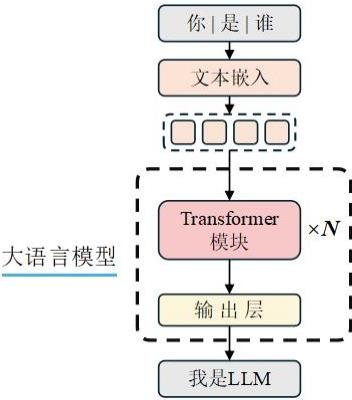
 点击查看大图
计量
- 文章访问数: 756
- HTML全文浏览量: 86
- PDF下载量: 137
- 被引次数: 0
