




Significance of Volatiles for Rare-Earth Mineralization: Insights from the Weishan and Xuezhuang Alkaline(-Carbonatite) Complexes, Shandong Province
-
摘要: 碱性岩-碳酸岩杂岩体贡献了全球逾半稀土资源,其源区性质与岩浆演化过程可导致成矿差异,但具体控制因素仍不清楚.选取华北克拉通东南缘同时代且相邻的微山(成矿)与薛庄(不成矿)碱性岩(-碳酸岩)体,对比其岩相学特征,全岩与长石、磷灰石的化学组成,以及Sr-Nd同位素特征.微山与薛庄正长岩的(87Sr/86Sr)t为0.707 297~0.709 173;εNd(t)均约为8.4,指示共同源于富集岩石圈地幔. 微山岩体更富萤石、重晶石、磷灰石、方解石等挥发分矿物,其正长岩中CaO、P2O5含量更低,而Sr、Ba、Th、U等流体活动元素更高;微山长石更贫Ca,磷石F含量亦更高.微山和薛庄岩体虽源区一致,但微山更高的挥发份促进了更高程度的岩浆演化,进而促成稀土成矿.Abstract: Alkaline-carbonatite complexes host more than half of the world's rare-earth element (REE) resources. However, the key factors controlling REE fertility remain uncertain. In this study, we present petrography, whole-rock geochemistry, feldspar and apatite compositions, and Sr-Nd isotopes for the coeval Weishan and Xuezhuang alkaline (-carbonatite) complexes along the southeastern margin of the North China Craton. The Weishan complex is REE-mineralized, whereas the Xuezhuang complex is barren. Syenites from the two complexes show similar isotopic compositions, with (87Sr/86Sr)t = 0.707 297~0.709 173 and εNd(t)~+8.4, suggesting derivation from a common enriched lithospheric mantle source. In contrast, the Weishan complex contains more volatile-bearing minerals (fluorite, barite, apatite, and calcite) and displays distinct geochemical features, including lower CaO and P2O5 contents but higher Sr, Ba, Th, and U relative to Xuezhuang. Feldspar from Weishan shows lower Ca contents (lower anorthite component), and apatite has higher F contents. These mineralogical and geochemical differences indicate a higher volatile budget in the Weishan magma system, which promoted more advanced magmatic differentiation and ultimately facilitated REE mineralization.
-
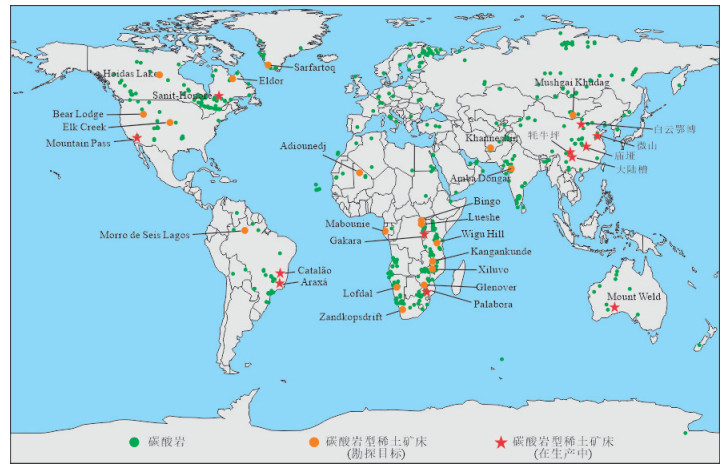
图 1 全球主要碳酸岩型稀土矿床分布简图(修改自Woolley and Kjarsgaard, 2008)
Fig. 1. Simplified global distribution map of major carbonatite-types of rare earth element (REE) deposits (modified after Woolley and Kjarsgaard, 2008)
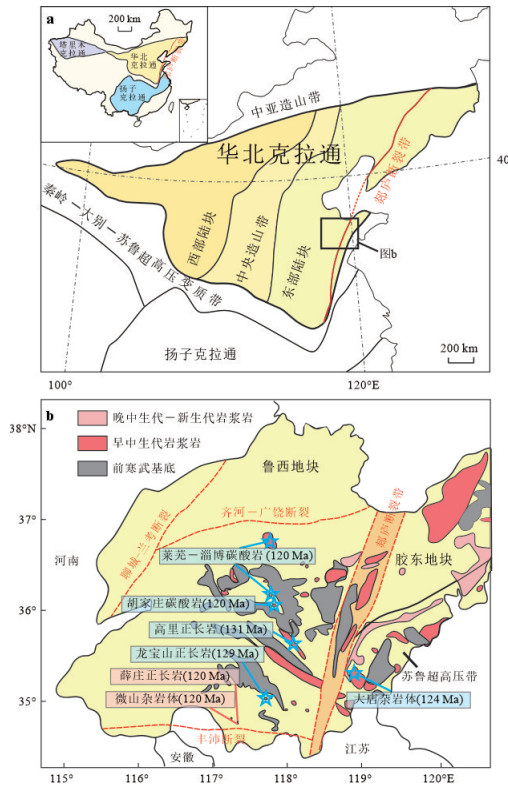
图 2 (a) 华北克拉通简化构造图,显示主要构造单元及其边界(修改自Huang et al, 2024); (b)鲁西地块地质简图,其中标识了中、新生代岩浆岩的分布范围及微山和薛庄的地理位置(修改自Zeng et al, 2022)
Fig. 2. (a) Simplified tectonic map of the North China Carton, showing the major tectonic units and their boundaries. (modified after Huang et al., 2024); (b) Simplified geological map of the Shandong province in the eastern North China Craton, showing the distribution of Mesozoic-Cenozoic magmatic rocks and locations of Weishan and Xuezhuang (modified after Zeng et al., 2022)
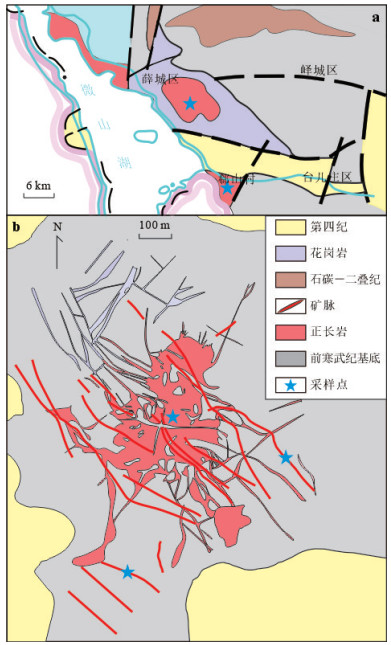
图 3 微山、薛庄正长岩地质简图,蓝色星标标出了采样地点(修改自孔庆友等,2006)
Fig. 3. Detailed geological map of the Weishan and Xuezhuang complex. Blue stars indicate sampling locations (modified after Kong et al., 2006)
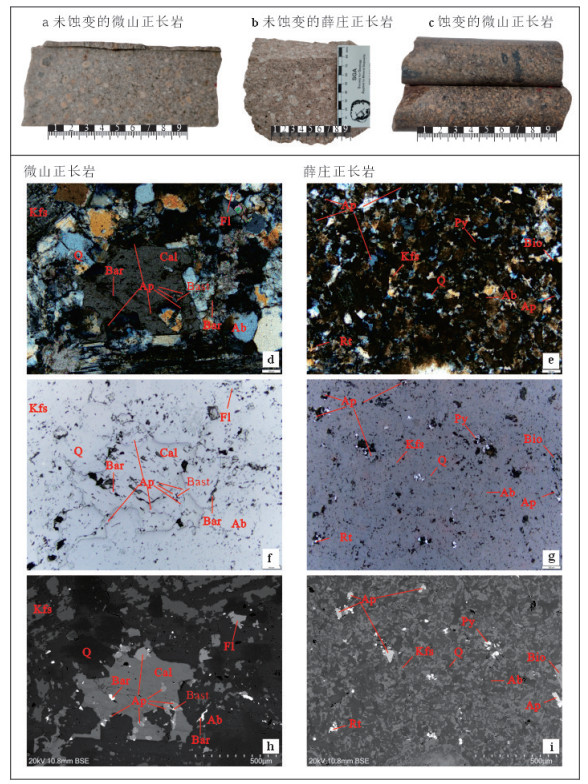
图 4 (a~c)采自微山和薛庄正长岩的手标本样品: (a)采自钻孔的未蚀变微山正长岩样品;(b)采自地表的未蚀变薛庄正长岩样品;(c)采自钻孔的、受到后期热液矿物叠加的蚀变微山正长岩样品; (d~i)微山和薛庄正长岩样品的透反射光显微照片和背散射电子(BSE)图像
矿物缩写:Ab. 钠长石;Ap. 磷灰石;Bar. 重晶石;Bast. 氟碳铈矿;Bio. 黑云母;Fl. 萤石;Kfs. 钾长石;Rt. 金红石;Py. 黄铁矿;Q. 石英
Fig. 4. (a~c) Hand specimens of syenites from Weishan and Xuezhuang: (a)A unaltered syenite sample in Weishan from drill core; (b)A unaltered syenite sample in Xuezhuang from surface outcrop; (c) A altered syenite in Weishan from drill core with overprinted hydrothermal minerals. (d-i) Transmitted/reflected light photomicrographs and backscattered electron (BSE) images of Weishan and Xuezhuang syenites
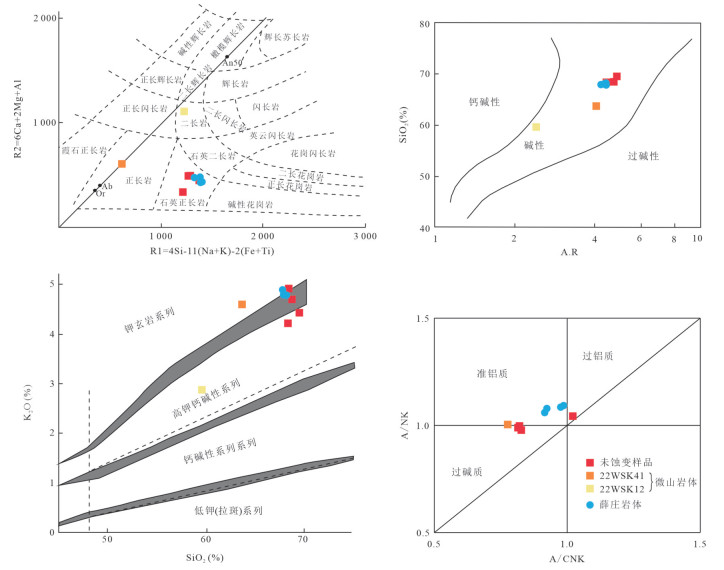
图 5 微山和薛庄正长岩主量元素特征
Fig. 5. Major element characteristics of Weishan and Xuezhuang syenites
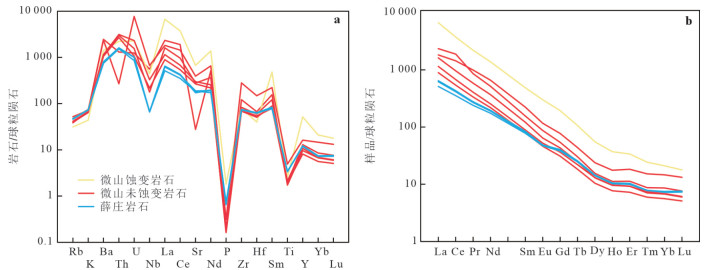
图 6 微山和薛庄正长岩微量元素(a)、稀土元素(b)特征
其中稀土元素使用球粒陨石标准化,微量元素使用原始地幔标准化
Fig. 6. Primitive mantle-normalized trace element spider diagrams(a) and chondrite-normalized REE patterns(b) for Weishan and Xuezhuang syenites
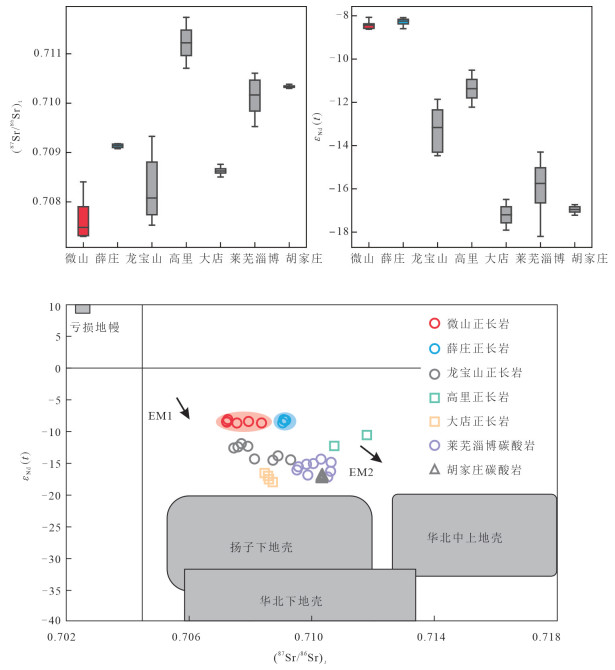
图 7 微山和薛庄正长岩及华北克拉通周边正长岩、碳酸岩全岩Sr同位素和Nd同位素组成(Ying et al., 2004; 蓝廷广, 2011; Huang et al., 2024)
华北下地壳和中上地壳以及扬子下地壳范围蓝廷广(2011)
Fig. 7. Whole-rock Sr and Nd isotopic compositions of Weishan/Xuezhuang syenites and adjacent syenites/carbonatites in the North China Craton (Ying et al., 2004; Lan, 2011; Huang et al., 2024)
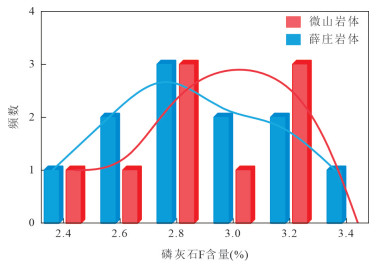
图 8 微山和薛庄正长岩岩体磷灰石F含量直方图分布图解
Fig. 8. Histograms showing F content distribution in apatite from Weishan and Xuezhuang syenites
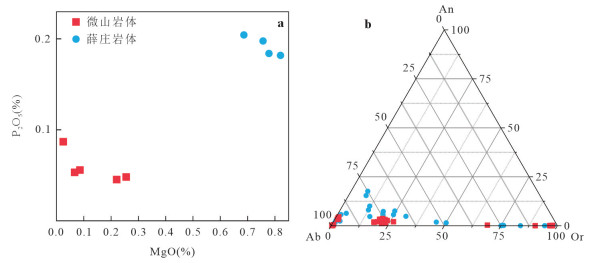
图 9 (a)微山和薛庄正长岩全岩MgO-P2O5图; (b)微山和薛庄正长岩长石三元图解
Fig. 9. (a) MgO vs. P2O5 diagram for Weishan and Xuezhuang syenites; (b) Ternary feldspar classification diagram for Weishan and Xuezhuang syenites
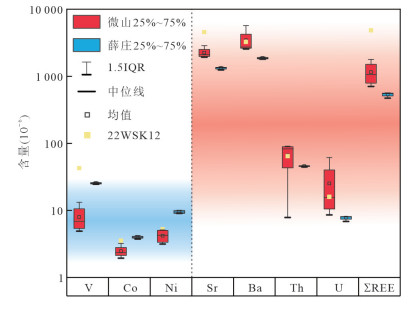
图 10 微山和薛庄正长岩全岩主微量元素箱线图
红色方框代表未蚀变的微山正长岩体数据,蓝色方框代表未蚀变的薛庄正长岩体数据,粉色正方形代表蚀变的微山正长岩数据
Fig. 10. Box plots of whole-rock major and trace elements for Weishan and Xuezhuang syenites
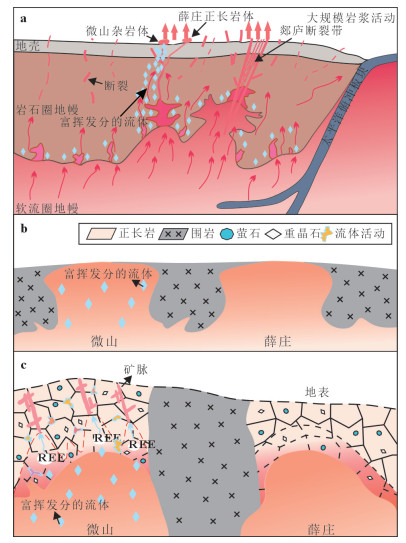
图 11 微山和薛庄正长岩体成因模式图(未绘制成比例尺)
a. 太平洋板块向西俯冲引发岩石圈减薄,促进地幔上升;b. 熔体携带稀土元素沿着深部断裂上升,侵入基底岩石;c.由于微山存在丰富的挥发分,因此在微山形成正长岩体的同时稀土元素在晚期富集成矿,形成稀土矿脉,而薛庄岩体未分异出富含挥发份的熔流体,稀土元素在演化过程中逐渐被稀释,因而未成矿
Fig. 11. Genetic model for Weishan and Xuezhuang syenites (not to scale)
表 1 山东微山和薛庄样品简介
Table 1. Sample information for the Weishan and Xuezhuang complexes, Shandong Province
采样地点 样号 岩性 微山 21WSK12 未蚀变的正长岩 22WSK12 强烈蚀变的正长岩 22WSK41 轻度蚀变的正长岩 22WSK55 未蚀变的正长岩 22WSK54 未蚀变的正长岩 22WSK58 未蚀变的正长岩 薛庄 21XZ01 未蚀变的正长岩 21XZ02 未蚀变的正长岩 21XZ03 未蚀变的正长岩 21XZ04 未蚀变的正长岩  下载: 导出CSV
-
Brooker, R. A., Kjarsgaard, B. A., 2011. Silicate-Carbonate Liquid Immiscibility and Phase Relations in the System SiO2-Na2O-Al2O3-CaO-CO2 at 0.1-2.5 GPa with Applications to Carbonatite Genesis. Journal of Petrology, 52(7/8): 1281-1305. https://doi.org/10.1093/petrology/egq081 Bühn, B., 2008. The Role of the Volatile Phase for REE and Y Fractionation in Low-Silica Carbonate Magmas: Implications from Natural Carbonatites, Namibia. Mineralogy and Petrology, 92(3): 453-470. https://doi.org/10.1007/s00710-007-0214-4 Castor, S. B., 2008. The Mountain Pass Rare-Earth Carbonatite and Associated Ultrapotassic Rocks, California. The Canadian Mineralogist, 46(4): 779-806. https://doi.org/10.3749/canmin.46.4.779 Chandler, R., Bhat, G., Mavrogenes, J., et al., 2024. The Primary Geology of the Paleoproterozoic Mt Weld Carbonatite Complex, Western Australia. Journal of Petrology, 65(2): egae007. https://doi.org/10.1093/petrology/egae007 Chen, S., Li, X. P., Kong, F. M., et al., 2018. Metamorphic Evolution and Zircon U-Pb Ages of the Nanshankou Mafic High Pressure Granulites from the Jiaobei Terrane, North China Craton. Journal of Earth Science, 29(5): 1219-1235. https://doi.org/10.1007/s12583-017-0956-9 Dowman, E., Wall, F., Treloar, P. J., et al., 2017. Rare-Earth Mobility as a Result of Multiple Phases of Fluid Activity in Fenite around the Chilwa Island Carbonatite, Malawi. Mineralogical Magazine, 81(6): 1367-1395. https://doi.org/10.1180/minmag.2017.081.007 Durand, C., Baumgartner, L. P., Marquer, D., 2015. Low Melting Temperature for Calcite at 1000 Bars on the Join CaCO3-H2O-Some Geological Implications. Terra Nova, 27(5): 364-369. https://doi.org/10.1111/ter.12168 Fan, H. R., Niu, H. C., Li, X. C., et al., 2020. The Types, Ore Genesis and Resource Perspective of Endogenic REE Deposits in China. Chinese Science Bulletin, 65(33): 3778-3793. (in Chinese with English abstract). doi: 10.1360/TB-2020-0432 Feng, X. P., 2020. Geological Characteristics and Metallogenic Prediction of the Weishan Rare Earth Deposit in Shandong Province(Dissertation). China University of Geosciences, Beijing(in Chinese with English abstract). Guzmics, T., Mitchell, R. H., Szabó, C., et al., 2011. Carbonatite Melt Inclusions in Coexisting Magnetite, Apatite and Monticellite in Kerimasi Calciocarbonatite, Tanzania: Melt Evolution and Petrogenesis. Contributions to Mineralogy and Petrology, 161(2): 177-196. https://doi.org/10.1007/s00410-010-0525-z Harmer, R. E., Gittins, J., 1998. The Case for Primary, Mantle-Derived Carbonatite Magma. Journal of Petrology, 39(11/12): 1895-1903. https://doi.org/10.1093/petroj/39.11-12.1895 Hou, Z. Q., Liu, Y., Tian, S. H., et al., 2015. Formation of Carbonatite-Related Giant Rare-Earth-Element Deposits by the Recycling of Marine Sediments. Scientific Reports, 5: 10231. https://doi.org/10.1038/srep10231 Huang, L., Li, X. C., Su, J. H., et al., 2024. Genesis of the Hujiazhuang Apatite-Rich Carbonatite Complex in North China and Its Implication for the REE Fertility of the Carbonatite System. Journal of Asian Earth Sciences, 267: 106149. https://doi.org/10.1016/j.jseaes.2024.106149 Jago, B. C., Gittins, J., 1991. The Role of Fluorine in Carbonatite Magma Evolution. Nature, 349(6304): 56-58. https://doi.org/10.1038/349056a0 Jochum, K. P., Nohl, U., 2008. Reference Materials in Geochemistry and Environmental Research and the GeoReM Database. Chemical Geology, 253(1/2): 50-53. https://doi.org/10.1016/j.chemgeo.2008.04.002 Goodenough, K. M., Deady, E. A., Beard, C. D., et al., 2021. Carbonatites and Alkaline Igneous Rocks in Post-Collisional Settings: Storehouses of Rare Earth Elements. Journal of Earth Science, 32(6): 1332-1358. https://doi.org/10.1007/s12583-021-1500-5 Kong, Q. Y., Zhang, T. Z., Yu, X. F., 2006. Shandong Deposits. Shandong Science and Technology Press, Jinan, 1-902(in Chinese with English abstract). Lan, T. G., 2011. Mesozoic Alkaline Rocks and Related Deposits in the Southeastern North China Craton(Dissertation). Chinese Academy of Sciences, Beijing(in Chinese with English abstract). Le Bas, M. J., 2008. Fenites Associated with Carbonatites. The Canadian Mineralogist, 46(4): 915-932. https://doi.org/10.3749/canmin.46.4.915 Li, X. C., Fan, H. R., Su, J. H., et al., 2024. Giant Rare Earth Element Accumulation Related to Voluminous, Highly Evolved Carbonatite: a Microanalytical Study of Carbonate Minerals from the Bayan Obo Deposit, China. Economic Geology, 119(2): 373-393. https://doi.org/10.5382/econgeo.5060 Martin, L. H. J., Schmidt, M. W., Mattsson, H. B., et al., 2013. Element Partitioning between Immiscible Carbonatite and Silicate Melts for Dry and H2O-Bearing Systems at 1~3 GPa. Journal of Petrology, 54(11): 2301-2338. https://doi.org/10.1093/petrology/egt048 Nelson, D. R., Chivas, A. R., Chappell, B. W., et al., 1988. Geochemical and Isotopic Systematics in Carbonatites and Implications for the Evolution of Ocean-Island Sources. Geochimica et Cosmochimica Acta, 52(1): 1-17. https://doi.org/10.1016/0016-7037(88)90051-8 Orris, G. J., Grauch, R. I., 2002. Rare Earth Element Mines, Deposits and Occurrences. US Department of the Interior, US Geological Survey, USA, 189. Simandl, G. J., Paradis, S., 2018. Carbonatites: Related Ore Deposits, Resources, Footprint, and Exploration Methods. Applied Earth Science, 127(4): 123-152. https://doi.org/10.1080/25726838.2018.1516935 Song, W. L., Xu, C., Wang, L. J., et al., 2013. Research Progress on the Metallogenesis of Endogenetic Rare-Earth Deposits Related to Carbonatite-Alkaline Complex. Acta Scientiarum Naturalium Universitatis Pekinensis, 49(4): 725-740(in Chinese with English abstract). Veksler, I. V., Dorfman, A. M., Dulski, P., et al., 2012. Partitioning of Elements between Silicate Melt and Immiscible Fluoride, Chloride, Carbonate, Phosphate and Sulfate Melts, with Implications to the Origin of Natrocarbonatite. Geochimica et Cosmochimica Acta, 79: 20-40. https://doi.org/10.1016/j.gca.2011.11.035 Wang, C., Liu, J. C., Zhang, H. D., et al., 2019. Geochronology and Mineralogy of the Weishan Carbonatite in Shandong Province, Eastern China. Geoscience Frontiers, 10(2): 769-785. https://doi.org/10.1016/j.gsf. 2018. 07.008 doi: 10.1016/j.gsf.2018.07.008 Weidendorfer, D., Schmidt, M. W., Mattsson, H. B., 2017. A Common Origin of Carbonatite Magmas. Geology, 45(6): 507-510. https://doi.org/10.1130/g38801.1 Weis, D., Kieffer, B., Maerschalk, C., et al., 2006. High-Precision Isotopic Characterization of USGS Reference Materials by TIMS and MC-ICP-MS. Geochemistry, Geophysics, Geosystems, 7(8): 2006GC001283. https://doi.org/10.1029/2006GC001283 Woolley, A. R., Kjarsgaard, A., 2008. Carbonatite Occurrences of the World: Map and Database. Geological Survey of Canada Open File, 5796: 1-22. Wu, F. Y., Lin, J. Q., Wilde, S. A., et al., 2005. Nature and Significance of the Early Cretaceous Giant Igneous Event in Eastern China. Earth and Planetary Science Letters, 233(1/2): 103-119. https://doi.org/10.1016/j.epsl. 2005. 02.019 doi: 10.1016/j.epsl.2005.02.019 Xu, Y. G., Huang, X. L., Ma, J. L., et al., 2004. Crust-Mantle Interaction during the Tectono-Thermal Reactivation of the North China Craton: Constraints from SHRIMP Zircon U-Pb Chronology and Geochemistry of Mesozoic Plutons from Western Shandong. Contributions to Mineralogy and Petrology, 147(6): 750-767. https://doi.org/10.1007/s00410-004-0594-y Yang, K. F., Fan, H. R., Pirajno, F., et al., 2019. The Bayan Obo (China) Giant REE Accumulation Conundrum Elucidated by Intense Magmatic Differentiation of Carbonatite. Geology, 47(12): 1198-1202. https://doi.org/10.1130/g46674.1 Yaxley, G. M., Anenburg, M., Tappe, S., et al., 2022. Carbonatites: Classification, Sources, Evolution, and Emplacement. Annual Review of Earth and Planetary Sciences, 50: 261-293. https://doi.org/10.1146/annurev-earth-032320-104243 Ying, J. F., Zhou, X. H., Zhang, H. F., 2004. Geochemical and Isotopic Investigation of the Laiwu? Zibo Carbonatites from Western Shandong Province, China, and Implications for Their Petrogenesis and Enriched Mantle Source. Lithos, 75(3/4): 413-426. https://doi.org/10.1016/j.lithos. 2004. 04.037 doi: 10.1016/j.lithos.2004.04.037 Ying, J. F., Zhou, X. H., Zhang, H. F., 2006. The Geochemical Variations of Mid-Cretaceous Lavas across Western Shandong Province, China and Their Tectonic Implications. International Journal of Earth Sciences, 95(1): 68-79. https://doi.org/10.1007/s00531-005-0509-9 Yuan, X. Y., Zhong, R. C., Xiong, X., et al., 2023. Transition from Carbonatitic Magmas to Hydrothermal Brines: Continuous Dilution or Fluid Exsolution? Science Advances, 9(29): eadh0458. https://doi.org/10.1126/sciadv.adh0458 Zeng, X., Li, X. C., Fan, H. R., et al., 2022. Generation of REE-Rich Syenite-(Carbonatite) Complex through Lithosphere-Asthenosphere Interaction: an In-Situ Sr-Nd-O Isotopic Study of the Mesozoic Weishan Pluton, Northern China. Journal of Asian Earth Sciences, 230: 105191. https://doi.org/10.1016/j.jseaes.2022.105191 Zhu, R. X., Sun, W. D., 2021. The Big Mantle Wedge and Decratonic Gold Deposits. Science China Earth Sciences, 64(9): 1451-1462. https://doi.org/10.1007/s11430-020-9733-1 Zhu, R. X., Yang, J. H., Wu, F. Y., 2012. Timing of Destruction of the North China Craton. Lithos, 149: 51-60. https://doi.org/10.1016/j.lithos.2012.05.013 范宏瑞, 牛贺才, 李晓春, 等, 2020. 中国内生稀土矿床类型, 成矿规律与资源展望. 科学通报, 65(33): 3778-3793. 冯玺平, 2020. 山东省微山稀土矿床地质特征与成矿预测(硕士学位论文). 北京: 中国地质大学. 孔庆友, 张天祯, 于学峰, 2006. 山东矿床. 济南: 山东科学技术出版社, 1-902. 蓝廷广, 2011. 华北克拉通东南缘中生代碱性岩及相关典型矿床研究(博士学位论文). 北京: 中国科学院. 宋文磊, 许成, 王林均, 等, 2013. 与碳酸岩-碱性杂岩体相关的内生稀土矿床成矿作用研究进展. 北京大学学报(自然科学版), 49(4): 725-740. -
 曾曦附表.xlsx

-

 点击查看大图
计量
- 文章访问数: 186
- HTML全文浏览量: 39
- PDF下载量: 9
- 被引次数: 0
