




Stability Assessment of CO2 Geological Storage Based on a Fracture Network Model
-
摘要: 裂缝作为CO2地质封存的主要储集空间和渗流通道,直接影响CO2的封存效率及长期封存的安全性.基于无人机倾斜摄影技术,构建了鄂尔多斯盆地裂缝性砂岩储层离散裂缝网络模型,并基于多物理场耦合仿真软件COMSOL Multiphysics建立了考虑基质‒层理‒裂缝的CO2-水两相流固耦合数值模型.研究发现,CO2优先沿高渗透性的层理和裂缝运移,横向层理与低倾角、低连通性的自然裂缝阻滞垂向渗流,降低了CO2逃逸到盖层的风险;裂缝网络加速了压力传递,诱发显著位移响应,初始位移增长率是基质模型的6.2倍.因此,考虑基质‒层理‒裂缝多重介质系统对CO2地质封存的稳定性具有重要意义.Abstract: Fractures serve as the primary storage space and seepage pathways for CO2 geological storage, directly influencing storage efficiency and long-term containment security. This study employed UAV oblique photogrammetry to construct a discrete fracture network (DFN) model of a fractured sandstone reservoir within the Ordos Basin. Subsequently, a fluid-solid coupling numerical model for CO2-water two-phase flow was established using the multiphysics simulation software COMSOL Multiphysics, explicitly accounting for the matrix-bedding-fracture system. Key findings reveal that CO2 preferentially migrates along high-permeability bedding planes and fractures. Horizontal bedding, combined with low-dip, low-connectivity natural fractures, impedes vertical seepage, thereby reducing the risk of CO2 escape into the caprock. The fracture network accelerates pressure transmission, inducing significant displacement responses. The initial rate of displacement increase was found to be 6.2 times higher than that observed in the matrix model. Consequently, accurately representing the multi-porosity system encompassing the matrix, bedding, and fractures is crucial for assessing the stability of CO2 geological storage.
-
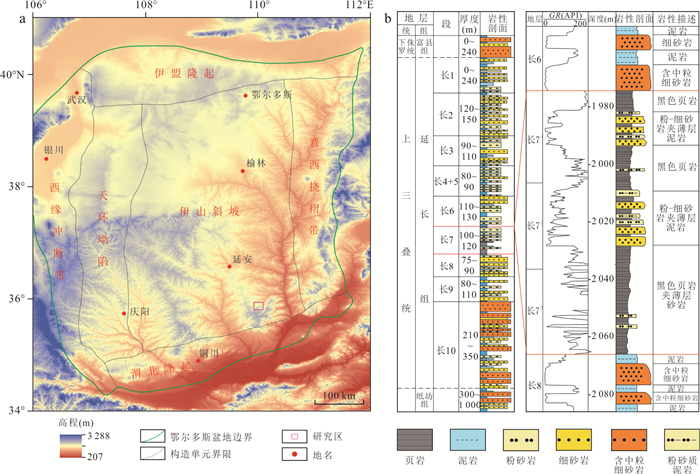
图 1 (a) 鄂尔多斯盆地高程图;(b)鄂尔多斯盆地延长组柱状图
Fig. 1. (a) Elevation map of Ordos Basin; (b) strata characteristics of Chang 7 Member in Ordos Basin
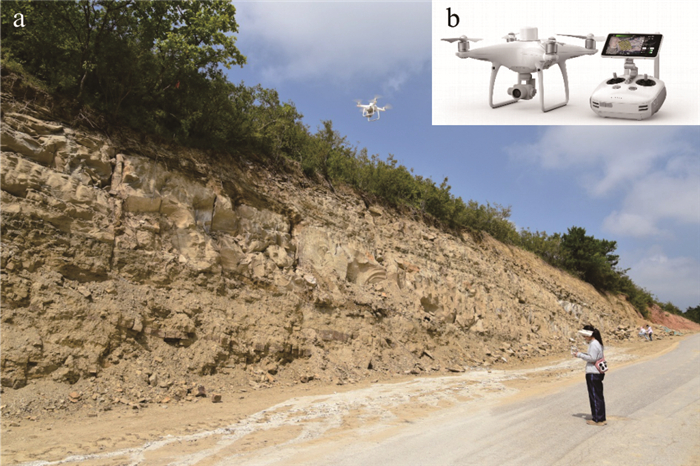
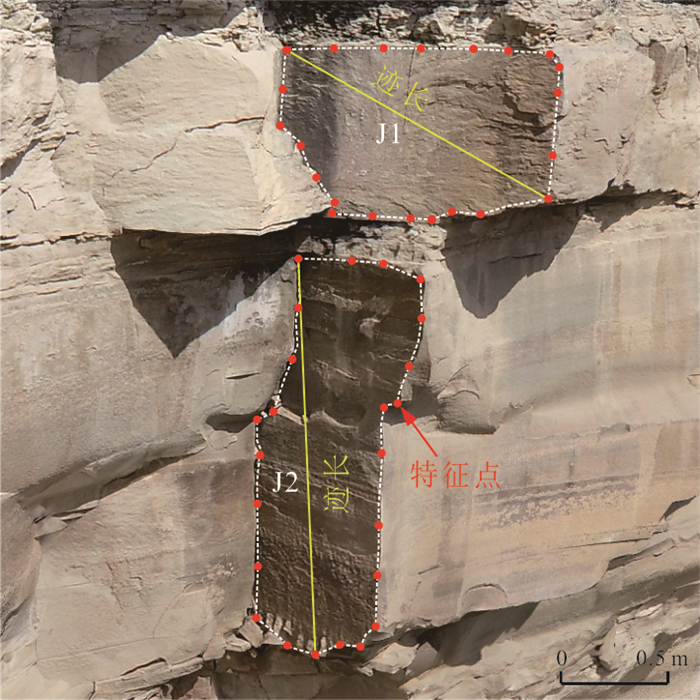
图 2 基于无人机摄影测量技术的延长组砂岩露头裂缝测绘
Fig. 2. Fracture mapping from a sandstone outcrop of Yangchang Formation using unmanned aerial vehicle photogrammetry
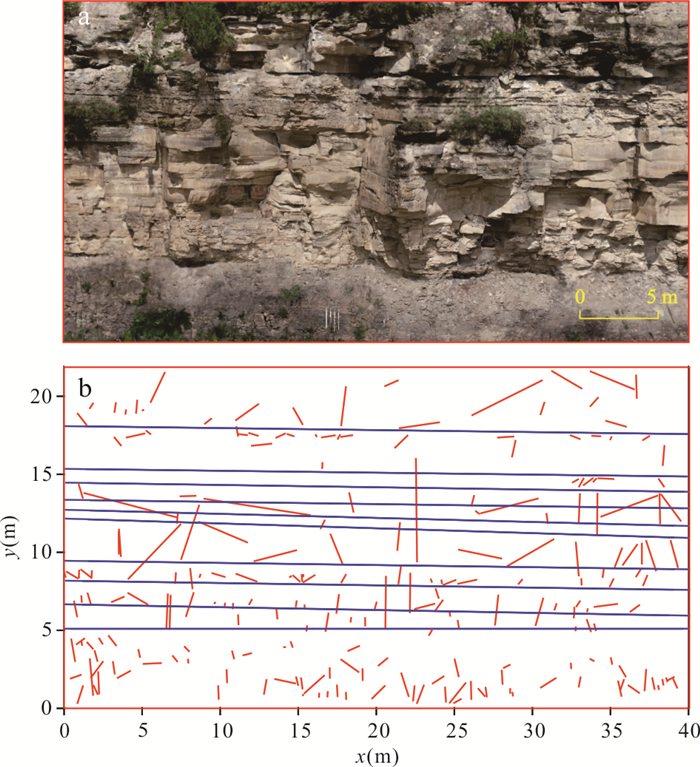
图 5 (a)地质剖面图;(b)天然裂隙迹线空间分布(红色线段表示裂隙,蓝色线段表示层理)
Fig. 5. (a) Geological section; (b) spatial distribution of natural fracture traces with red segments representing joints and blue segments indicating bedding planes
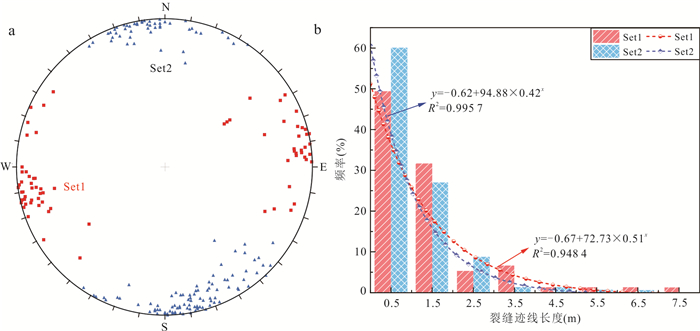
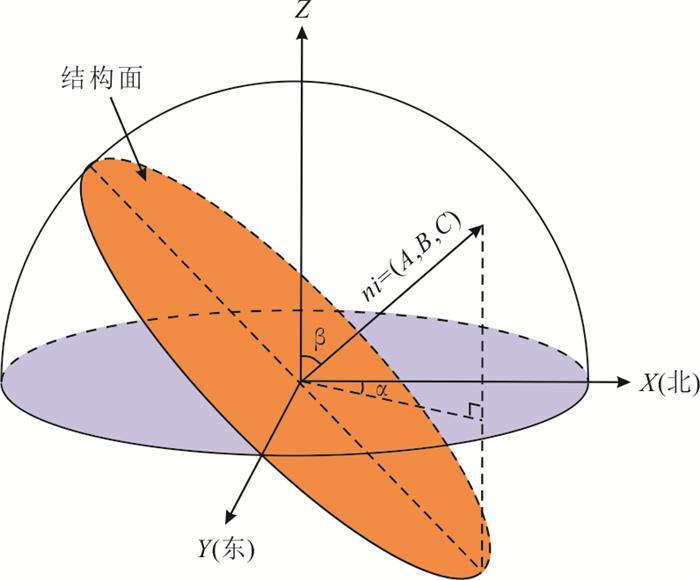
图 6 天然裂缝上半球等面积投影图(a)和天然裂隙迹长分布(b)
Fig. 6. Upper hemisphere and equal area projection of the mapped joints (a) and distribution of joint trace length (b)
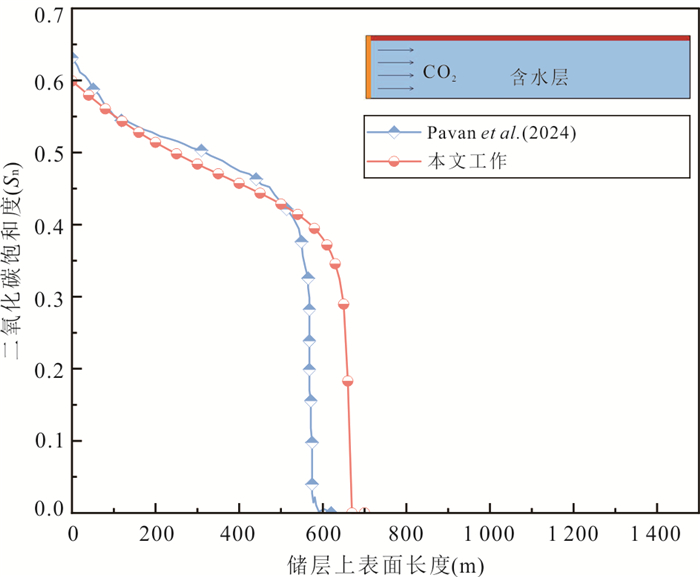
图 8 模型上边界CO2饱和度验证
Fig. 8. Verification of the CO2 saturation profiles of the present model
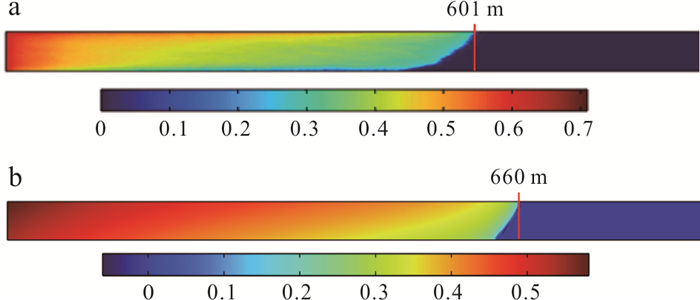
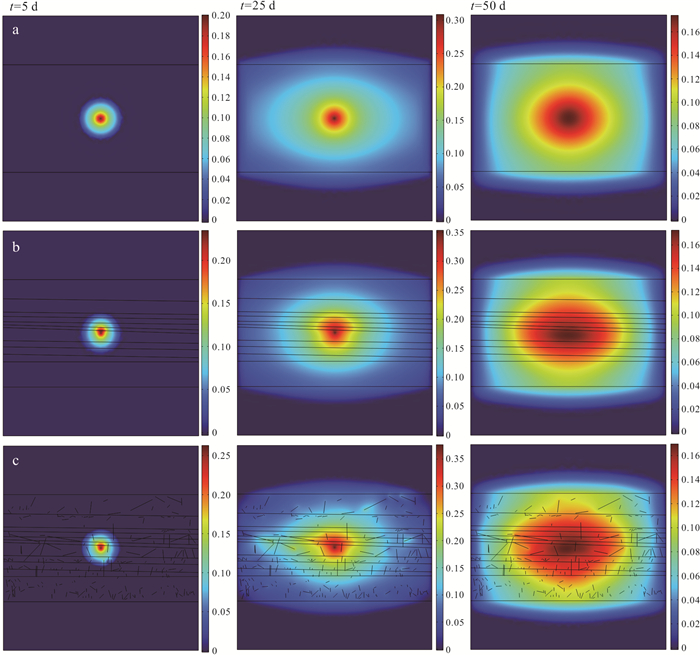
图 10 不同时间下三种地质模型的CO2饱和度分布
Fig. 10. CO2 saturation distribution in three geological models at different times
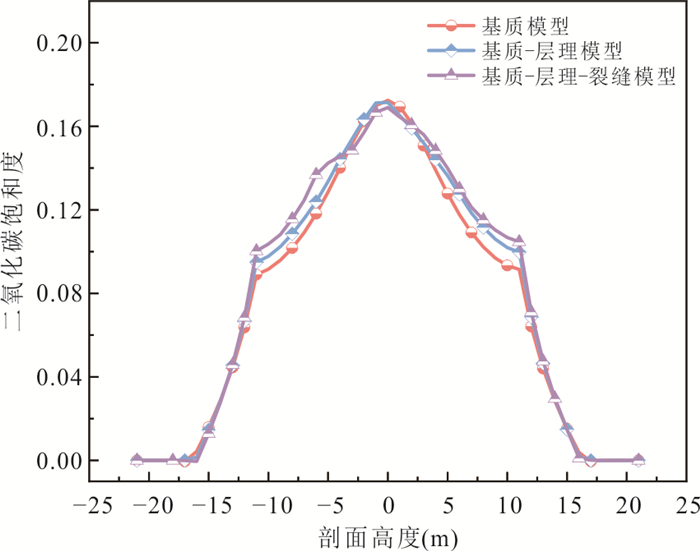
图 11 关井25 d后三种地质模型沿剖面深度的CO2饱和度分布
Fig. 11. CO2 saturation distribution along depth profile in three geological models after 25-day shut-in period
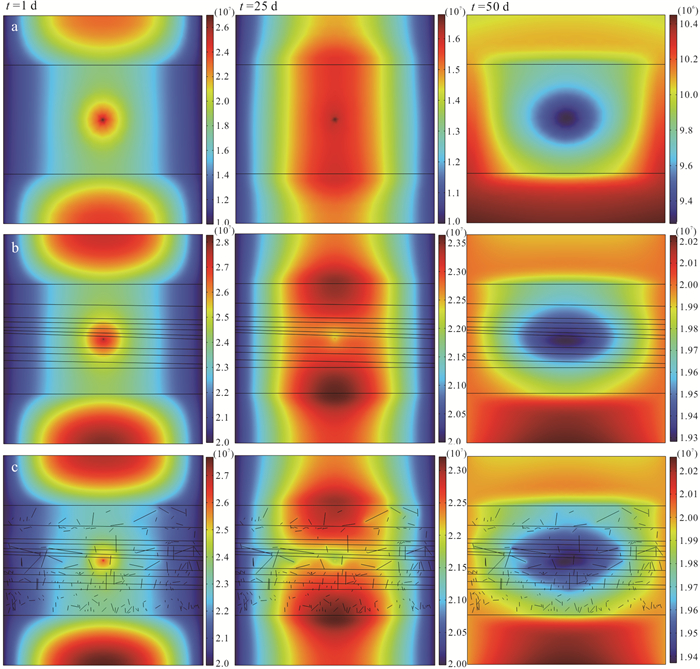
图 12 关井25 d后三种地质模型的表面压力
Fig. 12. Distribution of top surface pressure in three geological models after 25-day shut-in period
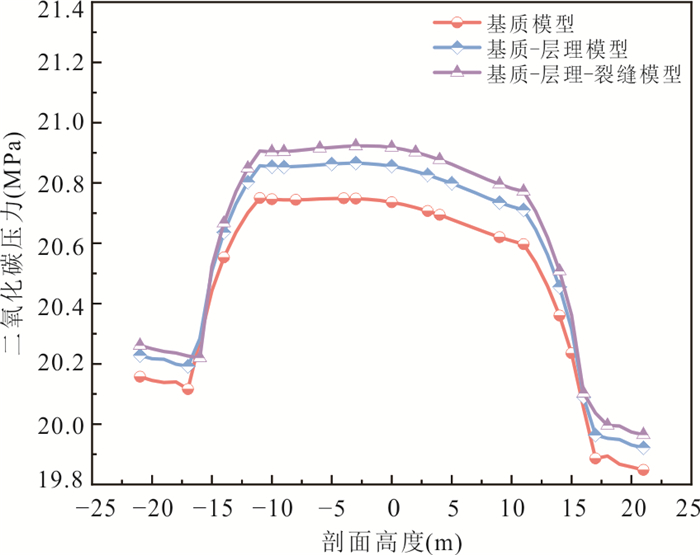
图 13 关井25 d后三种地质模型沿剖面深度的CO2压力
Fig. 13. Distribution of CO2 pressure along depth profile in three geological models after 25-day shut-in period
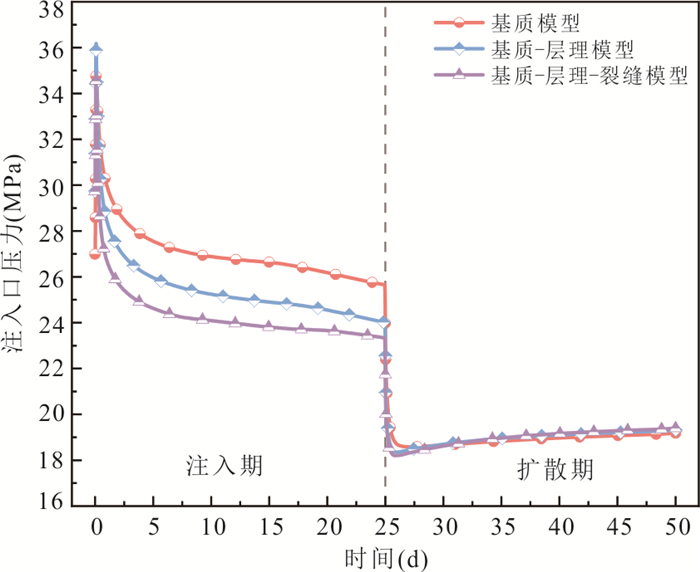
图 14 不同地质条件下注入口压力随时间演化规律
Fig. 14. Temporal evolution of wellbore pressure at injection point under three geological configurations
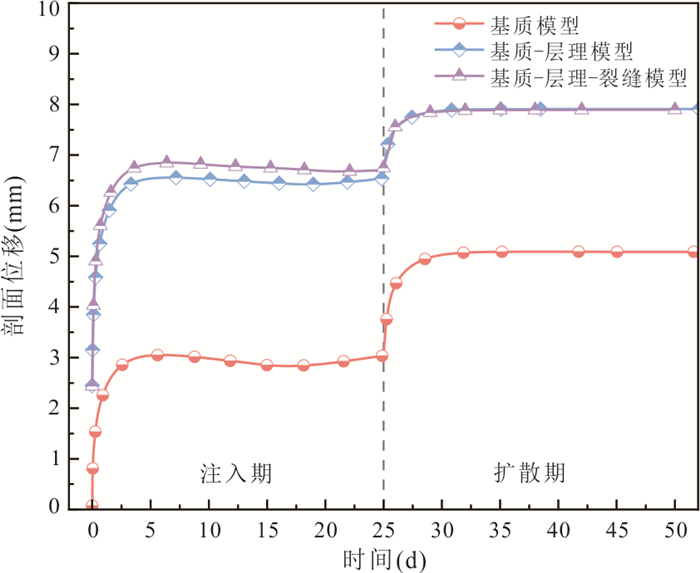
图 15 不同地质条件下垂向位移沿剖面深度的时间演化规律
Fig. 15. Temporal evolution of vertical displacement along depth profile under three geological configurations
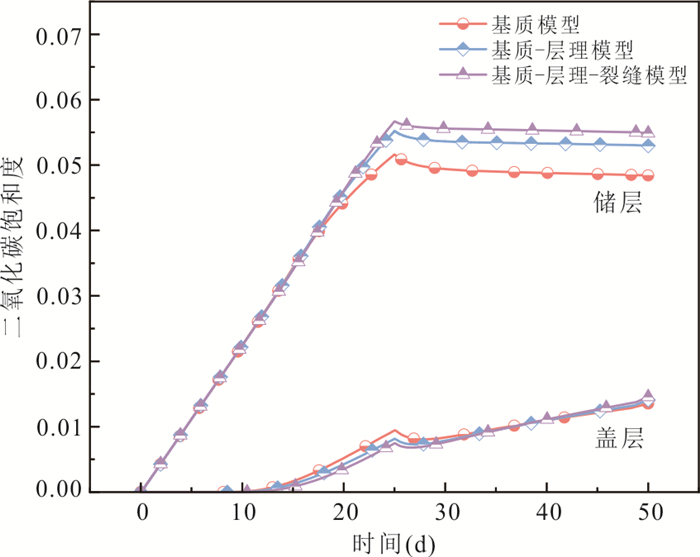
图 16 三种地质模型中储盖层系统CO2体积分数时间演化规律
Fig. 16. Spatiotemporal evolution of CO2 volume fraction in reservoir-caprock systems under three geological configurations
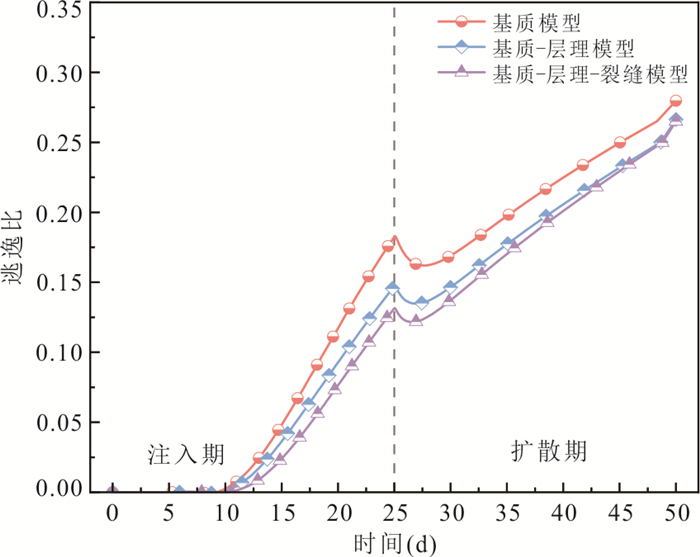
图 17 不同地质条件下盖层CO2累计逃逸比
Fig. 17. Cumulative CO2 leakage rates through caprock under three geological configurations
表 1 模型计算参数
Table 1. Computational parameters
参数 取值 参数物理意义 取值来源 rin 0.447 5×10‒6 m/s 注入速率 Pavan et al. (2024) ρw 1 093 kg/m3 盐水密度 Nordbotten et al. (2005) ρv 723 kg/m3 CO2密度 Nordbotten et al. (2005) μw 8.485×10‒4 Pa·S 盐水粘度 Nordbotten et al. (2005) φv 0.594×10‒4 Pa·S CO2粘度 Nordbotten et al. (2005) Srw 0.2 残余盐水饱和度 Srn 0 残余CO2饱和度 T0 348.15 K 储层温度 Wang et al. (2025) P0 22 MPa 初始地层压力 Wang et al. (2025) Pec 1.9 MPa 入口毛细压力 m 0.5 本构关系常数 PL 5 MPa Langmuir吸附压力 Sun et al. (2020) VL 0.005 m3/ kg Langmuir吸附体积 Sun et al. (2020) φr 0.102 5 砂岩初始孔隙率 杜书恒等(2019) φc 0.025 8 页岩初始孔隙率 白莹等(2022) kr 2×10‒16 m2 砂岩初始渗透率 杜书恒等(2019) kc 1×10‒17 m2 页岩初始渗透率 白莹等(2022) kb 2×10‒15 m2 层理渗透率 df 0.1 mm 裂缝开度 付金华等(2020) Er 27.71 GPa 砂岩杨氏模量 Wang et al. (2025) vr 0.241 砂岩泊松比 Wang et al. (2025) ρr 2 600 kg/m3 砂岩密度 Wang et al. (2025) Ec 22 GPa 页岩杨氏模量 李帅等(2020) vc 0.25 页岩泊松比 李帅等(2020) ρc 2 650 kg/m3 页岩密度 李帅等(2020) α 0.8 Bito系数  下载: 导出CSV
-
Bai, Y., Bai, B., Xu, W. L., et al., 2022. Pore Characteristics of Shale and Occurrence Mode of Shale Oil in Member 7 of Yanchang Formation in Southern Ordos Basin. Acta Petrolei Sinica, 43(10): 1395-1408 (in Chinese with English abstract). Bigi, S., Battaglia, M., Alemanni, A., et al., 2013. CO2 Flow through a Fractured Rock Volume: Insights from Field Data, 3D Fractures Representation and Fluid Flow Modeling. International Journal of Greenhouse Gas Control, 18: 183-199. https://doi.org/10.1016/j.ijggc.2013.07.011 Cai, B. F., Zhang, L., Lei, Y., et al., 2023. A Deeper Understanding of the CO2 Emission Pathway under China's Carbon Emission Peak and Carbon Neutrality Goals. Engineering, 9(11): 27-29. Du, S. H., Shi, Y. M., Guan, P., 2019. Fluid Filling Rule in Intra-Granular Pores of Feldspar and Fractal Characteristics: A Case Study on Yanchang Formation Tight Sandstone Reservoir in Ordos Basin. Earth Science, 44(12): 4252-4263 (in Chinese with English abstract). Fu, J. H., Li, S. X., Niu, X. B., et al., 2020. Geological Characteristics and Exploration of Shale Oil in Chang 7 Member of Triassic Yanchang Formation, Ordos Basin, NW China. Petroleum Exploration and Development, 47(5): 870-883 (in Chinese with English abstract). Han, L., Shi, X., Ni, H. J., et al., 2025. Fracture Initiation and Propagation Behaviours of Supercritical CO2 Enhanced Fracturing in Layered Shale of Horizontal Wells. Geoenergy Science and Engineering, 252: 213938. https://doi.org/10.1016/j.geoen.2025.213938 Hyman, J. D., Jiménez-Martínez, J., Gable, C. W., et al., 2020. Characterizing the Impact of Fractured Caprock Heterogeneity on Supercritical CO2 Injection. Transport in Porous Media, 131(3): 935-955. https://doi.org/10.1007/s11242-019-01372-1 Jiang, L. L., Tian, L., Chen, Z. X., et al., 2025. Research on the Micro-Pore Structure and Multiscale Fractal Characteristics of Shale under Supercritical CO2 Action: A Case Study of the Chang 73 Submember in the Ordos Basin, China. Journal of Natural Gas Geoscience, 10(3): 159-178. https://doi.org/10.1016/j.jnggs.2025.05.003 Kong, D. H., Wu, F. Q., Saroglou, C., 2020. Automatic Identification and Characterization of Discontinuities in Rock Masses from 3D Point Clouds. Engineering Geology, 265: 105442. https://doi.org/10.1016/j.enggeo.2019.105442 Kong, X. Y., Chen, F. L., Chen, G. Q., 1999. Mathematical Models and Feature Parameters of Non Newtonian Liquid Flows in Porous Media. Journal of University of Science and Technology of China, 29(2): 141-147 (in Chinese with English abstract). Lee, I. H., Ni, C. F., 2015. Fracture-Based Modeling of Complex Flow and CO2 Migration in Three-Dimensional Fractured Rocks. Computers & Geosciences, 81: 64-77. https://doi.org/10.1016/j.cageo.2015.04.012 Li, D. C., Saraji, S., Jiao, Z. S., et al., 2023. An Experimental Study of CO2 Injection Strategies for Enhanced Oil Recovery and Geological Sequestration in a Fractured Tight Sandstone Reservoir. Geoenergy Science and Engineering, 230: 212166. https://doi.org/10.1016/j.geoen.2023.212166 Li, S., Chen, J. B., Wang, H. Q., et al., 2020. Experimental Study on the Scale Effect of Strength and Deformation of Chang 7 Shale in Ordos Basin. Journal of China Coal Society, 45(12): 4121-4131 (in Chinese with English abstract). Liao, Z. W., Yang, J. M., Zhong, X. Y., et al., 2024. Review on Research Progress of Carbon Dioxide Geological Sequestration Technology. Chinese Journal of Underground Space and Engineering, 20(S1): 497-507 (in Chinese with English abstract). Liu, Y. Q., Chen, J. P., Tan, C., et al., 2022. Intelligent Scanning for Optimal Rock Discontinuity Sets Considering Multiple Parameters Based on Manifold Learning Combined with UAV Photogrammetry. Engineering Geology, 309: 106851. https://doi.org/10.1016/j.enggeo.2022.106851 Nordbotten, J. M., Celia, M. A., Bachu, S., 2005. Injection and Storage of CO2 in Deep Saline Aquifers: Analytical Solution for CO2 Plume Evolution during Injection. Transport in Porous Media, 58(3): 339-360. https://doi.org/10.1007/s11242-004-0670-9 Oh, J., Kim, K. Y., Han, W. S., et al., 2013. Experimental and Numerical Study on Supercritical CO2/Brine Transport in a Fractured Rock: Implications of Mass Transfer, Capillary Pressure and Storage Capacity. Advances in Water Resources, 62: 442-453. https://doi.org/10.1016/j.advwatres.2013.03.007 Pavan, T. N. V., Devarapu, S. R., Govindarajan, S. K., 2024. Numerical Investigations on the Performance of Sc-CO2 Sequestration in Heterogeneous Deep Saline Aquifers under Non-Isothermal Conditions. Gas Science and Engineering, 130: 205437. https://doi.org/10.1016/j.jgsce.2024.205437 Qin, X. J., Wang, H., Xia, Y. X., et al., 2025. Pore-Scale Investigation of Water-CO2-Oil Flow in Shale Fractures for Enhanced Displacement Efficiency and CO2 Sequestration. Engineering Geology, 348: 107969. https://doi.org/10.1016/j.enggeo.2025.107969 Ren, F., Ma, G. W., Wang, Y., et al., 2017. Two-Phase Flow Pipe Network Method for Simulation of CO2 Sequestration in Fractured Saline Aquifers. International Journal of Rock Mechanics and Mining Sciences, 98: 39-53. https://doi.org/10.1016/j.ijrmms.2017.07.010 Rui, Z. H., Zeng, L. B., Dindoruk, B., 2025. Challenges in the Large-Scale Deployment of CCUS. Engineering, 44: 17-20. https://doi.org/10.1016/j.eng.2024.11.031 Sheng, D. N., Wang, H. M., Sheng, J. C., et al., 2025. Effect of Random Fracture Network Orientations on Sealing Performance of Caprock in CO2 Geological Sequestration. Earth Science, 50(1): 349-360 (in Chinese with English abstract). Su, X. C., Gong, L., Fu, X. F., et al., 2023. Fracture Distribution Characteristics and Effectiveness Evaluation of Tight Sandstone Reservoir of Chang 7 Member in Sanbian Area, Ordos Basin. Earth Science, 48(7): 2601-2613 (in Chinese with English abstract). Sun, H., Jia, C., Xiong, F., et al., 2024. Numerical Modelling of CO2 Leakage through Fractured Caprock Using an Extended Numerical Manifold Method. Engineering Analysis with Boundary Elements, 162: 327-336. https://doi.org/10.1016/j.enganabound.2024.02.013 Sun, Z. D., Song, X. M., Feng, G., et al., 2020. Influence of Supercritical, Liquid, and Gaseous CO2 on Fracture Behavior in Sandstone. Energy Science and Engineering, 8(11): 3788-3804. https://doi.org/10.1002/ese3.736 Wang, H. D., Chen, Y., Ma, G. W., 2020. Effects of Capillary Pressures on Two-Phase Flow of Immiscible Carbon Dioxide Enhanced Oil Recovery in Fractured Media. Energy, 190: 116445. https://doi.org/10.1016/j.energy.2019.116445 Wang, W., Liang, Z. Z., Zuo, J., et al., 2025. The Pore Structure Changes and CO2 Migration Dynamic Characteristics in Tight Sandstone during Supercritical CO2 Geosequestration: A Case Study in the Chang 7 Layer, Ordos Basin, China. Fuel, 379: 133019. https://doi.org/10.1016/j.fuel.2024.133019 Wang, Y., Li, T., Chen, Y., et al., 2019. Numerical Analysis of Heat Mining and Geological Carbon Sequestration in Supercritical CO2 Circulating Enhanced Geothermal Systems Inlayed with Complex Discrete Fracture Networks. Energy, 173: 92-108. https://doi.org/10.1016/j.energy.2019.02.055 Yang, S. Q., Hong, W. X., Sun, B. W., et al., 2023. Experimental Study on Triaxial Mechanics and Failure Characteristics of Shale in Different Brine Environments. Chinese Journal of Geotechnical Engineering, 45(11): 2217-2226 (in Chinese with English abstract). Yang, S. Q., Xu, S. B., Liu, Z., 2022. Experimental Study on Mechanical and Permeability Behaviors of Sandstone under Deep Saline Environments. Chinese Journal of Rock Mechanics and Engineering, 41(2): 292-304 (in Chinese with English abstract). Yuan, Z., Ren, P. G., Liu, J. H., et al., 2025. Research on Whole Strata Geological Modeling Technology for CO2 Geological Storage in Salt Water Layer. Earth Science, 50(5): 1987-1998 (in Chinese with English abstract). Zheng, F. N., Jha, B., Jafarpour, B., 2025. Mitigating Caprock Failure and Leakage Risks through Controlled CO2 Injection and Coupled Flow-Geomechanics-Fracturing Simulation. International Journal of Greenhouse Gas Control, 144: 104387. https://doi.org/10.1016/j.ijggc.2025.104387 白莹, 白斌, 徐旺林, 等, 2022. 鄂尔多斯盆地南部延长组7段页岩孔隙特征及页岩油赋存方式. 石油学报, 43(10): 1395-1408. 杜书恒, 师永民, 关平, 2019. 长石粒内孔流体充注规律及分形特征: 以鄂尔多斯盆地延长组致密砂岩储层为例. 地球科学, 44(12): 4252-4263. doi: 10.3799/dqkx.2018.199 付金华, 李士祥, 牛小兵, 等, 2020. 鄂尔多斯盆地三叠系长7段页岩油地质特征与勘探实践. 石油勘探与开发, 47(5): 870-883. 孔祥言, 陈峰磊, 陈国权, 1999. 非牛顿流体渗流的特性参数及数学模型. 中国科学技术大学学报, 29(2): 141-147. 李帅, 陈军斌, 王汉青, 等, 2020. 鄂尔多斯盆地长7段页岩强度与变形尺度效应规律试验研究. 煤炭学报, 45(12): 4121-4131. 廖志伟, 羊俊敏, 钟翔宇, 等, 2024. 二氧化碳地质封存技术研究进展综述. 地下空间与工程学报, 20(S1): 497-507. 盛丹娜, 王惠民, 盛金昌, 等, 2025. CO2地质封存中随机裂隙网络走向对盖层密封性影响. 地球科学, 50(1): 349-360. doi: 10.3799/dqkx.2023.192 宿晓岑, 巩磊, 付晓飞, 等, 2023. 鄂尔多斯盆地三边地区延长组7段致密砂岩储层裂缝分布特征及有效性评价. 地球科学, 48(7): 2601-2613. doi: 10.3799/dqkx.2022.116 杨圣奇, 洪王星, 孙博文, 等, 2023. 不同盐水环境下页岩三轴力学及破坏特性试验研究. 岩土工程学报, 45(11): 2217-2226. 杨圣奇, 许帅博, 刘振, 2022. 深部盐水环境下砂岩力学及渗透特性试验研究. 岩石力学与工程学报, 41(2): 292-304. 袁哲, 任培罡, 刘金华, 等, 2025. 咸水层CO2地质封存全地层地质建模技术研究. 地球科学, 50(5): 1987-1998. doi: 10.3799/dqkx.2024.107 -

 点击查看大图
计量
- 文章访问数: 58
- HTML全文浏览量: 9
- PDF下载量: 2
- 被引次数: 0
