




Evolution of Stress Fields in Structural Intersection Zones and Its Impact on Fracture Development: A Case Study of Yuanba and Tongnanba Areas in North Sichuan
-
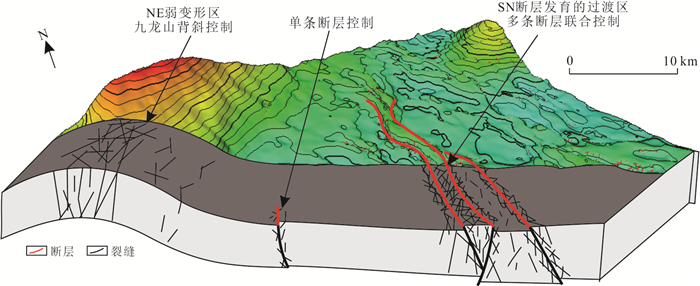
摘要: 构造交汇区致密砂岩储层往往受到不同方向、不同期次构造作用力的影响,致密砂岩储层在多期构造叠加改造下,形成不同密集程度、不同规模裂缝,裂缝的叠加改造大大增加了致密砂岩优势储集层刻画的难度.川东北元坝和通南巴上三叠统须家河组致密砂岩裂缝正是在大巴山冲断带、米仓山隆起、龙门山冲断带联合主导的交汇应力作用下所发育,这些多方向、多期次裂缝影响了川东北须家河组天然气的勘探开发.因此准确表征元坝、通南巴区块所处的构造交汇发育部位、特征、成因成为有效表达目标区块须家河组致密砂岩裂缝发育特征及空间分布规律的关键,是有效开发裂缝型气藏前提.利用川东北野外构造形迹实测数据,综合地震解释成果分析,明确交汇区构造空间特征,断裂分布的空间转化,并以此为基础分析和模拟构造交汇区不同区域的裂缝发育差异,解析构造交汇区对裂缝的控制作用.在构造应力场约束下,应用随机模拟技术体现裂缝发育区域单条裂缝之间方位偏转规律,表征自然裂缝的随机发育特征.研究结果显示,燕山晚期构造交汇区受到均一的北西-南东向构造应力作用,发育以北东向褶皱(九龙山背斜、通南巴背斜)为主,而喜山期构造交汇区呈现明显的差异:交汇区西部(元坝区块西部)发育北东向断裂,交汇区中部(元坝区块中东部)发育南北向断裂,而构造交汇区的东部(通南巴区块)发育北西向断裂.燕山晚期形成的NE向背斜控制裂缝分布,喜山期断裂控缝.构造交汇区自西向东,裂缝发育程度越来越高,控制裂缝的断层由形态简单的单条断层逐渐向由形态复杂单条断层控制、复杂的多条断层控制,裂缝方向也由西部(元坝区块西部)NW逐渐变化为东部(通南巴区块)NE.构造交汇区西部(元坝区块)主要由单条断层控制裂缝发育;往东构造交汇区中部(通南巴西部),主要由断层的弯曲、转折,以及断层的斜列来控制裂缝的发育;构造交汇区东部(通南巴东部)则主要发育距离较近断层联合控制,局部可见交切断层的交汇部位裂缝发育程度高.Abstract: Tight sandstone reservoirs within tectonic intersection zones are shaped by multi-directional, polyphase stresses that generate fractures of variable density and scale. These structural overprints, superimposed on porosity variations from sedimentary and diagenetic processes, introduce strong heterogeneity, complicating reservoir characterization and prediction. Accurate delineation of fracture networks therefore requires systematic analysis of the geometry, evolution, and genetic mechanisms of intersection zones. By integrating field structural measurements with seismic interpretation, it constrained the spatial architecture of intersection zones and simulated fracture variability across subregions. Stochastic modeling under stress-field constraints captured directional deviations between individual fractures, reflecting the intrinsic randomness of natural systems. Results indicate that during the late Yanshanian, NW-SE directed compression dominated, producing NE-trending folds (Jiulongshan and Tongnanba anticlines) that exerted first-order control on fracture development. In contrast, Himalayan deformation was partitioned: NE-trending faults developed in the western Yuanba area, NS-trending faults in the central Yuanba, and NW-trending faults in the Tongnanba area. While Yanshanian folds primarily governed fracture distribution, Himalayan faults became the dominant control. From west to east, fracture intensity increases, with mechanisms evolving from single-fault control (Yuanba) to more complex fault bending, inflection, and enéchelon arrangements (western Tongnanba), culminating in dense fracture networks generated by intersecting faults in eastern Tongnanba.
-
Key words:
- structural intersection /
- stress field /
- fracture /
- sandstone /
- tectonics
-
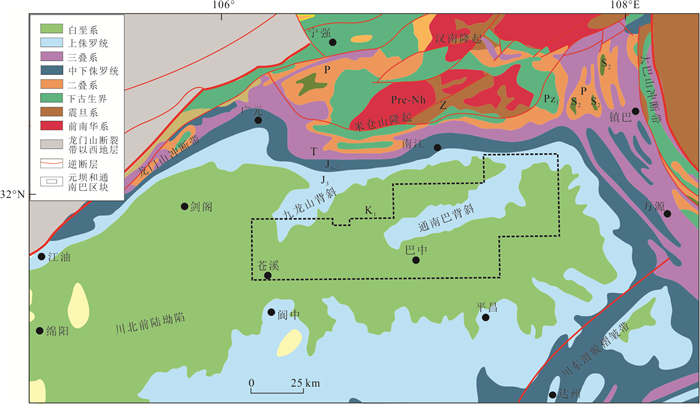
图 1 构造交汇区中的元坝、通南巴区块
Fig. 1. Yuanba and Tongnanba blocks in the structural intersection area
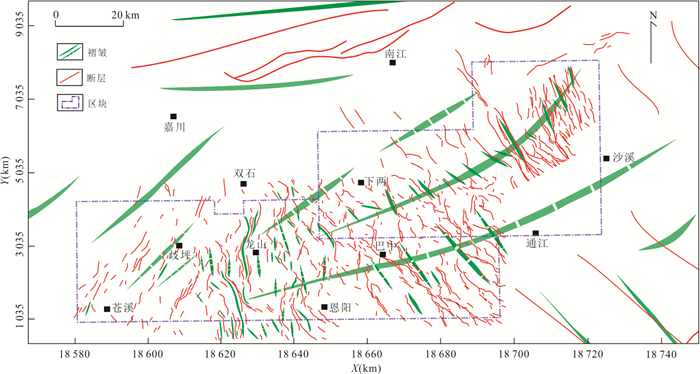
图 2 研究区构造叠加改造特征(须家河组顶面构造)
Fig. 2. The characteristics of structural superposition and reformation in the structural intersection area (the surface structure of the top Xujiahe Formation)
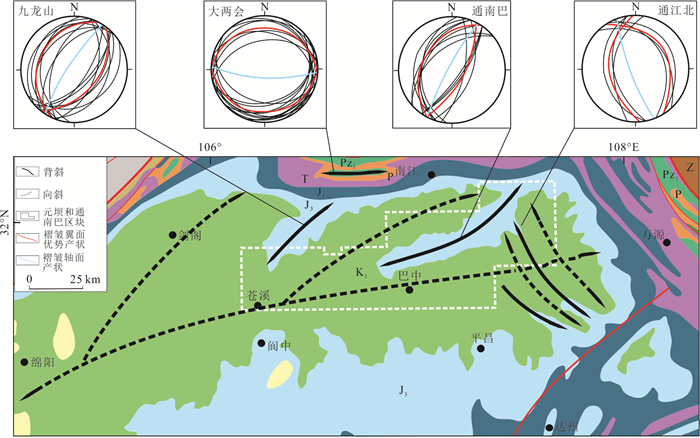
图 3 褶皱两翼优势方位和轴面产状分析
Fig. 3. Analysis on the dominant azimuths of the two limbs of the fold and the attitude of the axial plane
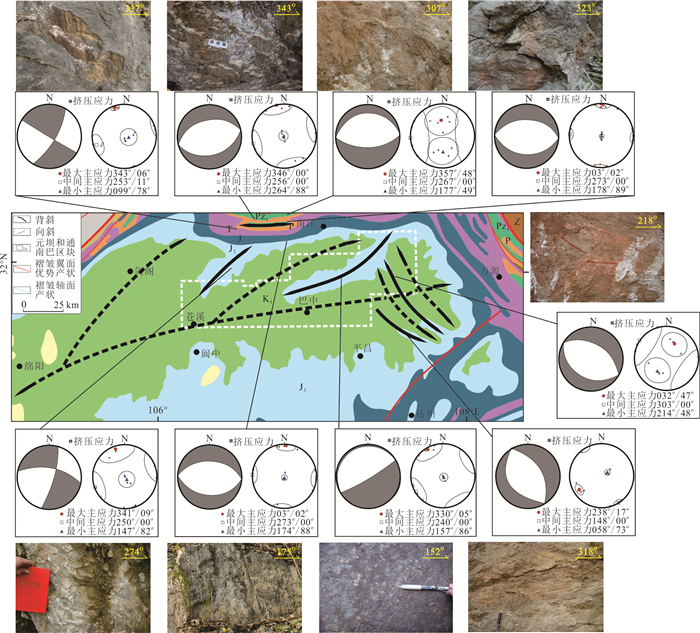
图 4 构造交汇区利用断裂面擦痕构造应力分析
Fig. 4. Structural stress analysis using fault plane striations in the structural intersection area
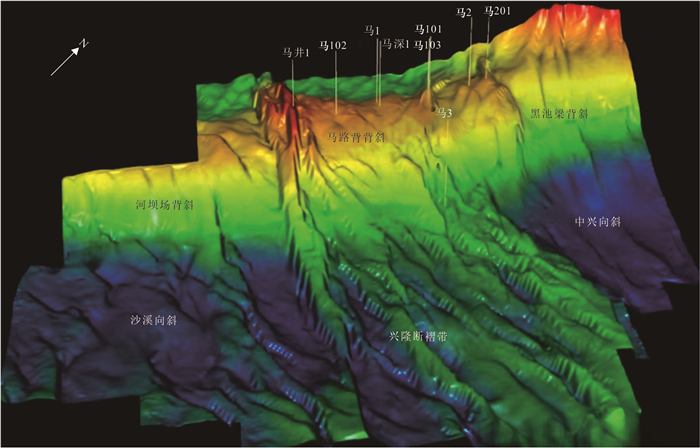
图 5 北东向马路背背斜被北西向构造切割
Fig. 5. The NE-trending Malubei anticline dissected by NW-trending structures
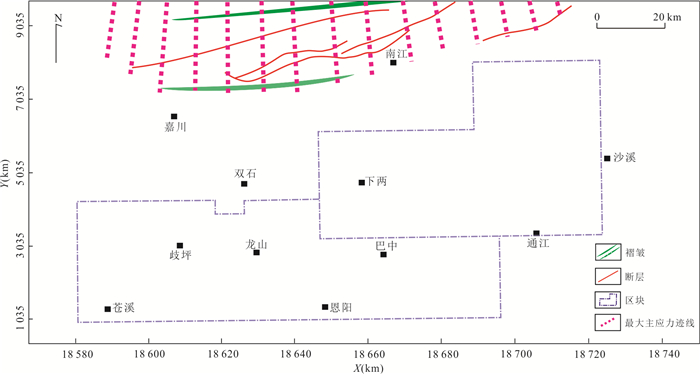
图 6 构造交汇区燕山早期应力迹线
Fig. 6. Stress trace of the early Yanshanian period in the structural intersection area
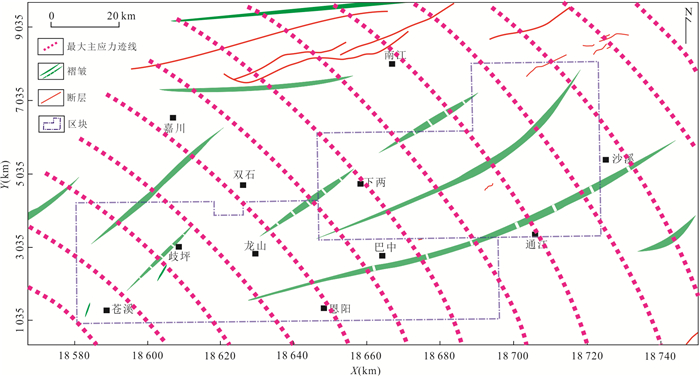
图 7 构造交汇区燕山晚期应力迹线
Fig. 7. Stress trace of the late Yanshanian period in the structural intersection area
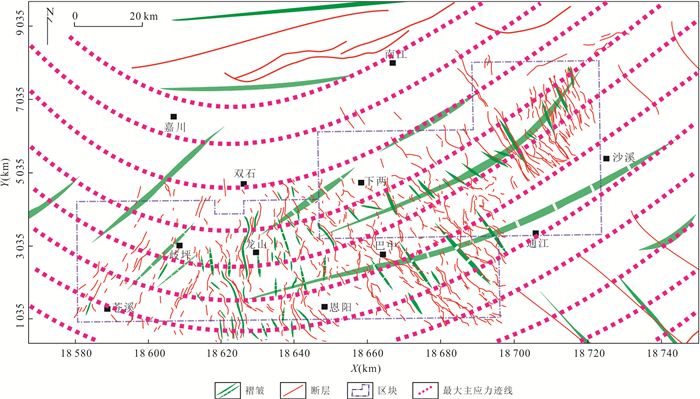
图 8 构造交汇区喜山期应力迹线
Fig. 8. Stress trace of the Himalayan period in the structural intersection area
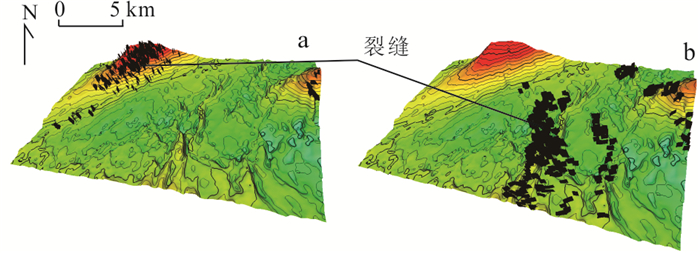
图 9 元坝地区须家河组裂缝随机模拟
a.燕山晚期裂缝;b.喜山期裂缝
Fig. 9. Stochastic simulation of fractures in Xujiahe Formation of Yuanba block
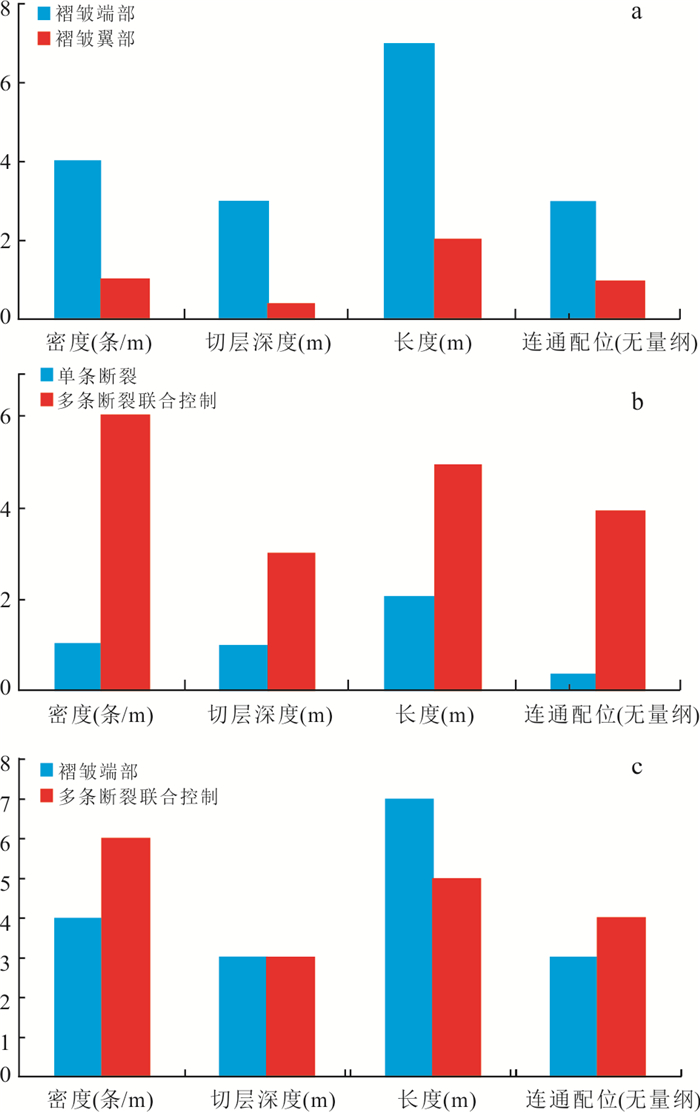
图 10 元坝地区须家河组构造控缝分析
a.燕山晚期构造控缝;b.喜山期构造控缝;c.燕山晚期与喜山期构造控缝对比
Fig. 10. Structural control of fractures in Xujiahe Formation of Yuanba block
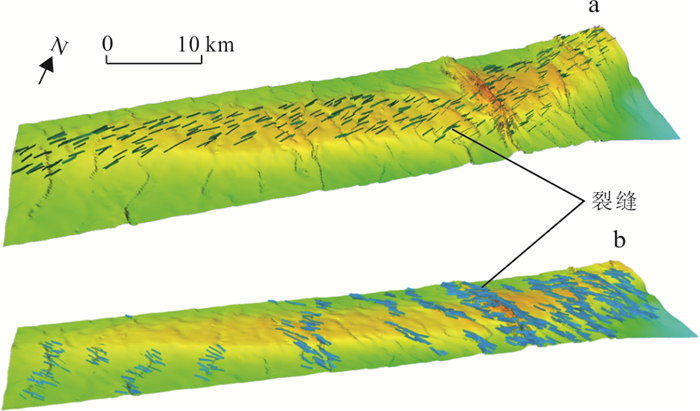
图 12 通南巴须家河组裂缝随机模拟
a. 燕山晚期裂缝;b. 喜山期裂缝
Fig. 12. Stochastic simulation in Xujiahe Formation of Tongnanba block
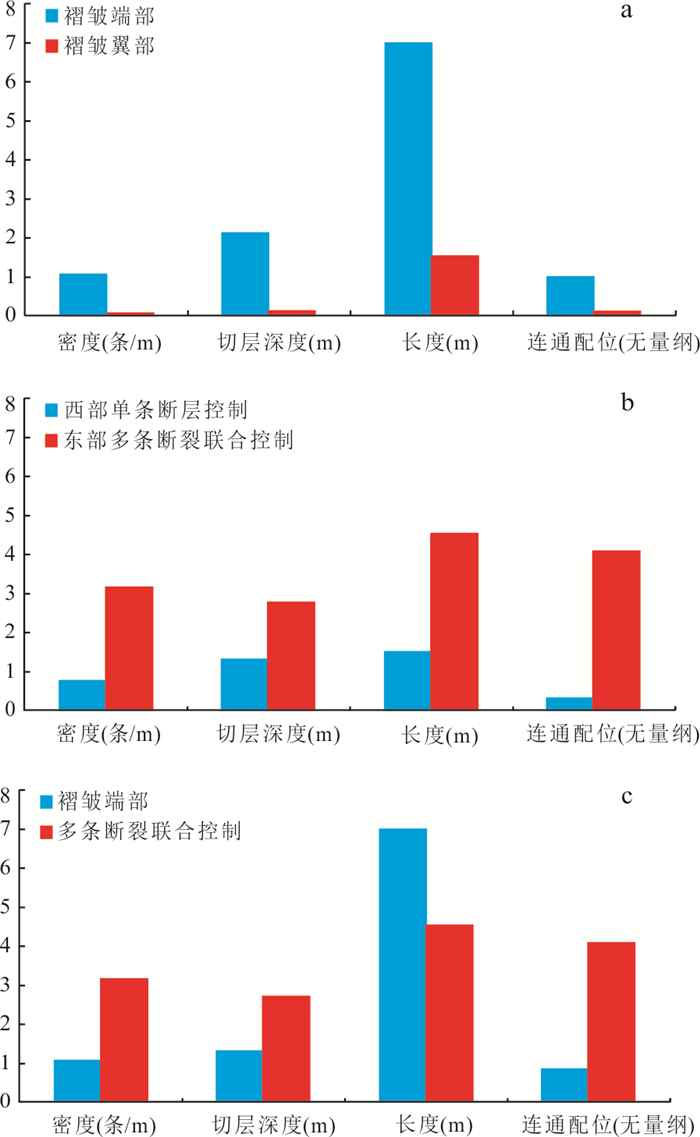
图 13 通南巴地区须家河组构造控缝分析
a.燕山晚期构造控缝;b.喜山期构造控缝;c.燕山晚期与喜山期构造控缝对比
Fig. 13. Structural control of fractures in Xujiahe Formation of Tongnanba block
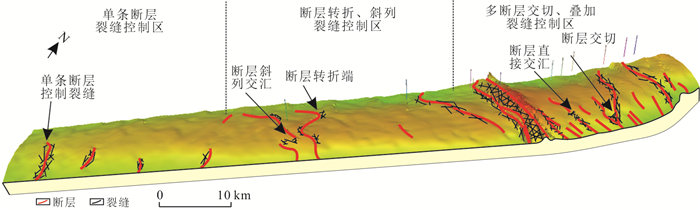
图 14 通南巴须家河组裂缝发育模式
Fig. 14. Fracture development model of Xujiahe Formation in Tongnanba block
表 1 研究区及相邻区域褶皱应力场分析
Table 1. Statistics of the fold stress analysis in the structural intersection area
背斜 数据点 两翼产状(°) 两翼优势方位(°) 轴面(°) 主应力方向(°) σ1 σ2 σ3 大两会 12 185/71, 185/69, 191/73, 190/70, 202/77, 220/65, 218/63, 11/63, 12/71, 15/72, 12/65, 15/78 192/71 11/68 298/84 11/22 328/14 131/62 九龙山 12 132/45, 159/52, 145/25, 154/71, 153/72, 159/56, 144/66, 325/40, 300/12, 342/6, 302/12, 332/5 150/55 322/15 329/80 148/13 58/23 345/68 通南巴 15 275/36, 290/57, 305/56, 310/37, 318/21, 295/31, 288/22, 135/65, 150/30, 133/60, 123/70, 138/46, 129/48, 109/55, 112/35 128/51 336/33 303/80 123/8 34/ 8 305/70 通江北 6 285/51, 268/55, 260/58, 66/75, 58/66, 63/76 61/33 258/20 255/77 49/ 3 323/5 140/85  下载: 导出CSV
表 2 主要断裂擦痕及应力分析统计
Table 2. Statistics of main fault striations and stress analysis in the structural intersection area
位置 来源 断裂面产状(°) 擦痕产状优势方位(°) 主应力 最大主应力(°) 中间主应力(°) 最小主应力(°) 正源乡 实测 215/46 181/41 346/00 256/00 264/88 高阳镇 实测 47/84 333/69 343/06 253/11 099/78 东溪镇 实测 203/83 119/35 341/09 250/04 147/82 水磨乡 实测 341/68 63/18 357/48 267/00 177/49 三江镇 实测 40/45 1/45 3/02 273/02 174/88 新民乡 实测 40/52 38/52 32/47 303/01 214/48 流坝乡 实测 23/62 21/62 158/14 249/06 75/78 赤江乡 实测 217/56 177/49 330/05 240/04 257/86 铁溪乡 实测 195/54 127/28 238/17 148/02 157/83 永安村 实测 88/78 71/76 172/13 259/17 58/73 大河村 实测 237/67 77/57 302/49 61/07 164/81
下载: 导出CSV
-
Cao, H. Y., Wang, W., Liu, M., 2018. Characteristics of Fractures in Xujiahe Formation of Tongnanba Structural Belt, Northeastern Sichuan Basin. Xinjiang Petroleum Geology, 39(4): 424-429 (in Chinese with English abstract). Chen, L. B., He, D. F., Wang, B., et al., 2017. Dating the Tectonic Deformation since the Middle Triassic for the Tongnanba Anticline in the Northeastern Sichuan Basin and Its Geological Implications. Geotectonica et Metallogenia, 41(3): 433-445 (in Chinese with English abstract). Cheng, S. Y., Zhang, G. W., Li, L., 2003. Lithospheric Electrical Structure of the Qinling Orogen and Its Geodynamic Implication. Chinese Journal of Geophysics, 46(3): 390-397 (in Chinese with English abstract). Deng, B., 2013. Meso-Cenozoic Architecture of Basin-Mountain System in the Sichuan Basin and Its Gas Distribution (Dissertation). Chengdu University of Technology, Chendu (in Chinese with English abstract). Deng, B., Shigeru, S., Liu, S. G., et al., 2014. Wedge-Thrust Folding in the Micangshan Constrained by Low-Temperature Thermochronometer Model and Its Significance. Chinese Journal of Geophysics, 57(4): 1155-1168 (in Chinese with English abstract). Fan, C. H., Qin, Q. R., Li, H., et al., 2017. Formation Stages of Structural Fractures of Xujiahe Formation in the Fault-Fold Belt of Central Yuanba Area, Sichuan Basin. Acta Petrolei Sinica, 38(10): 1135-1143 (in Chinese with English abstract). Fan, J. Y., Qin, Q. R., Su, P. D., 2009. Fracture Genesis in Tongnanba Structural Belt. Special Oil & Gas Reservoirs, 16(1): 38-41, 107 (in Chinese with English abstract). Gao, Z. Y., Bai, B., Zhu, R. K., et al., 2012. Reservior Sedimentary Response to Tectonic Movement of the Late Triassic in Front of Dabashan and Longmen Mountains. Journal of Palaeogeography, 14(6): 801-812 (in Chinese with English abstract). Guo, T. L., 2013. Key Controls on Accumulation and High Production of Large Non-Marine Gas Fields in Northern Sichuan Basin. Petroleum Exploration and Development, 40(2): 139-149 (in Chinese with English abstract). doi: 10.1016/S1876-3804(13)60017-8 Jia, D., Chen, Z. X., Jia, C. Z., et al., 2003. Structural Features of the Longmen Shan Fold and Thrust Belt and Develoment of the Western Sichuan Foreland Basin, Central China. Geological Journal of China Universities, 9(3): 402-410 (in Chinese with English abstract). Jiang, Y. L., Li, M. Y., Wang, L. J., et al., 2020. Characteristics and Controlling Factors of Tight Sandstone Reservoir Fractures of the Xujiahe Formation in the Bazhong-Tongnanba Area, Northeast Sichuan. Acta Geologica Sinica, 94(5): 1525-1537 (in Chinese with English abstract). Lei, Y. L., Jia, C. Z., Li, B. L., et al., 2012. Meso-Cenozoic Tectonic Events Recorded by Apatite Fission Track in the Northern Longmen-Micang Mountains Region. Acta Geologica Sinica-English Edition, 86(1): 153-165. https://doi.org/10.1111/j.1755-6724.2012.00618.x Li, H., Fan, C. H., Qin, Q. R., et al., 2018. Fracture Characteristics and Its Genesis of Tight Reservoir in Xujiahe Formation of Central Yuanba Area in Sichuan Basin. Reservoir Evaluation and Development, 8(2): 1-6 (in Chinese with English abstract). Liu, S. G., Deng, B., Li, Z. W., et al., 2011. The Texture of Sedimentary Basin-Orogenic Belt System and Its Influence on Oil/Gas Distribution: A Case Study from Sichuan Basin. Acta Petrologica Sinica, 27(3): 621-635 (in Chinese with English abstract). Liu, S. G., Luo, Z. L., Zhao, X. K., et al., 2003. Coupling Relationships of Sedimentary Basin-Orogenic Belt Systems and Their Dynamic Models in West China—A Case Study of the Longmenshan Orogenic Belt-West Sichuan Foreland Basin System. Acta Geologica Sinica, 77(2): 177-186 (in Chinese with English abstract). Liu, Z. Q., Luo, K. P., Tang, Y., et al., 2019. Critical Tectonic Periods and the Response of Gas Accumulation in Non-Marine Tight Sandstone Reservoir in Yuanba-Tongnanba Area, Sichuan Basin. Earth Science, 44(3): 756-772 (in Chinese with English abstract). Liu, Z. Q., Mei, L. F., Guo, T. L., et al., 2009. Characteristics and Differences of Hydrocarbon Accumulations in Marine Carbonate Rocks, Northeast Sichuan Basin: A Case Study from Puguang and Maoba Gas Fields. Petroleum Exploration and Development, 36(5): 552-561 (in Chinese with English abstract). Luo, L., Qi, J. F., Zhang, M. Z., 2015. Difference Study on Evolution and Deformation of the Fold-Thrust Belts Surrounding Sichuan Basin. Geological Review, 61(3): 525-535 (in Chinese with English abstract). Ma, D. L., Wang, H. B., Zhang, X. C., et al., 2023. Analogue Modeling of Structural Deformation of Tongnanba Anticline in Mesozoic and Cenozoic, NE Sichuan Basin. Earth Science, 48(4): 1307-1320 (in Chinese with English abstract). Pei, X. Z., Li, R. B., Ding, S. P., et al., 2009. Tectonic Intersection Relationship between Dabashan and Micangshan in Zhenba Area, Southern Shaanxi Province. Oil & Gas Geology, 30(5): 576-583 (in Chinese with English abstract). Qin, Q. R., Zhu, M. Y., Fan, C. H., et al., 2017. Structural Features Analysis and Genetic Mechanism of Xujiahe Formation in the Center of Yuanba Area, Sichuan Basin. Reservoir Evaluation and Development, 7(2): 1-6 (in Chinese with English abstract). Qiu, N. S., Qin, J. Z., McInnes, B., et al., 2008. Tectonothermal Evolution of the Northeastern Sichuan Basin: Constraints from Apatite and Zircon (U-Th)/He Ages and Vitrinite Reflectance Data. Geological Journal of China Universities, 14(2): 223-230 (in Chinese with English abstract). Shen, C. B., Mei, L. F., Guo, T. L., 2007. Fission Track Analysis of Mesozoic-Cenozoic Thermal History in Northeast Sichuan Basin. Natural Gas Industry, 27(7): 24-26, 131-132 (in Chinese with English abstract). Shi, W., Dong, S. W., Hu, J. M., et al., 2007. An Analysis of Superposed Deformation and Tectonic Stress Fields of the Western Segment of Daba Mountains Foretland. Acta Geologica Sinica, 81(10): 1314-1327 (in Chinese with English abstract). Song, Q. W., Yan, D. P., Jiao, S. T., et al., 2014. The Response of Compounding Process of Dabashan and Xuefengshan Thrust Belt in J3-K1: The Structural Styles and Formation Mechanism of the Zigui Fold Belt, Western Hubei. Acta Geologica Sinica, 88(8): 1382-1400 (in Chinese with English abstract). Tang, Y., Liu, H. Q., Li, Q. H., et al., 2015. Analysis of Tectonic Stress Field and Potential Activities in Lingshan Fault Zone, Guangxi. Geotectonica et Metallogenia, 39(1): 62-75 (in Chinese with English abstract). Wang, W., Fan, R., 2019. Characteristics of Xujiahe Formation Fault-Fracture Reservoirs in the Northern Sichuan Basin and Its Exploration Significance. Journal of Chengdu University of Technology (Science & Technology Edition), 46(5): 541-548 (in Chinese with English abstract). Wang, X. J., Yang, Z. R., Han, B., 2015. Superposed Evolution of Sichuan Basin and Its Petroleum Accumulation. Earth Science Frontiers, 22(3): 161-173 (in Chinese with English abstract). Wen, K., Li, C. X., 2020. The Geometry and Kinematics of the Intersection Area of Eastern Sichuan and the Dabashan Fold-Thrust Belt. Acta Geologica Sinica, 94(2): 426-438 (in Chinese with English abstract). Wu, S. X., Tang, L. J., Guo, T. L., et al., 2005. Structural Zonation and Oil/Gas Distribution in Intersecting Area of Micang and Daba Mountains. Oil & Gas Geology, 26(3): 361-365, 390 (in Chinese with English abstract). Xu, C. H., Zhou, Z. Y., Chang, Y., et al., 2010. Genesis of Daba Arcuate Structural Belt Related to Adjacent Basement Upheavals: Constraints from Fission-Track and (U-Th)/He Thermochronology. Science China Earth Sciences, 53(11): 1634-1646 (in Chinese). doi: 10.1007/s11430-010-4112-y Yang, S., Wang, W., Zhang, L., et al., 2020. Control Factors and Distribution of Chlorite-Cemented Facies in the Xujiahe Sandstone, Yuanba and Tongnanba Area. Earth Science, 45(2): 479-488 (in Chinese with English abstract). Zhang, C., Zhou, W., Xie, R. C., et al., 2015. Fracture Prediction in the Fault Belt of Xu Member 4 in Yuanba Gasfield. Petroleum Geology & Oilfield Development in Daqing, 34(1): 11-17 (in Chinese with English abstract). Zhang, G. W., Guo, A. L., Yao, A. P., 2004. Western Qinling-Songpan Continental Tectonic Nodein China's Continental Tectonics. Earth Science Frontiers, 11(3): 23-32 (in Chinese with English abstract). Zhang, Y. N., 2015. Study of Tectonic Thermal Evolution History and Uplift in Mesozoic-Cenozoic in the North Rim of Sichuan Basin (Dissertation). Chang'an University, Xi'an (in Chinese with English abstract). 曹环宇, 王威, 刘明, 2018. 川东北通南巴构造带须家河组裂缝特征. 新疆石油地质, 39(4): 424-429. 陈龙博, 何登发, 王贝, 等, 2017. 川东北地区通南巴背斜中三叠世以来构造变形时间厘定及其地质意义. 大地构造与成矿学, 41(3): 433-445. 程顺有, 张国伟, 李立, 2003. 秦岭造山带岩石圈电性结构及其地球动力学意义. 地球物理学报, 46(3): 390-397. 邓宾, 2013. 四川盆地中-新生代盆-山结构与油气分布(博士学位论文). 成都: 成都理工大学. 邓宾, Shigeru, S., 刘树根, 等, 2014. 米仓山楔入冲断构造模型低温热年代学证据及其意义. 地球物理学报, 57(4): 1155-1168. 范存辉, 秦启荣, 李虎, 等, 2017. 四川盆地元坝中部断褶带须家河组储层构造裂缝形成期次. 石油学报, 38(10): 1135-1143. 樊靖宇, 秦启荣, 苏培东, 2009. 通南巴构造带裂缝成因研究. 特种油气藏, 16(1): 38-41, 107. 高志勇, 白斌, 朱如凯, 等, 2012. 大巴山与龙门山前晚三叠世构造运动的储集层沉积学响应. 古地理学报, 14(6): 801-812. 郭彤楼, 2013. 四川盆地北部陆相大气田形成与高产主控因素. 石油勘探与开发, 40(2): 139-149. 贾东, 陈竹新, 贾承造, 等, 2003. 龙门山前陆褶皱冲断带构造解析与川西前陆盆地的发育. 高校地质学报, 9(3): 402-410. 蒋有录, 李明阳, 王良军, 等, 2020. 川东北巴中-通南巴地区须家河组致密砂岩储层裂缝发育特征及控制因素. 地质学报, 94(5): 1525-1537. 李虎, 范存辉, 秦启荣, 等, 2018. 川东北元坝中部地区须家河组致密储层裂缝特征及成因探讨. 油气藏评价与开发, 8(2): 1-6. 刘树根, 邓宾, 李智武, 等, 2011. 盆山结构与油气分布: 以四川盆地为例. 岩石学报, 27(3): 621-635. 刘树根, 罗志立, 赵锡奎, 等, 2003. 中国西部盆山系统的耦合关系及其动力学模式: 以龙门山造山带-川西前陆盆地系统为例. 地质学报, 77(2): 177-186. 刘昭茜, 罗开平, 唐永, 等, 2019. 四川盆地元坝-通南巴地区关键构造期构造特征及陆相致密砂岩天然气成藏响应. 地球科学, 44(3): 756-772. doi: 10.3799/dqkx.2019.032 刘昭茜, 梅廉夫, 郭彤楼, 等, 2009. 川东北地区海相碳酸盐岩油气成藏作用及其差异性: 以普光、毛坝气藏为例. 石油勘探与开发, 36(5): 552-561. 罗良, 漆家福, 张明正, 2015. 四川盆地周缘冲断带构造演化及变形差异性研究. 地质论评, 61(3): 525-535. 马德龙, 王宏斌, 张希晨, 等, 2023. 川东北通南巴背斜中新生代构造变形的砂箱构造物理模拟. 地球科学, 48(4): 1307-1320. doi: 10.3799/dqkx.2022.423 裴先治, 李瑞保, 丁仨平, 等, 2009. 陕南镇巴地区大巴山与米仓山构造交接关系. 石油与天然气地质, 30(5): 576-583. 秦启荣, 朱梦月, 范存辉, 等, 2017. 四川盆地元坝中部须家河组构造形迹解析及成因机制. 油气藏评价与开发, 7(2): 1-6. 邱楠生, 秦建中, Brent I A McInnes, 等, 2008. 川东北地区构造-热演化探讨: 来自(U-Th)/He年龄和Ro的约束. 高校地质学报, 14(2): 223-230. 沈传波, 梅廉夫, 郭彤楼, 2007. 川东北地区中、新生代热历史的裂变径迹分析. 天然气工业, 27(7): 24-26, 131-132. 施炜, 董树文, 胡健民, 等, 2007. 大巴山前陆西段叠加构造变形分析及其构造应力场特征. 地质学报, 81(10): 1314-1327. 宋庆伟, 颜丹平, 焦守涛, 等, 2014. 大巴山与雪峰山逆冲构造带J3-K1复合过程的响应: 鄂西秭归褶皱带构造样式与形成机制. 地质学报, 88(8): 1382-1400. 唐永, 刘怀庆, 黎清华, 等, 2015. 广西灵山断裂带构造应力场地质分析及活动性预测. 大地构造与成矿学, 39(1): 62-75. 王威, 凡睿, 2019. 四川盆地北部须家河组"断缝体"气藏特征及勘探意义. 成都理工大学学报(自然科学版), 46(5): 541-548. 王学军, 杨志如, 韩冰, 2015. 四川盆地叠合演化与油气聚集. 地学前缘, 22(3): 161-173. 文凯, 李传新, 2020. 川东与大巴山褶皱冲断带交汇区构造几何学和运动学特征. 地质学报, 94(2): 426-438. 吴世祥, 汤良杰, 郭彤楼, 等, 2005. 米仓山与大巴山交汇区构造分区与油气分布. 石油与天然气地质, 26(3): 361-365, 390. 许长海, 周祖翼, 常远, 等, 2010. 大巴山弧形构造带形成与两侧隆起的关系: FT和(U-Th)/He低温热年代约束. 中国科学: 地球科学, 40(12): 1684-1696. 杨烁, 王威, 张莉, 等, 2020. 元坝-通南巴地区须家河组绿泥石膜胶结相砂岩发育控制因素与分布规律. 地球科学, 45(2): 479-488. doi: 10.3799/dqkx.2019.011 张冲, 周文, 谢润成, 等, 2015. 元坝气田须四段断裂带裂缝预测. 大庆石油地质与开发, 34(1): 11-17. 张国伟, 郭安林, 姚安平, 2004. 中国大陆构造中的西秦岭-松潘大陆构造结. 地学前缘, 11(3): 23-32. 张艳妮, 2015. 四川盆地北缘构造热演化史与中-新生代隆升研究(硕士学位论文). 西安: 长安大学. -

 点击查看大图
计量
- 文章访问数: 177
- HTML全文浏览量: 12
- PDF下载量: 45
- 被引次数: 0
