




A Geological Information and Enhanced Graph Convolutional Network Method for Extracting Information on Lithium and Beryllium-Rich Pegmatites from Hyperspectral Imagery
-
摘要:
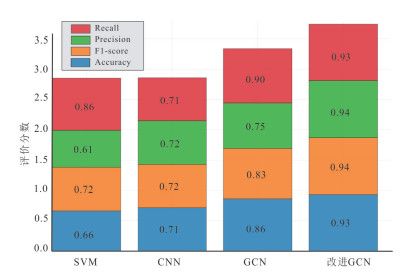
近年来,随着高光谱卫星影像的发展,以及机器学习领域的技术突破,高光谱影像已在成矿预测领域取得众多成功应用.然而,传统的机器学习方法较多仅应用在高光谱数据上,往往忽视了地质成矿的复杂性,没有注意到地质领域信息对成矿的重要性.针对传统高光谱找矿中地质信息缺失的问题,本文将传统的高光谱数据与岩体、断层位置这类地质信息相结合,创建高光谱‒地质信息39通道综合数据集,同时对GCN(图卷积神经网络)模型进行改进,在网络中加入残差连接模块,同时对残差连接模块和卷积层进行批量化归一操作,加强训练效果.使用资源一号02D卫星(ZY-1 02D)高光谱数据对大红柳滩地区进行实验.结果表明,改进后的GCN模型对研究区内含矿花岗伟晶岩具有较高的识别精度.相比原始GCN网络、卷积神经网络模型和支持向量机模型,准确率分别提高了7、22和27个百分点,实现了高光谱遥感影像中锂铍矿化花岗伟晶岩的高精度自动化预测.
Abstract:While advances in satellite hyperspectral technology and machine learning have significantly boosted its application in mineral prospectivity modeling, conventional data-driven approaches often fall short by neglecting the essential geological information that controls mineralization processes. To bridge the gap, this study develops a novel methodology that integrates hyperspectral imagery with critical geological determinants-specifically pluton boundaries and fault systems, establishing a 39-channel comprehensive data set featuring hyperspectral geological information, and introduces an enhanced Graph Convolutional Network (GCN) model. Architectural improvements include the incorporation of residual connections and the systematic application of batch normalization across both residual modules and convolutional layers, substantially stabilizing and accelerating the training process. Validation using ZY-1 02D hyperspectral data from the Dahongliutan area demonstrates that our refined GCN model achieves superior accuracy in identifying mineralized granitic pegmatites. Quantitative evaluations confirm substantial performance gains, with accuracy improvements of 7, 22, and 27 percentage points over the baseline GCN, Convolutional Neural Network, and Support Vector Machine models, respectively. This work establishes an effective and automated framework for high-precision prediction of lithium- and beryllium-mineralized granitic pegmatites via hyperspectral remote sensing.
-
Key words:
- hyperspectrum /
- ZY-1 /
- graph convolutional network /
- pegmatite /
- Li-Be mineralization /
- remote sensing /
- ore deposits
-
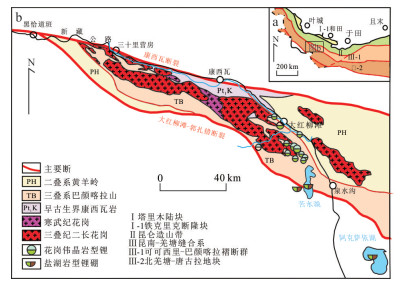
图 1 新疆大红柳滩一带地质矿产图
Fig. 1. Geological and mineral map of the Dahongliutan area in Xinjiang
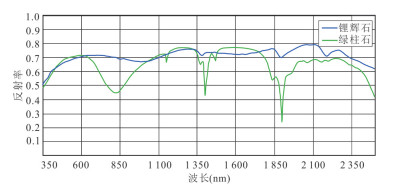
图 3 绿柱石、锂辉石的可见‒短波红外光谱曲线
Fig. 3. Visible short wave infrared spectra curves of beryl and spodumene
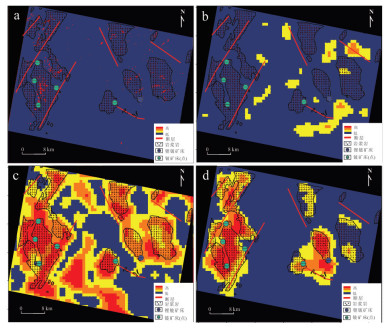
图 7 模型综合预测热图对比
Fig. 7. Comparison of Model Comprehensive Prediction Heatmaps
a. SVM; b. CNN; c. GCN; d. Enhanced-GCN
表 1 改进GCN网络架构
Table 1. Enhanced GCN network architecture
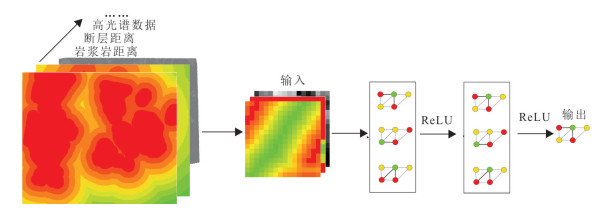
网络结构 维度 输入层 39 GCN1-BN-RELU 39~64 GCN2-BN-RELU 64~256 投影层 64~256 残差连接 256 GCN3-BN-RELU 64~256 投影层 64~256 残差连接 64 全局池化层 - 输出层 -  下载: 导出CSV
-
Benson, T. R., Coble, M. A., Rytuba, J. J., et al., 2017. Lithium Enrichment in Intracontinental Rhyolite Magmas Leads to Li Deposits in Caldera Basins. Nature Communications, 8: 270. https://doi.org/10.1038/s41467-017-00234-y Cardoso-Fernandes, J., Teodoro, A. C., Lima, A., 2019. Remote Sensing Data in Lithium (Li) Exploration: A New Approach for the Detection of Li-Bearing Pegmatites. International Journal of Applied Earth Observation and Geoinformation, 76: 10-25. https://doi.org/10.1016/j.jag.2018.11.001 Dai, J. J., Wang, D. H., Dai, H. Z., et al., 2017. Geological Mapping and Ore-Prospecting Study Using Remote Sensing Technology in Jiajika Area of Western Sichuan Province. Geology in China. 44(2): 389-398 (in Chinese with English abstract). Ding, L., Chen, B. N., Zhu, Y. L., et al., 2024. Mineral Prediction Based on Prototype Learning. Computers & Geosciences, 184: 105540. https://doi.org/10.1016/j.cageo.2024.105540 Du, X. C., Lou, D. B., Xu, L. G., et al., 2023. Extracting Granite Pegmatite Information Based on GF-2 Images and the Random Forest Algorithm. Remote Sensing for Natural Resources, 35(4): 53-60 (in Chinese with English abstract). Fan, Y. H., Wang, H., Yang, X. K., et al., 2018. Application of High-Resolution Remote Sensing Technology to the Prospecting for Rare Metal Mineralization Belt. Remote Sensing for Natural Resources, 30(1): 128-134 (in Chinese with English abstract). Guan, Q. F., Ren, S. L., Chen, L. R., et al., 2022. Recognizing Multivariate Geochemical Anomalies Related to Mineralization by Using Deep Unsupervised Graph Learning. Natural Resources Research, 31(5): 2225-2245. https://doi.org/10.1007/s11053-022-10088-x Ioffe, S., Szegedy, C., 2015. Batch Normalization: Accelerating Deep Network Training by Reducing Internal Covariate Shift. arXiv: 1502.03167. https://arxiv.org/abs/1502.03167 Jiang, G., Zhou, K. F., Wang, J. L., et al., 2023. Identification of Lithium-Beryllium Granitic Pegmatites Based on Deep Learning. Earth Science Frontiers, 30(5): 185-196 (in Chinese with English abstract). Jin, M. S., Gao, Y. B., Li, K., et al., 2019. Remote Sensing Prospecting Method for Pegmatite Type Rare Metal Deposit—Taking Dahongliutan Area in Western Kunlun for Example. Northwestern Geology, 52(4): 222-231 (in Chinese with English abstract). Kipf, T. N., Welling, M., 2017. Semi-Supervised Classification with Graph Convolutional Networks. arXiv, 1609.02907. https://doi.org/10.48550/arXiv.1609.02907 Liang, C. B., Xiao, B. H., Cheng, B., 2021. GCN-Based Semantic Segmentation Method for Mine Information Extraction in GAOFEN-1 Imagery. 2021 IEEE International Geoscience and Remote Sensing Symposium IGARSS., Brussels. https://doi.org/10.1109/IGARSS47720.2021.9554657 Lu, H., Qiao, D. Y., Li, Y. X., et al., 2021. Fusion of China ZY-1 02D Hyperspectral Data and Multispectral Data: Which Methods should be Used? Remote Sensing, 13(12): 2354. https://doi.org/10.3390/rs13122354 Pan, M., Tang, Y., Xiao, R. Q., et al., 2016. The Discovery of the Superlarge Li Ore Vein X03 in the Jiajika Ore District. Acta Geologica Sichuan, 36(3): 422-425, 430 (in Chinese with English abstract). Pathak, A. R., Pandey, M., Rautaray, S., 2018. Application of Deep Learning for Object Detection. Procedia Computer Science, 132: 1706-1717. https://doi.org/10.1016/j.procs.2018.05.144 Ren, G. L., Kong, H. L., Zhao, K. D., et al., 2022. Spectral Characteristics and Prospecting Implications of Lithium Deposits in Dahongliutan Area, Karakoram, Xinjiang. Northwestern Geology, 55(4): 103-114 (in Chinese with English abstract). Tu, Q. J., Han, Q., Li, P., et al., 2019a. Basic Characteristics and Exploration Progress of the Spodumene Ore Deposit in the Dahongliutan Area, West Kunlun. Acta Geologica Sinica, 93(11): 2862-2873 (in Chinese with English abstract). Tu, Q. J., Li, J. K., Wang, G., et al., 2019b. Mineralization Comparisons of the Major Pegmatite Type Spodumene Deposits and Their Prospecting Potential in West China. Geological Survey of China, 6(6): 35-47 (in Chinese with English abstract). Wang, H., Huang, L., Ma, H. D., et al., 2023. Geological Characteristics and Metallogenic Regularity of Lithium Deposits in Dahongliutan-Bailongshan Area, West Kunlun, China. Acta Petrologica Sinica, 39(7): 1931-1949 (in Chinese with English abstract). doi: 10.18654/1000-0569/2023.07.04 Wang, H. Y., 2021. Research on Pegmatite Dike Information Extraction from Remote Sensing Images Based on Deep Semantic Segmentation (Dissertation). China University of Geosciences, Beijing (in Chinese with English abstract). Wu, X. W., Sahoo, D., Hoi, S. C. H., 2020. Recent Advances in Deep Learning for Object Detection. Neurocomputing, 396: 39-64. https://doi.org/10.1016/j.neucom.2020.01.085 Xiong, X., Li, J. K., Yan, Q. G., 2024. The Ore-Forming Mechanism and Geological Indicators of the Zhawulong Pegmatite-Type Rare-Metal Deposit in Sichuan. Acta Petrologica Sinica, 40(9): 2863-2877 (in Chinese with English abstract). doi: 10.18654/1000-0569/2024.09.15 Zhang, S., Ju, N., Wu, Y., et al., 2023. Distribution Characteristics, Main Types and Exploration and Development Status of Beryllium Deposit. Geology in China, 50(2): 410-424 (in Chinese with English abstract). Zhao, Z. Q., Zheng, P., Xu, S. T., et al., 2019. Object Detection with Deep Learning: A Review. IEEE Transactions on Neural Networks and Learning Systems, 30(11): 3212-3232. https://doi.org/10.1109/TNNLS.2018.2876865 Zuo, R. G., Xu, Y., 2023. Graph Deep Learning Model for Mapping Mineral Prospectivity. Mathematical Geosciences, 55(1): 1-21. https://doi.org/10.1007/s11004-022-10015-z Zuo, R. G., Xu, Y., 2024. A Physically Constrained Hybrid Deep Learning Model to Mine a Geochemical Data Cube in Support of Mineral Exploration. Computers & Geosciences, 182: 105490. https://doi.org/10.1016/j.cageo.2023.105490 代晶晶, 王登红, 代鸿章, 等, 2017. 遥感技术在川西甲基卡大型锂矿基地找矿填图中的应用. 中国地质, 44(2): 389-398. 杜晓川, 娄德波, 徐林刚, 等, 2023. 基于GF-2影像和随机森林算法的花岗伟晶岩提取. 自然资源遥感, 35(4): 53-60. 范玉海, 王辉, 杨兴科, 等, 2018. 基于高分辨率遥感数据的稀有金属矿化带勘查. 国土资源遥感, 30(1): 128-134. 蒋果, 周可法, 王金林, 等, 2023. 基于深度学习的花岗伟晶岩型锂铍矿物识别研究. 地学前缘, 30(5): 185-196. 金谋顺, 高永宝, 李侃, 等, 2019. 伟晶岩型稀有金属矿的遥感找矿方法: 以西昆仑大红柳滩地区为例. 西北地质, 52(4): 222-231. 潘蒙, 唐屹, 肖瑞卿, 等, 2016. 甲基卡新3号超大型锂矿脉找矿方法. 四川地质学报, 36(3): 422-425, 430. 任广利, 孔会磊, 赵凯东, 等, 2022. 新疆喀喇昆仑大红柳滩一带锂矿光谱特征及其找矿指示意义. 西北地质, 55(4): 103-114. 涂其军, 韩琼, 李平, 等, 2019a. 西昆仑大红柳滩一带锂辉石矿基本特征和勘查新进展. 地质学报, 93(11): 2862-2873. 涂其军, 李建康, 王刚, 等, 2019b. 中国西部主要伟晶岩型锂辉石矿床成矿作用对比及找矿前景. 中国地质调查, 6(6): 35-47. 王核, 黄亮, 马华东, 等, 2023. 西昆仑大红柳滩‒白龙山矿集区锂矿成矿特征与成矿规律初探. 岩石学报, 39(7): 1931-1949. 王海宇, 2021. 基于深度语义分割的遥感影像伟晶岩脉信息提取研究(硕士学位论文). 北京: 中国地质大学. 熊欣, 李建康, 严清高, 2024. 四川扎乌龙伟晶岩型稀有金属矿床的成矿机制及找矿标志. 岩石学报, 40(9): 2863-2877. 张森, 鞠楠, 伍月, 等, 2023. 铍矿分布特点、主要类型与勘查开发现状. 中国地质, 50(2): 410-424. -

 点击查看大图
计量
- 文章访问数: 266
- HTML全文浏览量: 27
- PDF下载量: 49
- 被引次数: 0
