




Snow Avalanche Release Area Identification and Hazard Assessment Based on GIS and RAMMS Modeling: A Case Study of the Galongla Section of the Zhamo Highway, Xizang
-
摘要: 随着人类活动和重大基础设施建设向高寒山区扩展,雪崩灾害风险日益凸显,生成雪崩危险性地图是一项至关重要的基础性工作.以西藏扎墨公路嘎隆拉段为研究区,结合GIS和RAMMS数值模拟技术,构建了基于DEM数据识别雪崩潜在释放区并进行大范围危险性评估的框架.设定了基于常规地形参数阈值的“一般情境”与评估潜在最大危险性的“极端情境”进行模拟对比.结果表明,在两种不同情境下分别识别出539个和526个潜在释放区. 一般情境下,雪崩影响面积为43.89 km2,占研究区总面积的54.58%;极端情境下,影响面积扩大至53.24 km2,占66.20%. 扎墨公路嘎隆拉段在两种情境下分别有16.7%和25.8%的路段处于高危险等级之中,最大雪崩冲击压力可达580 kPa以上.西藏扎墨公路嘎隆拉段的雪崩危险性可以划分为高、中、低、无4个危险等级,高危险区为防治工程的优先布局的“靶区”.将GIS-DEM参数识别与RAMMS大规模数值模拟相结合,提出了一种可移植的高效雪崩危险性评估框架,具有在类似数据匮乏的高寒山区推广应用的潜力.Abstract: As human activities and major infrastructure construction extend into high-altitude mountainous regions, the risk of snow avalanche disasters is increasingly severe. Generating avalanche hazard maps is a crucial foundational task. This study, focusing on the Galongla Section of the Zhamo Highway in Xizang, developed a framework for identifying potential avalanche release areas and conducting large-scale hazard assessments by integrating GIS and RAMMS numerical simulation technologies based on DEM data. This study defined a "general scenario" based on standard terrain parameter thresholds and an "extreme scenario" in order to assess the potential maximum hazard. The results indicate that under general and extreme scenarios, 539 and 526 potential release areas were identified, respectively. In the general scenario, the avalanche-affected area was 43.89 km2, accounting for 54.58% of the total study area; under the extreme scenario, the affected area expanded to 53.24 km2, representing 66.20%. Additionally, 16.7% and 25.8% of the highway section in the Galongla area were classified as high hazard level under the two scenarios, with maximum avalanche impact pressures exceeding 580 kPa. The avalanche hazard in the Galongla Section of the Zhamo Highway, Xizang, can be categorized into four hazard level levels: high, medium, low, and none. The high hazard zones are prioritized as target areas for mitigation engineering. This research establishes a portable and efficient avalanche hazard assessment framework by combining GIS-DEM analysis and RAMMS simulation, offering a practical solution for data-deficient high-mountain environments.
-
Key words:
- snow avalanche /
- RAMMS /
- numerical simulation /
- hazard assessment /
- Zhamo highway /
- Qinghai-Xizang plateau
-
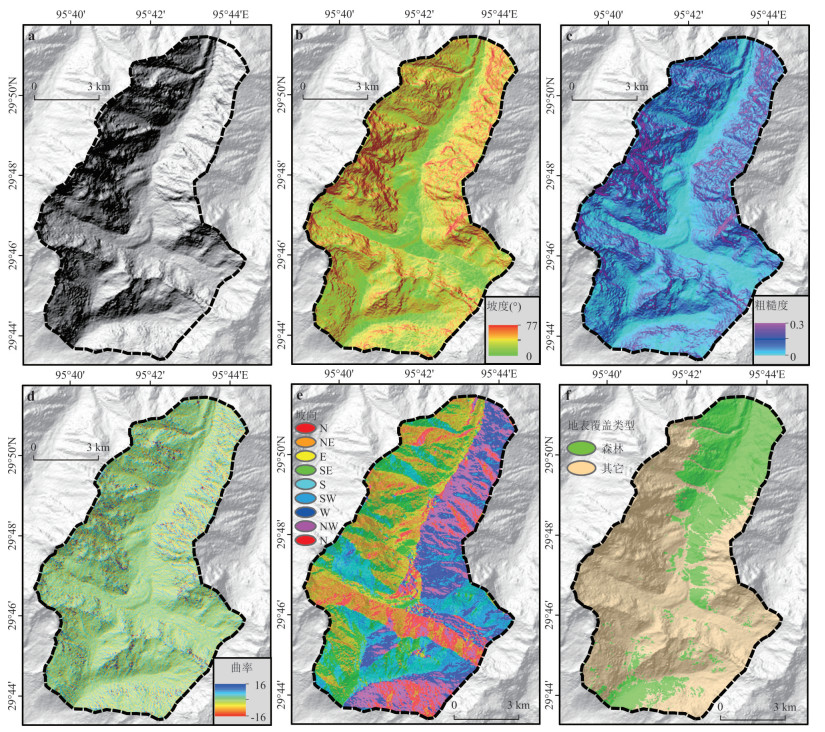
图 3 识别PRA的输入数据
a.山体阴影;b.坡度;c. 地表粗糙度;d. 平面曲率;e. 坡向;f. 地表覆盖类型
Fig. 3. Input layers for PRA identification
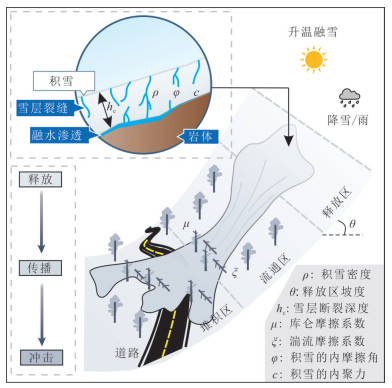
图 5 RAMMS模型模拟雪崩的物理过程及其参数示意
Fig. 5. Schematic illustration of the physical processes and associated parameters in the RAMMS avalanche simulation model
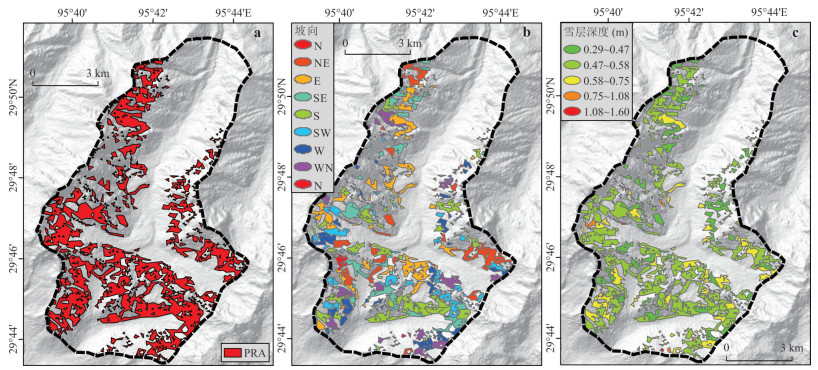
图 6 一般情境下的PRA识别结果
a. PRA分布;b. 进一步细分的PRA;c. PRA的雪层断裂深度
Fig. 6. PRA identification results under general conditions
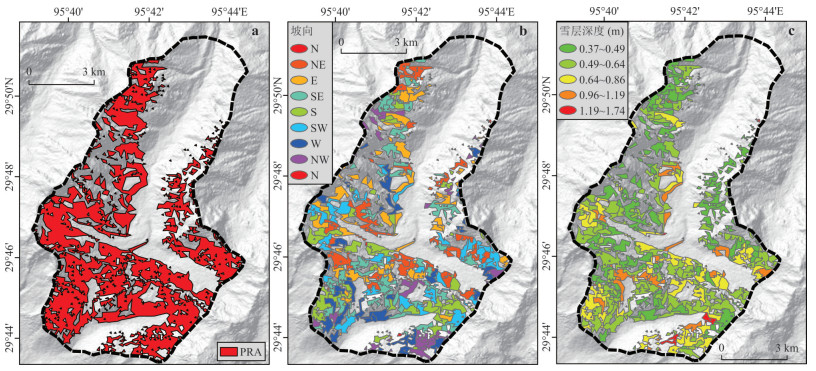
图 7 极端情境下的PRA识别结果
a. PRA分布;b. 进一步细分的PRA;c. PRA的雪层断裂深度
Fig. 7. PRA identification results under extreme conditions
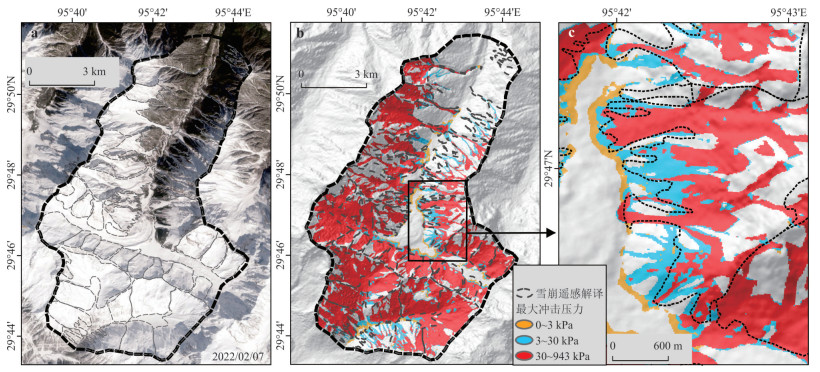
图 9 基于光学卫星数据测绘的雪崩影响范围与模拟结果的对比
a. Sentinel-2卫星影像;b. 一般情景下雪崩遥感测绘结果与数值模拟结果的叠加;c. 局部放大图
Fig. 9. Comparison between avalanche-affected areas mapped from optical satellite data and simulation outputs
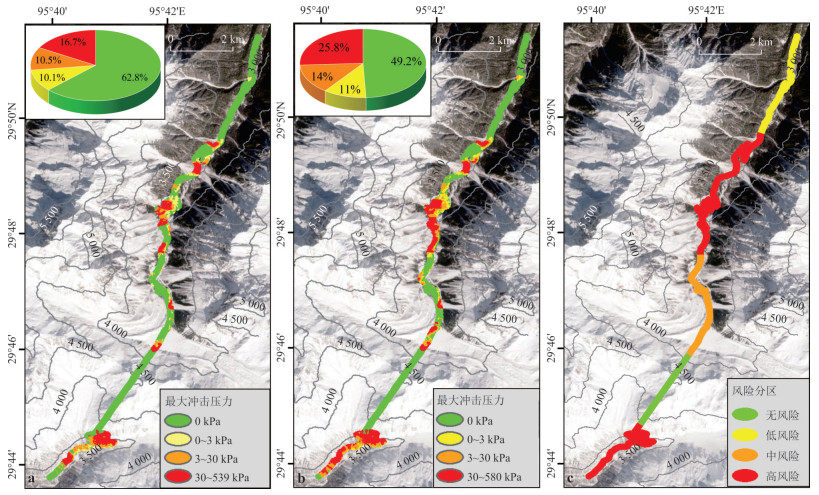
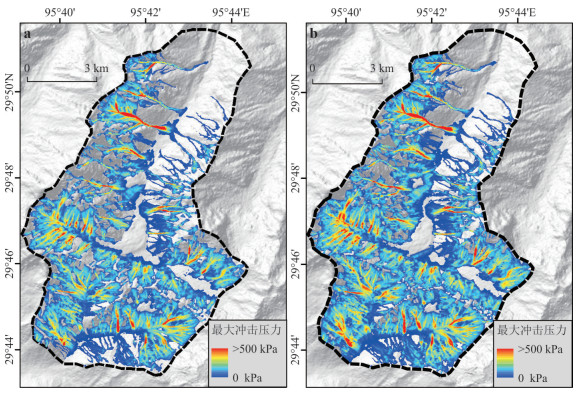
图 10 扎墨公路嘎隆拉段雪崩冲击压力及危险性分区
a. 一般情境下公路受到的雪崩冲击压力;b. 极端情境下公路受到的雪崩冲击压力;c. 雪崩危险性分区;底图来源于2022年2月7日的Sentinel-2卫星影像
Fig. 10. Avalanche impact pressure and risk zoning along the Galongla section of the Zhamo Highway
表 1 研究区不同情景下模拟结果的统计
Table 1. Statistics of simulation results under different scenarios in the study area
情境 PRA数量 PRA总面积(km2) PRA占研究区总面积的比例(100%=80.42 km2) 雪崩影响面积(km2) 雪崩影响面积占研究区总面积的比例(100%=80.42 km2) 一般情境 539 20.27 25.21% 43.89 54.58% 极端情境 526 30.70 38.17% 53.24 66.20%  下载: 导出CSV
-
Aydin, A., Bühler, Y., Christen, M., et al., 2014. Avalanche Situation in Turkey and back Calculation of Selected Events. Natural Hazards and Earth System Sciences, 14(5): 1145-1154. https://doi.org/10.5194/nhess-14-1145-2014 Bartelt, P., Valero, C. V., Feistl, T., et al., 2015. Modelling Cohesion in Snow Avalanche Flow. Journal of Glaciology, 61(229): 837-850. https://doi.org/10.3189/2015jog14j126 Bühler, Y., Bebi, P., Christen, M., et al., 2022. Automated Avalanche Hazard Indication Mapping on a Statewide Scale. Natural Hazards and Earth System Sciences, 22(6): 1825-1843. https://doi.org/10.5194/nhess-22-1825-2022 Bühler, Y., von Rickenbach, D., Stoffel, A., et al., 2018. Automated Snow Avalanche Release Area Delineation -Validation of Existing Algorithms and Proposition of a New Object-Based Approach for Large-Scale Hazard Indication Mapping. Natural Hazards and Earth System Sciences, 18(12): 3235-3251. https://doi.org/10.5194/nhess-18-3235-2018 Chen, L. J., 2021. Avalanche Hazard Assessment Based on Multi-Source Data: A Case Study in Northern Xinjiang(Dissertation). China University of Geosciences, Wuhan (in Chinese with English abstract). Chen, N. S., Li, A. H., Tian, S. F., et al., 2024. Characteristics and Causes of a Catastrophic Snow Avalanche that Occurred on January 17, 2023, in Tibet. Landslides, 21(3): 661-667. https://doi.org/10.1007/s10346-023-02205-5 Christen, M., Bartelt, P., Kowalski, J., 2010. Back Calculation of the In Den Arelen Avalanche with RAMMS: Interpretation of Model Results. Annals of Glaciology, 51(54): 161-168. https://doi.org/10.3189/172756410791386553 Duan, S. M., Liu, S. Y., Zhu, Y., et al., 2022. Reconstructing and Analyzing Avalanche Events of 1991 and 2019 in Meili Snow Mountain. Journal of Glaciology and Geocryology, 44(3): 771-783(in Chinese with English abstract). Ge, M. L., Li, X. Y., Huang, Y., et al., 2025. Influence Mechanism of Local Terrain Features on Snow Avalanche Dynamics. Scientia Sinica (Technologica), 55(6): 1043-1054(in Chinese with English abstract). doi: 10.1360/SST-2024-0324 Guo, F., Lai, P., Huang, F. M., et al., 2024. Literature Review and Research Progress of Landslide Susceptibility Mapping Based on Knowledge Graph. Earth Science, 49(5): 1584-1606(in Chinese with English abstract). Huang, F. M., Chen, J. W., Fan, X. M., et al., 2022. Logistic Regression Fitting of Rainfall-Induced Landslide Occurrence Probability and Continuous Landslide Hazard Prediction Modelling. Earth Science, 47(12): 4609-4628(in Chinese with English abstract). . Huang, F. M., Ye, Z., Yao, C., et al., 2020. Uncertainties of Landslide Susceptibility Prediction: Different Attribute Interval Divisions of Environmental Factors and Different Data-Based Models. Earth Science, 45(12): 4535-4549(in Chinese with English abstract). Huang, H., Gong, C., 2024. Spatial-Temporal Evolution of Geohazard Chain Participated by Glacier and Snow in Zhibai Gully, SE Tibetan Plateau. Earth Science, 49(10): 3784-3798(in Chinese with English abstract). Laute, K., Beylich, A. A., 2014. Morphometric and Meteorological Controls on Recent Snow Avalanche Distribution and Activity at Hillslopes in Steep Mountain Valleys in Western Norway. Geomorphology, 218: 16-34. https://doi.org/10.1016/j.geomorph.2013.06.006 Mayer, S., Hendrick, M., Michel, A., et al., 2024. Impact of Climate Change on Snow Avalanche Activity in the Swiss Alps. The Cryosphere, 18(11): 5495-5517. https://doi.org/10.5194/tc-18-5495-2024 Ortner, G., Bründl, M., Kropf, C. M., et al., 2023. Large-Scale Risk Assessment on Snow Avalanche Hazard in Alpine Regions. Natural Hazards and Earth System Sciences, 23(6): 2089-2110. https://doi.org/10.5194/nhess-23-2089-2023 Reuter, B., Hagenmuller, P., Eckert, N., 2025. Trends in Avalanche Problems in the French Alps between 1958 and 2020. Cold Regions Science and Technology, 238: 104555. https://doi.org/10.1016/j.coldregions.2025.104555 Salm, B., 1993. Flow, Flow Transition and Runout Distances of Flowing Avalanches. Annals of Glaciology, 18: 221-226. https://doi.org/10.3189/s0260305500011551 Sampl, P., Zwinger, T., 2004. Avalanche Simulation with SAMOS. Annals of Glaciology, 38: 393-398. https://doi.org/10.3189/172756404781814780 Shen, Y. P., Su, H. C., Wang, G. Y., et al., 2013. The Responses of Glaciers and Snow Cover to Climate Change in Xinjiang (Ⅰ): Hydrological Effects. Journal of Glaciology and Geocryology, 35(3): 513-527(in Chinese with English abstract). Shu, X. Y., Wu, X. Y., Wen, H., et al., 2023. Comparison of Snow Avalanche Susceptibility Assessment and Potential Snow Avalanche Release Areas Identification along Yining-Aksu Railway, Xinjiang Tianshan Mountains. Journal of Engineering Geology, 31(4): 1200-1212(in Chinese with English abstract). Sykes, J., Haegeli, P., Bühler, Y., 2022. Automated Snow Avalanche Release Area Delineation in Data-Sparse, Remote, and Forested Regions. Natural Hazards and Earth System Sciences, 22(10): 3247-3270. https://doi.org/10.5194/nhess-22-3247-2022 Thakur, K., Kumar, H., Snehmani, 2025. Avalanche Susceptibility Factors, Trends, Techniques, and Practices in Indian Himalaya: a Review. Earth-Science Reviews, 269: 105207. https://doi.org/10.1016/j.earscirev.2025.105207 Tian, X. W., Wang, Y. B., Zhu, S., et al., 2025. Geological Environment and Main Geological Safety Challenges in the Northern Segment of the Southeast Xizang (Tibet) Power Transmission Corridor. Journal of Geomechanics, 31(1): 91-108(in Chinese with English abstract). Védrine, L., Li, X. Y., Gaume, J., 2022. Detrainment and Braking of Snow Avalanches Interacting with Forests. Natural Hazards and Earth System Sciences, 22(3): 1015-1028. https://doi.org/10.5194/nhess-22-1015-2022 Wang, K., Li, X., Huang, Y., et al., 2025. Analysis on Density Profile Characteristics of Naturally Deposited Snow and Avalanche Deposition. Earth Science, 50(10): 3955-3966(in Chinese with English abstract). Wang, Y. L., 1986. A Wet Snow Avalanche with Heavy Harmfulness in China. Journal of Glaciology and Geocryology, 01: 52-60+97-98(in Chinese with English abstract). Wen, H., 2024. Spatio-Temporal Evolution Mechanism of Channeled Snow Avalanches in the Parlung Tsangpo Catchment(Dissertation). Southwest Jiaotong University, Nanjing(in Chinese with English abstract). Woodard, J. B., Mirus, B. B., 2025. Overcoming the Data Limitations in Landslide Susceptibility Modeling. Science Advances, 11(8): eadt1541. https://doi.org/10.1126/sciadv. adt1541 doi: 10.1126/sciadv.adt1541 Xu, Q., Dong, X. J., Li, W. L., 2019. Integrated Space-Air-Ground Early Detection, Monitoring and Warning System for Potential Catastrophic Geohazards. Geomatics and Information Science of Wuhan University, 44(7): 957-966(in Chinese with English abstract). Yang, J., Huang, X., 2021. The 30 m Annual Land Cover Dataset and Its Dynamics in China from 1990 to 2019. Earth System Science Data, 13(8): 3907-3925. https://doi.org/10.5194/essd-13-3907-2021 Yariyan, P., Omidvar, E., Karami, M., et al., 2022. Evaluating Novel Hybrid Models Based on GIS for Snow Avalanche Susceptibility Mapping: a Comparative Study. Cold Regions Science and Technology, 194: 103453. https://doi.org/10.1016/j.coldregions.2021.103453 Yuan, X. X., Guo, C. B., Yan, Y. Q., et al., 2025. Landslide Hazard Assessment in Alpine Gorge Region Based on Slope Units and SBAS-InSAR Surface Deformation Velocity: A Case Study of the Diwu Township Section in the Upper Reaches of Jinsha River. Earth Science, 1-20(in Chinese with English abstract). Zhang, J. J., Liu, J. K., Gao, B., et al., 2018. Characteristics of Material Sources of Galongqu Glacial Debris Flow and the Influence to Zhamo Road. Journal of Geomechanics, 24(01): 106-115(in Chinese with English abstract). Zhang, P. P., Li, B., Gao, H. Y., et al., 2024. Research on High-Altitude Avalanche Susceptibility Area Zoning Based on Informativeness Modeling in the Duoxiong River Basin, Nyingchi Area of Xizang Autonomous Region. The Chinese Journal of Geological Hazard and Control, 35(6): 44-57(in Chinese with English abstract). Zhang, P. P., Li, B., Gao, H. Y., et al., 2025. Evolutionary Characteristics and Movement Process of the January 2023 Duoxiongla Snow Avalanche, Tibet. Natural Hazards, 121(4): 4901-4927. https://doi.org/10.1007/s11069-024-06996-1 Zhang, T. Y., Liu, J., Wang, B., et al., 2024. Sensitivity Analysis of Avalanche Simulation Parameters Based on RAMMS-AVALANCHE Model. Science Technology and Engineering, 24(8): 3466-3478(in Chinese with English abstract). Zhuang, Y., Xing, A. G., Bilal, M., et al., 2024. The Effect of Ambient Air Temperature on Meltwater Production and Flow Dynamics in Snow Avalanches. Landslides, 21(10): 2389-2398. https://doi.org/10.1007/s10346-024-02303-y 陈联君. 2021. 基于多源数据的雪崩危险性评价——以北疆地区为例(博士学位论文). 武汉: 中国地质大学. 段仕美, 刘时银, 朱钰, 等, 2022. 梅里雪山1991年和2019年雪崩事件重建及影响因素分析. 冰川冻土, 44(3): 771-783 葛梦林, 李星月, 黄雨, 等, 2025. 局部地形特征对雪崩动力行为影响机制研究. 中国科学: 技术科学, 55(6): 1043-1054. 郭飞, 赖鹏, 黄发明, 等, 2024. 基于知识图谱的滑坡易发性评价文献综述及研究进展. 地球科学, 49(5): 1584-1606. doi: 10.3799/dqkx.2023.058 黄发明, 陈佳武, 范宣梅, 等, 2022. 降雨型滑坡时间概率的逻辑回归拟合及连续概率滑坡危险性建模. 地球科学, 47(12): 4609-4628. doi: 10.3799/dqkx.2021.164 黄发明, 叶舟, 姚池, 等, 2020. 滑坡易发性预测不确定性: 环境因子不同属性区间划分和不同数据驱动模型的影响. 地球科学, 45(12): 4535-4549. 黄海, 龚诚, 2024. 藏东南地区直白沟冰雪型地质灾害链时空演化特征. 地球科学, 49(10): 3784-3798. doi: 10.3799/dqkx.2023.140 沈永平, 苏宏超, 王国亚, 等, 2013. 新疆冰川、积雪对气候变化的响应(Ⅱ): 灾害效应. 冰川冻土, 35(6): 1355-1370. 舒晓燕, 巫锡勇, 文洪, 等, 2023. 新疆天山伊阿铁路区域雪崩易发性与潜在释放区识别对比研究. 工程地质学报, 31(4): 1200-1212. 田旭文, 王彦兵, 朱姝, 等, 2025. 藏东南输电走廊北线区域地质环境与主要地质安全问题. 地质力学学报, 31(1): 91-108. 王楷迪, 李星月, 黄雨, 等, 2025. 自然积雪与雪崩堆积体的剖面密度特征分析. 地球科学, 50(10): 3955-3966. doi: 10.3799/dqkx.2025.102 王彦龙. 1986. 我国危害性较大的湿雪雪崩. 冰川冻土, 1: 52-60+97-98. 文洪, 2024. 帕隆藏布流域沟槽型雪崩时空演化机制研究(博士学位论文). 成都: 西南交通大学. 许强, 董秀军, 李为乐, 2019. 基于天-空-地一体化的重大地质灾害隐患早期识别与监测预警. 武汉大学学报(信息科学版), 44(7): 957-966. 袁新霞, 郭长宝, 闫怡秋, 等. 2025. 基于斜坡单元与SBAS-InSAR地表形变速率的高山峡谷区滑坡危险性评价: 以金沙江上游地巫乡段为例. 地球科学, 1-20. doi: 10.3799/dqkx.2025.146 张佳佳, 刘建康, 高波, 等, 2018. 藏东南嘎龙曲冰川泥石流的物源特征及其对扎墨公路的影响. 地质力学学报, 24(1): 106-115. 张平平, 李滨, 高浩源, 等, 2024. 西藏林芝多雄河流域高位雪崩易发性评价. 中国地质灾害与防治学报, 35(6): 44-57. 张天意, 刘杰, 王斌, 等, 2024. 基于RAMMS-AVALANCHE模型的雪崩模拟参数敏感性分析. 科学技术与工程, 24(8): 3466-3478. -

 点击查看大图
计量
- 文章访问数: 112
- HTML全文浏览量: 24
- PDF下载量: 4
- 被引次数: 0
