




Multi-Source Geophysical Parameter Dataset of Earthquake Cases in Sichuan-Yunnan Region for Deep Learning and Its Application
-
摘要: 川滇地区新构造运动和地震活动强烈.近20年来积累了大量的地球物理观测资料,其中4.5级及以上地震由于其造成震损大而格外受到关注.深度学习技术基于数据驱动可以挖掘数据隐含特征,如震区地球物理参数特征及变化方式与中强震发生关联性,而以地震事件为单个样本的地震波检测数据集较丰富而地球物理背景数据集目前较为缺少.以川滇地区近20年的4.5级及以上的798个震例数据为基础,搜集了以震源为中心一定空间范围内与发震关联性较强的历史地震目录、重力、断层、地壳速度、地壳厚度、莫霍面深度、岩性和地下水等资料,通过计算、清洗和归一化等数据处理手段制作成了带标注的数据集.为了保证正、负例样本的平衡性,同样选取了与正例数量相等的不显著发震(3级及以下,与4.5级及以上地震能量相差悬殊)同区域的地球物理资料并制作了带标注的负例数据集;对数据集中正例、负例及数据组成进行了阐述,基于准确率、召回率等评估指标对数据集在4种经典的学习模型中使用效果进行分析,均可达到80%左右的准确率.最后通过在其他地区进行迁移学习方式验证了数据集的质量,并不低于数据集测试集的精度,这些表明构建的数据集具有良好的质量、适用性及泛化性,可为其他的深度学习地震学数据集的构建提供借鉴.Abstract: The Sichuan-Yunnan region is characterized by intense neotectonic movements and seismic activities. Over the past two decades, a large amount of geophysical observation data have been accumulated. Among them, earthquakes with magnitudes ≥4.5 are particularly concerned due to the significant damage they cause. Deep learning technology, based on the principle of data-driven, can mine the implicit features among data, such as the correlation between geophysical parameter characteristics and their variations and the occurrence of moderate to strong earthquakes. However, while seismic event-based single-sample seismic wave detection datasets are abundant, geophysical background datasets are currently relatively scarce.Based on this, in this article it uses the dataset of 798 earthquakes with magnitudes ≥4.5 that occurred in the Sichuan-Yunnan region over the past 20 years. Historical earthquake catalogs, gravity, faults, crustal velocity, crustal thickness, Moho depth, lithology, and groundwater with strong correlation to earthquake occurrence within a certain spatial range centered on the earthquake source were collected. Through data processing methods such as calculation, cleaning, and normalization, an annotated dataset was created. In order to ensure the balance of positive and negative samples, it also selected geophysical data from the same region with an equal number of non-significant earthquakes (magnitude 3 and below, which have a significant energy difference from earthquakes above magnitude 4.5) as positive examples, and created a labeled negative example dataset. Examples, negative examples, and data composition were elaborated based on accuracy. The evaluation indicators such as recall rate were used to analyze the performance of the dataset in four classic learning models, all of which achieved an accuracy of about 80%. Finally, the quality of the dataset was verified through transfer learning in other regions, which was not lower than the accuracy of the dataset testset. These indicate that the constructed dataset has good quality, applicability, and generalization. This article can provide reference for the construction of other deep learning seismology datasets.
-
Key words:
- Sichuan-Yunnan /
- geophysical parameter /
- dataset /
- transfer learning /
- seismology
-
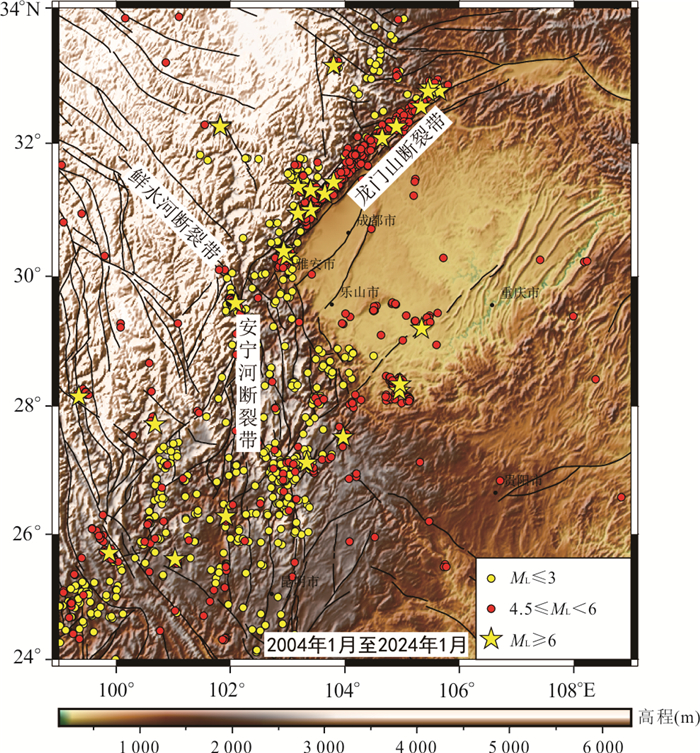
图 1 川滇地区$ {M}_{\mathrm{L}} $4.5以上地震与主要断裂概况(2004.01-2024.01)
Fig. 1. Earthquakes above $ {M}_{\mathrm{L}} $4.5 and main fault zones in Sichuan-Yunnan region(2004.01-2024.01)
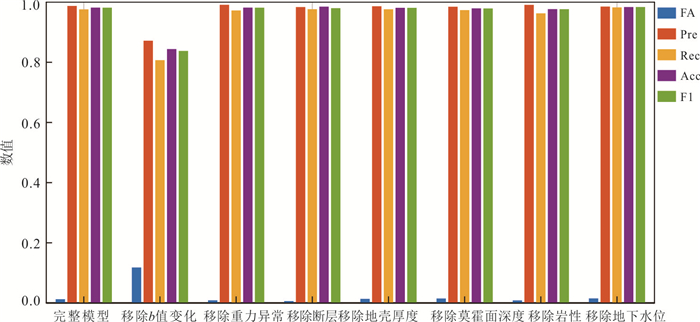
图 7 随机丢掉某参数层的消融实验效果
Fig. 7. Ablation experiment results of randomly discarding a certain parameter layer
表 1 川滇地区近20年震例地球物理参数关联数据集组成来源
Table 1. Composition and source of the dataset correlating earthquakes with geophysical parameters in the Sichuan-Yunnan region over the past 20 years
数据类型 数据属性 数据来源 来源国家 处理方式 备注 重力异常 地球物理 EGM2008 Earth gravity model 美国 0.033°下采样至0.25° 背景 莫霍面深度 地球物理 CRUST1.0模型 中国 1°上采样至0.25° 背景 地壳厚度 地球物理 CRUST1.0模型 中国 1°上采样至0.25° 背景 壳幔速度 地球物理 高精度川滇地区速度模型2.0 中国 0.2°下采样至0.25° 背景 地震b值 地球物理 中国地震台网地震目录 中国 窗口滑动计算区域b值 地震前后 地下水位 水文 GRACE-FO卫星数据 美国、德国 1°上采样至0.25° 地震前后 断层分布 地质 国家地震科学数据中心断层数据 中国 划分为至0.25°格网,断层线经过赋值 背景 岩石类型 地质 中国地质资料馆1∶250万地层岩性数据 中国 0.25°格网内以面积最大的岩性为格网岩性 背景  下载: 导出CSV
表 2 二元分类混淆矩阵
Table 2. The confusion matrix of the binary classification

Positive(正例)Negative(负例) Positive(正例) TP(Ture Positive) FN(False Negative) Negative(负例) FP(False Positive) TN(Ture Negative)
下载: 导出CSV
表 3 几种模型在高光谱数据中的分类表现
Table 3. Classification performance of several models in hyperspectral data
数据集 RGB影像 Ground Truth BP RF CNN U-net ①:Indian pines 


②:Salinas 


总体分类精度 / ①100%
②100%①76.0%
②79.1%①78.3%
②80.6%①82.1%
②85.7%①83.2%
②86.0%分类
效果/ 地类准确
边缘清晰小噪声较多、边界总体较明显 小噪声较多、边界总体较明显 斑块噪声较多、边界明显 斑块噪声较多、边界明显
下载: 导出CSV
表 4 验证区一的正负例情况
Table 4. Positive and negative samples in the Verification Zone 1
时间 纬度(N) 经度(E) 震级($ {M}_{\mathrm{L}} $) 标签 发震地点 2023/06/10 21.15° 99.91° 4.9 正 云南省普洱市孟连傣族拉祜族佤族自治县 2023/11/17 21.20° 99.35° 6.2 正 云南省西双版纳傣族自治州勐海县境内 2023/11/24 38.02° 106.26° 4.7 正 宁夏回族自治区银川市灵武市 2023/12/19 35.83° 102.78° 4.6 正 甘肃省临夏回族自治州 2023/12/31 36.74° 105.02° 5.3 正 宁夏回族自治区中卫市海原县 2022/09/05 38.92° 99.81° 2.1 负 青海省海西蒙古族藏族自治州祁连县 2019/07/15 22.42° 106.50° 2.2 负 广西壮族自治区崇左市龙州县 2021/12/24 22.35° 101.67° 3.0 负 云南省普洱市江城县 2022/03/12 37.78° 101.21° 2.2 负 青海省海西蒙古族藏族自治州刚察县 2010/07/23 36.57° 104.15° 2.1 负 甘肃省白银市靖远县
下载: 导出CSV
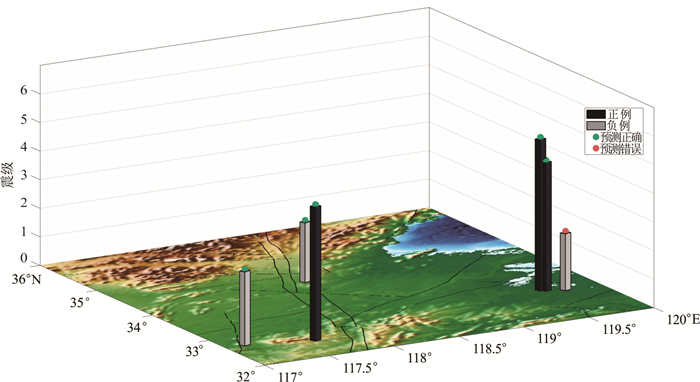
表 5 验证区二的正负例情况
Table 5. Positive and negative samples in the Verification Zone 2
时间 纬度(N) 经度(E) 震级($ {M}_{\mathrm{L}} $) 标签 发震地点 2006/07/26 32.53° 117.62° 4.7 正 安徽省合肥市肥东县 2012/07/20 33.00° 119.60° 4.5 正 江苏省盐城市响水县 2012/07/20 33.03° 119.57° 5.3 正 江苏省盐城市阜宁县 2004/04/19 32.70° 117.15° 2.5 负 安徽省滁州市定远县 2012/03/15 34.33° 118.32° 2.1 负 江苏省连云港市东海县 2008/05/03 32.93° 119.72° 2.0 负 江苏省扬州市高邮市
下载: 导出CSV
-
Archana, R., Jeevaraj, P. S. E., 2024. Deep Learning Models for Digital Image Processing: A Review. Artificial Intelligence Review, 57(1): 11. https://doi.org/10.1007/s10462-023-10631-z Chai, C. P., Maceira, M., Santos-Villalobos, H. J., et al., 2020. Using a Deep Neural Network and Transfer Learning to Bridge Scales for Seismic Phase Picking. Geophysical Research Letters, 47(16): e2020GL088651. https://doi.org/10.1029/2020gl088651 Cheng, J. W., Liu, C. C., Zhou, L., et al., 2022. Deblending of Simultaneous-Source Seismic Data Based on Deep Convolutional Neural Network. IEEE Transactions on Geoscience and Remote Sensing, 60: 5912613. https://doi.org/10.1109/TGRS.2022.3153642 Cofré, A., Marín, M., Pino, O. V., et al., 2022. End-to-End LSTM-Based Earthquake Magnitude Estimation with a Single Station. IEEE Geoscience and Remote Sensing Letters, 19: 3006905. https://doi.org/10.1109/LGRS.2022.3175108 Dou, J., Tang, H. M., Dong, A. N., et al., 2025. Intelligent Recognition and Feature Analysis of Seismic Surface Cracks Integrating Multi‐Scale Features and Attention Mechanism: A Case Study of the 2025 Dingri, Xizang Ms 6.8 Earthquake. Earth Science, 50(5): 1744-1758 (in Chinese with English abstract). Fang, L. H., Wu, J. P., Su, J. R., et al., 2018. Relocation of Mainshock and Aftershock Sequence of the Ms7.0 Sichuan Jiuzhaigou Earthquake. Chinese Science Bulletin, 63(7): 649-662 (in Chinese). doi: 10.1360/N972017-01184 Hu, J. J., Ding, Y. T., Zhang, H., et al., 2023. A Real-Time Seismic Intensity Prediction Model Based on Long Short-Term Memory Neural Network. Earth Science, 48(5): 1853-1864 (in Chinese with English abstract). Huamani, R. J., Auqui, O. J., Aguirre Madrid, E. M., et al., 2025. A Systematic Review about the Use of Machine Learning Related to Earthquake Studies. Advances in Civil Engineering, (1): 1-21. https://doi.org/10.1155/adce/4432234 Jiang, C., Lyu, Z. Y., Fang, L. H., 2024. Earthquake Detection Model Trained on Velocity and Acceleration Records and Its Application in Xinfengjiang Reservoir. Earth Science, 49(2): 469-479 (in Chinese with English abstract). Li, S. T., Song, W. W., Fang, L. Y., et al., 2019. Deep Learning for Hyperspectral Image Classification: An Overview. IEEE Transactions on Geoscience and Remote Sensing, 57(9): 6690-6709. https://doi.org/10.1109/TGRS.2019.2907932 Liu, Y., Yu, Z. Y., Zhang, Z. Q., et al., 2023. The High-Resolution Community Velocity Model V2.0 of Southwest China, Constructed by Joint Body and Surface Wave Tomography of Data Recorded at Temporary Dense Arrays. Scientia Sinica Terrae, 53(10): 2407-2424 (in Chinese). doi: 10.1360/SSTe-2022-0394 Lyu, S., Fang, L. H., Ren, H. Y., et al., 2024. Overview of the Earthquake Monitoring Status in the United States. China Earthquake Engineering Journal, 46(2): 431-448 (in Chinese with English abstract). Mooney, D. W., Carol Barrera-Lopez, C., Suárez, G. M., et al., 2023. Earth Crustal Model 1 (ECM1): A 1° x 1° Global Seismic and Density Model. Earth-Science Reviews, 243: 1-32. https://doi.org/10.1016/j.earscirev.2023.104493 Mousavi, S. M., Ellsworth, W. L., Zhu, W. Q., et al., 2020. Earthquake Transformer—An Attentive Deep-Learning Model for Simultaneous Earthquake Detection and Phase Picking. Nature Communications, 11: 3952. https://doi.org/10.1038/s41467-020-17591-w Ranganath, R., Rao, T., Kodipalli, A., et al., 2025. Revolutionizing Earthquake Prediction: Harnessing Machine Learning and Deep Learning. In: 5th International Conference on Design and Manufacturing Aspects for Sustainable Energy. AIP Publishing, Dehradun. https://doi.org/10.1063/5.0261607 Ren, C., Sun, A. H., Wang, W. T., et al., 2025. Revealing the Seismogenic Structural Characteristics of the Menyuan MS6.4 Earthquake in 2016 Based on Dense Array and Deep Learning. Chinese Journal of Geophysics, 68(4): 1287-1303 (in Chinese with English abstract). Shi, X. Y., Wang, X. Q., Qiu, Y. R., et al., 2020. Analysis of the Minimum Magnitude of Completeness for Earthquake Catalog in China Seismic Experimental Site. Chinese Journal of Geophysics, 63(10): 3683-3697 (in Chinese with English abstract). Shi, Y. L., Li, L. F., Cheng, S., 2022. Application of LSTM Neural Network for Intermediate-Term Earthquake Prediction: Retrospective Prediction of 2008 Wenchuan MS8.0 Earthquake. Journal of University of Chinese Academy of Sciences, 39(1): 1-12 (in Chinese with English abstract). Wang, S. Y., Wang, J., Yu, Y. X., et al., 2010. The Empirical Relation between ML and MS Based on Bulletin of Seismological Observations of Chinese Stations. Earthquake Research in China, 26(1): 14-22 (in Chinese with English abstract). Xia, H. B., Wu, J. J., Yao, J. Q., et al., 2023. A Deep Learning Application for Building Damage Assessment Using Ultra-High-Resolution Remote Sensing Imagery in Turkey Earthquake. International Journal of Disaster Risk Science, 14(6): 947-962. https://doi.org/10.1007/s13753-023-00526-6 Xiang, J. B., Yu, T., Zhang, D. D., et al., 2024. Application of High Generalization Model in the b-Value and Medium and Strong Earthquake Backtracking of the Central and Southern Section of the Tanlu Fault Zone. Progress in Earthquake Sciences, 54(12): 868-877 (in Chinese with English abstract). Xu, X. W., Wu, X. Y., Yu, G. H., et al., 2017. Seismo-Geological Signatures for Identifying M≥7.0 Earthquake Risk Area and Their Preliminary Application in Mainland China. Seismology and Geology, 39(2): 219-275 (in Chinese with English abstract). Yao, H. J., 2020. Building the Community Velocity Model in the Sichuan-Yunnan Region, China: Strategies and Progresses. Scientia Sinica Terrae, 50(9): 1319-1322 (in Chinese). doi: 10.1360/SSTe-2020-0106 Yao, Q., Wang, H., Liu, J., et al., 2023. A Hybrid Method of Earthquake Forecasting Based on Numerical Simulation and Seismicity Statistics: An Application to China Seismic Experimental Site. Chinese Journal of Geophysics, 66(10): 4162-4175 (in Chinese with English abstract). Yu, T., Zhu, Y. M., Wang, X., et al., 2020. Research on the b-Value Space-Time Characteristics of Jiangsu-Shandong Intersection Area of Tanlu Fault Zone. Progress in Geophysics, 35(6): 2134-2142 (in Chinese with English abstract). Yu, Z. Y., Chu, R. S., Sheng, M. H., 2018. Pick Onset Time of P and S Phase by Deep Neural Network. Chinese Journal of Geophysics, 61(12): 4873-4886 (in Chinese with English abstract). Zhang, B., Hu, Z. A., Wu, P., et al., 2023. EPT: A Data-Driven Transformer Model for Earthquake Prediction. Engineering Applications of Artificial Intelligence, 123: 106176. https://doi.org/10.1016/j.engappai.2023.106176 Zhang, P. Z., 2008. Contemporary Tectonic Deformation, Strain Partitioning, and Deep-Seated Dynamic Processes in the Eastern Margin of the Tibetan Plateau, Western Sichuan Region. Scientia Sinica Terrae, 38(9): 1041-1056 (in Chinese). Zhao, M., Chen, S., Yuen, D., 2019. Waveform Classification and Seismic Recognition by Convolution Neural Network. Chinese Journal of Geophysics, 62(1): 374-382 (in Chinese with English abstract). Zheng, Z., Lin, B. H., Jin, X., et al., 2024a. Predicting Instrumental Seismic Intensity Using Deep Learning and Physical Features. Chinese Journal of Geophysics, 67(7): 2712-2728 (in Chinese with English abstract). Zheng, Z., Lin, B. H., Yu, W. H., et al., 2024b. Research on the Application of Transformer Model and Transfer Learning in Earthquake P-Wave and Noise Discrimination. Chinese Journal of Geophysics, 67(11): 4189-4203 (in Chinese with English abstract). Zhu, J. B., Liu, H. Y., Luan, S. C., et al., 2025. Prediction of On-Site Peak Ground Motion Based on Machine Learning and Transfer Learning. Earth Science, 50(5): 1842-1860 (in Chinese with English abstract). Zhu, W. Q., Beroza, G. C., 2019. PhaseNet: A Deep-Neural-Network-Based Seismic Arrival Time Picking Method. Geophysical Journal International, 216(1): 261-273. https://doi.org/10.1093/gji/ggy423 窦杰, 唐辉明, 董傲男, 等, 2025. 融合多尺度特征与注意力机制的地震地表裂缝智能识别与特征分析: 以2025年西藏定日MS 6.8地震为例. 地球科学, 50(5): 1744-1758. doi: 10.3799/dqkx.2025.058 房立华, 吴建平, 苏金蓉, 等, 2018. 四川九寨沟Ms7.0地震主震及其余震序列精定位. 科学通报, 63(7): 649-662. 胡进军, 丁祎天, 张辉, 等, 2023. 基于长短期记忆神经网络的实时地震烈度预测模型. 地球科学, 48(5): 1853-1864. doi: 10.3799/dqkx.2022.338 蒋策, 吕作勇, 房立华, 2024. 融合处理速度和加速度记录的地震检测模型及其在新丰江水库的应用. 地球科学, 49(2): 469-479. doi: 10.3799/dqkx.2023.186 刘影, 于子叶, 张智奇, 等, 2023. 基于密集流动台阵构建的川滇地区高分辨率公共速度模型2.0版本. 中国科学: 地球科学, 53(10): 2407-2424. 吕帅, 房立华, 任华育, 等, 2024. 美国地震监测现状综述. 地震工程学报, 46(2): 431-448. 任超, 孙安辉, 王伟涛, 等, 2025. 密集台阵和深度学习方法揭示的2016年门源MS6.4地震发震构造特征. 地球物理学报, 68(4): 1287-1303. 史翔宇, 王晓青, 邱玉荣, 等, 2020. 川滇地震科学实验场地震目录最小完整性震级分析. 地球物理学报, 63(10): 3683-3697. 石耀霖, 李林芳, 程术, 2022. 运用LSTM神经网络对川滇地区的地震中期预报——回溯性预测2008年汶川MS8.0地震的探索. 中国科学院大学学报, 39(1): 1-12. 汪素云, 王健, 俞言祥, 等, 2010. 基于中国地震台网观测报告的ML与MS经验关系. 中国地震, 26(1): 14-22. 向健斌, 余腾, 张丹丹, 等, 2024. 高泛化性模型在郯庐断裂带中南段b值与中强震回溯中的应用. 地震科学进展, 54(12): 868-877. 徐锡伟, 吴熙彦, 于贵华, 等, 2017. 中国大陆高震级地震危险区判定的地震地质学标志及其应用. 地震地质, 39(2): 219-275. 姚华建, 2020. 中国川滇地区公共速度模型构建: 思路与进展. 中国科学: 地球科学, 50(9): 1319-1322. 姚琪, 王辉, 刘杰, 等, 2023. 基于数值模拟和地震活动性统计的混合地震预测: 在中国地震科学实验场的应用. 地球物理学报, 66(10): 4162-4175. 余腾, 朱益民, 王鑫, 等, 2020. 郯庐断裂带苏鲁交汇区b值时空特征研究. 地球物理学进展, 35(6): 2134-2142. 于子叶, 储日升, 盛敏汉, 2018. 深度神经网络拾取地震P和S波到时. 地球物理学报, 61(12): 4873-4886 张培震, 2008. 青藏高原东缘川西地区的现今构造变形、应变分配与深部动力过程. 中国科学: 地球科学, 38(9): 1041-1056. 赵明, 陈石, Dave Yuen, 2019. 基于深度学习卷积神经网络的地震波形自动分类与识别. 地球物理学报, 62(1): 374-382. 郑周, 林彬华, 金星, 等, 2024a. 利用深度学习与物理特征预测仪器地震烈度. 地球物理学报, 67(7): 2712-2728. 郑周, 林彬华, 于伟恒, 等, 2024b. Transformer模型和迁移学习在地震P波和噪声判别中的应用研究. 地球物理学报, 67(11): 4189-4203. 朱景宝, 刘赫奕, 栾世成, 等, 2025. 基于机器学习和迁移学习的现地地震动峰值预测. 地球科学, 50(5): 1842-1860. doi: 10.3799/dqkx.2024.071 -

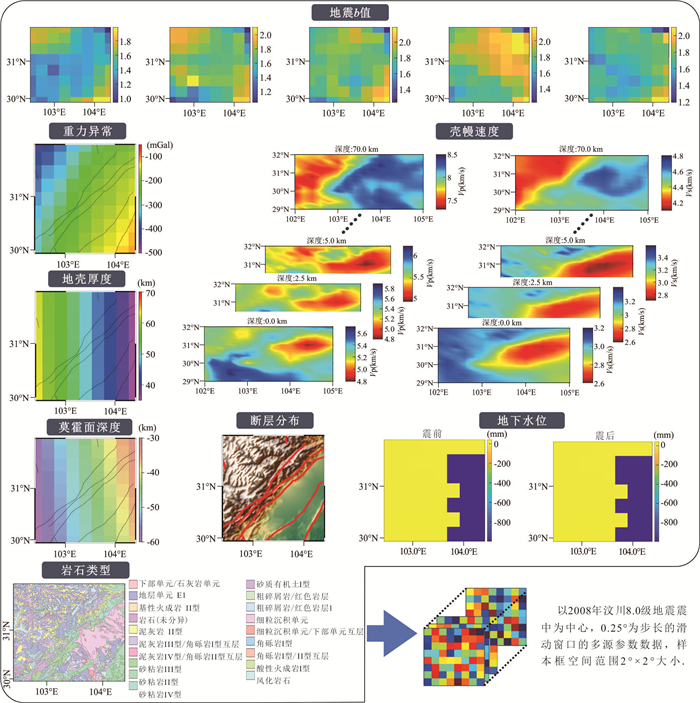
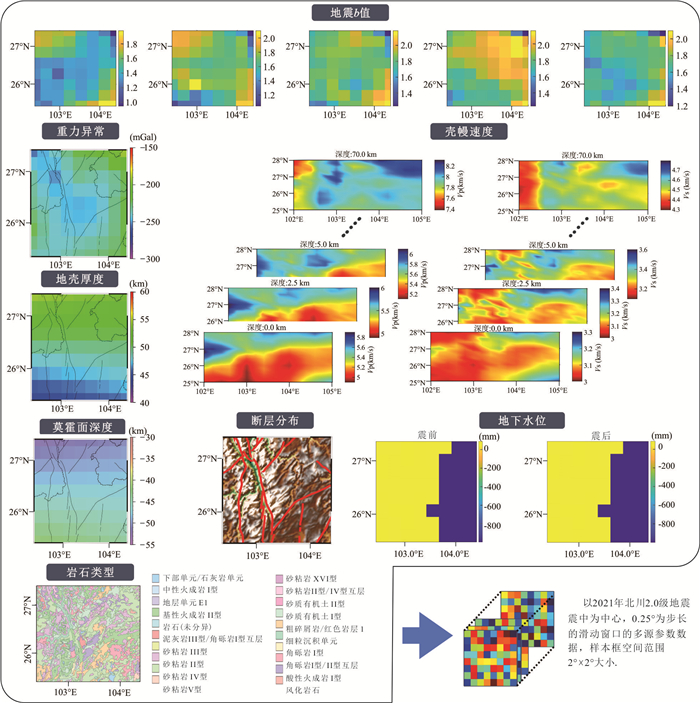
 点击查看大图
计量
- 文章访问数: 6
- HTML全文浏览量: 8
- PDF下载量: 2
- 被引次数: 0
