




Progress and Prospect of Marine Methane Leakage, Migration and Diffusion Mechanism and Ecological Environment Impact
-
摘要: 甲烷作为强效温室气体,其单分子温室效应在百年尺度上是二氧化碳的30倍,而海洋甲烷储量占全球总储量的95%,甲烷源汇过程直接影响全球气候变化.本文通过文献调研和数据分析方法,系统梳理了全球海洋甲烷渗漏的空间分布格局与运移扩散机理,并结合南海、墨西哥湾等典型案例区实测数据定量评估环境效应.结果显示全球甲烷渗漏呈显著空间差异,环太平洋海域渗漏最为活跃,北极与大西洋沿岸次之,环南极洲海域最低.这种分布格局主要由板块构造活动、水合物稳定带条件以及沉积有机质供给共同控制.北极等高纬度地区的实际渗漏活跃度可能被低估,这些地方是海洋甲烷进入大气的主要来源.从全球来看约70%~90%的海底渗漏甲烷被微生物氧化消耗,但仍有1.5%~4.0%直接进入大气,年贡献量6~12 Tg.海底甲烷渗漏通过水体运移扩散、生态重构和温室气体排放对全球环境产生显著影响.应加强动态监测及甲烷负排放技术研发,服务“双碳”目标与全球气候治理.Abstract: Over a 100-year period, methane has a global warming potential 30 times that of carbon dioxide on a per-molecule basis. As a potent greenhouse gas, methane stored in the ocean accounts for 95% of the global total reserves, and the processes of methane sources and sinks directly influence global climate change. In this paper, the spatial distribution pattern and transport and diffusion mechanism of global marine methane leakage are systematically investigated through literature research and data analysis, and the environmental effects are quantitatively assessed by combining the measured data of typical case areas such as the South China Sea and the Gulf of Mexico. The global methane seepage shows significant spatial differences, with the most active seepage in the Pacific Rim, followed by the Arctic and Atlantic coasts, and the lowest in the Antarctic Rim. This distribution pattern is primarily controlled by tectonic activity, conditions within the hydrate stability zone, and the supply of sedimentary organic matter. The actual seepage activity in high-latitude regions such as the Arctic may be underestimated, representing a major source of oceanic methane in the atmosphere. Approximately 70%-90% of seafloor methane seepage is oxidized and consumed by microorganisms, but 1.5%-4% enters the atmosphere directly, contributing 6-12 Tg per year. Seafloor methane seepage has significant impacts on the global environment through ocean acidification, ecological restructuring, and greenhouse gas emissions. Dynamic monitoring and research and development of methane negative emission technologies should be strengthened to serve the dual carbon goals and global climate governance.
-
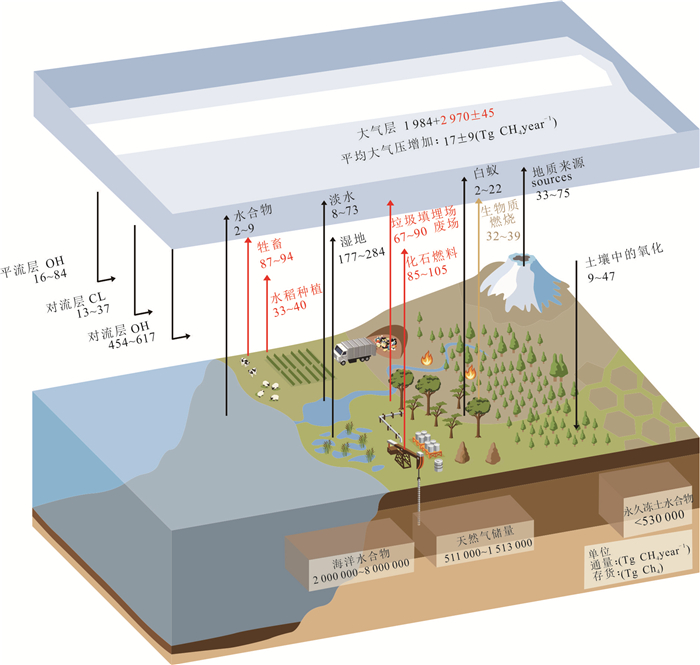
图 1 全球甲烷储量和通量
数字代表2000—2009年估计的第四季度(Tg CH4)年度通量和第四季度(Tg CH4)CH4储量.黑色箭头表示“自然”通量,即自1750年以来不是由人类活动直接引起的通量,红色箭头表示人为因素造成的通量,浅棕色箭头表示自然和人为因素共同造成的通量,引自Ciais et al.(2014);Reay et al.(2018)
Fig. 1. Global methane reserves and fluxes
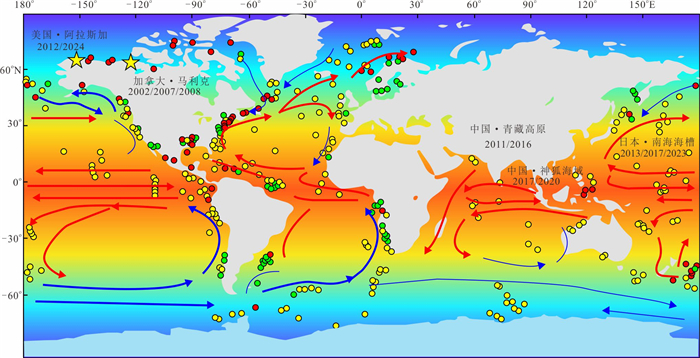
图 2 全球海域甲烷渗漏空间分布图(引自Ni et al., 2025)
Fig. 2. Spatial distribution map of methane leaks in global oceans (Ni et al., 2025)
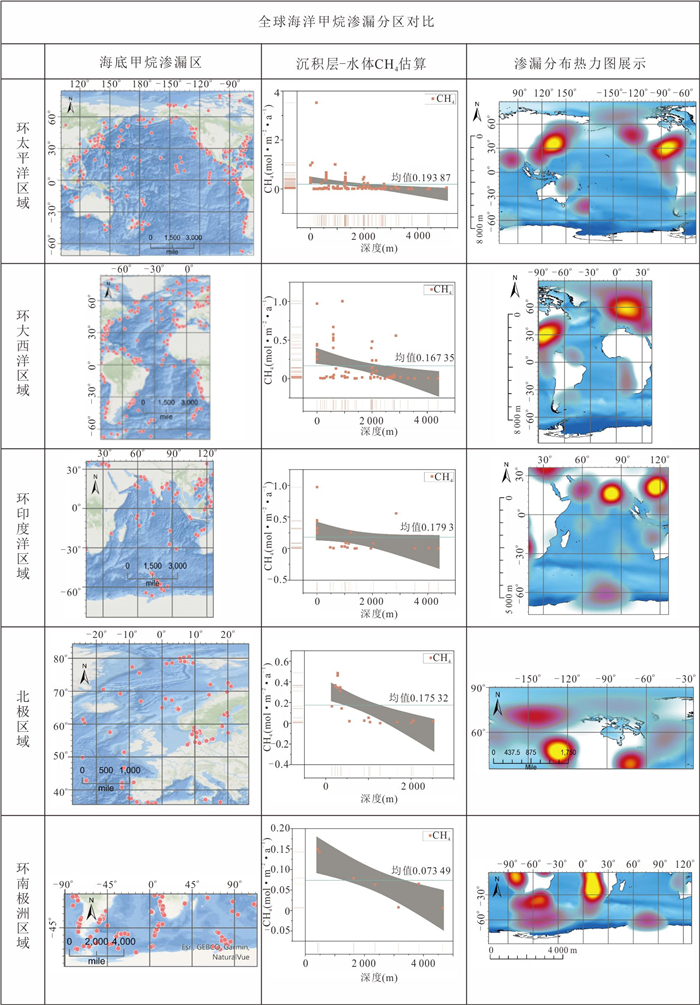
图 3 全球海洋甲烷渗漏分区对比
左侧位各区域沉积层和水体中甲烷浓度分布;中间为基于SMT深度估算的甲烷渗漏通量随水深变化(横坐标为水深(m),纵坐标为CH4通量/mol·m-2·a-1);右侧为全球甲烷渗漏空间分布.引自Ni et al.(2025)
Fig. 3. Comparison of global methane seepage zones
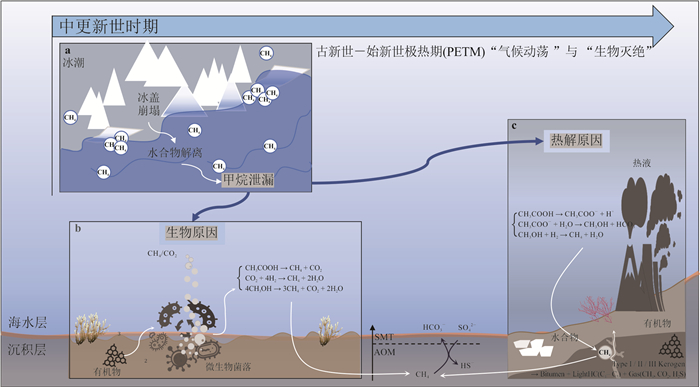
图 4 甲烷成因类型与古气候事件示意
a.末次冰消期高纬度地区(如北极)的甲烷渗漏过程,蓝色箭头表示时间序列;b.生物成因甲烷的形成途径;c.热成因甲烷的形成过程;据Sluijs et al.(2007);Dickens(2003)修改绘制
Fig. 4. Schematic diagram of methane sources and paleoclimatic events
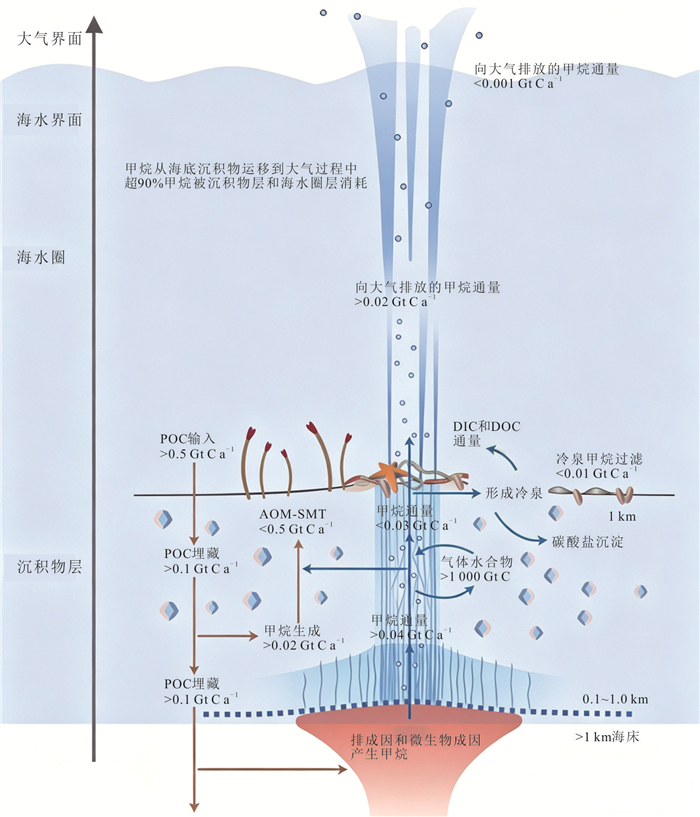
图 5 沉积层至海水大气甲烷渗漏碳通量示意
AOM-SMT表示在硫酸盐-甲烷过渡区的甲烷厌氧氧化.棕色箭头表示扩散驱动系统中通量,蓝色箭头表示对流(冷泉)系统中通量;据Boetius et al.(2013)修改
Fig. 5. Schematic of carbon flux from sedimentary layers to seawater and atmospheric methane seepage
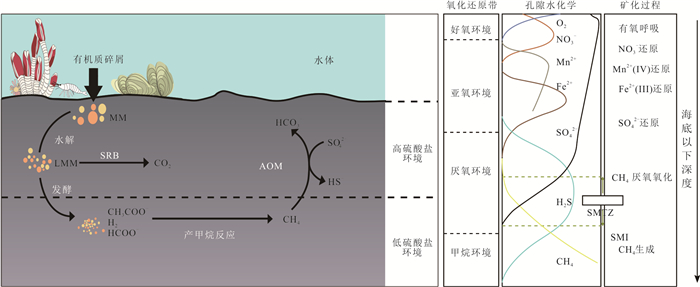
图 6 海洋沉积物中甲烷迁移的主要机制示意
据Madison et al.(2013);牛明杨等(2018)修改
Fig. 6. Schematic representation of the primary mechanisms of methane migration in marine sediments
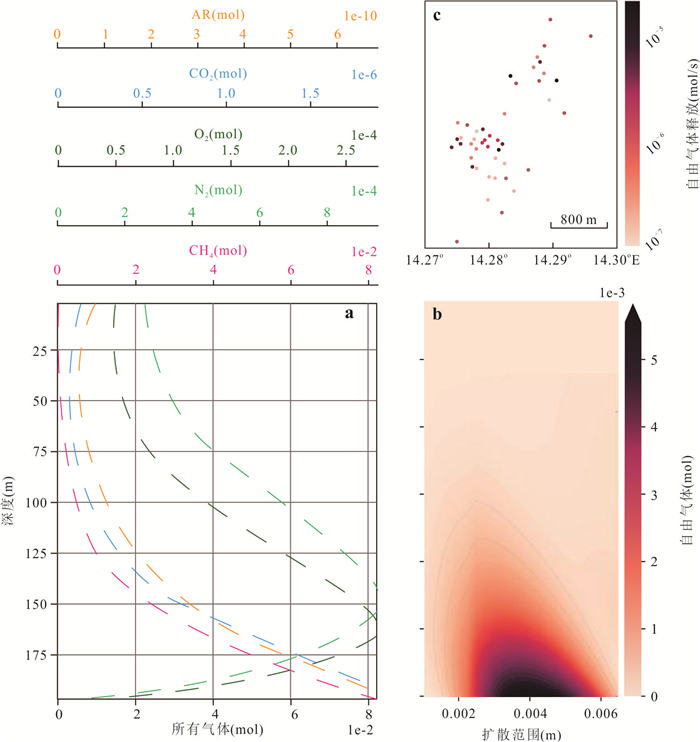
图 7 水柱自由气体分布及通量
a. 水柱中CH4、N2、O2、CO2、Ar等5种气体(彩色坐标轴)及总自由气体(黑色,下方x轴)的垂直剖面含量;b. 不同深度下,所有渗漏点及气体综合的气泡大小分布;c. 45个渗漏点处海面自由大气气体通量分布(对数色标);引自Dølven et al.(2025)
Fig. 7. Distribution and flux of free gases in the water column
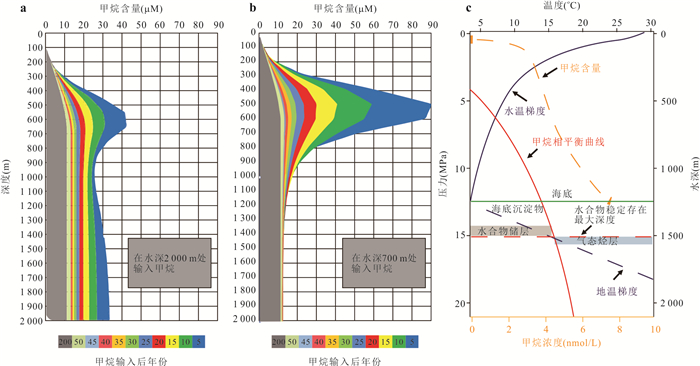
图 8 海水甲烷溶解度曲线和平衡相图
.a,b图显示的是黑海2 000 m和700 m水深的甲烷预算,色标表示甲烷输入事件时间,灰色区域表示黑海水体中甲烷的最终稳定浓度,据Schmale et al.(2011)修改.c图红色实线表示海水中甲烷水合物的平衡线;蓝色实线为试采区海水温度曲线;红色虚线表示生产试验后海水溶解甲烷含量的实测值
Fig. 8. Methane solubility curves and equilibrium phase diagrams in seawater
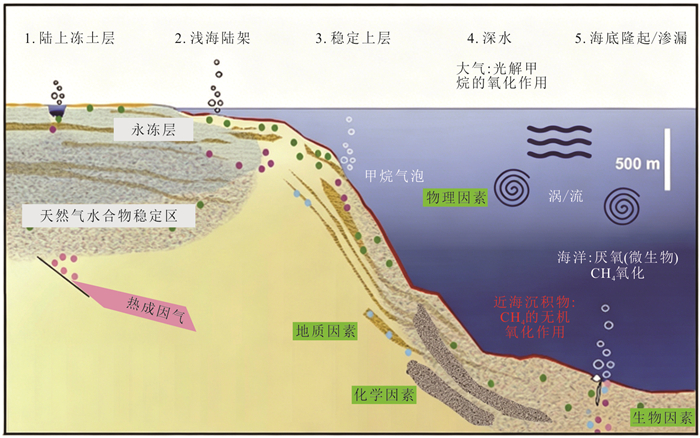
图 9 海底甲烷运移扩散影响因素图(据Ruppel, 2011修改)
Fig. 9. Map of factors affecting the transport and diffusion of seabed methane (modified from Ruppel, 2011)
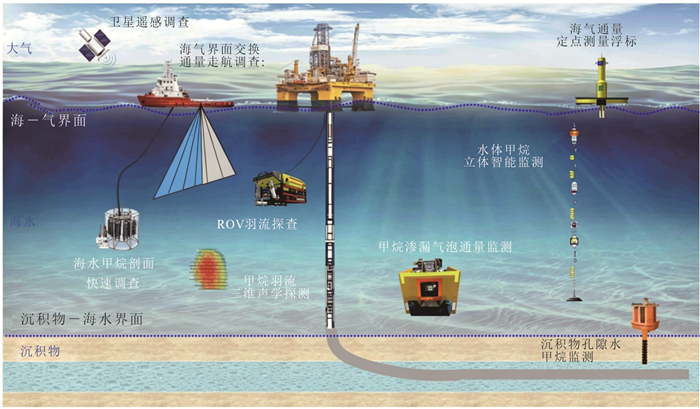
图 10 海底-水体-大气“三层两界面”的甲烷调查监测技术装备体系
Fig. 10. The methane survey and monitoring system for the "three layers and two interfaces" of seabed, water column, and atmosphere
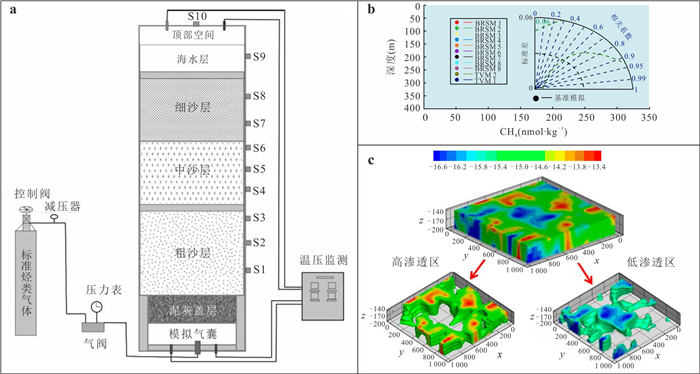
图 11 实验室模拟及甲烷渗漏数值模拟
a图为海底烃类气体渗漏实验模拟装置(李双林等,2020);b图为北冰洋水柱中溶解的CH4浓度曲线模拟(Jansson et al.,2019);c图为具有空间异质性的水合物储层的渗透率分布(Bei et al.,2019)
Fig. 11. Laboratory simulations and numerical modeling of methane leaks
表 1 IPCC对海洋水合物分解后向大气释放通量的历次估算
Table 1. Historical estimates by the IPCC of fluxes released into the atmosphere following the decomposition of marine hydrates
IPCC评估年份(a) 海洋地质甲烷排放对大气的贡献量(Tg∙a-1 CH4) 主要参考文献 第一次IPCC报告(1990) 5 甲烷水合物与全球气候(Kvenvolden, 1988) 第二次IPCC报告(1995) 未提及 水合物来源未纳入总清单 第三次IPCC报告(2001) 5 全球甲烷循环三维模型综述(Fung et al., 1991) 第四次IPCC报告(2007) 5 政府间气候变化,2007年气候变化综合报告(Bernstein et al., 2008) 第五次IPCC报告(2013) 6 利用大型、动态和微生物介导的天然气水合物电容器反思全球碳循环(Dickens, 2003) 第六次IPCC报告(2021) 54(33~75) AR6增强了对海洋中红树林和深海大洋最小含氧带(OMZ)的CH4排放量估算.当OMZ上升并接近透光带时,近海区低氧或严重缺氧期延长,都会增强海气CH4通量(袁佳双等, 2024)  下载: 导出CSV
-
Adler, M., Eckert, W., Sivan, O., 2011. Quantifying Rates of Methanogenesis and Methanotrophy in Lake Kinneret Sediments (Israel) Using Pore-Water Profiles. Limnology and Oceanography, 56(4): 1525-1535. https://doi.org/10.4319/lo.2011.56.4.1525 Adopted, I., 2014. Climate Change 2014 Synthesis Report. IPCC. Geneva, Szwitzerland, 1059, 1072. Aguzzi, J., Chatzievangelou, D., Marini, S., et al., 2019. New High-Tech Flexible Networks for the Monitoring of Deep-Sea Ecosystems. Environmental Science Technology, 53(12): 6616-6631. https://doi.org/10.1021/acs.est.9b00409 Alperin, M., Hoehler, T., 2010. The Ongoing Mystery of Sea-Floor Methane. Science, 329(5989): 288-289. https://doi.org/10.1126/science.1189966 Aoyama, C., Maeda, N., 2021. Proposed Methodology to Quantify the Amount of Methane Seepage by Understanding the Correlation between Methane Plumes and Originating Seeps. Frontiers in Earth Science, 9: 589399. https://doi.org/10.3389/feart.2021.589399 Archer, D., Buffett, B., Brovkin, V., 2009. Ocean Methane Hydrates as a Slow Tipping Point in the Global Carbon Cycle. Proceedings of the National Academy of Sciences of the United States of America, 106(49): 20596-20601. https://doi.org/10.1073/pnas.0800885105 Ayasse, A. K., Thorpe, A. K., Cusworth, D. H., et al., 2022. Methane Remote Sensing and Emission Quantification of Offshore Shallow Water Oil and Gas Platforms in the Gulf of Mexico. Environmental Research Letters, 17(8): 084039. https://doi.org/10.1088/1748-9326/ac8566 Bakunov, N. A., Bolshiyanov, D. Y., Aksenov, A. O., et al., 2023. On Global 137Cs Diffusion in Bottom Sediments of Northern Seas. Radiochemistry, 65(4): 485-492. https://doi.org/10.1134/s1066362223040100 Bei, K., Xu, T., Shang, S., et al., 2019. Numerical Modeling of Gas Migration and Hydrate Formation in Heterogeneous Marine Sediments. Journal of Marine Science and Engineering, 7(10): 348. https://doi.org/10.3390/jmse7100348 Bernstein, L., P. Bosch, O. Canziani., et al., 2008. IPCC, 2007: Climate Change 2007: Synthesis Report. IPCC, Geneva, Switzerland. Blair, N., 1998. The δ13C of Biogenic Methane in Marine Sediments: The Influence of COrg Deposition Rate. Chemical Geology, 152(1-2): 139-150. https://doi.org/10.1016/S0009-2541(98)00102-8 Boetius, A., Ravenschlag, K., Schubert, C. J., et al., 2000. A Marine Microbial Consortium Apparently Mediating Anaerobic Oxidation of Methane. Nature, 407: 623-626. https://doi.org/10.1038/35036572 Boetius, A., Wenzhöfer, F., 2013. Seafloor Oxygen Consumption Fuelled by Methane from Cold Seeps. Nature Geoscience, 6(9): 725-734. https://doi.org/10.1038/ngeo1926 Bohnhoff, M., Martínez-Garzón, P., Ben-Zion, Y., 2024. Global Warming will Increase Earthquake Hazards through Rising Sea Levels and Cascading Effects. Seismological Research Letters, 95(5): 2571-2576. https://doi.org/10.1785/0220240100 Bonaglia, S., Brüchert, V., Callac, N., et al., 2017. Methane Fluxes from Coastal Sediments are Enhanced by Macrofauna. Scientific Reports, 7: 13145. https://doi.org/10.1038/s41598-017-13263-w Brown, K., Tryon, M., Deshon, H., et al., 2005. Correlated Transient Fluid Pulsing and Seismic Tremor in the Costa Rica Subduction Zone. Earth and Planetary Science Letters, 238(1-2): 189-203. https://doi.org/10.1016/j.epsl.2005.06.055 Bünz, S., Mienert, J., Berndt, C., 2003. Geological Controls on the Storegga Gas-Hydrate System of the Mid-Norwegian Continental Margin. Earth and Planetary Science Letters, 209(3-4): 291-307. https://doi.org/10.1016/S0012-821X(03)00097-9 Cahill, A. G., Parker, B. L., Mayer, B., et al., 2018. High Resolution Spatial and Temporal Evolution of Dissolved Gases in Groundwater during a Controlled Natural Gas Release Experiment. Science of the Total Environment, 622: 1178-1192. https://doi.org/10.1016/j.scitotenv.2017.12.049 Caldwell, S. L., Laidler, J. R., Brewer, E. A., et al., 2008. Anaerobic Oxidation of Methane: Mechanisms, Bioenergetics, and the Ecology of Associated Microorganisms. Environmental Science Technology, 42(18): 6791-6799. https://doi.org/10.1021/es800120b Chen, J. W., Li, Y. D., Zhong, C., et al., 2023a. Genomic Insights into Niche Partitioning across Sediment Depth among Anaerobic Methane-Oxidizing Archaea in Global Methane Seeps. mSystems, 8(2): e01179-e01122. https://doi.org/10.1128/msystems.01179-22 Chen, Q. W., Hu, Y., Peckmann, J., et al., 2023b. The Formation of Authigenic Phosphorus Minerals in Cold-Seep Sediments from the South China Sea: Implications for Carbon Cycling below the Sulfate-Methane Transition. Marine and Petroleum Geology, 155: 106425. https://doi.org/10.1016/j.marpetgeo.2023.106425 Chen, K. T., Hsu, S. K., Lin, A. T., et al., 2024a. Changes in Marine Sedimentation Patterns in the Northeastern South China Sea in the Past 35, 000 Years. Communications Earth Environment, 5: 420. https://doi.org/10.1038/s43247-024-01593-3 Chen, Z. H., Jia, Z. C., Gong, S. G., et al., 2024b. Behaviors of Trace Elements under Varying Methane Seepage Intensity: Insight from Tubular Seep Carbonates in the South China Sea. Marine and Petroleum Geology, 163: 106816. https://doi.org/10.1016/j.marpetgeo.2024.106816. [LinkOut] doi: 10.1016/j.marpetgeo.2024.106816.[LinkOut Chen, Y., Sun, Z. L., Wu, N. Y., et al., 2022. Advances in the Study of Methane-Metabolizing Microbial Communities in Marine Sediments. Marine Geology Quaternary Geology, 42(6): 82-92 (in Chinese with English abstract). Cheng, C., He, Q., Zhang, J., et al., 2022. Is the Role of Aerobic Methanotrophs Underestimated in Methane Oxidation under Hypoxic Conditions? Science of the Total Environment, 833: 155244. https://doi.org/10.1016/j.scitotenv.2022.155244 Chuang, P. C., Dale, A. W., Wallmann, K., et al., 2013. Relating Sulfate and Methane Dynamics to Geology: Accretionary Prism Offshore SW Taiwan. Geochemistry, Geophysics, Geosystems, 14(7): 2523-2545. https://doi.org/10.1002/ggge.20168 Chuang, P. C., Yang, T. F., Hong, W. L., et al., 2010. Estimation of Methane Flux Offshore SW Taiwan and the Influence of Tectonics on Gas Hydrate Accumulation. Geofluids, 10(4): 497-510. https://doi.org/10.1111/j.1468-8123.2010.00313.x Ciais, P., C. Sabine, G. Bala., et al., 2014. Carbon and Other Biogeochemical Cycles. Climate Change 2013: The Physical Science Basis. Contribution of Working Group Ⅰ to the Fifth Assessment Report of the Intergovernmental Panel on Climate Change Change. Cambridge University Press, the United Kingdom, 465-570. Cicerone, R. J., Oremland, R. S., 1988. Biogeochemical Aspects of Atmospheric Methane. Global Biogeochemical Cycles, 2(4): 299-327. https://doi.org/10.1029/gb002i004p00299 Ciotoli, G., Procesi, M., Etiope, G., et al., 2020. Influence of Tectonics on Global Scale Distribution of Geological Methane Emissions. Nature Communications, 11: 2305. https://doi.org/10.1038/s41467-020-16229-1 Daigle, H., Dugan, B., 2010. Origin and Evolution of Fracture-Hosted Methane Hydrate Deposits. Journal of Geophysical Research: Solid Earth, 115(B11): 2010JB007492. https://doi.org/10.1029/2010jb007492 Damm, E., Helmke, E., Thoms, S., et al., 2010. Methane Production in Aerobic Oligotrophic Surface Water in the Central Arctic Ocean. Biogeosciences, 7(3): 1099-1108. https://doi.org/10.5194/bg-7-1099-2010 Dean, J. F., Middelburg, J. J., Röckmann, T., et al., 2018. Methane Feedbacks to the Global Climate System in a Warmer World. Reviews of Geophysics, 56(1): 207-250. https://doi.org/10.1002/2017rg000559 Di, P. F., Li, N., Chen, L. Y., et al., 2023. Elevated Nutrients and Surface Chlorophyll-α Associated with Natural Methane Seeps in the Haima Cold Seep Area of the Qiongdongnan Basin, Northern South China Sea. Marine Pollution Bulletin, 191: 114873. https://doi.org/10.1016/j.marpolbul.2023.114873 Dickens, G. R., 2003. Rethinking the Global Carbon Cycle with a Large, Dynamic and Microbially Mediated Gas Hydrate Capacitor. Earth and Planetary Science Letters, 213(3/4): 169-183. https://doi.org/10.1016/S0012-821X(03)00325-X Dickens, G. R., Quinby-Hunt, M. S., 1994. Methane Hydrate Stability in Seawater. Geophysical Research Letters, 21(19): 2115-2118. https://doi.org/10.1029/94gl01858 Dølven, K. O., Espenes, H., Hanssen, A., et al., 2025. Modeling Water Column Gas Transformation, Migration and Atmospheric Flux from Seafloor Seepage. Ocean Science, 21(6): 3031-3054. https://doi.org/10.5194/os-21-3031-2025 Duan, X. Y., Yin, P., Tsona, N., et al., 2023. Biogenic Methane in Coastal Unconsolidated Sediment Systems: A Review. Environmental Research, 227: 115803. https://doi.org/10.1016/j.envres.2023.115803 Egger, M., Riedinger, N., Mogollón, J. M., et al., 2018. Global Diffusive Fluxes of Methane in Marine Sediments. Nature Geoscience, 11(6): 421-425. https://doi.org/10.1038/s41561-018-0122-8 Erland, B. M., Thorpe, A. K., Gamon, J. A., 2022. Recent Advances toward Transparent Methane Emissions Monitoring: A Review. Environmental Science Technology, 56(23): 16567-16581. https://doi.org/10.1021/acs.est.2c02136 Etiope, G., 2012. Methane Uncovered. Nature Geoscience, 5(6): 373-374. https://doi.org/10.1038/ngeo1483 Etminan, M., Myhre, G., Highwood, E. J., et al., 2016. Radiative Forcing of Carbon Dioxide, Methane, and Nitrous Oxide: A Significant Revision of the Methane Radiative Forcing. Geophysical Research Letters, 43(24). https://doi.org/10.1002/2016gl071930 Fallati, L., Panieri, G., Argentino, C., et al., 2023. Characterizing Håkon Mosby Mud Volcano (Barents Sea) Cold Seep Systems by Combining ROV-Based Acoustic Data and Underwater Photogrammetry. Frontiers in Marine Science, 10: 1269197. https://doi.org/10.3389/fmars.2023.1269197 Feng, J. C., Yan, J. Y., Wang, Y., et al., 2022. Methane Mitigation: Learning from the Natural Marine Environment. The Innovation, 3(5): 100297. https://doi.org/10.1016/j.xinn.2022.100297 Ferré, B., Jansson, P. G., Moser, M., et al., 2020. Reduced Methane Seepage from Arctic Sediments during Cold Bottom-Water Conditions. Nature Geoscience, 13(2): 144-148. https://doi.org/10.1038/s41561-019-0515-3 Fu, X., Waite, W. F., Ruppel, C. D., 2021. Hydrate Formation on Marine Seep Bubbles and the Implications for Water Column Methane Dissolution. Journal of Geophysical Research: Oceans, 126(9): e2021JC017363. https://doi.org/10.1029/2021jc017363 Fung, I., John, J., Lerner, J., et al., 1991. Three-Dimensional Model Synthesis of the Global Methane Cycle. Journal of Geophysical Research: Atmospheres, 96(D7): 13033-13065. https://doi.org/10.1029/91jd01247 Gamwo, I. K., Liu, Y., 2010. Mathematical Modeling and Numerical Simulation of Methane Production in a Hydrate Reservoir. Industrial Engineering Chemistry Research, 49(11): 5231-5245. https://doi.org/10.1021/ie901452v Gelesh, L., Marshall, K., Boicourt, W., et al., 2016. Methane Concentrations Increase in Bottom Waters during Summertime Anoxia in the Highly Eutrophic Estuary, Chesapeake Bay, U. S. A.. Limnology and Oceanography, 61(S1): S253-S266. https://doi.org/10.1002/lno.10272 Gorchov Negron, A. M., Kort, E. A., Conley, S. A., et al., 2020. Airborne Assessment of Methane Emissions from Offshore Platforms in the U. S. Gulf of Mexico. Environmental Science Technology, 54(8): 5112-5120. https://doi.org/10.1021/acs.est.0c00179 Graves, C. A., Steinle, L., Rehder, G., et al., 2015. Fluxes and Fate of Dissolved Methane Released at the Seafloor at the Landward Limit of the Gas Hydrate Stability Zone Offshore Western Svalbard. Journal of Geophysical Research: Oceans, 120(9): 6185-6201. https://doi.org/10.1002/2015jc011084 Greinert, J., Artemov, Y., Egorov, V., et al., 2006.1 300 m-High Rising Bubbles from Mud Volcanoes at 2 080 m in the Black Sea: Hydroacoustic Characteristics and Temporal Variability. Earth and Planetary Science Letters, 244(1-2): 1-15. https://doi.org/10.1016/j.epsl.2006.02.011 Greinert, J., McGinnis, D. F., Naudts, L., et al., 2010. Atmospheric Methane Flux from Bubbling Seeps: Spatially Extrapolated Quantification from a Black Sea Shelf Area. Journal of Geophysical Research: Oceans, 115(C1): 2009JC005381. https://doi.org/10.1029/2009jc005381 Hao, H. Y., Zhao, J., Liu, H. S., et al., 2018. Prediction of Oil and Gas Reservoir Traps by Aromatic Hydrocarbons from Seabed Sediments in Chaoshan Depression, South China Sea. Acta Petrolei Sinica, 39(5): 528-540 (in Chinese with English abstract). Hilligsøe, K. M., Jensen, J. B., Ferdelman, T. G., et al., 2018. Methane Fluxes in Marine Sediments Quantified through Core Analyses and Seismo-Acoustic Mapping (Bornholm Basin, Baltic Sea). Geochimica et Cosmochimica Acta, 239: 255-274. https://doi.org/10.1016/j.gca.2018.07.040 Hiruta, A., Matsumoto, R., 2023. Seafloor Activity and Deep-Subsurface Geology of Gas Hydrate Areas Revealed from δ13C of Methane-Derived Authigenic Carbonates along the Eastern Margin of the Sea of Japan. Marine Geology, 464: 107124. https://doi.org/10.1016/j.margeo.2023.107124 Hofmann, H., Federwisch, L., Peeters, F., 2010. Wave-Induced Release of Methane: Littoral Zones as Source of Methane in Lakes. Limnology and Oceanography, 55(5): 1990-2000. https://doi.org/10.4319/lo.2010.55.5.1990 Hu, C. Y., Frank Yang, T., Burr, G. S., et al., 2017. Biogeochemical Cycles at the Sulfate-Methane Transition Zone (SMTZ) and Geochemical Characteristics of the Pore Fluids Offshore Southwestern Taiwan. Journal of Asian Earth Sciences, 149: 172-183. https://doi.org/10.1016/j.jseaes.2017.07.002 Hu, L., Yvon-Lewis, S. A., Kessler, J. D., et al., 2012. Methane Fluxes to the Atmosphere from Deepwater Hydrocarbon Seeps in the Northern Gulf of Mexico. Journal of Geophysical Research: Oceans, 117(C1): 2011JC007208. https://doi.org/10.1029/2011jc007208 Hu, Y., Feng, D., Peckmann, J., et al., 2023. The Crucial Role of Deep-Sourced Methane in Maintaining the Subseafloor Sulfate Budget. Geoscience Frontiers, 14(3): 101530. https://doi.org/10.1016/j.gsf.2022.101530 Hu, Y., Zhang, X. X., Feng, D., et al., 2022. Enhanced Sulfate Consumption Fueled by Deep-Sourced Methane in a Hydrate-Bearing Area. Science Bulletin, 67(2): 122-124. https://doi.org/10.1016/j.scib.2021.09.006 Irakulis-Loitxate, I., Gorroño, J., Zavala-Araiza, D., et al., 2022. Satellites Detect a Methane Ultra-Emission Event from an Offshore Platform in the Gulf of Mexico. Environmental Science Technology Letters, 9(6): 520-525. https://doi.org/10.1021/acs.estlett.2c00225. Iyer, S. D., Mehta, C. M., Das, P., et al., 2012. Seamounts-Characteristics, Formation, Mineral Deposits and Biodiversity. Geologica Acta, 10(3): 295-308. https://doi.org/10.1344/105.000001758 James, R. H., Bousquet, P., Bussmann, I., et al., 2016. Effects of Climate Change on Methane Emissions from Seafloor Sediments in the Arctic Ocean: A Review. Limnology and Oceanography, 61(S1). https://doi.org/10.1002/lno.10307 Jansson, P., Ferré, B., Silyakova, A., et al., 2019. A New Numerical Model for Understanding Free and Dissolved Gas Progression toward the Atmosphere in Aquatic Methane Seepage Systems. Limnology and Oceanography: Methods, 17(3): 223-239. https://doi.org/10.1002/lom3.10307 Jia, Z. J., Wu, H. J., Peng, J. B., et al., 2023. The Deep Origin of Ground Fissures in the Kenya Rift Valley. Scientific Reports, 13: 3672. https://doi.org/10.1038/s41598-023-30918-z Jing, J. E., Zhao, Q. X., Deng, M., et al., 2018. A Study on Natural Gas Hydrates and Their Forming Model Using Marine Controlled-Source Electromagnetic Survey in the Qiongdongnan Basin. Chinese Journal of Geophysics, 61(11): 4677-4689(in Chinese with English abstract). Joung, D., Ruppel, C., Southon, J., et al., 2022. Negligible Atmospheric Release of Methane from Decomposing Hydrates in Mid-Latitude Oceans. Nature Geoscience, 15(11): 885-891. https://doi.org/10.1038/s41561-022-01044-8 Judd, A. G., Hovland, M., Dimitrov, L. I., et al., 2002. The Geological Methane Budget at Continental Margins and Its Influence on Climate Change. Geofluids, 2(2): 109-126. https://doi.org/10.1046/j.1468-8123.2002.00027.x Karstens, J., Haflidason, H., Berndt, C., et al., 2023. Revised Storegga Slide Reconstruction Reveals Two Major Submarine Landslides 12, 000 Years apart. Communications Earth Environment, 4: 55. https://doi.org/10.1038/s43247-023-00710-y Kessler, J. D., Valentine, D. L., Redmond, M. C., et al., 2011. A Persistent Oxygen Anomaly Reveals the Fate of Spilled Methane in the Deep Gulf of Mexico. Science, 331(6015): 312-315. https://doi.org/10.1126/science.1199697 Kim, B., Zhang, Y. G., Zeebe, R. E., et al., 2025. Arctic CO2 Emissions Amplified by Aerobic Methane Oxidation during the Palaeocene-Eocene Thermal Maximum. Nature Geoscience, 18(10): 975-982. https://doi.org/10.1038/s41561-025-01784-3 Knittel, K., Boetius, A., 2009. Anaerobic Oxidation of Methane: Progress with an Unknown Process. Annual Review of Microbiology, 63: 311-334. https://doi.org/10.1146/annurev.micro.61.080706.093130 Kotelnikova, S., 2002. Microbial Production and Oxidation of Methane in Deep Subsurface. Earth-Science Reviews, 58(3-4): 367-395. https://doi.org/10.1016/S0012-8252(01)00082-4 Kretschmer, K., Biastoch, A., Rüpke, L., et al., 2015. Modeling the Fate of Methane Hydrates under Global Warming. Global Biogeochemical Cycles, 29(5): 610-625. https://doi.org/10.1002/2014gb005011 Kulkarni, A. A., Joshi, J. B., 2005. Bubble Formation and Bubble Rise Velocity in Gas-Liquid Systems: A Review. Industrial Engineering Chemistry Research, 44(16): 5873-5931. https://doi.org/10.1021/ie049131p Kvenvolden, K. A., 1988. Methane Hydrates and Global Climate. Global Biogeochemical Cycles, 2(3): 221-229. https://doi.org/10.1029/gb002i003p00221 Kvenvolden, K. A., Rogers, B. W., 2005. Gaia's Breath—Global Methane Exhalations. Marine and Petroleum Geology, 22(4): 579-590. https://doi.org/10.1016/j.marpetgeo.2004.08.004 Lai, H. F., Fang, Y. X., Kuang, Z. G., et al., 2021. Geochemistry, Origin and Accumulation of Natural Gas Hydrates in the Qiongdongnan Basin, South China Sea: Implications from Site GMGS5-W08. Marine and Petroleum Geology, 123: 104774. https://doi.org/10.1016/j.marpetgeo.2020.104774 Lawton, T. J., Rosenzweig, A. C., 2016. Methane-Oxidizing Enzymes: An Upstream Problem in Biological Gas-to-Liquids Conversion. Journal of the American Chemical Society, 138(30): 9327-9340. https://doi.org/10.1021/jacs.6b04568 Leifer, I., Judd, A. G., 2002. Oceanic Methane Layers: The Hydrocarbon Seep Bubble Deposition Hypothesis. Terra Nova, 14(6): 417-424. https://doi.org/10.1046/j.1365-3121.2002.00442.x Leifer, I., Luyendyk, B. P., Boles, J., et al., 2006. Natural Marine Seepage Blowout: Contribution to Atmospheric Methane. Global Biogeochemical Cycles, 20(3): 2005GB002668. https://doi.org/10.1029/2005gb002668 Leifer, I., MacDonald, I., 2003. Dynamics of the Gas Flux from Shallow Gas Hydrate Deposits: Interaction between Oily Hydrate Bubbles and the Oceanic Environment. Earth and Planetary Science Letters, 210(3/4): 411-424. https://doi.org/10.1016/S0012-821X(03)00173-0 Leifer, I., Patro, R. K., 2002. The Bubble Mechanism for Methane Transport from the Shallow Sea Bed to the Surface: A Review and Sensitivity Study. Continental Shelf Research, 22(16): 2409-2428. https://doi.org/10.1016/S0278-4343(02)00065-1 Levin, L., P. R. Girguis, C. R. German., et al., 2016. Exploration and Discovery of Methane Seeps and Associated Communities in the California Borderland. Oceanography, 29: 40-43. Li, C., Feng, J. C., Chen, X., et al., 2024. Behaviours of Methane Metabolism and Community Dynamics of Methane Anaerobic Oxidation Microbes on Carbonate Rocks with Long-Term Cultivation in Cold Seep Environment. Applied Energy, 365: 123296. https://doi.org/10.1016/j.apenergy.2024.123296 Li, M. S., Bralower, T. J., Kump, L. R., et al., 2022a. Astrochronology of the Paleocene-Eocene Thermal Maximum on the Atlantic Coastal Plain. Nature Communications, 13: 5618. https://doi.org/10.1038/s41467-022-33390-x Li, Y., Xie, H., Scarratt, M. G., et al., 2022b. Dissolved Methane in the World's Largest Semi-Enclosed Estuarine System: The Estuary and Gulf of St. Lawrence (Canada). Journal of Geophysical Research: Oceans, 127(8): e2022JC018850. https://doi.org/10.1029/2022jc018850 Li, S. L., Dong, H. P., Zhao, Q. F., et al., 2020. Experimental Simulation of Seabed Hydrocarbon Gas Seepage: Variation of Content and Molecular Composition of the Hydrocarbon Gas and Reconstruction of Seepage Process. Marine Geology Frontiers, 36(5): 1-13(in Chinese with English abstract). Liang, J. H., McWilliams, J. C., Sullivan, P. P., et al., 2012. Large Eddy Simulation of the Bubbly Ocean: New Insights on Subsurface Bubble Distribution and Bubble-Mediated Gas Transfer. Journal of Geophysical Research: Oceans, 117(C4): 2011JC007766. https://doi.org/10.1029/2011jc007766 Liang, Q. Y., Wu, X. M., Yu, Z. C., et al., 2025. Submarine Deformation Monitoring during the Second Gas Hydrate Production Test in the South China Sea. Energy, 335: 138149. https://doi.org/10.1016/j.energy.2025.138149 Liang, Q. Y., Zhao, J., Xia, Z., et al., 2017. Distribution Characteristics and Influential Factors of Dissolved Methane in Sea Water above Gas Hydrate Area on the Northern Slope of the South China Sea. Earth Science Frontiers, 24(4): 89-101 (in Chinese with English abstract). Liebner, S., Zeyer, J., Wagner, D., et al., 2011. Methane Oxidation Associated with Submerged Brown Mosses Reduces Methane Emissions from Siberian Polygonal Tundra: Moss-Associated Methane Oxidation. Journal of Ecology, 99(4): 914-922. https://doi.org/10.1111/j.1365-2745.2011.01823.x Lin, J. J. Y., Buehler, C., Datta, A., et al., 2023. Laboratory and Field Evaluation of a Low-Cost Methane Sensor and Key Environmental Factors for Sensor Calibration. Environmental Science: Atmospheres, 3(4): 683-694. https://doi.org/10.1039/d2ea00100d Liu, H. T., Zhan, L. S., Lu, H. L., 2022. Mechanisms for Upward Migration of Methane in Marine Sediments. Frontiers in Marine Science, 9: 1031096. https://doi.org/10.3389/fmars.2022.1031096 Lollar, B. S., Lacrampe-Couloume, G., Slater, G. F., et al., 2006. Unravelling Abiogenic and Biogenic Sources of Methane in the Earth's Deep Subsurface. Chemical Geology, 226(3-4): 328-339. https://doi.org/10.1016/j.chemgeo.2005.09.027 Luff, R., Wallmann, K., 2003. Fluid Flow, Methane Fluxes, Carbonate Precipitation and Biogeochemical Turnover in Gas Hydrate-Bearing Sediments at Hydrate Ridge, Cascadia Margin: Numerical Modeling and Mass Balances. Geochimica et Cosmochimica Acta, 67(18): 3403-3421. https://doi.org/10.1016/S0016-7037(03)00127-3 Madison, A. S., Tebo, B. M., Mucci, A., et al., 2013. Abundant Porewater Mn(Ⅲ) is a Major Component of the Sedimentary Redox System. Science, 341(6148): 875-878. https://doi.org/10.1126/science.1241396 Maltby, J., Sommer, S., Dale, A. W., et al., 2016. Microbial Methanogenesis in the Sulfate-Reducing Zone of Surface Sediments Traversing the Peruvian Margin. Biogeosciences, 13(1): 283-299. https://doi.org/10.5194/bg-13-283-2016 McGinnis, D. F., Greinert, J., Artemov, Y., et al., 2006. Fate of Rising Methane Bubbles in Stratified Waters: How Much Methane Reaches the Atmosphere? Journal of Geophysical Research: Oceans, 111(C9): 2005JC003183. https://doi.org/10.1029/2005jc003183 Michaelis, W., Seifert, R., Nauhaus, K., et al., 2002. Microbial Reefs in the Black Sea Fueled by Anaerobic Oxidation of Methane. Science, 297(5583): 1013-1015. https://doi.org/10.1126/science.1072502 Mienert, J., Vanneste, M., Bünz, S., et al., 2005. Ocean Warming and Gas Hydrate Stability on the Mid-Norwegian Margin at the Storegga Slide. Ormen Lange—An Integrated Study for Safe Field Development in the Storegga Submarine Area. Elsevier, Amsterdam, 233-244. https://doi.org/10.1016/b978-0-08-044694-3.50024-x Milkov, A. V., 2005. Molecular and Stable Isotope Compositions of Natural Gas Hydrates: A Revised Global Dataset and Basic Interpretations in the Context of Geological Settings. Organic Geochemistry, 36(5): 681-702. https://doi.org/10.1016/j.orggeochem.2005.01.010 Milkov, A. V., Etiope, G., 2018. Revised Genetic Diagrams for Natural Gases Based on a Global Dataset of >20 000 Samples. Organic Geochemistry, 125: 109-120. https://doi.org/10.1016/j.orggeochem.2018.09.002 Miller, D. C., Muir, C. L., Hauser, O. A., 2002. Detrimental Effects of Sedimentation on Marine Benthos: What can be Learned from Natural Processes and Rates? Ecological Engineering, 19(3): 211-232. https://doi.org/10.1016/S0925-8574(02)00081-2 Mogollón, J. M., Dale, A. W., L'Heureux, I., et al., 2011. Impact of Seasonal Temperature and Pressure Changes on Methane Gas Production, Dissolution, and Transport in Unfractured Sediments. Journal of Geophysical Research, 116(G3): G03031. https://doi.org/10.1029/2010jg001592 Ni, X., Liu, X. G., Pang, S. L., et al., 2025. Global Marine Methane Seepage: Spatiotemporal Patterns and Ocean Current Control. Marine Geology, 487: 107589. https://doi.org/10.1016/j.margeo.2025.107589 Niemann, H., Duarte, J., Hensen, C., et al., 2006. Microbial Methane Turnover at Mud Volcanoes of the Gulf of Cadiz. Geochimica et Cosmochimica Acta, 70(21): 5336-5355. https://doi.org/10.1016/j.gca.2006.08.010 Niewöhner, C., Hensen, C., Kasten, S., et al., 1998. Deep Sulfate Reduction Completely Mediated by Anaerobic Methane Oxidation in Sediments of the Upwelling Area off Namibia. Geochimica et Cosmochimica Acta, 62(3): 455-464. https://doi.org/10.1016/S0016-7037(98)00055-6 Nisbet, E. G., 2022. Methane's Unknowns Better Known. Nature Geoscience, 15(11): 861-862. https://doi.org/10.1038/s41561-022-01049-3 Niu, M. Y., Liang, W. Y., Wang, F. P., 2018. Methane Biotransformation in the Ocean and Its Effects on Climate Change: A Review. Science China Earth Sciences, 61(12): 1697-1713(in Chinese). doi: 10.1007/s11430-017-9299-4 Peckmann, J., Thiel, V., 2004. Carbon Cycling at Ancient Methane-Seeps. Chemical Geology, 205(3-4): 443-467. https://doi.org/10.1016/j.chemgeo.2003.12.025 Plaza-Faverola, A., Vadakkepuliyambatta, S., Hong, W. L., et al., 2017. Bottom-Simulating Reflector Dynamics at Arctic Thermogenic Gas Provinces: An Example from Vestnesa Ridge, Offshore West Svalbard. Journal of Geophysical Research: Solid Earth, 122(6): 4089-4105. https://doi.org/10.1002/2016jb013761 Polonik, N. S., Legkodimov, A. A., 2024. Methane Distribution above the Emperor Seamount Chain. Deep Sea Research Part II: Topical Studies in Oceanography, 218: 105431. https://doi.org/10.1016/j.dsr2.2024.105431 Portnov, A., Smith, A. J., Mienert, J., et al., 2013. Offshore Permafrost Decay and Massive Seabed Methane Escape in Water Depths >20 m at the South Kara Sea Shelf. Geophysical Research Letters, 40(15): 3962-3967. https://doi.org/10.1002/grl.50735 Radziejewska, T., Węsławski, J. M., Tomczak, M., et al., 2024. Deep Sea Research Methods to be Used during the Exploration of the Mid-Atlantic Ridge Polymetallic Sulphide Areas. In: Radziejewska, T., Węsławski, J. M., Tomczak, M., eds., The Natural Environment of the Mid-Atlantic Ridge: A Case Study of the Potential Mining Site. Springer Cham: International Publishing, 101-111. https://doi.org/10.1007/978-3-031-51865-2_7 Reay, D. S., Smith, P., Christensen, T. R., et al., 2018. Methane and Global Environmental Change. Annual Review of Environment and Resources, 43: 165-192. https://doi.org/10.1146/annurev-environ-102017-030154 Reeburgh, W. S., 2007. Oceanic Methane Biogeochemistry. ChemInform, 38(20): chin. 200720267. https://doi.org/10.1002/chin.200720267 Regnier, P., Dale, A. W., Arndt, S., et al., 2011. Quantitative Analysis of Anaerobic Oxidation of Methane (AOM) in Marine Sediments: A Modeling Perspective. Earth-Science Reviews, 106(1-2): 105-130. https://doi.org/10.1016/j.earscirev.2011.01.002 Rehder, G., Keir, R. S., Suess, E., et al., 1999. Methane in the Northern Atlantic Controlled by Microbial Oxidation and Atmospheric History. Geophysical Research Letters, 26(5): 587-590. https://doi.org/10.1029/1999gl900049 Rehder, G., Suess, E., 2001. Methane and pCO2 in the Kuroshio and the South China Sea during Maximum Summer Surface Temperatures. Marine Chemistry, 75(1-2): 89-108. https://doi.org/10.1016/S0304-4203(01)00026-3 Rice, D. D., Claypool, R. G. E., 1981. Generation, Accumulation, and Resource Potential of Biogenic Gas. AAPG Bulletin, 65: 5-25. https://doi.org/10.1306/2f919765-16ce-11d7-8645000102c1865d Ruff, S. E., Arnds, J., Knittel, K., et al., 2013. Microbial Communities of Deep-Sea Methane Seeps at Hikurangi Continental Margin (New Zealand). PLoS One, 8(9): e72627. https://doi.org/10.1371/journal.pone.0072627 Ruppel, C. D., 2011. Methane Hydrates and Contemporary Climate Change. Nature Eduction Knowledge, 3(10): 29. Ruppel, C. D., Kessler, J. D., 2017. The Interaction of Climate Change and Methane Hydrates. Reviews of Geophysics, 55(1): 126-168. https://doi.org/10.1002/2016rg000534 Rusakov, O., Kutas, R., 2018. Mantle Origin of Methane in the Black Sea. Geofizicheskiy Zhurnal, 40(5): 191-207. https://doi.org/10.24028/gzh.0203-3100.v40i5.2018.147482 Saunois, M., Stavert, A. R., Poulter, B., et al., 2020. The Global Methane Budget 2000-2017. Earth System Science Data, 12(3): 1561-1623. https://doi.org/10.5194/essd-12-1561-2020 Schmale, O., Haeckel, M., McGinnis, D. F., 2011. Response of the Black Sea Methane Budget to Massive Short-Term Submarine Inputs of Methane. Biogeosciences, 8(4): 911-918. https://doi.org/10.5194/bg-8-911-2011 Schreiber, L., Holler, T., Knittel, K., et al., 2010. Identification of the Dominant Sulfate-Reducing Bacterial Partner of Anaerobic Methanotrophs of the ANME-2 Clade. Environmental Microbiology, 12(8): 2327-2340. https://doi.org/10.1111/j.1462-2920.2010.02275.x Serov, P., Mattingsdal, R., Winsborrow, M., et al., 2023. Widespread Natural Methane and Oil Leakage from Sub-Marine Arctic Reservoirs. Nature Communications, 14: 1782. https://doi.org/10.1038/s41467-023-37514-9 Serov, P., Vadakkepuliyambatta, S., Mienert, J., et al., 2017. Postglacial Response of Arctic Ocean Gas Hydrates to Climatic Amelioration. Proceedings of the National Academy of Sciences of the United States of America, 114(24): 6215-6220. https://doi.org/10.1073/pnas.1619288114 Sha, Z. B., Liang, J. Q., Su, P. B., et al., 2015. Natural Gas Hydrate Accumulation Elements and Drilling Results Analysis in the Eastern Part of the Pearl River Mouth Basin. Earth Science Frontiers, 22(6): 125-135 (in Chinese with English abstract). Shakhova, N., Semiletov, I., Gustafsson, O., et al., 2017. Current Rates and Mechanisms of Subsea Permafrost Degradation in the East Siberian Arctic Shelf. Nature Communications, 8: 15872. https://doi.org/10.1038/ncomms15872 Shakhova, N., Semiletov, I., Salyuk, A., et al., 2010. Extensive Methane Venting to the Atmosphere from Sediments of the East Siberian Arctic Shelf. Science, 327(5970): 1246-1250. https://doi.org/10.1126/science.1182221 Shakhova, N., Semiletov, I., Sergienko, V., et al., 2015. The East Siberian Arctic Shelf: Towards Further Assessment of Permafrost-Related Methane Fluxes and Role of Sea Ice. Philosophical Transactions of the Royal Society A: Mathematical, Physical and Engineering Sciences, 373(2052): 20140451. https://doi.org/10.1098/rsta.2014.0451 Shakirov, R. B., Mau, S., Mishukova, G. I., et al., 2020. The Features of Methane Fluxes in the Western and Eastern Artcic: A Review. Part Ⅰ. Geosystems of Transition Zones, 4(1): 4-25. https://doi.org/10.30730/2541-8912.2020.4.1.004-025 Skarke, A., Ruppel, C., Kodis, M., et al., 2014. Widespread Methane Leakage from the Sea Floor on the Northern US Atlantic Margin. Nature Geoscience, 7(9): 657-661. https://doi.org/10.1038/ngeo2232 Sloan, E. D. Jr, Koh, C. A., Koh, C. A., 2007. Clathrate Hydrates of Natural Gases. Boca Raton: CRC Press, https://doi.org/10.1201/9781420008494 Sluijs, A., Brinkhuis, H., Schouten, S., et al., 2007. Environmental Precursors to Rapid Light Carbon Injection at the Palaeocene/Eocene Boundary. Nature, 450(7173): 1218-1221. https://doi.org/10.1038/nature06400 Solomon, E. A., Kastner, M., MacDonald, I. R., et al., 2009a. Considerable Methane Fluxes to the Atmosphere from Hydrocarbon Seeps in the Gulf of Mexico. Nature Geoscience, 2(8): 561-565. https://doi.org/10.1038/ngeo574 Solomon, S., Plattner, G. K., Knutti, R., et al., 2009b. Irreversible Climate Change Due to Carbon Dioxide Emissions. Proceedings of the National Academy of Sciences of the United States of America, 106(6): 1704-1709. https://doi.org/10.1073/pnas.0812721106 Stolper, D. A., Martini, A. M., Clog, M., et al., 2015. Distinguishing and Understanding Thermogenic and Biogenic Sources of Methane Using Multiply Substituted Isotopologues. Geochimica et Cosmochimica Acta, 161: 219-247. https://doi.org/10.1016/j.gca.2015.04.015 Stotler, R. L., Frape, S. K., Ahonen, L., et al., 2010. Origin and Stability of a Permafrost Methane Hydrate Occurrence in the Canadian Shield. Earth and Planetary Science Letters, 296(3-4): 384-394. https://doi.org/10.1016/j.epsl.2010.05.024 Suess, E., 2014. Marine Cold Seeps and Their Manifestations: Geological Control, Biogeochemical Criteria and Environmental Conditions. International Journal of Earth Sciences, 103(7): 1889-1916. https://doi.org/10.1007/s00531-014-1010-0 Sultan, N., Cochonat, P., Foucher, J. P., et al., 2004. Effect of Gas Hydrates Melting on Seafloor Slope Instability. Marine Geology, 213(1-4): 379-401. https://doi.org/10.1016/j.margeo.2004.10.015 Sultan, N., Plaza-Faverola, A., Vadakkepuliyambatta, S., et al., 2020. Impact of Tides and Sea-Level on Deep-Sea Arctic Methane Emissions. Nature Communications, 11: 5087. https://doi.org/10.1038/s41467-020-18899-3 Sun, X. H., Wang, Z. Y., Sun, B. J., et al., 2018. Modeling of Dynamic Hydrate Shell Growth on Bubble Surface Considering Multiple Factor Interactions. Chemical Engineering Journal, 331: 221-233. https://doi.org/10.1016/j.cej.2017.08.105 Talling, P., Clare, M., Urlaub, M., et al., 2014. Large Submarine Landslides on Continental Slopes: Geohazards, Methane Release, and Climate Change. Oceanography, 27(2): 32-45. https://doi.org/10.5670/oceanog.2014.38 Thanwerdas, J., M. Saunois, A. Berchet., et al., 2019. Impact of Atomic Chlorine on the Modelling of Total Methane and Its 13C: 12C Isotopic Ratio at Global Scale. Atmospheric Chemistry and Physics Discussions. https://doi.org/10.5194/acp-2019-925 Timmers, P. H. A., Suarez-Zuluaga, D. A., van Rossem, M., et al., 2016. Anaerobic Oxidation of Methane Associated with Sulfate Reduction in a Natural Freshwater Gas Source. The ISME Journal, 10(6): 1400-1412. https://doi.org/10.1038/ismej.2015.213 Tishchenko, P., Hensen, C., Wallmann, K., et al., 2005. Calculation of the Stability and Solubility of Methane Hydrate in Seawater. Chemical Geology, 219(1-4): 37-52. https://doi.org/10.1016/j.chemgeo.2005.02.008 Tori, M., Albert, D. B., Alperin, M. J., et al., 1999. Acetogenesis from CO2 in an Anoxic Marine Sediment. Limnology and Oceanography, 44(3): 662-667. https://doi.org/10.4319/lo.1999.44.3.0662 Treude, T., Orphan, V., Knittel, K., et al., 2007. Consumption of Methane and CO2 by Methanotrophic Microbial Mats from Gas Seeps of the Anoxic Black Sea. Applied and Environmental Microbiology, 73(11): 3770. https://doi.org/10.1128/aem.00806-07 Tryon, M. D., Brown, K. M., Torres, M. E., 2002. Fluid and Chemical Flux in and out of Sediments Hosting Methane Hydrate Deposits on Hydrate Ridge, OR, Ⅱ: Hydrological Processes. Earth and Planetary Science Letters, 201(3-4): 541-557. https://doi.org/10.1016/S0012-821X(02)00732-X Valentine, D. L., 2011. Emerging Topics in Marine Methane Biogeochemistry. Annual Review of Marine Science, 3: 147-171. https://doi.org/10.1146/annurev-marine-120709-142734 Valentine, D. L., Blanton, D. C., Reeburgh, W. S., et al., 2001. Water Column Methane Oxidation Adjacent to an Area of Active Hydrate Dissociation, Eel River Basin. Geochimica et Cosmochimica Acta, 65(16): 2633-2640. https://doi.org/10.1016/S0016-7037(01)00625-1 Vereshchagina, O. F., Korovitskaya, E. V., Mishukova, G. I., 2013. Methane in Water Columns and Sediments of the North Western Sea of Japan. Deep Sea Research Part II: Topical Studies in Oceanography, 86/87: 25-33. https://doi.org/10.1016/j.dsr2.2012.08.017 Wallenius, A. J., Dalcin Martins, P., Slomp, C. P., et al., 2021. Anthropogenic and Environmental Constraints on the Microbial Methane Cycle in Coastal Sediments. Frontiers in Microbiology, 12: 631621. https://doi.org/10.3389/fmicb.2021.631621 Wang, Q., Alowaifeer, A., Kerner, P., et al., 2021. Aerobic Bacterial Methane Synthesis. Proceedings of the National Academy of Sciences of the United States of America, 118(27): e2019229118. https://doi.org/10.1073/pnas.2019229118 Wang, X. C., Chen, B. Y., Chen, L. Y., et al., 2024. Biogenic Methane Clumped Isotope Signatures: Insights from Microbially Enhanced Coal Bed Methane. Fuel, 365: 131307. https://doi.org/10.1016/j.fuel.2024.131307 Wang, X. D., Zhuang, G. C., Feng, D., 2024. Advancements in Studying the Biogeochemistry of Methane in Marine Depositional Systems through Trace Element Geochemistry. Marine Geology Quaternary Geology, 44(6): 82-95(in Chinese with English abstract). Weber, T., Wiseman, N. A., Kock, A., 2019. Global Ocean Methane Emissions Dominated by Shallow Coastal Waters. Nature Communications, 10: 4584. https://doi.org/10.1038/s41467-019-12541-7 Westbrook, G. K., Thatcher, K. E., Rohling, E. J., et al., 2009. Escape of Methane Gas from the Seabed along the West Spitsbergen Continental Margin. Geophysical Research Letters, 36(15). https://doi.org/10.1029/2009gl039191 Whiticar, M. J., 1999. Carbon and Hydrogen Isotope Systematics of Bacterial Formation and Oxidation of Methane. Chemical Geology, 161(1-3): 291-314. https://doi.org/10.1016/S0009-2541(99)00092-3 Wohleber, A., Blouzon, C., Witwicky, J., et al., 2025. A Membrane Inlet Laser Spectrometer for In Situ Measurement of Triple Water Isotopologues. Limnology and Oceanography: Methods, 23(1): 26-38. https://doi.org/10.1002/lom3.10660 Wood, J. M., Sanei, H., 2016. Secondary Migration and Leakage of Methane from a Major Tight-Gas System. Nature Communications, 7: 13614. https://doi.org/10.1038/ncomms13614 Wu, N. Y., Yang, S. X., Wang, H. B., et al., 2009. Gas-Bearing Fluid Influx Sub-System for Gas Hydrate Geological System in Shenhu Area, Northern South China Sea. Chinese Journal of Geophysics, 52(6): 1641-1650 (in Chinese with English abstract). Wuebbles, D. J., Hayhoe, K., 2002. Atmospheric Methane and Global Change. Earth-Science Reviews, 57(3-4): 177-210. https://doi.org/10.1016/S0012-8252(01)00062-9 Xie, Y., Feng, J. C., Hu, W. Q., et al., 2022. Deep-Sea Sediment and Water Simulator for Investigation of Methane Seeping and Hydrate Formation. Journal of Marine Science and Engineering, 10(4): 514. https://doi.org/10.3390/jmse10040514 Xu, S. N., Wu, Z. J., Zhang, X. L., et al., 2024. Advances in Numerical Modelling of Carbon Cycling Processes in Marine Sediments. Earth Science, 49(4): 1431-1447(in Chinese with English abstract). Xu, S. N., Sun, Z. L., Geng, W., et al., 2022. Advance in Numerical Simulation Research of Marine Methane Processes. Frontiers in Earth Science, 10: 891393. https://doi.org/10.3389/feart.2022.891393 Xu, W. Y., Lowell, R. P., Peltzer, E. T., 2001. Effect of Seafloor Temperature and Pressure Variations on Methane Flux from a Gas Hydrate Layer: Comparison between Current and Late Paleocene Climate Conditions. Journal of Geophysical Research: Solid Earth, 106(B11): 26413-26423. https://doi.org/10.1029/2001jb000420 Yang, K. H., Yu, X. G., Chu, F. Y., et al., 2016. Environmental Changes in Methane Seeps Recorded by Carbon and Oxygen Isotopes in the Northern South China Sea. Earth Science, 41(7): 1206-1215 (in Chinese with English abstract). Ye, J. L., Wei, J. G., Liang, J. Q., et al., 2019. Complex Gas Hydrate System in a Gas Chimney, South China Sea. Marine and Petroleum Geology, 104: 29-39. https://doi.org/10.1016/j.marpetgeo.2019.03.023 Yin, X. J., Zhou, H. Y., Yang, Q. H., et al., 2008. The Evidence for the Existence of Methane Seepages in the Northern South China Sea: Abnormal High Methane Concentration in Bottom Waters. Acta Oceanologica Sinica, 30(6): 69-75 (in Chinese with English abstract). Yu, Y. S., Zhang, X. W., Liu, J. W., et al., 2021. Natural Gas Hydrate Resources and Hydrate Technologies: A Review and Analysis of the Associated Energy and Global Warming Challenges. Energy Environmental Science, 14(11): 5611-5668. https://doi.org/10.1039/d1ee02093e Yuan, J. S., Qiu, S., 2024. A Review Analysis of Methane Research Progress Related to IPCC AR6 and Its Implications for China. Climate Change Research, 20(3): 327-336 (in Chinese with English abstract). Zhang, C. L., Li, Y. L., Wall, J. D., et al., 2002. Lipid and Carbon Isotopic Evidence of Methane-Oxidizing and Sulfate-Reducing Bacteria in Association with Gas Hydrates from the Gulf of Mexico. Geology, 30(3): 239. https://doi.org/10.1130/0091-7613(2002)0300239:lacieo>2.0.co;2 doi: 10.1130/0091-7613(2002)0300239:lacieo>2.0.co;2 Zhang, J., Lei, H. Y., Yang, M., et al., 2018. The Interactions of P-S-Fe in Sediment from the Continental Slope of Northern South China Sea and Their Implication for the Sulfate-Methane Transition Zone. Earth Science Frontiers, 25(3): 285-293(in Chinese with English abstract). Zhang, T. T., Liang, Q. Y., Zhao, J., et al., 2020. Discussion on the Sources and Mechanism of Supersaturated Methane in Euphotic Seawater. Marine Geology Quaternary Geology, 40(1): 50-59 (in Chinese with English abstract). Zhao, G. J., Gong, G. J., Sun, H. R., et al., 2022. Effect of Methane Solubility on Hydrate Formation and Dissociation: Review and Perspectives. Energy Fuels, 36(14): 7269-7283. https://doi.org/10.1021/acs.energyfuels.2c01017 Zhao, J., Liang, Q. Y., Yu, J. G., et al., 2020. Seafloor Geology and Geochemistry Characteristic of Methane Seepage of the "Haima" Cold Seep, Northwestern Slope of the South China Sea. Geochimica, 49(1): 108-118 (in Chinese with English abstract). Zhao, Y., Yu, J. H., Shi, H. L., et al., 2024. Study of Methane Solubility Calculation Based on Modified Henry's Law and BP Neural Network. Processes, 12(6): 1091. https://doi.org/10.3390/pr12061091 Zhu, J. J., Ding, X., Liu, Z. Y., et al., 2025. Geomorphological Characteristics and Formation Mechanisms of Large Pockmarks in the Baiyun Submarine Channel System, Northern South China Sea. Journal of Earth Science. https://doi.org/10.1007/s12583-025-0346-7 陈烨, 孙治雷, 吴能友, 等, 2022. 海洋沉积物中甲烷代谢微生物的研究进展. 海洋地质与第四纪地质, 42(6): 82-92. 郝海燕, 赵静, 刘海生, 等, 2018. 海洋沉积物中芳香烃预测中国南海潮汕坳陷油气圈闭方法. 石油学报, 39(5): 528-540. 景建恩, 赵庆献, 邓明, 等, 2018. 琼东南盆地天然气水合物及其成藏模式的海洋可控源电磁研究. 地球物理学报, 61(11): 4677-4689. 李双林, 董贺平, 赵青芳, 等, 2020. 海底烃类气体渗漏实验模拟: 烃类气体含量及分子组成变化与渗漏过程重建. 海洋地质前沿, 36(5): 1-13. 梁前勇, 赵静, 夏真, 等, 2017. 南海北部陆坡天然气水合物区海水甲烷浓度分布特征及其影响因素探讨. 地学前缘, 24(4): 89-101. 牛明杨, 梁文悦, 王风平, 2018. 海洋环境中甲烷的生物转化及其对气候变化的影响. 中国科学: 地球科学, 48(12): 1568-1588. 沙志彬, 梁金强, 苏丕波, 等, 2015. 珠江口盆地东部海域天然气水合物钻探结果及其成藏要素研究. 地学前缘, 22(6): 125-135. 王旭东, 庄光超, 冯东, 2024. 海洋沉积体系甲烷生物地球化学循环的微量元素地球化学示踪研究进展. 海洋地质与第四纪地质, 44(6): 82-95. . 吴能友, 杨胜雄, 王宏斌, 等, 2009. 南海北部陆坡神狐海域天然气水合物成藏的流体运移体系. 地球物理学报, 52(6): 1641-1650. 徐思南, 吴自军, 张喜林, 等, 2024. 海洋沉积物碳循环过程数值模型的研究进展. 地球科学, 49(4): 1431-1447. doi: 10.3799/dqkx.2022.292 杨克红, 于晓果, 初凤友, 等, 2016. 南海北部甲烷渗漏系统环境变化的碳、氧同位素记录. 地球科学, 41(7): 1206-1215. 尹希杰, 周怀阳, 杨群慧, 等, 2008. 南海北部甲烷渗漏活动存在的证据: 近底层海水甲烷高浓度异常. 海洋学报, 30(6): 69-75. 尹希杰, 周怀阳, 杨群慧, 等, 2010. 珠江口淇澳岛海岸带沉积物中硫酸盐还原和不同形态硫的分布. 海洋学报, 32(3): 31-39. 袁佳双, 邱爽, 2024. IPCC AR6相关甲烷研究进展分析及其对中国的启示. 气候变化研究进展, 20(3): 327-336. 张劼, 雷怀彦, 杨鸣, 等, 2018. 南海北部陆坡沉积物中P-S-Fe的相互作用及其对划分硫酸盐-甲烷转换带的指示意义. 地学前缘, 25(3): 285-293 张亭亭, 梁前勇, 赵静, 等, 2020. 真光层海水过饱和甲烷的来源及机制探讨. 海洋地质与第四纪地质, 40(1): 50-59. 赵静, 梁前勇, 尉建功, 等, 2020. 南海北部陆坡西部海域"海马"冷泉甲烷渗漏及其海底表征. 地球化学, 49(1): 108-118. -

 点击查看大图
计量
- 文章访问数: 508
- HTML全文浏览量: 15
- PDF下载量: 67
- 被引次数: 0
