




Vision Transformer Based 3D Mineral Prospectivity Modeling for Deep Concealed Ore Bodies
-
摘要:
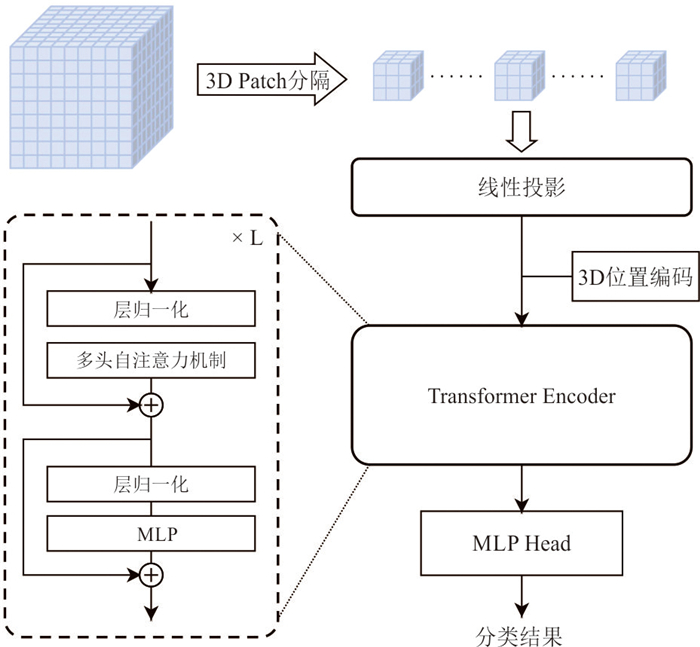
三维成矿预测是深部隐伏矿产资源勘查重要的方法技术之一.近年来,以卷积神经网络为代表的深度学习方法在三维成矿预测信息融合方面取得一定研究进展,但受限于卷积神经网络的局部感受野,可能难以提取三维预测要素与矿化事实之间的长程依赖与全局关联,制约了深部隐伏矿体的预测精度.针对上述问题,本研究基于Vision Transformer(ViT)架构,构建了适用于三维地质体数据的3D-ViT模型.模型通过3D体素块嵌入模块和分离式三维位置编码,显式保留地质体的结构信息,借助多头自注意力机制构建全局感知场,以期建立岩体、地层、构造等多预测要素与矿化事实之间的跨尺度空间关联.在安徽省狮子山矿田的实例研究中,该模型成功预测了主要已知矿体,AUC值达到0.96,其准确率、召回率与F1分数均优于3D-CNN(Convolutional Neural Network)及传统机器学习模型,展现出良好的预测能力和预测精度.基于预测结果,研究最终在狮子山矿田深部圈定了4处找矿靶区,验证了该方法在复杂地质结构下捕捉隐蔽矿化信息的有效性与可靠性.本研究不仅拓展了ViT在地学三维数据中的应用范畴,也为深部矿产资源智能预测提供了具有全局感知能力的新方法,具备重要的勘查应用前景.
-
关键词:
- 三维成矿预测 /
- 深部隐伏矿体 /
- 视觉Transformer(ViT) /
- 矿床学 /
- 机器学习
Abstract:Three-dimensional mineral prospectivity modeling serves as a crucial technical approach in the exploration of deep concealed mineral resources. In recent years, deep learning methods represented by convolutional neural networks have achieved some progress in integrating 3D predictive information; however, constrained by the local receptive fields of CNNs, it remains difficult to extract long-range dependencies and global correlations between 3D predictive factors and mineralization occurrences, which limits the prediction accuracy for deep concealed ore bodies. To address these issues, this study develops a 3D-ViT model based on the Vision Transformer (ViT) architecture, tailored for 3D geological data. The model employs a 3D voxel-patch embedding module and decoupled 3D positional encoding to explicitly preserve the structural information of geological bodies. By leveraging a multi-head self-attention mechanism, a global perceptual field is constructed to model cross-scale spatial relationships between multiple predictive factors-such as intrusions, strata, and structures- and mineralization evidence. In a case study of the Shizishan ore field in Anhui Province, the model successfully predicted the main known ore bodies, achieving an AUC of 0.96. It demonstrated strong predictive capability and precision with accuracy, recall, and F1-score above those of 3D-CNN and traditional machine learning models. Based on the prediction results, four prospective target areas were delineated in the deep part of the Shizishan ore field, verifying the method's effectiveness and reliability in detecting concealed mineralization under complex geological settings. This study not only extends the application of ViT to three-dimensional geoscientific data but also provides a novel method with global perception for intelligent prediction of deep mineral resources, holding significant potential for practical exploration applications.
-
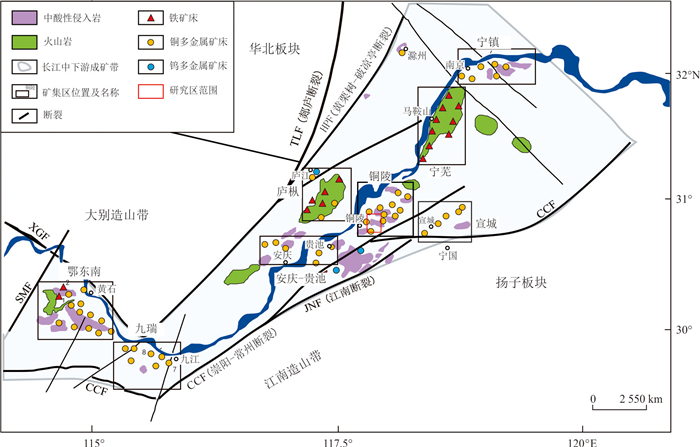
图 2 长江中下游成矿带区域地质简图(周涛发等,2017)
Fig. 2. Simplified regional geological map of the Middle-Lower Yangtze River metallogenic belt (Zhou et al., 2017)
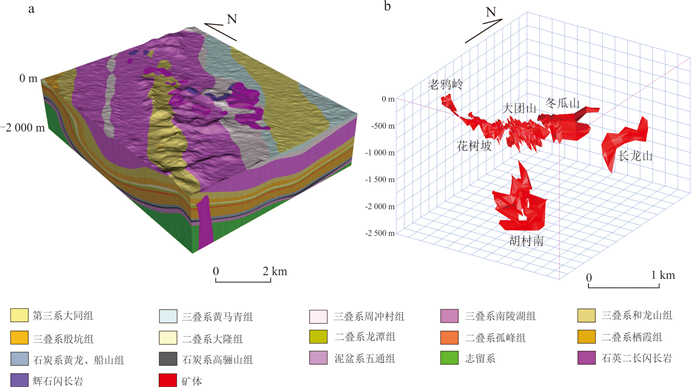
图 4 铜陵狮子山三维地质模型
a. 狮子山矿田三维地质模型;b. 典型矿床/矿段主要矿体模型
Fig. 4. 3D geological model of the Shizishan area, Tongling
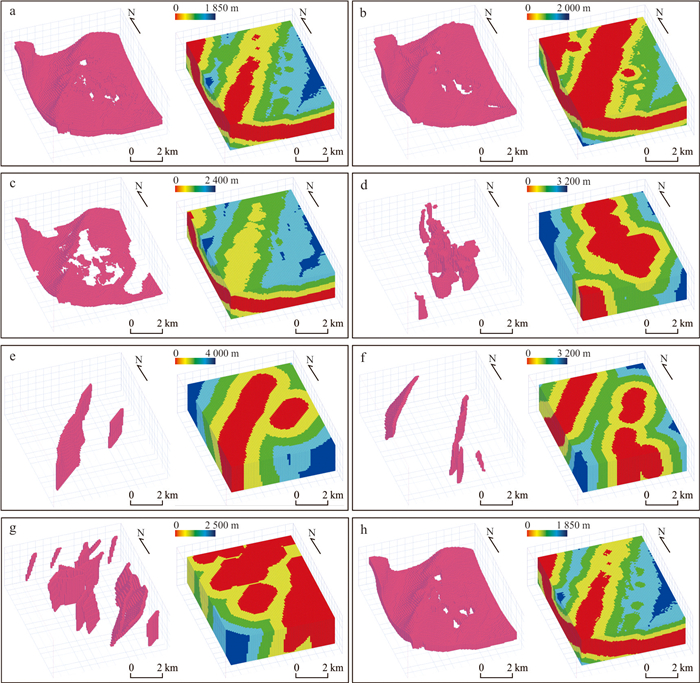
图 5 三维预测要素
a. 二叠系碳酸盐地层及三维距离场;b. 三叠系碳酸盐地层及三维距离场;c. 石炭系碳酸盐地层及三维距离场;d. 成矿有利岩体及三维距离场;e. 背斜轴面及三维距离场;f. 向斜轴面及三维距离场;g. 断裂及三维距离场;h. Si/Ca界面及三维距离场
Fig. 5. 3D predictive maps
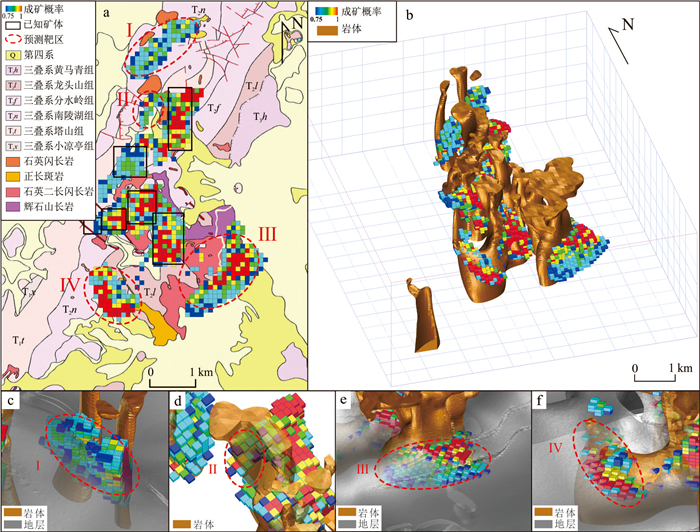
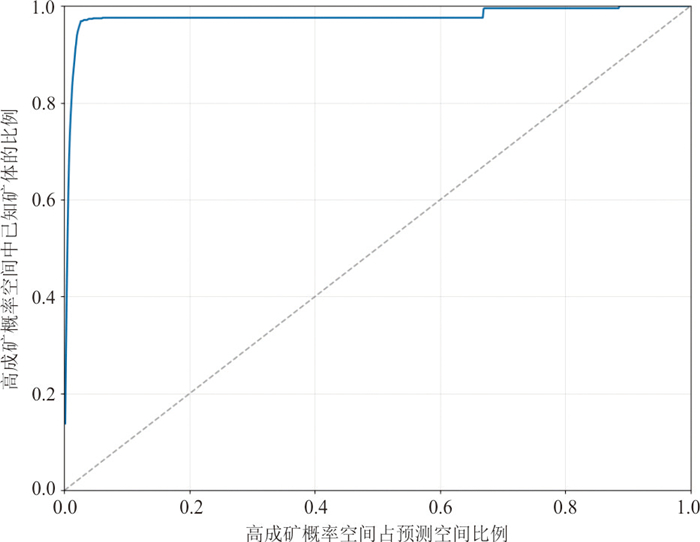
图 9 基于ViT模型的三维成矿预测结果
a. 俯视图;b. 三维视图;c. Ⅰ号靶区;d. Ⅱ号靶区;e. Ⅲ号靶区;f. Ⅳ号靶区
Fig. 9. ViT-based 3D mineral prospectivity map
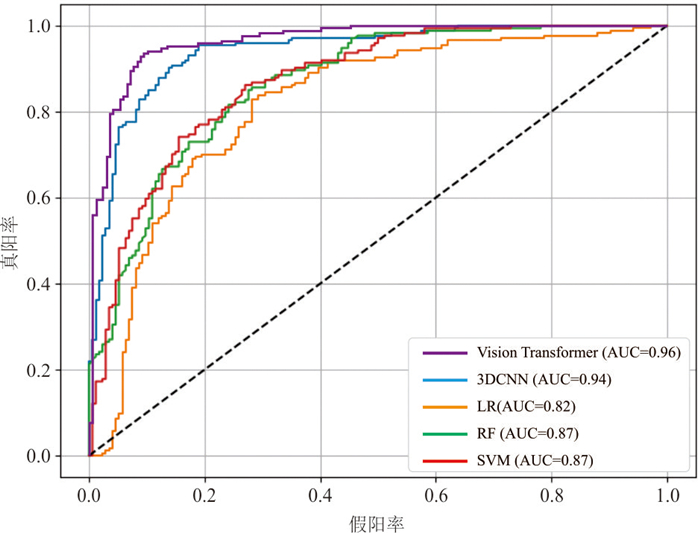
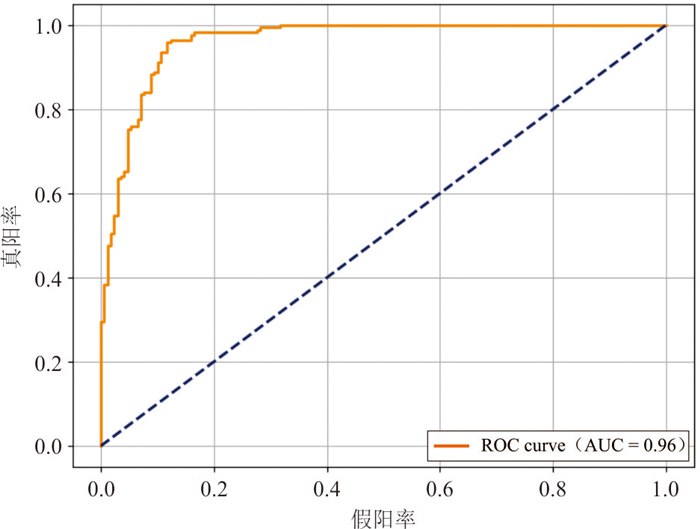
图 10 ViT、3DCNN、LR、RF和SVM模型的ROC曲线
Fig. 10. ROC curves of the ViT, 3D-CNN, LR, RF, and SVM models
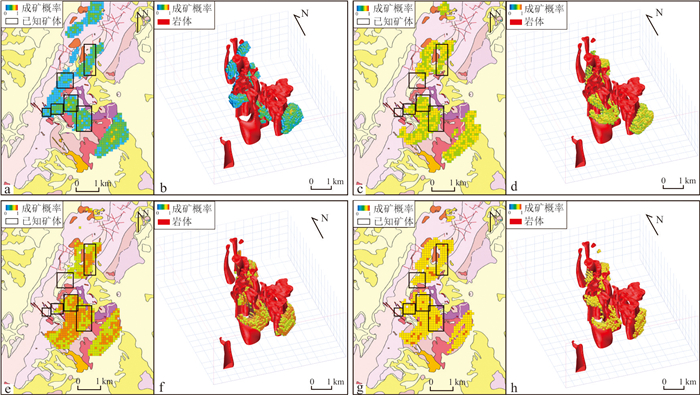
图 11 不同模型的三维成矿预测结果
a. 3DCNN模型预测结果俯视图;b. 3DCNN模型预测结果三维视图;c. LR模型预测结果俯视图;d. LR模型预测结果三维视图;e. RF模型预测结果俯视图;f. RF模型预测结果三维视图;g. SVM模型预测结果俯视图;h. SVM模型预测结果三维视图
Fig. 11. 3D mineral prospectivity maps of different models
表 1 层控/接触交代型矽卡岩型矿床三维成矿预测概念模型
Table 1. Conceptual model of 3D mineral prospectivity mapping for stratabound and contact-metasomatic skarn deposits
类别 区域找矿预测标志 三维预测要素 三维空间分析方法 成矿有利地层 石炭系中上统黄龙‒船山组、二叠系下统栖霞组、大隆组、三叠系下统殷坑组、龙山组 各碳酸盐地层 三维地质体表面提取、三维距离场分析 岩浆岩 闪长岩、石英二长/闪长斑岩、石英闪长岩等中酸性侵入岩 中酸性岩体中酸性岩体表面 三维地质体表面提取、三维距离场分析 构造 背斜、向斜轴面北东‒北北东向与北西向断裂Si/Ca界面 背斜、向斜轴面有利断裂Si/Ca界面 三维距离场分析  下载: 导出CSV
表 2 各预测模型分类指标对比
Table 2. Comparison of classification metrics for different prediction models
模型 Accuracy Precision Recall F1 Score AUC 3D-ViT 0.914 7 0.889 5 0.947 1 0.917 4 0.962 3 3D-CNN 0.801 7 0.941 2 0.643 6 0.764 5 0.940 3 LR 0.755 7 0.717 0 0.844 8 0.775 7 0.815 4 RF 0.775 7 0.756 6 0.821 0 0.787 9 0.865 0 SVM 0.790 2 0.751 2 0.867 8 0.805 3 0.869 6
下载: 导出CSV
-
Chang, Y. F., Liu, X. P., Wu, Y. C., 1991. The Copper-Iron Belt of the Lower and Middle Reaches of the Changjiang River. Geological Publishing House, Beijing (in Chinese). Chu, G. Z., 1992. Shizishan Orefield Tectonics and the Characteristics of Its Control over Rocks and Ores. Geology of Anhui, 2(2): 1-14 (in Chinese with English abstract). Deng, H., Zheng, Y., Chen, J., et al., 2022. Learning 3D Mineral Prospectivity from 3D Geological Models Using Convolutional Neural Networks: Application to a Structure-Controlled Hydrothermal Gold Deposit. Computers & Geosciences, 161: 105074. https://doi.org/10.1016/j.cageo.2022.105074 Dosovitskiy, A., 2020. An Image is Worth 16×16 Words: Transformers for Image Recognition at Scale. arXiv, 2010.11929. https://doi.org/10.48550/arXiv.2010.11929 Fawcett, T., 2006. An Introduction to ROC Analysis. Pattern Recognition Letters, 27(8): 861-874. https://doi.org/10.1016/j.patrec.2005.10.010 Fu, Z. J., Li, J. J., Ren, L., et al., 2023. SLDDNet: Stagewise Short and Long Distance Dependency Network for Remote Sensing Change Detection. IEEE Transactions on Geoscience and Remote Sensing, 61: 3000319. https://doi.org/10.1109/TGRS.2023.3305554 Gao, L., Gopalakrishnan, G., Nasri, A., et al., 2025. Transformer-GCN Fusion Framework for Mineral Prospectivity Mapping: A Geospatial Deep Learning Approach. Minerals, 15(7): 711. https://doi.org/10.3390/min15070711 Huang, X. C., Chu, G. Z., 1993. Multistory Metallogenic Model of the Shizishan Orefield in Tongling, Anhui Province. Mineral Deposits, 12(3): 221-230, 252 (in Chinese with English abstract). Jain, S., Wallace, B. C., 2019. Attention is not Explanation. arXiv, 1902.10186. https://doi.org/10.48550/arXiv.1902.10186 Krizhevsky, A., Sutskever, I., Hinton, G. E., 2017. ImageNet Classification with Deep Convolutional Neural Networks. Communications of the ACM, 60(6): 84-90. https://doi.org/10.1145/3065386 Li, C., Xiao, K. Y., Sun, L., et al., 2024a. CNN-Transformers for Mineral Prospectivity Mapping in the Maodeng-Baiyinchagan Area, Southern Great Xing'an Range. Ore Geology Reviews, 167: 106007. https://doi.org/10.1016/j.oregeorev.2024.106007 Li, H., Li, X. H., Yuan, F., et al., 2020. Convolutional Neural Network and Transfer Learning Based Mineral Prospectivity Modeling for Geochemical Exploration of Au Mineralization within the Guandian-Zhangbaling Area, Anhui Province, China. Applied Geochemistry, 122: 104747. https://doi.org/10.1016/j.apgeochem.2020.104747 Li, X. H., Chen, Y. H., Yuan, F., et al., 2024b. 3D Mineral Prospectivity Modeling Using Multi-Scale 3D Convolution Neural Network and Spatial Attention Approaches. Geochemistry, 84(4): 126125. https://doi.org/10.1016/j.chemer.2024.126125 Li, X. H., Xue, C., Chen, Y. H., et al., 2023. 3D Convolutional Neural Network-Based 3D Mineral Prospectivity Modeling for Targeting Concealed Mineralization within Chating Area, Middle-Lower Yangtze River Metallogenic Belt, China. Ore Geology Reviews, 157: 105444. https://doi.org/10.1016/j.oregeorev.2023.105444 Li, X. H., Yuan, F., Zhang, M. M., et al., 2015. Three-Dimensional Mineral Prospectivity Modeling for Targeting of Concealed Mineralization within the Zhonggu Iron Orefield, Ningwu Basin, China. Ore Geology Reviews, 71: 633-654. https://doi.org/10.1016/j.oregeorev.2015.06.001 Mao, J. W., Shao, Y. J., Xie, G. Q., et al., 2009. Mineral Deposit Model for Porphyry-Skarn Polymetallic Copper Deposits in Tongling Ore Dense District of Middle-Lower Yangtze Valley Metallogenic Belt. Mineral Deposits, 28(2): 109-119 (in Chinese with English abstract). Mao, X. C., Su, Z., Deng, H., et al., 2024. Three-Dimensional Mineral Prospectivity Modeling with Geometric Restoration: Application to the Jinchuan Ni-Cu-(PGE) Sulfide Deposit, Northwestern China. Natural Resources Research, 33(1): 75-105. https://doi.org/10.1007/s11053-023-10269-2 Mao, X. C., Zhang, M. M., Deng, H., et al., 2016. Three-Dimensional Visualization Prediction Method for Concealed Ore Bodies in Deep Mining Areas. Journal of Geology, 40(3): 363-371 (in Chinese with English abstract). Ning, Y., Wang, Y. Z., Lu, J. L., et al., 2025. Mineral Prospectivity Mapping for Multi-Source Geoscience Data: A Novel Unsupervised Deep Learning Method. Ore Geology Reviews, 186: 106866. https://doi.org/10.1016/j.oregeorev.2025.106866 Porwal, A., González-Álvarez, I., Markwitz, V., et al., 2010. Weights-of-Evidence and Logistic Regression Modeling of Magmatic Nickel Sulfide Prospectivity in the Yilgarn Craton, Western Australia. Ore Geology Reviews, 38(3): 184-196. https://doi.org/10.1016/j.oregeorev.2010.04.002 Singer, D. A., 2018. Comparison of Expert Estimates of Number of Undiscovered Mineral Deposits with Mineral Deposit Densities. Ore Geology Reviews, 99: 235-243. https://doi.org/10.1016/j.oregeorev.2018.06.019 Sun, T., Li, H., Wu, K. X., et al., 2020. Data-Driven Predictive Modelling of Mineral Prospectivity Using Machine Learning and Deep Learning Methods: A Case Study from Southern Jiangxi Province, China. Minerals, 10(2): 102. https://doi.org/10.3390/min10020102 Vaswani, A., Shazeer, N., Parmar, N., et al., 2017. Attention is All You Need. arXiv, 1706.03762. https://doi.org/10.48550/arXiv.1706.03762 Wang, G. W., Li, R. X., Carranza, E. J. M., et al., 2015. 3D Geological Modeling for Prediction of Subsurface Mo Targets in the Luanchuan District, China. Ore Geology Reviews, 71: 592-610. https://doi.org/10.1016/j.oregeorev.2015.03.002 Wang, J. J., Xie, H. R., Wang, F. L., et al., 2023. A Transformer-Convolution Model for Enhanced Session-Based Recommendation. Neurocomputing, 531: 21-33. https://doi.org/10.1016/j.neucom.2023.01.083 Xiao, F., Cheng, Q. M., Hou, W. S., et al., 2025. Three-Dimensional Prospectivity Modeling of Jinshan Ag-Au Deposit, Southern China by Weights-of-Evidence. Journal of Earth Science, 36(5): 2038-2057. https://doi.org/10.1007/s12583-023-1822-6 Xu, X. C., Fan, Z. L., He, J., et al., 2014. Metallogenic Model for the Copper-Gold-Polymetallic Deposits in Shizishan Ore-Field, Tongling, Anhui Province. Acta Petrologica Sinica, 30(4): 1054-1074 (in Chinese with English abstract). Xu, Y. Y., Li, Z. X., Xie, Z., et al., 2021. Mineral Prospectivity Mapping by Deep Learning Method in Yawan-Daqiao Area, Gansu. Ore Geology Reviews, 138: 104316. https://doi.org/10.1016/j.oregeorev.2021.104316 Xu, Y., Zuo, R. G., Chen, Z. Y., et al., 2025. Recent Advances and Future Research Directions in Deep Learning as Applied to Geochemical Mapping. Earth-Science Reviews, 270: 105209. https://doi.org/10.1016/j.earscirev.2025.105209 Yang, F. F., Zuo, R. G., 2024. Geologically Constrained Convolutional Neural Network for Mineral Prospectivity Mapping. Mathematical Geosciences, 56(8): 1605-1628. https://doi.org/10.1007/s11004-024-10141-w Yousefi, M., Lindsay, M. D., Kreuzer, O., 2024. Mitigating Uncertainties in Mineral Exploration Targeting: Majority Voting and Confidence Index Approaches in the Context of an Exploration Information System (EIS). Ore Geology Reviews, 165: 105930. https://doi.org/10.1016/j.oregeorev.2024.105930 Yuan, F., Li, X. H., Zhang, M. M., et al., 2018. Research Progress of 3D Prospectivity Modeling. Gansu Geology, 27(1): 32-36 (in Chinese with English abstract). Zhai, M. G., Wu, F. Y., Hu, R. Z., et al., 2019. Critical Metal Mineral Resources: Current Research Status and Scientific Issues. Bulletin of National Natural Science Foundation of China, 33(2): 106-111 (in Chinese with English abstract). Zhai, Y. S., Yao, S. Z., Lin, X. D., et al., 1992. Metallogenic Regularity of Iron and Copper Deposits in the Middle and Lower Valley of the Yangtze River. Mineral Deposits, 11(1): 1-12 (in Chinese with English abstract). Zhang, S., Carranza, E. J. M., Wei, H. T., et al., 2021. Data-Driven Mineral Prospectivity Mapping by Joint Application of Unsupervised Convolutional Auto-Encoder Network and Supervised Convolutional Neural Network. Natural Resources Research, 30(2): 1011-1031. https://doi.org/10.1007/s11053-020-09789-y Zhou, T. F., Fan, Y., Wang, S. W., et al., 2017. Metallogenic Regularity and Metallogenic Model of the Middle-Lower Yangtze River Valley Metallogenic Belt. Acta Petrologica Sinica, 33(11): 3353-3372 (in Chinese with English abstract). Zuo, R. G., 2025. Key Technology for Intelligent Mineral Prospectivity Mapping: Challenges and Solutions. Science China Earth Sciences, 68(9): 2976-2991. https://doi.org/10.1007/s11430-025-1622-1 Zuo, R. G., Yang, F. F., Cheng, Q. M., et al., 2025. A Novel Data-Knowledge Dual-Driven Model Coupling Artificial Intelligence with a Mineral Systems Approach for Mineral Prospectivity Mapping. Geology, 53(3): 284-288. https://doi.org/10.1130/g52970.1 常印佛, 刘湘培, 吴言昌, 1991. 长江中下游铜铁成矿带. 北京: 地质出版社. 储国正, 1992. 铜陵狮子山矿田构造及其控岩控矿作用的研究. 安徽地质, 2(2): 1-14. 黄许陈, 储国正, 1993. 铜陵狮子山矿田多位一体(多层楼)模式. 矿床地质, 12(3): 221-230, 252. 毛景文, 邵拥军, 谢桂青, 等, 2009. 长江中下游成矿带铜陵矿集区铜多金属矿床模型. 矿床地质, 28(2): 109-119. 毛先成, 张苗苗, 邓浩, 等, 2016. 矿区深部隐伏矿体三维可视化预测方法. 地质学刊, 40(3): 363-371. 徐晓春, 范子良, 何俊, 等, 2014. 安徽铜陵狮子山矿田铜金多金属矿床的成矿模式. 岩石学报, 30(4): 1054-1074. 袁峰, 李晓晖, 张明明, 等, 2018. 三维成矿预测研究进展. 甘肃地质, 27(1): 32-36. 翟明国, 吴福元, 胡瑞忠, 等, 2019. 战略性关键金属矿产资源: 现状与问题. 中国科学基金, 33(2): 106-111. 翟裕生, 姚书振, 林新多, 等, 1992. 长江中下游地区铁、铜等成矿规律研究. 矿床地质, 11(1): 1-12. 周涛发, 范裕, 王世伟, 等, 2017. 长江中下游成矿带成矿规律和成矿模式. 岩石学报, 33(11): 3353-3372. -

 点击查看大图
计量
- 文章访问数: 244
- HTML全文浏览量: 30
- PDF下载量: 63
- 被引次数: 0
