




Big Data and Artificial Intelligence-Driven Mineral Prospectivity Mapping
-
摘要:
大数据和人工智能时代未来已来.大数据是一种解决问题的新思维,强调变量间的多维关联性,让数据“发声”,从而得到新的洞察和启发性的答案.人工智能是一种新的数据挖掘方法,具有强大的非线性建模能力,可深度挖掘数据,发现隐蔽规律.大数据人工智能驱动的矿产预测已经成为全球矿业科技竞争的制高点,正在重塑矿产勘查的研究范式.本文提出了大数据人工智能驱动的矿产预测的基本概念和主要组成,分析了智能认知、智能学习和智能决策的科学内涵、研究进展和关键科学与技术问题,指出三者是智能矿产预测的重要组成部分,分别对应实现地球系统与成矿系统、成矿系统与勘查系统,以及勘查系统与评价系统的关联.未来,大数据人工智能驱动的矿产预测要重视找矿大数据构建、地质约束矿产预测人工智能新算法、图像处理大算力、创新性复合人才培养等方面.
Abstract:We have entered the era of big data and artificial intelligence. Big data or big data analytics is a new thinking for solving geoscientific problems, emphasizing the multidimensional associations among variables and allowing data to speak for themselves, thereby leading to new insights and more informative answers. Artificial intelligence is a new data mining approach with a strong non-linear modeling ability, which can deeply mine data and discover hidden patterns. The big data and artificial intelligence-driven mineral prospectivity mapping has become the high ground of global mining technology competition, reshaping the paradigm of mineral exploration. This study proposes the basic concepts and main components of big data and artificial intelligence-driven mineral prospectivity mapping, analyzes the scientific connotations, the state-of-the-art, and key scientific and technological issues in intelligent cognition, intelligent learning, and intelligent decision-making. These three key parts are essential components of intelligent mineral prospectivity mapping, and link between the Earth system and mineral system, mineral system and exploration system, and exploration system and evaluation system, respectively. In the future, big data and artificial intelligence-driven mineral prospectivity mapping should focus on the construction of prospecting big data, new geological constrained algorithms for mineral prospectivity mapping, high-performance computing in image processing, and the cultivation of innovative interdisciplinary talent.
-
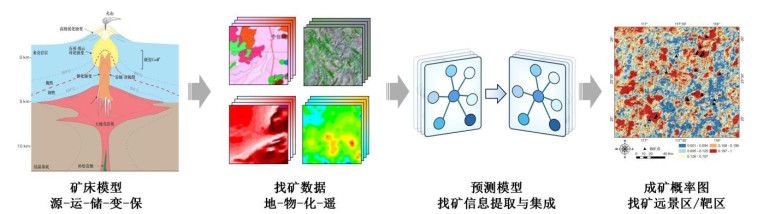
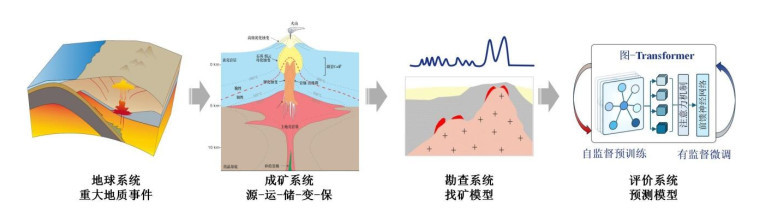
图 2 矿产预测系统工程
成矿系统和勘查系统分别修改自孟旭阳和毛景文(2025)和成秋明(2025)
Fig. 2. A systems engineering of mineral prospectivity mapping
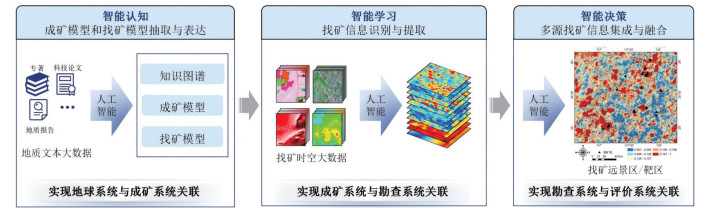
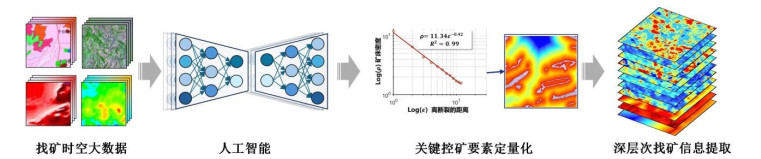
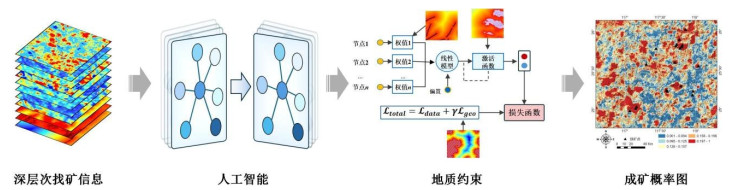
图 3 大数据人工智能驱动的矿产预测
Fig. 3. Big data and artificial intelligence-driven mineral prospectivity mapping
-
Agterberg, F. P., 1989. Computer Programs for Mineral Exploration. Science, 245(4913): 76-81. https://doi.org/10.1126/science.245.4913.76 Bonham-Carter, G. F., 1994. Introduction to GIS. In: Bonham-Carter, G. F., ed., Geographic Information Systems for Geoscientists. Elsevier, Amsterdam. https://doi.org/10.1016/b978-0-08-041867-4.50006-0 Carranza, E. J. M., 2009. Geochemical Anomaly and Mineral Prospectivity Mapping in GIS. Elsevier, Amsterdam. https://doi.org/10.1016/s0168-6275(08)x0001-7 Carranza, E. J. M., Laborte, A. G., 2015. Random Forest Predictive Modeling of Mineral Prospectivity with Small Number of Prospects and Data with Missing Values in Abra (Philippines). Computers & Geosciences, 74: 60-70. https://doi.org/10.1016/j.cageo.2014.10.004 Chen, J. P., Zhou, G. Y., Chu, Z. Y., et al., 2024. Geological Big Data Three-Dimensional Modelling and Mineralization Prediction of Diamond Deposit in Mengyin, Shandong, China. Mineral Deposits, 43(4): 802-820 (in Chinese with English abstract). Chen, Y. L., 2015. Mineral Potential Mapping with a Restricted Boltzmann Machine. Ore Geology Reviews, 71: 749-760. https://doi.org/10.1016/j.oregeorev.2014.08.012 Cheng, Q. M., 2008. Non-Linear Theory and Power-Law Models forInformation Integration and Mineral Resources Quantitative Assessments. Mathematical Geosciences, 40(5): 503-532. https://doi.org/10.1007/s11004-008-9172-6 Cheng, Q. M., 2012. Ideas and Methods for Mineral Resources Integrated Prediction in Covered Areas. Earth Science, 37(6): 1109-1125 (in Chinese with English abstract). Cheng, Q. M., 2025. A New Paradigm for Mineral Resource Prediction Based on Human Intelligence-Artificial Intelligence Integration. Earth Science Frontiers, 32(4): 1-19 (in Chinese with English abstract). Devlin, J., Chang, M. W., Lee, K., et al., 2019. BERT: Pre-Training of Deep Bidirectional Transformers for Language Understanding. The 2019 Conference of the North American Chapter of the Association for Computational Linguistics: Human Language Technologies, Minnesota Association for Computational Linguistics, Minneapolis. Dhar, V., 2024. The Paradigm Shifts in Artificial Intelligence. Communications of the ACM, 67(11): 50-59. https://doi.org/10.1145/3664804 Dong, Y. L., Zhang, Z. J., 2024. Deep Forest Modeling: An Interpretable Deep Learning Method for Mineral Prospectivity Mapping. Journal of Geophysical Research: Machine Learning and Computation, 1(4): e2024JH000311. https://doi.org/10.1029/2024JH000311 Elmahdy, S. I., Ali, T. A., Mohamed, M. M., et al., 2022. Topographically and Hydrologically Signatures Express Subsurface Geological Structures in an Arid Region: A Modified Integrated Approach Using Remote Sensing and GIS. Geocarto International, 37(7): 2095-2115. https://doi.org/10.1080/10106049.2020.1801858 Ford, A., 2020. Practical Implementation of Random Forest-Based Mineral Potential Mapping for Porphyry Cu-Au Mineralization in the Eastern Lachlan Orogen, NSW, Australia. Natural Resources Research, 29(1): 267-283. https://doi.org/10.1007/s11053-019-09598-y Guo, D. S., Yang, X. S., Peng, P., et al., 2025. The Intelligent Fault Identification Method Based on Multi-Source Information Fusion and Deep Learning. Scientific Reports, 15: 6643. https://doi.org/10.1038/s41598-025-90823-5 Guo, L., He, Z. T., Li, L. L., 2023. Responses of Stream Geomorphic Indices to Piedmont Fault Activity in the Northern Segment of the Red River Fault Zone. Remote Sensing, 15(4): 988. https://doi.org/10.3390/rs15040988 Han, S., Li, H., Li, M. C., et al., 2022. Deep Learning-Based Stochastic Modelling and Uncertainty Analysis of Fault Networks. Bulletin of Engineering Geology and the Environment, 81(6): 242. https://doi.org/10.1007/s10064-022-02735-7 Harris, J. R., Grunsky, E., Behnia, P., et al., 2015. Data- and Knowledge-Driven Mineral Prospectivity Maps for Canada's North. Ore Geology Reviews, 71: 788-803. https://doi.org/10.1016/j.oregeorev.2015.01.004 Huang, D. Z., Zuo, R. G., Wang, J., 2022. Geochemical Anomaly Identification and Uncertainty Quantification Using a Bayesian Convolutional Neural Network Model. Applied Geochemistry, 146: 105450. https://doi.org/10.1016/j.apgeochem.2022.105450 Lawley, C. J. M., Gadd, M. G., Parsa, M., et al., 2023. Applications of Natural Language Processing to Geoscience Text Data and Prospectivity Modeling. Natural Resources Research, 32(4): 1503-1527. https://doi.org/10.1007/s11053-023-10216-1 LeCun, Y., Bengio, Y., Hinton, G., 2015. Deep Learning. Nature, 521(7553): 436-444. https://doi.org/10.1038/nature14539 LeCun, Y., Boser, B., Denker, J. S., et al., 1989. Backpropagation Applied to Handwritten Zip Code Recognition. Neural Computation, 1(4): 541-551. https://doi.org/10.1162/neco.1989.1.4.541 LeCun, Y., Bottou, L., Bengio, Y., et al., 1998. Gradient-Based Learning Applied to Document Recognition. Proceedings of the IEEE, 86(11): 2278-2324. https://doi.org/10.1109/5.726791 Li, T., Zuo, R. G., Xiong, Y. H., et al., 2021. Random-Drop Data Augmentation of Deep Convolutional Neural Network for Mineral Prospectivity Mapping. Natural Resources Research, 30(1): 27-38. https://doi.org/10.1007/s11053-020-09742-z Liang, Z. X., Xiong, Y. H., Zuo, R. G., 2025. Coupling Graph Attention Networks with Causal Discovery for Geochemical Anomaly Recognition. Mathematical Geosciences, 57(8): 1665-1693. https://doi.org/10.1007/s11004-025-10218-0 Luo, T. H., Zhou, Z. L., Tang, L., et al., 2025. Identification of Geochemical Anomalies Using a Memory-Augmented Autoencoder Model with Geological Constraint. Natural Resources Research, 34(1): 23-40. https://doi.org/10.1007/s11053-024-10433-2 Luo, Z. J., Farahbakhsh, E., Müller, R. D., et al., 2024. Multivariate Statistical Analysis and Bespoke Deviation Network Modeling for Geochemical Anomaly Detection of Rare Earth Elements. Applied Geochemistry, 174: 106146. https://doi.org/10.1016/j.apgeochem.2024.106146 Luo, Z. J., Zuo, R. G., 2025. Causal Discovery and Deep Learning Algorithms for Detecting Geochemical Patterns Associated with Gold-Polymetallic Mineralization: A Case Study of the Edongnan Region. Mathematical Geosciences, 57(1): 193-220. https://doi.org/10.1007/s11004-024-10153-6 Luo, Z. J., Zuo, R. G., Xiong, Y. H., 2022. Visual Interpretable Deep Learning Algorithm for Geochemical Anomaly Recognition. Natural Resources Research, 31(5): 2211-2223. https://doi.org/10.1007/s11053-022-10080-5 Luo, Z. J., Zuo, R. G., Xiong, Y. H., et al., 2023. Metallogenic-Factor Variational Autoencoder for Geochemical Anomaly Detection by Ad-Hoc and Post-Hoc Interpretability Algorithms. Natural Resources Research, 32(3): 835-853. https://doi.org/10.1007/s11053-023-10200-9 Manyika, J., Chui, M., Brown, B., et al., 2011. Big Data: The Next Frontier for Innovation, Competition, and Productivity. McKinsey Global Institute, New York. Mao, X. C., Deng, H., Chen, J., et al., 2024. Theory and Methods for Three-Dimensional Intelligent Prospectivity Mapping of Deep Resources in Metal Mines. Mineral Exploration, 15(8): 1365-1378 (in Chinese with English abstract). Mayer-Schönberger, V., Cukier, K., 2013. Big Data: A Revolution That Will Transform How We Live, Work, and Think. Houghton Mifflin Harcourt, Boston. McCarthy, J., Minsky, M. L., Rochester, N., et al., 2006. A Proposal for the Dartmouth Summer Research Project on Artificial Intelligence: August 31, 1955. AI Magazine, 27(4): 12-14. https://doi.org/10.1609/aimag.v27i4.1904 McCuaig, T. C., Beresford, S., Hronsky, J., 2010. Translating the Mineral Systems Approach into an Effective Exploration Targeting System. Ore Geology Reviews, 38(3): 128-138. https://doi.org/10.1016/j.oregeorev.2010.05.008 Meng, X. Y., Mao, J. W., 2025. Temporal Distribution of Porphyry Copper Deposits and the Influencing Factors. Acta Petrologica Sinica, 41(12): 4164-4177 (in Chinese with English abstract). doi: 10.18654/1000-0569/2025.12.13 Mou, N. N., Carranza, E. J. M., Wang, G. W., et al., 2023. A Framework for Data-Driven Mineral Prospectivity Mapping with Interpretable Machine Learning and Modulated Predictive Modeling. Natural Resources Research, 32(6): 2439-2462. https://doi.org/10.1007/s11053-023-10272-7 Parsa, M., Cumani, R., 2025. Class Label Representativeness in Machine Learning-Based Mineral Prospectivity Mapping. Natural Resources Research, 34(4): 1901-1925. https://doi.org/10.1007/s11053-025-10468-z Parsa, M., Cumani, R., Fam, H. J. A., et al., 2026. Large Language Models and Geoscience Transformers for Predictive Mapping of Canadian Critical Minerals. Natural Resources Research, 35(1): 207-225. https://doi.org/10.1007/s11053-025-10564-0 Parsa, M., Lawley, C. J. M., Cawood, T., et al., 2025. Pan-Canadian Predictive Modeling of Lithium-Cesium-Tantalum Pegmatites with Deep Learning and Natural Language Processing. Natural Resources Research, 34(2): 639-668. https://doi.org/10.1007/s11053-024-10438-x Reichstein, M., Camps-Valls, G., Stevens, B., et al., 2019. Deep Learning and Process Understanding for Data- Driven Earth System Science. Nature, 566(7743): 195-204. https://doi.org/10.1038/s41586-019-0912-1 Saadi, N. M., Aboud, E., Saibi, H., et al., 2008. Integrating Data from Remote Sensing, Geology and Gravity for Geological Investigation in the Tarhunah Area, Northwest Libya. International Journal of Digital Earth, 1(4): 347-366. https://doi.org/10.1080/17538940802435844 Singer, D. A., 1993. Basic Concepts in Three-Part Quantitative Assessments of Undiscovered Mineral Resources. Nonrenewable Resources, 2(2): 69-81. https://doi.org/10.1007/BF02272804 Taylor, R. B., Steven, T. A., 1983. Definition of Mineral Resource Potential. Economic Geology, 78(6): 1268-1270. https://doi.org/10.2113/gsecongeo.78.6.1268 Vance, T. C., Huang, T., Butler, K. A., 2024. Big Data in Earth Science: Emerging Practice and Promise. Science, 383(6688): eadh9607. https://doi.org/10.1126/science.adh9607 Vaswani, A., Shazeer, N., Parmar, N., et al., 2017. Attention is All You Need. The 31st International Conference on Neural Information Processing Systems, Long Beach. Wang, S. C., Wang, Y. T., Liu, S. H., et al., 1992. Overview of a Theory and Method for Prediction of Mineral Resources in China. Mathematical Geology, 24(6): 597-608. https://doi.org/10.1007/BF00894227 Wang, Z. Y., Zuo, R. G., 2022. Mineral Prospectivity Mapping Using a Joint Singularity-Based Weighting Method and Long Short-Term Memory Network. Computers & Geosciences, 158: 104974. https://doi.org/10.1016/j.cageo.2021.104974 Wang, Z. Y., Zuo, R. G., Dong, Y. N., 2019. Mapping Geochemical Anomalies through Integrating Random Forest and Metric Learning Methods. Natural Resources Research, 28(4): 1285-1298. https://doi.org/10.1007/s11053-019-09471-y Wang, Z. Y., Zuo, R. G., Dong, Y. N., 2020a. Mapping of Himalaya Leucogranites Based on ASTER and Sentinel-2A Datasets Using a Hybrid Method of Metric Learning and Random Forest. IEEE Journal of Selected Topics in Applied Earth Observations and Remote Sensing, 13: 1925-1936. https://doi.org/10.1109/JSTARS.2020.2989509 Wang, Z. Y., Zuo, R. G., Dong, Y. N., 2020b. Mapping Himalayan Leucogranites Using a Hybrid Method of Metric Learning and Support Vector Machine. Computers & Geosciences, 138: 104455. https://doi.org/10.1016/j.cageo.2020.104455 Wang, Z. Y., Zuo, R. G., Kreuzer, O. P., 2025. Uncertainty Quantification of Deep Learning Algorithms for Lithological Mapping. Mathematical Geosciences, Online. https://doi.org/10.1007/s11004-025-10235-z Woodhead, J., Landry, M., 2021. Harnessing the Power of Artificial Intelligence and Machine Learning in Mineral Exploration—Opportunities and Cautionary Notes. SEG Discovery, (127): 19-31. https://doi.org/10.5382/geo-and-mining-13 Xiang, Y. C., Gong, Q. J., Liu, R. M., et al., 2014. Model and Application of Deducing Geological Body on Regional Geochemical Survey Data: A Case Study on Granitic Intrusions in China. Acta Petrologica Sinica, 30(9): 2609-2618 (in Chinese with English abstract). Xiao, K. Y., Li, C., Tang, R., et al., 2025. Big Data Intelligent Prediction and Evaluation. Earth Science Frontiers, 32(4): 20-37 (in Chinese with English abstract). Xiao, K. Y., Xing, S. W., Ding, J. H., et al., 2016. Division of Major Mineralization Belts of China's Key Solid Mineral Resources and Their Mineral Resource Potential. Acta Geologica Sinica, 90(7): 1269-1280 (in Chinese with English abstract). Xiong, Y. H., Zuo, R. G., Luo, Z. J., et al., 2022. A Physically Constrained Variational Autoencoder for Geochemical Pattern Recognition. Mathematical Geosciences, 54(4): 783-806. https://doi.org/10.1007/s11004-021-09979-1 Xu, Y., Zuo, R. G., Bai, Y., 2025. Geological Knowledge-Guided Dual-Branch Deep Learning Model for Identification of Geochemical Anomalies Related to Mineralization. Journal of Geophysical Research: Machine Learning and Computation, 2(1): e2024JH000468. https://doi.org/10.1029/2024JH000468 Yang, F. F., Wang, Z. Y., Zuo, R. G., et al., 2023. Quantification of Uncertainty Associated with Evidence Layers in Mineral Prospectivity Mapping Using Direct Sampling and Convolutional Neural Network. Natural Resources Research, 32(1): 79-98. https://doi.org/10.1007/s11053-022-10144-6 Yang, F. F., Zuo, R. G., Kreuzer, O. P., 2024a. Artificial Intelligence for Mineral Exploration: A Review and Perspectives on Future Directions from Data Science. Earth-Science Reviews, 258: 104941. https://doi.org/10.1016/j.earscirev.2024.104941 Yang, F. F., Zuo, R. G., Xiong, Y. H., et al., 2024b. Dual-Branch Convolutional Neural Network and Its Post Hoc Interpretability for Mapping Mineral Prospectivity. Mathematical Geosciences, 56(7): 1487-1515. https://doi.org/10.1007/s11004-024-10137-6 Yang, N., Zhang, Z. K., Yang, J. H., et al., 2022. Applications of Data Augmentation in Mineral Prospectivity Prediction Based on Convolutional Neural Networks. Computers & Geosciences, 161: 105075. https://doi.org/10.1016/j.cageo.2022.105075 Yin, J. N., Li, N., 2022. Ensemble Learning Models with a Bayesian Optimization Algorithm for Mineral Prospectivity Mapping. Ore Geology Reviews, 145: 104916. https://doi.org/10.1016/j.oregeorev.2022.104916 Yousefi, M., Lindsay, M. D., Kreuzer, O., 2024. Mitigating Uncertainties in Mineral Exploration Targeting: Majority Voting and Confidence Index Approaches in the Context of an Exploration Information System (EIS). Ore Geology Reviews, 165: 105930. https://doi.org/10.1016/j.oregeorev.2024.105930 Yu, Z. Y., Idris, M. Y. I., Wang, P., et al., 2025. SatelliteFormula: Multi-Modal Symbolic Regression from Remote Sensing Imagery for Physics Discovery. arXiv, 2506.06176. https://arxiv.org/abs/2506.06176 Yuan, F., Li, X. H., Tian, W. D., et al., 2024. Key Issues in Three-Dimensional Predictive Modeling of Mineral Prospectivity. Earth Science Frontiers, 31(4): 119-128 (in Chinese with English abstract). Zhang, C. J., Zuo, R. G., 2024. Incorporating Geological Knowledge into Deep Learning to Enhance Geochemical Anomaly Identification Related to Mineralization and Interpretability. Mathematical Geosciences, 56(6): 1233-1254. https://doi.org/10.1007/s11004-023-10133-2 Zhang, C. J., Zuo, R. G., Xiong, Y. H., et al., 2022. A Geologically-Constrained Deep Learning Algorithm for Recognizing Geochemical Anomalies. Computers & Geosciences, 162: 105100. https://doi.org/10.1016/j.cageo.2022.105100 Zhang, Z. J., Cheng, Q. M., Yang, J., et al., 2021. Machine Learning for Mineral Prospectivity: A Case Study of Iron-Polymetallic Mineral Prospectivity in Southwestern Fujian. Earth Science Frontiers, 28(3): 221-235 (in Chinese with English abstract). Zhang, Z. J., Yang, Z. X., Jian, F. Y., et al., 2026. Interpretability-Enhanced Mineral Prospectivity Models: A Synergistic Approach Using Large Language Models, Knowledge Graphs, and Machine Learning. Mathematical Geosciences, 58(1): 195-231. https://doi.org/10.1007/s11004-025-10231-3 Zhang, Z. Q., Wang, G. W., Carranza, E. J. M., et al., 2025. Three-Dimensional Mineral Prospectivity Mapping Using a Residual Convolutional Neural Network with Lightweight Attention Mechanisms. Ore Geology Reviews, 185: 106797. https://doi.org/10.1016/j.oregeorev.2025.106797 Zhao, M. L., Zhang, Z. J., Yang, J., et al., 2025. Knowledge Graph Construction and Knowledge Discovery for Porphyry Copper Deposits. Ore Geology Reviews, 186: 106875. https://doi.org/10.1016/j.oregeorev.2025.106875 Zhao, P. D., 1992. Theories, Principles, and Methods for the Statistical Prediction of Mineral Deposits. Mathematical Geology, 24(6): 589-595. https://doi.org/10.1007/BF00894226 Zhou, K. F., Chen, Y. J., Zhang, N. N., et al., 2012. Feature Extraction and Prediction Methods for Typical Deposit in Central Asia. Arid Land Geography, 35(3): 339-347 (in Chinese with English abstract). Zhou, Y. Z., Zhang, Q. L., Huang, Y. J., et al., 2021. Constructing Knowledge Graph for the Porphyry Copper Deposit in the Qingzhou-Hangzhou Bay Area: Insight into Knowledge Graph Based Mineral Resource Prediction and Evaluation. Earth Science Frontiers, 28(3): 67-75 (in Chinese with English abstract). Zuo, R. G., 2016. A Nonlinear Controlling Function of Geological Features on Magmatic-Hydrothermal Mineralization. Scientific Reports, 6: 27127. https://doi.org/10.1038/srep27127 Zuo, R. G., 2018. Selection of an Elemental Association Related to Mineralization Using Spatial Analysis. Journal of Geochemical Exploration, 184: 150-157. https://doi.org/10.1016/j.gexplo.2017.10.020 Zuo, R. G., 2021. Data Science-Based Theory and Method of Quantitative Prediction of Mineral Resources. Earth Science Frontiers, 28(3): 49-55 (in Chinese with English abstract). Zuo, R. G., 2025. Key Technology for Intelligent Mineral Prospectivity Mapping: Challenges and Solutions. Scientia Sinica (Terrae), 55(9): 3104-3119 (in Chinese with English abstract). doi: 10.1360/SSTe-2025-0096 Zuo, R. G., Cheng, Q. M., Xu, Y., et al., 2024. Explainable Artificial Intelligence Models for Mineral Prospectivity Mapping. Scientia Sinica (Terrae), 54(9): 2917-2928 (in Chinese with English abstract). doi: 10.1360/N072024-0018 Zuo, R. G., Kreuzer, O. P., Wang, J., et al., 2021. Uncertainties in GIS-Based Mineral Prospectivity Mapping: Key Types, Potential Impacts and Possible Solutions. Natural Resources Research, 30(5): 3059-3079. https://doi.org/10.1007/s11053-021-09871-z Zuo, R. G., Wang, Z. Y., 2020. Effects of Random Negative Training Samples on Mineral Prospectivity Mapping. Natural Resources Research, 29(6): 3443-3455. https://doi.org/10.1007/s11053-020-09668-6 Zuo, R. G., Xiong, Y. H., 2018. Big Data Analytics of Identifying Geochemical Anomalies Supported by Machine Learning Methods. Natural Resources Research, 27(1): 5-13. https://doi.org/10.1007/s11053-017-9357-0 Zuo, R. G., Xiong, Y. H., Wang, J., et al., 2019. Deep Learning and Its Application in Geochemical Mapping. Earth-Science Reviews, 192: 1-14. https://doi.org/10.1016/j.earscirev.2019.02.023 Zuo, R. G., Xu, Y., 2023. Graph Deep Learning Model for Mapping Mineral Prospectivity. Mathematical Geosciences, 55(1): 1-21. https://doi.org/10.1007/s11004-022-10015-z Zuo, R. G., Yang, F. F., Cheng, Q. M., et al., 2025. A Novel Data-Knowledge Dual-Driven Model Coupling Artificial Intelligence with a Mineral Systems Approach for Mineral Prospectivity Mapping. Geology, 53(3): 284-288. https://doi.org/10.1130/g52970.1 Zuo, R. G., Zhang, Z. J., Zhang, D. J., et al., 2015. Evaluation of Uncertainty in Mineral Prospectivity Mapping Due to Missing Evidence: A Case Study with Skarn-Type Fe Deposits in Southwestern Fujian Province, China. Ore Geology Reviews, 71: 502-515. https://doi.org/10.1016/j.oregeorev.2014.09.024 陈建平, 周冠云, 褚志远, 等, 2024. 山东蒙阴金刚石矿床地质大数据三维建模与成矿预测. 矿床地质, 43(4): 802-820. 成秋明, 2012. 覆盖区矿产综合预测思路与方法. 地球科学, 37(6): 1109-1125. doi: 10.3799/dqkx.2012.118 成秋明, 2025. 面向人类智能与人工智能融合的矿产资源预测新范式. 地学前缘, 32(4): 1-19. 毛先成, 邓浩, 陈进, 等, 2024. 金属矿山深部资源三维智能预测理论与方法. 矿产勘查, 15(8): 1365-1378. 孟旭阳, 毛景文, 2025. 斑岩铜矿时间分布规律与影响因素. 岩石学报, 41(12): 4164-4177. 向运川, 龚庆杰, 刘荣梅, 等, 2014. 区域地球化学推断地质体模型与应用: 以花岗岩类侵入体为例. 岩石学报, 30(9): 2609-2618. 肖克炎, 李程, 唐瑞, 等, 2025. 大数据智能预测评价. 地学前缘, 32(4): 20-37. 肖克炎, 邢树文, 丁建华, 等, 2016. 全国重要固体矿产重点成矿区带划分与资源潜力特征. 地质学报, 90(7): 1269-1280. 袁峰, 李晓晖, 田卫东, 等, 2024. 三维成矿预测关键问题. 地学前缘, 31(4): 119-128. 张振杰, 成秋明, 杨玠, 等, 2021. 机器学习与成矿预测: 以闽西南铁多金属矿预测为例. 地学前缘, 28(3): 221-235. 周可法, 陈衍景, 张楠楠, 等, 2012. 中亚地区典型矿床的特征提取技术及预测方法. 干旱区地理, 35(3): 339-347. 周永章, 张前龙, 黄永健, 等, 2021. 钦杭成矿带斑岩铜矿知识图谱构建及应用展望. 地学前缘, 28(3): 67-75. 左仁广, 2021. 基于数据科学的矿产资源定量预测的理论与方法探索. 地学前缘, 28(3): 49-55. 左仁广, 2025. 智能矿产预测的技术挑战与解决方案. 中国科学: 地球科学, 55(9): 3104-3119. 左仁广, 成秋明, 许莹, 等, 2024. 可解释性矿产预测人工智能模型. 中国科学: 地球科学, 54(9): 2917-2928. -

 下载:
下载:
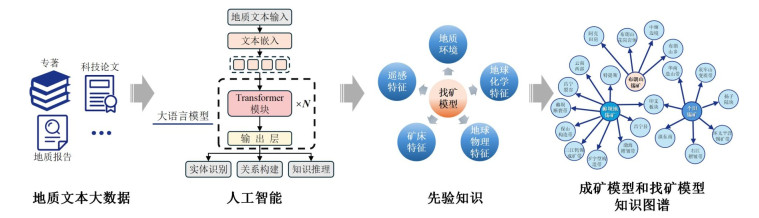
 点击查看大图
计量
- 文章访问数: 613
- HTML全文浏览量: 64
- PDF下载量: 151
- 被引次数: 0
