




Deep Learning Empowers Deep Geothermal Resources Exploration: Progress and Trend
-
摘要:
全球深层地热资源勘探开发正处于从“实验性探索”向“规模化应用”转型的关键阶段.以深度学习为代表的人工智能已经在大数据分析、模式识别和非线性问题求解方面展现出变革性潜力,为破解当前制约我国深层地热资源高效精准勘探的核心难题提供了新途径.推动深度学习与传统地热勘探流程的深度融合,对我国在全球深层地热资源开发利用领域提升竞争力具有重要意义.本文聚焦深度学习数据处理、建模及预测技术与深层地热资源勘探(涵盖地热地质勘查、地球物理勘探、地球化学勘探等环节)的深度结合,系统梳理并总结了地热资源勘探技术、深度学习技术方法、深度学习赋能深层地热资源勘探的关键技术方法、核心进展与研究成果,展现了深度学习赋能地热资源勘探方法相较于传统方法带来的效率、准确率与精度提升.本文最后结合前沿技术阐述了深度学习赋能深层地热资源勘探领域面临的核心挑战,未来深层地热资源智能勘探亟须聚焦多模态数据融合、可解释与可信人工智能、地热垂直领域智能计算基座与大模型建设等方面,最终实现从“经验驱动”到“知识驱动”再到“智能驱动”的跨越,为地热能源资源行业数字化智能化发展提供核心技术支撑.
Abstract:The global exploration and development of deep geothermal resources is at a critical stage, transitioning from experiment to application. Artificial intelligence, particularly deep learning, has demonstrated transformative potential in big data analysis, pattern recognition, and nonlinear problem solution, offering new pathways to address challenges hindering efficient and precise exploration of deep geothermal resources. It is significantly important to promote the integration of deep learning with traditional geothermal exploration processes to enhance China's competitiveness in the development and utilization of deep geothermal resources. This paper focuses on the integration of deep learning data processing, modeling, and prediction with deep geothermal resource exploration (including geothermal geological surveys, geophysical exploration, and geochemical exploration, etc.). It systematically reviews and summarizes key technological methods in geothermal resource exploration, deep learning techniques, and the critical advancements and research outcomes that empower deep geothermal exploration. This study demonstrates the improvement of efficiency, accuracy, and precision brought by deep-learning-based geothermal resources exploration methods compared to traditional methods. Finally, the paper discusses the core challenges with cutting-edge technologies faced by deep geothermal exploration. In future, intelligent deep geothermal resources exploration urgently needs to focus on multiple modal data fusion, interpretable and trustworthy artificial intelligence, and construction of intelligent computing foundations and large models, which ultimately, will enable a leap from "experience-driven" to "knowledge-driven" and then to "intelligent-driven", providing core technological support for the digital and intelligent development of the geothermal energy resources industry.
-
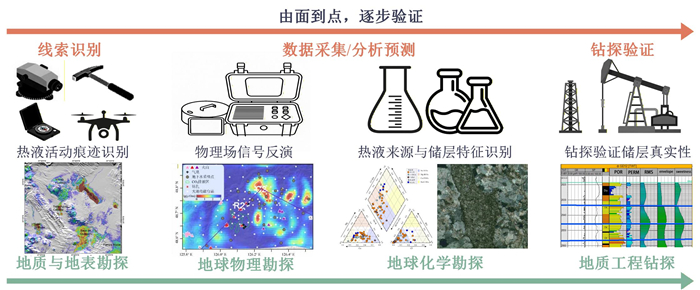
图 1 地热资源勘探流程
图件来自van der Meer et al.(2014)、刘庆等(2022)、Huang et al.(2023)、Sun et al.(2023)
Fig. 1. Geothermal resource exploration process
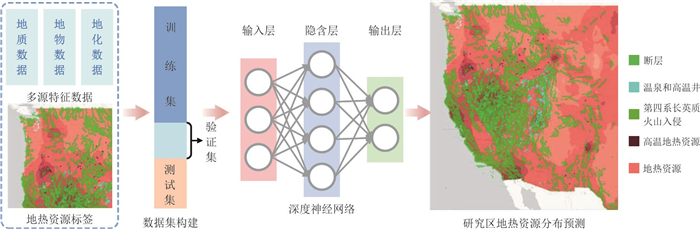
图 3 基于监督学习的地热资源分布预测工作流程(修改自蒋恕等, 2020)
Fig. 3. Supervised-learning-based geothermal resources potential prediction (modified from Jiang et al., 2020)
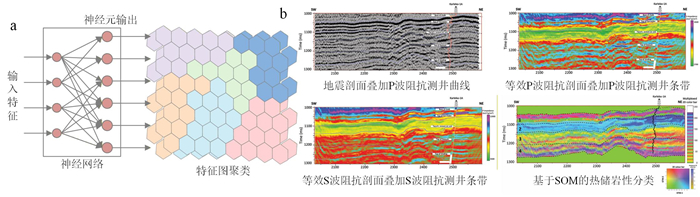
图 4 基于无监督自组织映射神经网络的丹麦Triassic-Jurassic深层地热砂岩储层地震岩性识别与特征分析
图修改自Chopra et al.(2021). a. 无监督自组织映射神经网络;b. 研究区热储岩性分类
Fig. 4. Seismic characterization of a Triassic-Jurassic deep geothermal sandstone reservoir, onshore Denmark, based on unsupervised self-organizing map neural network
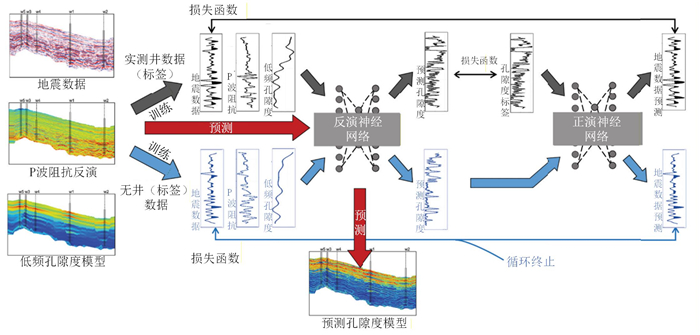
图 5 基于半监督学习的孔隙度预测流程(修改自Chen et al., 2025b)
Fig. 5. Porosity prediction process based on semi-supervised learning (modified from Chen et al., 2025b)
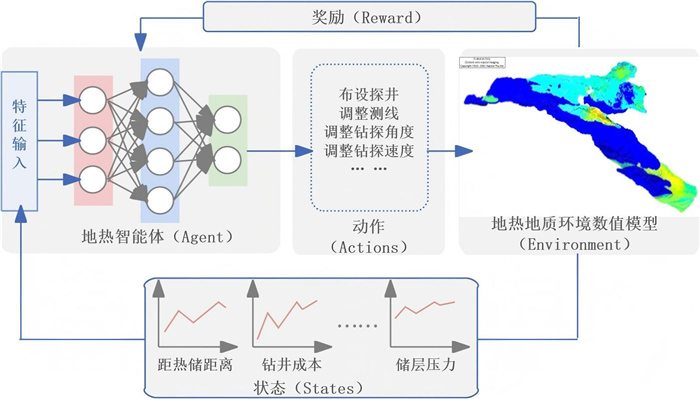
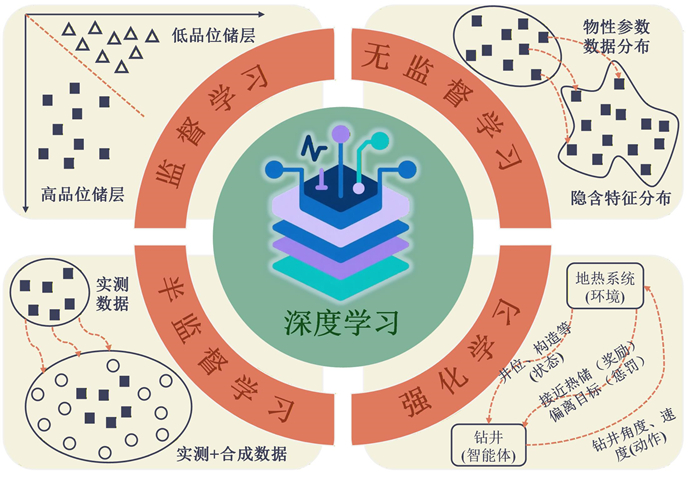
图 6 地热勘探场景下智能体强化学习流程
Fig. 6. Reinforcement learning process of agent in geothermal exploration scenarios
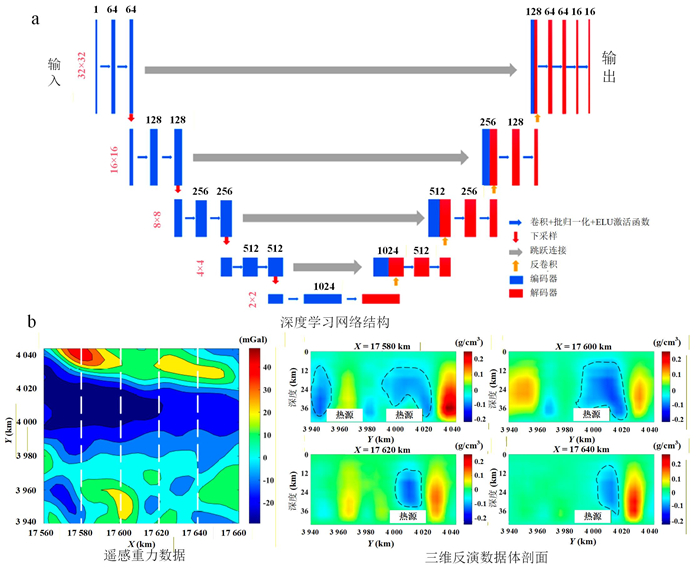
图 7 基于深度学习的重力反演揭示共和盆地地热系统深部热源
图修改自Zhou et al.(2024). a. U-Net神经网络架构;b. 研究区重力反演结果
Fig. 7. Deep learning-based gravity inversion reveals the deep heat source of the geothermal system in the Gonghe basin
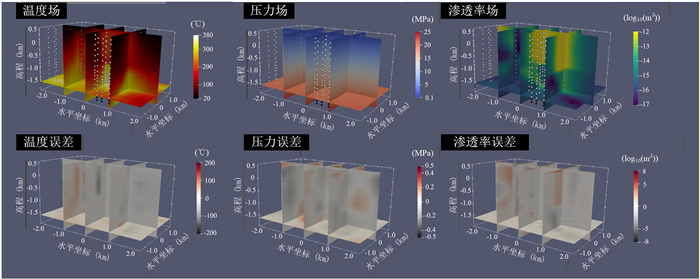
图 8 基于物理信息神经网络的地热物性参数三维模拟(修改自Ishitsuka et al., 2025)
Fig. 8. 3-D modeling of geothermal physical parameters based on physics-informed neural network (modified from Ishitsuka et al., 2025)
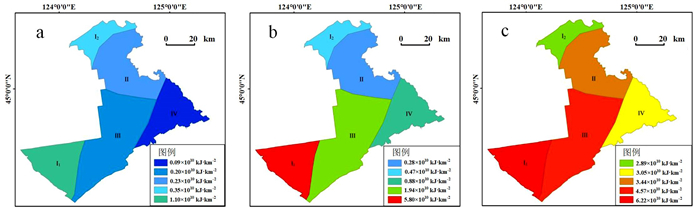
图 9 前郭县地热资源潜力评价
a. 姚家组储层;b. 青山口组储层;c. 泉头组储层,据Zhang et al.(2023)
Fig. 9. Geothermal resource potential assessment in Qianguo County
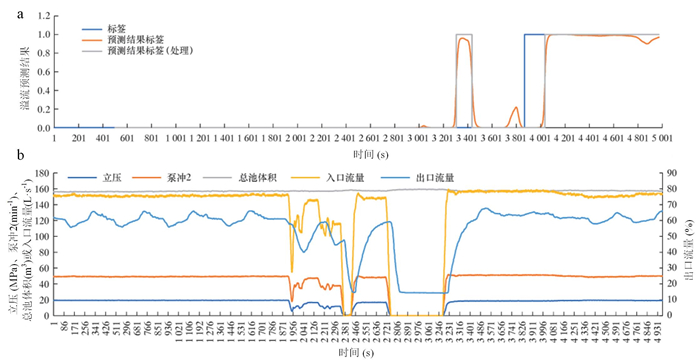
图 10 基于CNN-LSTM融合网络的溢流早期预测
图修改自付加胜等(2021). a. 溢流预测结果;b. 钻井参数图
Fig. 10. CNN-LSTM fusion network for early prediction of overflow
-
Afshar, A., Norouzi, G. H., Moradzadeh, A., 2023. Exploring Geothermal Potential through Multi-Modal Geophysical Data Integration: Gravity, Magnetic, and Magnetotelluric Prospecting. International Journal of Mining and Geo-Engineering, 57(4): 427-434. https://doi.org/10.1007/s00024-016-1448-z Asghar, S., Choi, J., Yoon, D., et al., 2020. Spatial Pseudo-Labeling for Semi-Supervised Facies Classification. Journal of Petroleum Science and Engineering, 195: 107834. https://doi.org/10.1016/j.petrol.2020.107834 Assouline, D., Mohajeri, N., Gudmundsson, A., et al., 2019. A Machine Learning Approach for Mapping the very Shallow Theoretical Geothermal Potential. Geothermal Energy, 7(1): 19. https://doi.org/10.1186/s40517-019-0135-6 Bénard, B., Famin, V., Agrinier, P., et al., 2024. Use of Cold Waters Geochemistry as a Geothermal Prospecting Tool for Hidden Hydrothermal Systems in Réunion Island. Communications Earth & Environment, 5: 55. https://doi.org/10.1038/s43247-024-01210-3 Brown, S., Rodi, W. L., Seracini, M., et al., 2022. Bayesian Neural Networks for Geothermal Resource Assessment: Prediction with Uncertainty. arXiv, 2209.15543. https://arxiv.org/abs/2209.15543 Carlo, C., 2025. Zanskar Validates AI-Based Discovery Method with Drilling at Pumpernickel Geothermal Site, Nevada. [2025-9-19] https://www.thinkgeoenergy.com/zanskar-validates-ai-based-discovery-method-with-drilling-at-pumpernickel-geothermal-site-nevada/ Chang, K., Zhang, Q. J., Jiang, Q. Y., et al., 2025. Research Status of Geothermal Energy Detection Technology in Middle-Deep Depths in China. Progress in Geophysics, 40(1): 54-69 (in Chinese with English abstract). Chao, J. Q., Zhao, Z. F., Xu, S. G., et al., 2024. Geothermal Target Detection Integrating Multi-Source and Multi-Temporal Thermal Infrared Data. Ore Geology Reviews, 167: 105991. https://doi.org/10.1016/j.oregeorev.2024.105991 Chen, C. X., Yan, J. Y., Zhou, W. Y., et al., 2020. Status and Prospects of Geophysical Method Used in Geothermal Exploration. Progress in Geophysics, 35(4): 1223-1231 (in Chinese with English abstract). Chen, G. D., Jiao, J. J., Wang, Z. Z., et al., 2025a. Multi-Fidelity Machine Learning with Knowledge Transfer Enhances Geothermal Energy System Design and Optimization. Advances in Geo-Energy Research, 16(3): 244-259. https://doi.org/10.46690/ager.2025.06.05 Chen, H. L., Chen, H. Z., Zhao, Z. J., et al., 2026a. An Overview of Domain-Specific Foundation Model: Key Technologies, Applications and Challenges. Science China Information Sciences, 69(1): 111301. https://doi.org/10.1007/s11432-025-4498-2 Chen, M. X., 1992. Advances of Studies of Geothermal Resources in China. Advance in Earth Sciences, 7(3): 9-14 (in Chinese with English abstract). Chen, Q. Y., Liu, G., He, Z. W., et al., 2020. Current Situation and Prospect of Structure-Attribute Integrated 3D Geological Modeling Technology for Geological Big Data. Bulletin of Geological Science and Technology, 39(4): 51-58 (in Chinese with English abstract). Chen, Q. Y., Xun, L., Cui, Z. S., et al., 2025. Recent Progress and Development Trends of Three-Dimensional Geological Modeling. Bulletin of Geological Science and Technology, 44(3): 373-387 (in Chinese with English abstract). Chen, Q. Y., Zhou, R. H., Chen, D. J., et al., 2026b. A Conditional Masked Autoencoder Network Based on Efficient Multiple-Head Self-Attention for Characterizing Heterogeneous Reservoirs. Expert Systems with Applications, 296: 128973. https://doi.org/10.1016/j.eswa.2025.128973 Chen, Y. Y., Zhao, L. X., Liu, J. Y., et al., 2025b. Seismic Porosity Prediction via Semi-Supervised Learning: Integrating a Low-Frequency Model and a Closed-Loop Network Structure. IEEE Transactions on Geoscience and Remote Sensing, 63: 4506617. https://doi.org/10.1109/TGRS.2025.3589022 Cheng, Q. M., 2021. What Are Mathematical Geosciences and Its Frontiers? Earth Science Frontiers, 28(3): 6-25 (in Chinese with English abstract). Cheng, Q. M., 2025. A New Paradigm for Mineral Resource Prediction Based on Human Intelligence-Artificial Intelligence Integration. Earth Science Frontiers, 32(4): 1-19 (in Chinese with English abstract). Cheng, X. G., Qiao, W., Hu, D. Q., et al., 2024. Quality Analysis of Machine Learning Methods Applied to the Geothermal Potential Assessment: A Case Study. Energy Sources, Part A: Recovery, Utilization, and Environmental Effects, 46(1): 854-871. https://doi.org/10.1080/15567036.2023.2291451 Chopra, S., Sharma, R. K., Bredesen, K., et al., 2021. Seismic Characterization of a Triassic-Jurassic Deep Geothermal Sandstone Reservoir, Onshore Denmark, Using Unsupervised Machine Learning Techniques. Interpretation, 9(4): T1097-T1106. https://doi.org/10.1190/int-2021-0091.1 Cong, T. T., Tan, H. B., Cong, P. X., et al., 2024. Mechanism Governing on Different Hydrochemical Evolution Processes for Two Types of Travertine and Silica Sinters in Shannan, Tibet. Geological Journal of China Universities, 30(6): 646-659 (in Chinese with English abstract). Cui, Z. S., Chen, Q. Y., Liu, G., 2023. A Two-Stage Downscaling Hydrological Modeling Approach via Convolutional Conditional Neural Process and Geostatistical Bias Correction. Journal of Hydrology, 620: 129498. https://doi.org/10.1016/j.jhydrol.2023.129498 Cui, Z. S., Chen, Q. Y., Luo, J., et al., 2024. Characterizing Subsurface Structures from Hard and Soft Data with Multiple-Condition Fusion Neural Network. Water Resources Research, 60(11): e2024WR038170. https://doi.org/10.1029/2024WR038170 Cui, Z. S., Jiang, S., Chen, Q. Y., et al., 2025. Characterization of Reservoir Structures with Knowledge- Informed Neural Network. SPE Journal, 30(8): 4469-4486. https://doi.org/10.2118/228279-pa Dong, B., Li, B., Song, R. C., et al., 2025. Detection and Constraints of Geothermal Latent Heat Zones under the Complex Terrain of the Western Sichuan Plateau: a Fusion of Multi-Source Temporal Remote Sensing Data. Geothermics, 130: 103287. https://doi.org/10.1016/j.geothermics.2025.103287 Dong, P. Y., Du, L., Zhao, L., et al., 2025. Application of Machine Learning Models for Groundwater Temperature Prediction in Geothermal Development. Bulletin of Geological Science and Technology, 44(3): 388-398 (in Chinese with English abstract). Dong, Y., Li, G. H., Gao, P. J., et al., 2020. The Application of Fretting Exploration Technology in the Exploration of Middle and Deep Clean Energy. Geophysical and Geochemical Exploration, 44(6): 1345-1351 (in Chinese with English abstract). Feng, R. H., Grana, D., Mukerji, T., et al., 2022. Application of Bayesian Generative Adversarial Networks to Geological Facies Modeling. Mathematical Geosciences, 54(5): 831-855. https://doi.org/10.1007/s11004-022-09994-w Fu, G. Q., Peng, S. P., Wang, R. Z., et al., 2022. Seismic Prediction and Evaluation Techniques for Hot Dry Rock Exploration and Development. Journal of Geophysics and Engineering, 19(4): 694-705. https://doi.org/10.1093/jge/gxac042 Fu, J. S., Liu, W., Han, X. S., et al., 2021. CNN-LSTM Fusion Network Based Deep Learning Method for Early Prediction of Overflow. China Petroleum Machinery, 49(6): 16-22 (in Chinese with English abstract). Gao, W. L., Zhao, J. T., 2024. Deep-Time Temperature Field Simulation of Hot Dry Rock: A Deep Learning Method in both Time and Space Dimensions. Geothermics, 119: 102978. https://doi.org/10.1016/j.geothermics.2024.102978 Gao, Z. J., Sun, Z. J., Yang, Y. H., et al., 2019. Occurrence Characteristics and Hydrochemical Characteristics of Geothermal Water in Shandong Province. Science Technology and Engineering, 19(20): 85-90 (in Chinese with English abstract). Gunning, D., Stefik, M., Choi, J., et al., 2019. XAI—Explainable Artificial Intelligence. Science Robotics, 4(37): eaay7120. https://doi.org/10.1126/scirobotics.aay7120 Guo, J. T., Xu, X. C., Wang, L. Y., et al., 2024. GeoPDNN 1.0: A Semi-Supervised Deep Learning Neural Network Using Pseudo-Labels for Three-Dimensional Shallow Strata Modelling and Uncertainty Analysis in Urban Areas from Borehole Data. Geoscientific Model Development, 17(3): 957-973. https://doi.org/10.5194/gmd-17-957-2024 Guo, Q. H., 2020. Magma-Heated Geothermal Systems and Hydrogeochemical Evidence of Their Occurrence. Acta Geologica Sinica, 94(12): 3544-3554 (in Chinese with English abstract). He, J. S., 2020. New Research Progress in Theory and Application of Wide Field Electromagnetic Method. Geophysical and Geochemical Exploration, 44(5): 985-990 (in Chinese with English abstract). Hopcroft, P. O., Gallagher, K., 2023. Global Variability in Multi-Century Ground Warming Inferred from Geothermal Data. Geophysical Research Letters, 50(13): e2023GL104631. https://doi.org/10.1029/2023GL104631 Hu, M. G., Fu, T. Y., Yang, X. B., et al., 2026. Fracture Identification in Hot Dry Rock Using TSD-Unet: From Feature Extraction to Quantitative Analysis of Geometric Parameters. Geothermics, 136: 103569. https://doi.org/10.1016/j.geothermics.2025.103569 Huang, X. L., Han, Y. J., Xiao, Z. C., et al., 2023. Fluoride Occurrence in Geothermal Water of Fault Zone Area, Southeast China. Chemosphere, 328: 138468. https://doi.org/10.1016/j.chemosphere.2023.138468 Huang, X. L., Wang, S., Wang, H., et al., 2024. Hidden Magma Reservoirs: Insights from Helium and Carbon Isotopic Compositions in Shallow Groundwater Beneath the Wudalianchi Volcanic Field, Northeastern China. Chemical Geology, 666: 122310. https://doi.org/10.1016/j.chemgeo.2024.122310 Huo, C., Lin, Y. T., Li, G., et al., 2023. China's Geothermal Resource Exploration Technology Research Progress under the Background of Carbon Neutrality. Science Technology and Engineering, 23(12): 4917-4927 (in Chinese with English abstract). Ishitsuka, K., Ishizu, K., Watanabe, N., et al., 2025. Reliable and Practical Inverse Modeling of Natural-State Geothermal Systems Using Physics-Informed Neural Networks: Three-Dimensional Model Construction and Assimilation with Magnetotelluric Data. Journal of Geophysical Research: Machine Learning and Computation, 2(3): e2025JH000683. https://doi.org/10.1029/2025JH000683 Ishitsuka, K., Kobayashi, Y., Watanabe, N., et al., 2021. Bayesian and Neural Network Approaches to Estimate Deep Temperature Distribution for Assessing a Supercritical Geothermal System: Evaluation Using a Numerical Model. Natural Resources Research, 30(5): 3289-3314. https://doi.org/10.1007/s11053-021-09874-w Ishizu, K., Ogawa, Y., Nunohara, K., et al., 2022. Estimation of Spatial Distribution and Fluid Fraction of a Potential Supercritical Geothermal Reservoir by Magnetotelluric Data: A Case Study from Yuzawa Geothermal Field, NE Japan. Journal of Geophysical Research: Solid Earth, 127(2): e2021JB022911. https://doi.org/10.1029/2021JB022911 Jiang, S., Wang, S., Qi, S. H., et al., 2020. Recent Advances in the Data-Driven Play Fairway Analysis for Geothermal Exploration. Geological Journal of China Universities, 26(1): 111-120 (in Chinese with English abstract). Kaur, D., Uslu, S., Rittichier, K. J., et al., 2022. Trustworthy Artificial Intelligence: A Review. ACM Computing Surveys, 55(2): 1-38. https://doi.org/10.1145/3491209 Kiran, R., Dansena, P., Salehi, S., et al., 2022. Application of Machine Learning and Well Log Attributes in Geothermal Drilling. Geothermics, 101: 102355. https://doi.org/10.1016/j.geothermics.2022.102355 Kristensen, L., Hjuler, M. L., Frykman, P., et al., 2016. Pre-Drilling Assessments of Average Porosity and Permeability in the Geothermal Reservoirs of the Danish Area. Geothermal Energy, 4(1): 6. https://doi.org/10.1186/s40517-016-0048-6 Kuang, L. C., Liu, H., Ren, Y. L., et al., 2021. Application and Development Trend of Artificial Intelligence in Petroleum Exploration and Development. Petroleum Exploration and Development, 48(1): 1-11 (in Chinese with English abstract). doi: 10.1016/S1876-3804(21)60001-0 LeCun, Y., Bengio, Y., Hinton, G., 2015. Deep Learning. Nature, 521(7553): 436-444. https://doi.org/10.1038/nature14539 Lei, Y. D., Yuan, Y. J., Qin, G. X., et al., 2023. Analysis of Thermal Storage Characteristics of the Guide Zhacang Geothermal Field in Gonghe Basin Based on Logging Data. Acta Geoscientica Sinica, 44(1): 145-157 (in Chinese with English abstract). Lei, Y. K., Wang, S., Huang, X. L., et al., 2025. Hydrochemical Characteristics and Formation-Evolution Analysis of Medium-Low Temperature Geothermal Systems with High Salinity in Coastal Western Guangdong. Earth Science, 50(9): 3616-3630 (in Chinese with English abstract). Li, C., Zhang, P., Dai, L., et al., 2021. Research on the Application of Comprehensive Geophysical Prospecting in Middle-Deep Geothermal Exploration. Progress in Geophysics, 36(2): 611-617 (in Chinese with English abstract). Li, G. S., Song, X. Z., Shi, Y., et al., 2024a. Current Status and Construction Scheme of Smart Geothermal Field Technology. Petroleum Exploration and Development, 51(4): 899-909 (in Chinese with English abstract). Li, G. S., Song, X. Z., Shi, Y., et al., 2024b. Current Status and Development Trends of Smart Geothermal Field Technology. Petroleum Exploration and Development, Online (in Chinese with English abstract). https://link.cnki.net/urlid/11.2360.TE.20240619.2200.004 Li, G. S., Wang, T. Y., Li, J., et al., 2025. Pathways and Prospects for Intelligent and Green Development of Oil and Gas Driven by Multi-Energy Integration. Xinjiang Oil & Gas, 21(3): 1-13 (in Chinese with English abstract). Li, H. B., Luo, P. Y., Bai, Y., et al., 2022. Summary for Machine Learning Algorithms and Their Applications in Drilling Engineering. Xinjiang Oil & Gas, 18(1): 1-13 (in Chinese with English abstract). Li, J. T., Wu, X. M., Ye, Y. M., et al., 2023. Unsupervised Contrastive Learning for Seismic Facies Characterization. Geophysics, 88(1): WA81-WA89. https://doi.org/10.1190/geo2022-0148.1 Li, Y., Dong, M., Li, M., 2025. Research Advances in the Application of Machine Learning to Geothermal Heat Flow. Progress in Geophysics, 40(6): 2460-2475 (in Chinese with English abstract). Liu, Q. Y., Yan, L. Z., 2025. Current Status and Progress of Research on Intelligent Drill Bits. Acta Petrolei Sinica, 46(6): 1193-1202 (in Chinese with English abstract). Liu, Q., Lin, T. Y., Yang, M., et al., 2022. Micropore Structure and Physical Property of Geothermal Reservoir of Wumishan Formation in Beijing Area. Geological Bulletin of China, 41(4): 657-668 (in Chinese with English abstract). Liu, Y. C., Liu, K., Sun, Y., et al., 2015. Geochemical Characteristics of Geothermal Water in Beijing. South-to-North Water Transfers and Water Science & Technology, 13(2): 324-329 (in Chinese with English abstract). Lösing, M., Ebbing, J., 2021. Predicting Geothermal Heat Flow in Antarctica with a Machine Learning Approach. Journal of Geophysical Research: Solid Earth, 126(6): e2020JB021499. https://doi.org/10.1029/2020JB021499 Luo, G. W., An, X. P., Yao, W. H., et al., 2025. Application Status and Development Trends of Artificial Intelligence in Logging Interpretation for Unconventional Oil and Gas Reservoirs. Petroleum Science Bulletin, 10(5): 908-925 (in Chinese with English abstract). Lyu, Q., Peng, P., Ji, X. J., et al., 2025. Application of 3D Inversion of Controlled Source Audio-Frequency Magnetotelluric in Deep Geothermal Structure Exploration—A Case Study in Volcanic Region of Eastern Zhejiang. Chinese Journal of Engineering Geophysics, 22(3): 416-425 (in Chinese with English abstract). Ma, Y. S., 2023. Deep Geothermal Resources in China: Potential, Distribution, Exploitation, and Utilization. Energy Geoscience, 4(4): 100209. https://doi.org/10.1016/j.engeos.2023.100209 Moradi, M., Basiri, S., Kananian, A., et al., 2015. Fuzzy Logic Modeling for Hydrothermal Gold Mineralization Mapping Using Geochemical, Geological, ASTER Imageries and Other Geo-Data, a Case Study in Central Alborz, Iran. Earth Science Informatics, 8(1): 197-205. https://doi.org/10.1007/s12145-014-0151-9 Mudunuru, M. K., Vesselinov, V. V., Ahmmed, B., 2022. Geothermalcloud: Machine Learning for Geothermal Resource Exploration. Journal of Machine Learning for Modeling and Computing, 3(4): 57-72. https://doi.org/10.1615/jmachlearnmodelcomput.2022046445 Nooshiri, N., Bean, C. J., Dahm, T., et al., 2022. A Multibranch, Multitarget Neural Network for Rapid Point-Source Inversion in a Microseismic Environment: Examples from the Hengill Geothermal Field, Iceland. Geophysical Journal International, 229(1): 999-1016. https://doi.org/10.1093/gji/ggab511 Palo, M., Ogliari, E., Sakwa, M., 2024. Spatial Pattern of the Seismicity Induced by Geothermal Operations at the Geysers (California) Inferred by Unsupervised Machine Learning. IEEE Transactions on Geoscience and Remote Sensing, 62: 5905813. https://doi.org/10.1109/TGRS.2024.3361169 Pang, Z. H., Luo, J., Cheng, Y. Z., et al., 2020. Evaluation of Geological Conditions for the Development of Deep Geothermal Energy in China. Earth Science Frontiers, 27(1): 134-151 (in Chinese with English abstract). Piana Agostinetti, N., Licciardi, A., Piccinini, D., et al., 2017. Discovering Geothermal Supercritical Fluids: A New Frontier for Seismic Exploration. Scientific Reports, 7: 14592. https://doi.org/10.1038/s41598-017-15118-w Qin, T. C., Deng, J. Z., Chen, H., et al., 2020. Application of Audio Frequency Magnetotelluric Method Three-Dimensional Inversion in Geothermal Exploration in Fengcheng of Jiangxi, China. Science Technology and Engineering, 20(14): 5489-5498 (in Chinese with English abstract). Qiao, Y., Zhang, H., 2025. Methodology and Application of Deep Geothermal Sounding in Low-Resistance Cover Areas. Applied Geophysics, 22(1): 99-109. https://doi.org/10.1007/s11770-023-1026-y Ragueh, R. R., Tarits, P., Hautot, S., et al., 2024. Inversion of Gravity Data Constrained by a Magnetotelluric Resistivity Model: Application to the Asal Rift, Djibouti. Journal of Geophysical Research: Solid Earth, 129(8): e2023JB028484. https://doi.org/10.1029/2023JB028484 Rangel-Arista, J. A., Zarrouk, S. J., Kaya, E., et al., 2025. Downflows during Transient Geothermal Well Test Analysis. Geothermics, 125: 103158. doi: 10.1016/j.geothermics.2024.103158 Salimzadeh, S., Grandahl, M., Medetbekova, M., et al., 2019. A Novel Radial Jet Drilling Stimulation Technique for Enhancing Heat Recovery from Fractured Geothermal Reservoirs. Renewable Energy, 139: 395-409. https://doi.org/10.1016/j.renene.2019.02.073 Shahdi, A., Lee, S., Karpatne, A., et al., 2021. Exploratory Analysis of Machine Learning Methods in Predicting Subsurface Temperature and Geothermal Gradient of Northeastern United States. Geothermal Energy, 9(1): 18. https://doi.org/10.1186/s40517-021-00200-4 Shebl, A., Abdellatif, M., Badawi, M., et al., 2023. Towards Better Delineation of Hydrothermal Alterations via Multi-Sensor Remote Sensing and Airborne Geophysical Data. Scientific Reports, 13: 7406. https://doi.org/10.1038/s41598-023-34531-y Song, S. H., Shi, Y. Q., Hou, J. G., 2022. Review of a Generative Adversarial Networks(GANs)-Based Geomodelling Method. Petroleum Science Bulletin, 7(1): 34-49 (in Chinese with English abstract). Sun, F., Hu, H. T., Zhao, F., et al., 2021. Micro-Seismic Event Detection of Hot Dry Rock Based on the Gated Recurrent Unit Model and a Support Vector Machine. Acta Geologica Sinica (English Edition), 95(6): 1940-1947. https://doi.org/10.1111/1755-6724.14882 Sun, H. Q., Mao, X., Wu, C., et al., 2024. Geothermal Resources Exploration and Development Technology: Current Status and Development Directions. Earth Science Frontiers, 31(1): 400-411 (in Chinese with English abstract). Sun, X. Y., Zhan, Y., Zhao, L. Q., et al., 2023. Does a Shallow Magma Reservoir Exist in the Wudalianchi Volcanic Field? Constraints from Magnetotelluric Imaging. Geophysical Research Letters, 50(17): e2023GL104318. https://doi.org/10.1029/2023GL104318 Sun, Z. X., Gao, B., Liu, J. H., 2004. Geothermal Gas Geochemistry of the Hengjinghot Springs Area in Jiangxi Province. Geoscience, 18(1): 116-120 (in Chinese with English abstract). Tian, B. Q., Pang, Z. H., Kong, Y. L., et al., 2020. Exploration and Amount Fine Evaluation of Geothermal Resources Based on Microtremor Survey Method. Science & Technology for Development, 16(S1): 367-374 (in Chinese with English abstract). Tian, J., Pang, Z. H., Li, Y. M., et al., 2022. Research Progress on Geothermal Gas. Acta Geologica Sinica, 96(5): 1752-1766 (in Chinese with English abstract). doi: 10.1111/1755-6724.14912 Tomac, I., Sauter, M., 2018. A Review on Challenges in the Assessment of Geomechanical Rock Performance for Deep Geothermal Reservoir Development. Renewable and Sustainable Energy Reviews, 82: 3972-3980. https://doi.org/10.1016/j.rser.2017.10.076 Tut Haklidir, F. S., Haklidir, M., 2020. Prediction of Reservoir Temperatures Using Hydrogeochemical Data, Western Anatolia Geothermal Systems (Turkey): A Machine Learning Approach. Natural Resources Research, 29(4): 2333-2346. https://doi.org/10.1007/s11053-019-09596-0 van der Meer, F., Hecker, C., van Ruitenbeek, F., et al., 2014. Geologic Remote Sensing for Geothermal Exploration: A Review. International Journal of Applied Earth Observation and Geoinformation, 33: 255-269. https://doi.org/10.1016/j.jag.2014.05.007 Van Noorden, R., Perkel, J. M., 2023. AI and Science: What 1 600 Researchers Think. Nature, 621(7980): 672-675. https://doi.org/10.1038/d41586-023-02980-0 Vesselinov, V. V., Ahmmed, B., Mudunuru, M. K., et al., 2022. Discovering Hidden Geothermal Signatures Using Non-Negative Matrix Factorization with Customized K-Means Clustering. Geothermics, 106: 102576. https://doi.org/10.1016/j.geothermics.2022.102576 Wang, D. F., Cheng, J. F., 2023. China's Dry-Hot Rock Resources Present Situation and Prospect of Exploration Technology under Carbon Peaking and Carbon Neutrality Background. Coal Geology of China, 35(4): 43-49 (in Chinese with English abstract). Wang, G. F., Ren, H. W., Zhao, G. R., et al., 2021. Analysis and Countermeasures of Ten'pain Points' of Intelligent Coal Mine. Industry and Mine Automation, 47(6): 1-11 (in Chinese with English abstract). Wang, G. L., Lin, W. J., Liu, F., et al., 2023. Theory and Survey Practice of Deep Heat Accumulation in Geothermal System and Exploration Practice. Acta Geologica Sinica, 97(3): 639-660 (in Chinese with English abstract). Wang, G. L., Liu, Y. G., Zhu, X., et al., 2020. The Status and Development Trend of Geothermal Resources in China. Earth Science Frontiers, 27(1): 1-9 (in Chinese with English abstract). Wang, G. L., Lu, C., 2022. Progress of Geothermal Resources Exploitation and Utilization Technology Driven by Carbon Neutralization Target. Geology and Resources, 31(3): 412-425, 341 (in Chinese with English abstract). Wang, L., Yu, Z. W., Zhang, Y. J., et al., 2023a. Review of Machine Learning Methods Applied to Enhanced Geothermal Systems. Environmental Earth Sciences, 82(3): 69. https://doi.org/10.1007/s12665-023-10749-x Wang, N. Z., Chang, H. B., Kong, X. Z., et al., 2023b. Deep Learning Based Closed-Loop Well Control Optimization of Geothermal Reservoir with Uncertain Permeability. Renewable Energy, 211: 379-394. https://doi.org/10.1016/j.renene.2023.04.088 Wang, S. Z., Zhou, Y. Q., Zhang, X., et al., 2024. Mapping and Resource Evaluation of Deep High-Temperature Geothermal Resources in the Jiyang Depression, China. Energy Geoscience, 5(4): 100320. https://doi.org/10.1016/j.engeos.2024.100320 Wang, S., Huang, X. H., Han, W., et al., 2023c. Lithological Mapping of Geological Remote Sensing via Adversarial Semi-Supervised Segmentation Network. International Journal of Applied Earth Observation and Geoinformation, 125: 103536. https://doi.org/10.1016/j.jag.2023.103536 Wang, S., Qi, S. H., Huang, X. L., et al., 2025a. Helium Isotopes in Hot Springs of the Karakorum Fault and the Central Pamir: Tracing Mantle Contributions and Tectonic Dynamics. Global and Planetary Change, 253: 104897. https://doi.org/10.1016/j.gloplacha.2025.104897 Wang, T. Y., Li, G. S., Song, X. Z., et al., 2024. Development of Smart Oil and Gas Fields with Multi-Energy Synergy of Wind, Solar, Geothermal, and Energy Storage. Strategic Study of CAE, 26(4): 259-270 (in Chinese with English abstract). doi: 10.15302/J-SSCAE-2024.04.004 Wang, Y. H., Zhang, X., Qian, J. F., et al., 2025b. Machine and Deep Learning-Based Prediction of Potential Geothermal Areas in Hangjiahu Plain by Integrating Remote Sensing Data and GIS. Energy, 315: 134370. doi: 10.1016/j.energy.2025.134370 Wei, X., Shi, H. J., Chen, S., et al., 2024. Application of Hydrogeochemical Methods in Geothermal Resource Exploration: A Case Study of Yingcheng City, Hubei Province. Bulletin of Geological Science and Technology, 43(3): 68-80 (in Chinese with English abstract). Wu, C. L., Liu, G., 2015. Current Situation, Existent Problems, Trend and Strategy of the Construction of "Glass Earth". Geological Bulletin of China, 34(7): 1280-1287 (in Chinese with English abstract). Xin, H., Ning, Y. W., Ping, J. H., et al., 2024. Hydrogeochemical Characteristics and Genesis of Geothermal Fields in the Henan Section of the Neihuang Uplift. Science Technology and Engineering, 24(34): 14537-14550 (in Chinese with English abstract). Xin, L., Liu, X. X., Zhang, B., 2021. Land Surface Temperature Retrieval and Geothermal Resources Prediction by Remote Sensing Image: A Case Study in the Shijiazhuang Area, Hebei Province. Journal of Geomechanics, 27(1): 40-51 (in Chinese with English abstract). Xu, Y. J., Liu, X., Cao, X., et al., 2021. Artificial Intelligence: A Powerful Paradigm for Scientific Research. Innovation, 2(4): 100179. https://doi.org/10.1016/j.xinn.2021.100179 Yamaya, Y., 2025. Electromagnetic Exploration of Supercritical/Super-Hot Geothermal Systems. Surveys in Geophysics, Online. https://doi.org/10.1007/s10712-025-09907-6 Yang, Y., Zhao, J. T., Fu, G. Q., 2024. Predicting Geothermal Reservoir Temperature Based on the PSO-LSTM Model. Journal of Mining Science and Technology, 9(4): 538-548 (in Chinese with English abstract). Yehia, T., Gasser, M., Ebaid, H., et al., 2024. Comparative Analysis of Machine Learning Techniques for Predicting Drilling Rate of Penetration (ROP) in Geothermal Wells: a Case Study of FORGE Site. Geothermics, 121: 103028. https://doi.org/10.1016/j.geothermics.2024.103028 Yin, R. G., Wei, S., Li, H., et al., 2016. Introduction of Unsupervised Learning Methods in Deep Learning. Computer Systems & Applications, 25(8): 1-7 (in Chinese with English abstract). Yue, W. X., He, X., Lai, F., et al., 2024. Assessing the Contribution of Sedimentary Layer Heat Generation Rate to Geothermal Energy Based on Natural Gamma Logging in the Moxi Area of the Sichuan Basin. Mineralogy and Petrology, 44(4): 193-205 (in Chinese with English abstract). Yun, X. R., Feng, J. Y., Zheng, H. R., et al., 2026. Hercynian Granite over Cretaceous Sediments Discovered in Northern Hainan Island—New Evidence of Late Mesozoic Extension—Compressional Tectonic Transformation in South China. Geological Review, 72(1): 50-66 (in Chinese with English abstract). Zhai, W., Feng, B., Liu, S. Z., et al., 2025. A Shallow Machine Learning Method Based on Geothermal Drilling Data: A Case Study of Well 58-32 at the U. S. FORGE Site. Geothermics, 127: 103239. https://doi.org/10.1016/j.geothermics.2024.103239 Zhang, G. Y., Lin, C. Y., Wang, Z. Z., et al., 2024. Hybrid Knowledge-Driven and Data-Driven Intelligent Reservoir Characterization and Its Research Progress. Progress in Geophysics, 39(1): 119-140 (in chinese). Zhang, J., Xiao, C. L., Yang, W. F., et al., 2023. Probabilistic Geothermal Resources Assessment Using Machine Learning: Bayesian Correction Framework Based on Gaussian Process Regression. Geothermics, 114: 102787. https://doi.org/10.1016/j.geothermics.2023.102787 Zhang, S. Q., Fu, L., Zhang, Y., et al., 2020. Delineation of Hot Dry Rock Exploration Target Area in the Gonghe Basin Based on High-Precision Aeromagnetic Data. Natural Gas Industry, 40(9): 156-169 (in Chinese with English abstract). Zhang, Y. L., Zhao, G. F., 2020. A Global Review of Deep Geothermal Energy Exploration: From a View of Rock Mechanics and Engineering. Geomechanics and Geophysics for Geo-Energy and Geo-Resources, 6(1): 4. https://doi.org/10.1007/s40948-019-00126-z Zhao, B. Y., Wang, S., Chen, F., et al., 2024. Hydrogeochemical Characteristics and Genesis of Medium-High Temperature Geothermal System in Northeast Margin of Pamir Plateau. Earth Science, 49(10): 3736-3748 (in Chinese with English abstract). Zhao, T. J., Wang, S., Ouyang, C. J., et al., 2024. Artificial Intelligence for Geoscience: Progress, Challenges, and Perspectives. The Innovation, 5(5): 100691. https://doi.org/10.1016/j.xinn.2024.100691 Zheng, S. F., Li, X., Wang, M., 2025. Multivariate Prediction Model of Geothermal Parameters Based on Machine Learning. Energy, 316: 134497. https://doi.org/10.1016/j.energy.2025.134497 Zhou, F. Y., Jin, L. P., Dong, J., 2017. Review of Convolutional Neural Network. Chinese Journal of Computers, 40(6): 1229-1251 (in Chinese with English abstract). Zhou, S., Wei, Y., Lu, P. Y., et al., 2024. Deep-Learning Gravity Inversion Method with Depth-Weighting Constraints and Its Application in Geothermal Exploration. Remote Sensing, 16(23): 4467. https://doi.org/10.3390/rs16234467 Zhou, T. Y., Wang, Z. H., Qin, H. Y., et al., 2020. Remote Sensing Extraction of Geothermal Anomaly Based on Terrain Effect Correction. Journal of Remote Sensing, 24(3): 265-276 (in Chinese with English abstract). Zhou, Y., Li, S. J., Fan, M., 2011. Study on Sealing Capacity of Cap Rock in the Process of Tectonic Deformation. Chinese Journal of Geology (Scientia Geologica Sinica), 46(1): 226-232 (in Chinese with English abstract). Zhou, Y. Z., Zuo, R. G., Liu, G., et al., 2021. The Great-Leap-Forward Development of Mathematical Geoscience during 2010-2019: Big Data and Artificial Intelligence Algorithm Are Changing Mathematical Geoscience. Bulletin of Mineralogy, Petrology and Geochemistry, 40(3): 556-573, 777 (in Chinese with English abstract). Zhu, J., Jin, S., Yang, Y., et al., 2022. Geothermal Resource Exploration in Magmatic Rock Areas Using a Comprehensive Geophysical Method. Geofluids, 2022(1): 5929324. https://doi.org/10.1155/2022/5929324 Zhu, S. L., Sun, L. X., Zhu, J. B., et al., 2025. An Identification Method for a 3D Geological Anomalous Body Based on a Small Number of Profile Labels. Chinese Journal of Geophysics, 68(3): 1116-1129 (in Chinese with English abstract). 常宽, 张钱江, 蒋奇云, 等, 2025. 我国中深层地热能探测技术研究现状. 地球物理学进展, 40(1): 54-69. 陈昌昕, 严加永, 周文月, 等, 2020. 地热地球物理勘探现状与展望. 地球物理学进展, 35(4): 1223-1231. 陈墨香, 1992. 中国地热资源研究的进展. 地球科学进展, 7(3): 9-14. 陈麒玉, 刘刚, 何珍文, 等, 2020. 面向地质大数据的结构‒属性一体化三维地质建模技术现状与展望. 地质科技通报, 39(4): 51-58. 陈麒玉, 荀磊, 崔哲思, 等, 2025. 三维地质建模技术的最新进展和发展趋势. 地质科技通报, 44(3): 373-387. 成秋明, 2021. 什么是数学地球科学及其前沿领域? 地学前缘, 28(3): 6-25. 成秋明, 2025. 面向人类智能与人工智能融合的矿产资源预测新范式. 地学前缘, 32(4): 1-19. 丛婷婷, 谭红兵, 丛培鑫, 等, 2024. 西藏山南钙华与硅华大规模沉积型地热泉水化学演化对比研究. 高校地质学报, 30(6): 646-659. 董珮瑶, 杜利, 赵磊, 等, 2025. 机器学习模型在地热开发水温预测中的应用. 地质科技通报, 44(3): 388-398. 董耀, 李光辉, 高鹏举, 等, 2020. 微动勘查技术在地热勘探中的应用. 物探与化探, 44(6): 1345-1351. 付加胜, 刘伟, 韩霄松, 等, 2021. 基于CNN-LSTM融合网络的溢流早期预测深度学习方法. 石油机械, 49(6): 16-22. 高宗军, 孙智杰, 杨永红, 等, 2019. 山东省地热水水化学研究及赋存特征. 科学技术与工程, 19(20): 85-90. 郭清海, 2020. 岩浆热源型地热系统及其水文地球化学判据. 地质学报, 94(12): 3544-3554. 何继善, 2020. 广域电磁法理论及应用研究的新进展. 物探与化探, 44(5): 985-990. 霍超, 林倚天, 李刚, 等, 2023. 碳中和背景下中国地热资源勘查技术研究进展. 科学技术与工程, 23(12): 4917-4927. 蒋恕, 王帅, 祁士华, 等, 2020. 基于大数据分析的地热勘探潜力区预测方法的新进展. 高校地质学报, 26(1): 111-120. 匡立春, 刘合, 任义丽, 等, 2021. 人工智能在石油勘探开发领域的应用现状与发展趋势. 石油勘探与开发, 48(1): 1-11. 雷玉德, 袁有靖, 秦光雄, 等, 2023. 基于测井资料的共和盆地贵德扎仓地热田热储特征分析. 地球学报, 44(1): 145-157. 雷云开, 王帅, 黄学莲, 等, 2025. 粤西沿海高盐度中低温地热系统水化学特征及形成演化. 地球科学, 50(9): 3616-3630. doi: 10.3799/dqkx.2025.108 李丛, 张平, 代磊, 等, 2021. 综合物探在中深层地热勘查的应用研究. 地球物理学进展, 36(2): 611-617. 李根生, 宋先知, 石宇, 等, 2024a. 智慧地热田技术研究现状与系统构建方案. 石油勘探与开发, 51(4): 899-909. 李根生, 宋先知, 石宇, 等, 2024b. 智慧地热田技术研究现状和发展趋势. 石油勘探与开发, 知网首发. https://link.cnki.net/urlid/11.2360.TE.20240619.2200.004 李根生, 王天宇, 李杰, 等, 2025. 多能融合下油气智能绿色开发路径与展望. 新疆石油天然气, 21(3): 1-13. 李宏波, 罗平亚, 白杨, 等, 2022. 机器学习算法概述及其在钻井工程中的应用. 新疆石油天然气, 18(1): 1-13. 李月, 董淼, 李泯, 2025. 机器学习在大地热流中的应用研究进展. 地球物理学进展, 40(6): 2460-2475. 刘清友, 严梁柱, 2025. 智能钻头研究现状与进展. 石油学报, 46(6): 1193-1202. 刘庆, 林天懿, 杨淼, 等, 2022. 北京地区雾迷山组地热储层微观孔隙结构及孔渗特征. 地质通报, 41(4): 657-668. 刘颖超, 刘凯, 孙颖, 等, 2015. 北京市地热水地球化学特征. 南水北调与水利科技, 13(2): 324-329. 罗功伟, 安小平, 姚卫华, 等, 2025. 非常规油气储层测井智能解释应用现状与发展趋势. 石油科学通报, 10(5): 908-925. 吕清, 彭鹏, 姬肖杰, 等, 2025. 可控源音频大地电磁三维反演在深部地热构造勘查中的应用: 以浙东火山岩区为例. 工程地球物理学报, 22(3): 416-425. 庞忠和, 罗霁, 程远志, 等, 2020. 中国深层地热能开采的地质条件评价. 地学前缘, 27(1): 134-151. 覃田赐, 邓居智, 陈辉, 等, 2020. 音频大地电磁三维反演在江西丰城地热勘查中的应用. 科学技术与工程, 20(14): 5489-5498. 宋随宏, 史燕青, 侯加根, 2022. 基于生成对抗网络的储层地质建模方法研究进展. 石油科学通报, 7(1): 34-49. 孙焕泉, 毛翔, 吴陈冰洁, 等, 2024. 地热资源勘探开发技术与发展方向. 地学前缘, 31(1): 400-411. 孙占学, 高柏, 刘金辉, 2004. 江西省横迳温泉区地热气体地球化学. 现代地质, 18(1): 116-120. 田宝卿, 庞忠和, 孔彦龙, 等, 2020. 基于微动技术的浅层地热资源勘探与储量精细评价方法研究. 科技促进发展, 16(S1): 367-374. 天娇, 庞忠和, 李义曼, 等, 2022. 地热气体研究进展. 地质学报, 96(5): 1752-1766. 王丹凤, 程剑峰, 2023. "双碳"背景下我国干热岩资源勘查技术现状及展望. 中国煤炭地质, 35(4): 43-49. 王国法, 任怀伟, 赵国瑞, 等, 2021. 煤矿智能化十大"痛点"解析及对策. 工矿自动化, 47(6): 1-11. 王贵玲, 蔺文静, 刘峰, 等, 2023. 地热系统深部热能聚敛理论及勘查实践. 地质学报, 97(3): 639-660. 王贵玲, 刘彦广, 朱喜, 等, 2020. 中国地热资源现状及发展趋势. 地学前缘, 27(1): 1-9. 王贵玲, 陆川, 2022. 碳中和目标驱动下地热资源开采利用技术进展. 地质与资源, 31(3): 412-425, 341. 王天宇, 李根生, 宋先知, 等, 2024. "风光热储"多能协同的智慧油气田发展研究. 中国工程科学, 26(4): 259-270. 卫兴, 师红杰, 陈松, 等, 2024. 水文地球化学方法在地热资源勘查中的应用: 以湖北省应城市为例. 地质科技通报, 43(3): 68-80. 吴冲龙, 刘刚, 2015. "玻璃地球"建设的现状、问题、趋势与对策. 地质通报, 34(7): 1280-1287. 辛浩, 宁艺武, 平建华, 等, 2024. 内黄凸起河南段地热田水文地球化学特征及其成因. 科学技术与工程, 24(34): 14537-14550. 辛磊, 刘新星, 张斌, 2021. 遥感影像地表温度反演与地热资源预测: 以石家庄地区为例. 地质力学学报, 27(1): 40-51. 杨艺, 赵惊涛, 付国强, 2024. 基于PSO-LSTM模型的地热储层温度预测研究. 矿业科学学报, 9(4): 538-548. 殷瑞刚, 魏帅, 李晗, 等, 2016. 深度学习中的无监督学习方法综述. 计算机系统应用, 25(8): 1-7. 岳雯秀, 何骁, 赖芳, 等, 2024. 基于自然伽马测井评估四川盆地磨溪地区沉积层生热率对地热的贡献. 矿物岩石, 44(4): 193-205. 贠晓瑞, 冯建赟, 郑和荣, 等, 2026. 海南岛北部白垩系之上发现海西期花岗岩: 华南晚中生代伸展—挤压构造转换新证据. 地质论评, 72(1): 50-66. 张国印, 林承焰, 王志章, 等, 2024. 知识与数据融合驱动的油气藏智能表征及研究进展. 地球物理学进展, 39(1): 119-140. 张森琦, 付雷, 张杨, 等, 2020. 基于高精度航磁数据的共和盆地干热岩勘查目标靶区圈定. 天然气工业, 40(9): 156-169. 赵钵渊, 王帅, 陈锋, 等, 2024. 帕米尔高原东北缘中高温地热流体水文地球化学特征及成因机制. 地球科学, 49(10): 3736-3748. doi: 10.3799/dqkx.2023.081 周飞燕, 金林鹏, 董军, 2017. 卷积神经网络研究综述. 计算机学报, 40(6): 1229-1251. 周桃勇, 王正海, 秦昊洋, 等, 2020. 地形效应校正的遥感地热异常提取. 遥感学报, 24(3): 265-276. 周雁, 李双建, 范明, 2011. 构造变形过程中盖层封闭性研究. 地质科学, 46(1): 226-232. 周永章, 左仁广, 刘刚, 等, 2021. 数学地球科学跨越发展的十年: 大数据、人工智能算法正在改变地质学. 矿物岩石地球化学通报, 40(3): 556-573, 777. 朱世龙, 孙龙祥, 朱剑兵, 等, 2025. 基于少量剖面标注的三维地质异常体识别方法. 地球物理学报, 68(3): 1116-1129. -

 下载:
下载:
 点击查看大图
计量
- 文章访问数: 115
- HTML全文浏览量: 54
- PDF下载量: 36
- 被引次数: 0
