




Deep Learning Aided Kalman Filter for 3D Detailed Modelling of Deep Fault in Metal Mines: A Case Study from the Xiadian Gold Deposit, Jiaodong Peninsula, Eastern China
-
摘要:
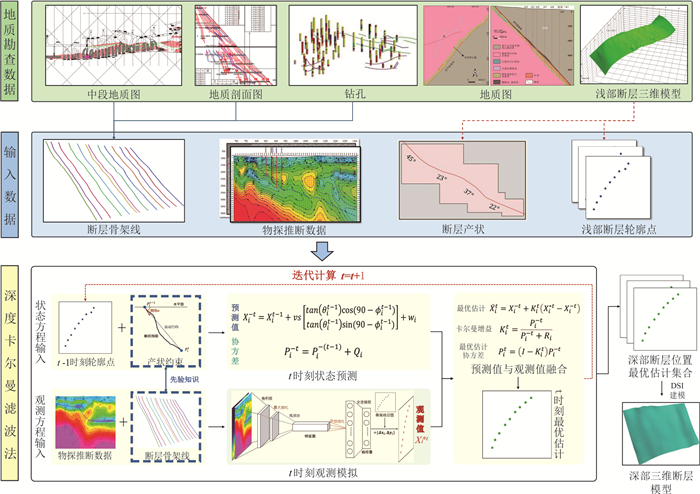
为了解决金属矿山深部直接观测缺乏、间接观测不确定性高,深部构造难以精细化三维重建的问题,利用先验知识弥补数据缺陷,研发了深度卡尔曼滤波法.基于卡尔曼滤波的思想,将由浅部到深部的断层三维建模视为“时序预测”问题:(1)结合浅部断层和产状约束,构建预测深部断层位置的状态方程;(2)借助物探推断数据和卷积网络代替观测,构建观测方程.通过融合预测和观测结果,实现深部断层位置的最优推断.该模型在夏甸金矿的应用表明:建模结果在深部钻孔揭露的断裂位置平均水平误差为6.17 m,精度较隐式建模方法提升91%~93%,能更准确反映深部断层的精细形态特征.基于重建的模型,在夏甸矿区深部圈定出四个成矿潜力区,可为后续资源勘查提供指导.
Abstract:The construction of fine-scale 3D models of deep structures remains challenging due to the lack of direct exploration data and the high uncertainty associated with geophysical prospecting inferred data. To address these issues, utilizing prior knowledge to mitigate the limitations of scarce exploration data and uncertain geophysical data is a valid idea. In this work, a 3D refined modelling method for deep fault named Deep Learning Aided Kalman Filter (DLAKF) was proposed. Based on the concept of Kalman filtering, the 3D modelling of the deep fault from shallow to deep was regarded as a "temporal sequence prediction" problem involving both system disturbances and observation errors: (1) A state equation for the Kalman filter was constructed to predict deep fault positions. The prior knowledge constraints of shallow fault locations and occurrence were integrated in the equation. (2) A deep spatial attention convolutional network, embedded with prior knowledge constraints, was designed. The observation equation for Kalman filter was construct based on the outputs of the deep neural network. By calculating the Kalman Gain, the positions predicted by the state equation and the observation equation were dynamically fused and the optimal estimation of deep fault location was achieved. The proposed method was applied to construct a 3D detailed model of deep fault at the Xiadian gold deposit. DLAKF successfully constructed the detailed model down to 3000 meters. The average horizontal error between the constructed model and drilling holes was 6.17 meters. The accuracy was improved by 91% to 93% compared to existing implicit modelling methods, which means the detailed model constructed by DLAKF reflected the detailed geometry of the deep fault structures more accurately. Based on the reconstructed 3D deep fault model, four prospective mineralization areas were identified in the deep sections of the Xiadian deposit, providing valuable guidance for deep resource exploration.
-
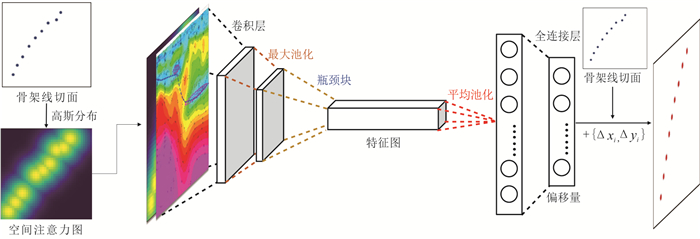
图 3 融合骨架线约束的空间注意力卷积网络结构
Fig. 3. The structure of spatial attention convolutional network with skeleton constraint
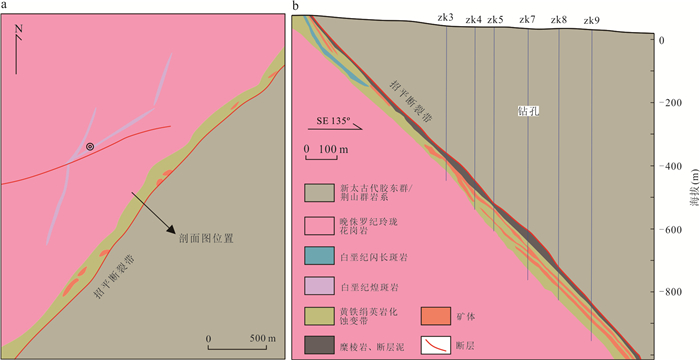
图 4 夏甸金矿床地质平面图及剖面图
图改自Liu et al.(2021);a.夏甸金矿床地质平面图;b.夏甸金矿床剖面图
Fig. 4. Geological plan and profile of Xiadian gold deposit
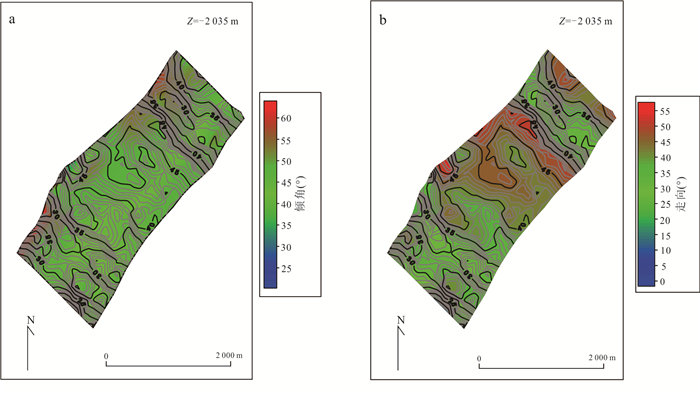
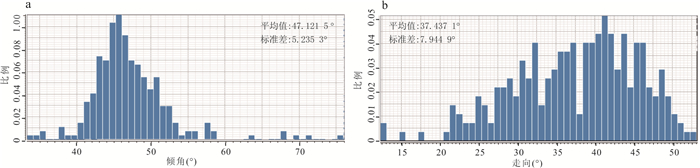
图 7 ‒1 200 m至‒3 000 m深部断层模型水平投影图
a.倾角等值线图;b.走向等值线图
Fig. 7. Plan views of deep fault model from ‒1 200 m to ‒3 000 m
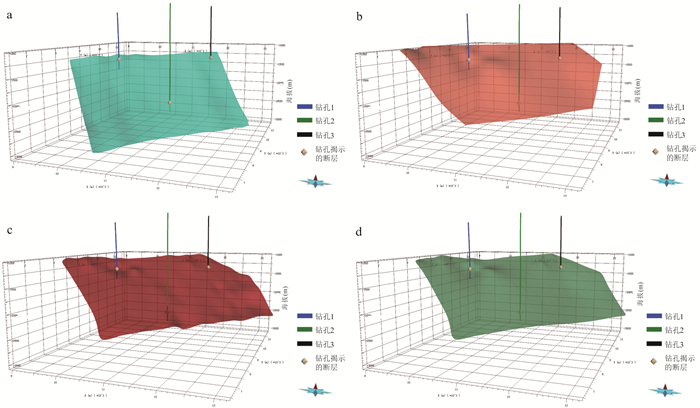
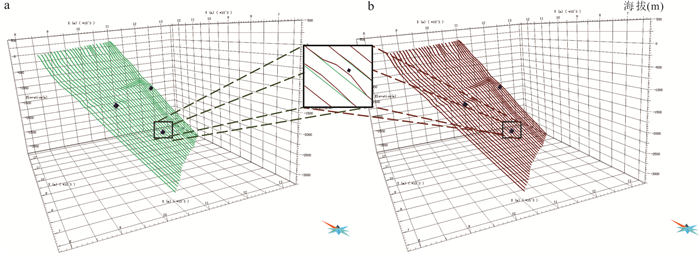
图 10 深度卡尔曼滤波法及对比方法重建三维模型
a.深度卡尔曼滤波(‒1 200~‒3 000 m);b.径向基插值(‒1 000~‒2 500 m);c.克里金插值(‒1 000~‒2 500 m);d.离散光滑插值(‒1 000~‒2 500 m)
Fig. 10. 3D models generated by the DLAKF and comparison methods
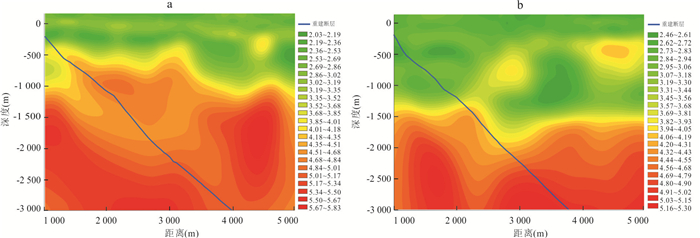
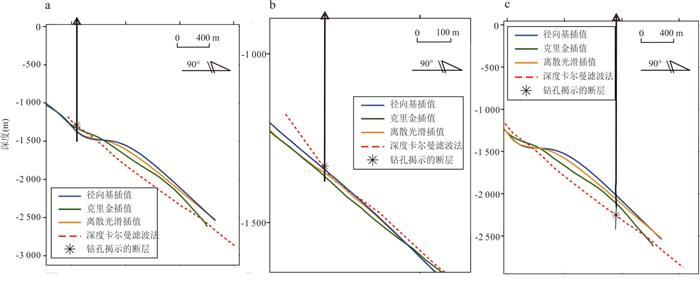
图 11 深度卡尔曼滤波法重建断层与视电阻率剖面对比
a.勘探线A解算的视电阻率剖面;b.勘探线B解算的视电阻率剖面
Fig. 11. Comparison of the DLAKF model and apparent resistivity profile
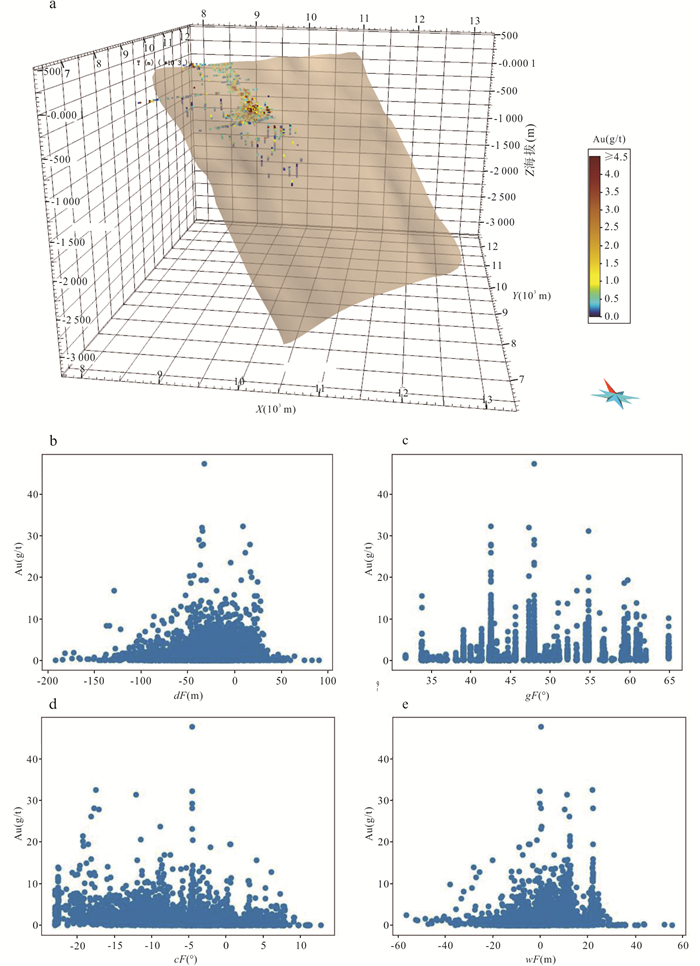
图 12 断层整体三维模型(200 m至‒3 000 m)及矿化关联散点图
a.断层三维模型及金矿化分布;b. dF与矿化关联散点图;c. gF与矿化关联散点图;d. cF与矿化关联散点图;e. wF与矿化关联散点图
Fig. 12. 3D model of fault (200 m to ‒3 000 m) and mineralization correlation scatter plot
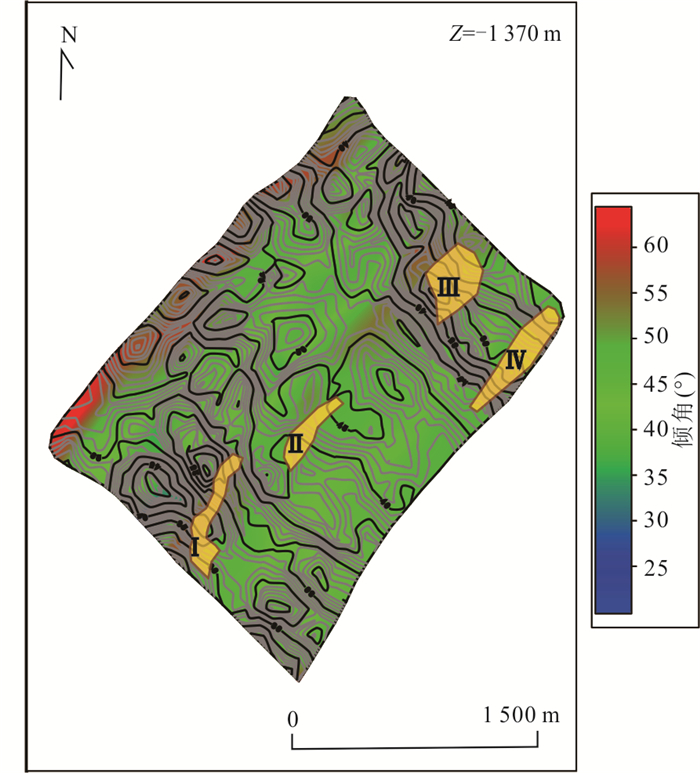
图 13 深部成矿潜力靶区水平投影图(黄色区域)
Fig. 13. Plan view of favourable metallogenic zones (yellow zones) inferred based on the DLAKF model
表 1 深部断层水平误差
Table 1. Horizontal error table of deep faults
钻孔编号 钻孔深度(m) 深度卡尔曼滤波(m) 骨架线模型(m) 径向基插值(m) 克里金插值(m) 离散光滑插值(m) 1 ‒1 288.82 9.64 35.90 65.62 57.38 64.01 2 ‒1 333.35 4.51 38.33 9.99 31.40 29.04 3 ‒2 251.40 4.37 31.32 195.39 119.54 173.33 平均 6.17 35.18 90.33 69.44 88.79  下载: 导出CSV
-
Ansel, J., Yang, E., He, H., et al., 2024. PyTorch 2: Faster Machine Learning Through Dynamic Python Bytecode Transformation and Graph Compilation. 29th ACM International Conference on Architectural Support for Programming Languages and Operating Systems, La Jolla. https://doi.org/10.1145/3620665.3640366 .Che, D. F., Jia, Q. R., 2019. Three-Dimensional Geological Modeling of Coal Seams Using Weighted Kriging Method and Multi-Source Data. IEEE Access, 7: 118037-118045. https://doi.org/10.1109/ACCESS.2019.2936811 Fonseca, C. M., Fleming, P. J., 1995. An Overview of Evolutionary Algorithms in Multiobjective Optimization. Evolutionary Computation, 3(1): 1-16. https://doi.org/10.1162/evco.1995.3.1.1 Gallardo, L. A., Meju, M. A., 2004. Joint Two-Dimensional DC Resistivity and Seismic Travel Time Inversion with Cross-Gradients Constraints. Journal of Geophysical Research: Solid Earth, 109(B3): 2003JB002716. https://doi.org/10.1029/2003JB002716 Gou, J., Zhou, W., Wu, L., 2016. Implicit three-Dimensional geo-Modelling Based on HRBF Surface. The International Archives of the Photogrammetry, Remote Sensing and Spatial Information Sciences, 42: 63-66. https://doi.org/10.5194/isprs-archives-xlii-2-w2-63-2016 Guo, D., Ding, W. X., Lan, X. Y., et al., 2024.3D Geological Modeling Based on Joint Interpretation of Gravity, Magnetism, Electricity and Seismicity: A Case Study of Nanling-Xuancheng Ore District. Geological Survey of China, 11(5): 139-152 (in Chinese with English abstract). Guo, J. T., Li, Y. Q., Jessell, M. W., et al., 2021.3D Geological Structure Inversion from Noddy-Generated Magnetic Data Using Deep Learning Methods. Computers & Geosciences, 149: 104701. https://doi.org/10.1016/j.cageo.2021.104701 He, J. S., 2019. Theory and Technology of Wide Field Electromagnetic Method. The Chinese Journal of Nonferrous Metals, 29(9): 1809-1816 (in Chinese with English abstract). He, K. M., Zhang, X. Y., Ren, S. Q., et al., 2016. Deep Residual Learning for Image Recognition. 2016 IEEE Conference on Computer Vision and Pattern Recognition (CVPR). Las Vegas. https://doi.org/10.1109/CVPR.2016.90 Huang, J. X., Deng, H., Mao, X. C., et al., 2023. 3D Modeling of Detachment Faults in the Jiaodong Gold Province, Eastern China: A Bayesian Inference Perspective and Its Exploration Implications. Ore Geology Reviews, 154: 105307. https://doi.org/10.1016/j.oregeorev.2023.105307 Huston, D. L., Blewett, R. S., Champion, D. C., 2012. Australia through Time: A Summary of Its Tectonic and Metallogenic Evolution. Episodes, 35(1): 23-43. https://doi.org/10.18814/epiiugs/2012/v35i1/004 Jia, R., Lü, Y. K., Wang, G. W., et al., 2021. A Stacking Methodology of Machine Learning for 3D Geological Modeling with Geological-Geophysical Datasets, Laochang Sn Camp, Gejiu (China). Computers & Geosciences, 151: 104754. https://doi.org/10.1016/j.cageo.2021.104754 Jiang, Y. F., Li, H., Yan, X. H., et al., 2025. Identification and Prospecting Application of Wide Filed Electromagnetic Method to Deep Pluton: Take the Longkou-Tudui Gold Deposit in Jiaodong as an Example. Journal of Central South University (Science and Technology), 56(3): 966-978 (in Chinese with English abstract). Kalman, R. E., 1960. A New Approach to Linear Filtering and Prediction Problems. Journal of Basic Engineering, 82(1): 35-45. https://doi.org/10.1115/1.3662552 Li, D. Q., Wang, Z. X., Hu, Y. F., et al., 2020. The Application of Wide Field Electromagnetic Method to Shale Gas Exploration in Wuling Mountain Area: A Case Study of Tongzi Area in Northern Guizhou. Geophysical and Geochemical Exploration, 44(5): 991-998 (in Chinese with English abstract). Liu, L. M., Cao, W., Liu, H. S., et al., 2022. Applying Benefits and Avoiding Pitfalls of 3D Computational Modeling-Based Machine Learning Prediction for Exploration Targeting: Lessons from Two Mines in the Tongling-Anqing District, Eastern China. Ore Geology Reviews, 142: 104712. https://doi.org/10.1016/j.oregeorev.2022.104712 Liu, Z. K., Chen, J., Mao, X. C., et al., 2021. Spatial Association between Orogenic Gold Mineralization and Structures Revealed by 3D Prospectivity Modeling: A Case Study of the Xiadian Gold Deposit, Jiaodong Peninsula, China. Natural Resources Research, 30(6): 3987-4007. https://doi.org/10.1007/s11053-021-09956-9 Lü, Q. T., Qi, G., Yan, J. Y., 2013. 3D Geologic Model of Shizishan Ore Field Constrained by Gravity and Magnetic Interactive Modeling: A Case History. Geophysics, 78(1): B25-B35. https://doi.org/10.1190/geo2012-0126.1 Mao, X. C., Ren, J., Liu, Z. K., et al., 2019. Three- Dimensional Prospectivity Modeling of the Jiaojia-Type Gold Deposit, Jiaodong Peninsula, Eastern China: A Case Study of the Dayingezhuang Deposit. Journal of Geochemical Exploration, 203: 27-44. https://doi.org/10.1016/j.gexplo.2019.04.002 Mao, X. C., Deng, H., Chen, J., et al., 2024. Theory and Methods for Three-Dimensional Intelligent Prospectivity Mapping of Deep Resources in Metal Mines. Mineral Exploration, 15(8): 1365-1378 (in Chinese with English abstract). Mao, X. C., Wang, Q., Chen, J., et al., 2020. Three- Dimensional Modeling of Deep Metallogenic Structure in Northwestern Jiaodong Peninsula and Its Gold Prospecting Significance. Acta Geoscientica Sinica, 41(2): 166-178 (in Chinese with English abstract). Meng, C., Zhang, H., Zhang, T., et al., 2024. Application of Wide Field Electromagnetic Method in Deep Exploration of Huangshaping Lead-Zinc Polymetallic Ore Field. Mineral Exploration, 15(9): 1607-1616 (in Chinese with English abstract). Mueller, C. O., Wächter, J., Jahnke, C., et al., 2021. Integrated Geological and Gravity Modelling to Improve 3-D Model Harmonization—Methods and Benefits for the Saxony-Anhalt/Brandenburg Cross-Border Region (North German Basin). Geophysical Journal International, 227(2): 1295-1321. https://doi.org/10.1093/gji/ggab256 Schuster, G. T., Chen, Y. Q., Feng, S. H., 2024. Review of Physics-Informed Machine-Learning Inversion of Geophysical Data. Geophysics, 89(6): 337-356. https://doi.org/10.1190/geo2023-0615.1 Song, H. B., Jiang, Z. H., Guo, Q., et al., 2026. Research Progress and Prospects of Joint Electromagnetic and Seismic Inversion Methods. Progress in Geophysics: 41(1): 156-173 (in Chinese with English abstract). Song, Y. X., Song, M. C., Ding, Z. J., et al., 2017. Major Ad Vances on Deep Prospecting in Jiaodong Gold Ore Cluster and Its Metallogenic Characteristics. Gold Science and Technology, 25(3): 4-18 (in Chinese with English abstract). Wang, G. W., Zhu, Y. Y., Zhang, S. T., et al., 2012. 3D Geological Modeling Based on Gravitational and Magnetic Data Inversion in the Luanchuan Ore Region, Henan Province, China. Journal of Applied Geophysics, 80: 1-11. https://doi.org/10.1016/j.jappgeo.2012.01.006 Wang, J. L., Mao, X. C., Peng, C., et al., 2023. Three- Dimensional Refined Modelling of Deep Structures by Using the Level Set Method: Application to the Zhaoping Detachment Fault, Jiaodong Peninsula, China. Mathematical Geosciences, 55(2): 229-262. https://doi.org/10.1007/s11004-022-10031-z Wang, J. M., Zhao, H., Bi, L., et al., 2018. Implicit 3D Modeling of Ore Body from Geological Boreholes Data Using Hermite Radial Basis Functions. Minerals, 8(10): 443. https://doi.org/10.3390/min8100443 Wang, T. R., Ji, X. B., Wang, J. B., et al., 2025. Implicit 3D Geological Modeling Based on Machine Learning: A Case Study of Lazigou Gold Deposit in Muping-Rushan Metallogenic Belt. Earth Science, 50(8): 3167-3181 (in Chinese with English abstract). Wang, Y., Chen, X. F., Di, Q. Y., et al., 2025. Deep Mineral Exploration: Opportunities and Challenges in Reflection Seismics. Earth Science, 50(11): 4284-4299 (in Chinese with English abstract). Wei, L. N., Li, Y. J., Yin, C. C., et al., 2025. Status and Prospects of Joint Inversion of Geophysical Electromagnetic Data. Reviews of Geophysics and Planetary Physics, 56(6): 620-640 (in Chinese with English abstract). Witter, J. B., Siler, D. L., Faulds, J. E., et al., 2016.3D Geophysical Inversion Modeling of Gravity Data to Test the 3D Geologic Model of the Bradys Geothermal Area, Nevada, USA. Geothermal Energy, 4(1): 14. https://doi.org/10.1186/s40517-016-0056-6 Wu, C. L., Liu, G., Zhang, X. L., et al., 2016. Discussion on Geological Science Big Data and Its Applications. Chinese Science Bulletin, 61(16): 1797-1807 (in Chinese with English abstract). doi: 10.1360/N972015-01035 Xu, G. Y., Wen, Y. M., Wang, L. Y., et al., 2025. Current Status and Prospects of Joint Inversion on Geodesy and Geophysics. Geomatics and Information Science of Wuhan University, 50(10): 1939-1947 (in Chinese with English abstract). Xue, R. H., Wang, G. J., Di, Q. Y., et al., 2011. The Comprehensive Application of Several Geophysical Methods in Mineral Exploration in Guangdong, Shaoguan. Progress in Geophysics, 26(4): 1364-1371 (in Chinese with English abstract). Yang, H., Dai, S. K., Song, H. B., et al., 2002. Overview of Joint Inversion of Integrated Geophysics. Progress in Geophysics, 17(2): 262-271 (in Chinese with English abstract). Yang, J., Liu, Q. L., Mao, X. C., et al., 2026. YangNet: A Nonlinear and Nonstationary Spatial Interpolation Method Based on Spatial Compound Variable Theory. International Journal of Geographical Information Science, 40(1): 112-139. https://doi.org/10.1080/13658816.2025.2508840 Ye, R., Li, X. H., Yuan, F., et al., 2019. A Study on Deep Geological Structure Analysis of Magushan Area Based on Gravity and Magnetic Joint Inversion. Chinese Journal of Geology (Scientia Geologica Sinica), 54(3): 876-892 (in Chinese with English abstract). Zhai, Y. S., Deng, J., Wang, J. P., et al., 2004. Researches on Deep Ore Prospecting. Mineral Deposits, 23(2): 142-149 (in Chinese with English abstract). 郭冬, 丁文祥, 兰学毅, 等, 2024. 基于重磁电震综合解释的三维地质建模: 以南陵‒宣城矿集区为例. 中国地质调查, 11(5): 139-152. 何继善, 2019. 大深度高精度广域电磁勘探理论与技术. 中国有色金属学报, 29(9): 1809-1816. 蒋永芳, 李欢, 颜晓华, 等, 2025. 广域电磁法对深部岩体的识别及在找矿中的应用: 以胶东龙口‒土堆金矿区为例. 中南大学学报(自然科学版), 56(3): 966-978. 李帝铨, 汪振兴, 胡艳芳, 等, 2020. 广域电磁法在武陵山区页岩气勘探中的探索应用: 以黔北桐梓地区为例. 物探与化探, 44(5): 991-998. 毛先成, 邓浩, 陈进, 等, 2024. 金属矿山深部资源三维智能预测理论与方法. 矿产勘查, 15(8): 1365-1378. 毛先成, 王琪, 陈进, 等, 2020. 胶西北金矿集区深部成矿构造三维建模与找矿意义. 地球学报, 41(2): 166-178. 孟超, 张慧, 张婷, 等, 2024. 广域电磁法在黄沙坪铅锌多金属矿田深部探测中的应用. 矿产勘查, 15(9): 1607-1616. 宋昊博, 姜志海, 郭强, 等, 2026. 电磁与地震联合反演方法研究进展与展望. 地球物理学进展, 41(1): 156-173. 宋英昕, 宋明春, 丁正江, 等, 2017. 胶东金矿集区深部找矿重要进展及成矿特征. 黄金科学技术, 25(3): 4-18. 王统荣, 纪旭波, 王江波, 等, 2025. 基于机器学习的隐式三维地质建模: 以牟乳成矿带腊子沟金矿为例. 地球科学, 50(8): 3167-3181. doi: 10.3799/dqkx.2025.048 王赟, 陈晓非, 底青云, 等, 2025. 深部找矿: 金属矿地震技术的机遇与挑战. 地球科学, 50(11): 4284-4299. doi: 10.3799/dqkx.2025.109 韦老闹, 李永吉, 殷长春, 等, 2025. 地球物理电磁联合反演研究进展与展望. 地球与行星物理论评(中英文), 56(6): 620-640. 吴冲龙, 刘刚, 张夏林, 等, 2016. 地质科学大数据及其利用的若干问题探讨. 科学通报, 61(16): 1797-1807. 许光煜, 温扬茂, 王乐洋, 等, 2025. 大地测量地球物理联合反演现状与展望全文替换. 武汉大学学报(信息科学版), 50(10): 1939-1947. 薛融晖, 王光杰, 底青云, 等, 2011. 广东韶关某地找矿的多种地球物理方法综合应用. 地球物理学进展, 26(4): 1364-1371. 杨辉, 戴世坤, 宋海斌, 等, 2002. 综合地球物理联合反演综述. 地球物理学进展, 17(2): 262-271. 叶睿, 李晓晖, 袁峰, 等, 2019. 基于重磁联合反演的麻姑山地区深部地质结构解析研究. 地质科学, 54(3): 876-892. 翟裕生, 邓军, 王建平, 等, 2004. 深部找矿研究问题. 矿床地质, 23(2): 142-149. -

 点击查看大图
计量
- 文章访问数: 88
- HTML全文浏览量: 37
- PDF下载量: 38
- 被引次数: 0
