




Spatio-Temporal Variation Characteristics of Water Quality and Pollutant Source Apportionment in Xiaoqing River Mainstream
-
摘要:
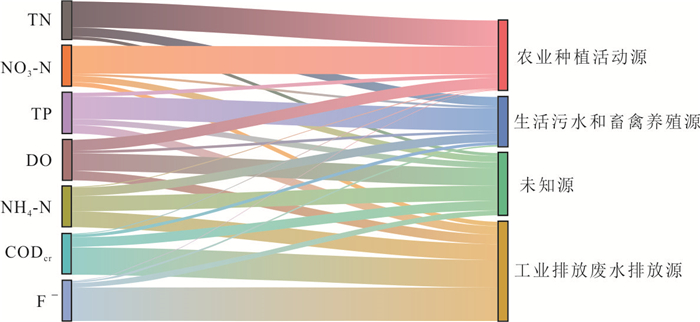
河流作为人类及其他生物赖以生存的重要自然生态系统,其水质状况直接关系到生态安全与可持续发展.为探究小清河干流水质时空变化特征,基于2019—2022年的水质监测数据,采用综合水质指数法(water quality index,WQI)分析小清河干流水质时空变化特征,并利用绝对主成分-多元线性回归模型解析干流污染物来源及其贡献率.结果表明:2019—2022年小清河干流水质年均WQI值呈现增加趋势,水质等级从“中等”转变为“良好”;水质状况在季节尺度上未呈现显著波动,但丰水期WQI均值相对较低.空间上,小清河干流水质WQI值总体上表现为中游<上游<下游,水质较差的区域主要分布在中上游,尤其是干流沿岸建设用地和耕地面积占比较大的地区.源解析结果显示,干流污染物来源较为复杂,主要为工业废水排放源(25.81%)、农业种植活动源(24.92%)、生活污水排放和畜禽养殖源(17.60%);干流各监测断面的污染物来源组成相似,然而,其污染源的贡献结构存在差异,这种差异与沿岸的土地利用方式及人类活动强度密切相关.研究结果可为小清河流域的污染防控与治理决策提供关键科学依据.
Abstract:As a critical natural ecosystem supporting the survival of humans and other organisms, the water quality of rivers directly influences ecological security and sustainable development. To investigate the spatiotemporal variations in water quality of the Xiaoqing River mainstream, this study analyzed and evaluated these characteristics using the comprehensive water quality index (WQI) method based on monitoring data from 2019 to 2022. Additionally, an absolute principal component score-multiple linear regression (APCS-MLR) model was employed to identify pollution sources and quantify their contribution rates in the mainstream. The results indicate that the annual average WQI of the Xiaoqing River mainstream showed an increasing trend, with the water quality grade improving from "moderate" to "good" from 2019 to 2022. No significant seasonal variation in water quality grade was observed, though the WQI during the wet season was slightly higher than in other periods. Spatially, the WQI values along the Xiaoqing River mainstream generally exhibited a pattern of midstream < upstream < downstream, with the best water quality observed in the downstream section. Poorer water quality was primarily distributed in the midstream and upstream regions, particularly in areas with a high proportion of built-up and agricultural land along the main channel. Source apportionment results revealed that pollutant sources in the Xiaoqing River mainstream were diverse, with primary contributions from industrial wastewater discharge (25.81%), agricultural activities (24.92%), and domestic sewage coupled with livestock farming (17.60%). The predominant pollution sources were generally consistent across all monitoring sections, though dominant types varied spatially, which was closely associated with land use patterns and anthropogenic activities along the river. The findings of this study can provide an important scientific basis for pollution control decision-making in the Xiaoqing River basin.
-
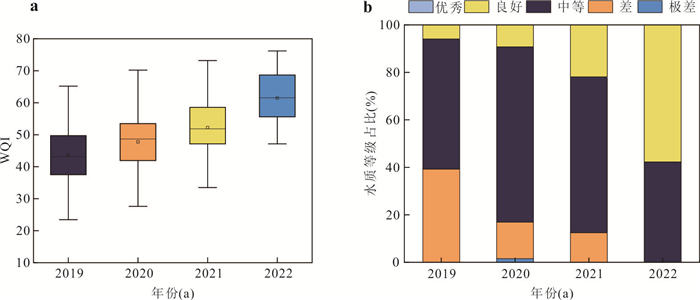
图 2 2019—2022年干流各监测断面WQI值(a)及其各水质等级百分比的年际变化(b)
Fig. 2. Interannual variation in WQI (a) and interannual in percentage of each water quality grade (b) at various monitoring sites from 2019 to 2022
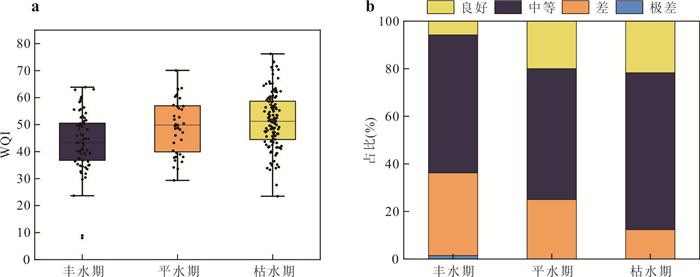
图 3 2019—2022年干流各监测断面WQI值及其各水质等级百分比季节变化
Fig. 3. Seasonal variation in WQI and seasonal variation in percentage of each water quality grade at various monitoring sites from 2019 to 2022
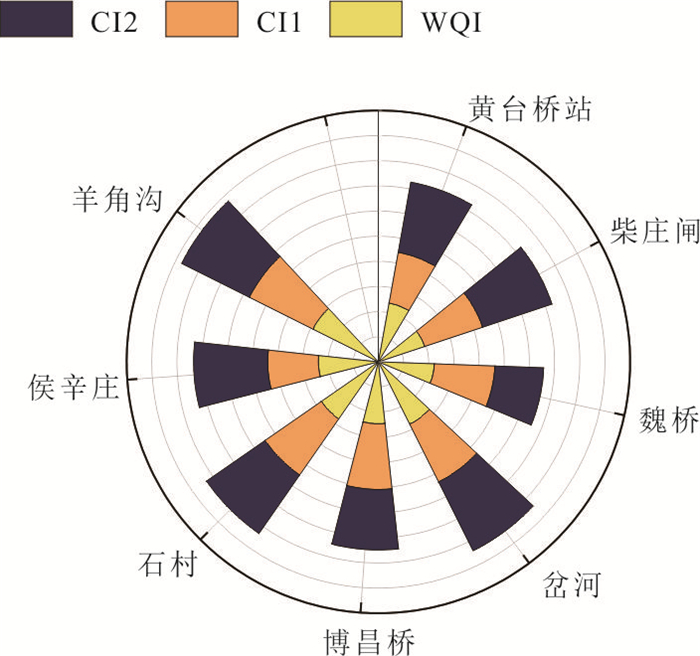
图 4 两类分类指数空间分布玫瑰图
Fig. 4. Rose chart of spatial distribution of two groups of classification indexes
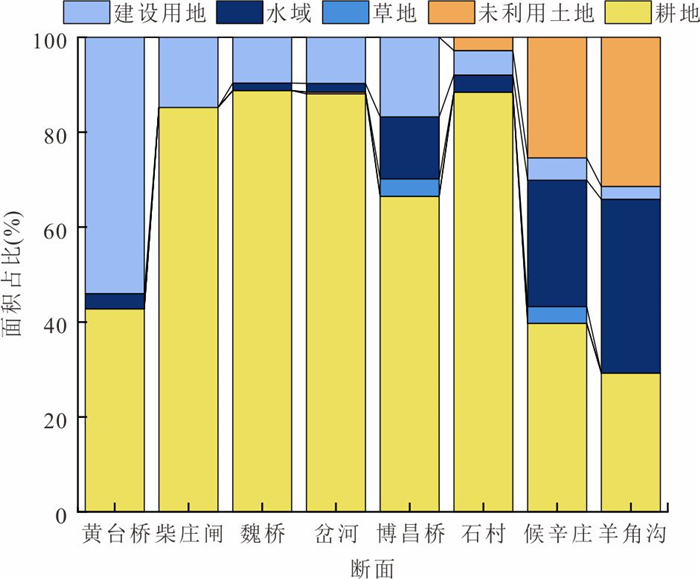
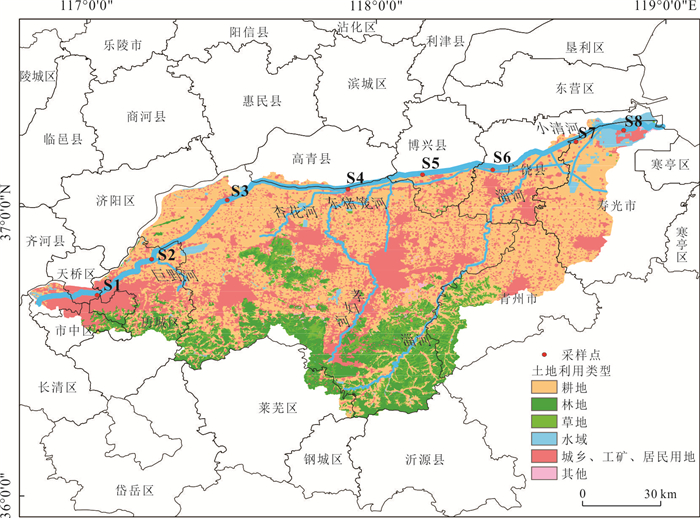
图 5 各断面处不同土地利用类型面积占比
Fig. 5. Proportion of land use type area at various monitoring sites
表 1 WQI中各水质指标权重值和标准化因子
Table 1. The normalization values and weights of water quality parameters used in the WQI calculation
权重(Pi) 参数 地表水质量标准 Ⅰ Ⅱ Ⅲ Ⅳ Ⅴ Ii, 1=20b Ii, 2=40b Ii, 3=60b Ii, 4=80b Ii, 5=100b 4 DO (mg/L) ≥ 7.5 6 5 3 2 3 NH4-N (mg/L) ≤ 0.15 0.5 1 1.5 2 4 TP (mg/L) ≤ 0.02 0.1 0.2 0.3 0.4 - TN (mg/L) ≤ 0.2 0.5 1 1.5 2 2 F- (mg/L) ≤ 1 1 1 1.5 1.5 2 CODCr (mg/L) ≤ 15 15 20 30 40 注:根据《地表水环境质量标准》(2002年),在评价河流地表水时,总氮不作为基本项目,不参与评价,因此在本研究中,水质指数(WQI)的计算将不包括总氮.  下载: 导出CSV
表 2 水质指标与土地利用类型的相关性
Table 2. Relationship between landscape pattern and water quality
土地利用类型 TP CODCr DO NH4⁃N F- TN NO3⁃N CI1 CI2 WQI 耕地 0.351 -0.354 0.346 0.014 -0.203 0.809* 0.472 -0.265 0.346 0.248 林地 -0.389 -0.096 0.053 -0.171 -0.216 0.414 -0.066 -0.163 -0.343 -0.367 草地 0.167 -0.654* -0.438 -0.270 -0.500 0.026 -0.106 0.282 0.124 0.097 水域 -0.374 0.188 -0.304 -0.563 -0.267 -0.443 -0.717* -0.143 -0.014 -0.448 建设用地 0.313 0.217 0.113 0.891* 0.737* 0.464 0.312 0.537 0.010 0.303 未利用土地 -0.528 0.295 -0.437 -0.537 -0.199 -0.516 -0.512 -0.056 -0.394 -0.402 注:*表示在0.05水平上显著相关.
下载: 导出CSV
表 3 研究区主成分总方差解释(%)
Table 3. Interpretation of total variance of principal components in the study area
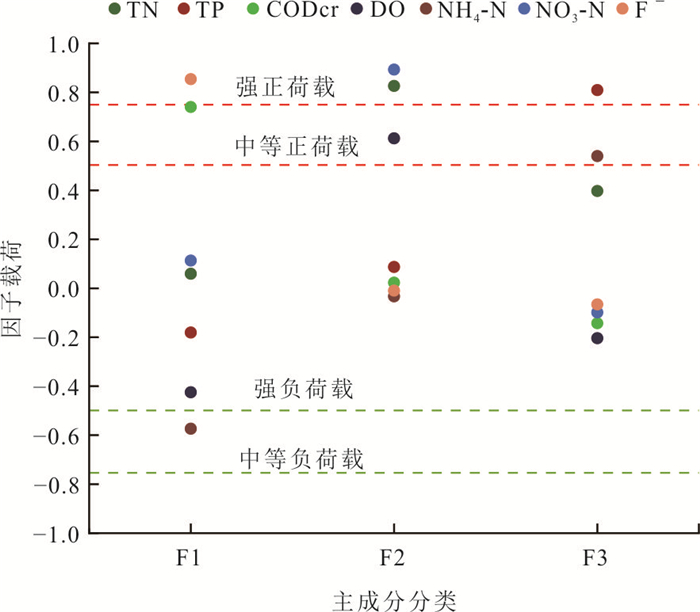
成分 初始特征值 初始提取载荷平方和 旋转后载荷平方和 合计 方差贡献率 累积方差贡献率 合计 方差贡献率 累积方差贡献率 合计 方差贡献率 累积方差贡献率 F1 2.36 29.44 29.44 2.36 29.44 29.44 2.07 25.81 25.81 F2 1.83 22.88 52.32 1.83 22.88 52.32 1.99 24.92 50.74 F3 1.28 16.01 68.33 1.28 16.01 68.33 1.41 17.60 68.33
下载: 导出CSV
-
Bi, Y. L., Wang, H. C., Xia, B., et al., 2022. Pollution Characterization and Comprehensive Water Quality Assessment of Rain-Source River: A Case Study of the Longgang River in Shenzhen. Environmental Science, 43(2): 782-794(in Chinese with English abstract). Cao, Y. X., Xin, M., Wang, B. D., et al., 2020. Spatiotemporal Distribution, Source, and Ecological Risk of Polycyclic Aromatic Hydrocarbons (PAHs) in the Urbanized Semi-Enclosed Jiaozhou Bay, China. Science of the Total Environment, 717: 137224. https://doi.org/10.1016/j.scitotenv.2020.137224 Cheng, G. W., Wang, M. J., Chen, Y., et al., 2020. Source Apportionment of Water Pollutants in the Upstream of Yangtze River Using APCS-MLR. Environmental Geochemistry and Health, 42(11): 3795-3810. https://doi.org/10.1007/s10653-020-00641-z Dai, X. J., Jiang, T. L., Liu, Y., et al., 2022. Pollution Status and Trend Analysis of Xiaoqing River in Jinan Section in Recent 20 Years. Journal of Arid Land Resources and Environment, 36(1): 143-150(in Chinese with English abstract). Ding, Q. Z., Zhou, Y. Z., Zhou, J. L., et al., 2024. Spatial Distribution, Source Apportionment and Health Risk Assessment of Inorganic Pollutant in Groundwater in Eastern Plain of Xinjiang. Earth Science, 49(11): 4008-4021 (in Chinese with English abstract). Du, Z. P., Wang, M. J., Yan, C. A., et al., 2020. Pollution Source Apportionment of Lake Dianchi Based on Abolute Principal Component Score Multiple Linear Regression. Acta Scientiae Circumstantiae, 40(3): 1130-1137 (in Chinese with English abstract). Fan, X. F., Han, M., Wang, L., et al., 2020. Analysis of Water Quality Change and Its Driving Factors of the Xiaoqing River Estuary in Recent Ten Rears. Environmental Science, 41(4): 1619-1628 (in Chinese with English abstract). Gu, J. T., 2023. Study on Comprehensive Evaluation and Driving Factors of "Happy River" Based on Xiaoqing River Basin (Dissertation). University of Jinan, Jinan (in Chinese with English abstract). Hou, W., Sun, S. H., Wang, M. Q., et al., 2016. Assessing Water Quality of Five Typical Reservoirs in Lower Reaches of Yellow River, China: Using a Water Quality Index Method. Ecological Indicators, 61: 309-316. https://doi.org/10.1016/j.ecolind.2015.09.030 Hu, Y. Y., Wang, Y. C., Zhou, Y. Y., et al., 2022. Water Quality Assessment of Baiyangdian Watershed Based on a Comprehensive Water Quality Index. Water Resources and Hydropower Engineering, 53(3): 145-154(in Chinese with English abstract). Iloba, K. I., Akawo, N. O., Godwin, P. I., 2021. Assessment of Anwai River Water Quality Using the Weighted Arithmetic Water Quality Index (WQI) in Delta State, Nigeria. Journal of Applied and Natural Science, 13(3): 913-922. https://doi.org/10.31018/jans.v13i3.2758 Jiao, Z., 2022. Comprehensive Evaluation of Groundwater Environmental Ecological Effect in Typical Reach of Xiaoqing River under Multi-Source Confluence (Dissertation). University of Jinan, Jinan (in Chinese with English abstract). Li, X. F., Xu, W. Z., Song, S., et al., 2023. Sources and Spatiotemporal Distribution Characteristics of Nitrogen and Phosphorus Loads in the Haihe River Basin, China. Marine Pollution Bulletin, 189: 114756. https://doi.org/10.1016/j.marpolbul.2023.114756 Liu, Y. J., Lei, H. J., Lu, Y. L., et al., 2025. Multiple Impacts of Human Activities on Environmental Fate of Per- and Polyfluoroalkyl Substances (PFAS) in the Xiaoqing River of China. Environmental Pollution, 382: 126738. https://doi.org/10.1016/j.envpol.2025.126738 Ma, E. P., Cai, J. M., Lin, J., et al., 2021. Spatial Pattern and Water Environmental Impact of Nitrogen and Phosphorus Emissions from Agricultural Sources in China in Recent 30 Years. Journal of Natural Resources, 36(3): 752-770 (in Chinese with English abstract). doi: 10.31497/zrzyxb.20210316 Mao, D. H., Zhou, Y., Zhou Y. L., 2024. Analysis of Spatiotemporal Variation and Driving Factors of Water Quality in the Xiangjiang River Basin from 1990 to 2016. Environmental Science, 45(7): 3953-3964 (in Chinese with English abstract). Meng, L., Zuo, R., Wang, J. S., et al., 2018. Apportionment and Evolution of Pollution Sources in a Typical Riverside Groundwater Resource Area Using PCA-APCS-MLR Model. Journal of Contaminant Hydrology, 218: 70-83. https://doi.org/10.1016/j.jconhyd.2018.10.005 Nong, X. Z., Shao, D. G., Xiao, Y., et al., 2019. Spatio-Temporal Characterization Analysis and Water Quality Assessment of the South-to-North Water Diversion Project of China. International Journal of Environmental Research and Public Health, 16(12): 2227. https://doi.org/10.3390/ijerph16122227 Nong, X. Z., Shao, D. G., Zhong, H., et al., 2020. Evaluation of Water Quality in the South-to-North Water Diversion Project of China Using the Water Quality Index (WQI) Method. Water Research, 178: 115781. https://doi.org/10.1016/j.watres.2020.115781 Pesce, S. F., Wunderlin, D. A., 2000. Use of Water Quality Indices to Verify the Impact of Córdoba City (Argentina) on Suquı́a River. Water Research, 34(11): 2915-2926. https://doi.org/10.1016/S0043-1354(00)00036-1 Sun, L. T., Zhao, Z., Tang, J. H., 2020. Distribution Characteristics of Per-/Polyflouralkyl Substances in River Sediments around Typical Fluorine Industrial Parks. Environmental Science, 41(9): 4069-4075(in Chinese with English abstract). Wang, H. F., Dai, C. Y., Zhang, Y. K., et al., 2024. Evaluation of the Comprehensive Pollution Control Effectiveness in the Zouping Section of the Xiaoqing River Basin Based on Water Quality Targets. Transactions of the Chinese Society of Agricultural Engineering, 40(21): 212-220(in Chinese with English abstract). Wang, Q., 2015. Calculation of the Discharge Amounts and Total Pollution Amount Control of Nitrogen and Phosphorus in Xiaoqinghe Watershed (Dissertation). Yantai Institute of Coastal Zone Research Chinese Academy of Sciences, Yantai(in Chinese with English abstract). Wang, X. S., Li, Q., Gao, J. F., et al., 2021. A Preliminary Analysis on Response of River Water Quality to Land Use in Riparian Zone of Changzhou. Resources and Environment in the Yangtze Basin, 30(12): 2915-2924 (in Chinese with English abstract). Wang, Y. N., Guan, W. C., Zou, L., et al., 2023. Composition and Transport of Nitrogen and Phosphorus in the Main Estuaries around Laizhou Bay. Marine Environmental Science, 42(5): 684-692 (in Chinese with English abstract). Xia, S. Y., Lü, W., Yang, J. Y., et al., 2025. Analysis of the Spatiotemporal Distribution Characteristics and Influencing Factors of River Water Quality in Suzhou City. Environmental Science, 46(7): 4241-4250(in Chinese with English abstract). Xiang, R., Wang, L. J., Li, H., et al., 2021. Temporal and Spatial Variation in Water Quality in the Three Gorges Reservoir from 1998 to 2018. Science of the Total Environment, 768: 144866. https://doi.org/10.1016/j.scitotenv.2020.144866 Yang, J., Huang, X., 2021. The 30 m Annual Land Cover Dataset and Its Dynamics in China from 1990 to 2019. Earth System Science Data, 13(8): 3907-3925. https://doi.org/10.5194/essd-13-3907-2021 Zhou, B., Li, X. G., Tong, S. C., et al., 2024. Spatial and Temporal Distribution of Nitrogen in the Liaohe River Basin and Its Responses to Land Use and Rainfall. Environmental Science, 45(4): 2373-2384 (in Chinese with English abstract). Zhu, M., Cheng, R., Dong, P., et al., 2025. Exploring the Groundwater Quality Index and Its Pollution Sources in Southwest Karst Regions Using Machine Learning Models. Journal of Earth Science. https://doi.org/10.1007/s12583-025-0357-4 (in press).毕业亮, 王华彩, 夏兵, 等, 2022. 雨源型城市河流水污染特征及水质联合评价: 以深圳龙岗河为例. 环境科学, 43(2): 782-794. 代雪静, 姜腾龙, 刘杨, 等, 2022. 近二十年小清河济南段污染状况及其趋势分析. 干旱区资源与环境, 36(1): 143-150. 丁启振, 周殷竹, 周金龙, 等, 2024. 新疆东部平原区地下水无机污染物空间分布、源解析及健康风险评价. 地球科学, 49(11): 4008-4021. doi: 10.3799/dqkx.2023.152 杜展鹏, 王明净, 严长安, 等, 2020. 基于绝对主成分-多元线性回归的滇池污染源解析. 环境科学学报, 40(3): 1130-1137. 范新凤, 韩美, 王磊, 等, 2020. 小清河入海口近十年水质变化及驱动因素分析. 环境科学, 41(4): 1619-1628. 顾佳韬, 2023. 基于小清河流域的"幸福河"综合评价及驱动因子研究(硕士学位论文). 济南: 济南大学. 胡莹莹, 王义成, 周毓彦, 等, 2022. 基于综合水质指数的白洋淀流域水质评价. 水利水电技术(中英文), 53(3): 145-154. 焦贞, 2022. 多源汇流条件下小清河典型河段地下水环境生态效应综合评价(硕士学位论文). 济南: 济南大学. 马恩朴, 蔡建明, 林静, 等, 2021. 近30年中国农业源氮磷排放的格局特征与水环境影响. 自然资源学报, 36(3): 752-770. 毛德华, 周滢, 周懿琳, 2024.1990—2016年湘江流域水质时空变化及驱动因素分析. 环境科学, 45(7): 3953-3964. 孙琳婷, 赵祯, 唐建辉, 2020. 典型氟工业园周边河流沉积物中全(多)氟化合物的分布特征. 环境科学, 41(9): 4069-4075. 王好芳, 代晨洋, 张祎珂, 等, 2024. 基于水质目标的小清河流域邹平段污染物综合治理效果评价. 农业工程学报, 40(21): 212-220. 王琼, 2015. 基于SWAT模型的小清河流域氮磷污染负荷核算及总量控制(硕士学位论文). 烟台: 中国科学院烟台海岸带研究所. 王雪松, 李琪, 高俊峰, 等, 2021. 常州市河流水质对滨岸带土地利用响应的初步分析. 长江流域资源与环境, 30(12): 2915-2924. 王一诺, 关纬城, 邹立, 等, 2023. 环莱州湾主要河口氮磷组成特征及其输送贡献. 海洋环境科学, 42(5): 684-692. 夏诗语, 吕文, 杨金艳, 等, 2025. 苏州市河流水质时空分布特征及影响因素分析. 环境科学, 46(7): 4241-4250. 周波, 李晓光, 童思陈, 等, 2024. 辽河流域氮素时空分布及其对土地利用和降雨的响应. 环境科学, 45(4): 2373-2384. -

 点击查看大图
计量
- 文章访问数: 306
- HTML全文浏览量: 21
- PDF下载量: 52
- 被引次数: 0
