




Dynamic Early Warning of Safety Status for Dock Engineering in Soft Soil Stratum Based on Multi-Point Time-Series Monitoring Information Fusion
-
摘要:
软土地层船坞工程因地质条件复杂、施工周期长等特点,面临土体参数不确定性高、传统预警误差大等挑战.针对上述问题,提出一种基于多点时序监测信息融合的安全状态动态预警方法.首先,构建贝叶斯网络模型,利用网络节点响应关系和蒙特卡洛(MCS)模拟计算先验概率;然后,引入时序监测数据,通过马尔可夫链-蒙特卡洛算法(MCMC)更新后验概率,动态量化安全系数(Fs)、失效概率(Pf)等指标,实现监测信息与安全状态直接关联.最后,基于软土特性与相关规范,建立包含5级预警级别、3种响应状态的动态预警标准.以上海某船坞工程为例,该方法融合多点时序监测信息进行参数反演,有效降低土体参数不确定性(变异系数降低14%~30%);同时实现时效性安全评价,安全系数时变曲线随变形增大呈规律性递减;基于此建立分级动态预警标准,判定船坞施工期处于安全级Ⅰ(Fs=1.945 > 1.50,Pf < 0.001%);并通过设计极端工况模拟验证了预警标准在危险状态下触发预警的可行性.构建的动态预警体系,显著提升了参数反演精度与安全评价的准确性与实时性,有效规避了单一数据误报风险,增强了动态预警的精度和全面性,为同类工程风险防控提供科学方法.
Abstract:Dock engineering in soft soil stratum faces challenges such as high uncertainty of soil parameters and large errors in traditional early warning due to complex geological conditions and long construction periods. To address these issues, this study proposes a dynamic early warning method for safety status based on multi-point time-series monitoring information fusion. First, a Bayesian network model is constructed, which utilizes the response relationships of network nodes and Monte Carlo Simulation (MCS) to calculate prior probabilities. Then, time-series monitoring data are introduced to update posterior probabilities through the Markov Chain Monte Carlo (MCMC) Simulation, dynamically quantifying indicators such as the safety factor (Fs) and failure probability (Pf) to establish a direct correlation between monitoring information and safety status. Finally, based on the characteristics of soft soil and relevant specifications, dynamic early warning criteria incorporating 5 warning levels and 3 response states are established. Applying the method to a dock project in Shanghai, this method integrates multi-point time-series monitoring information for parameter inversion, effectively reducing the uncertainty of soil parameters (with the coefficient of variation decreased by 14%-30%). Meanwhile, it realizes time-sensitive safety evaluation, where the time-varying curve of the safety factor shows a regular decrease as deformation increases. Based on this, a hierarchical dynamic early warning standard is established, which determines that the dock is in Safety Level I during the construction period (Fs=1.945 > 1.50, Pf < 0.001%). Additionally, the feasibility of the early warning standard triggering alerts under hazardous conditions is verified through extreme working condition simulation. The proposed dynamic early warning system significantly improves the accuracy of parameter inversion and the accuracy and real-time performance of safety evaluation, effectively avoids the risk of false alarms from single-source data, enhances the precision and comprehensiveness of dynamic early-warning, and provides a scientific method for risk prevention and control in similar engineering projects.
-
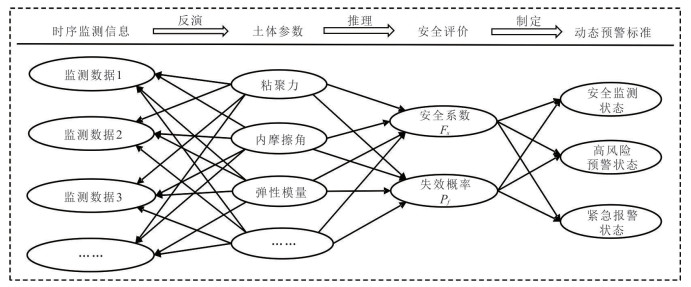
图 2 融合多点时序监测信息的贝叶斯网络
Fig. 2. A Bayesian network integrating multi-point time-series monitoring information
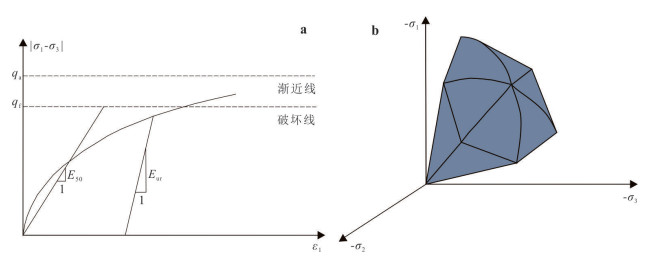
图 3 土体硬化本构模型(姜焱培和周晓敏, 2021)
a.标准排水三轴试验主加载下双曲线应力-应变关系;b.主应力空间屈服面
Fig. 3. Soil hardening constitutive model (Jiang and Zhou, 2021)
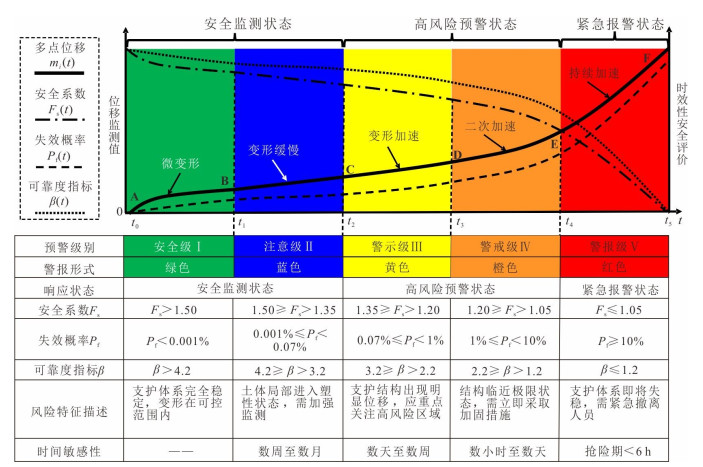
图 4 船坞工程安全状态预警标准
图中各预警等级的限值以软土地区Ⅰ级船坞工程进行设定,在推广应用中,应结合具体工程安全等级、地质条件和施工要求等,重新设定合理的临界参数.位移监测曲线遵循典型滑坡蠕变发展五阶段(Zheng et al.,2025),此处仅用于展示监测点位移和安全评价间的对应关系,具体变形趋势和各预警级别对应的变形范围、持续时间应根据实际情况确定
Fig. 4. Standard for safety status warning of the dock engineering
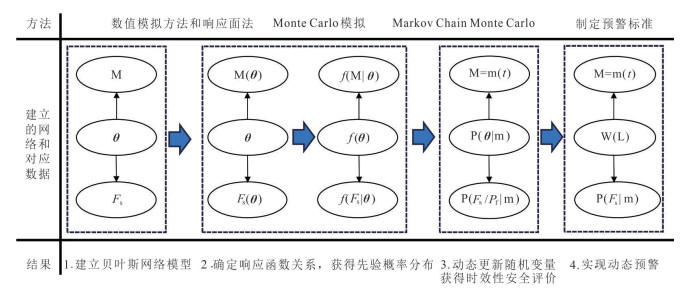
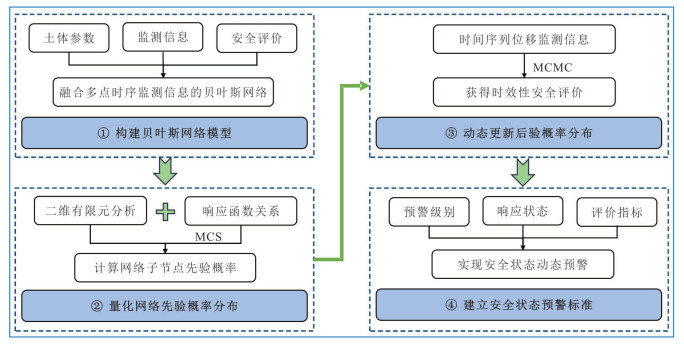
图 5 融合多点时序监测信息的安全状态动态预警流程
M=监测信息;θ=随机变量(土体参数);Fs=安全系数;m(t)=时序监测信息;M(θ)=M关于θ的响应函数;Fs(θ)=Fs关于θ的响应函数;f(θ)=θ的先验概率;f(M|θ)=M的先验条件概率;f(Fs|θ)=Fs的先验条件概率;P(θ|m)=在m(t)的条件下θ的后验概率;P(Fs/ Pf|m)=在m(t)的条件下Fs或Pf的后验概率;W(L)=基于预警标准进行安全状态动态预警(预警级别Level:安全级Ⅰ,注意级Ⅱ,警示级Ⅲ,警戒级Ⅳ,警报级Ⅴ)
Fig. 5. Procedure for dynamic safety status early warning integrating multi-point time-series monitoring information
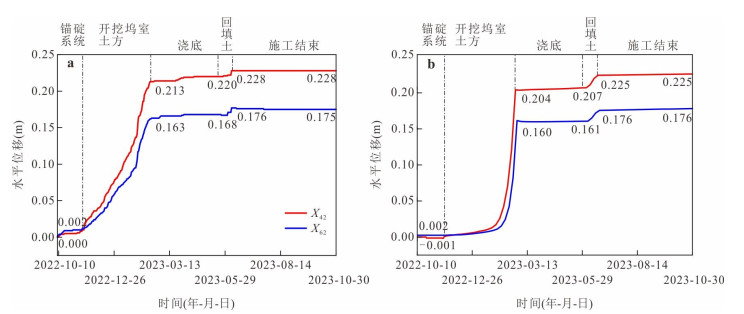
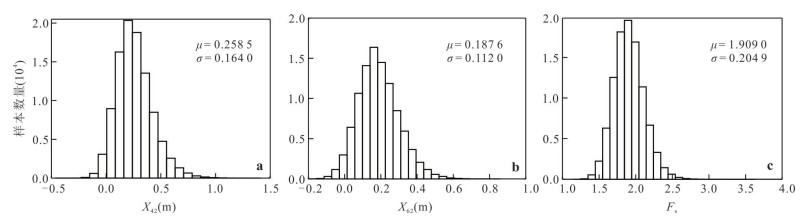
图 7 X42和X62监测点水平位移时变曲线
a.实际监测;b.数值模拟
Fig. 7. Horizontal displacement time-varying curves of X42 and X62
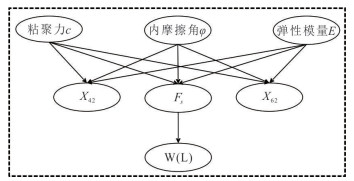
图 9 “监测信息-土体参数-安全评价”贝叶斯网络
Fig. 9. A Bayesian network of "monitoring information-soil parameters-safety factor"
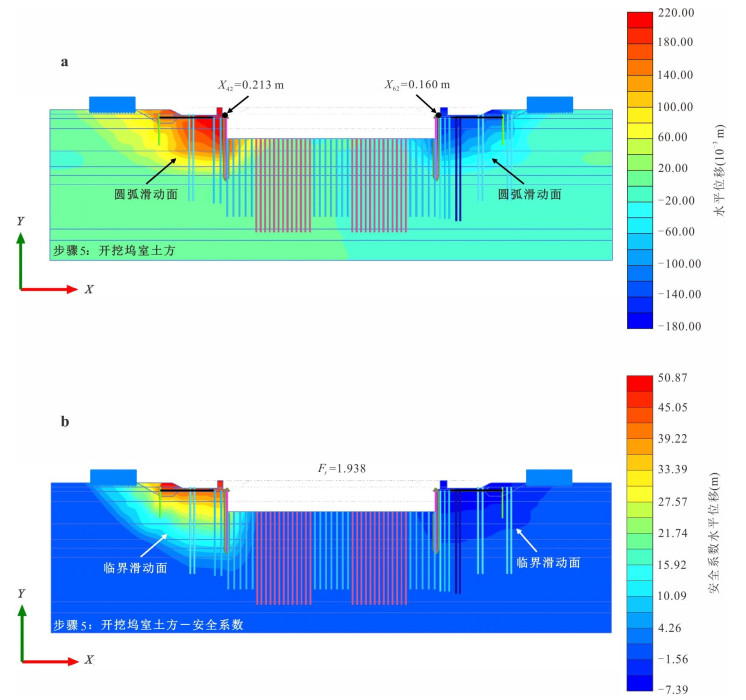
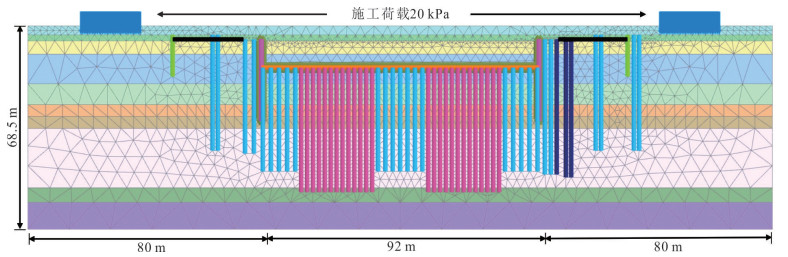
图 10 船坞工程二维有限元数值模型
a.水平位移云图;b.安全系数水平位移云图(强度折减计算)
Fig. 10. 2D finite element model for the dock engineering
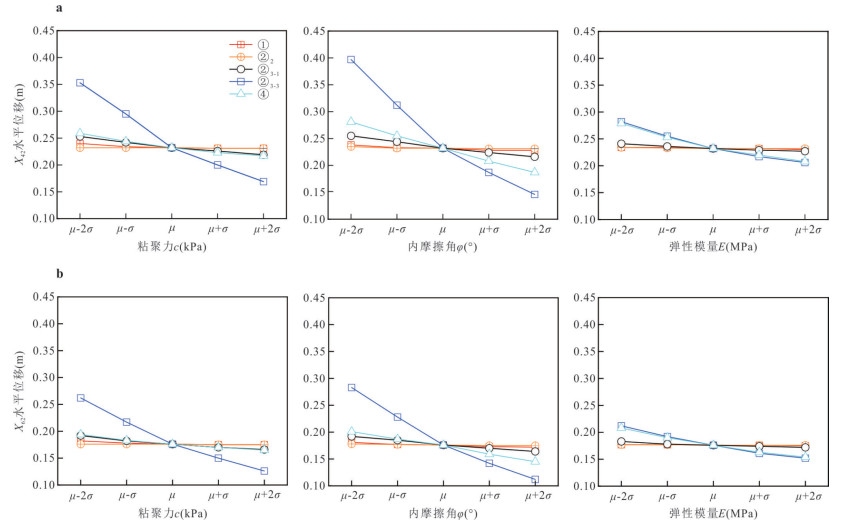
图 11 监测信息对各土层随机变量的敏感性分析
a. X42水平位移;b. X62水平位移
Fig. 11. Sensitivity of monitoring information to random variables in soil layers
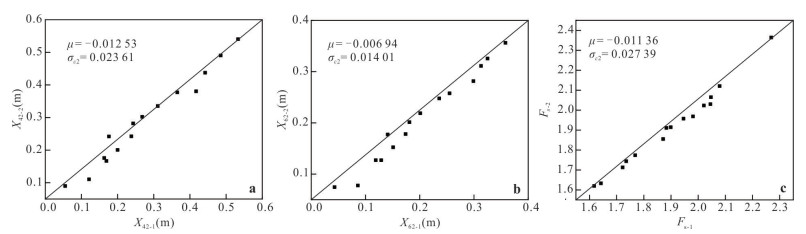
图 12 响应面法与数值模拟结果对比
a.X42;b.X62;c.Fs. 响应面结果:X42-1、X62-1和Fs-1;数值模拟结果:X42-2、X62-2和Fs-2
Fig. 12. Comparison of response function and finite element method results
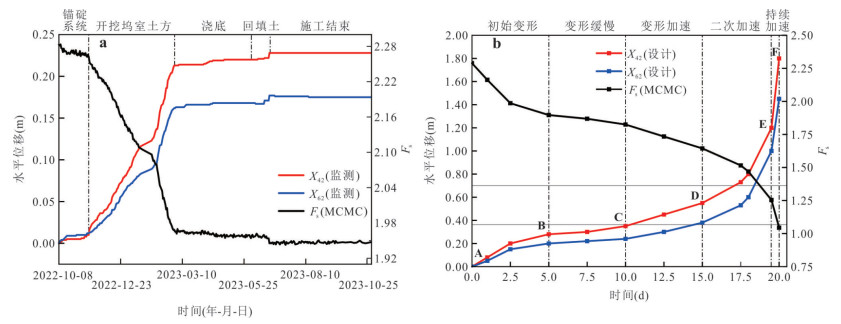
图 15 “安全系数-水平位移”时变曲线
a.实际船坞工程;b.设计极端工况
Fig. 15. Time-varying curves of "safety factor-horizontal displacement"
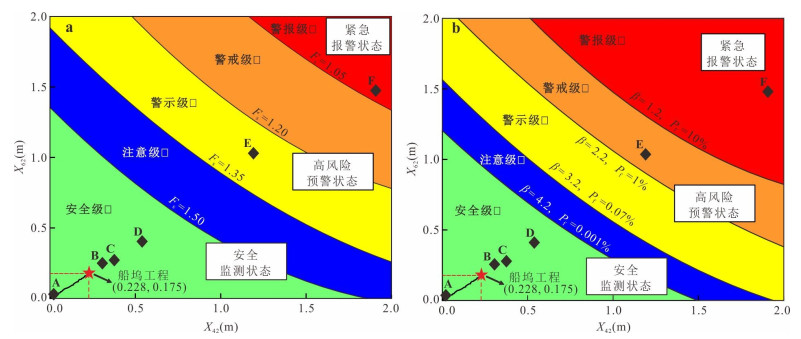
图 16 二维安全状态动态预警平面图
a.安全系数Fs预警;b.失效概率Pf(可靠度指标β)预警.二维预警平面图是由2点位移监测信息和预警标准组成,在推广应用中,根据工程需求可以选取更多监测点,绘制2~3维甚至更高维的动态预警空间
Fig. 16. 2D dynamic early warning plan of safety status
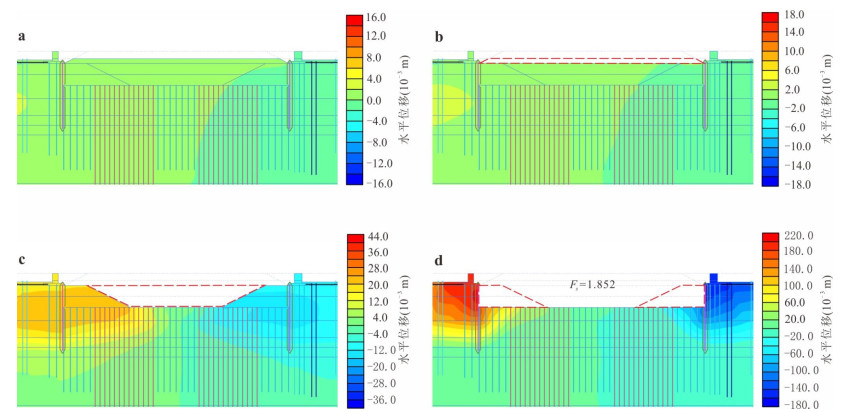
图 17 “盆式开挖”关键步骤水平位移云图
a.安装锚碇体;b.开挖表层土体;c.先开挖中部土体;d.后开挖两侧土体
Fig. 17. Horizontal displacement cloud map of key steps in "basin excavation"
表 1 土层力学参数
Table 1. Mechanical parameters of soil layers
土层 重度γ
(kN/m3)平均厚度
(m)粘聚力c
(kPa)内摩擦角φ
(°)压缩模量Es1-2
(MPa)渗透系数K
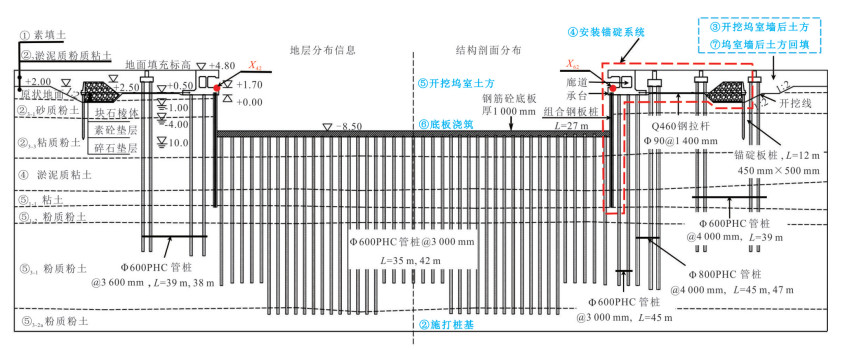
(m/s)①杂填土 18.5 3.0 10.0 10.0 5.0 5.00×10⁻⁶ ②2淤泥质粉质粘土 18.0 2.0 13.0 20.5 5.3 2.00×10⁻⁷ ②3-1砂质粉土 18.7 4.5 8.0 27.0 9.2 2.80×10⁻⁵ ②3-3粘质粉土 18.0 10.0 10.0 23.5 7.6 1.15×10⁻⁵ ④淤泥质粘土 16.9 7.0 12.0 11.0 2.4 3.51×10⁻⁸ ⑤1-1粘土 17.3 4.0 14.0 13.0 2.7 2.80×10⁻⁸ ⑤1-2粉质粘土 17.8 4.0 16.0 16.0 3.4 4.42×10⁻⁸ ⑤3-1粉质粘土 18.2 20.0 20.0 20.5 4.5 5.91×10⁻⁷ ⑤3-2a粉质粘土 18.2 5.0 21.0 22.5 5.0 5.91×10⁻⁷  下载: 导出CSV
表 2 船坞施工步骤与地下水位变化表
Table 2. Construction steps of the dock and changes in groundwater level
施工步骤 时间 工况 地下水位(m) 坞室外 坞室内 1 - 初始应力场建立 -1.0 -1.0 2 - 施打桩基(位移清零) -1.0 -1.0 3 - 开挖坞室墙后土方 -4.0 -4.0 4 2022-10~2022-11 安装锚碇系统 -4.0 -4.0 5 2022-11~2023-02 开挖坞室土方 -4.0 -10.0 6 2023-02~2023-04 坞室内底板施工 -4.0 -10.0 7 2023-05~2023-06 坞室墙后土方回填 -1.0 -9.5 8 2023-06~2023-10 施工结束 -1.0 -9.5
下载: 导出CSV
表 3 船坞各土层HS-Small模型主要参数取值表
Table 3. Parameters of HS-Small model for each soil layer in the dock
土层号 $ {E}_{\mathrm{o}\mathrm{e}\mathrm{d}}^{\mathrm{r}\mathrm{e}\mathrm{f}} $
(MPa)$ {E}_{50}^{\mathrm{r}\mathrm{e}\mathrm{f}} $
(MPa)$ {E}_{\mathrm{u}\mathrm{r}}^{\mathrm{r}\mathrm{e}\mathrm{f}} $
(MPa)$ {G}_{0}^{\mathrm{r}\mathrm{e}\mathrm{f}} $
(MPa)pref
(kPa)ψ
(°)γ0.7
(10-4)vur m Rf ① 5.0 5.0 15.0 60.0 100 0 2.0 0.2 0.8 0.9 ②2 4.8 5.7 28.5 85.5 100 0 2.0 0.2 0.8 0.9 ②3-1 8.2 9.9 49.5 148.0 100 0 2.0 0.2 0.8 0.9 ②3-3 6.8 8.2 40.8 122.0 100 0 2.0 0.2 0.8 0.9 ④ 2.1 2.6 17.1 51.2 100 0 2.0 0.2 0.8 0.9 ⑤1-1 2.5 3.0 14.7 44.2 100 0 2.0 0.2 0.8 0.9 ⑤1-2 3.1 3.7 18.3 54.9 100 0 2.0 0.2 0.8 0.9 ⑤3-1 4.0 4.8 24.1 72.3 100 0 2.0 0.2 0.8 0.9 ⑤3-2a 4.5 5.4 26.8 80.4 100 0 2.0 0.2 0.8 0.9
下载: 导出CSV
表 4 船坞结构参数
Table 4. Parameters of the dock structures
结构 单元 材料类型 重度
(kN/m3)弹性模量
(MPa)泊松比 截面积
(m2/m)惯性矩
(m4/m)PHC管桩 Embedded桩 弹性 20.0 3.80×10⁴ 0.2 0.17(φ600) 0.005 3(φ600) 0.24(φ800) 0.015(φ800) 混凝土底板 板 弹性 25.0 2.55×10⁴ 0.2 1.00 0.083 混凝土廊道 土体 线弹性 25.0 3.15×10⁴ 0.2 - - 块石棱体 土体 线弹性 25.0 5.00×10² 0.2 - - 拉杆 锚杆 弹性 - 2.05×10⁵ 0.2 0.006 4 - 锚碇板桩 Embedded桩 弹性 20.0 2.05×10⁵ 0.2 0.25 0.005 2 热轧箱型组合钢板桩 板 弹性 20.0 2.05×10⁵ 0.2 0.35 0.003 5 注:“()”内为不同直径类型的PHC管桩.
下载: 导出CSV
表 5 随机变量及其分布特征
Table 5. Random variables and their distribution characteristics
随机变量 分布类型 以②3-3土层为代表 均值
μ标准差
σ变异系数
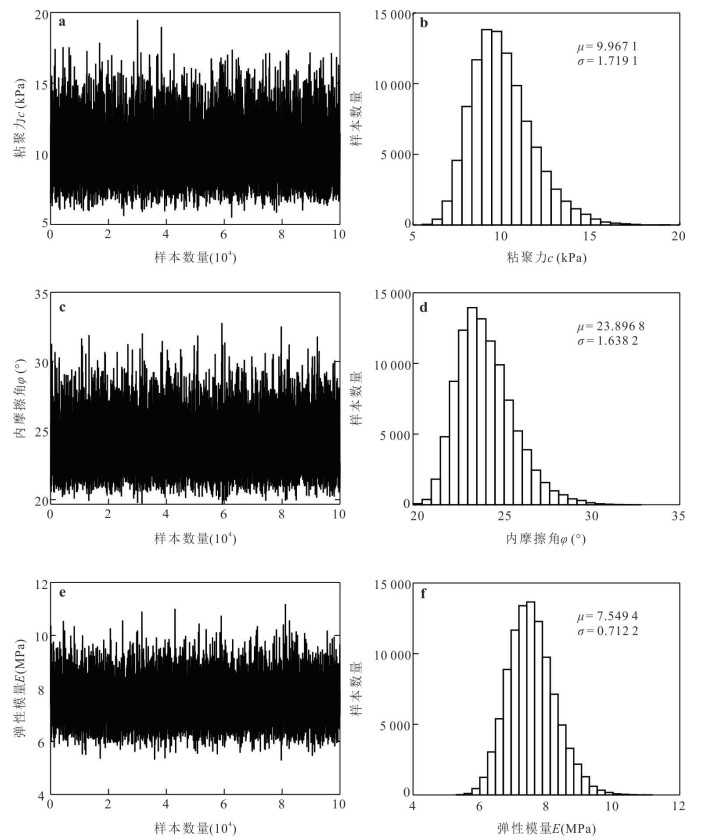
covc(kPa) 对数正态分布 10.0 2.00 0.2 φ(°) 对数正态分布 23.5 2.35 0.1 E (MPa) 对数正态分布 7.56 0.756 0.1
下载: 导出CSV
表 6 各关键步骤水平位移模拟值与实测值对比
Table 6. Comparison of simulated and measured horizontal displacement values for each key step
施工步骤 工况 X42(m) X62(m) 实际监测 数值模拟 实际监测 数值模拟 4 安装锚定系统 0.000 -0.001 0.002 0.003 5 开挖坞室土方 0.213 0.204 0.163 0.160 6 坞室内底板施工 0.220 0.207 0.168 0.161 7 坞室墙后土方回填 0.228 0.225 0.176 0.176
下载: 导出CSV
表 7 各土层参数对X42水平位移的影响权重
Table 7. The influence weight of soil layer parameters on X42 horizontal displacement
土层 参数 敏感性系数 变异系数cov 影响权重 权重占比 ②3-3 c -0.004 63 0.2 0.009 26 33.5% φ -0.062 70 0.1 0.006 27 22.7% E -0.019 00 0.1 0.001 90 6.9% ④ c -0.010 50 0.2 0.002 10 7.6% φ -0.023 50 0.1 0.002 35 8.5% E -0.017 50 0.1 0.001 75 6.3% ①+②2+②3-1 - - - 0.003 98 14.4% 总计 - - - 0.027 61 100%
下载: 导出CSV
表 8 响应面系数
Table 8. Coefficients for response surfaces
响应面系数 X42 X62 Fs $ {a}_{31} $ -0.000 43 -0.000 20 0.000 41 $ {a}_{32} $ -0.000 52 -0.000 13 5.188 84E-06 $ {a}_{33} $ -0.003 13 -0.000 79 7.718 31E-17 $ {b}_{21} $ 0.017 85 0.008 65 -0.011 79 $ {b}_{22} $ 0.043 42 0.012 39 5.743 94E-05 $ {b}_{23} $ 0.082 44 0.024 15 0.000 67 $ {c}_{11} $ -0.259 21 -0.138 59 0.148 41 $ {c}_{12} $ -1.218 21 -0.403 67 0.062 52 $ {c}_{13} $ -0.763 28 -0.272 98 -0.010 12 $ {d}_{0} $ 15.308 28 6.209 44 -0.311 32 $ {\sigma }_{\varepsilon 2} $ 0.023 61 0.014 01 0.027 39 $ {R}^{2} $ 0.971 40 0.978 80 0.987 10
下载: 导出CSV
表 9 随机变量先验分布与后验分布比较
Table 9. Comparison of prior and posterior distributions of random variables
随机变量 μ σ cov 先验分布 后验分布 先验分布 后验分布 先验分布 后验分布 c(kPa) 10.00 9.967 2.000 1.719 0.2 0.172 φ(°) 23.50 23.897 2.350 1.638 0.1 0.068 E(MPa) 7.56 7.549 0.756 0.712 0.1 0.094
下载: 导出CSV
表 10 船坞超大变形极端工况设计与安全评价
Table 10. Design and safety evaluation of extreme working conditions for super large deformation of dock
时间(d) 变形发展 抗剪强度衰减 安全评价 X42(m) X62(m) c(kPa) φ(°) E(MPa) Fs Pf β 0 0.00 0.00 12.3 26.7 8.22 2.29 0 - 1.0 0.08 0.05 11.5 25.8 7.96 2.16 0 - 2.5 0.20 0.15 10.2 24.3 7.59 1.99 0 - 5.0 0.28 0.20 9.72 23.3 7.48 1.90 0 - 7.5 0.30 0.22 9.59 23.1 7.43 1.87 0 - 10.0 0.35 0.24 9.40 22.6 7.39 1.82 0 - 12.5 0.45 0.30 9.07 21.5 7.33 1.73 0 - 15.0 0.55 0.38 8.75 20.5 7.24 1.64 0 - 17.5 0.73 0.53 8.15 19.0 7.10 1.52 6.0×10⁻⁵ 3.85 18.0 0.80 0.60 7.87 18.5 7.01 1.47 2.3×10⁻⁴ 3.50 19.5 1.20 1.00 6.13 16.6 6.42 1.25 3.6×10⁻² 1.80 20.0 1.80 1.45 4.81 14.6 5.93 1.04 5.0×10⁻¹ 2.5×10⁻⁵
下载: 导出CSV
表 11 “一步开挖”与“盆式开挖”模拟结果误差对比
Table 11. Comparison of simulated result errors between "one-step excavation" and "basin excavation"
工况 监测点/指标 数值模拟 误差 一步开挖 盆式开挖 绝对误差 相对误差 最危险工况(m)(坞室土体完全开挖,此时主动土压力最大) X42水平位移 0.204 0.199 0.005 2.5% X62水平位移 0.160 0.154 0.006 3.7% 安全系数Fs 1.938 1.852 0.086 4.4%
下载: 导出CSV
-
Benz, T., 2006. Small Strain Stiffness of Soils and Its Numerical Consequences (Dissertation). University of Stuttgart, Stuttgart. Biot, M. A., 1941. General Theory of Three-Dimensional Consolidation. Journal of Applied Physics, 12(2): 155-164. https://doi.org/10.1063/1.1712886 Cao, P., Tang, H. M., Wang, M., et al., 2025. Exploring the Failure Mechanism of the Baige Landslide via Field Observations and Physical Model Tests. Journal of Earth Science, 36(4): 1682-1699. https://doi.org/10.1007/s12583-025-0267-5 Fan, H. Y., Li, L. P., Zhou, S., et al., 2025. Prediction and Risk Assessment of Lateral Collapse in Deep Foundation Pits Using Machine Learning. Automation in Construction, 171: 106011. https://doi.org/10.1016/j.autcon.2025.106011 Feng, S., Liu, Y. C., 2022. Deformation Analysis of Ultra-Deep Diaphragm Wall in Soft Soil Area during Construction. Hans Journal of Civil Engineering, 11(1): 71-78 (in Chinese with English abstract). doi: 10.12677/HJCE.2022.111009 Gao, D. X., Li, K., Cai, Y. C., et al., 2024. Landslide Displacement Prediction Based on Time Series and PSO-BP Model in Three Georges Reservoir, China. Journal of Earth Science, 35(3): 1079-1082. https://doi.org/10.1007/s12583-021-1575-z Gelman, A., Rubin, D. B., 1992. Inference from Iterative Simulation Using Multiple Sequences. Statistical Science, 7(4): 457-472. Guo, Y. H., Ren, X. P., Liu, S. Q., et al., 2025. Dvelopment and Application of Similar Material for Physical Model Test of an Ultradeep Foundation Pit in Round Gravel Strata. Scientific Reports, 15: 16515. https://doi.org/10.1038/s41598-025-99344-7 Hardin, B. O., Drnevich, V. P., 1972. Shear Modulus and Damping in Soils: Design Equations and Curves. Journal of the Soil Mechanics and Foundations Division, 98(7): 667-692. https://doi.org/10.1061/jsfeaq.0001760 He, J. T., Zhang, J., Huang, H. W., et al., 2012. Back Analysis of Displacements of Excavation Based on Multiple Response Surface Method. Rock and Soil Mechanics, 33(12): 3810-3817 (in Chinese with English abstract). Jiang, Y. P., Zhou, X. M., 2021. Displacement Response of Large-Diameter Single-Pile Offshore Wind Turbine Structure Based on Hardening Soil Model with Small Strain Stiffness. Acta Energiae Solaris Sinica, 42(4): 430-437 (in Chinese with English abstract). Li, S. M., Hong, C. Y., Ji, F. L., et al., 2023. Study on Machine Vision Monitoring and Deformation Prediction of Deep Foundation Pit. Chinese Journal of Underground Space and Engineering, 19(3): 992-1000 (in Chinese with English abstract). Li, X. Y., Zhang, L. M., Jiang, S. H., et al., 2016. Assessment of Slope Stability in the Monitoring Parameter Space. Journal of Geotechnical and Geoenvironmental Engineering, 142(7): 04016029. https://doi.org/10.1061/(asce)gt.1943-5606.0001490 Lin, D., Zheng, J. J., Xue, P. P., et al., 2024. Probabilistic Method for Displacement back Analysis of Deep Excavations in Soft Soil Based on Bayesian Method. Journal of Civil and Environmental Engineering, 46(3): 52-60 (in Chinese with English abstract). Liu, Z. B., Liu, F. J., Wang, Y. C., et al., 2023. Prediction of Retaining Structure Deformation of Ultra-Deep Foundation Pit by Empirical Mode Decomposition with Recurrent Neural Networks. Environmental Earth Sciences, 82(23): 553. https://doi.org/10.1007/s12665-023-11214-5 Lü, C. C., Li, Z. L., Li, D. Q., 2018. Problems of Applying Seepage Pressure in Coupling Analysis of Seepage and Stress Using ABAQUS. Journal of Yangtze River Scientific Research Institute, 35(5): 68-72 (in Chinese with English abstract). Luo, F., Luo, Q., Jiang, L. W., et al., 2015. Influence of Variation Levels of Soil Strength Indexes on the Value of Slope Stability Safety Factor. Journal of Civil, Architectural & Environmental Engineering, 37(4): 77-83 (in Chinese with English abstract). Mahadevan, S., Zhang, R. X., Smith, N., 2001. Bayesian Networks for System Reliability Reassessment. Structural Safety, 23(3): 231-251. https://doi.org/10.1016/S0167-4730(01)00017-0 Metropolis, N., Rosenbluth, A. W., Rosenbluth, M. N., et al., 1953. Equation of State Calculations by Fast Computing Machines. The Journal of Chemical Physics, 21(6): 1087-1092. https://doi.org/10.1063/1.1699114 Peng, M., Li, X. Y., Li, D. Q., et al., 2014. Slope Safety Evaluation by Integrating Multi-Source Monitoring Information. Structural Safety, 49: 65-74. https://doi.org/10.1016/j.strusafe.2013.08.007 Phoon, K. K., Kulhawy, F. H., 1999. Characterization of Geotechnical Variability. Canadian Geotechnical Journal, 36(4): 612-624. https://doi.org/10.1139/t99-038 Qin, Z. L., Li, J. P., Yao, J. P., et al., 2022. Risk Assessment Index and Comprehensive Evaluation Method for Construction of Super Large Excavation in Soft Soils. Structural Engineers, 38(4): 176-185 (in Chinese with English abstract). Qiu, Y., Wang, J. W., Zhang, C., et al., 2024. Numerical Simulation Study on the Impact of Excavation on Existing Subway Stations Based on BIM-FEM Framework. Buildings, 14(5): 1444. https://doi.org/10.3390/buildings14051444 Reichstein, M., Camps-Valls, G., Stevens, B., et al., 2019. Deep Learning and Process Understanding for Data-Driven Earth System Science. Nature, 566(7743): 195-204. https://doi.org/10.1038/s41586-019-0912-1 Tian, J. C., Li, Y. L., Luo, Y. H., et al., 2025. Multisource Information Fusion Model for Deformation Safety Monitoring of Earth and Rock Dams Based on Deep Graph Feature Fusion. Structural Health Monitoring, 24(2): 925-940. https://doi.org/10.1177/14759217241244549 Wang, H. B., Yang, H. X., Zhang, H., 2010. Monitoring and Advance Warning in Deep Foundation Pit Project. Architecture Technology, 41(3): 257-260 (in Chinese with English abstract). Wang, L. F., Liu, X. L., Xu, K., et al., 2024. Bayesian-MCMC(Markov Chain Monte Carlo) Based Three-Dimensional Geological Model Optimization by Data and Knowledge Fusion. Earth Science, 49(8): 3056-3070 (in Chinese with English abstract). Wang, S. H., Han, B. W., Jiang, J. H., et al., 2025. Machine Learning and FEM-Driven Analysis and Optimization of Deep Foundation Pits in Coastal Area: A Case Study in Fuzhou Soft Ground. Underground Space, 22: 55-76. https://doi.org/10.1016/j.undsp.2024.11.001 Wang, W. D., Li, Q., Xu, Z. H., et al., 2023. Study and Application of Parameters of Small Strain Constitutive Model for Soft Clay. Chinese Journal of Underground Space and Engineering, 19(3): 844-855 (in Chinese with English abstract). Wu, J. J., Peng, L. M., Li, J. W., et al., 2021. Rapid Safety Monitoring and Analysis of Foundation Pit Construction Using Unmanned Aerial Vehicle Images. Automation in Construction, 128: 103706. https://doi.org/10.1016/j.autcon.2021.103706 Wu, X. G., Wang, L., Feng, Z. B., et al., 2022. Analysis on the Reliability of Metro Deep Foundation Pit System under Multiple Failure Modes. Modern Tunnelling Technology, 59(4): 167-175 (in Chinese with English abstract). Xu, B., Rong, Z., Pang, R., et al., 2024. A Novel Method for Settlement Imputation and Monitoring of Earth-Rockfill Dams Subjected to Large-Scale Missing Data. Advanced Engineering Informatics, 62: 102642. https://doi.org/10.1016/j.aei.2024.102642 Yang, D. X., Zhao, K., Zeng, P., et al., 2019. Numerical Simulation of Unknown Wave Velocity Acoustic Emission Localization Based on Particle Swarm Optimization Algorithm. Rock and Soil Mechanics, 40(S1): 494-502 (in Chinese with English abstract). Yang, J., Wang, J., Lyu, Z. B., et al., 2022. Multi-Source Information Fusion—Based Study on Dynamic Safety Evaluation of Landslide in Plateau Reservoir Area. Water Resources and Hydropower Engineering, 53(4): 165-171 (in Chinese with English abstract). Yang, Q. N., 2010. Analysis of Deformation Characteristics of Deep Foundation Pit in Wuhan Subway Station (Dissertation). Huazhong University of Science and Technology, Wuhan (in Chinese with English abstract). Yu, J. C., Jin, A. Y., Pan, J. W., et al., 2022. GA-BP Artificial Neural Networks for Predicting the Seismic Response of Arch Dams. Journal of Tsinghua University (Science and Technology), 62(8): 1321-1329 (in Chinese with English abstract). Zhang, W., Li, D. Q., Cao, Z. J., 2016. Comparative Study of Bayesian Methods for back Analysis of Deep Excavation. Engineering Journal of Wuhan University, 49(6): 806-811 (in Chinese with English abstract). Zhang, W. G., Gu, X., Liu, H. L., et al., 2022. Probabilistic back Analysis of Soil Parameters and Displacement Prediction of Unsaturated Slopes Using Bayesian Updating. Rock and Soil Mechanics, 43(4): 1112-1122 (in Chinese with English abstract). Zhao, J., Jiang, L. W., Luo, Q., et al., 2018. Correlative Analysis between Variation Level of Soil Strength Parameters and Influencing Factors. Journal of Engineering Geology, 26(3): 592-601 (in Chinese with English abstract). Zheng, Z., Li, Y. L., Zhang, Y., et al., 2025. Prediction and Pre-Warning of Step-Like Landslide Displacement Based on Deep Learning Coupled with ICEEMDAN. Measurement, 246: 116585. https://doi.org/10.1016/j.measurement.2024.116585 Zhou, X. P., Xu, Q., Zhao, K. Y., et al., 2020. Study on Meso-Parameter Calibration Method of Discrete Element Based on Neural Network—A Case Study of Heifangtai Loess Landslide in Gansu Province. Chinese Journal of Rock Mechanics and Engineering, 39(S1): 2837-2847 (in Chinese with English abstract). Zhu, Y., Gu, Q. Y., Jiang, J., et al., 2016. Reliability Analysis for Overall Stability of Large-Span Double-Row Steel Sheet-Piled Dock Cofferdam Based on Bayesian Method. Rock and Soil Mechanics, 37(S1): 609-615 (in Chinese with English abstract). 冯师, 刘羿辰, 2022. 软土地区超深地连墙施工全过程变形分析. 土木工程, 11(1): 71-78. 何军涛, 张洁, 黄宏伟, 等, 2012. 基于多重响应面法的基坑位移反分析. 岩土力学, 33(12): 3810-3817. 姜焱培, 周晓敏, 2021. 基于小应变硬化土体模型的大直径单桩海上风力机结构位移响应研究. 太阳能学报, 42(4): 430-437. 李尚明, 洪成雨, 姬凤玲, 等, 2023. 深基坑的机器视觉监测与变形预测研究. 地下空间与工程学报, 19(3): 992-1000. 林东, 郑俊杰, 薛鹏鹏, 等, 2024. 基于贝叶斯方法的软土深基坑不确定性位移反演分析. 土木与环境工程学报(中英文), 46(3): 52-60. 骆飞, 罗强, 蒋良潍, 等, 2015. 土体抗剪强度指标变异水平对边坡稳定安全系数取值的影响. 土木建筑与环境工程, 37(4): 77-83. 吕从聪, 李宗利, 李东奇, 2018. ABAQUS渗流应力耦合分析中渗透荷载施加问题探讨. 长江科学院院报, 35(5): 68-72. 覃子玲, 李镜培, 姚建平, 等, 2022. 超大面积软土基坑施工风险评价指标与综合评价方法. 结构工程师, 38(4): 176-185. 王海飙, 杨海旭, 张华, 2010. 深基坑工程施工安全监测与预警. 建筑技术, 41(3): 257-260. 王丽芳, 刘肖莉, 徐坤, 等, 2024. 数据和知识融合的Bayesian-MCMC三维地质建模. 地球科学, 49(8): 3056-3070. doi: 10.3799/dqkx.2023.069 王卫东, 李青, 徐中华, 等, 2023. 软黏土小应变本构模型参数研究与应用. 地下空间与工程学报, 19(3): 844-855. 吴贤国, 王雷, 冯宗宝, 等, 2022. 多失效模式下的地铁深基坑系统可靠度分析. 现代隧道技术, 59(4): 167-175. 杨道学, 赵奎, 曾鹏, 等, 2019. 基于粒子群优化算法的未知波速声发射定位数值模拟. 岩土力学, 40(增刊1): 494-502. 杨军, 旺加, 吕梽槟, 等, 2022. 基于多源信息融合的高原库区滑坡动态安全评价研究. 水利水电技术(中英文), 53(4): 165-171. 杨庆年, 2010. 武汉地铁车站深基坑变形特性分析(博士学位论文). 武汉: 华中科技大学. 于京池, 金爱云, 潘坚文, 等, 2022. 基于GA-BP神经网络的拱坝地震易损性分析. 清华大学学报(自然科学版), 62(8): 1321-1329. 张湾, 李典庆, 曹子君, 2016. 基坑开挖参数反分析贝叶斯方法比较研究. 武汉大学学报(工学版), 49(6): 806-811. 仉文岗, 顾鑫, 刘汉龙, 等, 2022. 基于贝叶斯更新的非饱和土坡参数概率反演及变形预测. 岩土力学, 43(4): 1112-1122. 赵晶, 蒋良潍, 罗强, 等, 2018. 土体强度参数变异水平及影响因素关联分析. 工程地质学报, 26(3): 592-601. 周小棚, 许强, 赵宽耀, 等, 2020. 基于神经网络的离散元细观参数标定方法研究: 以甘肃黑方台黄土滑坡为例. 岩石力学与工程学报, 39(增刊1): 2837-2847. 朱艳, 顾倩燕, 江杰, 等, 2016. 基于贝叶斯方法的船坞双排钢板桩围堰整体稳定性可靠度分析. 岩土力学, 37(增刊1): 609-615. -

 点击查看大图
计量
- 文章访问数: 167
- HTML全文浏览量: 16
- PDF下载量: 35
- 被引次数: 0
