




Controlling Rainfall Infiltration in Slopes Using an Unsaturated Barrier Layer under Coarse-Grained Layer Pressurization
-
摘要: 传统土质边坡表面硬化防渗措施易因降雨入渗产生干缩开裂问题,威胁工程安全,采用非饱和阻隔层(capillary barrier layer,CBL)阻隔保护可提升工程的长期稳定性,但存在导水能力随长期降雨入渗而下降的现象.针对传统非饱和阻隔层中毛细阻滞能力随降雨入渗衰减的问题,本文从水-气耦合角度,提出了通过粗粒层增压以增强非饱和阻隔层阻隔降雨入渗的方法.采用系列物理模型试验,在气密封闭条件下,探讨不同降雨强度、CBL初始含水量和粗粒层增压值等条件对其阻隔降雨入渗的影响,主要取得以下认知:(1)当粗粒层注气增压(1~3 kPa)时,降雨全部从细粒层、过渡层与粗粒层界面排出,完全抑制降雨突破过渡层/粗粒层界面而进入粗粒层,显著提升非饱和阻隔层的阻隔效率.(2)二元结构最大导排能力随粗粒层增压值增加而增大,而随细粒层含水量增加而下降.(3)提出综合阻隔性能指数以量化注气条件下非饱和阻隔层对降雨入渗的阻隔效果.该研究成果开创性地利用土体气相作为阻隔层排水驱动力,可为边坡防护工程等领域提供科学依据.Abstract: Traditional surface hardening and impermeabilization measures for earthen slopes are prone to desiccation cracking due to rainfall infiltration, threatening engineering safety. The application of an capillary barrier layer (CBL) for protection can enhance the safety and stability of the project. However, its hydraulic conductivity decays with the long-term process of rainfall infiltration.To address the attenuation of capillary barrier strength in conventional unsaturated CBL during rainfall infiltration, this study proposes a method to enhance the infiltration resistance of the unsaturated barrier by pressurizing the coarse-grained layer from a coupled water-gas perspective. A series of physical model tests were conducted to investigate the effects of different rainfall intensities, initial CBL moisture contents, and coarse-grained layer pressurization levels on infiltration resistance. The main findings are as follows. (1) When the coarse-grained layer is pressurized (1-3 kPa), rainfall is entirely discharged along the interface between the fine-grained layer, the transition layer, and the coarse-grained layer, completely preventing rainfall breakthrough into the coarse-grained layer and significantly improving the barrier efficiency of the unsaturated CBL. (2) The steady-state lateral drainage rate of the binary structure increases with higher pressurization in the coarse-grained layer but decreases with increasing moisture content in the fine-grained layer. (3) A Comprehensive Barrier Efficacy Index (CBEI) is proposed to quantify the effectiveness of the unsaturated barrier under air injection conditions. This result innovatively establishes the soil gas phase as the drainage driving force in barrier layers, providing a scientific basis for slope protection engineering.
-
Key words:
- coupled water-gas /
- rainfall infiltration /
- barrier effect /
- slope /
- engineering geology
-
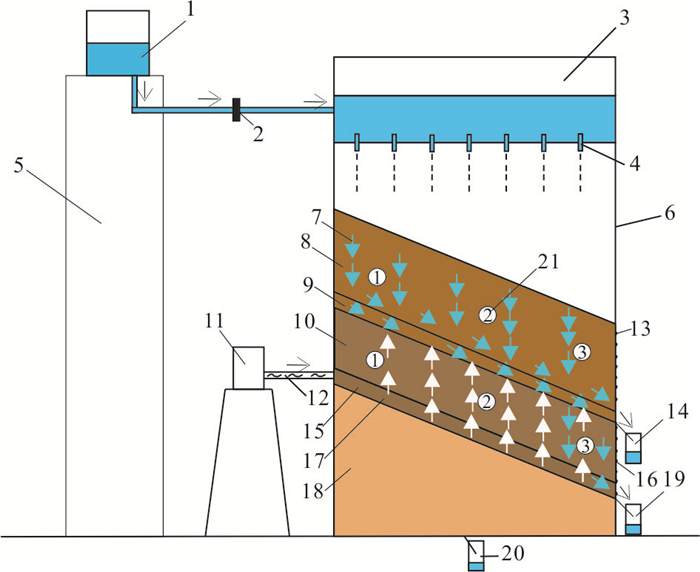
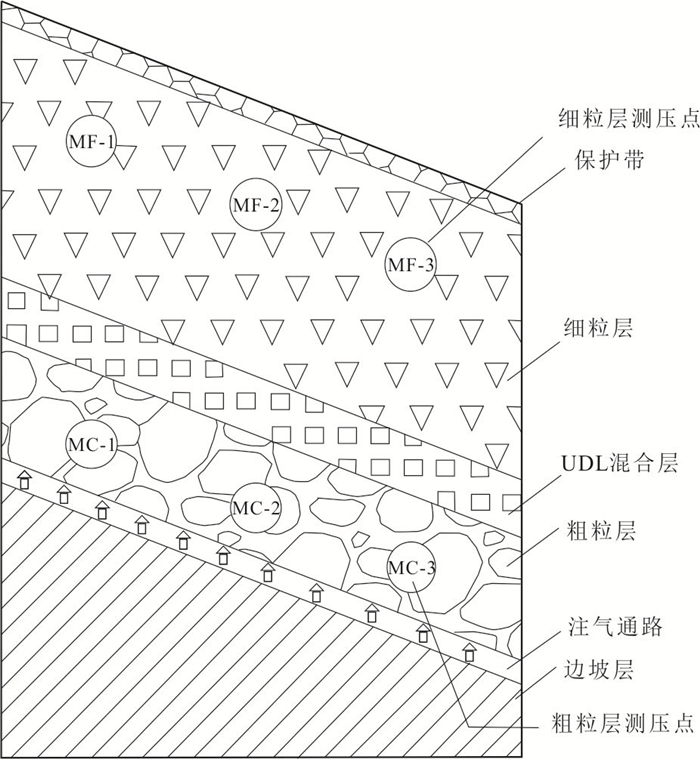
图 1 物理模型结构示意
1.供水系统;2.输水阀门;3.降雨模拟器;4.医用针头;5.供水支架;6.降雨支架;7.降雨运移路径;8.细粒层;9.混合层;10.粗粒层;11.双源稳压注气系统;12.注气通路;13.细粒层多孔排水板;14.细粒层/混合层排水搜集;15.粗粒层注气铜管网;16.粗粒层多孔排水板;17.增压气体运移路径;18.边坡层;19.粗粒层排水收集;20.边坡层排水收集;21.测压点
Fig. 1. Physical model of the CBL
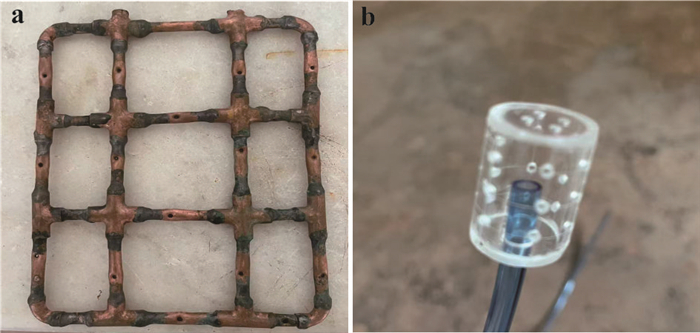
图 3 注压与测压单元
a. 粗粒层注气铜管网; b. 细/粗粒层测压玻璃腔
Fig. 3. Pressure injection and pressure measuring unit
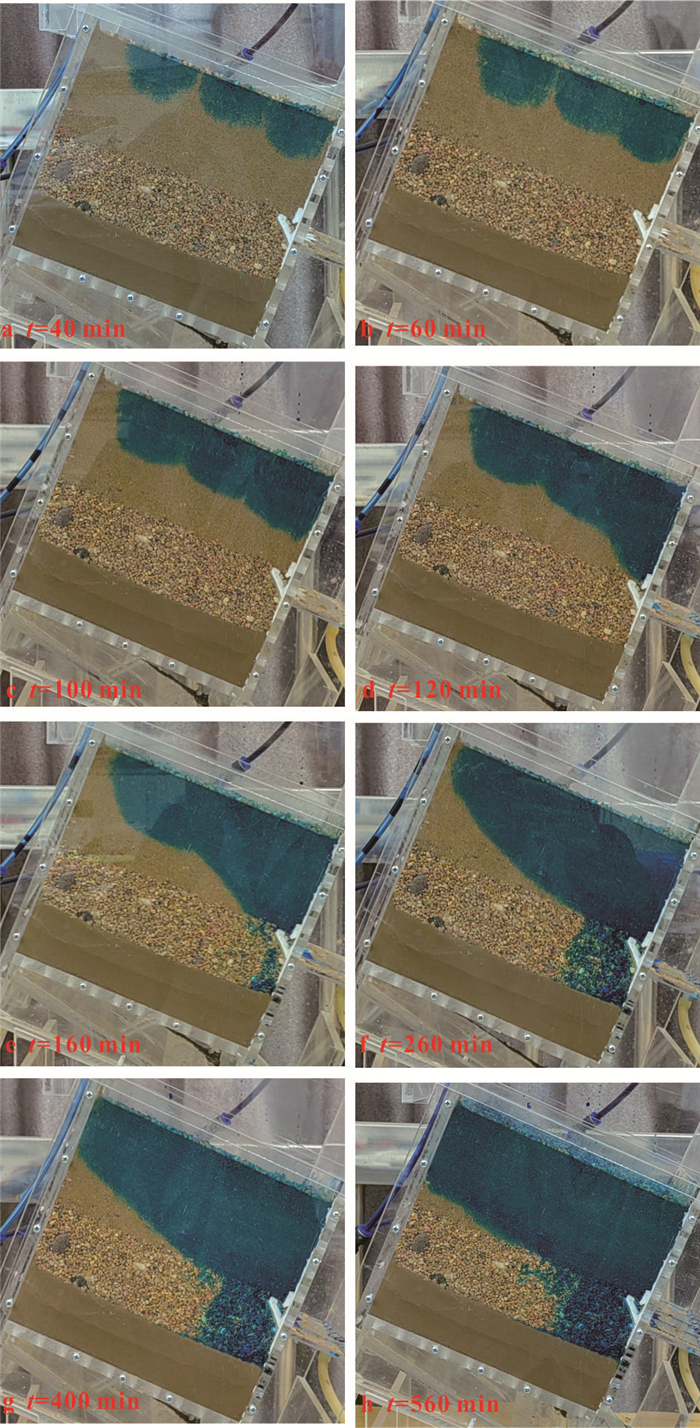
图 4 F0无粗粒层增压条件下二元结构降雨入渗示踪
Fig. 4. Tracking of rainfall infiltration in capillary barrier layer under F0 no pressurization condition in coarse-grained layer
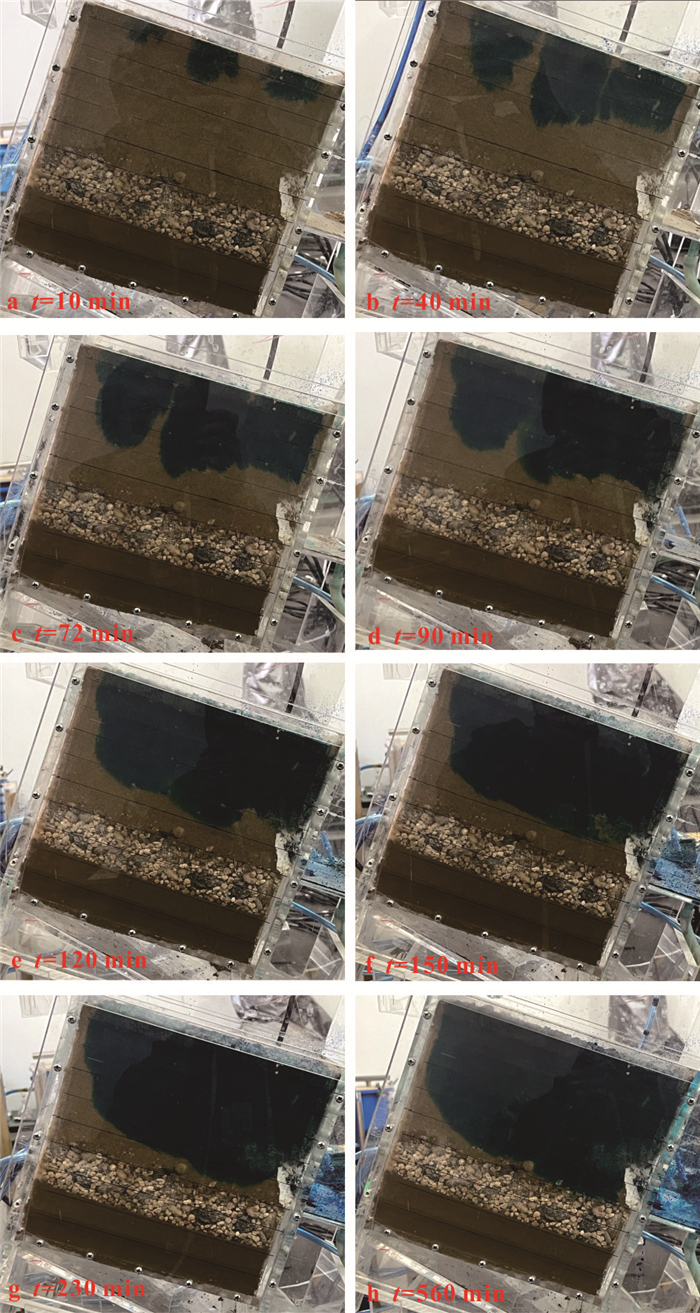
图 5 F1粗粒层增压条件下二元结构降雨入渗示踪
Fig. 5. Tracking of rainfall infiltration in capillary barrier layer under F1 pressurization condition in coarse-grained layer
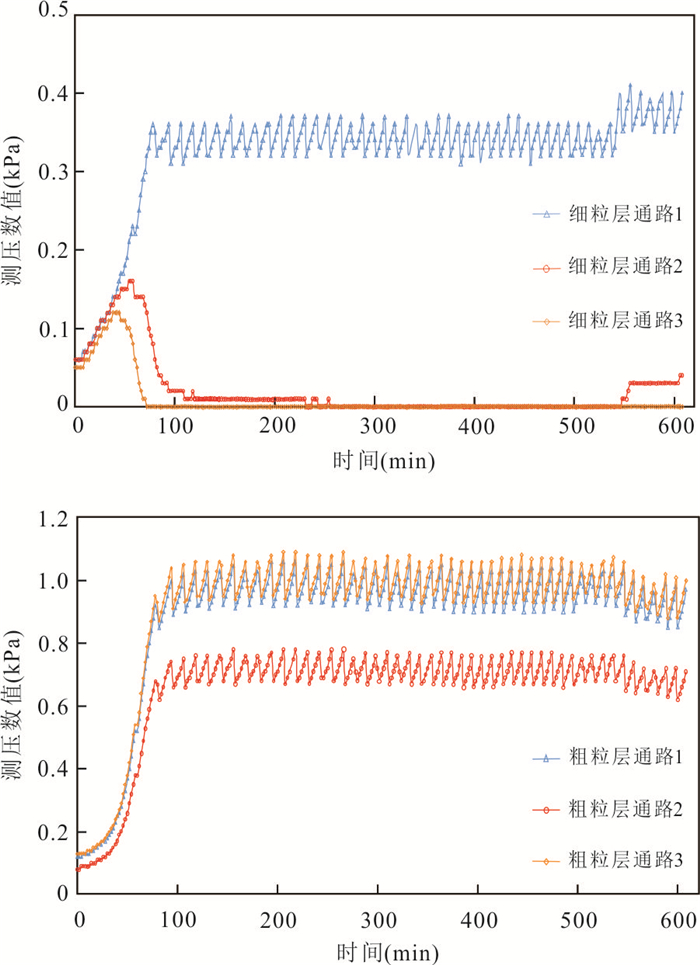
图 6 F1二元结构测压变化趋势
Fig. 6. Trend chart of pressure variation in capillary barrier layer for scheme F1
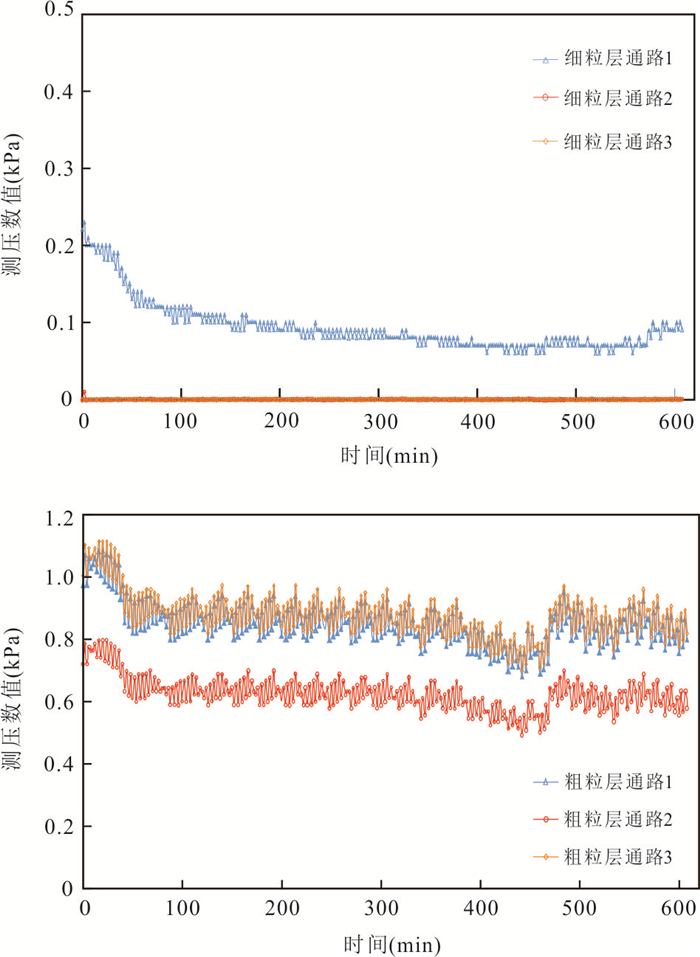
图 7 F3二元结构测压变化趋势
Fig. 7. Trend chart of pressure variation in capillary barrier layer for scheme F3
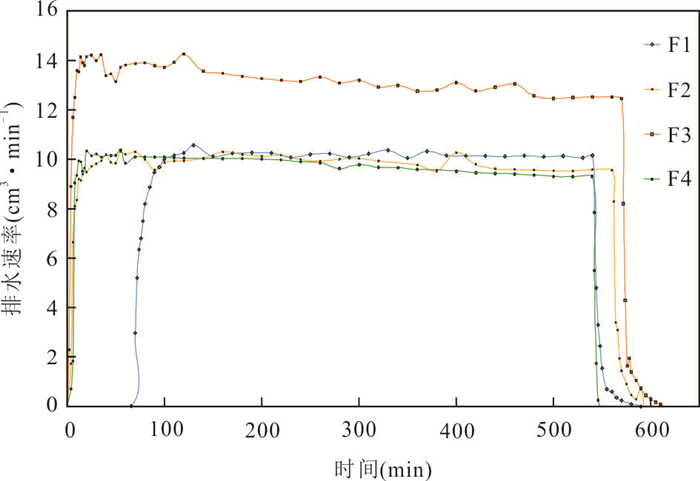
图 8 不同方案二元结构侧向排水速率趋势
Fig. 8. Lateral drainage rate trend chart of capillary barrier layer with different schemes
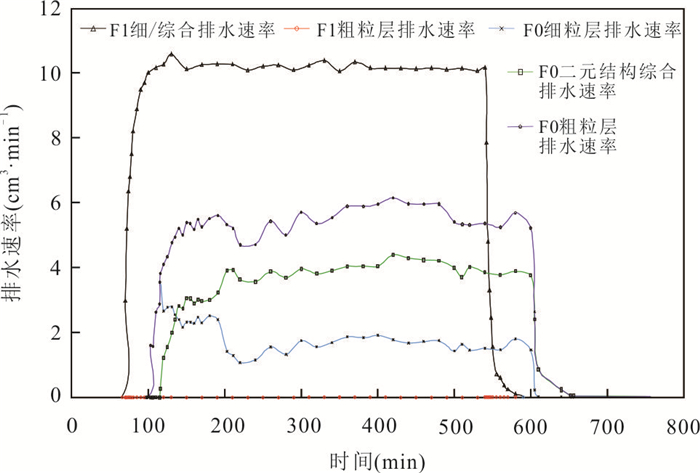
图 9 不同粗粒层注压条件下二元结构侧向排水速率
Fig. 9. Lateral drainage rate of capillary barrier layer under different coarse-grained layer injection pressure conditions
表 1 二元结构地层颗粒级配与主要物理参数
Table 1. Particle size distribution and physical parameters of the dual structure layer
土样 土壤类型 粒径分布(%) 干密度(g/cm3) 饱和渗透系数(cm/s) 混合比例 中砾 细砾 中砂 细砂 粉粒/黏粒 20~10 mm 10~5 mm 5~2 mm 0.50~0.25 mm 0.250~0.075 mm <0.075 mm 细粒层 粉砂 - - - 20 75 5 1.45 1.19×10⁻² 粗粒层 圆砾 30 20 50 - - - 1.7 1.05 UDL 圆砾 16.55 11.03 27.58 8.97 33.63 2.24 1.62 5.28×10⁻² 1∶1 边坡层 黏土 - - 1.6 2.8 95.6 1.6 5.3×10⁻⁶  下载: 导出CSV
表 2 试验方案
Table 2. Schemes of rainfall tests
方案名称 降雨强度
(10-4 cm/s)粗粒层增压值
(kPa)CBL初始含水量
(细粒层/混合层/粗粒层)降雨时间
(h)F0 3.64 0 低(7%/4.75%/2.5%) 10 F1 3.64 2~3 低(7%/4.75%/2.5%) 10 F2 3.64 2~3 高(F1完成后连续降雨试验) 10 F3 5.34 2~3 高(F2完成后连续降雨试验) 10 F4 3.64 1~2 高(F3完成后连续降雨试验) 10
下载: 导出CSV
表 3 不同方案的细/粗粒层降雨排水特征参数
Table 3. Drainage paramters of different experimental schemes
方案 稳定增压强度(kPa) 细/粗粒层总排水体积(mL) 细/粗粒层稳定排水速率(mL/min) $ \mathrm{l}\mathrm{g}\frac{{K}_{c}}{{K}_{f}} $ $ {\eta }_{cb} $ F1 0.95 4 805.4/0 10.12/0 1.946 2.01 F2 0.81 5 526.8/0 9.56/0 1.97 F3 0.90 7 456.2/0 12.50/0 2.58 F4 0.72 5 526.5/0 9.38/0 1.76
下载: 导出CSV
-
Aubertin, M., Cifuentes, E., Apithy, S. A., et al., 2009. Analyses of Water Diversion along Inclined Covers with Capillary Barrier Effects. Canadian Geotechnical Journal, 46(10): 1146-1164. https://doi.org/10.1139/T09-050 Chen, G. Y., Xiao, J., Chen, Q., et al., 2022. Study on Seepage and Stability of Expansive Soil Slope Treated by Different Capillary Barrier Cover Layers. Journal of Central South University (Science and Technology), 53(1): 199-213 (in Chinese with English abstract). Harnas, F. R., Rahardjo, H., Leong, E. C., et al., 2014. Experimental Study on Dual Capillary Barrier Using Recycled Asphalt Pavement Materials. Canadian Geotechnical Journal, 51(10): 1165-1177. https://doi.org/10.1139/cgj-2013-0432 Jiao, W. G., Zhan, L. T., Ji, Y. X., et al., 2019. Analysis on Long-Term Performance of Capillary-Barrier Cover with Unsaturated Drainage Layer. Journal of Zhejiang University (Engineering Science), 53(6): 1101-1109 (in Chinese with English abstract). Jiao, W. G., Zhan, L. T., Ji, Y. X., et al., 2020. Model Test and Numerical Analysis on Lateral Drainage in Capillary-Barrier Cover with Unsaturated Drainage Layer. Journal of Yangtze River Scientific Research Institute, 37(5): 92-98 (in Chinese with English abstract). Li, G. Y., 2020. Micro-/ Macro-Scale Water and Gas Transport Properties and Practical Performance of Capillary Barrier Covers(Dissertation). Zhejiang University, Hangzhou(in Chinese with English abstract). Li, X. K., Li, X., Wu, Y., et al., 2022. Experimental Study on Service Performance of Capillary Barrier Cover with Unsaturated Drainage Layer. Chinese Journal of Geotechnical Engineering, 44(Suppl.1): 189-194 (in Chinese with English abstract). Liu, G., Tong, F. G., Xi, N. N., et al., 2015. Impact Test of Rainfall on Clay Soil Infiltration Rate, Moisture Content and Pore Pressure under Aeration and Gas Sealing Conditions. Water Resources and Power, 33(12): 19-21 (in Chinese with English abstract). Mancarella, D., Simeone, V., 2012. Capillary Barrier Effects in Unsaturated Layered Soils, with Special Reference to the Pyroclastic Veneer of the Pizzo d'Alvano, Campania, Italy. Bulletin of Engineering Geology and the Environment, 71(4): 791-801. https://doi.org/10.1007/s10064-012-0419-6 Morris, C. E., Stormont, J. C., 1998. Evaluation of Numerical Simulations of Capillary Barrier Field Tests. Geotechnical Geological Engineering, 16(3): 201-213. https://doi.org/10.1023/A:1008853710339 Morris, C. E., Stormont, J. C., 1999. Parametric Study of Unsaturated Drainage Layers in a Capillary Barrier. Journal of Geotechnical and Geoenvironmental Engineering, 125(12): 1057-1065. https://doi.org/10.1061/(ASCE)1090-0241(1999)125:12(1057) Parent, S. É., Cabral, A., 2006. Design of Inclined Covers with Capillary Barrier Effect. Geotechnical and Geological Engineering, 24(3): 689-710. https://doi.org/10.1007/s10706-005-3229-9 Shaikh, J., Bordoloi, S., Yamsani, S. K., et al., 2019. Long-Term Hydraulic Performance of Landfill Cover System in Extreme Humid Region: Field Monitoring and Numerical Approach. Science of the Total Environment, 688: 409-423. https://doi.org/10.1016/j.scitotenv.2019.06.213 Tami, D., Rahardjo, H., Leong, E. C., et al., 2004. Design and Laboratory Verification of a Physical Model of Sloping Capillary Barrier. Canadian Geotechnical Journal, 41(5): 814-830. https://doi.org/10.1139/t04-036 Wang, J. N., Xu, H., 2021. Study on the Comprehensive Performance Evaluation of the Capillary Barrier Soil Cover System in Humid Climate Zone Built with Construction Wastes. Journal of Zhejiang Sci-Tech University (Natural Sciences Edition), 45(1): 136-148 (in Chinese with English abstract). Wu, Q. H., Wang, K., 2025. Effect of Angle and Lithology on Infiltrating to Fine/Coarse Dual-Structure Slope under Rainfall Condition. Earth Science, 50(1): 311-321 (in Chinese with English abstract). Wu, Q. H., Zhang, J. F., Cui, H. D., et al., 2017. Experimental Study of Drainage Control of Slopes with Fine-Coarse Grain Structure. Rock and Soil Mechanics, 38(2): 392-399 (in Chinese with English abstract). Zhan, L. T., Li, G. Y., Jiao, W. G., et al., 2020. Performance of a Compacted Loess/Gravel Cover as a Capillary Barrier and Landfill Gas Emissions Controller in Northwest China. Science of the Total Environment, 718: 137195. https://doi.org/10.1016/j.scitotenv.2020.137195 Zhan, L. T., Qiu, Q. W., Yang, Y. B., et al., 2017. Soil Column Tests and Numerical Simulations of Moisture-Gas Coupled Flow in a Loess Cover. Chinese Journal of Geotechnical Engineering, 39(6): 969-977 (in Chinese with English abstract). 陈冠一, 肖杰, 陈强, 等, 2022. 不同毛细阻滞覆盖层处治膨胀土边坡的渗流及稳定性研究. 中南大学学报(自然科学版), 53(1): 199-213. 焦卫国, 詹良通, 季永新, 等, 2019. 含非饱和导排层的毛细阻滞覆盖层长期性能分析. 浙江大学学报(工学版), 53(6): 1101-1109. 焦卫国, 詹良通, 季永新, 等, 2020. 非饱和导排层水分侧向导排作用模型试验验证与影响因素分析. 长江科学院院报, 37(5): 92-98. 李光耀, 2020. 毛细阻滞型覆盖层微观-宏观水气传导特性及服役性能(硕士学位论文). 杭州: 浙江大学. 李晓康, 李旭, 吴羊, 等, 2022. 含非饱和导排层毛细阻滞覆盖层服役性能试验研究. 岩土工程学报, 44(增刊1): 189-194. 刘刚, 童富果, 习念念, 等, 2015. 通气和封气条件下降雨对粘性土入渗速率、含水率及孔隙压力的影响试验. 水电能源科学, 33(12): 19-21. 王锦楠, 徐辉, 2021. 以建筑垃圾为填料的湿润气候区毛细阻滞型覆盖层综合性能评价. 浙江理工大学学报(自然科学版), 45(1): 136-148. 吴庆华, 王珂, 2025. 细/粗二元结构边坡角度与岩性特征对其阻隔降雨入渗的影响规律. 地球科学, 50(1): 311-321. doi: 10.3799/dqkx.2023.170 吴庆华, 张家发, 崔皓东, 等, 2017. 细/粗粒二元结构边坡的排水防渗效果试验研究. 岩土力学, 38(2): 392-399. 詹良通, 邱清文, 杨益彪, 等, 2017. 黄土覆盖层水-气耦合运移土柱试验及数值模拟. 岩土工程学报, 39(6): 969-977. -

 点击查看大图
计量
- 文章访问数: 156
- HTML全文浏览量: 13
- PDF下载量: 41
- 被引次数: 0
