




Sedimentary Proxies of Volcanism across Permian-Triassic Transition: A Review
-
摘要: 二叠纪-三叠纪之交发生了剧烈的气候环境扰动,并伴随着显生宙以来最大的一次生物大灭绝事件.该时期发生了剧烈的火山活动,被认为是引起此次生态系统危机的主要触发机制.由于环境和生物信息保存丰富的沉积岩中缺乏有效的火山活动记录,开展该时期高精度的火山活动-环境扰动-生物危机的因果关系研究一直是学术界的难点.破解该难点的关键在于如何在保存丰富的沉积岩中示踪古火山活动记录.以二叠纪-三叠纪之交强烈火山活动为典型案例,综述古火山沉积记录示踪指标在地层中的记录,包括火山熔岩和火山灰凝灰岩、挥发组分(碳、汞、硫等)及非挥发组分(铜、锌、镍、锇、锶、铂族等元素)等.结果表明,各项指标在该时期地层中均有显著的记录,指示火山喷发对地表元素循环产生剧烈的影响.同时,探讨了各项指标的优势性与局限性,为进一步开展深时火山示踪研究提供借鉴,并展望了该领域未来研究方向.Abstract: The Permian-Triassic transition was characterized by severe climatic and environmental perturbations, accompanied by the largest mass extinction event in the Phanerozoic. The Siberian Traps Large Igneous Province, the largest continental large igneous province in Earth history, is widely considered to be the ultimate trigger of this ecological crisis. However, although sedimentary rocks preserve abundant environmental and biological signals, they generally lack direct records of volcanic activity, which has long hindered high-resolution investigations of the causal relationships among volcanism, environmental perturbations, and biotic crises during this interval. A critical challenge, therefore, lies in tracing signals of ancient volcanic activity within sedimentary successions. Taking the intense volcanism at the Permian-Triassic boundary as a representative case, this study reviews volcanic proxies preserved in stratigraphic records, including volcanic lava and ash (tuff) layers, volatile components (e.g., carbon, mercury, and sulfur), and non-volatile components (e.g., metallic elements such as copper, zinc, and nickel). The results indicate that these proxies exhibit pronounced signals saddle the Permian-Triassic boundary strata, suggesting that volcanic eruptions exerted significant impacts on surface elemental cycles. Furthermore, the advantages and limitations of different proxies are evaluated, providing a reference for future deep-time volcanic tracing studies and offering perspectives on future research directions.
-
Key words:
- volcanism /
- geochemical proxies /
- Permian-Triassic /
- mass extinction /
- metal isotope /
- mercury record /
- black shale /
- geochemistry
-
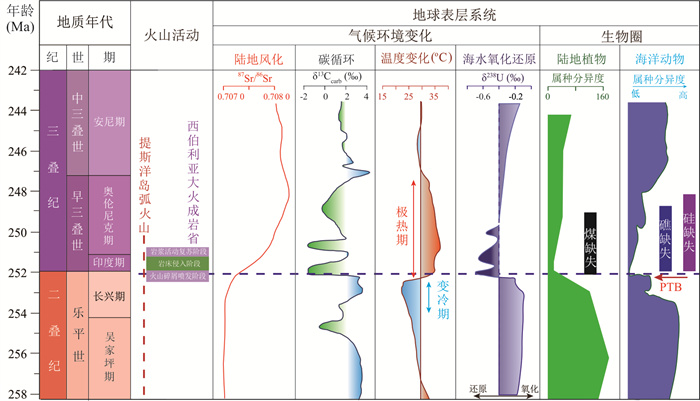
图 1 二叠纪‒三叠纪之交火山‒环境‒时间研究
火山活动修改自殷鸿福等(
1989 )、Burgess et al.(2014);陆地风化Sr同位素数据来自Song et al.(2015);碳循环数据来自Payne et al.(2004)、Xie et al.(2007)、Shen et al.(2011a);温度变化数据来自Sun et al.(2012);海水氧化还原数据来自Zhang et al.(2018);陆地植物数据来自Yu et al.(2015)、Xu et al.(2022);海洋动物数据来自Chen et al.(2012)Fig. 1. Integrated volcanism-environment-time framework across the Permian-Triassic boundary
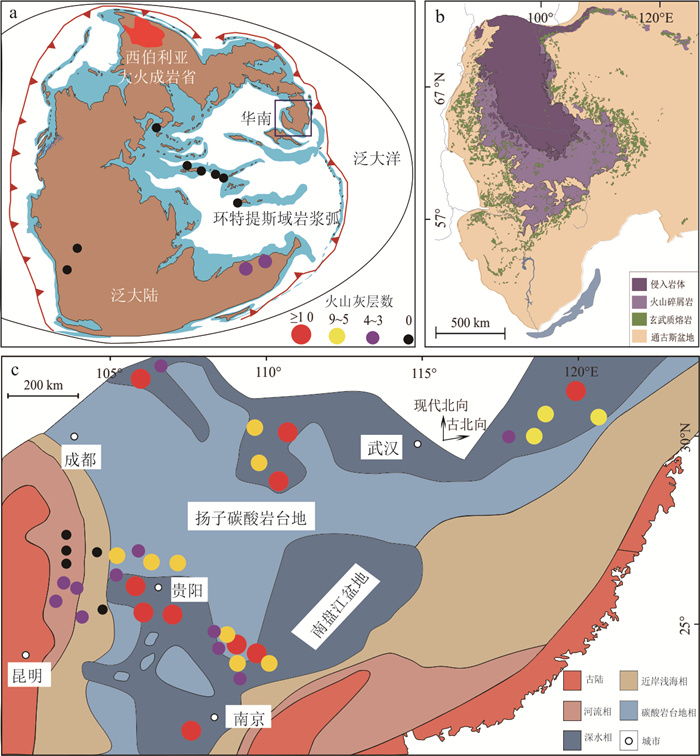
图 2 二叠纪‒三叠纪之交火山岩分布
a. 二叠纪‒三叠纪之交环特提斯域酸性岛弧火山空间分布,修改自Chapman et al.(2022);b. 西伯利亚大火成岩省空间分布,修改自Burgess et al.(2017);c. 二叠纪‒三叠纪之交华南酸性火山灰空间分布,修改自Xie et al.(2010)和Shen et al.(2021)
Fig. 2. Distribution of volcanic rocks across the Permian-Triassic transition
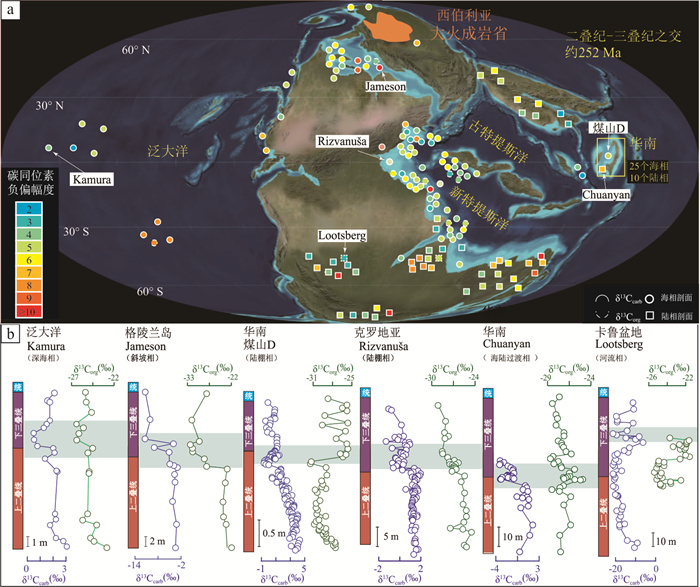
图 3 全球二叠纪‒三叠纪之交碳同位素研究剖面古地理分布以及典型盆地数据
a. 全球二叠纪‒三叠纪之交碳同位素研究剖面古地理分布图,其中剖面投点颜色代表碳同位素负偏幅度,实线描边代表测试无机碳同位素数据,虚线描边代表测试有机碳同位素数据,图中研究剖面参考文献见附件;二叠纪‒三叠纪之交古地理图据
http://jan.ucc.nau.edu/~rcb7/ ,© 2016 Colorado Plateau Geosystems Inc. b. 选取的6个经典二叠纪‒三叠纪之交研究剖面的碳同位素数据投图,其中蓝色阴影代表的无机、有机碳同位素负偏区间Fig. 3. Global paleogeographic distribution and trends of carbon isotope across the Permian-Triassic boundary
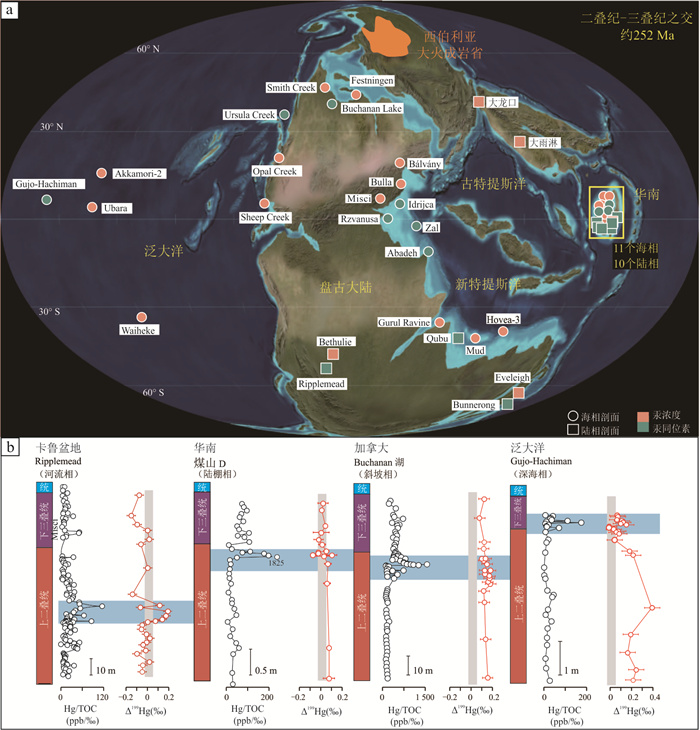
图 4 全球二叠纪‒三叠纪之交汞和汞同位素研究剖面古地理分布以及典型盆地数据
a. 全球二叠纪‒三叠纪之交汞和汞同位素研究剖面古地理分布图,研究剖面参考文献见附件,古地理图据
http://jan.ucc.nau.edu/~rcb7/ ,© 2016 Colorado Plateau Geosystems Inc. b. 选取的4个经典二叠纪‒三叠纪之交研究剖面的汞及其同位素数据投图,其中蓝色阴影代表的汞富集以及Δ199Hg波动区间,4个剖面的数据来源于Shen et al.(2023)Fig. 4. Global paleogeographic distribution and trends of Hg and Hg isotope across the Permian-Triassic boundary
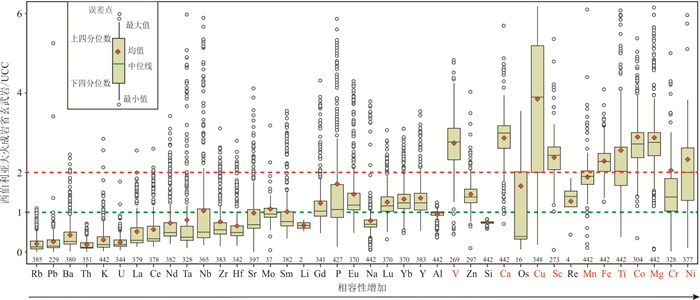
图 5 西伯利亚大火成岩省玄武岩元素丰度
图中所用西伯利亚大火成岩省玄武岩地球化学数据来自GeoRock数据库,上地壳值(Upper Continental Crust,UCC)值来自Taylor and McLennan(1985),横坐标元素按从左到右相容性增加排序,纵坐标代表西伯利亚大火成岩省与UCC的元素比值,每个箱线图下面的数字代表所用数据个数.其中蓝色虚线代表西伯利亚大火成岩省玄武岩元素接近UCC值,红色虚线代表西伯利亚大火成岩省元素相对UCC出现两倍富集,其中V、Ca、Cu、Sc、Mn、Fe、Ti、Co、Mg、Cr和Ni等元素为红色字体,代表其在西伯利亚大火成岩省玄武岩中显著富集于UCC值
Fig. 5. Element abundances of the Siberia Trap large igneous province basalt
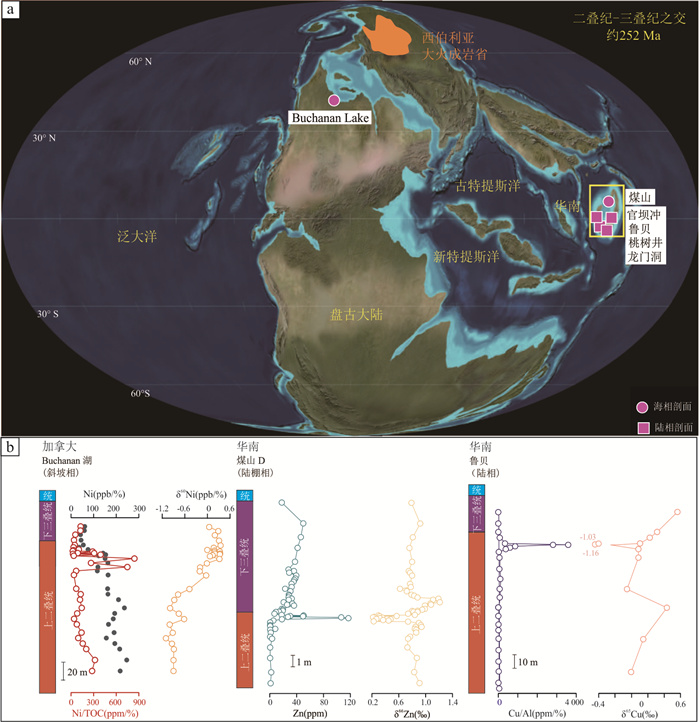
图 6 全球二叠纪‒三叠纪之交镍、铜、锌及其同位素研究剖面古地理分布与典型盆地数据
a. 二叠纪‒三叠纪之交镍、铜、锌及其同位素研究剖面古地理分布图,研究剖面参考文献见附件,古地理图据
http://jan.ucc.nau.edu/~rcb7/ ,© 2016 Colorado Plateau Geosystems Inc. b. 选取的3个经典二叠纪‒三叠纪之交研究剖面的金属元素及其同位素数据投图,其中蓝色阴影代表的金属元素富集及其同位素异常变动区间,其中加拿大剖面Ni及其同位素数据来源Li et al.(2021);华南煤山剖面Zn及其同位素数据来源Liu et al.(2017);华南鲁贝剖面Cu及其同位素数据来源Zhang et al.(2021)Fig. 6. Global paleogeographic distribution and trends of Ni, Cu, Zn and isotopes across the Permian-Triassic boundary
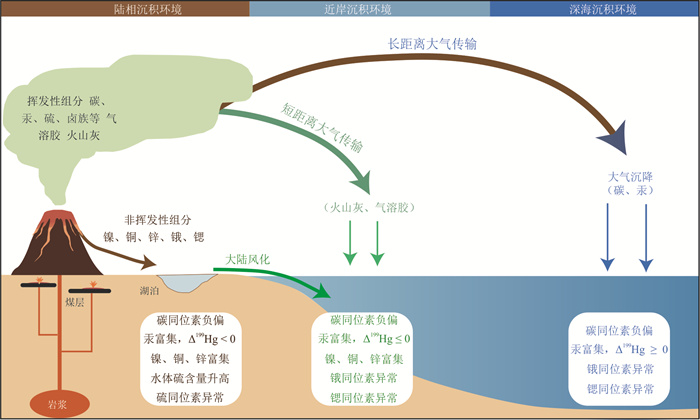
图 7 火山活动释放组分沉积记录模式
Fig. 7. Conceptual diagram of sedimentary recording patterns for volcanically released components
表 1 不同火山示踪指标的综合比较与适用性
Table 1. Comparative evaluation and applicability of different volcanic proxies
指标类型 优势 局限性 适用沉积环境 火山灰(黏土岩)、熔岩 直接记录、可定年 保存不连续,主要分布在火山喷发口附近 海陆相 碳同位素 高分辨率、全球对比性强 成因多解 海陆相 Hg浓度及其同位素 高分辨率、全球对比性强 来源多样 海陆相 S、卤族元素 大气传输,全球对比性强 海水缓冲作用强,信号不敏感 陆相 Ni、Cu、Zn等浓度及同位素 响应明显 火山喷发口附近记录明显,受地表过程影响显著 海陆相 187Os/188Os,87Sr/86Sr 全球对比性强 时间尺度长、端元假设依赖 海相  下载: 导出CSV
-
Algeo, T. J., Shen, J., 2024. Theory and Classification of Mass Extinction Causation. National Science Review, 11(1): 1-21. https://doi.org/10.1093/nsr/nwad237 Allègre, C. J., Louvat, P., Gaillardet, J., et al., 2010. The Fundamental Role of Island Arc Weathering in the Oceanic Sr Isotope Budget. Earth and Planetary Science Letters, 292(1-2): 51-56. https://doi.org/10.1016/j.epsl.2010.01.019 Alvarez, L. W., Alvarez, W., Asaro, F., et al., 1980. Extraterrestrial Cause for the Cretaceous-Tertiary Extinction. Science, 208(4448): 1095-1108. https://doi.org/10.1126/science.208.4448.1095 Baresel, B., Bucher, H., Brosse, M., et al., 2017. Precise Age for the Permian-Triassic Boundary in South China from High-Precision U-Pb Geochronology and Bayesian Age-Depth Modeling. Solid Earth, 8(2): 361-378. https://doi.org/10.5194/se-8-361-2017 Benca, J. P., Duijnstee, I. A. P., Looy, C. V., 2018. UV-B-Induced Forest Sterility: Implications of Ozone Shield Failure in Earth's Largest Extinction. Science Advances, 4(2): e1700618. https://doi.org/10.1126/sciadv.1700618 Black, B. A., Elkins-Tanton, L. T., Rowe, M. C., et al., 2012. Magnitude and Consequences of Volatile Release from the Siberian Traps. Earth and Planetary Science Letters, 317-318: 363-373. https://doi.org/10.1016/j.epsl.2011.12.001 Black, B. A., Hauri, E. H., Elkins-Tanton, L. T., et al., 2014. Sulfur Isotopic Evidence for Sources of Volatiles in Siberian Traps Magmas. Earth and Planetary Science Letters, 394: 58-69. https://doi.org/10.1016/j.epsl.2014.02.057 Black, B. A., Neely, R. R., Lamarque, J. F., et al., 2018. Systemic Swings in End-Permian Climate from Siberian Traps Carbon and Sulfur Outgassing. Nature Geoscience, 11(12): 949-954. https://doi.org/10.1038/s41561-018-0261-y Blum, J. D., Sherman, L. S., Johnson, M. W., 2014. Mercury Isotopes in Earth and Environmental Sciences. Annual Review of Earth and Planetary Sciences, 42: 249-269. https://doi.org/10.1146/annurev-earth-050212-124107 Broadley, M. W., Barry, P. H., Ballentine, C. J., et al., 2018. End-Permian Extinction Amplified by Plume- Induced Release of Recycled Lithospheric Volatiles. Nature Geoscience, 11(9): 682-687. https://doi.org/10.1038/s41561-018-0215-4 Burgess, S. D., Bowring, S. A., 2015. High-Precision Geochronology Confirms Voluminous Magmatism before, during, and after Earth's Most Severe Extinction. Science Advances, 1(7): e1500470. https://doi.org/10.1126/sciadv.1500470 Burgess, S. D., Bowring, S., Shen, S. Z., 2014. High- Precision Timeline for Earth's Most Severe Extinction. Proceedings of the National Academy of Sciences of the United States of America, 111(9): 3316-3321. https://doi.org/10.1073/pnas.1317692111 Burgess, S. D., Muirhead, J. D., Bowring, S. A., 2017. Initial Pulse of Siberian Traps Sills as the Trigger of the End-Permian Mass Extinction. Nature Communications, 8: 164. https://doi.org/10.1038/s41467-017-00083-9 Callegaro, S., Svensen, H. H., Neumann, E. R., et al., 2021. Geochemistry of Deep Tunguska Basin Sills, Siberian Traps: Correlations and Potential Implications for the End-Permian Environmental Crisis. Contributions to Mineralogy and Petrology, 176(7): 49. https://doi.org/10.1007/s00410-021-01807-3 Canil, D., Crockford, P. W., Rossin, R., et al., 2015. Mercury in Some Arc Crustal Rocks and Mantle Peridotites and Relevance to the Moderately Volatile Element Budget of the Earth. Chemical Geology, 396: 134-142. https://doi.org/10.1016/j.chemgeo.2014.12.029 Cao, C., Bataille, C. P., Song, H. J., et al., 2022. Persistent Late Permian to Early Triassic Warmth Linked to Enhanced Reverse Weathering. Nature Geoscience, 15(10): 832-838. https://doi.org/10.1038/s41561-022-01009-x Chapman, T., Milan, L. A., Metcalfe, I., et al., 2022. Pulses in Silicic Arc Magmatism Initiate End- Permian Climate Instability and Extinction. Nature Geoscience, 15(5): 411-416. https://doi.org/10.1038/s41561-022-00934-1 Chen, H., Savage, P. S., Teng, F. Z., et al., 2013. Zinc Isotope Fractionation during Magmatic Differentiation and the Isotopic Composition of the Bulk Earth. Earth and Planetary Science Letters, 369-370: 34-42. https://doi.org/10.1016/j.epsl.2013.02.037 Chen, J. B., Sun, G. Y., Lu, B. J., et al., 2023. Inconsistent Mercury Records from Terrestrial Upland to Coastal Lowland across the Permian-Triassic Transition. Earth and Planetary Science Letters, 614: 118195. https://doi.org/10.1016/j.epsl.2023.118195 Chen, J., Xu, Y. G., 2017. Permian Large Igneous Provinces and Their Impact on Paleoenvironment and Biodiversity: Progresses and Perspectives. Bulletin of Mineralogy, Petrology and Geochemistry, 36(3): 374-393 (in Chinese with English abstract). Chen, X., Zhou, Y., Shields, G. A., 2022. Progress towards an Improved Precambrian Seawater 87Sr/86Sr Curve. Earth-Science Reviews, 224: 103869. https://doi.org/10.1016/j.earscirev.2021.103869 Chen, Z. Q., Benton, M. J., 2012. The Timing and Pattern of Biotic Recovery Following the End-Permian Mass Extinction. Nature Geoscience, 5(6): 375-383. https://doi.org/10.1038/ngeo1475 Chi, Q. H., 2004. Abundance of Mercury in Crust, Rocks and Loose Sediments. Geochimica, 33(6): 641-648 (in Chinese with English abstract). Chu, D. L., Corso, J. D., Shu, W. C., et al., 2021. Metal-Induced Stress in Survivor Plants Following the End-Permian Collapse of Land Ecosystems. Geology, 49(6): 657-661. https://doi.org/10.1130/g48333.1 Chu, D. L., Grasby, S. E., Song, H. J., et al., 2020. Ecological Disturbance in Tropical Peatlands Prior to Marine Permian-Triassic Mass Extinction. Geology, 48(3): 288-292. https://doi.org/10.1130/g46631.1 Chu, D. L., Song, H. J., Dal Corso, J., et al., 2025. Diachronous End-Permian Terrestrial Crises in North and South China. Geology, 53(1): 55-60. https://doi.org/10.1130/g52655.1 Clapham, M. E., Renne, P. R., 2019. Flood Basalts and Mass Extinctions. Annual Review of Earth and Planetary Sciences, 47: 275-303. https://doi.org/10.1146/annurev-earth-053018-060136 Clarkson, M. O., Kasemann, S. A., Wood, R. A., et al., 2015. Ocean Acidification and the Permo-Triassic Mass Extinction. Science, 348(6231): 229-232. https://doi.org/10.1126/science.aaa0193 Conway, T. M., John, S. G., 2014. The Biogeochemical Cycling of Zinc and Zinc Isotopes in the North Atlantic Ocean. Global Biogeochemical Cycles, 28(10): 1111-1128. https://doi.org/10.1002/2014gb004862 Crockford, P. W., Kunzmann, M., Bekker, A., et al., 2019. Claypool Continued: Extending the Isotopic Record of Sedimentary Sulfate. Chemical Geology, 513: 200-225. https://doi.org/10.1016/j.chemgeo.2019.02.030 Cui, Y., Li, M. S., van Soelen, E. E., et al., 2021. Massive and Rapid Predominantly Volcanic CO2 Emission during the End-Permian Mass Extinction. Proceedings of the National Academy of Sciences of the United States of America, 118(37): e2014701118. https://doi.org/10.1073/pnas.2014701118 Deng, C. Z., Gou, J., Sun, D. Y., et al., 2022. Mercury Isotopic Composition of Igneous Rocks from an Accretionary Orogen: Implications for Lithospheric Recycling. Geology, 50(9): 1001-1006. https://doi.org/10.1130/g50131.1 Duan, Y. R., Wang, Z. R., Gou, W. X., et al., 2025. Stable Zinc Isotopes as Tracers in Environmental Geochemistry. Earth-Science Reviews, 269: 105185. https://doi.org/10.1016/j.earscirev.2025.105185 Edmonds, M., Mason, E., Hogg, O., 2022. Volcanic Outgassing of Volatile Trace Metals. Annual Review of Earth and Planetary Sciences, 50: 79-98. https://doi.org/10.1146/annurev-earth-070921-062047 Fan, J. X., Shen, S. Z., Erwin, D. H., et al., 2020. A High-Resolution Summary of Cambrian to Early Triassic Marine Invertebrate Biodiversity. Science, 367(6475): 272-277. https://doi.org/10.1126/science.aax4953 Fedorenko, V. A., Lightfoot, P. C., Naldrett, A. J., et al., 1996. Petrogenesis of the Flood-Basalt Sequence at Noril'sk, North Central Siberia. International Geology Review, 38(2): 99-135. https://doi.org/10.1080/00206819709465327 Fedorenko, V., Czamanske, G., Zen'ko, T., et al., 2000. Field and Geochemical Studies of the Melilite-Bearing Arydzhangsky Suite, and an Overall Perspective on the Siberian Alkaline-Ultramafic Flood-Volcanic Rocks. International Geology Review, 42(9): 769-804. https://doi.org/10.1080/00206810009465111 Feng, X. B., Yin, R. S., Yu, B., et al., 2015. A Review of Hg Isotope Geochemistry. Earth Science Frontiers, 22(5): 124-135 (in Chinese with English abstract). Gales, E., Black, B., Elkins-Tanton, L. T., 2020. Carbonatites as a Record of the Carbon Isotope Composition of Large Igneous Province Outgassing. Earth and Planetary Science Letters, 535: 116076. https://doi.org/10.1016/j.epsl.2020.116076 Gao, J. F., Zhou, M. F., Lightfoot, P. C., et al., 2013. Sulfide Saturation and Magma Emplacement in the Formation of the Permian Huangshandong Ni-Cu Sulfide Deposit, Xinjiang, Northwestern China. Economic Geology, 108(8): 1833-1848. https://doi.org/10.2113/econgeo.108.8.1833 Gernon, T. M., Hincks, T. K., Merdith, A. S., et al., 2021. Global Chemical Weathering Dominated by Continental Arcs since the Mid-Palaeozoic. Nature Geoscience, 14(9): 690-696. https://doi.org/10.1038/s41561-021-00806-0 Grasby, S. E., Beauchamp, B., Bond, D. P. G., et al., 2015. Progressive Environmental Deterioration in Northwestern Pangea Leading to the Latest Permian Extinction. Geological Society of America Bulletin, 127(9-10): 1331-1347. https://doi.org/10.1130/b31197.1 Grasby, S. E., Beauchamp, B., Bond, D. P. G., et al., 2016. Mercury Anomalies Associated with Three Extinction Events (Capitanian Crisis, Latest Permian Extinction and the Smithian/Spathian Extinction) in NW Pangea. Geological Magazine, 153(2): 285-297. https://doi.org/10.1017/s0016756815000436 Grasby, S. E., Shen, W. J., Yin, R. S., et al., 2017. Isotopic Signatures of Mercury Contamination in Latest Permian Oceans. Geology, 45(1): 55-58. https://doi.org/10.1130/g38487.1 Grasby, S. E., Them, T. R., Chen, Z. H., et al., 2019. Mercury as a Proxy for Volcanic Emissions in the Geologic Record. Earth-Science Reviews, 196: 102880. https://doi.org/10.1016/j.earscirev.2019.102880 He, B., Zhong, Y. T., Xu, Y. G., et al., 2014. Triggers of Permo-Triassic Boundary Mass Extinction in South China: The Siberian Traps or Paleo-Tethys Ignimbrite Flare-up? Lithos, 204: 258-267. https://doi.org/10.1016/j.lithos.2014.05.011 He, W. H., Wu, Y. Y., Zhang, K. X., et al., 2025. Gradual Collapse of Global Marine Ecosystem in the Late Permian and Its Link to the Anoxia. Earth Science, 50(3): 983-999 (in Chinese with English abstract). Hollander, D. J., McKenzie, J. A., 1991. CO2 Control on Carbon-Isotope Fractionation during Aqueous Photosynthesis: A Paleo-pCO2 Barometer. Geology, 19(9): 929-932. https://doi.org/10.1130/0091-7613(1991)019<0929:ccocif>2.3.co;2 doi: 10.1130/0091-7613(1991)019<0929:ccocif>2.3.co;2 Jin, Y. G., Wang, Y., Wang, W., et al., 2000. Pattern of Marine Mass Extinction near the Permian-Triassic Boundary in South China. Science, 289(5478): 432-436. https://doi.org/10.1126/science.289.5478.432 Joachimski, M. M., Lai, X., Shen, S., et al., 2012. Climate Warming in the Latest Permian and the Permian- Triassic Mass Extinction. Geology, 40(3): 195-198. https://doi.org/10.1130/g32707.1 Korte, C., Kozur, H. W., 2010. Carbon-Isotope Stratigraphy across the Permian-Triassic Boundary: A Review. Journal of Asian Earth Sciences, 39(4): 215-235. https://doi.org/10.1016/j.jseaes.2010.01.005 Kump, L. R., 1991. Interpreting Carbon-Isotope Excursions: Strange Love Oceans. Geology, 19(4): 299-302. https://doi.org/10.1130/0091-7613(1991)019<0299:icieso>2.3.co;2 doi: 10.1130/0091-7613(1991)019<0299:icieso>2.3.co;2 Kump, L. R., Pavlov, A., Arthur, M. A., 2005. Massive Release of Hydrogen Sulfide to the Surface Ocean and Atmosphere during Intervals of Oceanic Anoxia. Geology, 33(5): 397-400. https://doi.org/10.1130/g21295.1 Le Vaillant, M., Barnes, S. J., Mungall, J. E., et al., 2017. Role of Degassing of the Noril'sk Nickel Deposits in the Permian-Triassic Mass Extinction Event. Proceedings of the National Academy of Sciences of the United States of America, 114(10): 2485-2490. https://doi.org/10.1073/pnas.1611086114 Lee, C. A., Wasserburg, G. J., Kyte, F. T., 2003. Platinum-Group Elements (PGE) and Rhenium in Marine Sediments across the Cretaceous-Tertiary Boundary: Constraints on Re-PGE Transport in the Marine Environment. Geochimica et Cosmochimica Acta, 67(4): 655-670. https://doi.org/10.1016/S0016-7037(02)01135-3 Li, M. H., Frank, T. D., Xu, Y. L., et al., 2022. Sulfur Isotopes Link Atmospheric Sulfate Aerosols from the Siberian Traps Outgassing to the End-Permian Extinction on Land. Earth and Planetary Science Letters, 592: 117634. https://doi.org/10.1016/j.epsl.2022.117634 Li, M. H., Grasby, S. E., Wang, S. J., et al., 2021. Nickel Isotopes Link Siberian Traps Aerosol Particles to the End-Permian Mass Extinction. Nature Communications, 12: 2024. https://doi.org/10.1038/s41467-021-22066-7 Little, S. H., Vance, D., Walker-Brown, C., et al., 2014. The Oceanic Mass Balance of Copper and Zinc Isotopes, Investigated by Analysis of Their Inputs, and Outputs to Ferromanganese Oxide Sediments. Geochimica et Cosmochimica Acta, 125: 673-693. https://doi.org/10.1016/j.gca.2013.07.046 Liu, F., Peng, H. P., Marshall, J. E. A., et al., 2023. Dying in the Sun: Direct Evidence for Elevated UV-B Radiation at the End-Permian Mass Extinction. Science Advances, 9: eabo6102. https://doi.org/10.1126/sciadv.abo6102 Liu, S. A., Wu, H. C., Shen, S. Z., et al., 2017. Zinc Isotope Evidence for Intensive Magmatism Immediately before the End-Permian Mass Extinction. Geology, 45(4): 343-346. https://doi.org/10.1130/g38644.1 Liu, Z. Y., Selby, D., 2021. Deep-Water Osmium- Isotope Record of the Permian-Triassic Interval from Niushan, China Reveals Potential Delayed Volcanic Signal Post the Mass Extinction. Global and Planetary Change, 200: 103473. https://doi.org/10.1016/j.gloplacha.2021.103473 Liu, Z. Y., Selby, D., Zhang, H., et al., 2020. Evidence for Volcanism and Weathering during the Permian-Triassic Mass Extinction from Meishan (South China) Osmium Isotope Record. Palaeogeography, Palaeoclimatology, Palaeoecology, 553: 109790. https://doi.org/10.1016/j.palaeo.2020.109790 Meisel, T., Walker, R. J., Morgan, J. W., 1996. The Osmium Isotopic Composition of the Earth's Primitive Upper Mantle. Nature, 383(6600): 517-520. https://doi.org/10.1038/383517a0 Miller, C. A., Peucker-Ehrenbrink, B., Walker, B. D., et al., 2011. Re-Assessing the Surface Cycling of Molybdenum and Rhenium. Geochimica et Cosmochimica Acta, 75(22): 7146-7179. doi: 10.1016/j.gca.2011.09.005 Misztela, M. A., Rampino, M. R., Campbell, I. H., 2025. Platinum-Group Elements (PGEs) and Rhenium in Permian-Triassic Boundary Sediments from Southern China and Japan Linked to Concurrent Eruptions of the Siberian Traps. Chemical Geology, 681: 122715. https://doi.org/10.1016/j.chemgeo.2025.122715 Moynier, F., Vance, D., Fujii, T., et al., 2017. The Isotope Geochemistry of Zinc and Copper. Reviews in Mineralogy and Geochemistry, 82(1): 543-600. https://doi.org/10.2138/rmg.2017.82.13 Park, J. W., Hu, Z. C., Gao, S., et al., 2012. Platinum Group Element Abundances in the Upper Continental Crust Revisited-New Constraints from Analyses of Chinese Loess. Geochimica et Cosmochimica Acta, 93: 63-76. https://doi.org/10.1016/j.gca.2012.06.026 Payne, J. L., Lehrmann, D. J., Wei, J. Y., et al., 2004. Large Perturbations of the Carbon Cycle during Recovery from the End-Permian Extinction. Science, 305(5683): 506-509. https://doi.org/10.1126/science.1097023 Payne J. L., Turchyn A. V., Paytan A., et al., 2010. Calcium Isotope Constraints on the End-Permian Mass Extinction. Proceedings of the National Academy of Sciences, 107: 8543-8548. https://doi.org/10.1073/pnas.0914065107 Peucker-Ehrenbrink, B., Ravizza, G., 2000. The Marine Osmium Isotope Record. Terra Nova, 12(5): 205-219. https://doi.org/10.1046/j.1365-3121.2000.00295.x Pyle, D. M., Mather, T. A., 2003. The Importance of Volcanic Emissions for the Global Atmospheric Mercury Cycle. Atmospheric Environment, 37(36): 5115-5124. https://doi.org/10.1016/j.atmosenv.2003.07.011 Pyle, D. M., Mather, T. A., 2009. Halogens in Igneous Processes and Their Fluxes to the Atmosphere and Oceans from Volcanic Activity: A Review. Chemical Geology, 263(1-4): 110-121. https://doi.org/10.1016/j.chemgeo.2008.11.013 Rampino, M. R., Rodriguez, S., Baransky, E., et al., 2017. Global Nickel Anomaly Links Siberian Traps Eruptions and the Latest Permian Mass Extinction. Scientific Reports, 7: 12416. https://doi.org/10.1038/s41598-017-12759-9 Raup, D. M., Jr Sepkoski, J. J., 1982. Mass Extinctions in the Marine Fossil Record. Science, 215(4539): 1501-1503. https://doi.org/10.1126/science.215.4539.1501 Reichow, M. K., Pringle, M. S., Al'Mukhamedov, A. I., et al., 2009. The Timing and Extent of the Eruption of the Siberian Traps Large Igneous Province: Implications for the End-Permian Environmental Crisis. Earth and Planetary Science Letters, 277(1-2): 9-20. https://doi.org/10.1016/j.epsl.2008.09.030 Retallack, G. J., Jahren, A. H., 2008. Methane Release from Igneous Intrusion of Coal during Late Permian Extinction Events. The Journal of Geology, 116(1): 1-20. https://doi.org/10.1086/524120 Rong, J. Y., Huang, B., 2014. Study of Mass Extinction over the Past Thirty Years: A Synopsis. Scientia Sinica Terrae, 44(3): 377-404 (in Chinese). doi: 10.1360/zd-2014-44-3-377 Rooney, A. D., MacDonald, F. A., Strauss, J. V., et al., 2014. Re-Os Geochronology and Coupled Os-Sr Isotope Constraints on the Sturtian Snowball Earth. Proceedings of the National Academy of Sciences of the United States of America, 111(1): 51-56. https://doi.org/10.1073/pnas.1317266110 Rothman, D. H., Fournier, G. P., French, K. L., et al., 2014. Methanogenic Burst in the End-Permian Carbon Cycle. Proceedings of the National Academy of Sciences of the United States of America, 111(15): 5462-5467. https://doi.org/10.1073/pnas.1318106111 Sanei, H., Grasby, S. E., Beauchamp, B., 2012. Latest Permian Mercury Anomalies. Geology, 40(1): 63-66. https://doi.org/10.1130/g32596.1 Selin, N. E., 2009. Global Biogeochemical Cycling of Mercury: A Review. Annual Review of Environment and Resources, 34: 43-63. https://doi.org/10.1146/annurev.environ.051308.084314 Shen, J., Algeo, T. J., Feng, Q. L., et al., 2013. Volcanically Induced Environmental Change at the Permian- Triassic Boundary (Xiakou, Hubei Province, South China): Related to West Siberian Coal-Field Methane Releases? Journal of Asian Earth Sciences, 75: 95-109. https://doi.org/10.1016/j.jseaes.2013.07.013 Shen, J., Algeo, T. J., Hu, Q., et al., 2012. Negative C-Isotope Excursions at the Permian-Triassic Boundary Linked to Volcanism. Geology, 40(11): 963-966. https://doi.org/10.1130/g33329.1 Shen, J., Algeo, T. J., Planavsky, N. J., et al., 2019a. Mercury Enrichments Provide Evidence of Early Triassic Volcanism Following the End-Permian Mass Extinction. Earth-Science Reviews, 195: 191-212. https://doi.org/10.1016/j.earscirev.2019.05.010 Shen, J., Chen, J. B., Algeo, T. J., et al., 2019b. Evidence for a Prolonged Permian-Triassic Extinction Interval from Global Marine Mercury Records. Nature Communications, 10: 1563. https://doi.org/10.1038/s41467-019-09620-0 Shen, J., Yu, J. X., Chen, J. B., et al., 2019c. Mercury Evidence of Intense Volcanic Effects on Land during the Permian-Triassic Transition. Geology, 47(12): 1117-1121. https://doi.org/10.1130/g46679.1 Shen, J., Chen, J. B., Algeo, T. J., et al., 2021. Mercury Fluxes Record Regional Volcanism in the South China Craton Prior to the End-Permian Mass Extinction. Geology, 49(4): 452-456. https://doi.org/10.1130/g48501.1 Shen, J., Chen, J. B., Yu, J. X., et al., 2023. Mercury Evidence from Southern Pangea Terrestrial Sections for End-Permian Global Volcanic Effects. Nature Communications, 14: 1-9. https://doi.org/10.1038/s41467-022-35272-8 Shen, J., Feng, Q. L., Algeo, T. J., et al., 2020. Sedimentary Host Phases of Mercury (Hg) and Implications for Use of Hg as a Volcanic Proxy. Earth and Planetary Science Letters, 543: 116333. https://doi.org/10.1016/j.epsl.2020.116333 Shen, S. Z., Crowley, J. L., Wang, Y., et al., 2011a. Calibrating the End-Permian Mass Extinction. Science, 334(6061): 1367-1372. https://doi.org/10.1126/science.1213454 Shen, Y. N., Farquhar, J., Zhang, H., et al., 2011b. Multiple S-Isotopic Evidence for Episodic Shoaling of Anoxic Water during Late Permian Mass Extinction. Nature Communications, 2: 1-5. https://doi.org/10.1038/ncomms1217 Shen, S. Z., Zhang, H., 2017. What Caused the Five Mass Extinctions? Chinese Science Bulletin, 62(11): 1119-1135 (in Chinese). doi: 10.1360/N972017-00013 Sobolev, S. V., Sobolev, A. V., Kuzmin, D. V., et al., 2011. Linking Mantle Plumes, Large Igneous Provinces and Environmental Catastrophes. Nature, 477(7364): 312-316. https://doi.org/10.1038/nature10385 Song, H. J., Wignall, P. B., Tong, J. N., et al., 2015. Integrated Sr Isotope Variations and Global Environmental Changes through the Late Permian to Early Late Triassic. Earth and Planetary Science Letters, 424: 140-147. https://doi.org/10.1016/j.epsl.2015.05.035 Suits, N. S., Wilkin, R. T., 1998. Pyrite Formation in the Water Column and Sediments of a Meromictic Lake. Geology, 26(12): 1099-1102. https://doi.org/10.1130/0091-7613(1998)026<1099:pfitwc>2.3.co;2 doi: 10.1130/0091-7613(1998)026<1099:pfitwc>2.3.co;2 Sun, H., Xiao, Y. L., Gao, Y. J., et al., 2018. Rapid Enhancement of Chemical Weathering Recorded by Extremely Light Seawater Lithium Isotopes at the Permian-Triassic Boundary. Proceedings of the National Academy of Sciences of the United States of America, 115(15): 3782-3787. https://doi.org/10.1073/pnas.1711862115 Sun, Y. D., Joachimski, M. M., Wignall, P. B., et al., 2012. Lethally Hot Temperatures during the Early Triassic Greenhouse. Science, 338(6105): 366-370. https://doi.org/10.1126/science.1224126 Svensen, H., Planke, S., Polozov, A. G., et al., 2009. Siberian Gas Venting and the End-Permian Environmental Crisis. Earth and Planetary Science Letters, 277(3-4): 490-500. https://doi.org/10.1016/j.epsl.2008.11.015 Sweere, T. C., Dickson, A. J., Jenkyns, H. C., et al., 2018. Isotopic Evidence for Changes in the Zinc Cycle during Oceanic Anoxic Event 2 (Late Cretaceous). Geology, 46(5): 463-466. https://doi.org/10.1130/g40226.1 Taylor, S. R., McLennan, S. M., 1985. The Continental Crust: Its Composition and Evolution. Blackwell, Oxford, 312. Veizer, J., Ala, D., Azmy, K., et al., 1999. 87Sr/86Sr, δ13C and δ18Oevolution of Phanerozoic seawater. Chemical Geology, 161(1-3): 59-88. https://doi.org/10.1016/S0009-2541(99)00081-9 Wang, M., Zhong, Y. T., Hou, Y. L., et al., 2018. Source and Extent of the Felsic Volcanic Ashes at the Permian-Triassic Boundary in South China. Acta Petrologica Sinica, 34(1): 36-48 (in Chinese with English abstract). Wang, X. D., Cawood, P. A., Zhao, H., et al., 2018. Mercury Anomalies across the End Permian Mass Extinction in South China from Shallow and Deep Water Depositional Environments. Earth and Planetary Science Letters, 496: 159-167. https://doi.org/10.1016/j.epsl.2018.05.044 Wang, X. D., Cawood, P. A., Zhao, H., et al., 2019. Global Mercury Cycle during the End-Permian Mass Extinction and Subsequent Early Triassic Recovery. Earth and Planetary Science Letters, 513: 144-155. https://doi.org/10.1016/j.epsl.2019.02.026 Wang, X. M., Yuan, C. S., Liu, S. A., et al., 2025. Volcanically Modulated Micronutrient Cycles in the Mid- Proterozoic Ocean. Geology, 53(7): 567-571. https://doi.org/10.1130/g52953.1 Wei, H. Y., Zhang, X., Qiu, Z., 2026. Pulsed Volcanism of the Emeishan Large Igneous Province Caused the Guadalupian (Middle Permian) Mass Extinction. Geological Society of America Bulletin, 1-14. https://doi.org/10.1130/b38771.1 Wu, Y. Y., Chu, D. L., Tong, J. N., et al., 2021. Six-Fold Increase of Atmospheric pCO2 during the Permian- Triassic Mass Extinction. Nature Communications, 12: 1-8. https://doi.org/10.1038/s41467-021-22298-7 Wu, Y. Y., Song, H. J., Chu, D. L., et al., 2025. Environmental Impacts and Biotic Responses to Volcanism during the Permian-Triassic Transition. Earth Science, 50(3): 964-982 (in Chinese with English abstract). Xie, S. C., Pancost, R. D., Huang, J. H., et al., 2007. Changes in the Global Carbon Cycle Occurred as Two Episodes during the Permian-Triassic Crisis. Geology, 35(12): 1083-1086. https://doi.org/10.1130/g24224a.1 Xie, S. C., Pancost, R. D., Wang, Y. B., et al., 2010. Cyanobacterial Blooms Tied to Volcanism during the 5 M. y. Permo-Triassic Biotic Crisis. Geology, 38(5): 447-450. https://doi.org/10.1130/g30769.1 Xu, Z., Hilton, J., Yu, J. X., et al., 2022. End Permian to Middle Triassic Plant Species Richness and Abundance Patterns in South China: Coevolution of Plants and the Environment through the Permian-Triassic Transition. Earth-Science Reviews, 232: 104136. https://doi.org/10.1016/j.earscirev.2022.104136 Yin, H. F., Huang, S. J., Zhang, K. X., et al., 1989. Volcanism at the Permian-Triassic Boundary in South China and Its Effects on Mass Extinction. Acta Geologica Sinica, 63(2): 169-180 (in Chinese with English abstract). Yin, H. F., Song, H. J., 2013. Mass Extinction and Pangea Integration during the Paleozoic-Mesozoic Transition. Scientia Sinica Terrae, 56(11): 1791-1803 (in Chinese). Yin, H. F., Zhang, K. X., Tong, J. N., et al., 2001. The Global Stratotype Section and Point (GSSP) of the Permian-Triassic Boundary. Episodes, 24(2): 102-114. https://doi.org/10.18814/epiiugs/2001/v24i2/004 Yin, R. S., Feng, X. B., Hurley, J. P., et al., 2016. Mercury Isotopes as Proxies to Identify Sources and Environmental Impacts of Mercury in Sphalerites. Scientific Reports, 6: 18686. https://doi.org/10.1038/srep18686 Yu, J. X., Broutin, J., Chen, Z. Q., et al., 2015. Vegetation Changeover across the Permian-Triassic Boundary in Southwest China Extinction, Survival, Recovery and Palaeoclimate: A Critical Review. Earth-Science Reviews, 149: 203-224. https://doi.org/10.1016/j.earscirev.2015.04.005 Zhang, F. F., Romaniello, S. J., Algeo, T. J., et al., 2018. Multiple Episodes of Extensive Marine Anoxia Linked to Global Warming and Continental Weathering Following the Latest Permian Mass Extinction. Science Advances, 4(4): e1602921. https://doi.org/10.1126/sciadv.1602921 Zhang, G. J., Zhang, X. L., Hu, D. P., et al., 2017. Redox Chemistry Changes in the Panthalassic Ocean Linked to the End-Permian Mass Extinction and Delayed Early Triassic Biotic Recovery. Proceedings of the National Academy of Sciences of the United States of America, 114(8): 1806-1810. https://doi.org/10.1073/pnas.1610931114 Zhang, H., Zhang, F. F, Chen, J. B., et al., 2021. Felsic Volcanism as a Factor Driving the End-Permian Mass Extinction. Science Advances, 7(47): eabh1390. https://doi.org/10.1126/sciadv.abh1390 Zhao, T. Y., Algeo, T. J., Feng, Q. L., et al., 2019. Tracing the Provenance of Volcanic Ash in Permian-Triassic Boundary Strata, South China: Constraints from Inherited and Syn-Depositional Magmatic Zircons. Palaeogeography, Palaeoclimatology, Palaeoecology, 516: 190-202. https://doi.org/10.1016/j.palaeo.2018.12.002 Zheng, W., Zhao, Y. Q., Sun, R. Y., et al., 2021. The Mechanism of Mercury Stable Isotope Fractionation: A Review. Bulletin of Mineralogy, Petrology and Geochemistry, 40(5): 1087-1106 (in Chinese with English abstract). Zhu, J., Zhang, Z. C., 2013. The Link between Large Igneous Provinces and the Two Mass Extinctions in Permian: Review of Recent Progress. Geological Review, 59(1): 137-148 (in Chinese with English abstract). 陈军, 徐义刚, 2017. 二叠纪大火成岩省的环境与生物效应: 进展与前瞻. 矿物岩石地球化学通报, 36(3): 374-393. 迟清华, 2004. 汞在地壳、岩石和疏松沉积物中的分布. 地球化学, 33(6): 641-648. 冯新斌, 尹润生, 俞奔, 等, 2015. 汞同位素地球化学概述. 地学前缘, 22(5): 124-135. 何卫红, 吴攸攸, 张克信, 等, 2025. 晚二叠世全球海洋生态系统逐步坍塌与缺氧的可能联系. 地球科学, 50(3): 983-999. 戎嘉余, 黄冰, 2014. 生物大灭绝研究三十年. 中国科学: 地球科学, 44(3): 377-404. 沈树忠, 张华, 2017. 什么引起五次生物大灭绝?科学通报, 62(11): 1119-1135. 王曼, 钟玉婷, 侯莹玲, 等, 2018. 华南地区二叠纪-三叠纪界线酸性火山灰的源区与规模. 岩石学报, 34(1): 36-48. 吴玉样, 宋海军, 楚道亮, 等, 2025. 二叠纪-三叠纪之交火山活动及其环境效应和生物响应. 地球科学, 50(3): 964-982. doi: 10.3799/dqkx.2024.156 殷鸿福, 黄思骥, 张克信, 等, 1989. 华南二叠纪-三叠纪之交的火山活动及其对生物绝灭的影响. 地质学报, 63(2): 169-180. 殷鸿福, 宋海军, 2013. 古、中生代之交生物大灭绝与泛大陆聚合. 中国科学: 地球科学, 43(10): 1539-1552. 郑旺, 赵亚秋, 孙若愚, 等, 2021. 汞的稳定同位素分馏机理. 矿物岩石地球化学通报, 40(5): 1087-1106. 朱江, 张招崇, 2013. 大火成岩省与二叠纪两次生物灭绝关系研究进展. 地质论评, 59(1): 137-148. -

 点击查看大图
计量
- 文章访问数: 225
- HTML全文浏览量: 35
- PDF下载量: 61
- 被引次数: 0
