




Reservoir Characteristics and Development Model of Lower Paleozoic Carbonate Buried Hill in Slope Zone of Nanpu Sag
-
摘要: 下古生界潜山储层非均质性强、发育机制不清严重制约其勘探成效.运用岩心、成像测井及分析化验等资料,开展了南堡凹陷斜坡带下古生界碳酸盐岩储层特征、主控因素和分布规律研究.结果表明,研究区发育“表生岩溶”和“缝溶体”两类储层.“表生岩溶”储层储集空间以小型溶蚀孔洞为主,集中分布于构造高部位和潜山顶部100 m内;“缝溶体”储层主要储集空间为裂缝,展布范围广,且储层段一般超过150 m.岩石类型是储层发育物质基础,灰岩和云质灰岩类为岩溶成储的优势岩性;裂缝是储层发育核心要素,缝网系统为大气水的溶蚀提供通道;古地貌是储层发育关键条件,上斜坡是岩溶作用有利位置.由此,建立了“岩性‒构造‒古地貌”三元耦合储层发育机制.Abstract: The strong heterogeneity and unclear development mechanism of the Lower Paleozoic buried hill reservoir seriously restrict its exploration effect. In this paper, the characteristics, main controlling factors and distribution rules of the Lower Paleozoic carbonate reservoirs in the slope zone of Nanpu sag were studied by using core, imaging logging and analytical test data. The results show that the study area develops two types of reservoirs: "supergene karst" and "fracture karst". The reservoir space of "supergene karst" reservoir is dominated by small dissolution pores, which are concentrated in the high part of the structure and the top of the buried hill within 100 m. The main reservoir space of the 'fracture-dissolved body' reservoir is fractures, with a wide range of distribution, and the reservoir section is generally more than 150 m. Rock type is the material basis of reservoir development, and limestone and dolomitic limestone are the dominant lithology of karst reservoir. Fracture is the core element of reservoir development, and the fracture network system provides a channel for the dissolution of atmospheric water. Paleogeomorphology is the key condition for reservoir development, and the upper slope is a favorable location for karstification. Therefore, the development mechanism of "lithology-structure-paleogeomorphology" three-element coupling reservoir is established.
-
Key words:
- Lower Paleozoic /
- carbonate /
- reservoir /
- structural fracture /
- karstification /
- reservoir model /
- petroleum geology
-
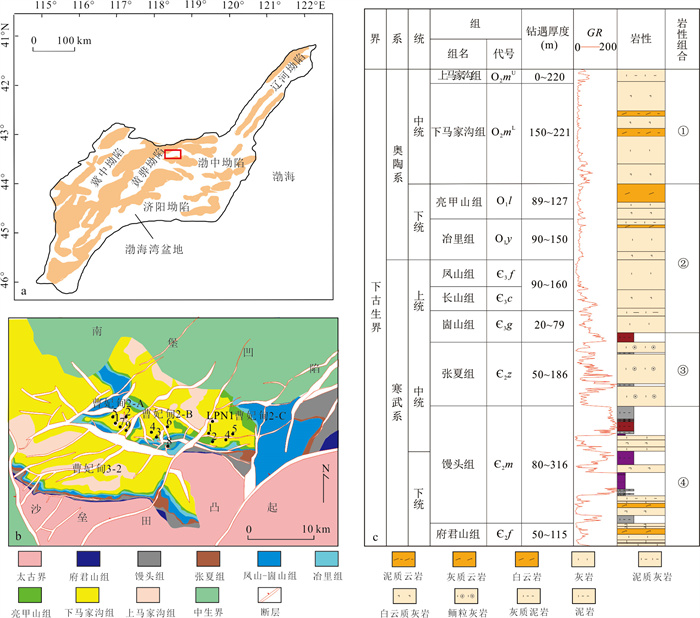
图 1 研究区地质背景
a.渤海湾盆地简图;b.南堡凹陷斜坡潜山地层与断裂体系叠合图;c.下古生界综合柱状图
Fig. 1. Geological background of the research area
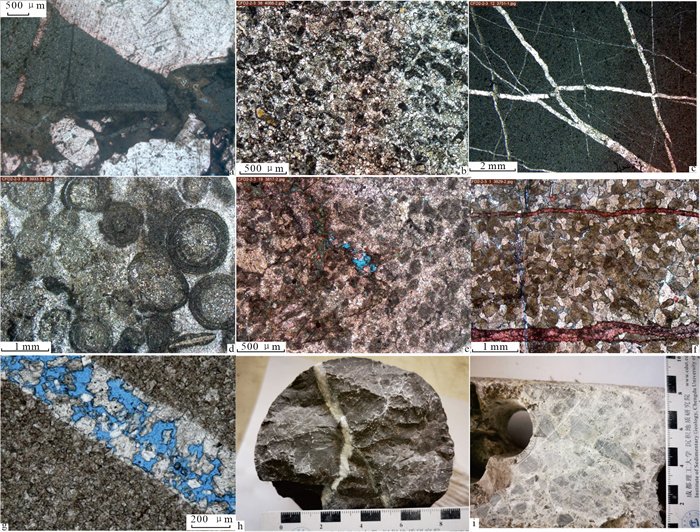
图 2 南堡凹陷斜坡带下古生生界碳酸盐岩储层岩石学特征
a.CFD2-B-9,3 566.74 m,粗晶云质灰岩;b.CFD2-B-3井,4 088.00 m,白云质亮晶砂屑灰岩;c.CFD2-B-3,3 751.00 m,泥晶灰岩;d.CFD2-B-3,3 933.50 m,亮晶鲕粒灰岩;e.CFD2-B-3,3 817.00 m,亮晶砂屑灰岩;f.CFD2-B-3,3 629.00 m,中‒细晶白云岩;g.CFD2-A-2,3 709.30 m,粉‒细晶白云岩,白云石具雾心亮边结构;h.CFD2-C-4,3 762.50~3 765.35 m,泥晶白云岩;i.CFD2-B-9,3 567.40~3 567.90 m,岩溶角砾灰岩
Fig. 2. Petrological characteristics of Lower Paleozoic carbonate reservoir in slope zone of Nanpu sag
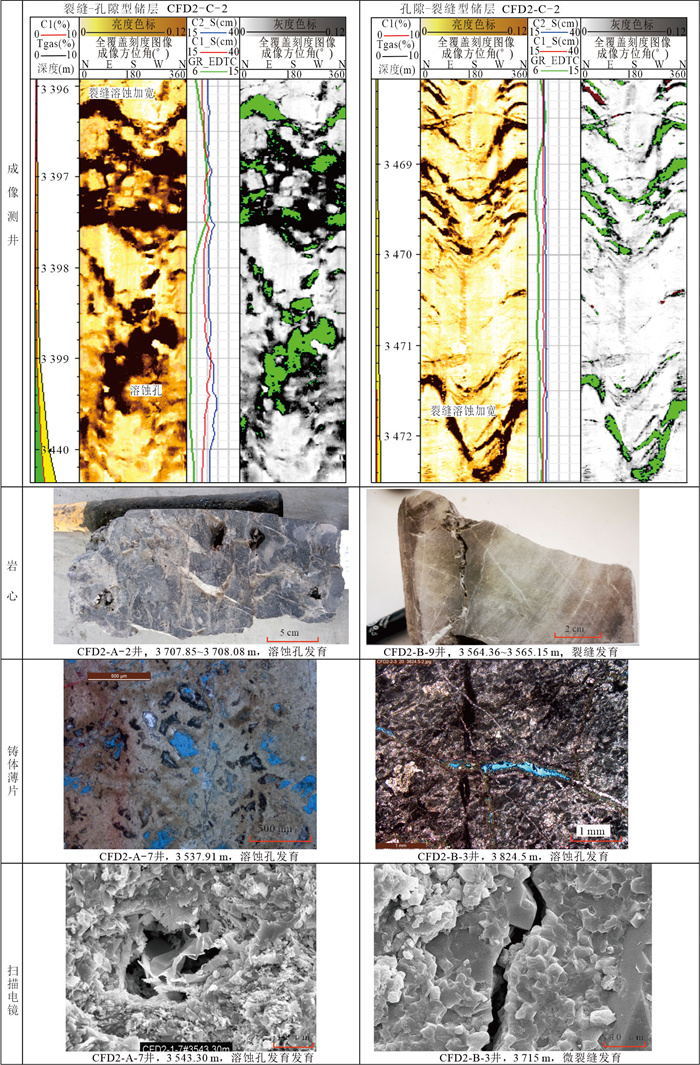
图 3 南堡斜坡带下古生生界碳酸盐岩潜山储层发育特征
Fig. 3. Development characteristics of Lower Paleozoic carbonate buried hill reservoir in Nanpu slope zone
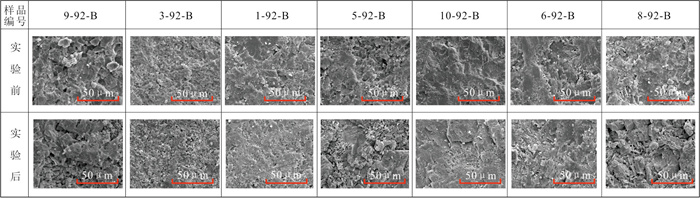
图 4 实验前后样品扫描电镜对比
Fig. 4. Scanning electron microscope comparison of samples before and after the experiment
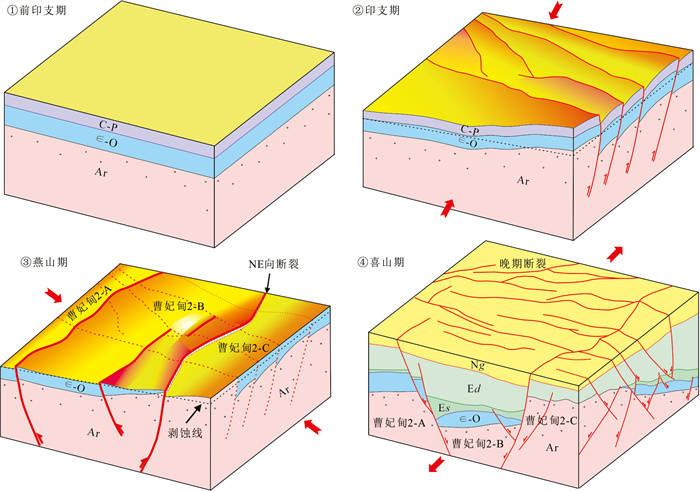
图 5 南堡凹陷斜坡带中新生代构造演化模式
Fig. 5. Meso-Cenozoic tectonic evolution model of slope zone in Nanpu sag
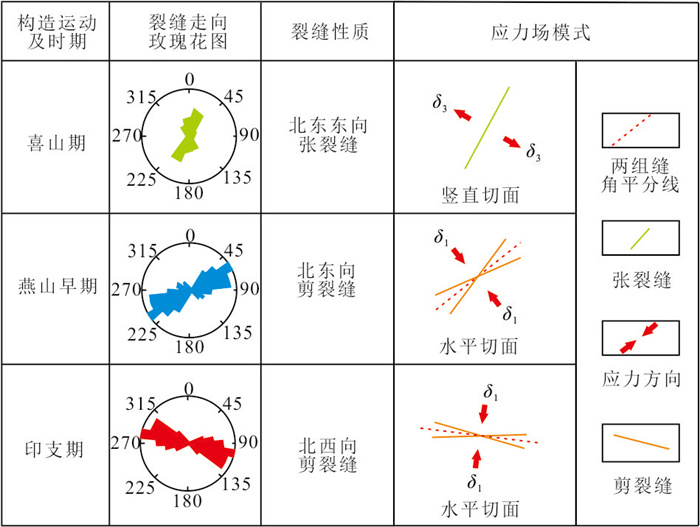
图 6 南堡凹陷斜坡带关键构造期应力场及潜山裂缝发育特征
Fig. 6. Characteristics of stress field and buried hill fracture development in key tectonic period of slope zone in Nanpu sag
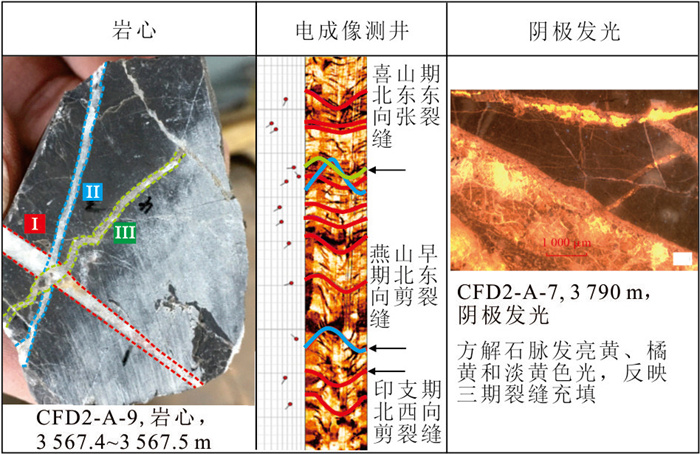
图 7 基于岩心、成像测井及阴极发光的潜山裂缝期次识别
Fig. 7. Identification of buried hill fracture stages based on core, imaging logging and cathodoluminescence
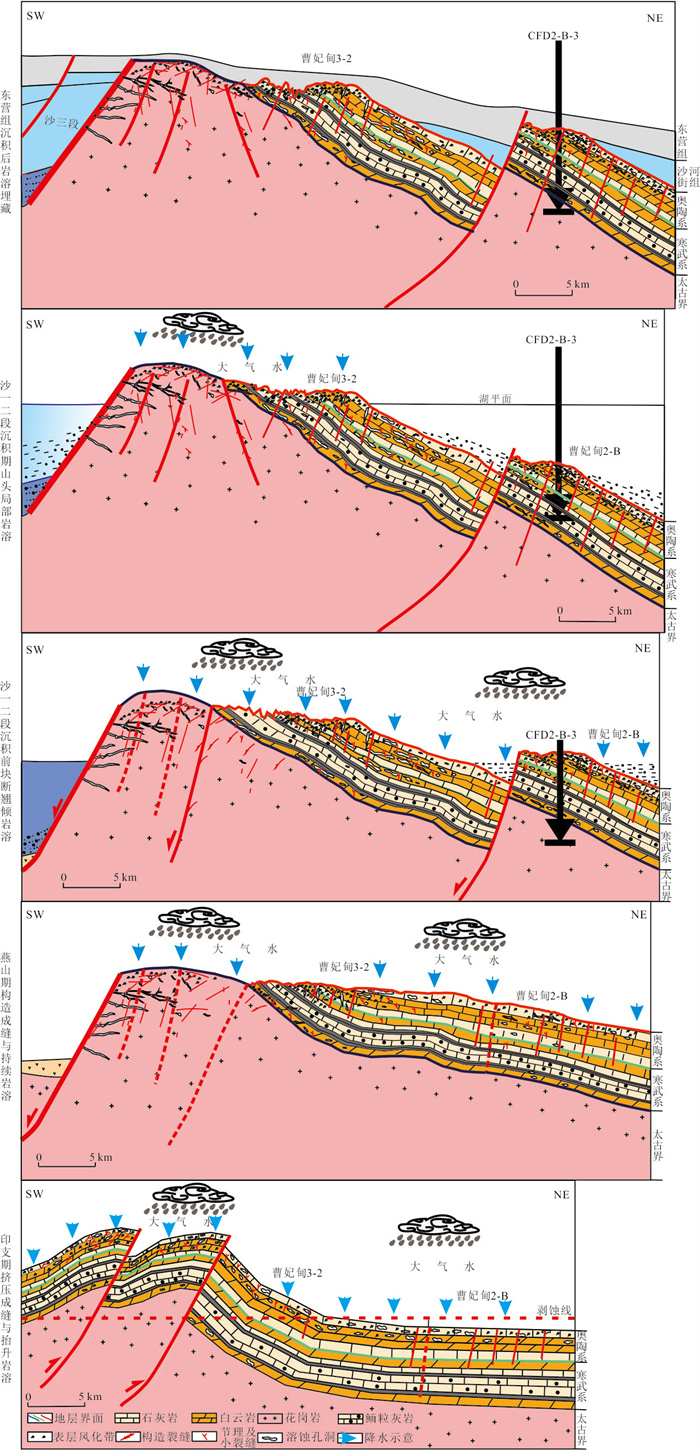
图 8 构造‒岩溶多阶段发育演化模式
Fig. 8. Structure-karst multi-stage development and evolution model diagram
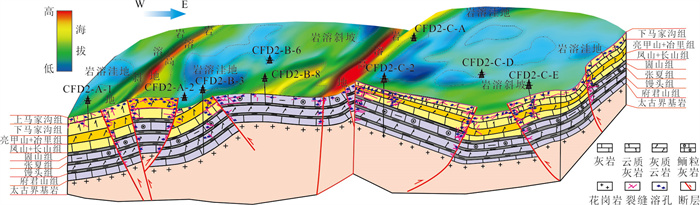
图 9 南堡凹陷斜坡带下古生界储层发育模式(据李慧勇等,2021修改)
Fig. 9. Development model of Lower Paleozoic reservoir in slope zone of Nanpu sag (from Li et al., 2021)
表 1 实验样品X-衍射成分数据及溶蚀度排序
Table 1. X-ray diffraction composition data and dissolution sort of experimental samples
岩类 样品编号 层位 深度(m) 方解石含量(%) 白云石含量(%) Ca+浓度 溶蚀度排序 灰岩 9-30-B 张夏组 3 544.0 95.45 2.28 5.94 3 3-30-B 下马家沟组 3 421.5 85.21 12.35 6.73 1 1-30-B 上马家沟组 3 217.5 54.47 41.71 6.69 2 5-30-B 亮甲山组 3 220.8 54.43 43.69 5.69 4 白云岩 10-30-B 徐庄组 3 188.0 0.31 67.73 3.49 1 6-30-B 冶里组 3 209.6 0.21 98.39 2.85 2 8-30-B 长山组 3 365.5 - 99.18 2.66 3  下载: 导出CSV
-
Cao, Z. H., Liu, G. Y., Zhang, H. C., et al., 2014. Experimental Research of Carbonate Rocks Dissolution Characteristics in Paleozoic Group of Nanpu Sag and Surrounding Bulge Areas. Journal of China University of Petroleum (Edition of Natural Science), 38(1): 8-13 (in Chinese with English abstract). Chen, Y., 2020. Research on Buried Hill Carbonate Karst Reservoirs in Bozhong 21-22 Structural Area (Dissertation). Chengdu University of Technology, Chengdu, 1-3 (in Chinese with English abstract). Cheng, X., 2020. Dissolution Mechanism and High-Quality Reservoir Genesis of Lower Paleozoic Carbonate Rocks in Jiyang-Huanghua Area (Dissertation). China University of Petroleum (East China), Qingdao (in Chinese with English abstract). Deng, X. L., Zhang, Q. Y., Liang, B., et al., 2015. Reconstruction of Karst Palaeogeomorphology for the Ordovician Yingshan Formation in the Central Tarim Basin. Carsologica Sinica, 34(2): 154-158 (in Chinese with English abstract). Dong, Y. X., Zhao, Z. J., Cao, Z. H., et al., 2015. Exploration Potential and Significance of Ordovician Carbonate Karst Monadnock Traps in Nanpu Sag. Acta Petrolei Sinica, 36(6): 653-663 (in Chinese with English abstract). Guo, J. H., Guo, Y. C., Wang, L. S., 2009. Features of Buried Hill Reservoirs in Hexiwu Structural Belt, Langgu Sag, Jizhong Depression. Petroleum Exploration and Development, 36(6): 701-708 (in Chinese with English abstract). doi: 10.1016/S1876-3804(10)60004-3 Han, C. C., 2017. Study on the Characteristics and Distribution of Ordovician Fault-Controlled Karst Reservoirs in Tahe Oilfield (Dissertation). China University of Petroleum (East China), Qingdao (in Chinese with English abstract). Hassani, A., Mortazavi, S. A., Gholinezhad, J., 2014. A New Practical Method for Determination of Critical Flow Rate in Fahliyan Carbonate Reservoir. Journal of Petroleum Science and Engineering, 115: 50-56. https://doi.org/10.1016/j.petrol.2014.02.010 Hua, X. L., Li, H. Y., Xu, P., et al., 2025. The Differential Genetic Mechanism and Model of the Lower Paleozoic Carbonate Buried Hill Reservoirs in the Western Bohai Sea. Earth Science, 50(2): 494-503 (in Chinese with English abstract). Ji, Y. L., Hu, G. M., Huang, J. J., et al., 2006. Study on Mesozoic Stratum Denudation and Mesozoic-Cenozoic Tectonic Evolution in Bohai Bay Area. Journal of Geology, 80(3): 351-358 (in Chinese with English abstract). Jiang, Q. C., Hu, S. Y., Wang, Z. C., et al., 2012. Karst Paleogeomorphology and Exploration Area of Maokou Formation in Sichuan Basin. Petroleum Journal, 33(6): 949-960 (in Chinese with English abstract). Jiang, W., 2017. High-Quality Reservoir Characteristics of Paleozoic Carbonate Buried Hills in Dongying Sag (Dissertation). China University of Petroleum (East China), Qingdao (in Chinese with English abstract). Jin, M. D., Tan, X. C., Zeng, W., et al., 2016. Reconstruction of the Tectonic Palaeogeomorphology of Longwangmiao Formation during the Caledonian-Hercynian Period in Moxi-Gaoshiti Area, Sichuan Basin and Its Geological Significance. Acta Sedimentologica Sinica, 34(4): 634-644 (in Chinese with English abstract). Khodaparast, S., Madanipour, S., Enkelmann, E., et al., 2020. Fault Inversion in Central Iran: Evidence of Post Pliocene Intracontinental Left Lateral Kinematics at the Northern Iranian Plateau Margin. Journal of Geodynamics, 140: 101784. https://doi.org/10.1016/j.jog.2020.101784 Li, H. Y., Xiao, S. G., Li, F., et al., 2021. Structural Characteristics of the Western Branch of the Tanlu Fault in Bohai Sea and Its Control on the Formation of Buried Hills. Bulletin of Geological Science and Technology, 40 (5): 33-41 (in Chinese with English abstract). Li, J. Y., Wang, Y. S., Liu, C. H., et al., 2016. Hydrothermal Fluid Activity and the Quantitative Evaluation of Its Impact on Carbonate Reservoirs: A Case Study of the Lower Paleozoic in the West of Dongying Sag, Bohai Bay Basin. Petroleum Exploration and Development, 43(3): 395-403 (in Chinese with English abstract). doi: 10.1016/S1876-3804(16)30046-5 Li, Z. H., Wang, X., Yang, S. Z., et al., 2006. Analysis of Control Factors of Ordovician Karst Reservoir in Ordos Basin. Geoscience, 20(2): 299-306 (in Chinese with English abstract). Liu, Y., Chen, L. X., Liang, B., et al., 2011. Comparison of Karst Features of Typical Carbonate Buried Hills in China. Marine Geology Letters, 27(3): 6-10 (in Chinese with English abstract). Liu, Y. Q., Deng, S., Li, H. Y., et al., 2025. Development Characteristics and Exploration Implications of Low-Order Fault Systems in Deep Carbonate Rocks: A Case Study of the Shunbei Oil and Gas Field in the Tarim Basin. Geoscience, 50(6): 2239-2254 (in Chinese with English abstract). Ma, L. C., Wang, Y. S., Jing, A. Y., 2020. Discovery and Significance of Subtle Buried Hills in Jiyang Depression, Bohai Bay Basin. Petroleum Geology and Experiment, 42(1): 13-18 (in Chinese with English abstract). Ma, Y. S., He, Z. L., Zhao, P. R., et al., 2019. A New Progress in Formation Mechanism of Deep and Ultra-Deep Carbonate Reservoir. Acta Petrolei Sinica, 40(12): 1415-1425 (in Chinese with English abstract). Nie, M. L., Wen, Z. X., Wang, Z. M., et al., 2020. Genesis and Evaporative Fractionation of Subsalt Condensate in the Northeastern Margin of the Amu Darya Basin. Journal of Petroleum Science and Engineering, 188: 106674. https://doi.org/10.1016/j.petrol.2019.106674 Qi, Z. Q., Cheng, C. R., Sun, X. H., et al., 2008. Evolution of Karst Paleogeomorphology and Development Features of Paleokarstic Caves in the Qianmiqiao Buried Hill in Huabei Oil Fields. Marine Origin Petroleum Geology, 13(4): 37-43 (in Chinese with English abstract). Shi, G., 2010. Ordovician Sequence Stratigraphy and Paleokarst within Sequence Framework in South China (Dissertation). Chengdu University of Technology, Chengdu (in Chinese with English abstract). Shi, Z., 2019. The Research on Palaeokarst Characteristics and Development Model in Nanpu Sag and Surrounding Uplift (Dissertation). China University of Petroleum (East China), Qingdao (in Chinese with English abstract). Tian, X. P., Zhang, W., Zhou, L. D., et al., 2021. Karst Model of Paleozoic Carbonate Buried Hill in No. 2 Fault Zone of Nanpu Sag. Lithologic Reservoirs, 33(6): 93-101 (in Chinese with English abstract). Wang, J. M., 2004. Research on Carbonate Reservoir in Qianmiqiao Buried Hill (Dissertation). China University of Geosciences (Beijing), Beijing (in Chinese with English abstract). Wang, Y. S., Li, J. Y., 2017. Characteristics and Main Controlling Factors of Layered Reservoir in Buried Hill of Carbonate Rock in Pingfangwang Oilfield, Jiyang Depression. Journal of China University of Petroleum (Edition of Natural Science), 41(4): 27-35 (in Chinese with English abstract). Wang, Z. C., Zhao, W. Z., Hu, S. Y., et al., 2013. Reservoir Types and Distribution Characteristics of Large Marine Carbonate Oil and Gas Fields in China. Oil & Gas Geology, 34(2): 153-160 (in Chinese with English abstract). Xiao, S. G., Lü, D. Y., Hou, M. C., et al., 2019. Mesozoic Tectonic Evolution and Buried Hill Formation Mechanism in the Southwestern Bohai Sea. Natural Gas Industry, 39(5): 34-44 (in Chinese with English abstract). Xu, Z. Q., Yang, J. S., Li, H. Q., et al., 2012. Indosinian Collision-Orogenic System of Chinese Continent and Its Orogenic Mechanism. Acta Petrologica Sinica, 28(6): 1697-1709 (in Chinese with English abstract). Zan, N. M., Wang, Y. Z., Cao, Y. C., et al., 2018. Characteristics and Development Patterns of Reservoir Space of the Lower Paleozoic Buried Hills in Dongying Sag, Bohai Bay Basin. Oil & Gas Geology, 39(2): 355-365 (in Chinese with English abstract). Zeng, L. B., Qi, J. F., Wang, Y. X., 2007. Origin Type of Tectonic Fractures and Geological Conditions in Low-Permeability Reservoirs. Acta Petrolei Sinica, 28(4): 52-56 (in Chinese with English abstract). Zhao, X. Z., Wang, Q., Jin, F. M., et al., 2012. Main Controlling Factors and Exploration Practice of Subtle Buried-Hill Hydrocarbon Reservoir in Jizhong Depression. Acta Petrolei Sinica, 33(S1): 71-79 (in Chinese with English abstract). Zou, C. N., Zhang, G. Y., Tao, S. Z., et al., 2010. Geological Features, Major Discoveries and Unconventional Petroleum Geology in the Global Petroleum Exploration. Petroleum Exploration and Development, 37(2): 129-145. https://doi.org/10.1016/S1876-3804(10)60021-3 曹中宏, 刘国勇, 张红臣, 等, 2014. 南堡凹陷及周边凸起区古生界碳酸盐岩溶解特性的试验研究. 中国石油大学学报(自然科学版), 38(1): 8-13. 陈扬, 2020. 渤中21-22构造区潜山碳酸盐岩岩溶储层研究(硕士学位论文). 成都: 成都理工大学. 程鑫, 2020. 济阳‒黄骅地区下古生界碳酸盐岩溶解机理及优质储层成因(博士学位论文). 青岛: 中国石油大学(华东). 邓兴梁, 张庆玉, 梁彬, 等, 2015. 塔中Ⅱ区奥陶系鹰山组岩溶古地貌恢复方法研究. 中国岩溶, 34(2): 154-158. 董月霞, 赵宗举, 曹中宏, 等, 2015. 南堡凹陷奥陶系碳酸盐岩岩溶残丘圈闭勘探潜力及意义. 石油学报, 36(6): 653-663. 郭建华, 郭原草, 王连山, 2009. 冀中坳陷廊固凹陷河西务构造带潜山储集层特征. 石油勘探与开发, 36(6): 701-708. 韩长城, 2017. 塔河油田奥陶系断控岩溶储集体特征及分布规律研究(博士学位论文). 青岛: 中国石油大学(华东). 华晓莉, 李慧勇, 许鹏, 等, 2025. 渤海西部下古生界碳酸盐岩潜山储层成因机理及模式. 地球科学, 50(2): 494-503. doi: 10.3799/dqkx.2024.050 纪友亮, 胡光明, 黄建军, 等, 2006. 渤海湾地区中生代地层剥蚀量及中、新生代构造演化研究. 地质学报, 80(3): 351-358. 江青春, 胡素云, 汪泽成, 等, 2012. 四川盆地茅口组风化壳岩溶古地貌及勘探选区. 石油学报, 33(6): 949-960. 姜伟, 2017. 东营凹陷古生界碳酸盐岩古潜山优质储层特征(硕士学位论文). 青岛: 中国石油大学(华东). 金民东, 谭秀成, 曾伟, 等, 2016. 四川盆地磨溪‒高石梯地区加里东‒海西期龙王庙组构造古地貌恢复及地质意义. 沉积学报, 34(4): 634-644. 李慧勇, 肖述光, 李飞, 等, 2021. 渤海郯庐断裂西支构造特征及对潜山形成的控制作用. 地质科技通报, 40(5): 33-41. 李继岩, 王永诗, 刘传虎, 等, 2016. 热液流体活动及其对碳酸盐岩储集层改造定量评价: 以渤海湾盆地东营凹陷西部下古生界为例. 石油勘探与开发, 43(3): 359-366. 李振宏, 王欣, 杨遂正, 等, 2006. 鄂尔多斯盆地奥陶系岩溶储层控制因素分析. 现代地质, 20(2): 299-306. 刘阳, 陈利新, 梁彬, 等, 2011. 中国东部与西部典型碳酸盐岩潜山的岩溶特征. 海洋地质前沿, 27(3): 6-10. 刘雨晴, 邓尚, 李海英, 等, 2025. 深层碳酸盐岩低序级断裂体系发育特征及勘探启示: 以塔里木盆地顺北油气田为例. 地球科学, 50(6): 2239-2254. doi: 10.3799/dqkx.2025.054 马立驰, 王永诗, 景安语, 2020. 渤海湾盆地济阳坳陷隐蔽潜山油藏新发现及其意义. 石油实验地质, 42(1): 13-18. 马永生, 何治亮, 赵培荣, 等, 2019. 深层‒超深层碳酸盐岩储层形成机理新进展. 石油学报, 40(12): 1415-1425. 齐振琴, 程昌茹, 孙秀会, 等, 2008. 千米桥古潜山岩溶地貌演化及古岩溶洞穴发育特征. 海相油气地质, 13(4): 37-43. 时国, 2010. 南华北地区奥陶系层序地层与层序格架内古岩溶研究(博士学位论文). 成都: 成都理工大学. 师政, 2016. 南堡凹陷及周边凸起古岩溶作用特征及发育模式研究(博士学位论文). 青岛: 中国石油大学(华东). 田晓平, 张汶, 周连德, 等, 2021. 南堡凹陷二号断裂带古生界碳酸盐岩潜山岩溶模式. 岩性油气藏, 33(6): 93-101. 王俊明, 2004. 千米桥潜山碳酸盐岩储层研究(博士学位论文). 北京: 中国地质大学(北京). 王永诗, 李继岩, 2017. 济阳坳陷平方王油田碳酸盐岩潜山内幕储层特征及其主控因素. 中国石油大学学报(自然科学版), 41(4): 27-35. 汪泽成, 赵文智, 胡素云, 等, 2013. 我国海相碳酸盐岩大油气田油气藏类型及分布特征. 石油与天然气地质, 34(2): 153-160. 肖述光, 吕丁友, 侯明才, 等, 2019. 渤海海域西南部中生代构造演化过程与潜山形成机制. 天然气工业, 39(5): 34-44. 许志琴, 杨经绥, 李化启, 等, 2012. 中国大陆印支碰撞造山系及其造山机制. 岩石学报, 28(6): 1697-1709. 昝念民, 王艳忠, 操应长, 等, 2018. 东营凹陷下古生界碳酸盐岩古潜山储层储集空间特征及发育模式. 石油与天然气地质, 39(2): 355-365. 曾联波, 漆家福, 王永秀, 2007. 低渗透储层构造裂缝的成因类型及其形成地质条件. 石油学报, 28(4): 52-56. 赵贤正, 王权, 金凤鸣, 等, 2012. 冀中坳陷隐蔽型潜山油气藏主控因素与勘探实践. 石油学报, 33(S1): 71-79. -

 点击查看大图
计量
- 文章访问数: 146
- HTML全文浏览量: 12
- PDF下载量: 38
- 被引次数: 0
