




Formation and Coupling Model of Basin-Mountain Systems Characterized by "Low Mountain, Deep Basin": Evidence from Jianghan Basin
-
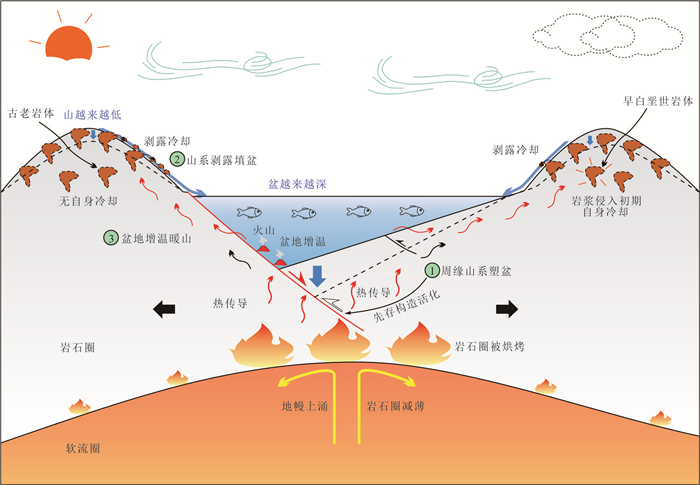
摘要: 目前,盆山耦合理论已形成广泛共识,然而该理论在解释裂陷盆地及其周缘山系的耦合过程中还存在较多问题.为了阐明伸展体制之下的盆山耦合关系,研究以江汉盆地及周缘山系为例,基于野外露头、钻井与地震资料、地球化学与热年代学数据的综合分析,系统揭示了盆山构造演化过程.结果表明:周缘山系先后经历了快速冷却、持续冷却、缓慢冷却和快速冷却阶段,相应地,盆地则经历了基底挤压变形、热隆升、裂陷沉降和坳陷演化;软流圈地幔在驱动盆地裂陷沉降的同时,也带来了大量的深部复合物质.研究认为,在“低山深盆型”盆山体系形成过程中,盆地不断沉降、变深,而周缘山系不断剥露、变低.盆山之间的耦合模式为“周缘山系塑盆、山系剥露填盆、盆地增温暖山”.Abstract: The basin-mountain coupling theory has been widely recognized. However, it remains controversial in its interpretation for the basin-mountain systems in extensional regime. To unravel the basin-mountain coupling relationships under extensional regime, this study integrates field outcrops, borehole and seismic data, and geochemical and thermochronological data from the Jianghan basin and surrounding mountains, systematically clarifying their tectonic evolution. The surrounding mountains successively experienced rapid cooling, continued cooling, slow cooling and rapid cooling stages, and the Jianghan basin accordingly experienced compressional deformation, thermal doming, rifting and subsidence, and post-rift evolution. The upwelling of asthenospheric mantle not only drove the basin to undergo rifting and subsidence, but also delivered a large amount of deep composite materials to the basin. Our study proposes that the Jianghan basin became progressively deeper during the formation of the basin-mountain system, while the surrounding mountains got progressively lower and lower. The influence between the Jianghan basin and surrounding mountains is multi-faceted and single-directional. Their coupling model can be summarized as follows: (1) surrounding mountains shape the basin; (2) mountain exhumation results in basin filling; (3) the basin with increasing heat input transfers heat to surrounding mountains.
-
Key words:
- basin-mountain system /
- basin-mountain coupling /
- thermal history /
- rift evolution /
- mantle upwelling /
- Jianghan basin /
- tectonics /
- geodynamics
-
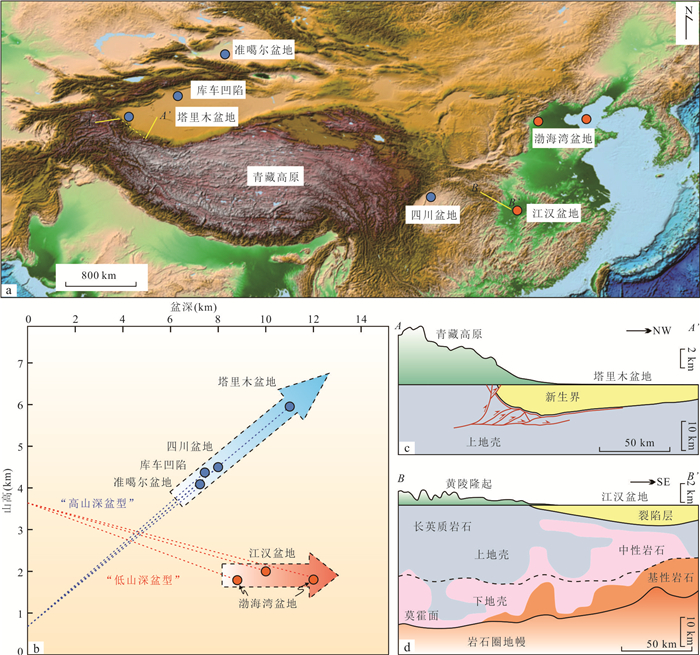
图 1 中国代表性盆山体系的分类(a、b)与结构特征剖面(c、d)
a.据Amante and Eakins(2009)修改;b.数据来自贾承造等(2008);Wu et al.,2020a,2020c;李智武等(2021);吴海等(2024);Xiang et al.(2024);徐振平等(2024);赵邦六等(2024);Zhang et al.(2025);c.据李超(2019);Xiang et al.(2024)修改;d.据Zhang et al.(2009)修改
Fig. 1. Classification (a, b) and sectional architecture (c, d) of the representative basin-mountain systems in China
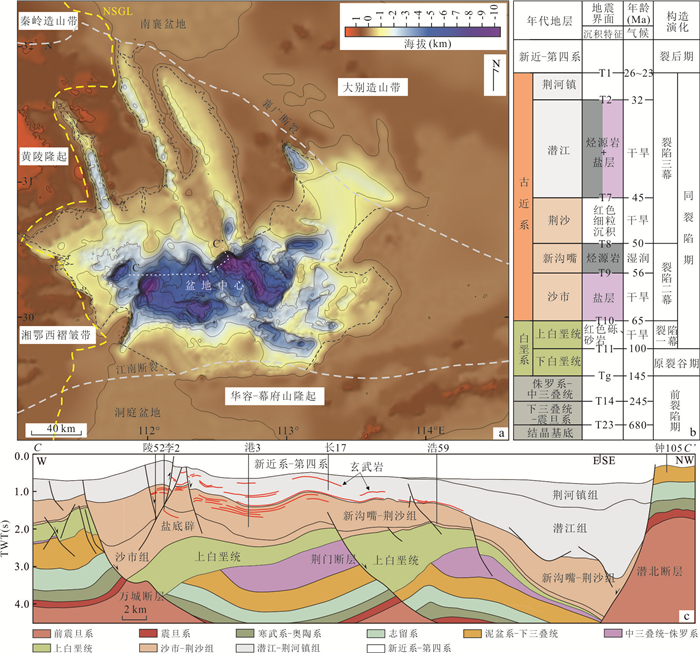
图 2 江汉盆地及周缘山系现今盆地埋深与山系高程等值线图(a);江汉盆地地层柱状图(b);江汉盆地近东西向骨架剖面(c)
Fig. 2. Present basin depth and mountain elevation of the Jianghan basin and its surrounding mountains (a); stratigraphy column of the Jianghan basin (b); nearly E-W-trending seismic profile crossing the Jianghan basin (c)
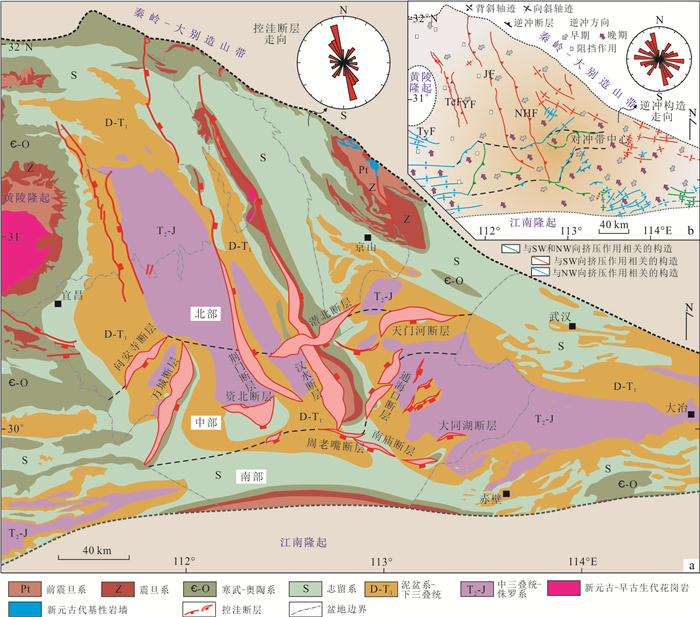
图 3 江汉盆地及邻区基底地质图(a)与晚侏罗世古构造格局(b)
Fig. 3. Basement geological map (a) and Late Jurassic tectonic map (b) of the Jianghan basin and its adjacent region
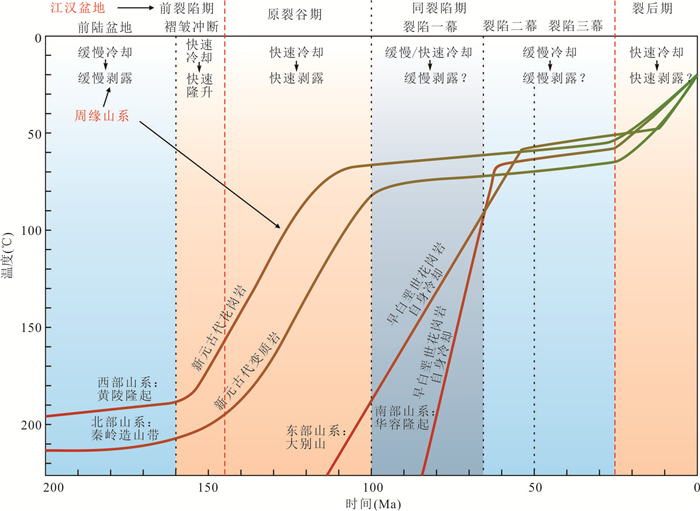
图 4 周缘山系晚侏罗世以来热历史
热史数据来自Shen et al.(2012,2018,2020);Ge et al.(2013);Ji et al.(2014);Tian et al.(2025)及所附参考文献
Fig. 4. Late Jurassic to present thermal history of the surrounding mountains of the Jianghan basin
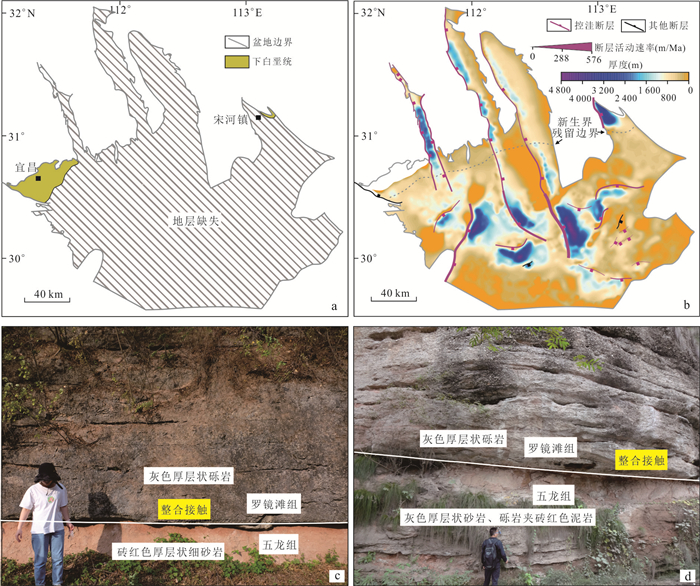
图 5 江汉盆地上、下白垩统分布特征(a、b)与接触关系(c、d)
a,d.据Wu et al.(2018)
Fig. 5. Distribution of Upper and Lower Cretaceous (a‒b) and their stratigraphic contact (c‒d)
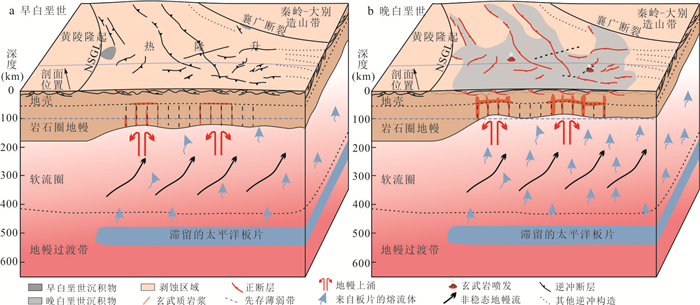
图 6 江汉盆地白垩纪动力学过程示意图
Fig. 6. Cartoon diagrams illustrating the Cretaceous geodynamics of the Jianghan basin
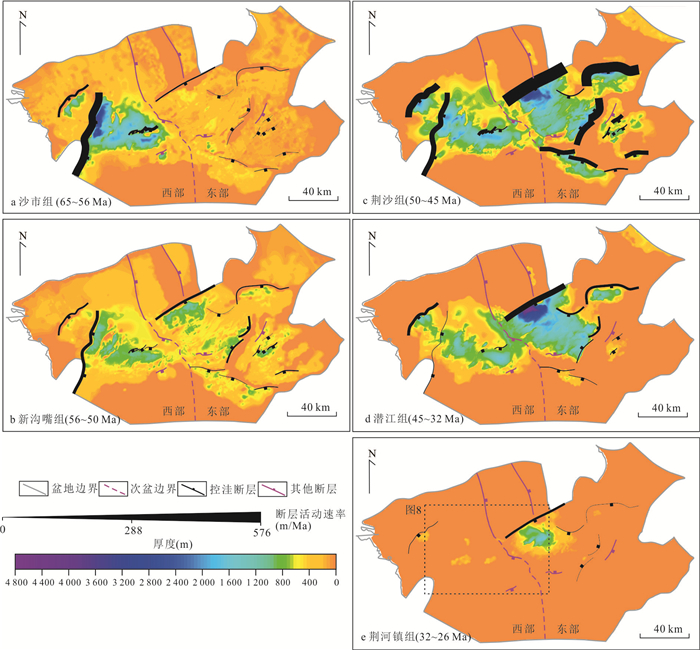
图 7 江汉盆地古近纪不同时期断层活动性与地层展布特征
Fig. 7. Paleocene fault activity rates of major faults and stratal thicknesses in the Jianghan basin
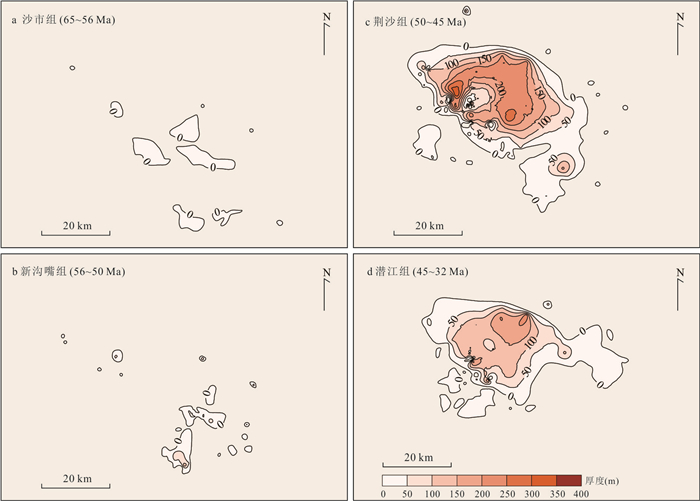
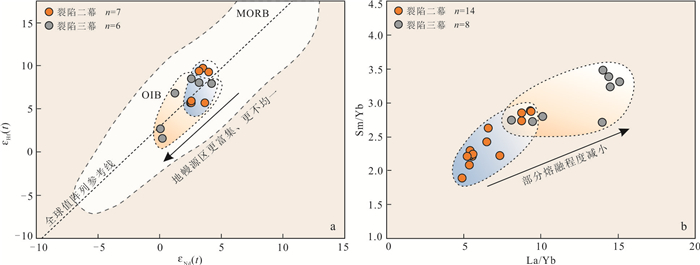
图 9 江汉盆地裂陷二幕‒三幕玄武岩Nd-Hf同位素组成(a)与La/Yb-Sm/Yb散点图(b)
数据来自彭头平等(2006);吴路路(2019)
Fig. 9. Nd and Hf isotope compositions (a) and La/Yb vs. Sm/Yb diagram (b) of the Jianghan basalts during rift Phases 2‒3
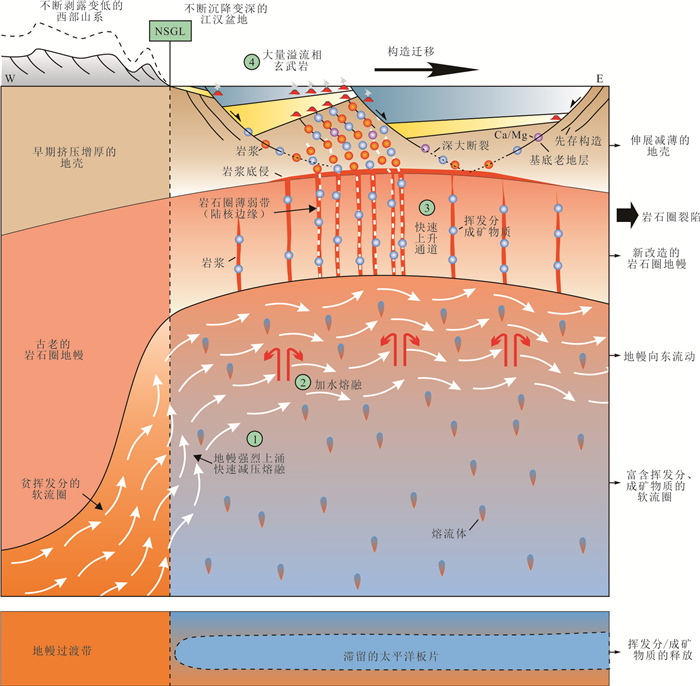
图 10 江汉盆地古近纪动力学过程与深部复合物质输入示意图
Fig. 10. Cartoon diagram illustrating the Paleogene geodynamics of the Jianghan basin, with plenty of deep composite material input
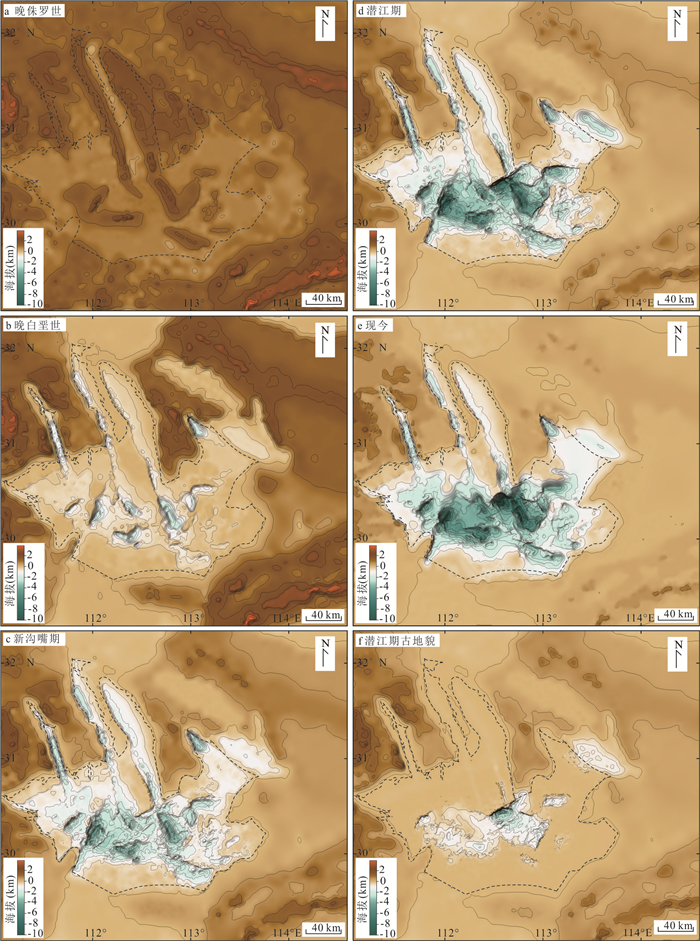
图 11 江汉盆地及周缘山系晚侏罗世以来盆深与山高演化示意图(a‒e)与潜江期古地貌图(f)
Fig. 11. Evolution of basin depth and mountain elevation of the Jianghan basin and its surrounding mountains during the Late Jurassic to present (a‒e), with the paleotopography during the Qianjiang stage (f)
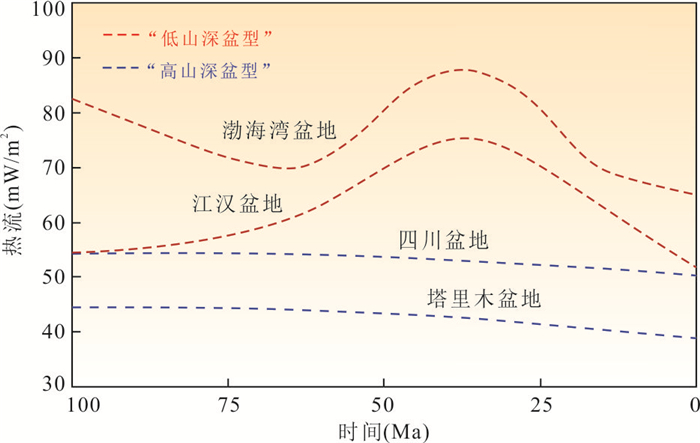
图 12 不同属性盆山体系下盆地热流史特征
数据来自袁玉松等(2007);李天义等(2012);Qiu et al.(2014);邱楠生等(2023)
Fig. 12. Basin heat flow history in different basin-mountain system
-
Amante, C., Eakins, B. W., 2009. ETOPO1 1 Arc-Minute Global Relief Model: Procedures, Data Sources and Analysis. NOAA Technical Memorandum NESDIS NGDC-24. National Geophysical Data Center, NOAA, Boulder. https://doi.org/10.7289/V5C8276M Ge, X., Shen, C. B., Yang, Z., et al., 2013. Low-Temperature Thermochronology Constraints on the Mesozoic-Cenozoic Exhumation of the Huangling Massif in the Middle Yangtze Block, Central China. Journal of Earth Science, 24(4): 541-552. https://doi.org/10.1007/s12583-013-0348-8 Guo, Z. F., Liu, X. M., Chen, H., 2007. Basin-Mountain Coupling Relationship and Oil-Gas Response in Lower Palaeozoic since the Indo-China Epoch in Jianghan Plain. Petroleum Geology and Recovery Efficiency, 14(3): 49-51, 114 (in Chinese with English abstract). Ji, W. B., Lin, W., Faure, M., et al., 2014. Origin and Tectonic Significance of the Huangling Massif within the Yangtze Craton, South China. Journal of Asian Earth Sciences, 86: 59-75. https://doi.org/10.1016/j.jseaes.2013.06.007 Jia, C. Z., Yang, S. F., Wei, G. Q., et al., 2008. Structure Characteristics and Petroleum-Bearing Prospects of Cenozoic Circum-Tibet Plateau Basin and Range System in China. Natural Gas Industry, 28(8): 1-11, 133 (in Chinese with English abstract). Ju, Y. W., Wang, W., Ren, Z. L., et al., 2025. Multi-Stage Evolution of the Ordos Basin: Its Coupled Basin-Mountain Systems and Energy Resource. Science China Earth Sciences, 55(8): 2537-2582 (in Chinese). Li, B. L., Jia, C. Z., Pang, X. Q., et al., 2007. The Spatial Distribution of the Foreland Thrust Tectonic Deformation in the Circum-Tibetan Plateau Basin and Range System. Acta Geologica Sinica, 81(9): 1200-1207 (in Chinese with English abstract). Li, C., 2019. Research on the Cenozoic Subsidence Evolution in the Tarim Basin and the Process of Uplift of the Tian Shan (Dissertation). Nanjing University, Nanjing (in Chinese with English abstract). Li, F. Q., Wang, C. S., Zhu, L. D., et al., 2002. The Basin-Range Coupling under the Regional Compressional Regimes: Examples from the Hexi Corridor Basin and North Qilian Mountains. Sedimentary Geology and Tethyan Geology, 22(4): 17-25 (in Chinese with English abstract). Li, J. L., Xiao, W. J., Yan, Z., 2003. Basin-Range Coupling and Its Sedimentation. Acta Sedimentologica Sinica, 21(1): 52-60 (in Chinese with English abstract). Li, T. Y., He, S., He, Z. L., et al., 2012. Reconstruction of Tectonic Uplift and Thermal History since Mesozoic in the Dangyang Synclinorium of the Central Yangtze Area. Acta Petrolei Sinica, 33(2): 213-224 (in Chinese with English abstract). Li, Y., 1998. On the Coupling Relationship between Longmenshan Foreland Basin and Longmenshan Orogenic Belt. Bulletin of Mineralogy, Petrology and Geochemistry, 17(2): 10-14 (in Chinese with English abstract). Li, Z. Q., Ma, C. D., Ying, D. L., et al., 2014. Tectonic Dynamic Evolution and Analysis of Basin-Range Coupling and Basin-Mountain Coupling in Sichuan-Chongqing Region, China. Acta Petrologica Sinica, 30(3): 631-640 (in Chinese with English abstract). Li, Z. W., Song, T. H., Wang, Z. J., et al., 2021. Strike Variation Evolution of the Basin-Mountain System in Western Sichuan Longmenshan as Recorded by Deformation, Exhumation and Deposition and Discussion on the Period of Key Structural Transformation. Journal of Chengdu University of Technology (Science & Technology Edition), 48(3): 257-282 (in Chinese with English abstract). Liu, C. L., Yu, X. C., Yuan, X. Y., et al., 2021. Characteristics, Distribution Regularity and Formation Model of Brine-Type Li Deposits in Salt Lakes in the World. Acta Geologica Sinica, 95(7): 2009-2029 (in Chinese with English abstract). Liu, D. M., Li, D. W., 2002. The Coupling Relationship between the Orogens and the Sedimentary Basins-An Example from Qinghai-Tibet Plateau and Its Surrounding Basins. Northwestern Geology, 35(1): 15-21 (in Chinese with English abstract). Liu, H. F., Liang, H. S., Li, X. Q., et al., 2000a. The Coupling Mechanisms of Mesozoic-Cenozoic Rift Basins and Extensional Mountain System in Eastern China. Earth Science Frontiers, 7(4): 477-486 (in Chinese with English abstract). Liu, H. F., Wang, Z. C., Xiong, B. X., et al., 2000b. Coupling Analysis of Mesozoic-Cenozoic Foreland Basin and Mountain System in Central and Western China. Earth Science Frontiers, 7(3): 55-72 (in Chinese with English abstract). Liu, S. F., Zhang, G. W., 2005. Fundamental Ideas, Contents and Methods in Study of Basin and Mountain Relationships. Earth Science Frontiers, 12(3): 101-111 (in Chinese with English abstract). Liu, S. G., Luo, Z. L., Dai, S. L., et al., 1995. The Uplift of the Longmenshan Thrust Belt and Subsidence of the Western Sichuan Foreland Basin. Acta Geologica Sinica, 69(3): 205-214 (in Chinese with English abstract). Ma, Z. J., Qu, G. S., Li, T., et al., 2008. Tectonic Coupling and Segmentation of Marginal Structural Belt in Junggar Basin. Xinjiang Petroleum Geology, 29(3): 271-277 (in Chinese with English abstract). Niu, S. Y., Shao, J. A., Sun, A. Q., et al., 2006. Coupling Relationship between Basin-Mountain and Nedogenic Mineralization in the Eastern Part of North China. Geotectonica et Metallogenia, 30(3): 331-342 (in Chinese with English abstract). Niu, S. Y., Sun, A. Q., Bai, W. J., 1995. Lateral Migration of the Lithospheric Material between Orogenic Zones and Adjacent Basins. Earth Science Frontiers, 2(1): 85-92 (in Chinese with English abstract). Peng, T. P., Wang, Y. J., Fan, W. M., et al., 2006. 39Ar/40Ar Geochronology and Geochemistry of the Early Tertiary Basaltic Rocks in the Jianghan Basin, China and Its Petrogenesis. Acta Petrologica Sinica, 22(6): 1617-1626 (in Chinese with English abstract). Qiu, N. S., Chang, J., Feng, Q. Q., et al., 2023. Maturation History of Deep and Ultra-Deep Source Rocks, Central and Western Basins, China. Earth Science Frontiers, 30(6): 199-212 (in Chinese with English abstract). Qiu, N. S., Zuo, Y. H., Chang, J., et al., 2014. Geothermal Evidence of Meso-Cenozoic Lithosphere Thinning in the Jiyang Sub-Basin, Bohai Bay Basin, Eastern North China Craton. Gondwana Research, 26(3/4): 1079-1092. https://doi.org/10.1016/j.gr.2013.08.011. Shen, C. B., Hu, D., Min, K., et al., 2020. Post-Orogenic Tectonic Evolution of the Jiangnan-Xuefeng Orogenic Belt: Insights from Multiple Geochronometric Dating of the Mufushan Massif, South China. Journal of Earth Science, 31(5): 905-918. https://doi.org/10.1007/s12583-020-1346-2 Shen, C. B., Hu, D., Shao, C., et al., 2018. Thermochronology Quantifying Exhumation History of the Wudang Complex in the South Qinling Orogenic Belt, Central China. Geological Magazine, 155(4): 893-906. https://doi.org/10.1017/s0016756816001047 Shen, C. B., Mei, L. F., Min, K., et al., 2012. Multi-Chronometric Dating of the Huarong Granitoids from the Middle Yangtze Craton: Implications for the Tectonic Evolution of Eastern China. Journal of Asian Earth Sciences, 52: 73-87. https://doi.org/10.1016/j.jseaes.2012.02.013 Shen, C. B., Mei, L. F., Xu, Z. P., et al., 2007. Architecture and Tectonic Evolution of Composite Basin-Mountain System in Sichuan Basin and Its Adjacent Areas. Geotectonica et Metallogenia, 31(3): 288-299 (in Chinese with English abstract). Shu, L. S., Zhou, X. M., Deng, P., et al., 2004. Characteristics and Tectonic Evolution of Mesozoic and Cenozoic Basins in Southeastern China. Geological Bulletin of China, 23(S2): 876-884 (in Chinese with English abstract). Sun, Z. L., Li, Z. M., He, C. C., et al., 2025. Characteristics of Connected Pores and Evaluation of Shale Oil Mobility in the Qianjiang Formation, Qianjiang Sag, Jianghan Basin, China. Journal of Earth Science, 36(4): 1591-1604. https://doi.org/10.1007/s12583-022-1699-9 Tang, L. J., Qiu, H. J., Yun, L., et al., 2012. Analysis of Basin-Mountain Coupling and Transition of the Northern Tarim Basin-Southern Tianshan Orogenic Belt. Earth Science Frontiers, 19(5): 195-204 (in Chinese with English abstract). Tian, Y. T., Li, B. J., Zhong, H. X., et al., 2025. A Method for Reconstructing Denudation Histories from Big Global Thermochronologic Data, Tested on the Dabie Orogen, Eastern China. Journal of Geophysical Research: Solid Earth, 130(3): e2024JB029044. https://doi.org/10.1029/2024JB029044 Wang, B. J., Bao, H. Y., Wu, S. Q., et al., 2024. New Fields, New Types and Resource Potentials of Oil-Gas Exploration in Jianghan Basin. Acta Petrolei Sinica, 45(1): 133-146, 240 (in Chinese with English abstract). Wang, D. L., Mei, L. F., Liu, Y. S., et al., 2018. Mesozoic-Cenozoic Episodic Subsidence and Migration of Jianghan Basin in Extensional Composite Basin-Mountain System. Earth Science, 43(11): 4180-4192 (in Chinese with English abstract). Wang, Q. C., Cong, B. L., Ma, L., 1997. Structural Coupling of the Dabie Orogen with Hefei Basin. Chinese Science Bulletin, 42(6): 575-580 (in Chinese). doi: 10.1360/csb1997-42-6-575 Wang, Q. C., Li, Z., 2003. Basin-Orogen Coupling and Origin of Sedimentary Basins. Acta Sedimentologica Sinica, 21(1): 24-30 (in Chinese with English abstract). Wu, C. L., Du, Y. S., Mei, L. F., et al., 2006. Composite Basin-and-Range System and Reformation of Basin Prototype in Indosinian-Yanshanian in South China. Oil & Gas Geology, 27(3): 305-315 (in Chinese with English abstract). Wu, G. Y., 1998. A Tectonic Outlook of Mobilism on Basin Study. Petroleum Geology & Experiment, 20(4): 309-318 (in Chinese with English abstract). Wu, G. Y., Ma, L., 2004. Orogeny and Coupled/Decoupled Basin Development: A Review. Geotectonica et Metallogenia, 28(1): 81-97 (in Chinese with English abstract). Wu, H., Zhuo, Q. G., Liu, S. B., et al., 2024. Ultra-Deep Tectonic Evolution and Hydrocarbon Accumulation Process in the Lower Play of Sikeshu Sag, Southern Junggar Basin, Western China. Acta Geologica Sinica, 98(7): 2216-2232 (in Chinese with English abstract). Wu, L., Yang, H. T., Zhang, Y. S., et al., 2023. Structural Coupling between the Qaidam Basin and Bordering Orogenic Belts in the Cenozoic. Acta Geologica Sinica, 97(9): 2939-2955 (in Chinese with English abstract). Wu, L. L., 2019. The Initiation, Evolution and Abandonment of the Jianghan Basin: Combined Influence of Basement Structures and Mantle Dynamics (Dissertation). China University of Geosciences, Wuhan (in Chinese with English abstract). Wu, L. L., Mei, L. F., Liu, Y. S., et al., 2018. The Stratigraphic and Structural Record of the Cretaceous Jianghan Basin, Central China: Implications for Initial Rifting Processes and Geodynamics. Cretaceous Research, 90: 21-39. https://doi.org/10.1016/j.cretres.2018.03.028. Wu, L. L., Mei, L. F., Paton, D. A., et al., 2020a. Basement Structures have Crucial Influence on Rift Development: Insights from the Jianghan Basin, Central China. Tectonics, 39(2): e2019TC005671. https://doi.org/10.1029/2019TC005671. Wu, L. L., Mei, L. F., Paton, D. A., et al., 2020b. Late Cretaceous-Cenozoic Intraplate Extension and Tectonic Transitions in Eastern China: Implications for Intraplate Geodynamic Origin. Marine and Petroleum Geology, 117: 104379. https://doi.org/10.1016/j.marpetgeo.2020.104379 Wu, W., Li, Q., Pei, J. X., et al., 2020c. Seismic Sedimentology, Facies Analyses, and High-Quality Reservoir Predictions in Fan Deltas: A Case Study of the Triassic Baikouquan Formation on the Western Slope of the Mahu Sag in China's Junggar Basin. Marine and Petroleum Geology, 120: 104546. https://doi.org/10.1016/j.marpetgeo.2020.104546 Xiang, X., Chen, H. L., Chen, L., et al., 2024. Plume-Modified Lithosphere Mantle Controlled the Cenozoic Sediment Thickness in the Tarim Basin. Geophysical Research Letters, 51(2): e2023GL106203. https://doi.org/10.1029/2023GL106203 Xiao, A. C., Wei, G. Q., Shen, Z. Y., et al., 2011. Basin-Mountain System and Tectonic Coupling between Yangtze Block and South Qinling Orogen. Acta Petrologica Sinica, 27(3): 601-611 (in Chinese with English abstract). Xu, J., Gao, Z. W., Sun, J. B., et al., 2001. A Preliminary Study of the Coupling Relationship between Basin and Mountain in Extensional Environments-A Case Study of the Bohai Bay Basin and Taihang Mountain. Acta Geologica Sinica, 75(2): 165-174 (in Chinese with English abstract). Xu, X. S., Xu, Q., 1996. Basin-Mountain Conversion and New Problems in Contemporary Basin Analysis. Sedimentary Facies and Palaeogeography, (2): 24-33 (in Chinese with English abstract). Xu, Z. P., Yang, X. Z., Neng, Y., et al., 2024. Layered Structural Deformation Characteristics of Kuqa Foreland Thrust Belt. Xinjiang Petroleum Geology, 45(5): 505-515 (in Chinese with English abstract). Yuan, Y. S., Zhu, C. Q., Hu, S. B., 2007. Heat Flow History, Tectono-Sedimentary Evolution and Thermal Events of the Jianghan Basin. Progress in Geophysics, 22(3): 934-939 (in Chinese with English abstract). Zhang, J., Ma, Z. J., Ren, W. J., 2004. Thinking on the Present Research of Basin-Mountain Coupling. Petroleum Geology & Expeximent, 26(2): 169-175 (in Chinese with English abstract). Zhang, Y. Z., Zeng, L. B., Zhang, R. J., et al., 2025. Control of Differential Tectonic Evolution on Tectonic Fractures in Different Tectonic Segments of Tight Gas Sandstone Reservoirs: Upper Triassic Xujiahe Formation, Western Sichuan Foreland Basin. Journal of Earth Science, 36(5): 2161-2178. https://doi.org/10.1007/s12583-025-0212-7 Zhang, Z. J., Bai, Z. M., Mooney, W., et al., 2009. Crustal Structure across the Three Gorges Area of the Yangtze Platform, Central China, from Seismic Refraction/ Wide-Angle Reflection Data. Tectonophysics, 475(3/4): 423-437. https://doi.org/10.1016/j.tecto.2009.05.022 Zhao, B. L., Liu, Y. M., Li, D. J., et al., 2024. Development and Prospects of Seismic Techniques for the Piedmont in Southwestern Tarim Basin. Geophysical Prospecting for Petroleum, 63(2): 265-278 (in Chinese with English abstract). Zhu, X. M., Liu, Q. H., Tan, M. X., et al., 2026. Research Frontier and Development of Source-to-Sink Systems. Journal of Palaeogeography (Chinese Edition), 28(1): 25-43 (in Chinese with English abstract). 郭战峰, 刘新民, 陈红, 2007. 江汉平原印支期以来的盆山耦合关系及下古生界油气响应. 油气地质与采收率, 14(3): 49-51, 114. 贾承造, 杨树锋, 魏国齐, 等, 2008. 中国环青藏高原新生代巨型盆山体系构造特征与含油气前景. 天然气工业, 28(8): 1-11, 133. 琚宜文, 王巍, 任战利, 等, 2025. 鄂尔多斯盆地的多阶段演化: 盆山耦合系统和能源资源. 中国科学: 地球科学, 55(8): 2537-2582. 李本亮, 贾承造, 庞雄奇, 等, 2007. 环青藏高原盆山体系内前陆冲断构造变形的空间变化规律. 地质学报, 81(9): 1200-1207. 李超, 2019. 塔里木盆地新生代沉降及天山隆升过程研究(博士学位论文). 南京: 南京大学. 李奋其, 王成善, 朱利东, 等, 2002. 区域挤压体制下盆‒山耦合关系探讨: 以河西走廊和北祁连山为例. 沉积与特提斯地质, 22(4): 17-25. 李继亮, 肖文交, 闫臻, 2003. 盆山耦合与沉积作用. 沉积学报, 21(1): 52-60. 李天义, 何生, 何治亮, 等, 2012. 中扬子地区当阳复向斜中生代以来的构造抬升和热史重建. 石油学报, 33(2): 213-224. 李勇, 1998. 论龙门山前陆盆地与龙门山造山带的耦合关系. 矿物岩石地球化学通报, 17(2): 10-14. 李忠权, 麻成斗, 应丹琳, 等, 2014. 川渝地区构造动力学演化与盆岭‒盆山耦合构造分析. 岩石学报, 30(3): 631-640. 李智武, 宋天慧, 王自剑, 等, 2021. 川西‒龙门山盆山系统走向差异演化的变形、隆升和沉积记录及关键构造变革期讨论. 成都理工大学学报(自然科学版), 48(3): 257-282. 刘成林, 余小灿, 袁学银, 等, 2021. 世界盐湖卤水型锂矿特征、分布规律与成矿动力模型. 地质学报, 95(7): 2009-2029. 刘德民, 李德威, 2002. 造山带与沉积盆地的耦合: 以青藏高原周边造山带与盆地为例. 西北地质, 35(1): 15-21. 刘和甫, 梁慧社, 李晓清, 等, 2000a. 中国东部中新生代裂陷盆地与伸展山岭耦合机制. 地学前缘, 7(4): 477-486. 刘和甫, 汪泽成, 熊保贤, 等, 2000b. 中国中西部中、新生代前陆盆地与挤压造山带耦合分析. 地学前缘, 7(3): 55-72. 刘少峰, 张国伟, 2005. 盆山关系研究的基本思路、内容和方法. 地学前缘, 12(3): 101-111. 刘树根, 罗志立, 戴苏兰, 等, 1995. 龙门山冲断带的隆升和川西前陆盆地的沉降. 地质学报, 69(3): 205-214. 马宗晋, 曲国胜, 李涛, 等, 2008. 准噶尔盆地盆山构造耦合与分段性. 新疆石油地质, 29(3): 271-277. 牛树银, 邵济安, 孙爱群, 等, 2006. 华北东部盆山耦合与内生成矿作用. 大地构造与成矿学, 30(3): 331-342. 牛树银, 孙爱群, 白文吉, 1995. 造山带与相邻盆地间物质的横向迁移. 地学前缘, 2(1): 85-92. 彭头平, 王岳军, 范蔚茗, 等, 2006. 江汉盆地早第三纪玄武质岩石39Ar/40Ar年代学和地球化学特征及其成因意义. 岩石学报, 22(6): 1617-1626. 邱楠生, 常健, 冯乾乾, 等, 2023. 我国中西部盆地深层‒超深层烃源岩热演化研究. 地学前缘, 30(6): 199-212. 沈传波, 梅廉夫, 徐振平, 等, 2007. 四川盆地复合盆山体系的结构构造和演化. 大地构造与成矿学, 31(3): 288-299. 舒良树, 周新民, 邓平, 等, 2004. 中国东南部中、新生代盆地特征与构造演化. 地质通报, 23(9): 876-884. 汤良杰, 邱海峻, 云露, 等, 2012. 塔里木盆地北缘‒南天山造山带盆‒山耦合和构造转换. 地学前缘, 19(5): 195-204. 王必金, 包汉勇, 吴世强, 等, 2024. 江汉盆地油气勘探新领域、新类型及资源潜力. 石油学报, 45(1): 133-146, 240. 王德良, 梅廉夫, 刘云生, 等, 2018. 伸展型复合盆山体系下江汉盆地中、新生代幕式沉降与迁移. 地球科学, 43(11): 4180-4192. doi: 10.3799/dqkx.2018.211 王清晨, 从柏林, 马力, 1997. 大别山造山带与合肥盆地的构造耦合. 科学通报, 42(6): 575-580. 王清晨, 李忠, 2003. 盆山耦合与沉积盆地成因. 沉积学报, 21(1): 24-30. 吴冲龙, 杜远生, 梅廉夫, 等, 2006. 中国南方印支‒燕山期复合盆山体系与盆地原型改造. 石油与天然气地质, 27(3): 305-315. 吴根耀, 1998. 盆地研究的活动论构造观. 石油实验地质, 20(4): 309-318. 吴根耀, 马力, 2004. "盆""山"耦合和脱耦: 进展, 现状和努力方向. 大地构造与成矿学, 28(1): 81-97. 吴海, 卓勤功, 柳少波, 等, 2024. 准噶尔盆地南缘四棵树凹陷超深层构造演化与油气成藏过程. 地质学报, 98(7): 2216-2232. 吴磊, 杨惠童, 张永庶, 等, 2023. 新生代柴达木盆地与周缘造山带的构造耦合. 地质学报, 97(9): 2939-2955. 吴路路, 2019. 江汉盆地的开始、演化与夭折: 基底构造与地幔动力的共同制约(博士学位论文). 武汉: 中国地质大学. 肖安成, 魏国齐, 沈中延, 等, 2011. 扬子地块与南秦岭造山带的盆山系统与构造耦合. 岩石学报, 27(3): 601-611. 徐杰, 高战武, 孙建宝, 等, 2001. 区域伸展体制下盆‒山构造耦合关系的探讨: 以渤海湾盆地和太行山为例. 地质学报, 75(2): 165-174. 许效松, 徐强, 1996. 盆山转换和当代盆地分析中的新问题. 岩相古地理, 16(2): 24-33. 徐振平, 杨宪彰, 能源, 等, 2024. 库车前陆冲断带构造分层变形特征. 新疆石油地质, 45(5): 505-515. 袁玉松, 朱传庆, 胡圣标, 2007. 江汉盆地热流史、沉积构造演化与热事件. 地球物理学进展, 22(3): 934-939. 张进, 马宗晋, 任文军, 2004. 对盆山耦合研究的新看法. 石油实验地质, 26(2): 169-175. 赵邦六, 刘依谋, 李大军, 等, 2024. 塔里木盆地塔西南山前带地震技术攻关进展及发展方向. 石油物探, 63(2): 265-278. 朱筱敏, 刘强虎, 谈明轩, 等, 2026. 源汇系统: 研究关注热点和发展趋势. 古地理学报, 28(1): 25-43. -

 下载:
下载:
 点击查看大图
计量
- 文章访问数: 205
- HTML全文浏览量: 6
- PDF下载量: 45
- 被引次数: 0
