




Geological Characteristics, Sweet Spot Evaluation Issues and Technical Countermeasures of Deep Longmaxi Formation Shale Gas in South Sichuan Basin
-
摘要: 针对川南龙马溪组深层页岩气开发工程问题频发、建产不及预期等难题,通过地质特征分析、开发问题梳理与成因探讨,探索深层页岩气甜点评价技术对策.研究表明,川南龙马溪组深层(埋深>3 500 m)页岩气储层具有沉积相变复杂、断层裂缝与微幅构造发育、地应力高且复杂、高温高流体压力、局部低电阻等地质特征,储层非均质性与工程复杂性远高于中深层.利用现有页岩气甜点评价技术优选出的深层甜点区,开发中出现局部资源品质差、水平井套管变形率高达53%、井间压窜普遍、单井产能与经济效益未达预期等问题,核心原因是现有评价体系未充分考虑深层地应力差大、天然裂缝发育、低电阻资源风险等深层特有的地质‒工程耦合问题.据此,提出建立地质‒工程一体化页岩气甜点高精度“透明地质体”、建立以“人造气藏”为核心的动态甜点风险评价体系、采用两次井网分步释放地应力的开发方式,通过资源、工程多要素精细刻画页岩储层特点,动态量化评估甜点开发风险,同时采用两次井网的开发方式,分步骤释放地应力以解决套变的问题.研究成果可为川南等深层页岩气甜点评价与开发风险防控提供技术对策参考.Abstract: To address the frequent engineering problems and lower-than-expected construction and production in the development of deep shale gas in the Longmaxi Formation of South Sichuan, this study explores technical countermeasures for deep shale gas sweet spot evaluation through analysis of geological characteristics, sorting out development challenges and discussing their genesis.Results show that deep shale gas reservoirs (buried depth>3 500 m) of the Longmaxi Formation in South Sichuan are characterized by complex sedimentary facies changes, well-developed faults, fractures and micro-amplitude structures, high and complex in-situ stress, high temperature and high fluid pressure, and local low resistivity.The reservoir heterogeneity and engineering complexity are much higher than those of mid-deep layers. Deep sweet spots optimized by existing shale gas sweet spot evaluation technologies have encountered problems in development, including poor local resource quality, horizontal well casing deformation rate as high as 53%, widespread inter-well fracturing communication, and unsatisfied single-well productivity and economic benefits.The core reason is that the current evaluation system insufficiently considers the unique geological-engineering coupling problems of deep reservoirs, such as large in-situ stress difference, well-developed natural fractures, and low-resistivity resource risks. Accordingly, in this paper it proposes to establish a high-precision "transparent geological body" for shale gas sweet spots through geology-engineering integration, build a dynamic sweet spot risk evaluation system centered on "artificial gas reservoirs", and adopt a development mode of two-step well pattern deployment to release in-situ stress step by step. The shale reservoirs are finely characterized by multiple factors of resources and engineering, and the risks of sweet spot development are dynamically and quantitatively evaluated. Meanwhile, the two-step well pattern development mode is adopted to release in-situ stress gradually to solve casing deformation.The research results can provide technical references for sweet spot evaluation and development risk prevention and control of deep shale gas in South Sichuan and other similar areas.
-
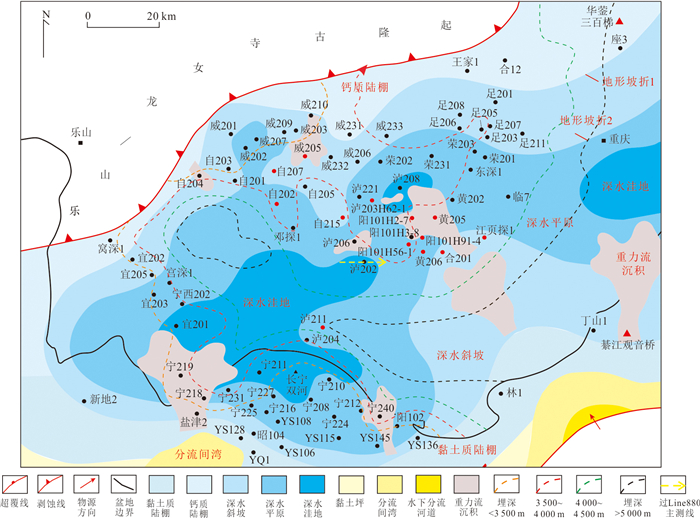
图 1 川南地区龙马溪组沉积相分布(据施振生等(2020)有改动)
Fig. 1. Sedimentary facies distribution of the Longmaxi Formation in South Sichuan (modified from Shi et al., 2020)
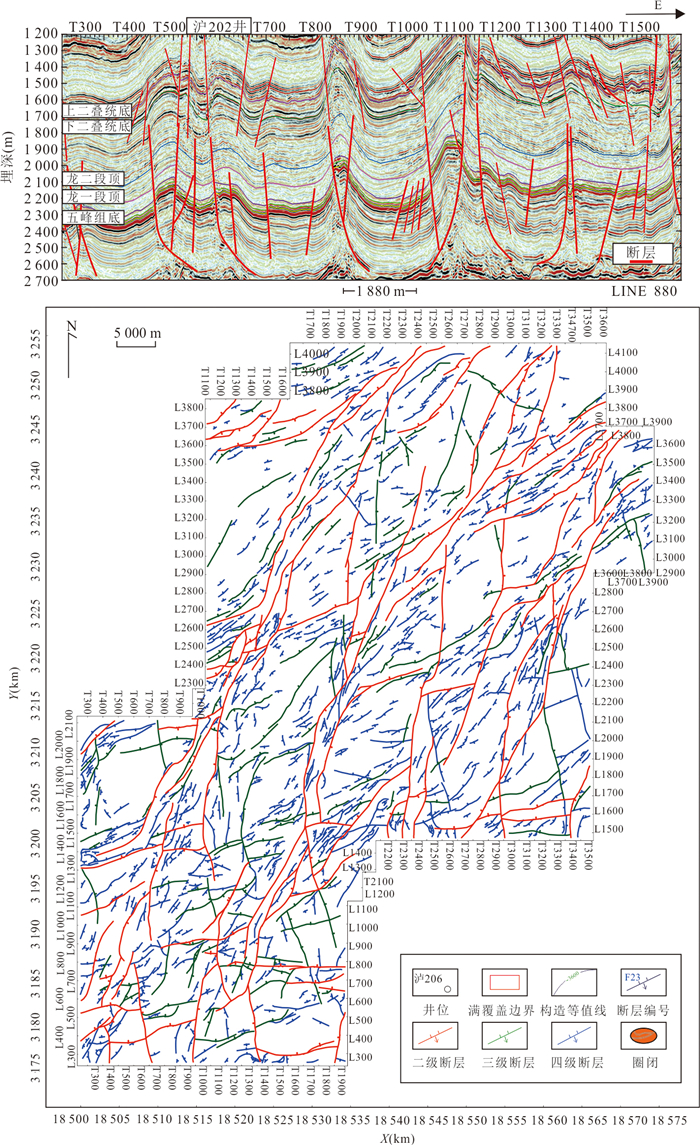
图 2 泸州深层典型地震剖面及构造解释成果
Fig. 2. Typical seismic profile and structural interpretation of deep formations in Luzhou
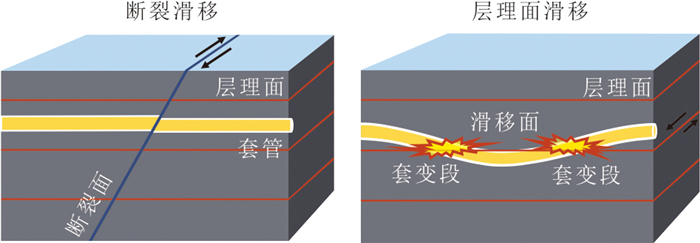
图 3 断裂滑移和层理滑移套变模式(据金亦秋等(2024))
Fig. 3. Schematic diagrams of casing deformation modes caused by fault slip and bedding slip (from Jin et al., 2024)
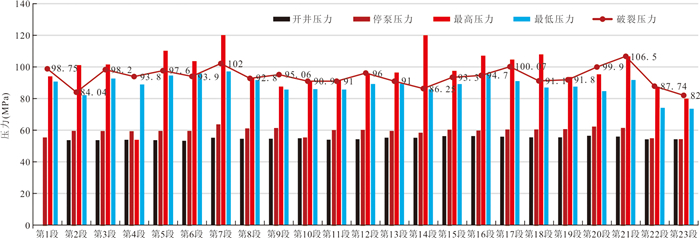
图 4 泸州深层泸203H62-1井水平井各段压裂施工压力与储层破裂压力关系对比
Fig. 4. Comparison between fracturing operation pressure and reservoir breakdown pressure in each horizontal section of Well Lu 203H62-1 in the deep Luzhou area
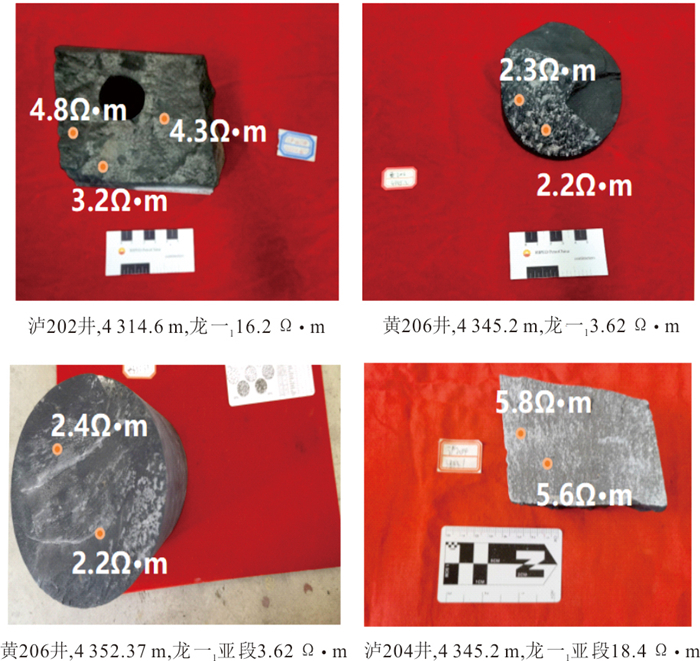
图 5 典型井龙马溪组底部页岩样品擦痕电阻率
Fig. 5. Scratch resistivity of shale samples from the bottom of the Longmaxi Formation in typical wells
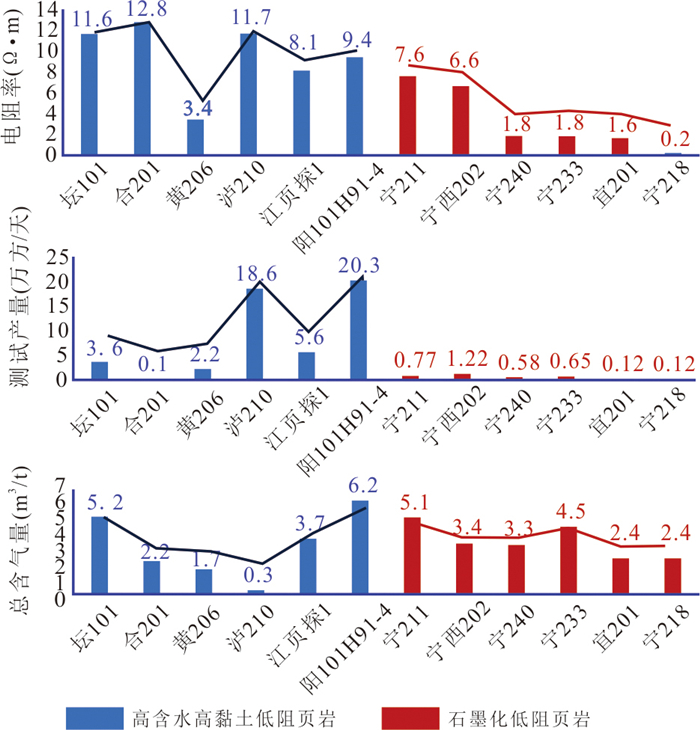
图 6 电阻率与页岩含气性统计关系
Fig. 6. Statistical relationship between resistivity and gas-bearing property of shale
表 1 川南深层与中深层龙马溪组页岩气地质特征对比
Table 1. Comparison of geological characteristics of deep and mid-deep shale gas in Longmaxi Formation, South Sichuan basin
关键参数 深层页岩气田 中深层页岩气田 泸州 自贡 大足 长宁 威远 焦石坝 构造特征 川南低陡褶皱带,次级背斜/向斜构造 川南低缓褶皱带,次级向斜为主 渝西低缓褶皱带,蒲吕场向斜为主 川南低陡褶皱带,长宁背斜为主 川南低缓褶皱带,威远背斜为主 川东高陡褶皱带,焦石坝背斜为主 断裂特征 较发育,高角度正断层为主 不发育,局部小型平移断层 不发育,局部小型逆断层 较发育,高角度逆断层为主 较发育,高角度正断层为主 发育,高角度逆断层为主 地层埋深(m) 3 800~5 000 3 500~4 500 3 800~5 000 2 800~3 500 2 500~3 500 2 300~3 500 优质页岩厚度(TOC>3%, 即Ⅰ类储层厚度)(m) 10~18 7~14 2~10 12~21 5~16 18~27 TOC含量(%) 2.0~5.0(平均3.5) 1.5~4.0(平均2.8) 1.8~4.5(平均3.2) 2.2~5.5(平均3.8) 1.9~4.8(平均3.3) 2.5~6.0(平均4.2) 孔隙度(%) 3.0~6.0(平均4.5) 2.5~5.0(平均3.8) 2.8~5.5(平均4.2) 3.2~6.5(平均4.8) 3.0~6.0(平均4.5) 3.5~7.0(平均5.2) 含气饱和度(%) 60~80 55~75 58~78 62~82 60~80 65~85 含气量(m3/t) 3~10 3~8 2~8 2~9 2~10 2~10 地层压力(MPa) 40~70 35~65 38~72 32~62 34~64 38~75 地层温度(℃) 120~160 110~150 115~155 105~145 108~148 115~160 压力系数 1.8~2.2 1.8~2.0 1.8~1.9 1.3~2.0 1.2~2.0 1.55 储量丰度(108m3/km2) 6~10 6~8 5~7 6~10 6~8 6~10 杨氏模量 30~40 28~38 29~39 32~42 30~40 22~25 泊松比 0.16~0.22 0.19~0.27 0.20~0.31 0.20~0.24 0.19~0.27 0.24~0.27 脆性指数 50~70 45~65 48~68 55~75 52~72 58~78 水平最大主应力(MPa) 95~115 87~115 99~106 65~85 86~98 65~80 水平最小主应力(MPa) 83~99 78~99 79~87 45~60 73~83 52~68 垂向主应力(MPa) 90~108 92~111 99~103 52~60 81~90 67~75 主应力差(MPa) 15~22 10~17 18~20 9~15 12~15 5~12 地应力机制 走滑‒挤压型 走滑‒挤压型 挤压‒走滑型 挤压型 走滑‒挤压型 挤压型  下载: 导出CSV
表 2 四川盆地五峰组-龙马溪组页岩储层分类标准
Table 2. Classification criteria for shale reservoirs of the Wufeng-Longmaxi formations in the Sichuan basin
参数 Ⅰ类储层 Ⅱ类储层 Ⅲ类储层 TOC含量(%) ≥3 2~3 1~2 孔隙度(%) ≥5 3~5 1~3 脆性指数(%) ≥55 45~55 30~45 含气量(m³/t) ≥3 2~3 1~2 注:据马新华(2018);张成林等(2019).
下载: 导出CSV
表 3 长宁—威远示范区页岩气选区评价指标体系
Table 3. Evaluation index system for shale gas target selection in the Changning-Weiyuan demonstration area
评价参数 一类区 二类区 三类区 沉积环境 沉积微相 深水硅质泥棚 深水‒半深水粘土质泥棚 半深水‒浅水陆棚 古地貌 深水洼陷区 深水‒半深水斜坡区 浅水区/古隆起 U/Th>1.25厚度(m) >4 4~2 <2 储层条件 Ro(%) 2.5~3.0 3.0~3.5 >3.5 Ⅰ类储层连续厚度(m) ≥10 10~5 <5 保存条件 构造保存条件 稳定区 较稳定区 改造区 气源类型 油裂解气为主 油裂解/干酪根裂解气 干酪根裂解气为主 压力系数 ≥1.2 1.2~1.0 <1.0 距剥蚀线距离(km) >10 10~8 <8 距I级断层距离(km) >1.5 1.5~0.7 <0.7 注:据张鉴等(2016); 雍锐等(2020, 2024).
下载: 导出CSV
-
Chen, X., Fan, J. X., Zhang, Y. D., et al., 2015. Subdivision and Delineation of the Wufeng and Lungmachi Black Shales in the Subsurface Areas of the Yangtze Platform. Journal of Stratigraphy, 39(4): 351-358 (in Chinese with English abstract). Chen, X., Fan, J. X., Zhang, Y. D., et al., 2016. Graptolite Biostratigraphy and Shale Gas Exploration of Black Shales from Wufeng-Longmaxi Formations in the Yangtze Area. In: Chinese Academy of Sciences, ed., Blue Book of Scientific Research Informatization in China (2015). Science Press, Beijing, 260-273 (in Chinese with English abstract). Fan, Y., Zhou, J. H., Song, Y., 2025. Key Technological Innovations and Applications in Deep Shale Gas Drilling and Reservoir Stimulation in the Sichuan Basin. Natural Gas Industry, 45(12): 167-178 (in Chinese with English abstract). Han, L. L., Li, X. Z., Liu, Z. Y., et al., 2023. Influencing Factors and Prevention Measures of Casing Deformation in Deep Shale Gas Wells in Luzhou Block, Southern Sichuan Basin, SW China. Petroleum Exploration and Development, 50(4): 979-988 (in Chinese with English abstract). https://doi.org/10.1016/s1876-3804(23)60443-4 He, X., Li, W. G., Dang, L. R., et al., 2021. Key Technological Challenges and Research Directions of Deep Shale Gas Development. Natural Gas Industry, 41(1): 118-124 (in Chinese with English abstract). He, X., Wu, J. F., Yong, R., et al., 2021. Accumulation Conditions and Key Exploration and Development Technologies of Marine Shale Gas Field in Changning- Weiyuan Block, Sichuan Basin. Acta Petrolei Sinica, 42(2): 259-272 (in Chinese with English abstract). Huang, Y. Z., Huang, J. L., Ge, C. M., et al., 2009. A Key Factor Promoting Rapid Development of Shale Gas in America: Technical Progress. Natural Gas Industry, 29(5): 7-10, 44, 133-134 (in Chinese with English abstract). Jin, Y. Q., Zhao, Q., Mou, Y. S., et al., 2024. Discussion on Formation Mechanism of Casing Deformation in Horizontal Wells in Deep Shale Gas of Luzhou Area. Natural Gas Industry, 44(2): 99-110 (in Chinese with English abstract). Kapoor, R., Murmann, J. P., 2024. The Organizational and Technological Origins of the U. S. Shale Gas Revolution, 1947 to 2012. Industrial and Corporate Change, 33(1): 106-125. https://doi.org/10.1093/icc/dtad021 Li, J. X., Liu, S. G., Li, Z. W., et al., 2023. New Understanding on the Genesis of Low-Resistivity Anomalies in Black Shales of Longmaxi Formation, Southern Sichuan: Tectono-Dynamic Metamorphism and Graphite Film. Acta Petrolei Sinica, 44(5): 681-696 (in Chinese with English abstract). Luo, C., Li, J. X., Li, Z. W., et al., 2022. Structural Deformation Characteristics and Formation Process of Luzhou Block in Sichuan Basin, China. Journal of Chengdu University of Technology (Science & Technology Edition), 49(6): 665-673 (in Chinese with English abstract). Ma, X. H., 2017. A Golden Era for Natural Gas Development in the Sichuan Basin. Natural Gas Industry, 37(2): 1-10 (in Chinese with English abstract). Ma, X. H., 2018. Enrichment Laws and Scale Effective Development of Shale Gas in the Southern Sichuan Basin. Natural Gas Industry, 38(10): 1-10 (in Chinese with English abstract). Ma, X. H., Wang, H. Y., Zhou, T. Q., et al., 2022. Geological Controlling Factors of Low Resistivity Shale and Their Implications on Reservoir Quality: A Case Study in the Southern Sichuan Basin, China. Energies, 15(16): 5801. https://doi.org/10.3390/en15165801 Ma, X. H., Yang, Y., Xie, J., et al., 2017. Major Progress in Shale Gas Exploration and Development in Sichuan Basin and Prospects for the 13th Five-Year Plan Period. Natural Gas Industry, 37(1): 1-10 (in Chinese with English abstract). Ministry of Natural Resources, 2021. Bulletin of National Oil and Gas Resources Exploration and Development in 2020 (in Chinese). Shi, Z. S., Dong, D. Z., Wang, H. Y., et al., 2020. Reservoir Characteristics and Genetic Mechanisms of Gas-Bearing Shales with Different Laminae and Laminae Combinations: A Case Study of Member 1 of the Lower Silurian Longmaxi Shale in Sichuan Basin, SW China. Petroleum Exploration and Development, 47(4): 829-840 (in Chinese with English abstract). Wu, J. F., Zeng, B., Huang, H. Y., et al., 2024. Achievement and Understanding of Geology and Engineering Integrated Shale Gas Development Practice in Southern Sichuan Basin. China Petroleum Exploration, 29(3): 81-90 (in Chinese with English abstract). Xie, J., Zhang, H. M., She, C. Y., et al., 2017. Practice of Geology-Engineering Integration in Changning State Shale Gas Demonstration Area. China Petroleum Exploration, 22(1): 21-28 (in Chinese with English abstract). Yong, R., Chang, C., Zhang, D. L., et al., 2020. Optimization of Shale-Gas Horizontal Well Spacing Based on Geology-Engineering-Economy Integration: A Case Study of Well Block Ning 209 in the National Shale Gas Development Demonstration Area. Natural Gas Industry, 40(7): 42-48 (in Chinese with English abstract). Yong, R., Wu, J. F., Zeng, B., et al., 2024. Geology- Engineering Integration Casing Deformation Prevention Technology and Its Application in Shale Gas, Luzhou Block. Drilling & Production Technology, 47(6): 83-92 (in Chinese with English abstract). Zhang, C. L., Zhang, J., Li, W. G., et al., 2019. Deep Shale Reservoir Characteristics and Exploration Potential of Wufeng-Longmaxi Formations in Dazu Area, Western Chongqing. Natural Gas Geoscience, 30(12): 1794-1804 (in Chinese with English abstract). Zhang, J., Wang, L. S., Yang, Y. M., et al., 2016. The Development and Application of the Evaluation Method of Marine Shale Gas in Sichuan Basin. Natural Gas Geoscience, 27(3): 433-441 (in Chinese with English abstract). Zou, C. N., Zhao, Q., Dong, D. Z., et al., 2017. Geological Characteristics, Main Challenges and Future Prospect of Shale Gas. Natural Gas Geoscience, 28(12): 1781-1796 (in Chinese with English abstract). 陈旭, 樊隽轩, 张元动, 等, 2015. 五峰组及龙马溪组黑色页岩在扬子覆盖区内的划分与圈定. 地层学杂志, 39(4): 351-358. 陈旭, 樊隽轩, 张元动, 等, 2016. 扬子区五峰组—龙马溪组黑色页岩的笔石生物地层与页岩气勘探. 见: 中国科学院编, 中国科研信息化蓝皮书(2015). 北京: 科学出版社, 260-273. 范宇, 周井红, 宋毅, 2025. 四川盆地深层页岩气钻井、储层改造关键技术创新与实践. 天然气工业, 45(12): 167-178. 韩玲玲, 李熙喆, 刘照义, 等, 2023. 川南泸州深层页岩气井套变主控因素与防控对策. 石油勘探与开发, 50(4): 853-861. 何骁, 李武广, 党录瑞, 等, 2021a. 深层页岩气开发关键技术难点与攻关方向. 天然气工业, 41(1): 118-124. 何骁, 吴建发, 雍锐, 等, 2021b. 四川盆地长宁: 威远区块海相页岩气田成藏条件及勘探开发关键技术. 石油学报, 42(2): 259-272. 黄玉珍, 黄金亮, 葛春梅, 等, 2009. 技术进步是推动美国页岩气快速发展的关键. 天然气工业, 29(5): 7-10, 44, 133-134. 金亦秋, 赵群, 牟易升, 等, 2024. 泸州地区深层页岩气水平井套变成因机理探讨. 天然气工业, 44(2): 99-110. 李金玺, 刘树根, 李智武, 等, 2023. 川南地区龙马溪组黑色页岩低阻异常成因新认识: 构造动力变质与石墨薄膜. 石油学报, 44(5): 681-696. 罗超, 李金玺, 李智武, 等, 2022. 四川盆地泸州区块构造变形特征及形成过程. 成都理工大学学报(自然科学版), 49(6): 665-673. 马新华, 2017. 四川盆地天然气发展进入黄金时代. 天然气工业, 37(2): 1-10. 马新华, 2018. 四川盆地南部页岩气富集规律与规模有效开发探索. 天然气工业, 38(10): 1-10. 马新华, 杨宇, 谢军, 等, 2017. 四川盆地页岩气勘探开发重大进展与"十三五" 展望. 天然气工业, 37 (1): 1-10. 自然资源部, 2021. 2020年度全国石油天然气资源勘查开采通报. 施振生, 董大忠, 王红岩, 等, 2020. 含气页岩不同纹层及组合储集层特征差异性及其成因: 以四川盆地下志留统龙马溪组一段典型井为例. 石油勘探与开发, 47(4): 829-840. 吴建发, 曾波, 黄浩勇, 等, 2024. 川南页岩气地质工程一体化实践成效与认识. 中国石油勘探, 29(3): 81-90. 谢军, 张浩淼, 佘朝毅, 等, 2017. 地质工程一体化在长宁国家级页岩气示范区中的实践. 中国石油勘探, 22(1): 21-28. 雍锐, 常程, 张德良, 等, 2020. 地质—工程—经济一体化页岩气水平井井距优化——以国家级页岩气开发示范区宁209井区为例. 天然气工业, 40(7): 42-48. 雍锐, 吴建发, 曾波, 等, 2024. 泸州区块页岩气地质工程一体化套变预防技术及应用. 钻采工艺, 47(6): 83-92. 张成林, 张鉴, 李武广, 等, 2019. 渝西大足区块五峰组—龙马溪组深层页岩储层特征与勘探前景. 天然气地球科学, 30(12): 1794-1804. 张鉴, 王兰生, 杨跃明, 等, 2016. 四川盆地海相页岩气选区评价方法建立及应用. 天然气地球科学, 27(3): 433-441. 邹才能, 赵群, 董大忠, 等, 2017. 页岩气基本特征、主要挑战与未来前景. 天然气地球科学, 28(12): 1781-1796. -

 点击查看大图
计量
- 文章访问数: 17
- HTML全文浏览量: 12
- PDF下载量: 5
- 被引次数: 0
