




A Dual-Domain Adaptive Mixture-of-Experts-Based Soft Measurement Method for Sonic Transit Time in Deep-Sea Drilling Processes
-
摘要: 针对深海钻探过程中测井参数(声波时差)获取代价大、且传统数据驱动的声波时差软测量方法在跨井应用中泛化能力不足等问题,提出一种基于双域自适应混合专家模型的深海钻探过程声波时差软测量方法. 该方法融合多源钻探数据,根据低频可迁移的趋势域与高频相关的残差域,分别构建声波时差多专家软测量模型;在此基础上,引入自适应混合权重,通过多源无监督信号动态评估两域的可信度,实现声波时差的自适应融合. 在多口实际钻井数据上的对比实验表明,所提方法在跨井预测精度与稳定性方面均优于SVR、RF、RNN、LSTM及Transformer等对比模型,平均误差降低约15%. 该方法在仅依靠钻前勘探与钻井数据的前提下,有效平衡了预测精度与跨井应用的稳定性,适用于深海钻探环境下的声波时差实时软测量.Abstract: In deepwater drilling operations, the acquisition of logging parameters such as sonic transit time (DTCO) is associated with high cost and operational constraints, while conventional data-driven soft-sensing methods often exhibit limited generalization capability in cross-well applications. To address these challenges, this study proposes adual-domain adaptive mixture-of-experts-based soft measurement method for sonic transit time in deep-sea drilling processes. This method integrates multi-source drilling data and constructs separate multi-expert soft measurement models for acoustic travel time based on low-frequency migratory trend domains and high-frequency residual domains. Building on this, adaptive mixed weights are introduced to dynamically assess the reliability of the two domains using multi-source unsupervised signals, thereby achieving adaptive fusion of acoustic travel times. Comparative experiments conducted on multiple real drilling datasets demonstrate that the proposed method consistently outperforms benchmark models, including SVR, RF, RNN, LSTM, and Transformer, in terms of cross-well prediction accuracy and stability, achieving an average error reduction of approximately 15%. This method effectively balances prediction accuracy with the stability of cross-well application whilst relying solely on pre-drilling exploration and drilling data, and is suitable for real-time sonic transit time soft measurement in deep-sea drilling environments.
-
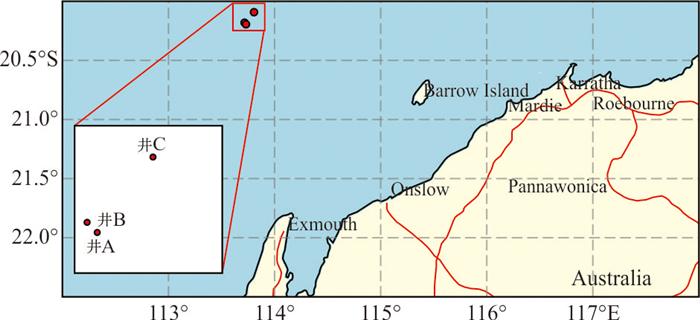
图 1 建模井(井A)、邻井(井B)及盲井(井C)位置示意图
Fig. 1. Location map of modeled (well A), neighboring (well B) and blind (well C) wells
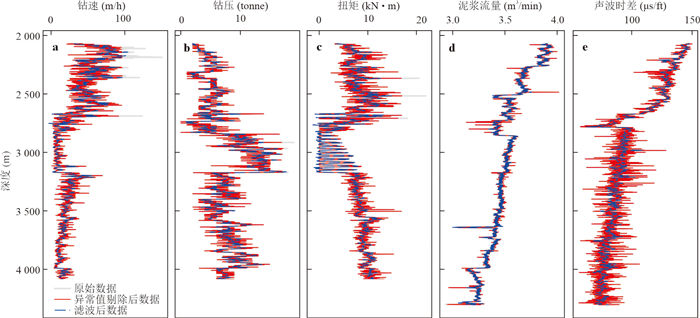
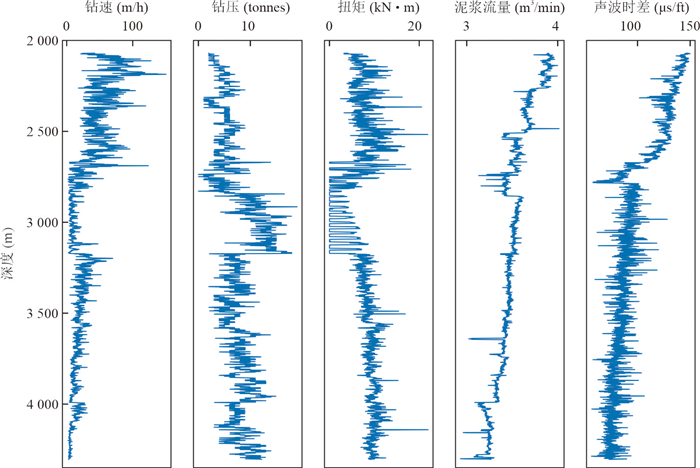
图 4 井A数据处理前后曲线对比
a. 钻速;b. 钻压;c. 扭矩;d. 泥浆流量;e.声波时差
Fig. 4. Comparison of curves for Well A before and after data processing
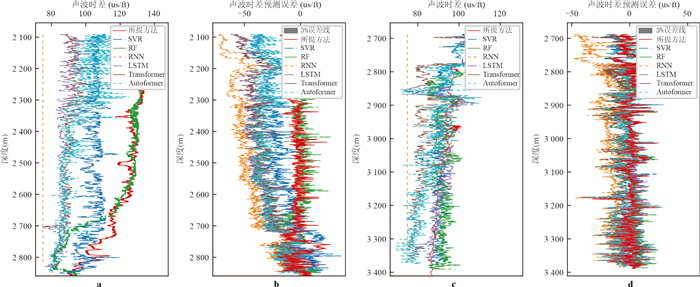
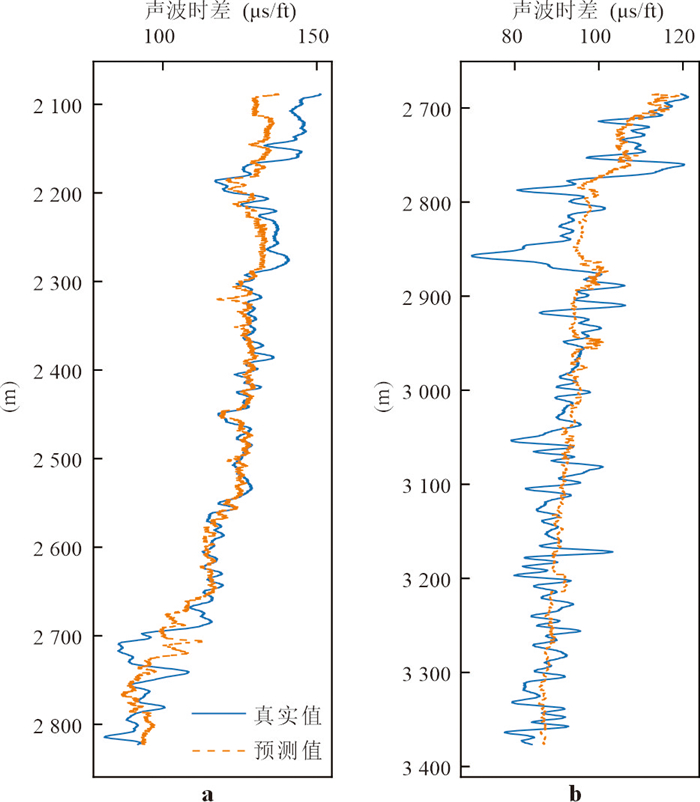
图 6 B井与C井上所提方法预测结果与误差曲线
a. B井预测结果;b. B井误差曲线;c. C井预测结果;d. C井误差曲线
Fig. 6. Prediction results and error curves for Wells B and C using the proposed method
表 1 多源钻探与测井数据及其获取方式
Table 1. Multi-source drilling and logging data and their acquisition methods
数据 描述 示例 地震数据 钻前数据,通过地震勘探获取 单程时间、双程时间、平均速度等 随钻测井 钻进过程中获取的随钻测井数据 伽马、电阻率、井斜角等 随钻测量 钻进过程中获取的随钻测量数据 钻速、钻压、转速、扭矩等 钻后测井 钻后数据,通过电缆测井作业获取 声波时差、地层密度、孔隙度等  下载: 导出CSV
表 2 多源数据的统计特征描述
Table 2. Statistical characterization of multi-source data
井 描述 参数 单程时间 双程时间 平均速度 RMS速度 钻速 钻压 转速 扭矩 泥浆流量 电阻率 声波时差 A 均值 1 584.04 3 171.78 1 942.42 2 025.97 26.20 7.38 84.04 7.42 3.48 1.15 96.56 标准差 191.12 372.28 149.70 189.66 23.57 3.27 34.88 3.49 0.18 0.27 22.26 最小值 1 195.60 2 403.61 1 698.23 1 728.24 1.01 0 0 0 2.93 0.58 56.25 最大值 1 883.85 3 742.70 2 203.55 2 361.74 150.51 19.00 174.25 21.99 4.02 1.81 149.98 方差 36 526.80 138 594.23 22 411.34 35 972.66 555.56 10.69 1 216.64 12.15 0.03 0.07 495.50 B 均值 1 363.82 2 732.22 1 773.57 1 813.75 103.43 6.43 115.22 4.32 4.12 0.82 121.38 标准差 88.41 176.91 40.64 46.32 55.55 2.28 7.34 1.79 0.17 0.17 16.22 最小值 1 205.00 2 414.42 1 705.78 1 736.78 7.45 0.96 92.00 0.16 3.54 0.42 70.13 最大值 1 505.28 3 015.26 1 852.84 1 909.05 276.66 15.59 138.65 9.79 4.36 1.62 153.66 方差 7 816.65 31 296.42 1 651.46 2 145.78 3 085.53 5.22 53.95 3.20 0.03 0.03 262.96 C 均值 1 599.76 3 212.30 1 866.84 1 925.98 60.58 3.57 103.53 5.49 2.52 0.90 93.09 标准差 61.09 122.25 53.35 69.45 20.53 1.28 11.62 1.08 0.05 0.11 10.09 最小值 1 487.68 2 988.05 1 777.82 1 811.44 13.85 0.94 77.01 1.85 1.96 0.56 55.45 最大值 1 702.87 3 418.54 1 958.39 2 044.58 121.02 7.47 122.93 9.41 2.63 1.24 123.54 方差 3 731.64 14 944.87 2 846.19 4 823.46 421.43 1.63 134.98 1.16 0 0.01 101.76
下载: 导出CSV
表 3 SWZ-Score异常检测算法
Table 3. SWZ-Score anomaly detection algorithm
算法A1:SWZ-Score (1) 输入:钻井过程特征参数 (2) 输出:异常值序列 (3) 对I=0:N do进行循环%对应第i个样本$ {x}_{i} $ (4) 为样本$ {x}_{i} $选取对应的滑动窗口 (5) 计算窗口间数据的均值$ {\mu }_{i} $和方差$ {\delta }_{i} $ (6) 计算样本$ {x}_{i} $的z值:$ {z}_{i}=({x}_{i}-{\mu }_{i})/{\delta }_{i} $ (7) 如果$ {z}_{i} > 3 $,标记为异常值 (8) 结束循环 (9) 输出异常值序列
下载: 导出CSV
表 4 不同模型在B井与C井上预测性能对比
Table 4. Comparison of predictive performance across different models for Wells B and C
井 模型 MAE RMSE MAPE R2 B 所提方法 5.286 8 6.981 0 4.580 2 0.813 0 SVR 19.757 8 22.560 0 15.644 5 -0.953 0 RF 5.847 7 8.375 9 5.139 9 0.730 8 RNN 46.277 5 49.006 8 36.879 1 -8.217 0 LSTM 33.250 6 36.181 2 26.216 5 -4.024 0 Transformer 31.958 7 34.689 7 25.212 9 -3.618 0 Autoformer 28.089 5 30.394 9 22.496 9 -2.545 0 C 所提方法 5.123 6 7.309 2 5.764 1 0.460 7 SVR 6.312 5 8.322 5 6.914 4 0.300 8 RF 6.496 3 8.403 7 7.237 3 0.287 1 RNN 18.247 3 20.554 5 18.834 7 -3.265 0 LSTM 5.575 5 7.390 9 6.181 6 0.448 6 Transformer 9.225 6 10.943 4 9.765 2 -0.208 0 Autoformer 7.483 4 9.576 4 8.075 8 0.074 3
下载: 导出CSV
-
Akinyemi, O. D., Elsaadany, M., Siddiqui, N. A., et al., 2023. Machine Learning Application for Prediction of Sonic Wave Transit Time: a Case of Niger Delta Basin. Results in Engineering, 20: 101528. https://doi.org/10.1016/j.rineng.2023.101528 Bertini, J. R., Lavi, B., 2025. Enhancing Rate of Penetration Prediction in Drilling Operations: a Data Stream Framework Approach. Engineering Applications of Artificial Intelligence, 143: 110034. https://doi.org/10.1016/j.engappai.2025.110034 Chen, X., Cao, W. H., Gan, C., et al., 2021. Semi-Supervised Support Vector Regression Based on Data Similarity and Its Application to Rock-Mechanics Parameters Estimation. Engineering Applications of Artificial Intelligence, 104: 104317. https://doi.org/10.1016/j.engappai.2021.104317 Chen, X., Cao, W. H., Gan, C., et al., 2022a. A Hybrid Partial Least Squares Regression-Based Real Time Pore Pressure Estimation Method for Complex Geological Drilling Process. Journal of Petroleum Science and Engineering, 210: 109771. https://doi.org/10.1016/j.petrol.2021.109771 Chen, X., Cao, W. H., Gan, C., et al., 2022b. A Hybrid Spatial Model Based on Identified Conditions for 3D Pore Pressure Estimation. Journal of Natural Gas Science and Engineering, 100: 104448. https://doi.org/10.1016/j.jngse.2022.104448 Du, K., Xi, W. Q., Huang, S., et al., 2024. Deep-Sea Mineral Resource Mining: a Historical Review, Developmental Progress, and Insights. Mining, Metallurgy & Exploration, 41(1): 173-192. https://doi.org/10.1007/s42461-023-00909-9 Eaton, B. A., 1972. The Effect of Overburden Stress on Geopressure Prediction from Well Logs. Journal of Petroleum Technology, 24(8): 929-934. https://doi.org/10.2118/3719-pa Feng, Y. W., Ren, Y., Zhang, G. C., et al., 2020. Petroleum Geology and Exploration Direction of Gas Province in Deepwater Area of North Carnarvon Basin, Australia. China Geology, 3(4): 623-632. https://doi.org/10.31035/cg2020064 Gan, C., Cao, W. H., Liu, K. Z., et al., 2021. A New Spatial Modeling Method for 3D Formation Drillability Field Using Fuzzy C-Means Clustering and Random Forest. Journal of Petroleum Science and Engineering, 200: 108371. https://doi.org/10.1016/j.petrol.2021.108371 Gan, C., Cao, W. H., Wu, M., et al., 2019. Prediction of Drilling Rate of Penetration (ROP) Using Hybrid Support Vector Regression: a Case Study on the Shennongjia Area, Central China. Journal of Petroleum Science and Engineering, 181: 106200. https://doi.org/10.1016/j.petrol.2019.106200 Gartrell, A. P., 2000. Rheological Controls on Extensional Styles and the Structural Evolution of the Northern Carnarvon Basin, North West Shelf, Australia. Australian Journal of Earth Sciences, 47(2): 231-244. https://doi.org/10.1046/j.1440-0952.2000.00776.x Geekiyanage, S. C. H., Tunkiel, A., Sui, D., 2021. Drilling Data Quality Improvement and Information Extraction with Case Studies. Journal of Petroleum Exploration and Production Technology, 11(2): 819-837. https://doi.org/10.1007/s13202-020-01024-x Lothe, A. E., Cerasi, P., Aghito, M., 2020. Digitized Uncertainty Handling of Pore Pressure and Mud-Weight Window Ahead of Bit: North Sea Example. SPE Journal, 25(2): 529-540. https://doi.org/10.2118/189665-pa Ramu, C., Sunkara, S. L., Ramu, R., et al., 2021. An ANN-Based Identification of Geological Features Using Multi-Attributes: a Case Study from Krishna-Godavari Basin, India. Arabian Journal of Geosciences, 14(4): 299. https://doi.org/10.1007/s12517-021-06652-z Su, Y. A., Dou, X. R., Gao, W. K., et al., 2023. Reflections and Outlook on the Development of Drilling-While-Measuring Technology for Oil and Gas Wells. Bulletin of Petroleum Science, 8(5): 535-554 (in Chinese with English abstract). Tao, Z. X., Cao, W. H., Gan, C., 2025. Physically Interpretable Pore Pressure Prediction in Marine Strata through Embedded Depositional Mechanisms and Attention-Guided Learning. SPE Journal, 31(2): 946-962. https://doi.org/10.2118/231425-pa Wen, Z. X., Wang, J. J., Wang, Z. M., et al., 2023. Analysis of the World Deepwater Oil and Gas Exploration Situation. Petroleum Exploration and Development, 50(5): 1060-1076. https://doi.org/10.1016/S1876-3804(23)60449-5 Xiang, M., Li, B., He, Y. M., et al., 2024. Research on Simulation Model of Deepwater Drilling and Optimization Method of Drilling Parameters Based on Energy. Ocean Engineering, 312: 119286. https://doi.org/10.1016/j.oceaneng.2024.119286 Xu, C. L., Sun, J. M., Dong, X., et al., 2017. Novel Method for Predicting Pore Pressure in Shale Gas Reservoirs via Logging. Acta Petrolei Sinica, 38(06): 666-676(in Chinese with English abstract). Xu, K., Yang, H. J., Zhang, H., et al., 2023. Efficient Exploration Techniques for Deep Tight Gas Reservoirs Based on Geomechanical Methods: The Case of the Dibei Gas Reservoir in the Kuqa Depression. Earth Science, 48(2): 621-639(in Chinese with English abstract). Yang, H., Feng, Y. C., Shang, G. Y., et al., 2025. A Sequence Learning Approach for Real-Time and A Head-of-Bit Pore Pressure Prediction Utilizing Drilling Data from the Drilled Section. SPE Journal, 30(2): 524-543. https://doi.org/10.2118/223962-pa Zhang, Z., Sun, B. J., Wang, Z. Y., et al., 2022. Formation Pressure Inversion Method Based on Multisource Information. SPE Journal, 27(2): 1287-1303. https://doi.org/10.2118/209206-pa 苏义脑, 窦修荣, 高文凯, 等, 2023. 油气井随钻测量技术发展思考与展望. 石油科学通报, 8(5): 535-554. 徐春露, 孙建孟, 董旭, 等, 2017. 页岩气储层孔隙压力测井预测新方法. 石油学报, 38(6): 666-676. 徐珂, 杨海军, 张辉, 等, 2023. 基于地质力学方法的深层致密气藏高效勘探技术: 以库车坳陷迪北气藏为例. 地球科学, 48(2): 621-639. doi: 10.3799/dqkx.2022.379 -

 点击查看大图
计量
- 文章访问数: 173
- HTML全文浏览量: 30
- PDF下载量: 22
- 被引次数: 0
