




Source-Reservoir Configuration and Hydrocarbon Accumulation Scale of Buried Hills in Central-Southern Bohai Sea Area
-
摘要: 渤海海域中南部潜山类型多样且油气勘探潜力巨大,但不同潜山的油气富集规模差异显著,其主控因素有待明确.源‒储配置关系是控制油气高效成藏与富集规模的核心.本研究综合利用地震、地质与地球化学资料,系统剖析了研究区不同构造位置潜山的源‒储配置特征及其对成藏规模的控制作用.根据潜山与烃源岩的空间耦合关系、输导体系及储层发育特征,将潜山划分为源储叠置型、源储侧接型与远源输导型三类.研究表明:源储叠置型潜山,多位于洼陷区,虽然埋藏较深,但具有近油源、源储压差大与“源盖一体”的优质保存条件,成藏效率最高,是发现特大型油气田的最优配置;源储侧接型潜山,常位于斜坡带/低凸起,具有多源供烃、立体输导与较好储盖组合的特征,可形成大中型油气田;而远源输导型潜山,多处于凸起区,虽然埋藏较浅,但因油源距离远、源储压差小、输导效率低及保存条件差,勘探风险较高.研究建立了基于源‒储配置的潜山分类与评价模式,指出洼陷区至斜坡带中源储叠置型与源储侧接型潜山是下步勘探的有利区域,这为“超级盆地”洼陷区规模潜山油气田的勘探部署提供了重要理论依据与决策指导.Abstract: The central-southern Bohai Sea area develops diverse types of buried hills with substantial petroleum exploration potential. However, the scale of hydrocarbon accumulation varies significantly among different buried hills, and the key controlling factors remain to be clarified. The source-reservoir configuration is the core element controlling efficient hydrocarbon accumulation and enrichment scale. This study systematically analyzes the source-reservoir configuration characteristics of buried hills in different structural positions within the study area and their control on accumulation scales by integrating seismic, geological, and geochemical data. Based on the spatial coupling relationship between buried hills and source rocks, migration pathways, and reservoir development characteristics, the buried hills are classified into three types: source-reservoir superimposed, source-reservoir lateral-connected, and distal-source transported types. The results indicate that source-reservoir superimposed buried hills, typically located in sag areas, exhibit the highest accumulation efficiency due to their proximity to source rocks, large source-reservoir pressure differential, and superior preservation conditions characterized by "source-caprock integration", securing their optimal configuration for discovering giant oil and gas fields. Source-reservoir lateral-connected buried hills, often situated in slope zones/low uplift, feature multiple source rock contributions, three-dimensional migration pathways, and favorable reservoir-seal assemblages, facilitating the formation of medium to large oil and gas fields. In contrast, distal-source transported buried hills, predominantly found in uplift areas, despite their shallow burial depths, present high exploration risks due to long migration distances from source rocks, small source-reservoir pressure differentials, low migration efficiency, and poor preservation conditions. This study establishes a buried hill classification and evaluation model based on source-reservoir configuration, identifying source-reservoir superimposed and lateral-connected buried hills in sag to slope zones as favorable targets for subsequent exploration. The findings provide an important theoretical basis and decision-making guidance for the exploration deployment of large-scale buried hill oil and gas fields in sag areas of "Super basins".
-
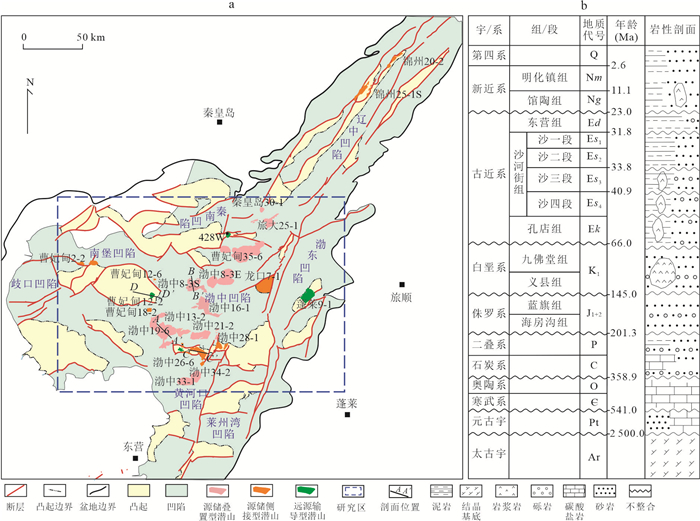
图 1 渤海海域潜山勘探区域(a)和地层综合柱状图(b)
Fig. 1. Exploration area map of buried hills in the Bohai Sea area (a) and comprehensive stratigraphic column (b)
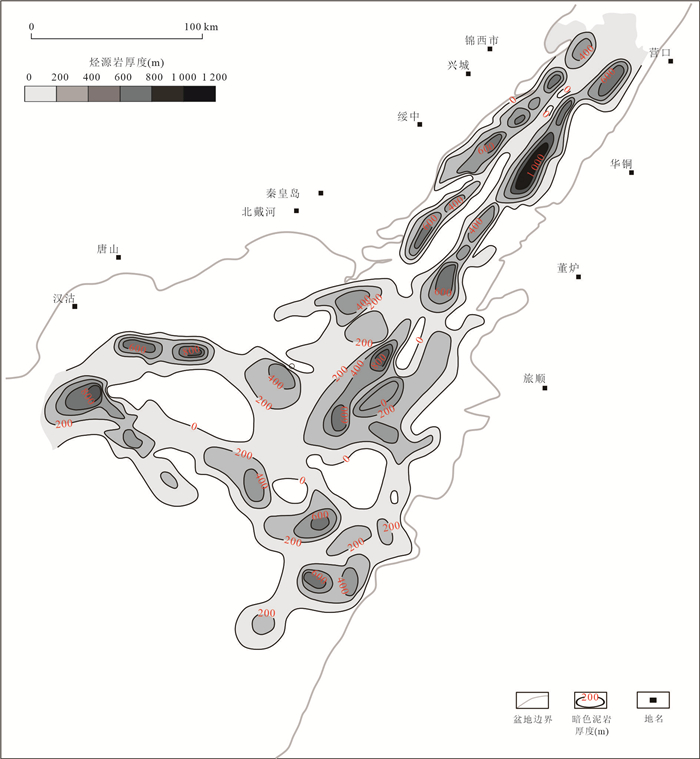
图 2 渤海海域沙三段烃源岩厚度分布
Fig. 2. Thickness distribution map of source rocks of the third member of Shahejie Formation in the offshore Bohai Bay area
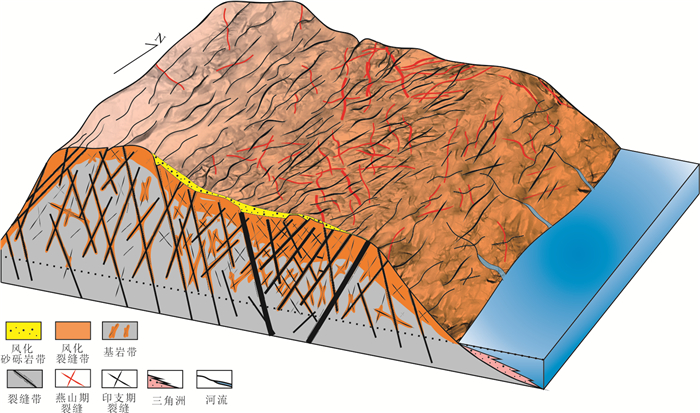
图 3 渤海海域太古界潜山成储模式
Fig. 3. Reservoir-forming pattern map of Archaean buried hills in the offshore Bohai Bay area
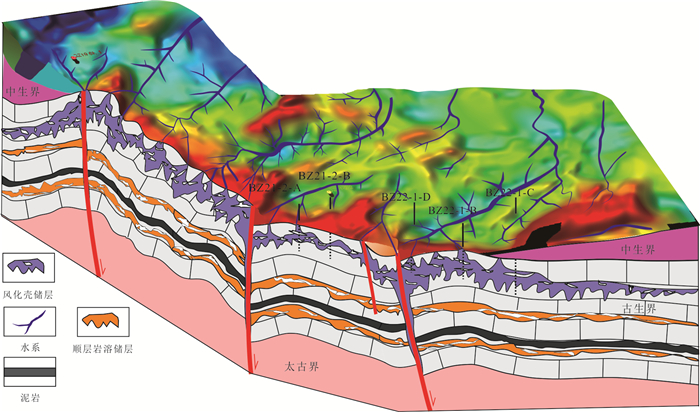
图 4 渤海海域古生界潜山成储模式
Fig. 4. Reservoir-forming pattern map of Paleozoic buried hills in the offshore Bohai Bay area
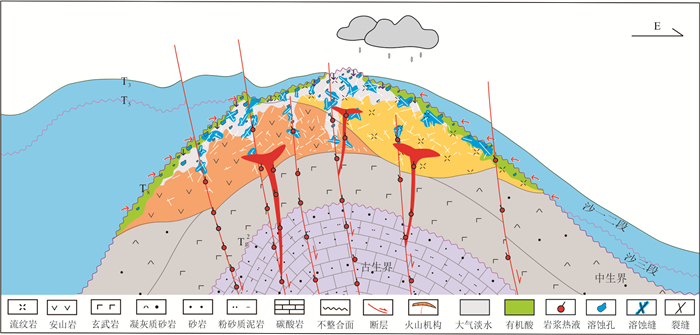
图 5 渤海海域中生界潜山成储模式
Fig. 5. Reservoir-forming pattern map of Mesozoic buried hills in the offshore Bohai bay area
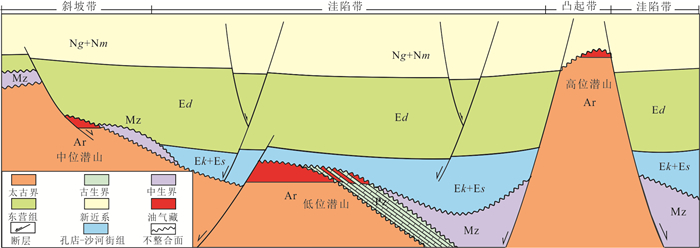
图 6 渤海海域中南部源‒储配置关系与潜山类型划分
Fig. 6. Source-reservoir configuration relationship and buried hill classification in the central-southern offshore Bohai bay area
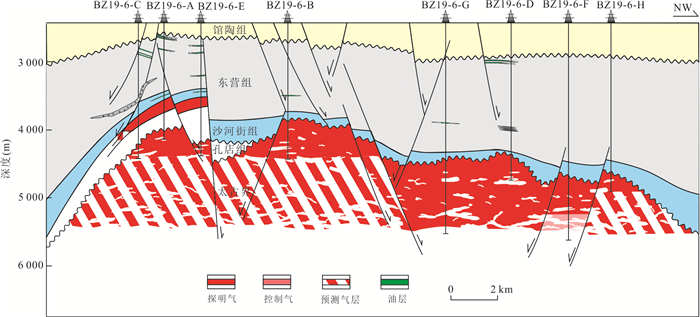
图 7 渤中19-6潜山成藏模式
剖面位置见图 1a图A‒A’剖面
Fig. 7. Reservoir-forming pattern map of the Bozhong 19-6 buried hill
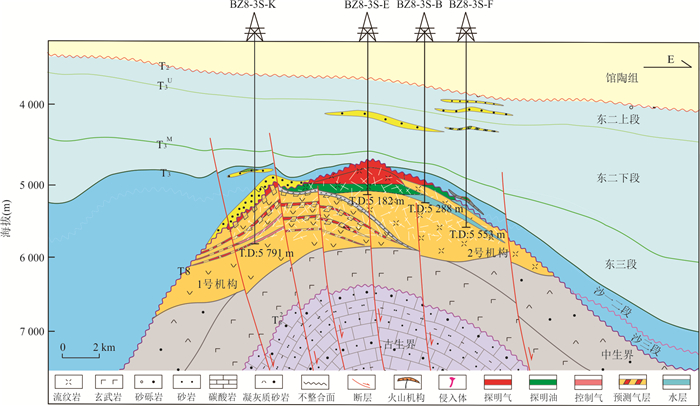
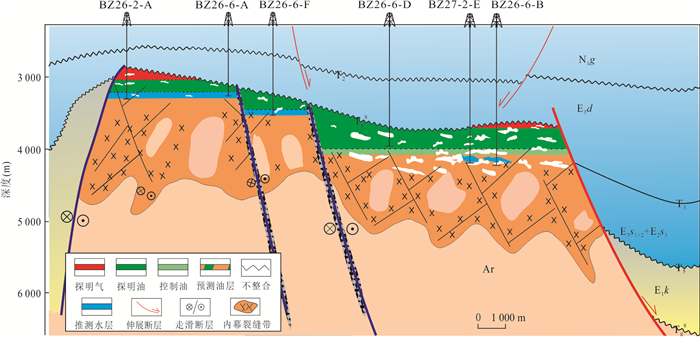
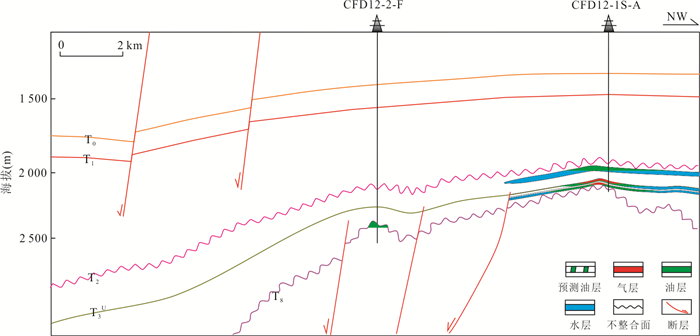
图 10 曹妃甸12-2潜山成藏模式
剖面位置见图 1a图D‒D’剖面
Fig. 10. Reservoir-forming pattern map of the CFD12-2 buried hill
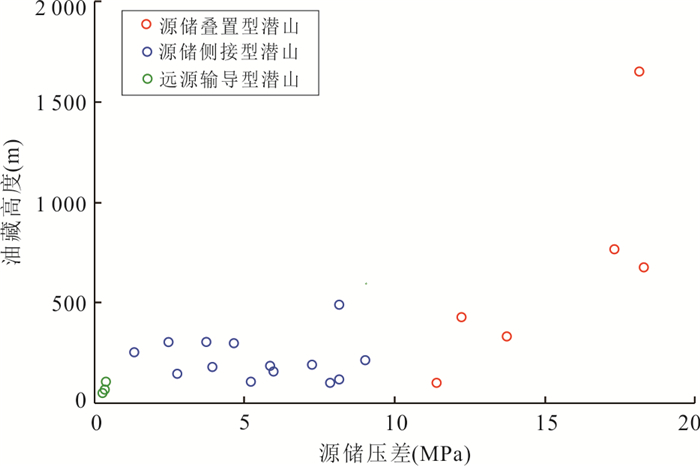
图 11 源‒储压差与油藏高度的关系
Fig. 11. Relationship between source-reservoir pressure differential and hydrocarbon column height
表 1 渤海潜山三种典型储层特征对比
Table 1. Comparison of characteristics of three typical reservoir types in Bohai buried hills

表 2 渤海中南部不同源‒储对接关系潜山分类
Table 2. Buried hill classification by different source-reservoir connection relationships in the central-southern offshore Bohai bay area
潜山类型 构造区带 顶面埋深 构造位置 与烃源岩距离 运移通道 源储叠置 凹陷内部 > 3 500 m 低位潜山 垂向 < 2 km 断裂+不整合面 源储侧接 斜坡带/低凸起 2 000~3 500 m 中位潜山 侧接2~5 km 断裂+不整合面 远源输导 凸起区 < 2 000 m 高位潜山 > 5 km 以不整合面为主  下载: 导出CSV
表 3 潜山源储配置类型及其成藏特征
Table 3. Types of source-reservoir configuration and their reservoir-forming characteristics of buried hills
源储配置类型 源储叠置型潜山 源储侧接型潜山 远源输导型潜山 构造位置 洼陷区:低位潜山 斜坡带/低凸起:中位潜山 凸起区:高位潜山 成藏模式 源储叠置‒超压驱动型(规模成藏最佳配置) 源储侧接‒超压浮力驱动(中‒大型油田有利目标) 远源输导‒浮力主导型(高风险勘探目标) 源储配置 烃源岩直接“包裹”潜山,油源极近. 源储侧接:烃源岩与潜山侧向接触. 远源:油源距离远. 源储压差 大于10 MPa 2~10 MPa 小于2 MPa 动力 核心动力:烃源岩强超压驱动,油气短距离、高效率充注. 复合动力:超压与浮力复合驱动,通过断面等侧向运移,常具多源、多期充注特点. 动力不足:以浮力为主,缺乏强超压驱动,运移路径复杂、效率低. 保存条件 最优:上覆厚层烃源岩本身即为优质盖层,“源盖一体”,封闭性好. 较好:依赖上覆区域盖层和侧向封堵条件. 差:顶部盖层条件通常较差,经历多期构造抬升,油气易散失. 典型案例 渤中19-6(变质岩)渤中8-3S(火山岩) 渤中26-6(变质岩、碳酸盐岩)曹妃甸2-2(碳酸盐岩) 曹妃甸1-6(变质岩)曹妃甸12-2(变质岩)
下载: 导出CSV
-
Deng, Y. H., 2015. Formation Mechanism and Exploration Practice of Large-Medium Buried-Hill Oil Fields in Bohai Sea. Acta Petrolei Sinica, 36(3): 253-261 (in Chinese with English abstract). Dmitriyevskiy, A. N., Kireyev, F. A., Bochko, R. A., et al., 1993. Hydrothermal Origin of Oil and Gas Reservoirs in Basement Rock of the South Vietnam Continental Shelf. International Geology Review, 35(7): 621-630. https://doi.org/10.1080/00206819309465547 Guan, D. Y., Shi, W. L., Zhao, D. J., et al., 2025. Accumulation Characteristics and Charging Process of Heterogeneous Mixed Reservoir in Bozhong 26-6 Buried Hill Oilfield, Bohai Bay Basin. Earth Science, 50(2): 478-493 (in Chinese with English abstract). Guan, D. Y., Wang, X., Liu, P. B., et al., 2024. The Characteristics and Development Pattern of Carbonate Buried Hill Reservoirs in the Southern Bohai Sea: A Case Study of Bozhong 28-29 Area. Journal of Northeast Petroleum University, 48(3): 1-13, 131 (in Chinese with English abstract). Guo, T., Wang, D. Y., Li, H., et al., 2025. Source-to-Sink System of Third Member of Shahejie Formation in Qinnan Sag and Its Control on Source Rock. China Offshore Oil and Gas, 37(4): 14-27 (in Chinese with English abstract). Hu, Z. W., Lyu, D. Y., Wang, D. Y., et al., 2023. Deformation Characteristics of Critical Tectonic Periods during Pre-Cenozoic and Significance of Buried Hill Hydrocarbon Accumulation in the Bohai Sea Area. China Offshore Oil and Gas, 35(1): 50-62 (in Chinese with English abstract). Landes, K. K., Amorouso, J. J., Charlesworth, L. J. J., et al., 1960. Petroleum Resources in Basement Rocks. AAPG Bulletin, 44(10): 1682-1691. Liu, S. G., Deng, B., Sun, W., et al., 2020. May Sichuan Basin be a Super Petroliferous Basin?. Journal of Xihua University (Natural Science Edition), 39(5): 20-35 (in Chinese with English abstract). Peng, J. S., Xu, C. G., Wei, A. J., et al., 2016. Hydrocarbon Migration Caused by Rupture of Pressure Compartment in South Liaozhong Sag, Bohai Bay Basin, Offshore China. Petroleum Exploration and Development, 43(3): 425-434 (in Chinese with English abstract). doi: 10.1016/S1876-3804(16)30049-0 Qi, J. F., Zhou, X. H., Wang, Q. S., 2010. Structural Model and Cenozoic Kinematics of Tan-Lu Deep Fracture Zone in Bohai Sea Area. Geology in China, 37(5): 1231-1242 (in Chinese with English abstract). Shi, H. S., Wang, Q. B., Wang, J., et al., 2019. Discovery and Exploration Significance of Large Condensate Gas Fields in BZ19-6 Structure in Deep Bozhong Sag. China Petroleum Exploration, 24(1): 36-45 (in Chinese with English abstract). Tang, H. F., Wang, P. J., Li, R. L., et al., 2012. Classification of Volcanic Edifices and Its Characteristics of Gas Pool in Faulted Sequence of the Songliao Basin, NE China. Journal of Jilin University (Earth Science Edition), 42(3): 583-589 (in Chinese with English abstract). Wang, D. Y., Wang, Q. B., Liu, X. J., et al., 2019. Characteristics and Developing Patterns of Gneiss Buried Hill Weathering Crust Reservoir in the Sea Area of the Bohai Bay Basin. Acta Petrologica Sinica, 35(4): 1181-1193 (in Chinese with English abstract). doi: 10.18654/1000-0569/2019.04.13 Wang, P. J., Gao, Y. F., Ren, Y. G., et al., 2009. 40Ar/ 39Ar Age and Geochemical Features of Mugearite from the Qingshankou Formation: Significances for Basin Formation, Hydrocarbon Generation and Petroleum Accumulation of the Songliao Basin in Cretaceous. Acta Petrologica Sinica, 25(5): 1178-1190 (in Chinese with English abstract). Wang, X., Chen, L., Gao, Y. F., et al., 2025. Discovery and New Understanding of Oil and Gas Exploration in Volcanic Buried Hill of LK7-1 in Bohai Sea. China Offshore Oil and Gas, 37(2): 14-26 (in Chinese with English abstract). Wang, X., Wang, Y. L., Guan, D. Y., et al., 2012. Shallow Petroleum Geology and Exploration Potential in the Slope Area, Circum-Bozhong Sag. China Offshore Oil and Gas, 24(3): 12-16 (in Chinese with English abstract). Wu, Q. X., Wei, A. J., Wang, Y. C., et al., 2018. Tectonic Difference and Genetic Mechanism of Buried Hill in Southern Bohai Area. Earth Science, 43(10): 3698-3708 (in Chinese with English abstract). Wu, Z. P., Xue, Y., Yan, S. Y., et al., 2013. The Development Characteristics of the Fault System and Basin Structures of the Bodong Sag, East China. Geological Journal of China Universities, 19(3): 463-471 (in Chinese with English abstract). Xiao, S. G., Lü, D. Y., Hou, M. C., et al., 2019. Mesozoic Tectonic Evolution and Buried Hill Formation Mechanism in the Southwestern Bohai Sea. Natural Gas Industry, 39(5): 34-44 (in Chinese with English abstract). Xie, Y. H., 2020. Gas Resources and Accumulation Model of BZ19-6 Archean Buried-Hill Large-Scale Gas Reservoir in Bozhong Sag, Bohai Bay Basin. Petroleum Geology and Experiment, 42(5): 858-866 (in Chinese with English abstract). Xu, C. G., Hou, M. C., Wang, Y. C., et al., 2019. Type and Genesis of Pre-Tertiary Deep Buried Hills in the Bohai Sea Area. Natural Gas Industry, 39(1): 21-32 (in Chinese with English abstract). Xu, C. G., Lai, W. C., Zhang, X. T., et al., 2023a. New Progress and Future Exploration Thinking of CNOOC Oil and Gas Exploration. China Offshore Oil and Gas, 35(2): 1-12 (in Chinese with English abstract). Xu, C. G., Zhou, J. X., Yang, H. F., et al., 2023b. Discovery of Large-Scale Metamorphic Buried-Hill Oilfield in Bohai Bay Basin and Its Geological Significance. Acta Petrolei Sinica, 44(10): 1587-1598, 1611 (in Chinese with English abstract). Xu, C. G., Wang, Q. B., Zhu, H. T., et al., 2024. Hydrothermal Alteration Mechanisms of an Archaean Metamorphic Buried Hill and the Models for Reservoir Zonation, Bozhong Depression, Bohai Bay Basin, China. Marine and Petroleum Geology, 164: 106843. https://doi.org/10.1016/j.marpetgeo.2024.106843 Xu, C. G., Wang, X., Yang, H. F., et al., 2025. Natural Gas Exploration of Mesozoic Ultra-Deep Volcanic Buried Hills in Bozhong Sag of Bohai Sea and Its Significance. Acta Petrolei Sinica, 46(5): 843-856, 908 (in Chinese with English abstract). Xu, C. G., Yang, H. F., Wang, F. L., et al., 2024. Formation Conditions of Deep to Ultra-Deep Large Composite Buried-Hill Hydrocarbon Reservoirs in Offshore Bohai Bay Basin, China. Petroleum Exploration and Development, 51(6): 1421-1434 (in Chinese with English abstract). doi: 10.1016/S1876-3804(25)60550-7 Xue, Y. A., Li, H. Y., 2018. Large Condensate Gas Field in Deep Archean Metamorphic Buried Hill in Bohai Sea: Discovery and Geological Significance. China Offshore Oil and Gas, 30(3): 1-9 (in Chinese with English abstract). Yang, H. F., Xu, C. G., Niu, C. M., et al., 2018. Joint Control of the Cenozoic Faults and Magma on Hydrocarbon Accumulation in BZ34-9 Oilfield in Huanghekou Sag, Bohai Bay Basin. Oil & Gas Geology, 39(5): 1056-1064 (in Chinese with English abstract). Yang, H. F., Ye, T., Yan, G., et al., 2025. Reservoir-Forming Conditions and Models of Large-and Medium-Sized Mesozoic Volcanic Oil and Gas Fields in the Bozhong Sag and Its Surrounding Areas. China Offshore Oil and Gas, 37(1): 1-12 (in Chinese with English abstract). Zhang, G. C., Tong, D. J., Chen, K., et al., 2024. Tectonic Evolution and Source Rocks Development of the Super Oil-Rich Bohai Bay Basin, East China. Petroleum Exploration and Development, 51(5): 1165-1182 (in Chinese with English abstract). doi: 10.1016/S1876-3804(25)60533-7 Zhou, J. X., Yang, H. F., Guan, D. Y., et al., 2023. Discovery of BZ26-6 Metamorphic Rock Buried Hill Oilfield in Bohai Bay Basin and Understanding Innovation. China Offshore Oil and Gas, 35(4): 1-11 (in Chinese with English abstract). Zhou, X. H., Wang, D. Y., Yu, H. B., et al., 2022. Major Controlling Factors and Hydrocarbon Accumulation Models of Large-Scale Lithologic Reservoirs in Shallow Strata around the Bozhong Sag, Bohai Bay Basin, China. Petroleum Exploration and Development, 49(4): 758-769 (in Chinese with English abstract). doi: 10.1016/S1876-3804(22)60308-2 邓运华, 2015. 渤海大中型潜山油气田形成机理与勘探实践. 石油学报, 36(3): 253-261. 官大勇, 石文龙, 赵弟江, 等, 2025. 渤海湾盆地渤中26-6潜山油田油气异源混合成藏特征及充注过程. 地球科学, 50(2): 478-493. doi: 10.3799/dqkx.2024.041 官大勇, 王昕, 刘朋波, 等, 2024. 渤海南部碳酸盐岩潜山储层特征及发育模式: 以渤中28-29区为例. 东北石油大学学报, 48(3): 1-13, 131. 郭涛, 王德英, 李虹, 等, 2025. 秦南凹陷沙三段"源‒汇"体系及其对烃源岩的控制. 中国海上油气, 37(4): 14-27. 胡志伟, 吕丁友, 王德英, 等, 2023. 渤海海域前新生代关键构造期变形特征与潜山油气成藏意义. 中国海上油气, 35(1): 50-62. 刘树根, 邓宾, 孙玮, 等, 2020. 四川盆地是"超级"的含油气盆地吗. 西华大学学报(自然科学版), 39(5): 20-35. 彭靖淞, 徐长贵, 韦阿娟, 等, 2016. 渤海湾盆地辽中南洼压力封存箱的破裂与油气运移. 石油勘探与开发, 43(3): 386-395. 漆家福, 周心怀, 王谦身, 2010. 渤海海域中郯庐深断裂带的结构模型及新生代运动学. 中国地质, 37(5): 1231-1242. 施和生, 王清斌, 王军, 等, 2019. 渤中凹陷深层渤中19-6构造大型凝析气田的发现及勘探意义. 中国石油勘探, 24(1): 36-45. 唐华风, 王璞珺, 李瑞磊, 等, 2012. 松辽盆地断陷层火山机构类型及其气藏特征. 吉林大学学报(地球科学版), 42(3): 583-589. 王德英, 王清斌, 刘晓健, 等, 2019. 渤海湾盆地海域片麻岩潜山风化壳型储层特征及发育模式. 岩石学报, 35(4): 1181-1193. 王璞珺, 高有峰, 任延广, 等, 2009. 松辽盆地青山口组橄榄组安岩: 40Ar/39Ar年龄、地球化学及其成盆、成烃和成藏意义. 岩石学报, 25(5): 1178-1190. 王昕, 陈磊, 高雁飞, 等, 2025. 渤海海域龙口7-1火山岩潜山油气勘探发现及成藏新认识. 中国海上油气, 37(2): 14-26. 王昕, 王永利, 官大勇, 等, 2012. 环渤中凹陷斜坡区浅层油气地质特征与勘探潜力. 中国海上油气, 24(3): 12-16. 吴庆勋, 韦阿娟, 王粤川, 等, 2018. 渤海南部地区潜山构造差异与成因机制. 地球科学, 43(10): 3698-3708. doi: 10.3799/dqkx.2018.578 吴智平, 薛雁, 颜世永, 等, 2013. 渤海海域渤东地区断裂体系与盆地结构. 高校地质学报, 19(3): 463-471. 肖述光, 吕丁友, 侯明才, 等, 2019. 渤海海域西南部中生代构造演化过程与潜山形成机制. 天然气工业, 39(5): 34-44. 谢玉洪, 2020. 渤海湾盆地渤中凹陷太古界潜山气藏BZ19-6的气源条件与成藏模式. 石油实验地质, 42(5): 858-866. 徐长贵, 侯明才, 王粤川, 等, 2019. 渤海海域前古近系深层潜山类型及其成因. 天然气工业, 39(1): 21-32. 徐长贵, 赖维成, 张新涛, 等, 2023a. 中国海油油气勘探新进展与未来勘探思考. 中国海上油气, 35(2): 1-12. 徐长贵, 周家雄, 杨海风, 等, 2023b. 渤海湾盆地大型变质岩潜山油田勘探发现及地质意义. 石油学报, 44(10): 1587-1598, 1611. 徐长贵, 王昕, 杨海风, 等, 2025. 渤海海域渤中凹陷中生界超深层火山岩潜山天然气勘探发现及意义. 石油学报, 46(5): 843-856, 908. 徐长贵, 杨海风, 王飞龙, 等, 2024. 渤海湾盆地海域深层: 超深层大型复合潜山油气藏形成条件. 石油勘探与开发, 51(6): 1227-1239. 薛永安, 李慧勇, 2018. 渤海海域深层太古界变质岩潜山大型凝析气田的发现及其地质意义. 中国海上油气, 30(3): 1-9. 杨海风, 徐长贵, 牛成民, 等, 2018. 渤海湾盆地黄河口凹陷BZ34-9油田新生界"断裂‒岩浆"联合控藏作用. 石油与天然气地质, 39(5): 1056-1064. 杨海风, 叶涛, 燕歌, 等, 2025. 渤中凹陷及周边地区中生界大中型火山岩油气田成藏条件及模式. 中国海上油气, 37(1): 1-12. 张功成, 佟殿君, 陈凯, 等, 2024. 渤海湾超级油盆构造演化及其烃源岩发育. 石油勘探与开发, 51(5): 1008-1023. 周家雄, 杨海风, 官大勇, 等, 2023. 渤海湾盆地渤中26-6变质岩潜山大油田发现与认识创新. 中国海上油气, 35(4): 1-11. 周心怀, 王德英, 于海波, 等, 2022. 环渤中地区浅层大规模岩性油藏的成藏主控因素与成藏模式. 石油勘探与开发, 49(4): 660-669, 740. -

 点击查看大图
计量
- 文章访问数: 63
- HTML全文浏览量: 12
- PDF下载量: 10
- 被引次数: 0
