




Developmental Characteristics of Fault System and Its Basin-Controlling Effects in Xihu Sag
-
摘要: 西湖凹陷是中国东部近海中、新生代叠合含油气盆地东海陆架盆地的重要组成部分,其断裂体系发育时空差异特征不仅决定了盆地结构,也控制了油气成藏.运用最新的三维地震连片资料及钻井资料,对西湖凹陷断裂体系的发育特征及其控盆效应进行了系统分析,区划出新生代盆地基底先存、裂陷拉张及反转挤压3类不同成因类型的断裂体系,明确了NW(NWW)向先存基底断裂对新生代西湖凹陷斜坡带、中央反转带的南北分区效应;揭示了新生代裂陷早期(前平湖组沉积期)由NE-SW向断裂主控至裂陷晚期(平湖组沉积期)由近SN向断裂主控的转变;阐明了纵张、横张及逆断(反转)等龙井、冲绳运动挤压反转形成的断裂体系与反转背斜的成因联系.研究成果对于认识西湖凹陷乃至整个东海陆架盆地构造差异演化过程与机理具有理论意义,也可为该地区油气勘探实践提供指导.Abstract: The Xihu Sag is an important Meso-Cenozoic superimposed petroliferous basin in the East China Sea Shelf Basin offshore eastern China. The spatiotemporal variation characteristics of its fault system development not only determine the basin structure but also control hydrocarbon accumulation. This paper uses the latest integrated 3D seismic data and drilling data to systematically analyze the developmental characteristics and basin-controlling effects of the fault system in the Xihu Sag, classifying three genetically distinct fault types: pre-existing Cenozoic basement faults, rift-related extensional faults, and inversion-related compressional faults. It clarifies the north-south partitioning effect of NW (NWW)-trending pre-existing basement faults on the Cenozoic slope belt and central inversion zone of the Xihu Sag; reveals the transition from NE-SW-trending faults dominating the early rifting stage (pre-Pinghu Formation deposition) to near SN-trending faults dominating the late rifting stage (Pinghu Formation deposition); and elucidates the genetic relationships between compressional inversion fault systems (longitudinal tension, transverse tension, and reverse faults) formed during the Longjing and Okinawa tectonic movements and inversion anticlines. The research results hold theoretical significance for understanding the tectonic differential evolution process and mechanisms of the Xihu Sag and even the entire East China Sea Shelf Basin, and can provide guidance for hydrocarbon exploration practices in this region.
-
Key words:
- fault controlled system /
- basin-controlling effect /
- Xihu Sag /
- petroleum geology
-
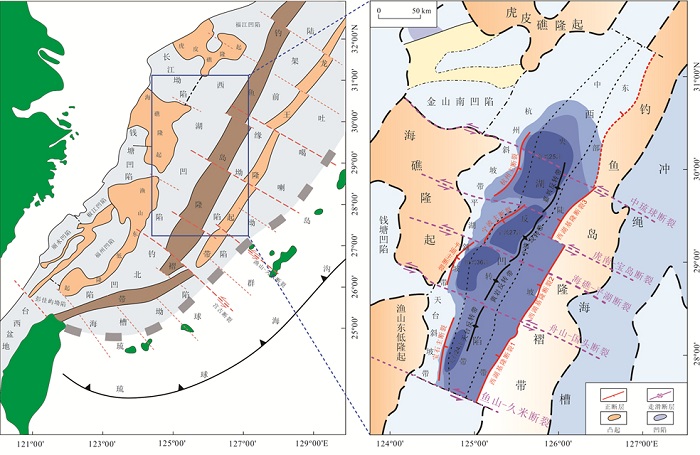
图 1 西湖凹陷构造位置与构造单元组成
据周心怀等(2019)修改. a.西湖凹陷在东海盆地内的构造位置; b.西湖凹陷构造单元组成
Fig. 1. Structural location and structural unit composition of Xihu Sag
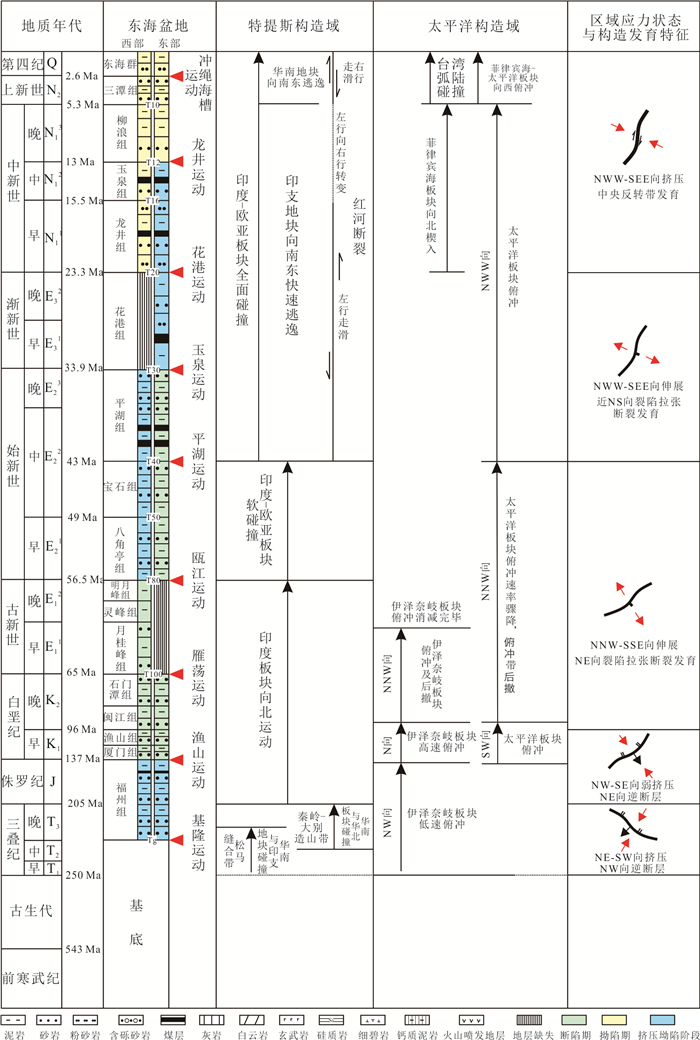
图 2 中、新生代东海盆地地层结构与构造演化综合柱状图
Fig. 2. Comprehensive histogram of stratigraphic structure and tectonic evolution of the Mesozoic and Cenozoic East China Sea Basin
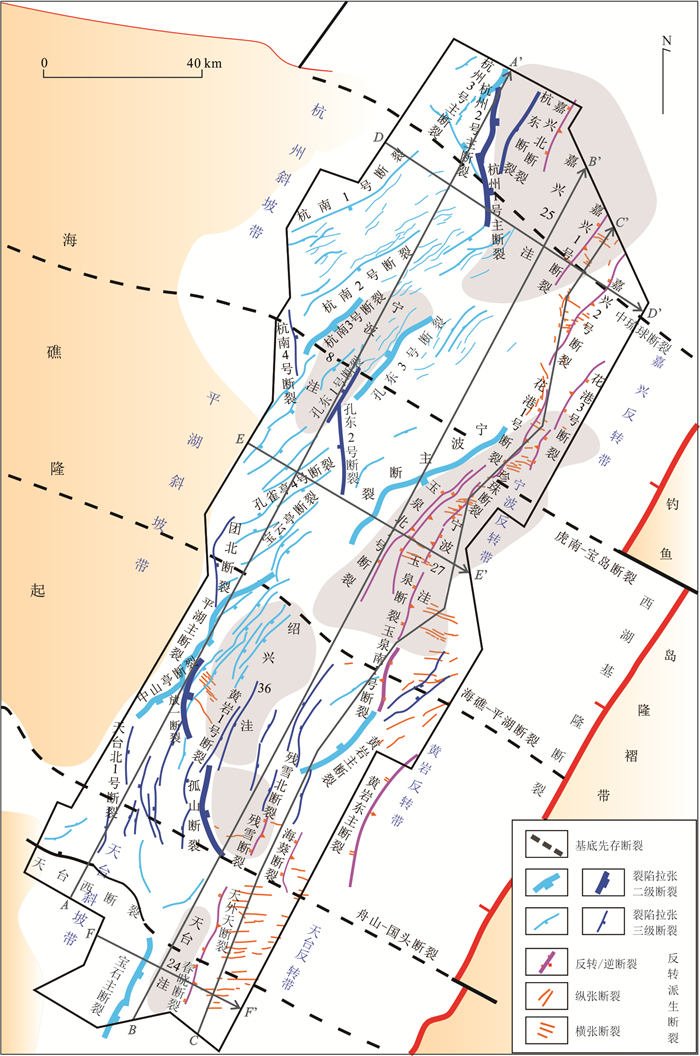
图 3 西湖凹陷断裂纲要图
Fig. 3. Map showing the distribution of the fault system and structural units in the Xihu Sag
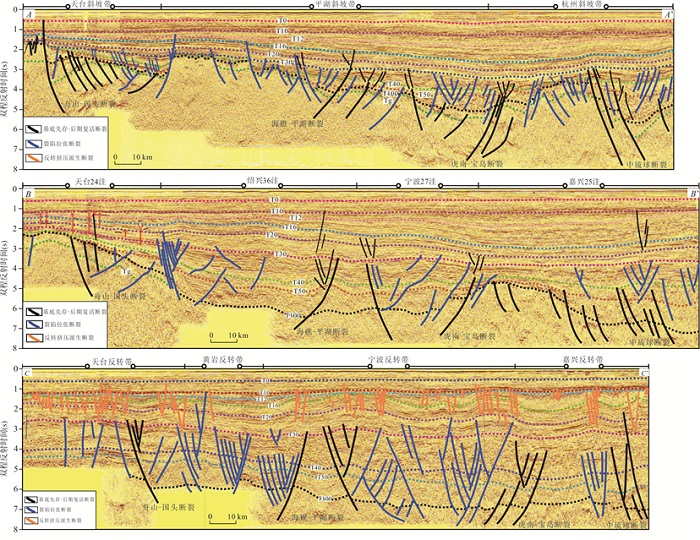
图 4 西湖凹陷SSW-NNE向测线所揭示的断裂体系发育特征(测线位置见图 3)
a.斜坡带AA'; b.凹陷中央带BB’; c.中央反转带CC’
Fig. 4. The development characteristics of the fault system revealed by the SSW-NNE trending line in the Xihu Sag
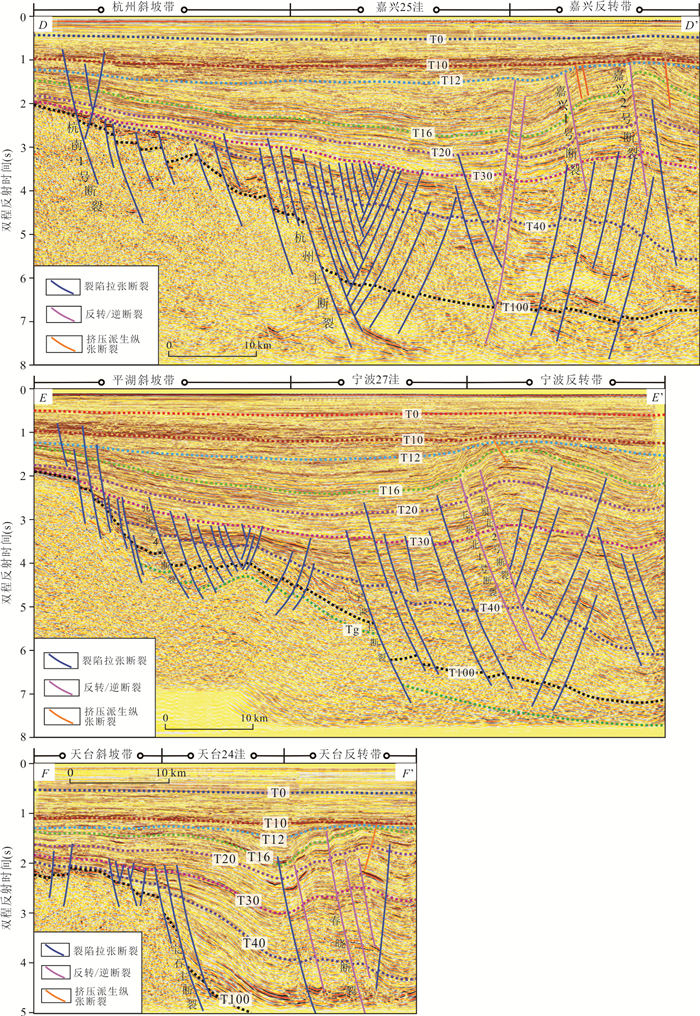
图 5 西湖凹陷NW-SE向测线所揭示的断裂体系发育特征(测线位置见图 3)
a.杭州斜坡‒嘉兴反转带DD’;b.平湖斜坡‒宁波反转带EE’;c.天台斜坡‒天台反转带FF’
Fig. 5. The development characteristics of fault system revealed by NW-SE trending survey line in the Xihu Sag
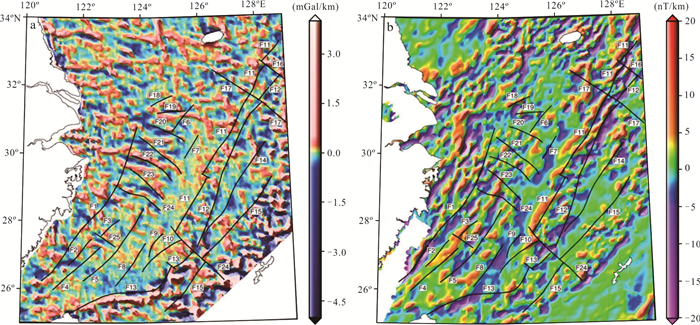
图 6 重力、磁力资料所揭示的东海盆地NW向基底断裂
a.重力异常图;b.磁力异常图
Fig. 6. The NW-trending basement faults in the East China Sea Basin revealed by gravity and magnetic data
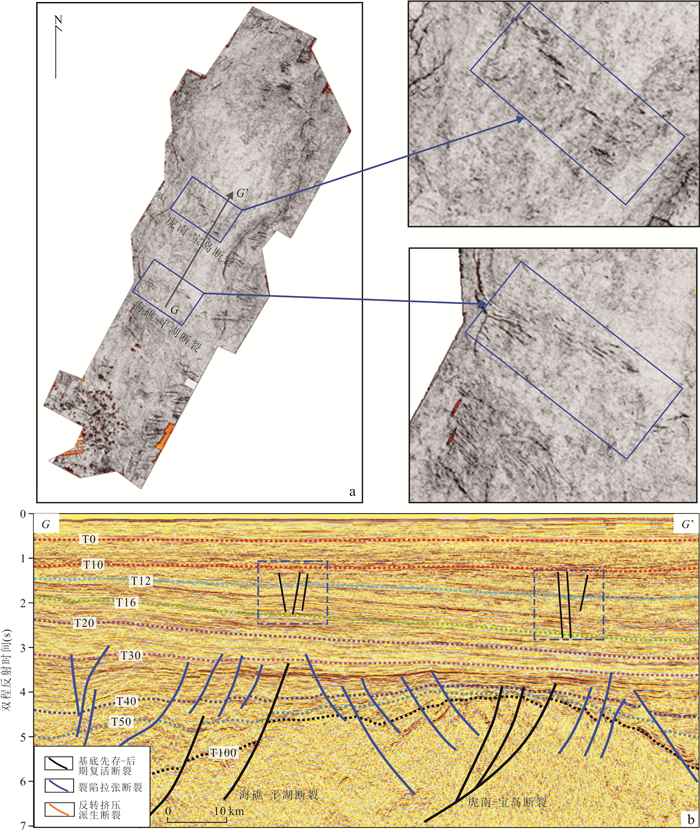
图 7 地震资料所揭示的NW向先存断裂在后期的走滑复活效应
a.沿层属性相干切面(T12);b.地震测线(位置见图a)
Fig. 7. The later strike-slip reactivation effect of NW-trending pre-existing faults revealed by seismic data
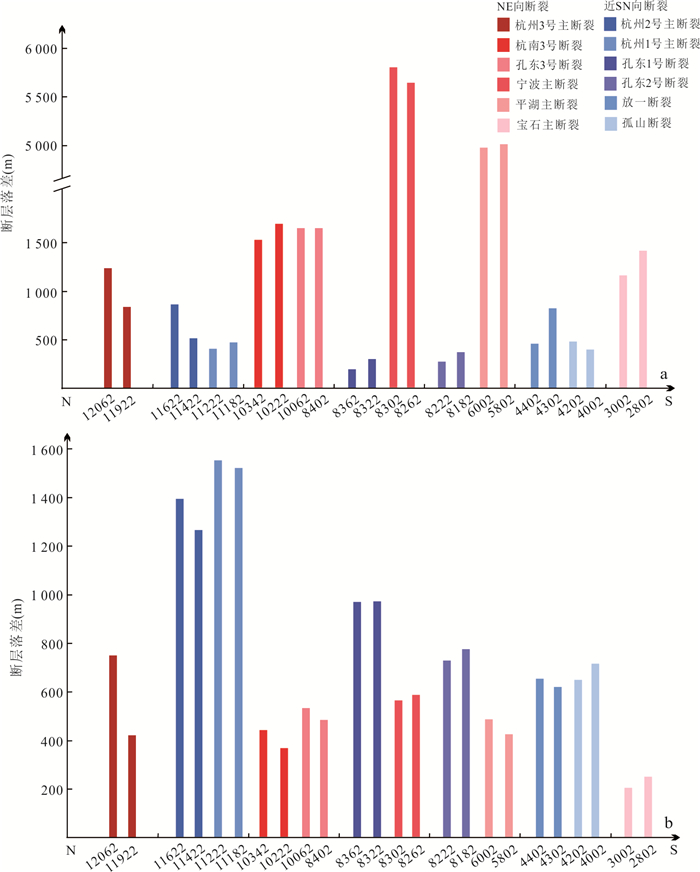
图 8 西湖凹陷三维工区主要断裂裂陷期的活动强度分析
a.新生代前平湖组沉积期(T100-T40)主要断层的落差;b.新生代平湖组沉积期(T40-T30)主要断层的落差. 选择过各断裂中部且与之近于垂直的NWW-SEE向测线进行断层落差统计,图中横坐标为自北向南的各NWW-SEE向的测线号,纵坐标为各测线所切断层的落差;各断层的发育平面位置见图 3
Fig. 8. The activity intensity analysis diagram of the main fault rifting period in the three-dimensional work area of the Xihu Sag
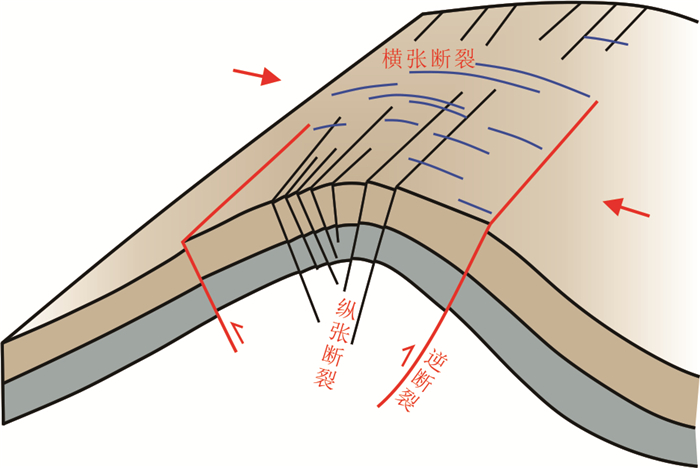
图 9 挤压反转褶皱伴生的断裂体系发育模式
Fig. 9. Development mode of fault system associated with compressional inversion fold
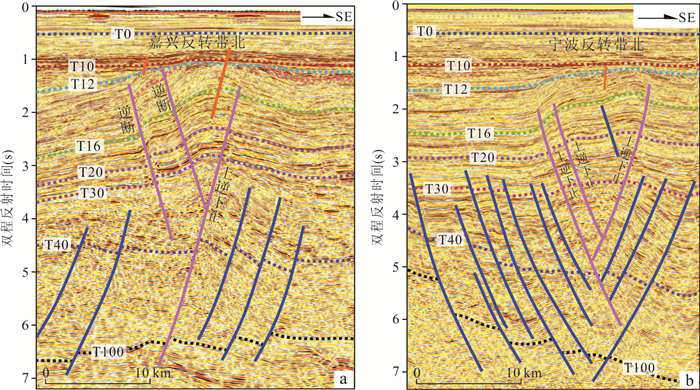
图 10 地震资料所揭示的西湖凹陷中央反转褶皱带逆断层与反转断层
a.嘉兴反转带北;b.宁波反转带北
Fig. 10. The reverse faults in the central inversion zone of the Xihu Sag revealed by seismic data
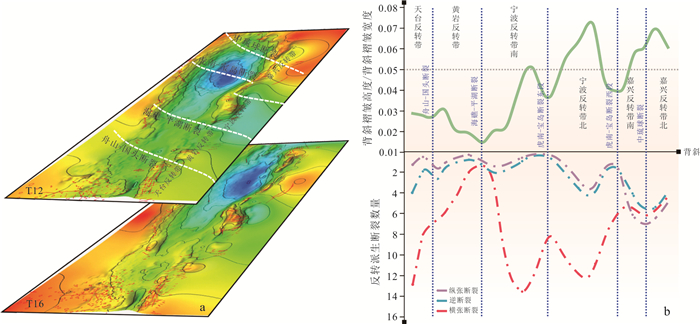
图 11 西湖凹陷中央反转带褶皱幅度与挤压派生断裂数量相关性分析
a.中央反转带的背斜形态;b.褶皱幅度与派生断裂数量
Fig. 11. Correlation analysis between fold amplitude and number of compression-derived faults in central inversion zone of the Xihu Sag
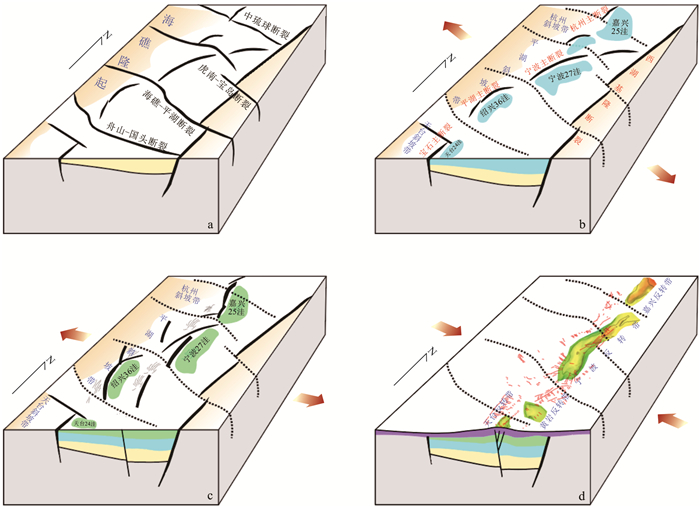
图 12 西湖凹陷断裂体系发育演化模式
a.前古近纪;b.古近纪早期裂陷(前平湖组沉积期);c.古近纪晚期裂陷(平湖组沉积期);d.新近纪挤压反转
Fig. 12. Development and evolution model of fault system in the Xihu Sag
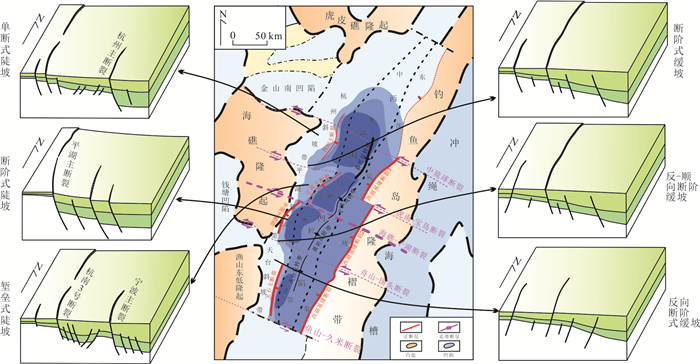
图 13 西湖凹陷西部斜坡带的结构差异
Fig. 13. Structural difference of western slope zone in the Xihu Sag
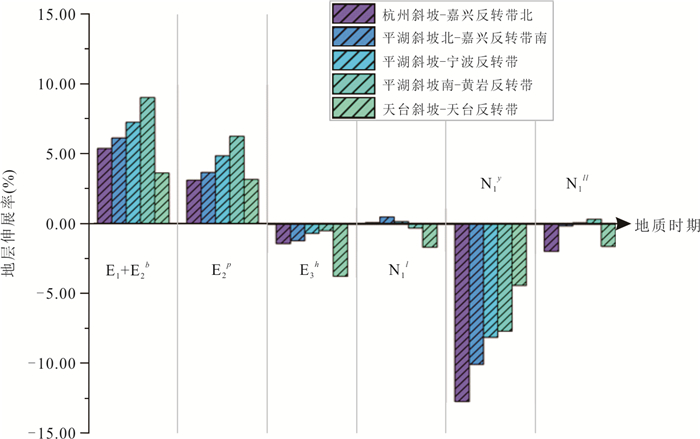
图 14 西湖凹陷南北不同区带测线的伸展率计算
纵坐标为依据所选各NWW-SEE向测线进行平衡剖面分析计算得出的各时期伸展率,其值为:(后期剖面长度‒前期剖面长度)/前期剖面长度,正值体现伸展强度,负值体现挤压强度)
Fig. 14. Stretching rate calculation of survey lines in different zones in north and south of the Xihu Sag
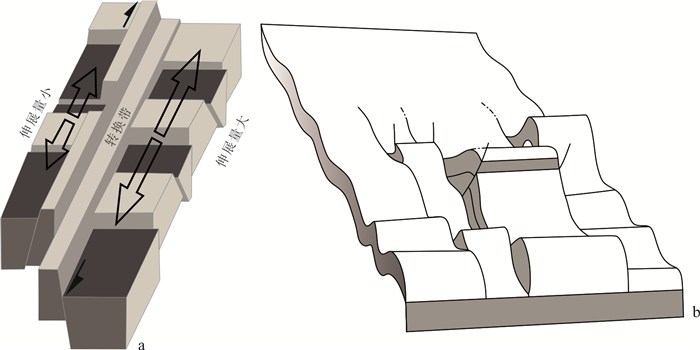
图 15 先存断裂对后期构造变形的调节转换所导致的分区效应
a.拉张转换(据Uzel et al.,2013修改);b.挤压转换(据Fossen and Rotevatn, 2016)
Fig. 15. The zoning effect caused by the adjustment and transformation of the pre-existing fault to the later structural deformation
-
Boschman, L. M., van Hinsbergen, D. J. J., 2016. On the Enigmatic Birth of the Pacific Plate within the Panthalassa Ocean. Science Advances, 2(7): e1600022. https://doi.org/10.1126/sciadv.1600022 Cai, H., Zhang, J. P., Tang, X. J., 2014. Characteristics of the Fault Systems and Their Control on Hydrocarbon Accumulation in the Xihu Sag, East China Sea Shelf Basin. Natural Gas Industry, 34(10): 18-26 (in Chinese with English abstract). Cheng, Y. J., Wu, Z. P., Xu, B., et al., 2023. The Mesozoic Tectonic Evolution of the East China Sea Basin: New Insights from 3D Seismic Reflection Data. Tectonophysics, 848: 229717. https://doi.org/10.1016/j.tecto.2023.229717 Cheng, Y. J., Wu, Z. P., Zhang, J., et al., 2022. Cenozoic Tectonic Evolution of Offshore Chinese Basins and Its Response to Geodynamic Processes of the East Asian Continental Margin. Earth-Science Reviews, 232: 104140. https://doi.org/10.1016/j.earscirev.2022.104140 Chu, Y., Lin, W., Faure, M., et al., 2019. Cretaceous Episodic Extension in the South China Block, East Asia: Evidence from the Yuechengling Massif of Central South China. Tectonics, 38(10): 3675-3702. https://doi.org/10.1029/2019tc005516 Corti, G., 2004. Centrifuge Modelling of the Influence of Crustal Fabrics on the Development of Transfer Zones: Insights into the Mechanics of Continental Rifting Architecture. Tectonophysics, 384(1-4): 191-208. https://doi.org/10.1016/j.tecto.2004.03.014 Cui, X., Wang, L. L., Luo, H. M., et al., 2017. Sandbox Modeling Test for Mesozoic Basins in Southern East China Sea Shelf Basin. Marine Geology & Quaternary Geology, 37(4): 181-192 (in Chinese with English abstract). Dai, L. M., Li, S. Z., Lou, D., et al., 2014. Numerical Modeling of Late Miocene Tectonic Inversion in the Xihu Sag, East China Sea Shelf Basin, China. Journal of Asian Earth Sciences, 86: 25-37. https://doi.org/10.1016/j.jseaes.2013.09.033 Faure, M., Lepvrier, C., van Nguyen, V., et al., 2014. The South China Block-Indochina Collision: Where, When, and How? Journal of Asian Earth Sciences, 79: 260-274. https://doi.org/10.1016/j.jseaes.2013.09.022 Fossen, H., Rotevatn, A., 2016. Fault Linkage and Relay Structures in Extensional Settings—A Review. Earth-Science Reviews, 154: 14-28. https://doi.org/10.1016/j.earscirev.2015.11.014 Gilder, S. A., Leloup, P. H., Courtillot, V., et al., 1999. Tectonic Evolution of the Tancheng-Lujiang (Tan-Lu) Fault via Middle Triassic to Early Cenozoic Paleomagnetic Data. Journal of Geophysical Research: Solid Earth, 104(B7): 15365-15390. https://doi.org/10.1029/1999jb900123 He, X. J., Jiang, Y. M., Li, L., et al., 2024. Progressive Deformation Characteristics and Mechanism of Longjing Movement in Xihu Sag. China Offshore Oil and Gas, 36(5): 34-43 (in Chinese with English abstract). He, X. J., Tang, X. J., Jiang, Y. M., et al., 2023. Middle-Late Miocene Fault Activity and Its Petroleum Exploration Significance of Middle-Shallow Layers in the Xihu Sag, East China Sea. Marine Geology & Quaternary Geology, 43(3): 167-174 (in Chinese with English abstract). Jiang, Y. M., Wu, L. L., Qin, J., et al., 2024. Deciphering Tectonic Mechanism and Origin of T85 Horizon in Lishui Depression, East China Sea Basin. Earth Science, 49(12): 4450-4464 (in Chinese with English abstract). Jiang, Y. M., Zou, W., Liu, J. S., et al., 2020. Genetic Mechanism of Inversion Anticline Structure at the End of Miocene in Xihu Sag, East China Sea: A New Understanding of Basement Structure Difference. Earth Science, 45(3): 968-979 (in Chinese with English abstract). Li, S. Z., Suo, Y. H., Li, X. Y., et al., 2018. Mesozoic Plate Subduction in West Pacific and Tectono- Magmatic Response in the East Asian Ocean-Continent Connection Zone. Chinese Science Bulletin, 63(16): 1550-1593 (in Chinese). doi: 10.1360/N972017-01113 Liu, J. S., Xu, H. Z., Jiang, Y. M., et al., 2020. Mesozoic and Cenozoic Basin Structure and Tectonic Evolution in the East China Sea Basin. Acta Geologica Sinica, 94(3): 675-691 (in Chinese with English abstract). Liu, L. P., Li, S. Z., Dai, L. M., et al., 2012. Geometry and Timing of Mesozoic Deformation in the Western Part of the Xuefeng Tectonic Belt, South China: Implications for Intra-Continental Deformation. Journal of Asian Earth Sciences, 49: 330-338. https://doi.org/10.1016/j.jseaes.2011.09.026 Liu, Y. M., Hao, F., Wu, Z. P., et al., 2025. Characteristics and Origin of Rift Migration within the East China Sea Basin: Coupling Relation with Deep Mantle Dynamics. Journal of Structural Geology, 191: 105334. https://doi.org/10.1016/j.jsg.2024.105334 Qu, T., Huang, Z. L., Li, T. J., et al., 2024. Formation Conditions and Reservoir Forming Characteristics of the Wuyunting Condensate Gas Field in Northern Pinghu Slope Zone of the Xihu Sag. Acta Geologica Sinica, 98(1): 247-265 (in Chinese with English abstract). Shi, W., Dong, S. W., Zhang, Y. Q., et al., 2015. The Typical Large-Scale Superposed Folds in the Central South China: Implications for Mesozoic Intracontinental Deformation of the South China Block. Tectonophysics, 664: 50-66. https://doi.org/10.1016/j.tecto.2015.08.039 Stern, R. J., Gerya, T., 2018. Subduction Initiation in Nature and Models: A Review. Tectonophysics, 746: 173-198. https://doi.org/10.1016/j.tecto.2017.10.014 Sun, Q. Y., Deng, H. D., Ji, M., et al., 2024. Characteristics of Multi-Phase Fracture Development in Cretaceous Granite from Coastal Region of South China and Its Implications for Buried-Hill Exploration. Earth Science, 49(7): 2570-2588 (in Chinese with English abstract). Suo, Y. H., Li, S. Z., Cao, X. Z., et al., 2017. Mesozoic-Cenozoic Inversion Tectonics of East China and Its Implications for the Subduction Process of the Oceanic Plate. Earth Science Frontiers, 24(4): 249-267 (in Chinese with English abstract). Tang, X. J., Li, N., Huang, X. S., et al., 2024. Reassessment of the Baoshi Formation of the Middle-Lower Eocene Series in the Xihu Sag of the East China Sea Basin. Journal of Stratigraphy, 48(4): 404-418 (in Chinese with English abstract). Tang, X. J., Zhu, H. H., Li, N., et al., 2025. Segmented Differential Deformation of Inverted Anticlines and Its Significance on Hydrocarbon Accumulation in the Ningbo Structural Zone, Xihu Sag, East China Sea Shelf Basin. Oil & Gas Geology, 46(1): 167-177 (in Chinese with English abstract). Torsvik, T. H., Doubrovine, P. V., Steinberger, B., et al., 2017. Pacific Plate Motion Change Caused the Hawaiian-Emperor Bend. Nature Communications, 8: 15660. https://doi.org/10.1038/ncomms15660 Uzel, B., Sözbilir, H., Özkaymak, Ç., et al., 2013. Structural Evidence for Strike-Slip Deformation in the İzmir-Balıkesir Transfer Zone and Consequences for Late Cenozoic Evolution of Western Anatolia (Turkey). Journal of Geodynamics, 65: 94-116. https://doi.org/10.1016/j.jog.2012.06.009 Wang, H., Qin, L. Z., Xu, J. Q., et al., 2025. Sedimentary Filling Characteristics of the Paleogene Baoshi Formation in the Western Slope of Xihu Sag, East China Sea Shelf Basin. Oil & Gas Geology, 46(3): 910-925 (in Chinese with English abstract). Wang, S., Zhang, D., Wu, G. G., et al., 2017. Late Paleozoic to Mesozoic Extension in Southwestern Fujian Province, South China: Geochemical, Geochronological and Hf Isotopic Constraints from Basic-Intermediate Dykes. Geoscience Frontiers, 8(3): 529-540. https://doi.org/10.1016/j.gsf.2016.05.005 Xie, X. J., Xiong, L. Q., Han, Y. K., et al., 2024. New Insights into Reservoirs Heterogeneous Genesis of Favorable Facies in Pinghu Formation, Xihu Depression. Earth Science, 49(4): 1400-1410 (in Chinese with English abstract). Yan, Y. H., Yuan, Z. P., Zhu, B. L., et al., 2024. Reservoir-Control Effect of Faults in Pingbei Area of Xihu Depression. Offshore Oil, 44(2): 1-6 (in Chinese with English abstract). Yang, C. Q., Yang, C. S., Li, G., et al., 2012. Mesozoic Tectonic Evolution and Prototype Basin Characters in the Southern East China Sea Shelf Basin. Marine Geology & Quaternary Geology, 32(3): 105-111 (in Chinese with English abstract). Yang, C. Q., Yang, C. S., Sun, J., et al., 2019. Mesozoic Evolution and Dynamics Transition in Southern Shelf Basin of the East China Sea. Journal of Jilin University (Earth Science Edition), 49(1): 139-153 (in Chinese with English abstract). Yang, X. H., Li, A. C., 2003. Basement Nature and Sedimentary Basins along the Continental Margin in East China Sea. China Offshore Oil and Gas, 17(1): 25-28, 56 (in Chinese with English abstract). Yu, Y. F., Zhang, J. P., Cheng, C., et al., 2022. Main Controlling Factors and Reservoir Forming Model for Hydrocarbon Accumulation in the Xihu Sag, the East China Sea Shelf Basin. Marine Geology Frontiers, 38(7): 40-47 (in Chinese with English abstract). Zhang, B. C., Liu, J., Jiao, S. B., et al., 2024. Characteristics of Strike-Transition System of Tiantai Structure of Xihu Sag and Its Reservoir-Controlling Effect. China Offshore Oil and Gas, 36(5): 44-56 (in Chinese with English abstract). Zhang, Y. Q., Xu, X. B., Jia, D., et al., 2009. Deformation Record of the Change from Indosinian Collision-Related Tectonic System to Yanshanian Subduction-Related Tectonic System in South China during the Early Mesozoic. Earth Science Frontiers, 16(1): 234-247 (in Chinese with English abstract). Zhang, Z., He, X. J., Tang, X. J., et al., 2022. Structural Trap Characteristics and Reservoir Types in Xihu Sag, East China Sea Basin. Marine Geology Frontiers, 38(3): 27-35 (in Chinese with English abstract). Zhao, Z. G., Wang, P., Qi, P., et al., 2016. Regional Background and Tectonic Evolution of East China Sea Basin. Earth Science, 41(3): 546-554 (in Chinese with English abstract). Zheng, Q. G., Zhou, Z. Y., Cai, L. G., et al., 2005. Meso-Cenozoic Tectonic Setting and Evolution of East China Sea Shelf Basin. Oil & Gas Geology, 26(2): 197-201 (in Chinese with English abstract). Zhou, X. H., Jiang, Y. M., Tang, X. J., 2019. Tectonic Setting, Prototype Basin Evolution and Exploration Enlightenment of Xihu Sag in East China Sea Basin. China Offshore Oil and Gas, 31(3): 1-10 (in Chinese with English abstract). Zhu, W. L., Wu, J. F., Zhang, G. C., et al., 2015. Discrepancy Tectonic Evolution and Petroleum Exploration in China Offshore Cenozoic Basins. Earth Science Frontiers, 22(1): 88-101 (in Chinese with English abstract). Zou, W., Yu, Y. X., Liu, J. S., et al., 2021. Main Controlling Factors of the Central Inversional Structure Belt and the Development of Ningbo Anticline in Xihu Sag, East China Sea Basin. Acta Petrolei Sinica, 42(2): 176-185 (in Chinese with English abstract). 蔡华, 张建培, 唐贤君, 2014. 西湖凹陷断裂系统特征及其控藏机制. 天然气工业, 34(10): 18-26. 崔幸, 王亮亮, 罗洪明, 等, 2017. 东海陆架盆地南部中生代盆地性质与演化: 砂箱物理模拟检验. 海洋地质与第四纪地质, 37(4): 181-192. 何新建, 蒋一鸣, 李磊, 等, 2024. 西湖凹陷龙井运动构造递进变形特征与机制. 中国海上油气, 36(5): 34-43. 何新建, 唐贤君, 蒋一鸣, 等, 2023. 东海西湖凹陷中新世中晚期断裂活动特征及中浅层勘探启示. 海洋地质与第四纪地质, 43(3): 167-174. 蒋一鸣, 吴路路, 覃军, 等, 2024. 东海盆地丽水凹陷T85构造变革界面的厘定及其成因模式探讨. 地球科学, 49(12): 4450-4464. doi: 10.3799/dqkx.2024.084 蒋一鸣, 邹玮, 刘金水, 等, 2020. 东海西湖凹陷中新世末反转背斜构造成因机制: 来自基底结构差异的新认识. 地球科学, 45(3): 968-979. doi: 10.3799/dqkx.2019.292 李三忠, 索艳慧, 李玺瑶, 等, 2018. 西太平洋中生代板块俯冲过程与东亚洋陆过渡带构造‒岩浆响应. 科学通报, 63(16): 1550-1593. 刘金水, 许怀智, 蒋一鸣, 等, 2020. 东海盆地中、新生代盆架结构与构造演化. 地质学报, 94(3): 675-691. 屈童, 黄志龙, 李天军, 等, 2024. 西湖凹陷平北地区武云亭凝析气田形成条件与成藏特征. 地质学报, 98(1): 247-265. 孙侨阳, 邓洪旦, 纪沫, 等, 2024. 华南沿海地区白垩纪花岗岩多期构造裂缝发育特征及其对潜山勘探的指示. 地球科学, 49(7): 2570-2588. 索艳慧, 李三忠, 曹现志, 等, 2017. 中国东部中新生代反转构造及其记录的大洋板块俯冲过程. 地学前缘, 24(4): 249-267. 唐贤君, 李宁, 黄晓松, 等, 2024. 东海盆地西湖凹陷中下始新统宝石组再认识. 地层学杂志, 48(4): 404-418. 唐贤君, 朱虹浩, 李宁, 等, 2025. 东海陆架盆地西湖凹陷宁波构造带反转背斜分段差异变形及其油气地质意义. 石油与天然气地质, 46(1): 167-177. 王辉, 秦兰芝, 徐靖琦, 等, 2025. 中国东海陆架盆地西湖凹陷西部斜坡带古近系宝石组沉积充填特征. 石油与天然气地质, 46(3): 910-925. 谢晓军, 熊连桥, 韩雅坤, 等, 2024. 西湖凹陷平湖斜坡有利相带内储层非均质性成因新认识. 地球科学, 49(4): 1400-1410. doi: 10.3799/dqkx.2022.246 晏玉环, 袁忠鹏, 朱碧兰, 等, 2024. 西湖凹陷平北地区断裂控藏作用研究. 海洋石油, 44(2): 1-6. 杨香华, 李安春, 2003. 东海大陆边缘基底性质与沉积盆地. 中国海上油气地质, 17(1): 25-28, 56. 杨长清, 杨传胜, 孙晶, 等, 2019. 东海陆架盆地南部中生代演化与动力学转换过程. 吉林大学学报(地球科学版), 49(1): 139-153. 杨长清, 杨传胜, 李刚, 等, 2012. 东海陆架盆地南部中生代构造演化与原型盆地性质. 海洋地质与第四纪地质, 32(3): 105-111. 余逸凡, 张建培, 程超, 等, 2022. 东海陆架盆地西湖凹陷油气成藏主控因素及成藏模式. 海洋地质前沿, 38(7): 40-47. 张伯成, 刘江, 焦社宝, 等, 2024. 西湖凹陷天台构造走滑‒转换体系特征及控藏作用. 中国海上油气, 36(5): 44-56. 张岳桥, 徐先兵, 贾东, 等, 2009. 华南早中生代从印支期碰撞构造体系向燕山期俯冲构造体系转换的形变记录. 地学前缘, 16(1): 234-247. 张宙, 何新建, 唐贤君, 等, 2022. 东海盆地西湖凹陷构造圈闭特征及其油气藏类型. 海洋地质前沿, 38(3): 27-35. 赵志刚, 王鹏, 祁鹏, 等, 2016. 东海盆地形成的区域地质背景与构造演化特征. 地球科学, 41(3): 546-554. doi: 10.3799/dqkx.2016.045 郑求根, 周祖翼, 蔡立国, 等, 2005. 东海陆架盆地中新生代构造背景及演化. 石油与天然气地质, 26(2): 197-201. 周心怀, 蒋一鸣, 唐贤君, 2019. 西湖凹陷成盆背景、原型盆地演化及勘探启示. 中国海上油气, 31(3): 1-10. 朱伟林, 吴景富, 张功成, 等, 2015. 中国近海新生代盆地构造差异性演化及油气勘探方向. 地学前缘, 22(1): 88-101. 邹玮, 余一欣, 刘金水, 等, 2021. 东海盆地西湖凹陷中央反转构造带发育主控因素及宁波背斜形成过程. 石油学报, 42(2): 176-185. -

 下载:
下载:
 点击查看大图
计量
- 文章访问数: 163
- HTML全文浏览量: 47
- PDF下载量: 25
- 被引次数: 0
