




Low-Temperature Kinematic Mechanisms of High-Elevation Rock-Ice Debris Flows Based on Rheological Characteristics
-
摘要:
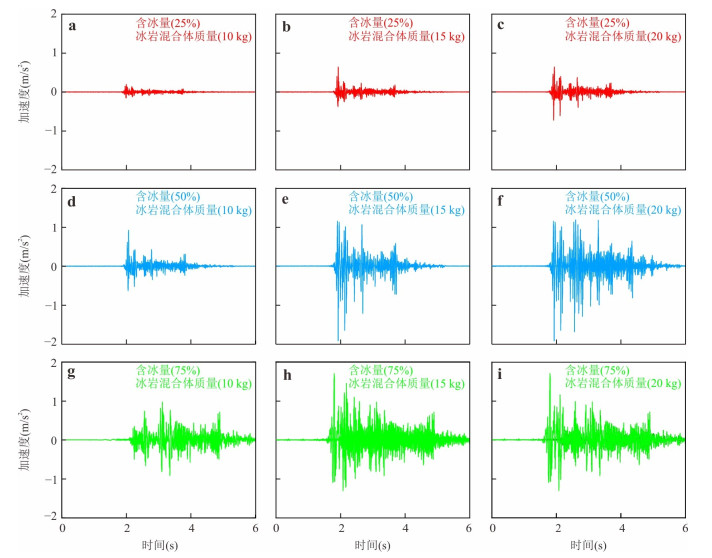
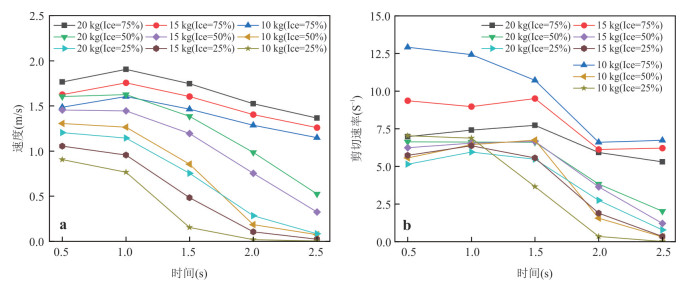
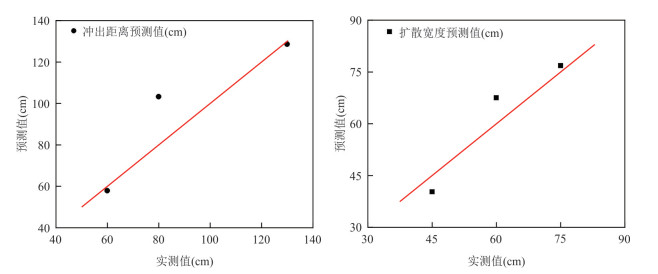
为揭示青藏高原冰岩崩转化形成的含冰碎屑流低温运动学机制,量化含冰量与质量对流动行为的控制效应,在智能温控条件下,结合冰碛土浆体流变试验与含冰碎屑流物理模型试验,利用加速度监测与PIV(粒子图像测速法)反演,分析不同含冰量(25%、50%、75%)与质量(10 kg、15 kg、20 kg)对动力响应、速度场演化及堆积特征的影响.流变试验表明,浆体屈服应力对容重高度敏感:低容重体系中屈服应力随容重提高呈倍数增长,高容重体系中冰碛物强化效应趋于饱和.物理模型试验揭示了含冰碎屑流冲出距离与含冰量、总质量均呈显著正相关,二者存在非线性耦合增强效应;含冰量通过调控颗粒接触网络主导体系流态转变,决定了“摩擦-胶结-润滑”力学行为的演化方向;总质量通过惯性效应调控力学行为转化强度与能量传递效率,二者协同控制含冰碎屑流的长距离超强运移能力.建立了考虑摩擦-润滑耦合机制的“冲出距离-扩散宽度-影响范围”多元非线性预测模型(R2 > 0.94),为青藏高原冰岩崩灾害危险范围评估提供了量化依据,能有效指导重大工程选线、建设与运维安全.
Abstract:To reveal the low-temperature kinematic mechanism of ice-bearing debris flow transformed from ice-rock avalanches on the Qinghai-Tibet Plateau and quantify the controlling effects of ice content and total mass on its flow behavior, it performed integrated tests under intelligent temperature-controlled conditions. Combining rheological tests of moraine soil slurry and physical model tests of ice-bearing debris flow, it analyzed the influences of varying ice contents (25%, 50%, 75%) and total masses (10 kg, 15 kg, 20 kg) on the dynamic response, velocity field evolution, and deposition characteristics of the debris flows via acceleration monitoring and Particle Image Velocimetry (PIV) inversion.Rheological test results demonstrate that the yield stress of the slurry is highly sensitive to bulk density. Specifically, in low bulk density systems, yield stress increases multiplicatively with rising bulk density, whereas the strengthening effect of moraine materials tends to saturate in high bulk density systems.Physical model tests reveal that the runout distance of ice-bearing debris flow exhibits a significantly positive correlation with both ice content and total mass, with a nonlinear coupling enhancement effect observed between the two factors. Ice content dominates the flow regime transition of the system by regulating the particle contact network, which dictates the evolution direction of the "friction-cementation-lubrication" mechanical behavior. Total mass modulates the transformation intensity of mechanical behavior and energy transfer efficiency through inertial effects. Together, these two factors synergistically control the ultra-long-distance, high-mobility transport capacity of ice-bearing debris flows.It established a multivariate nonlinear prediction model for "runout distance-spread width-impact scope" that incorporates the friction-lubrication coupling mechanism, with a coefficient of determination (R2 > 0.94). This model provides a quantitative basis for hazard range assessment of ice-rock avalanche disasters on the Qinghai-Tibet Plateau, and can effectively guide the route selection, construction, and safe operation and maintenance of major engineering projects.
-
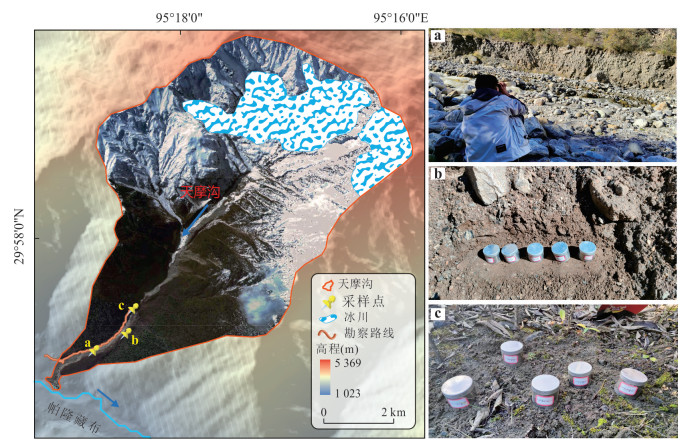
图 1 天摩沟高位冰川泥石流流域概况
Fig. 1. General situation of the Tianmo Gully high-altitude glacier debris flow basin
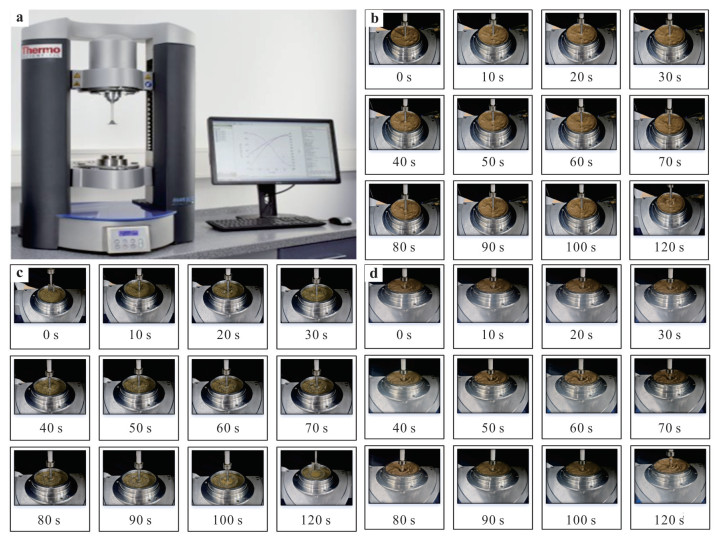
图 2 不同容重冰碛土浆体流变试验过程
Fig. 2. Rheological test process of moraine soil slurry with different unit weights
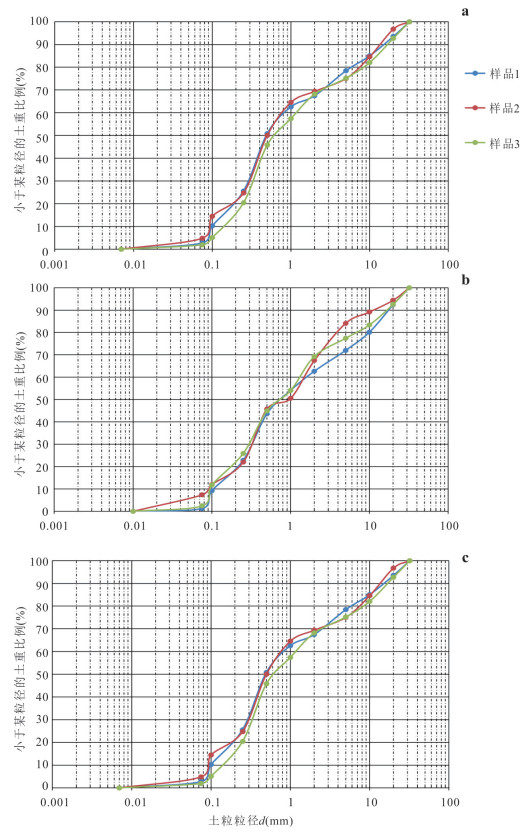
图 3 天摩沟土样颗粒级配曲线
a.物源区;b.流通区;c.堆积区
Fig. 3. Grain size distribution curves of soil samples from Tianmo Gully
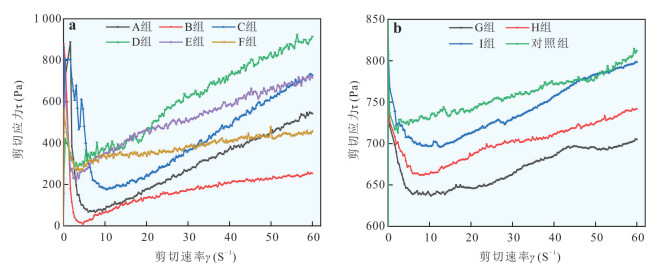
图 4 不同容重试验组流变曲线
Fig. 4. Rheological curves of different bulk density experimental groups
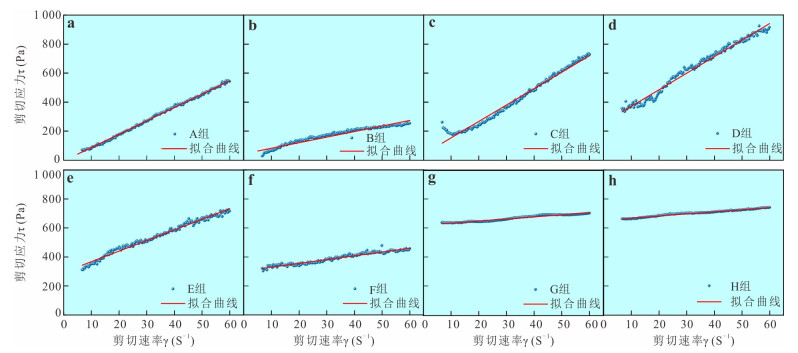
图 5 不同组别流变曲线的线性拟合图
Fig. 5. Linear fitting diagram of Rheological curves for different groups
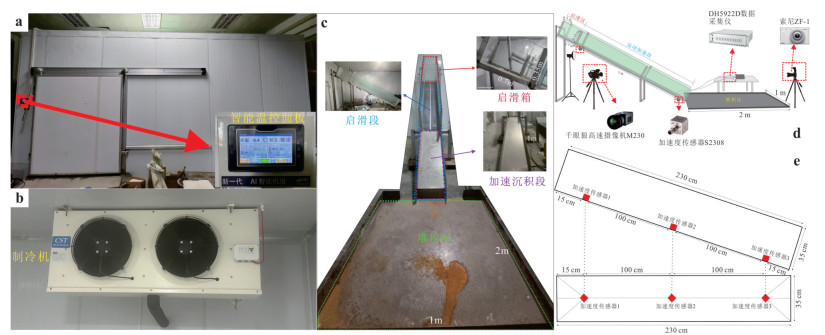
图 6 智能温控试验系统与传感器布设
Fig. 6. Intelligent temperature-controlled test system and sensor layout
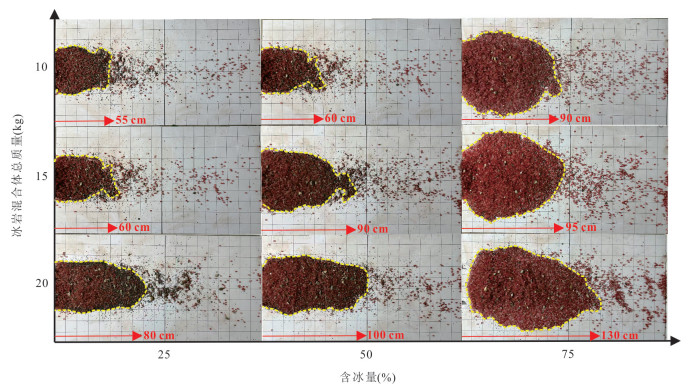
图 9 不同工况下含冰碎屑流冲出距离影响范围
Fig. 9. The influence range of the runout distance of ice-bearing debris flows under different working conditions
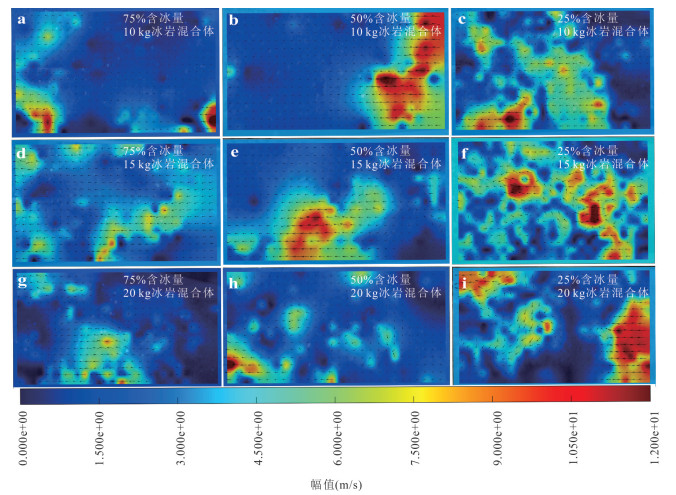
图 10 不同工况PIV处理分析
Fig. 10. PIV processing and analysis under different working conditions
表 1 不同区域土样颗粒筛分试验数据
Table 1. Sieving test data of soil samples from different zones of Tianmo Gully
序号 颗粒分布占比(单位:%) > 20 20~10 10~5 5~2 2~1 1~0.5 0.5~0.25 0.25~0.1 0.1~0.075 < 0.075 堆积区 1 6.43 8.55 6.56 11.00 4.86 11.77 25.26 15.35 7.45 2.77 2 3.24 12.18 9.57 5.62 4.84 14.56 25.29 10.28 9.59 4.84 3 7.27 10.65 6.88 7.02 10.75 11.64 25.38 15.33 3.16 1.92 平均 5.76 10.49 7.62 7.79 7.11 12.59 25.32 13.76 6.47 3.09 流通区 1 7.61 12.26 8.12 9.31 8.60 10.47 20.85 13.61 7.95 1.21 2 5.58 5.29 5.01 16.66 16.94 4.81 23.74 10.03 4.61 7.34 3 7.40 9.24 5.93 8.15 15.22 9.14 19.01 14.20 9.31 2.40 平均 6.95 9.25 6.50 11.07 13.18 8.39 21.09 12.76 7.43 3.38 物源区 1 3.28 12.05 10.78 15.98 6.56 15.25 14.37 7.44 7.71 6.58 2 4.57 5.65 8.44 21.08 4.31 10.62 19.73 13.89 5.76 5.94 3 8.61 7.27 15.43 10.87 12.59 11.13 11.19 5.35 8.73 8.84 平均 5.49 8.33 11.55 15.98 7.82 12.33 15.10 8.89 7.40 7.12  下载: 导出CSV
表 2 不同分组的流变参数
Table 2. Rheological parameters of different groups
组别 容重(t/m3) 冰碛物含量(%) 屈服应力$ {\tau }_{0} $(Pa) 对照组 1.9 50 587 A组 1.7 0 76 B组 1.7 30 113 C组 1.7 50 142 D组 1.8 0 239 E组 1.8 30 288 F组 1.8 50 326 G组 1.9 0 474 H组 1.9 30 515 I组 1.9 50 545
下载: 导出CSV
表 3 物理模型相似比尺
Table 3. Similarity scale of physical model
比尺类别 比尺名称 符号 比尺数值 推导依据 几何比尺 水平比尺 λL 102 原型与模型几何长度之比 面积比尺 λA 104 λA=λL2 体积比尺 λV 106 λV=λL3 流速比尺 λu 10 λu=λL0.5 运动学比尺 时间比尺 λt 10 λt=λL/λu 流量比尺 λq 105 λq=λu λL2 动力学比尺 动力比尺 λF 106 λF=λρ λL3 λg 容重比尺 λγ 1 弗劳德相似要求 材料比尺 级配比尺 λd 1 模拟原型材料组成 孔隙率比尺 λn 1 模拟原型堆积结构
下载: 导出CSV
表 4 基于原型岩粒级配含冰碎屑流试验方案
Table 4. Test scheme of rock-ice avalanche-debris flow based on prototype rock particle gradation
试验组号 总质量(kg) 含冰量 冰质量(kg) 岩石质量(kg) 岩石级配(原型) W1 10 25% 2.50 7.50 8.394%/11.684%/10.884%/23.304%/45.734% W2 10 50% 5.00 5.00 8.394%/11.684%/10.884%/23.304%/45.734% W3 10 75% 7.50 2.50 8.394%/11.684%/10.884%/23.304%/45.734% W4 15 25% 3.75 11.25 8.394%/11.684%/10.884%/23.304%/45.734% W5 15 50% 7.50 7.50 8.394%/11.684%/10.884%/23.304%/45.734% W6 15 75% 11.25 3.75 8.394%/11.684%/10.884%/23.304%/45.734% W7 20 25% 5.00 15.00 8.394%/11.684%/10.884%/23.304%/45.734% W8 20 50% 10.00 10.00 8.394%/11.684%/10.884%/23.304%/45.734% W9 20 75% 15.00 5.00 8.394%/11.684%/10.884%/23.304%/45.734%
下载: 导出CSV
-
Arenson, L. U., Springman, S. M., 2005. Mathematical Descriptions for the Behaviour of Ice-Rich Frozen Soils at Temperatures Close to 0 ℃. Canadian Geotechnical Journal, 42(2): 431-442. https://doi.org/10.1139/t04-109 Chang, M., Dou, X. Y., Luo, C. P., et al., 2025. Multi-Scenario Simulations for Quantitative Assessment of Debris Flow Chain Hazards in Southwestern China. Catena, 253: 108900. https://doi.org/10.1016/j.catena.2025.108900 Chang, M., Tang, C., Dou, X. Y., 2017. Mechanism and Hazards of Typical Glacier-Lake Burst in Southeastern Tibet. South-to-North Water Transfers and Water Science & Technology, 15(6): 115-121 (in Chinese with English abstract). Chang, M., Xu, Q., Wang, Y. S., et al., 2024. Development Characteristics and Disaster-Causing Mechanisms of the "8·3" Catastrophic Flash Flood and Debris Flow in Guzan, Kangding, Sichuan Province. Geomatics and Information Science of Wuhan University, 49(11): 2136-2144 (in Chinese with English abstract). Cudmani, R., Yan, W., Schindler, U., 2023. A Constitutive Model for the Simulation of Temperature-, Stress- and Rate-Dependent Behaviour of Frozen Granular Soils. Géotechnique, 73(12): 1043-1055. https://doi.org/10.1680/jgeot.21.00012 Du, G. L., Zhang, Y. S., Yang, Z. H., et al., 2017. Estimation of Seismic Landslide Hazard in the Eastern Himalayan Syntaxis Region of Tibetan Plateau. Acta Geologica Sinica (English Edition), 91(2): 658-668. https://doi.org/10.1111/1755-6724.13124 Gao, B., Zhang, J. J., Wang, J. C., et al., 2019. Formation Mechanism and Disaster Characteristics of Debris Flow in the Tianmo Gully in Tibet. Hydrogeology & Engineering Geology, 46(5): 144-153 (in Chinese with English abstract). Gao, H. Y., Gao, Y., Yin, Y. P., et al., 2022. New Scientific Issues in the Study of High-Elevation and Long-Runout Landslide Dynamics in the Qinghai-Tibet Plateau. Journal of Geomechanics, 28(6): 1090-1103 (in Chinese with English abstract). Guo, B., Zang, W. Q., Yang, F., et al., 2020. Spatial and Temporal Change Patterns of Net Primary Productivity and Its Response to Climate Change in the Qinghai-Tibet Plateau of China from 2000 to 2015. Journal of Arid Land, 12(1): 1-17. https://doi.org/10.1007/s40333-019-0070-1 Hu, W. T., Yao, T. D., Yu, W. S., et al., 2018. Advances in the Study of Glacier Avalanches in High Asia. Journal of Glaciology and Geocryology, 40(6): 1141-1152 (in Chinese with English abstract). Li, C. D., Wang, R., Gu, D. M., et al., 2022. Temperature and Ice Form Effects on Mechanical Behaviors of Ice-Rich Moraine Soil of Tianmo Valley nearby the Sichuan-Tibet Railway. Engineering Geology, 305: 106713. https://doi.org/10.1016/j.enggeo.2022.106713 Li, F. P., Zhang, Y. Q., Xu, Z. X., et al., 2013. The Impact of Climate Change on Runoff in the Southeastern Tibetan Plateau. Journal of Hydrology, 505: 188-201. https://doi.org/10.1016/j.jhydrol.2013.09.052 Li, L., Wang, T., Wei, R. M., et al., 2026. Study on the Development Characteristics and Dynamic Process of High-Altitude Geohazards in Tianmo Gully, Southeastern Xizang. Journal of Catastrophology, 41(1): 71-80 (in Chinese with English abstract). Liu, D. R., Fan, G., Lin, Z. Y., et al., 2025. Experimental Study on Model of Ice Rockfall Debris Flow Blocking River and Dam Break. Chinese Journal of Rock Mechanics and Engineering, 44(S1): 101-112 (in Chinese with English abstract). Liu, J. X., Guo, C. B., Xin, P., et al., 2025. Formation Mechanism and Research Prospect of Typical High-Altitude Debris Flow Disasters in the Eastern Tibetan Plateau. Geological Survey of China, 12(3): 1-18 (in Chinese with English abstract). Nian, T. K., Zhao, R. D., Zheng, D. F., et al., 2024. Advances in the Study of Ice-Rock Avalanche Disaster Chains in Yarlung Zangbo River Basin in Southeast Tibet. Journal of Hydraulic Engineering, 55(10): 1146-1162 (in Chinese with English abstract). Pudasaini, S. P., Krautblatter, M., 2014. A Two-Phase Mechanical Model for Rock-Ice Avalanches. Journal of Geophysical Research: Earth Surface, 119(10): 2272-2290. https://doi.org/10.1002/2014JF003183 Qu, Y. P., Xiao, J., Pan, Y. W., 2018. Preliminary Analysis on Formation Conditions of Glacier Debris Flow in Southeast Tibet—A Case of Glacial Debris Flow in Tianmo Gully. Water Resources and Hydropower Engineering, 49(12): 177-184 (in Chinese with English abstract). Ren, Y. H., Yang, Q. Q., Cheng, Q. G., et al., 2021. Solid-Liquid Interaction Caused by Minor Wetting in Gravel-Ice Mixtures: A Key Factor for the Mobility of Rock-Ice Avalanches. Engineering Geology, 286: 106072. https://doi.org/10.1016/j.enggeo.2021.106072 Sansone, S., Zugliani, D., Rosatti, G., 2021. A Mathematical Framework for Modelling Rock-Ice Avalanches. Journal of Fluid Mechanics, 919: A8. https://doi.org/10.1017/jfm.2021.348 Schneider, D., Huggel, C., Haeberli, W., et al., 2011. Unraveling Driving Factors for Large Rock-Ice Avalanche Mobility. Earth Surface Processes and Landforms, 36(14): 1948-1966. https://doi.org/10.1002/esp.2218 Shastri, A., Sánchez, M., Gai, X. R., et al., 2021. Mechanical Behavior of Frozen Soils: Experimental Investigation and Numerical Modeling. Computers and Geotechnics, 138: 104361. https://doi.org/10.1016/j.compgeo.2021.104361 Shen, Y. J., Chen, S. W., Zhang, L., et al., 2022. High-Altitude Initiation, Dynamic Collapse and Phase Transformation of Mountain Snow-Ice Melt Geological Disaster Chain. Journal of Glaciology and Geocryology, 44(2): 643-656 (in Chinese with English abstract). Tang, M. G., Wang, L. N., Liu, X. X., et al., 2022. Distribution and Risk of Ice Avalanche Hazards in Tibetan Plateau. Earth Science, 47(12): 4647-4662 (in Chinese with English abstract). Tang, M. G., Zhao, H. L., Xu, Q., et al., 2025. Mechanism and Geological Mechanics Pattern of Typical Ice and Rock Avalanches on the Tibetan Plateau. Journal of Geomechanics, 31(5): 940-959 (in Chinese with English abstract). Van der Woerd, J., Tapponnier, P., Ryerson, F. J., et al., 2004. Seismic and Structural Controls on Rock-Ice Avalanche Initiation and Mobility in the Himalayas. Geophysical Journal International, 157(2): 655-662. Wei, R. Q., Zeng, Q. L., Davies, T., et al., 2018. Geohazard Cascade and Mechanism of Large Debris Flows in Tianmo Gully, SE Tibetan Plateau and Implications to Hazard Monitoring. Engineering Geology, 233: 172-182. https://doi.org/10.1016/j.enggeo.2017.12.013 Wang, Y. F., Cheng, Q. G., Lin, Q. W., et al., 2025. Research on High-Speed and Long-Runout Landslides in the Qinghai-Tibet Plateau: From Geological Phenomena to Dynamic Mechanisms. Earth Science, 50(10): 4071-4095 (in Chinese with English abstract). Zhang, S. L., Yin, Y. P., Hu, X. W., et al., 2023. Block-Grain Phase Transition in Rock Avalanches: Insights from Large-Scale Experiments. Journal of Geophysical Research: Earth Surface, 128(11): e2023JF007204. https://doi.org/10.1029/2023JF007204 Zhang, Y. S., Ren, S. S., Guo, C. B., et al., 2022. Multi-Dynamic and Multi-Phase Evolution of High-Position Avalanche Hazards on the Eastern Margin of the Qinghai-Tibet Plateau. Sedimentary Geology and Tethyan Geology, 42(2): 310-318 (in Chinese with English abstract). Zhou, Y. S., Li, X., Zheng, D. H., et al., 2021. The Joint Driving Effects of Climate and Weather Changes Caused the Chamoli Glacier-Rock Avalanche in the High Altitudes of the India Himalaya. Scientia Sinica (Terrae), 51(12): 2112-2125 (in Chinese). doi: 10.1360/N072021-0169 常鸣, 唐川, 窦向阳, 2017. 藏东南典型冰湖溃决机制及危险性研究. 南水北调与水利科技, 15(6): 115-121. 常鸣, 许强, 王运生, 等, 2024. 四川康定姑咱"8·3"特大山洪泥石流发育特征及孕灾成因研究. 武汉大学学报(信息科学版), 49(11): 2136-2144. 高波, 张佳佳, 王军朝, 等, 2019. 西藏天摩沟泥石流形成机制与成灾特征. 水文地质工程地质, 46(5): 144-153. 高浩源, 高杨, 殷跃平, 等, 2022. 青藏高原高位远程滑坡动力学研究的新问题. 地质力学学报, 28(6): 1090-1103. 胡文涛, 姚檀栋, 余武生, 等, 2018. 高亚洲地区冰崩灾害的研究进展. 冰川冻土, 40(6): 1141-1152. 李禄, 王腾, 魏汝明, 等, 2026. 藏东南天摩沟高位链式灾害发育特征及动力学过程研究. 灾害学, 41(1): 71-80. 刘大瑞, 范刚, 林子钰, 等, 2025. 冰岩崩碎屑流堵江及溃坝模型试验研究. 岩石力学与工程学报, 44(增刊1): 101-112. 刘吉鑫, 郭长宝, 辛鹏, 等, 2025. 青藏高原东部典型高位泥石流灾害成因机制与研究展望. 中国地质调查, 12(3): 1-18. 年廷凯, 赵润东, 郑德凤, 等, 2024. 藏东南雅江流域冰-岩崩灾害链研究进展. 水利学报, 55(10): 1146-1162. 屈永平, 肖进, 潘义为, 2018. 藏东南地区冰川泥石流形成条件初步分析: 以天摩沟冰川泥石流为例. 水利水电技术, 49(12): 177-184. 申艳军, 陈思维, 张蕾, 等, 2022. 冰雪型地质灾害链高位萌生、动力溃散及物相转化过程剖析. 冰川冻土, 44(2): 643-656. 汤明高, 王李娜, 刘昕昕, 等, 2022. 青藏高原冰崩隐患发育分布规律及危险性. 地球科学, 47(12): 4647-4662. 汤明高, 赵欢乐, 许强, 等, 2025. 青藏高原典型冰岩崩灾害机理及地质力学模式. 地质力学学报, 31(5): 940-959. 王玉峰, 程谦恭, 林棋文, 等, 2025. 青藏高原高速远程滑坡研究: 从地质现象到动力学机理. 地球科学, 50 (10): 4071-4095. doi: 10.3799/dqkx.2025.207 张永双, 任三绍, 郭长宝, 等, 2022. 青藏高原东缘高位崩滑灾害多动力多期次演化特征. 沉积与特提斯地质, 42(2): 310-318. 周玉杉, 李新, 郑东海, 等, 2021. 气候变化和异常天气共同导致印度杰莫利冰-岩崩塌. 中国科学: 地球科学, 51(12): 2112-2125. -

 点击查看大图
计量
- 文章访问数: 26
- HTML全文浏览量: 16
- PDF下载量: 6
- 被引次数: 0
